By pursuing the latest technologies and promoting the transmission of scientific knowledge, scientists, industrialists, and planters facilitated the construction of a dynamic globalized economy based on overlapping scientific and manufacturing cultures. As discussion of the diffusion of vacuum pan technology and evaporation machinery in the nineteenth century will demonstrate, technology did not belong to a single empire or dominant economy.Footnote 1 It involved plural and multi-centred circulations of people, knowledge, and machines which formed a larger pool of skills and equipment producers utilized to discover, borrow, or appropriate engineering methods and devices.Footnote 2 Indeed, important industrial innovations took place in the colonies, away from the metropolises; some of these innovations were later incorporated in European factories.
As transient intermediaries, scientists, industrialists, planters, and technicians habitually travelled between regional areas, observing and learning from their host societies and subsequently incorporating their newfound knowledge into their own manufacturing designs, often without the consent of the original inventor. With the global circulation of scientific knowledge, scientists struggled at times to protect their intellectual rights from other designers and manufacturers. Even so, scientists and inventors remained profoundly cosmopolitan in their worldviews for they clearly understood the importance of adapting themselves and their machinery to the demands and circumstances of local communities by pursuing innovative ideas and presenting their results to other sugar producers. For scientists, industrialists, and planters the tropical plantation served as a laboratory for experimentation. Their cumulative actions not only brought seemingly disparate world areas closer together but also influenced the business culture of modern firms which relied on these networks in order to appropriate intellectual property.
Experimentation, integration, and globalization
This article will discuss the diffusion of evaporation technology and use the vacuum pan as a vehicle for understanding the dual processes of invention and globalization. In doing so, it further aims to include the Greater Caribbean within the broader scholarship of technology, transnational history, and globalization.Footnote 3 It will do so by presenting two interrelated arguments. First, it will make the case that sugar plantations in the Greater Caribbean were models of and laboratories for modernity where vital engineering developments took place. Long recognized by scholars as a ‘factory in the field’, the sugar plantation's role as a site for experimentation and invention, where engineering improvements and modifications in the tropics were subsequently incorporated into manufacturing and industrial designs in the North Atlantic, has yet to be fully explored.Footnote 4 Secondly, it will propose that scientific experimentation, invention, and the use of modern machinery for manufacturing purposes integrated the Greater Caribbean into an ever-expanding process of globalization characteristic of the mid nineteenth century by directly connecting this regional area with a myriad of worldwide scientific and industrial knowledge networks. In short, new technologies and machine designs such as the vacuum pan which were developed in conjunction with globalization and the construction of personal scientific knowledge networks were central to these larger transformations.
Recent research on the transfer, exchange, and diffusion of knowledge has emphasized the dynamism of colonial societies, where local demands, circumstances, and adaptations of new technologies resulted in significant technological innovations. In his study of Cuban networks of technological transfer, Jonathan Curry-Machado demonstrates how local demands for the production of sugar provided the impetus for the adaptation of technologies on the island by migrant engineers. Advances in technology that ‘were made in the Cuban field were fed back to metropolitan engineering companies’.Footnote 5 In other words, the spread of technology is not a simple process of diffusion from metropolitan areas but also involves local actions, including modification, adaptation, and invention.Footnote 6 Wim Ravesteijn describes this technological process as ‘localization’. He argues ‘that globalization leads to the spread of technology, both from and to the West, and that the diffusion of technology is not just a matter of applying existing technology in another area, but that it also involves creative actions and, consequently, local developments – in short, localization’.Footnote 7
Local and itinerant intermediaries modified evaporation machinery to fit the needs of the tropical sugar plantation and disseminated their knowledge to industrial centres for additional improvements and further incorporation.Footnote 8 By the 1850s scientists, industrialists, planters, and engineers in Britain, the Greater Caribbean, France, Java, and Germany had modified and adapted the vacuum pan to meet the demands of cane and beet sugar producers. Thus the production of scientific and industrial knowledge is inherently diffusive, involving personal and epistolary exchanges, observation, experimentation, adaptation, and invention, as well as a complex of industrial, production, and commercial networks throughout the world, navigated by a multitude of individuals belonging to different cultures and identities. The diffusion of knowledge and the circulation of machinery established a web of circuits that integrated scientific, industrial, commercial, and consumer networks and ultimately brought people from various regions closer together. In designing and perfecting evaporation machinery, scientists, engineers, industrialists, and planters adapted the technology to local manufacturing, environmental, and ecological circumstances, often conceptualizing the plantation as an industrial laboratory.
The ‘Demerara plan’ and the laboratory plantation
The following early experiment with the first use of the vacuum pan in a tropical setting provides some important illustrative points for the discussion that follows regarding the nineteenth-century laboratory plantation in the Greater Caribbean. In 1832, scientists, engineers, industrialists, and planters closely monitored the ‘scientific experiments’ involving the application of modern machinery to the production and crystallization of sugar on the ‘Vreed en Hoop’, a remote plantation laboratory located in Demerara (Guiana) on the outskirts of the British empire. For at least two years Thomas Dodson and other engineers collected, arranged, and rearranged an apparatus of steam engines and vacuum pans inside the mill. While sugar processors in Britain had been using similar systems for at least ten years, Dodson hoped that his trials in Demerara would demonstrate the production advantages of crystallizing sugar on the plantation. As Dodson remarked, the sugar they manufactured was in the category of ne plus ultra, or the highest quality attainable. A significant departure from previous manufacturing processes, the cane was ‘in the field in the morning’ and ‘converted into beautiful white sugar in the evening’. As a crop, cane sugar's properties are unique in that it decomposes immediately upon harvesting, resulting in lower production yields unless it is processed promptly near the plantation, hence Dodson's eagerness and enthusiasm for manufacturing sugar in the space where it was grown. Shortly after completing their experiments, Dodson, plantation administrators, and sugar technicians collected data and samples of their work and submitted them to chemists and manufacturers, as well as to periodicals for review and commentary.Footnote 9
Thus the old approach of sending vast quantities of ‘deteriorated material’ or ‘uncrystallizable sugar’ from the colonies to Britain for refining seemed regressive and methodologically irrational. For planters, manufacturers, and distributors of sugar, the ‘new system’, or what came to be known as the ‘Demerara plan’, signalled the arrival of an era characterized by efficiency and economy. New machinery would enable planters to harvest, process, and refine cane sugar ‘on the spot’. Thus producers embraced a scientific process that eliminated both obsolete approaches and wasteful production costs and that would allow them to package and transport ‘crystallized sugar fit for immediate consumption’ to buyers directly from the plantation.Footnote 10
Dodson experimented with modern technologies in order to achieve a higher yield and a better product, but in some respects these were secondary and tertiary goals. Ultimately, like many of his contemporaries who travelled to and worked and lived in the Greater Caribbean, he believed that the use of the latest machinery on the plantation would strengthen the relationship between science and industry in the colonies. With regard to the vacuum pan on plantations, he noted the following: ‘The manufacture of sugar in the colonies has hitherto received little or no aid from science, though essentially a chemical process; and although it has become so important an article of commerce and manufacture, it still retains the rudest simplicity.’ This statement suggests that Dodson's experiments would by some means mediate this perceived deficiency within the scientific community. Like many scientific experiments, his additional trials on the ‘Richmond’ and ‘Land of Plenty’ estates yielded varying results; the outcomes were ‘not uniformly experienced’. Yet Dodson believed that the dissimilar results ‘must be ascribed to the operation of causes of a local and adventitious nature’. Aware of how different local conditions, even within a region, would alter the function of the vacuum pan, he hoped that his ‘modifications’ would improve the equipment.Footnote 11
Modifying the vacuum pan (invented in Britain in 1813) for optimum performance involved spatial and temporal variables. In 1827 only ten of the hundred sugar factories in and around London had installed the equipment.Footnote 12 Experiments on laboratory plantations therefore contributed additional technical and manufacturing improvements. Thus the Demerara plan reveals the modern characteristics of the laboratory plantation, such as constant experimentation, rearrangement or modification of equipment, and the transmission of data to other areas for examination.
The vacuum pan, crystallization, and modernity
Assessing the significance of the vacuum pan in the mid nineteenth century, the editor of Engineering, a British journal, declared: ‘The vacuum pan occupies in the history of sugar manufacture the same position as the Bessemer process holds in the history of iron metallurgy. It has created a new era, it has converted the formerly primitive modes of concentration into a scientific process …’.Footnote 13 His statement succinctly summarizes the contemporary beliefs of a North Atlantic society preoccupied with progress and development. By juxtaposing ‘primitive modes’ with a new ‘scientific process’ the editor associated the vacuum pan with modernity while dismissing proven production methods as obsolete. Certainly the Jamaica train or the Dutch oven (see Figure 1) that the vacuum pan replaced in the West Indies and other parts of the world possessed several technological shortcomings when compared to the latter system.
A Dutch refinery employing a series of open pans enclosed in masonry, a proven but ‘primitive’ method. Source: Edward Koppeschaar, Evaporation in the cane and the beet sugar factory, London: Norman Rodger, 1914, p. 22.

The origins of sugar refining lie in China somewhere between the ninth and tenth centuries and reached the West via India. Yet Chinese pre-industrial methods were far more fuel-efficient than many of their contemporary counterparts of the seventeenth and eighteenth centuries. The arrangement employed a series of open pans in a linear fashion usually heated by a single furnace. The boiled cane juice passed through the sequence of kettles at temperatures ranging from 230 °F to 250 °F until it thickened into syrup.Footnote 14 These so-called ‘primitive modes’ demonstrated a ‘combination of adoption, adaptation, and energetic innovation’;Footnote 15 they worked well for centuries until the 1850s, when innovations in technology as well as changes in consumer tastes and demographic shifts galvanized a mass-market demand for crystallized sugar. Consumers developed a conspicuous distaste for coarser, sticky, dark-brown sugars, which were now less desirable, often associating whitened, crystallized, factory-made sugars with a ‘mark of rank’. As a result, sugar makers employing the ‘old method’ were compelled to address the scorching and caramelization of the final product.Footnote 16
What came to be known as ‘Howard's vacuum pan’ (see Figure 2) solved these issues. This apparatus consisted of upper and lower hemispherical copper pans bonded together to evaporate cane juice at lower temperatures and pressures. By reducing atmospheric pressure, the vacuum pan lowered the boiling point of the cane juice by at least 100 °F. In practical terms, it enabled sugar manufacturers to mass-produce crystallized sugar.Footnote 17 Once sugar makers installed this technology directly on British plantations the crystallization of their sugars exceeded the refinement levels of all other sugars, including sugar processed in industrial refineries in the North Atlantic. In the 1830s, the vacuum pan's crystallization process was so successful in Guiana that customs officials in Liverpool, London, and Bristol imposed higher duties on Demerara sugar because of its highly refined quality.Footnote 18
Howard's vacuum pan evaporated sugar at precise temperatures, resulting in higher yields. Source: Koppeschaar, Evaporation, p. 20.
The experiments conducted by Dodson yielded sugars of such superior quality that producers and consumers coined the term ‘Demerara crystals’ in order to distinguish the highly refined sugars from other products.Footnote 19 By the 1850s, Demerara crystals established a global standard from which all other sugars were measured, a favourable reputation that remained throughout the century.Footnote 20 Global producers of sugars and consumers developed a multitude of classifications which varied from region to region, based on a number of characteristics including colour, sweetness, texture, and composition. Sugars are not naturally white but are processed to appear as such. Most manufactured sugars in the nineteenth century were varied shades of brown; some were black.Footnote 21 Although Demerara crystals were not white but a light golden-brown, consumers appreciated them because the sugar's granular crystals were very large and brilliant when compared to most sugars of the period. Whitened Demerara crystals commanded a higher premium for their ‘purity and saccharine strength’. The crystals elevated Demerara itself, with some consumers regarding the colony ‘as the most progressive among England's West Indian possessions’. In an unflattering comparison to European beet sugar, a consumer justified her preference by declaring: ‘One pound of Demerara crystals will sweeten as much as two pounds of white or brown beetroot’. Initially ‘certain ultra-fashionable people in Great Britain’ embraced this sugar, thereby enhancing its popularity throughout the North Atlantic. Seeking an even better market, merchants re-exported Demerara sugar from Britain to the United States to meet increasing demand. However, as more and more consumers sought the Demerara crystals their availability diminished.Footnote 22
Not to be outdone, other global sugar producers either compared their products to Demerara crystals or imitated them. Jamaican refiners claimed that their sugars were ‘quite equal to the best Demerara crystals’.Footnote 23 German refiners of beet sugar imitated this sugar by ‘first making a high-grade coarse granulated sugar and then passing it through a bath of yellow liquid’.Footnote 24 British legislators associated such suspect manufacturing practices with ‘counterfeiting’. One unfortunate vendor in London was prosecuted for re-labelling Mauritius sugars as Demerara crystals. A magistrate declared that while the sugar was not substandard, ‘it was defective in its nature, the true meaning of the nature including reference to the place of production’. In the United States, sugar experts recommended the application of pure food laws in an effort to regulate imitation Demerara crystals and re-label them as ‘Demerara style’. Thus we can see that new technologies such as the vacuum pan enabled sugar producers to misinform the public on the origins and quality of their goods, sometimes confusing consumers in a global market.Footnote 25
Deforestation and experimentation
The vacuum pan was invented by Charles Edward Howard, a notable nineteenth-century chemist who had gained the attention of the Royal Society of London for his work on highly explosive fulminates as well as the composition of meteorites. Though Howard's scientific interests were wide-ranging, it was his personal links with the British West Indies and the localized ecological and commercial demands of the region that led to his mechanical invention. As the younger brother of the future Duke of Norfolk, his access to the family's wealth was tenuous at best, since English custom granted the eldest son the bulk of the inheritance. Thus finding a suitable bride who would ameliorate his financial situation governed Howard's marital options. He chose the daughter of a wealthy sugar refinery proprietor and, in the tradition of British family-operated firms, his father-in-law assigned him the task of managing his business interests.Footnote 26
In the early 1800s, Charles Few introduced Howard to Charles Ellis (Lord Seaford), the prominent West Indian planter who, during lively debates in the House of Commons, favoured plantation slavery as a means of ‘improving’ people of African descent. Ellis maintained vast financial interests in Jamaica, including ownership of one of the largest estates on the island. As was common among the principal producers of sugar, he found himself exposed to the vagaries of the international market and unable to sell an immense quantity of sugar held by customs in London. Lacking a buyer and seeking to avoid paying duties for a sub-par product, Ellis commissioned Howard to develop a method of converting the raw sugar, which would have otherwise degraded in government warehouses. In his experiments Howard devised a novel method for crystallizing sugar by means of the latent heat of a vacuum pan. His patents for ‘preparing and refining sugar’ and ‘separating insoluble liquids’ possessed considerable manufacturing advantages over older production processes, including the ability to harness the power of the steam engine efficiently, fuel economy, and higher product yields.Footnote 27
For West Indian refiners such as Ellis, the vacuum pan's design specifically alleviated one of their main production concerns: high fuel costs. Unlike some areas in the industrial North Atlantic, the West Indies lacked a cheap source of energy. Between 1700 and 1850, Caribbean plantation societies rapidly destroyed their rainforests for firewood because they lacked other natural resources for fuel, a prelude to intensified global deforestation patterns of the nineteenth century.Footnote 28 Once they exhausted their forests, the planters imported costly British coal. Thus they were continually investigating elaborate modern techniques to rid themselves of production inefficiencies.Footnote 29
By the turn of the twentieth century other world areas were undergoing similar forms of resource depletion in relation to the production of sugar; this was not just a West Indian phenomenon. For example, late nineteenth-century Mauritius, part of the Mascarene Archipelago, had also reached a critical stage in deforestation. About 80% of sugar factories were still using ‘primitive’ boiling pans, which consumed wood for fuel.Footnote 30 Some producers installed vacuum pans, but a dearth of capital investment along with a series of natural disasters including droughts, cyclones, and epidemics mitigated any commercial advantages the new technologies offered.Footnote 31 The correlation between sugar manufacturing and deforestation on the one hand and natural disasters on the other during this period is unknown. However, Richard Grover notes that as early as the eighteenth century scientists warned that enclosure and clearance of forests in Mauritius would result in decreased rainfall patterns and artificially enhanced droughts.Footnote 32
Planters in the neighbouring Isle of Bourbon (Réunion) similarly turned to the vacuum pan to alleviate environmental strains, but also to secure higher production yields and profits. Planter experimentation with monocropping in the eighteenth century, as well as careless land management policies, led to the destruction of island forests, often to the detriment of the agricultural economy.Footnote 33 By the mid nineteenth century, an observer noted an alarming trend: ‘the only fuel that could be obtained on most of the plantations was the bruised canes’, or residual organic waste. Seeking to counteract the ill-effects of deforestation, reduce fuel consumption on his estate, and reap the marketing benefits of new crystallization methods, A. Auguste Vincent left his estate, ‘St. Marie’, in the Isle of Bourbon, for Paris in the late 1830s. He visited the manufacturing facilities of Charles Derosne, the French industrialist whose firm would be known globally as Derosne and Cail by mid century.
After studying the company's devices Vincent provided the firm's engineers with his own designs ‘for the erection of similar establishments destined for the colonies’. Recognizing the vacuum pan's potential for economies of scale and speed, he ‘entered into negotiations’ with planters on the island for the long-term purchase of their crops in order to centralize production and control the local market. The terms of such ‘negotiations’ are unknown, but Vincent's financial success on the Isle of Bourbon fostered the ill will of local planters, resulting in a ‘feeling of hatred and envy’ against him. Just before returning to France with his large fortune, Vincent ‘disappeared’ near his residence under ‘peculiar circumstances’, never to be heard of again.Footnote 34 His efforts at establishing a central factory system based on the vacuum pan coincided with similar mechanization and centralization movements in Martinique, Guadeloupe, Cuba, and Java.Footnote 35
Innovation in sugar mill technology in the eighteenth century in the West Indies introduced some of the ecological and production challenges that other areas such as the Mascarene Islands encountered in the next century. The increased mechanization of the Caribbean plantation, especially with new sugar-cane-crushing technologies and the advent of the steam engine, led to systematic deforestation in the region. Such technological advancements placed a high premium on fuel and made energy conservation a priority. Noteworthy sugar mill technological innovations originated from the specific industrial needs of the tropical sugar plantation, as well as the geographic and ecological history of the West Indies. For example, in their study on the diffusion of roller mill technology, the machinery for crushing sugar cane, John Daniels and Christian Daniels have noted that there ‘was a steady development in sugarcane technology from the time of contact with the New World’. The Americas did not simply inherit ‘mature technologies’ from other world areas; rather, the ‘most significant advances took place in the New World’ through a ‘continuous effort to improve sugar-milling techniques’. When combined with the Jamaica train furnace or the steam engine, the three-roller mill facilitated the expansion of slavery in the Caribbean by allowing planters to crush sugar cane at a faster pace.Footnote 36 It is no coincidence that the first successful steam-driven roller mill crusher made its appearance in Cuba in 1797; island planters travelled to London in order to import the latest technologies.Footnote 37 The economies of speed generated by technologies such as the roller mill hastened the process of deforestation because of an increased demand for fuel, thereby necessitating the economy of fuel-saving equipment. Such circumstances in the West Indies played important roles in the Industrial Revolution and contributed to modernizing Europe's manufacturing technology.
Since West Indian planters exhausted their forests by the beginning of the eighteenth century they were among the first producers to utilize bagasse to boil their furnaces.Footnote 38 Bagasse was a by-product of crushing sugar cane and consisted of residue and straw. Its high liquid content possessed inherent heating limitations, mediated by the environment and contemporary industrial technologies. Available mill rollers, often powered by mules and oxen, wind, water, or steam, could not fully extract the fluid embedded in the stalk. The high liquid content found in bagasse after this process limited its combustibility, which was further reduced by West Indian climatic humidity, thus necessitating the use of expensive wood as fuel during inclement weather.Footnote 39 Even when it was possible to use bagasse, technicians often scorched the sugar, which resulted in a sub-par product. Thus, because of localized conditions, colonial sugar producers conducted additional experiments with bagasse and Howard's vacuum pan, improving the original design in the process. After experiments in the West Indies and Louisiana, engineers invented a new vacuum pan design which enabled planters to produce white sugar using bagasse alone. The new apparatus significantly reduced fuel consumption, eliminating the need for firewood and coal on Cuban plantations.Footnote 40
John Gladstone, a Liverpool merchant with extensive interests in the West and East Indies and one of the biggest producers of sugar in the early nineteenth century, possessed several plantations in Jamaica and Demerara. As the owner of more than 1,000 slaves and multiple estates, he benefited from economies of scale which enabled his administrators to shift equipment and relocate technicians, salaried workers, and people of African descent, as well as to transfer the knowledge of all from one area to the next according to production demands.Footnote 41 He maintained a staff of specialized advisors and regularly consulted with inventors and scientists on the subject of new machinery. The experiments that he funded and the innovative technologies that he promoted in Jamaica and Demerara drew the attention of other producers and scientists in the Caribbean and North Atlantic.Footnote 42
For example, Cuban planters were eager to familiarize themselves with new industrial techniques adopted by Gladstone and their Jamaican counterparts. Havana planters believed that the West Indian laboratory model was especially relevant to their island. After two hundred years of sugar cultivation, Jamaican planters were dealing successfully with the negative effects of deforestation by employing modern scientific principles. Despite ecological and environmental degradation, they managed to remain competitive in producing high-quality sugar. In the 1820s, after only a few decades of maximizing sugar production, Cuban planters became aware of their own limitations and realized that their wasteful methods would not be sustainable for very long. Like their British West Indian counterparts, they were systematically cutting down their forests. Cuban planters constructed mills and subsequently abandoned them after destroying nearby forests, an economically wasteful approach responsible for soil exhaustion. This was a local ecological process based on a global pattern of an expanding sugar frontier.Footnote 43
In the late 1820s, two Cuban sugar specialists, Ramón Arozarena and Pedro Bauduy, travelled to Jamaica in order to observe new methods of sugar production. They toured the island for five months, visiting several plantations; their first stop was on Gladstone's ‘Holland’ estate. In addition to being the first producer to employ Howard's vacuum pan in the Caribbean, Gladstone also experimented with other steam technologies. Arozarena and Bauduy were especially interested in studying his application of the reverb (reverberatory) furnace on the plantation.Footnote 44 Again, Gladstone sought to economize on fuel costs by rendering optimum levels of combustion with the use of the reverb. Metallurgists typically used the reverb furnace for casting non-commercial equipment. Yet, as sugar producers adopted and popularized its use, North Atlantic industrialists altered their designs, marketing and ‘accommodating’ the furnace ‘to the purposes of the sugar-baker’.Footnote 45
The personal knowledge networks that Arozarena and Bauduy followed and strengthened in Jamaica led to Cuban importation of the latest machines. Indeed, Cuban economic expansion generated a brisk business of transferring entire sugar mills – including heavy machinery such as steam engines, rollers, copper boiling kettles, and vacuum pans – from Jamaica to Cuba. In one example, an exasperated Jamaican planter wrote to the editor of the Jamaica Despatch delineating what he perceived as an alarming trend. He stated:
A vessel has arrived from Trinidad de Cuba, to load with the mill and machinery, coppers, and other apparatus, from Williamsfield Estate in this parish, late property of Mr. Alexander Grant. It does not require, Mr. Editor, a prophet to foretell the fate of Jamaica sugar properties, and that for every man's property destroyed here, half a dozen will flourish in Cuba.Footnote 46
Furthermore, Jamaican merchants and planters periodically advertised specialized sugar-making components in local Spanish newspapers. One particular notice read as follows:
To Cuba Sugar Planters—For sale, deliverable in Kingston, a set of estates, coppers with still, &c, complete. Also a new horizontal sugar mill with gear, for working by steam … This mill was manufactured by M'Onies of Glasgow, and was only imported last year, and has never been worked. The above estates’ machinery are well worthy the attention of Cuba planters.Footnote 47
Undoubtedly, a good portion of the sugar mill technology imported into Cuba from Jamaica was of British origin, but, as we shall see in the next sections, the porous nature of global commerce and the diffusion of vacuum pan knowledge sometimes makes it difficult to credit any one particular region, firm, or inventor.Footnote 48
Multi-centred circulations and appropriation
By the early 1820s Howard's vacuum pan had travelled from Britain to France. Although French technicians, inventors, and beet sugar makers modified the apparatus they did not necessarily improve its design. French beet sugar producers reproduced Howard's machinery and experimented with it; however their particular projects were rudimentary arrangements, missing key components and sometimes powered by direct fire instead of a steam engine. In one example, an inventor substituted literal horse power in lieu of a steam engine to maintain the vacuum air pump; it was an utter failure. In another example, J. A. Leclerc of Pérrone adopted the ‘Roth pan’ in his refinery in 1829, another simplified French vacuum pan model consisting of copper and wooden vessels, without the ‘auxiliary machines’ of Howard's device.Footnote 49
In a number of respects, experimental French vacuum pan designs of the 1820s and early 1830s were not as modern in terms of efficiency and productivity as those produced in Britain and modified in the Greater Caribbean during the same period.Footnote 50 Roth's pan required larger quantities of water than Howard's, limiting its use to refineries located close to waterways. Nor did French machines economize on fuel consumption. The Roth pan lacked the requisite air pump to be fully operational and consumed the same amount of fuel as the obsolete Jamaica train. French sugar makers applied higher levels of steam in order to compensate for the loss of power, much to the detriment of the final product. Unable to harness the power of steam adequately, beet sugar producers often scorched or caramelized their product, resulting in less desirable molasses. Fabricators of the Roth pan engaged in experiments throughout 1835 but were unable to adapt Howard's technology and gave up ‘after many fruitless attempts’. Because of its ineffective and ill-suited design, West Indian planters did not import the Roth pan.Footnote 51 Indeed, after inspecting industrial facilities in Europe, Alejandro Olivan, a representative of the Cuban Development Board (Junta de Fomento), left rather unimpressed with the performance of vacuum pans on the continent.Footnote 52
Until at least the mid 1830s Britain and the Greater Caribbean, albeit in a few model mills in the latter area, possessed a notable technological advantage over European beet sugar makers. Yet the example of the Roth pan in France demonstrates the complex spatial and temporal dynamics of the dissemination of technical knowledge. The pace of technical diffusion of vacuum pan technology was not linear; it varied in intensity in relation to time and space. As Liliane Hilaire-Pérez and Catherine Verna have noted: ‘Some technologies spread in short and halting bursts; others spread more slowly and continuously over several generations’.Footnote 53 Political and institutional factors may have altered the rhythm of vacuum pan knowledge circulation in France, though additional research would be required to establish a clear relationship. The Napoleonic wars of the early nineteenth century depleted the pool of skilled workers available in France while increasing the technological gap with its rival, Britain. Recognizing this widening industrial gap, Napoleon Bonaparte promoted the creation of industrial schools shortly after returning from exile. Yet the schools faced a multitude of challenges centred on technical disputes involving school officials, bureaucrats, politicians, and customers. The conflicting views over theory and practice or instruction versus production included the integration of steam technologies in the school curriculum.Footnote 54 Not until the second industrial revolution did France derive the benefits of its earlier industrial policies.Footnote 55
By the 1840s French and subsequently German innovators began to close the technological gap that separated them from sugar producers in Britain and the Greater Caribbean. Much like their counterparts, they did so by linking themselves into global knowledge networks in order to apply cane sugar technologies to the European beet sugar industry. In the early 1830s Degrand and Reybaud, two inventors from Marseille, integrated a condenser into Howard's design. The condenser cooled the sugar juice as it travelled through a maze of serpentine tubes by harnessing and dispersing the hot vapour produced by the vacuum pan. Producers could now save the water that they had previously injected through Howard's system to reduce temperatures.
While their innovation remains a mainstay in countless industrial and commercial applications, neither Degrand nor Reybaud fully capitalized on their own efforts because they relied on industrialists to market their inventions.Footnote 56 They and other inventors who constructed machines in small workshops depended on capital-goods makers to manufacture their inventions and distribute them to customers. Inventors created working prototypes but lacked the industrial capacity that larger machine shops and iron works possessed. Thus in the 1830s Degrand and Reybaud outlined a licensing agreement with Derosne. However, before the ink dried on their contract, Derosne proudly displayed Degrand and Reybaud's system as his own at the Paris Industrial Arts Exposition of 1834, garnering accolades from observers and official judges alike. Outraged by this seemingly shameless act, Degrand and Reybaud argued that Derosne had violated the terms of their agreement and charged him with counterfeiting their condenser, as well as with patent infringement. The Royal Court of Paris acknowledged their intellectual rights, assessed penalties against Derosne, and ordered him to remove his name from all the machinery he had assembled and ‘substitute “Degrand inventor” in large letters’.Footnote 57
As a result of the Derosne legal debacle, Degrand and Reybaud shifted production of their technology to the United States, by licensing the Novelty Iron Works of New York as manufactures of their assembly. Located near the shores of the East River, its massive facilities maintained direct links to the US munitions industry. As a supplier to federal, state, and municipal governments as well as industrial producers, the Novelty Iron Works benefitted from economies of scale, which enabled its proprietors to negotiate favourable terms with inventors such as Degrand and Reybaud. Awestruck by the enormity of the Novelty Works, ‘the heavy and massive machinery’, its ‘incessant clangor’ and ceaseless activity, one contemporary observer described the facility as a ‘complicated maze of buildings’ and giant cranes ‘used for receiving and delivering the vast masses of metal, shafts, the cylinders, the boilers, vacuum pans and other ponderous formations which are continually coming and going to and from the yard’. The same observer concluded that the plant's industrial activities and its 1,200 workers constructed a complex web of human and financial relations. He stated: ‘If now we add to this number a proper estimate for the families of these men and for the mechanics and artisans who supply their daily wants all of whom reside in the streets surrounding the works we shall find that the establishment represents at a moderate calculation a population of ten thousand souls’.Footnote 58 Had he pondered the global implications of this process, his estimate would have grown exponentially, for these same ironworkers in New York shipped the ‘Degrand apparatus’, a technology of French origin, to plantations in Louisiana, thereby connecting local manufacturing networks with global capitalist networks.
Although their machines established a presence in the Americas, Degrand and Reybaud struggled to maintain a strong following or customer base because planters continued to associate their invention with Derosne. A British civil engineer noted that even the machines ‘constructed at the Novelty Works are more commonly known as Derosne's apparatus’.Footnote 59 Derosne certainly appropriated Reybaud and Degrand's innovations without their outright consent. Yet the purpose here is not to award the original inventors with their due credit; in some respects French courts and the settlement that the litigants reached with Derosne have already done so. Rather, this incident serves as an example of the far-reaching implications of the rise of global capitalism. At the beginning of the nineteenth century, Reybaud and Degrand were talented independent mechanics, engineers, and entrepreneurs, but fought to maintain control of their intellectual property from a burgeoning corporation as the century progressed. Their efforts were part of broader legal battles over ownership of knowledge and acknowledgement of design and manufacture between mechanics and inventors on the one hand and firms on the other.Footnote 60 As Derosne displayed Reybaud and Degrand's condenser at industrial fairs and travelled the West and East Indies to promote his company's products, his marketing efforts transformed the manner in which the public and customers perceived him. He became the face of the company and his name synonymous with the commercial product itself. In other words, by affixing his name to machinery that he manufactured but did not invent, Derosne ensured that international consumers associated that name with a marque or a brand name. Indeed, in the West Indies the company's brand recognition often preceded Derosne's arrival.
In the early 1840s the Derosne and Cail Company developed a reputation among Cuban planters for continuous innovation– a distinction that the firm earned from Derosne's habitual travels throughout the West Indies both for consultations with planters regarding their needs and also to monitor new sugar mill arrangements and experiments that they conducted, the results of which he would then incorporate into his own industrial designs.Footnote 61 The firm continued its practice of borrowing ideas from West Indian planters and appropriating patented technologies from other inventors without their permission. A brief review triangulating the movement of vacuum pan technology from New Orleans to Paris and finally to a sugar mill in Cuba will further illustrate the complexity of these expanding social and economic links.
From Louisiana to the continent to the West Indies
In 1830 Norbert Rillieux of New Orleans approached Molfarine and Pecqueur, two Parisian mechanical engineers, with a revolutionary design for a new vacuum pan. Molfarine and Pecqueur ran a lively business of supplying French beet sugar refiners with old-fashioned open kettles. The engineers failed to understand both the technical complexities and the economic advantages of Rillieux's manufacturing process so he returned to New Orleans shortly thereafter.
Rillieux's career and life pattern were not unlike other intermediaries discussed thus far. A free person of African descent, he was born in 1806, three years after France ceded Louisiana to the United States. Educated in France as an adolescent and during the subsequent formative years, his cyclical travels between Paris and New Orleans enabled him to transcend and adapt to multiple cultures, simultaneously expanding his social and knowledge networks. At the age of twenty-four he earned a professorship at the newly founded École Centrale de Paris, where he taught the principles of steam technology and mechanical engineering. As editor of the journal Le Temps, he reviewed scientific contributions to the publication.Footnote 62
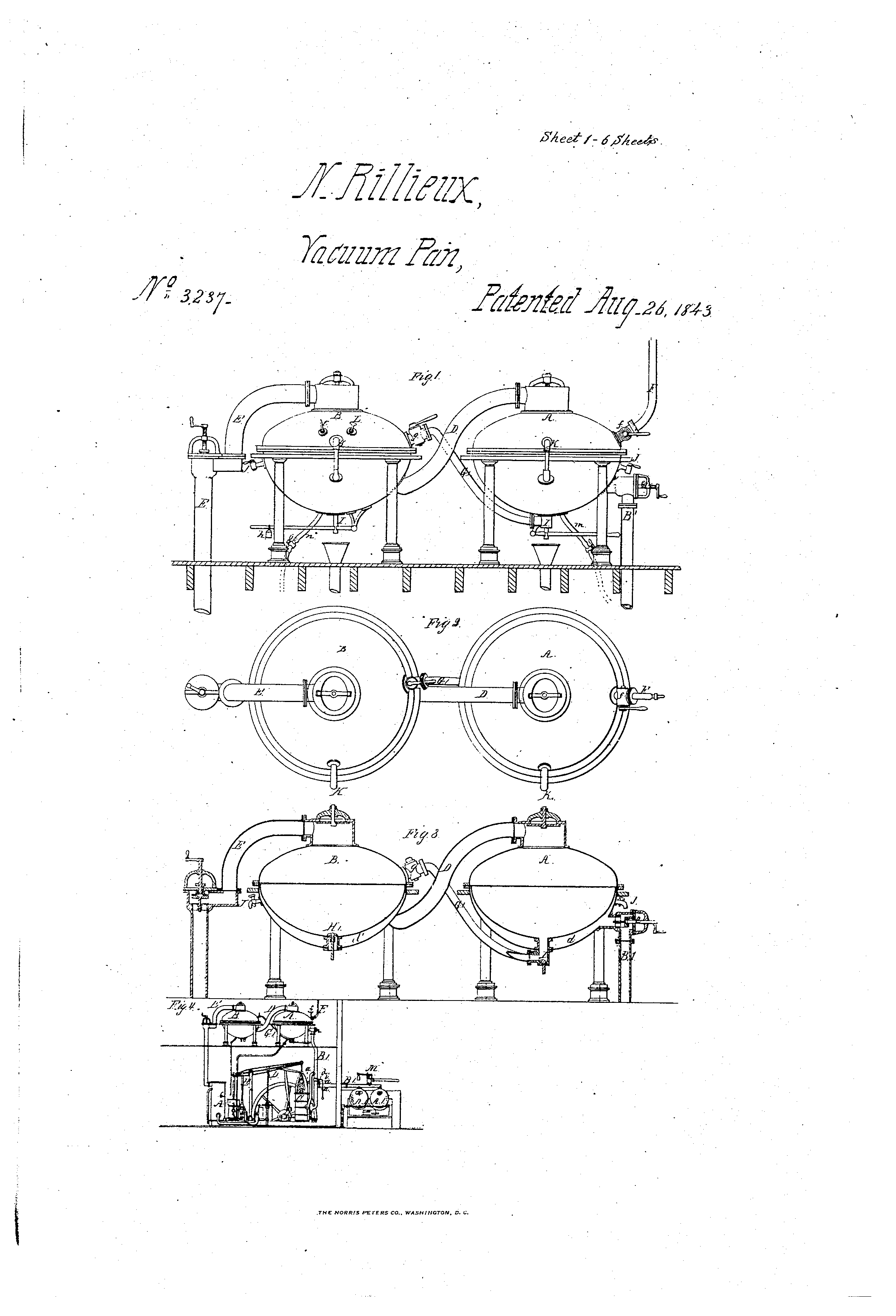
Arriving in New Orleans in 1831, Rillieux visited the estate of Thomas A. Morgan in Louisiana to promote his new manufacturing idea, having selected Morgan because of the planter's reputation for embracing new technologies: along with Gladstone of Demerara, Morgan was among the first planters in the Americas to install Howard's vacuum pan. However, Rillieux failed to convince Morgan to adopt his idea of ‘boiling one vacuum pan from the vapor of another’. Rillieux's machine later came to be known in the industry as the ‘double-effect apparatus’, or the double evaporation method for boiling sugar (see Figure 3). It fully modernized sugar-making by significantly reducing both water and fuel consumption, harnessing the otherwise wasted latent heat of the first pan and transferring it to a second pan for further use. Unfortunately for Rillieux, most Louisiana planters were not ready to institute major production changes and they declined his repeated offers to build them a working model.Footnote 63
The Rillieux double-effect apparatus transferred the latent heat of the first pan to heat sugar in a second pan. Source: http://patentimages.storage.googleapis.com/pages/US3237-0.png (accessed 17 October 2013).
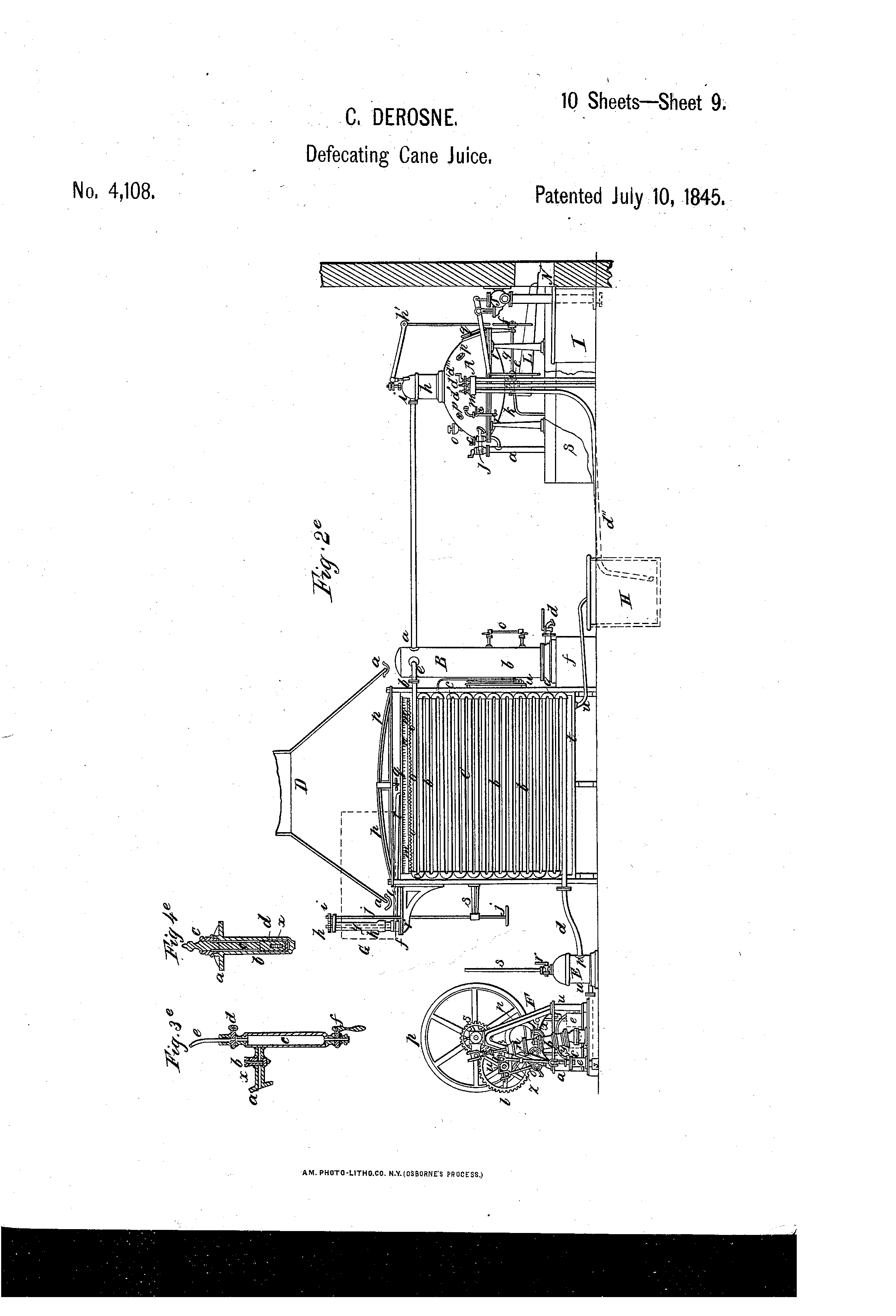
Rillieux finally gained an audience with Joseph Cucullu, the proprietor of the ‘Corinne’ plantation, the site of a former camp for British troops during the War of 1812 and an estate which periodically hosted Maximilian, the presumptive emperor of Mexico. Rillieux's initial experiments with his new equipment yielded mixed results but, because of subsequent scientific discussions, another planter in Louisiana learned of Rillieux's inventions. In 1834, the planter and his overseer visited Rillieux in his office, where the inventor explained the significance of his design to his visitors with several illustrations. Shortly thereafter the overseer travelled to Paris, where he encountered Jean-François Cail, of Derosne and Cail, and proceeded to describe Rillieux's drawings and ideas. Derosne and Cail integrated Rillieux's concepts into their own vacuum pan, which they then exhibited as their own at the National Fair in Paris (see Figure 4). Even so, Rillieux continued improving his design and constructed a working model of his double vacuum pan on a sugar mill belonging to Zenon Ranson of St Charles, Louisiana. Unbeknown to Rillieux at the time, the sugar master on this plantation was also an associate of Derosne, who described in detail to the French industrialist the inner workings of Rillieux's machinery.Footnote 64 Once again, Derosne appropriated Rillieux's latest innovations and demonstrated them to planters in Cuba.
Drawings attached to Derosne's US patent application (1845) for a complete system for manufacturing sugar. Note the incorporation of Degrand and Reybaud's condenser (D) into the vacuum pan apparatus (I) on the right. Source: http://patentimages.storage.googleapis.com/pages/US4108-8.png (accessed 17 October 2013).
In May 1843, scientists, engineers, industrialists, and planters studied the sugar harvest on the ‘San Juan Nepomuceno’, one of Cuba's largest estates, in anticipation of being able to assess what they now called the ‘new method’ of producing sugar. For two years, Wenceslao de Villa Urrutia, the well-heeled proprietor of the sugar mill, had experimented with Derosne and Cail's devices. The preliminary results encouraged Villa Urrutia to order an entire sugar mill. Derosne seized a lucrative marketing opportunity that would expand his company's presence not just in the West Indies but in the East Indies as well. As will be demonstrated later, Derosne and Cail aimed at establishing a global network of commercial, industrial, and laboratory facilities. Thus Derosne arrived on the island to direct the installation of this vast machinery. His industrial innovations produced noteworthy results: higher yields from a smaller area, higher-quality sugar, and economy in fuel and labour. Villa Urrutia hailed the coming of a new era for sugar in Cuba by praising the virtues of Derosne and Cail's machinery to all observers.Footnote 65
Five months later, Villa Urrutia delivered a public report detailing the experiments on his sugar mill to a group organized by the island's Development Board. The board then distributed 1,000 copies of a pamphlet promoting the island's sugar interests while endorsing Derosne and Cail's technology. Seven Cuban planters were impressed with the technology's advertised potential and placed orders with the firm.Footnote 66 But members of the audience were unaware that both Villa Urrutia and Derosne were misrepresenting themselves, the results, and the origins of the steam technology that they wholeheartedly promoted. For all their fanfare, Derosne and Cail's technology was not necessarily superior to the apparatus of other inventors.Footnote 67 Errors in judgement, mismanagement, and a general lack of familiarity with the novelty of operating double vacuum pan equipment resulted in inconsistencies in the quality of sugar produced. The mediocre results of the experiments added to Villa Urrutia's misfortunes, resulting in the all too familiar financial dilemma that planters encountered with their creditors: bankruptcy.
Derosne's trials in 1843 demonstrated to scientists and inventors his lack of expertise with a technology that his company manufactured, assembled, and operated, but whose theory had escaped him. Along with other scientists, Rillieux reviewed the results in Cuba and publicly rebuked Derosne for improperly arranging the equipment and for not demonstrating the true potential of his invention. Derosne and Cail evidently listened carefully to what Rillieux had to say, for it would not be the last time that the company would appropriate his expertise and technology.Footnote 68
Modernizing the continent
From 1846 to 1848, Andreae Brahmi, an engineer for the German firm Magdeburg-Steamship Company, visited several industrial manufacturers in the United States with the ‘view of becoming acquainted with … improvements in steam navigation and sugar works’. Among these companies was Merrick and Sons of Philadelphia, who were the primary manufacturers of Rillieux's apparatus before the US civil war. Because of the company's access to inexpensive coal and iron, the nearby Delaware river, and its vast commercial network of countless local establishments which supplied patterns, fittings, and tools, Merrick and Sons positioned itself as a global leader in the manufacture of heavy steam and gas machinery. In particular, it was a major contractor for the US Navy, supplying its ships with steamers. Located in the centre of the city, the industrial complex consisted of foundries, machine shops, boiler rooms, cranes, and steam hammers that employed 500 workers. The growing sugar apparatus department formed a large part of the company's operations as it sought strategically to position its machines in the West Indies.Footnote 69
After noting the advantages of Rillieux's technology, Brahmi ordered the entire steam assembly and shipped it to Germany in order to reverse-engineer the machinery. He then travelled to Louisiana to seek Rillieux's expertise. The two men discussed the theory and the merits of yet another vacuum pan design, a new multiple-effect apparatus that Rillieux was developing, at which point Brahmi asked his host to detail the modifications he would make to this system in order to adapt it to the German beet sugar industry. Rillieux granted Brahmi's request and proceeded to sketch a new industrial design for him. Brahmi returned to Europe. Soon thereafter, Rillieux's former draftsman journeyed to Austria, where he helped construct new vacuum pan assemblies.Footnote 70
When Brahmi returned to Saxony in 1849 he contacted Alfred Tischbein, the director of the engineering department at the Magdeburg-Steamship Company, offering him the Rillieux designs for 20,000 German marks. Tischbein readily bought the drawings, then patented, marketed, and sold Rillieux's system as his own and proceeded to install the ‘Tischbein apparatus’ at the beet sugar refinery of Jacob Hennige in Magdeburg in 1850. Rillieux's system then travelled southeast towards central Europe where Jules Robert, an engineer of French descent, installed Rillieux's machinery under the guise of the ‘Robert apparatus’ at the Seelowitz Sugar Manufactory, an experimental institution in Austria. Rillieux's technology then passed from central Europe back to France.Footnote 71
By the 1880s Rillieux's engineering principles, developed on plantation laboratories in Louisiana, had been widely accepted and dispersed by European engineers and industrialists. Refiners reported that his apparatus reduced coal consumption by half while the beet juice they extracted nearly doubled when compared to earlier processes they had employed. Yet implementation of Rillieux's technology was not universal. A German engineer lamented that his fellow countrymen were not as quick to embrace Rillieux's knowledge as his counterparts in France; apparently, German development of Rillieux's apparatus had decelerated in the mid nineteenth century. To reverse this trend, German refiners travelled to France ‘especially for studying the evaporation question by means of multiple-effect’. The engineer nevertheless declared: ‘This system, more or less modified, is now in use in nearly all German sugar factories and the merit of Rillieux, as founder of these modern and scientific principles, is irrevocably acknowledged and secured’. Thus Rillieux's technology helped modernize the French and German beet sugar industry.Footnote 72
Rillieux's ‘multiple-effect apparatus’ made its way to Paris via Tischbein of Magdeburg, who, wanting to recoup the 20,000 German marks he had previously spent on the designs, resold the plans to Derosne and Cail. The French company built the first Rillieux multiple-effect apparatus and installed it in Coincy, Lorraine, in north-eastern France. However, Derosne and Cail were again unable to maximize production with the new system because of their unfamiliarity with the theory and application of a technology they had not invented. The company therefore called upon the services of Jean-Baptiste Dureau, an associate of Rillieux, who recalibrated the assembly and improved the production process.Footnote 73 Derosne and Cail renamed Rillieux's equipment and demonstrated the ‘triple-effect apparatus’ (see Figure 5) at the 1878 Paris World Fair, as the company was apt to do with other patented technologies.Footnote 74
Derosne and Cail's triple-effect apparatus, largely based on Rillieux's multiple-effect vacuum pan design. Source: M‘Intosh, Technology of sugar, p. 194.
Closing the global circuit: the East Indies
Derosne and Cail's acquisition of Rillieux's intellectual property was certainly a manufacturing coup for a company seeking to incorporate the latest technological innovations and present itself as a global industrial leader; yet it was also part of a comprehensive marketing strategy that included the expansion of vital scientific and commercial links with the West Indies, the European continent, and the East Indies. For example, the evaporation experiments that Derosne conducted in Cuba helped the company gain a foothold in the Netherlands and its lucrative sugar industry by demonstrating the effectiveness of their products in a tropical setting.Footnote 75 As early as the 1830s the Indies state in Java took an active role in reorganizing capital investments and modernizing operations in sugar plantations. Initially these efforts centred on adopting the latest mechanized grinding machines, but by the 1840s the colonial state, along with an emerging bourgeoisie, recognized the significance of increasing capital savings via the vacuum pan. Derosne and Cail marketed and sold the company's vacuum pans as integrated components of entire sugar mills. Because of the technology's high cost the financial backing of the Indies state was essential; at least until 1850 the state provided sugar producers with subsidized loans for technological improvements.Footnote 76
It was in this context of state-sponsored modernization efforts that Derosne and Cail negotiated favourable industrial and licensing contracts with the Dutch government in 1840, and established joint manufacturing works with the Paul van Vlissingen and Dudok van Heel firm of Amsterdam. Subsequent agreements between Derosne and Cail and the Dutch government ‘stipulated that sugars would be produced by devices’ made by the French firm and its Amsterdam subsidiary, though as the discussion has emphasized it is unlikely that Dutch planters used Derosne and Cail exclusively. The Dutch plant integrated three divisions, including heavy industrial machinery and tooling, steamship equipment, and a section specifically dedicated to the manufacture of ‘coppers’ or vacuum pans and sugar mill apparatus.Footnote 77 The corporate relationship between the companies in Paris and Amsterdam resulted in products expressly marketed for sugar-making facilities in Java. It appears that Derosne and Cail adapted equipment to the localized conditions and requirements of sugar producers on the island and that Dutch planters and engineers provided the French company with recommendations based on their own experiments. In Amsterdam, engineers produced improved sugar mill structural designs from which the parent company no doubt benefitted.Footnote 78
With regard to the triple-effect vacuum pan display that van Vlissingen and van Heel demonstrated along with Derosne and Cail at the Paris International Exhibition of 1855, one observer pointedly remarked: ‘This apparatus differs from models exhibited by (Derosne) companies in Paris and Brussels and is specifically prepared for the needs of the Dutch colony’.Footnote 79 Thus Derosne and Cail's evaporation machinery, now produced in Amsterdam, gained a commercial advantage over other international manufacturers. The move, an early example of offshoring, theoretically made the technology relatively affordable to Dutch refiners.
Planters in Java experimented with vacuum pan equipment in 1835, only three years after trials in Demerara and certainly before the arrival of Derosne and Cail's machinery. One of these planters, Theodore Lucassen, recognized the revolutionary design of the vacuum pan and was among its earliest proponents in Java. A well-travelled individual like other cosmopolitan people discussed thus far, Colonel Lucassen was lucky enough to be repatriated after being captured during Napoleon's campaign in Russia. He was later dispatched to Java in 1816 after the British restored the Dutch colony. Lucassen knew ‘the right people’ and possessed ‘an ambitious plan for manufacture’. In 1839 he travelled to France to recruit beet sugar engineers for the island's plantations, demonstrating the complexity and effectiveness of global knowledge networks.Footnote 80
In evaluating the performance of Derosne and Cail's vacuum pans after experiments in Java during the 1840s, Lucassen was generally pleased, though not without offering critical commentary. He was ‘not unhappy’ with the French engineers who assembled the devices, and found their expertise acceptable. Nonetheless he echoed concerns over a domestic ‘dependency on foreign industry’ and pondered the roles that Dutch mechanics and supervisors would play as planters on the island incorporated the latest sugar mill equipment.Footnote 81 His observations were substantiated as Javanese plantations increasingly relied on French, German, English, and other European technicians by mid century. In some ways, Java was undergoing similar transformations to those in Cuba, where employing ‘foreign’ engineers linked the Caribbean island to globalization processes.Footnote 82
Closely monitoring developments in other world areas, Lucassen especially appreciated the potential fuel savings that the vacuum pan could yield; like his West Indian counterparts he hoped that Derosne and Cail's equipment would facilitate the use of bagasse as a fuel. His evaluation of the Derosne sugar mill assembly and specifically of the company's integration of Degrand's condenser was rather lukewarm. Recognizing the theoretical merits of their use, he was nonetheless unimpressed with the overall performance of the unit, emphasizing lower than average results during the filtration and purification process of the cane sugar, echoing criticisms made by Rillieux against Derosne in Cuba.Footnote 83 Like the West Indian planters, sugar refiners in the East Indies experimented with the latest evaporation technologies and compelled Derosne and Cail to modify and adapt the machinery to local circumstances and production needs.
By the middle of the nineteenth century at least 56 plantations of the 300 factories in Java were equipped with vacuum pans.Footnote 84 The machinery arrangements were certainly ‘mixed systems’, varying from state of the art equipment to ‘obsolete’ methods which operated in conjunction with the vacuum pan. But in this sense Java was no different from other regions where producers juxtaposed modern apparatus such as the vacuum pan with so called ‘primitive’ systems of manufacture.Footnote 85 A similar pattern of industrial modernization is discernable in mid-nineteenth-century Cuba, the often-cited example of scientific innovation in the West Indies, where planters installed sixty-four vacuum pans at the beginning of the 1860s.Footnote 86 The majority of Cuban plantations still relied on older equipment and antiquated methods, or experimented with mixed systems of production – only the largest plantations could afford the latest vacuum pans.Footnote 87
Nevertheless, Cuba and Java represented the economic dynamism of the West and East Indies. In Java, the island's highly fertile soils, an active colonial state, and a ‘skilled’ factory and coerced peasant workforce arbitrated the adoption of new technologies. In some respects Cuba and Java became the primary sugar exporters of the nineteenth and twentieth centuries because of their concerted efforts to import the latest technologies, thereby linking them to vital transnational networks of capital and migrant technical workers during a period when the two areas relied on slave and indentured labour and corvée labour respectively.Footnote 88 Thus the very existence of heterogeneous systems of manufacture in laboratory plantations exemplifies one of the main points emphasized here: even with the advent of cutting-edge technology, scientists, planters, and countless others participated in a constant process of experimentation with new vacuum pan equipment in order to adapt the machinery to localized conditions.
Conclusion
When Thomas Dodson conducted experiments with the vacuum pan in Demerara in the early 1830s he initially conceived the laboratory plantation as a space where innovation and engineering developments would influence industrial designs and manufacturing techniques in Britain. Indicative of his level of anticipation for the importance of the trials he conducted, he proclaimed: ‘The experiments have now been tried, and its effects are equal to our most sanguine expectations’. His statements also emphasized the progress he had made, the work to be done, and the exploratory role that the laboratory plantation would play in this process. Dodson further declared: ‘Since the period that publicly was first given to the introduction of the vacuum-pans, and the mode of operations in this colony, some modifications have been introduced and improvements suggested by practical experience’. He relayed evidence of the modifications and improvements that he made to the machinery to scientists such as Dr Andrew Ure and Dr Andrew Booth, as well as to the manufacturers of the vacuum pan equipment, Oaks and Son of London. He firmly believed that it was only a matter of time before such personal exchanges – what he called the ‘diffusion of scientific knowledge’ – would solve many of the engineering, manufacturing, and practical problems idiosyncratic to the production of sugar.Footnote 89
Yet the results of Dodson's experiments with the vacuum pan travelled far beyond the British empire, in some ways exceeding his own expectations. This ‘diffusion of scientific knowledge’ was transmitted and re-circulated by the likes of Degrand, Rillieux, Derosne and Cail, and Lucassen, as well as countless others who traversed global knowledge networks in pursuit of progress and profit. As this article has demonstrated, revolutionary vacuum pan designs invented by Rillieux and other scientists – such as the double-effect apparatus and the multiple-effect apparatus – were conceived and further developed in plantations in Louisiana and the West Indies, but they did not remain stationary. The laboratory plantation in the Greater Caribbean connected this area to an ongoing process of progress, modernity, and globalization. Like other technologies of the period the vacuum pan was emblematic of these developments, but it also served as a vehicle for larger transformations. European industrialists and beet sugar manufacturers as well as cane sugar producers in the East Indies later adapted the designs to suit their own marketing and production needs. Scientists and industrialists may have conducted multiple experiments with their equipment, but hardly ever did they perfect their machinery in isolation; it was a continuous progression of invention and reinvention along temporal and spatial axes. As sugar producers in the Greater Caribbean, Europe, and Java unpacked their wooden crates, constructed and rearranged devices, and reviewed and critiqued the results of their ‘trials’, they provided valuable data to scientists and industrialists who altered their original designs or incorporated changes based on the experiments conducted in laboratory plantations.
José Guadalupe Ortega is Assistant Professor of Colonial Latin American History at Whittier College. His research focuses on connecting slavery and Cuba with other Atlantic communities during the late colonial and early national periods.