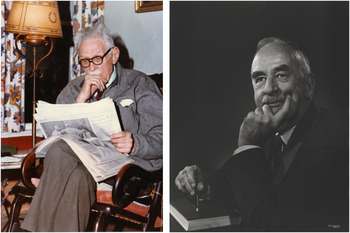
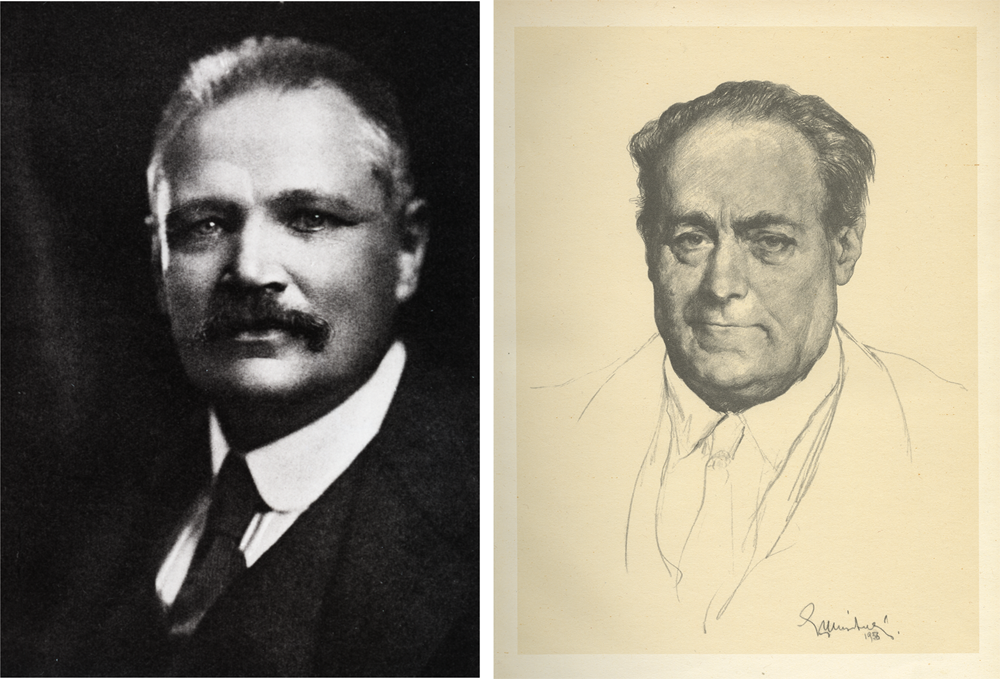
Capitalism does not seem like a concept in danger of disappearing.Footnote 1 At the Fourth Congress of the International Economic History Association, which met in Bloomington, Indiana, in September 1968, however, the term itself was under siege. The association's president, Frederic C. Lane (Figure 1, left), a historian of Renaissance Venice's shipping and shipbuilding industries who by that time had also become one of American economic history's foremost impresarios, noted that some of the Congress's participants found the very term “offensive or at least distasteful” and he set about trying to avert a “semantic battle.”Footnote 2 In an attempt to find common ground, Lane circulated a memorandum, entitled “Meanings of Capitalism,” before the Congress and solicited early comments from a small group of leading economic and business historians. The document bore the clear marks of Lane's long-term interest in sociology. Already in 1940, Lane had invited Talcott Parsons to lecture at Johns Hopkins University. Parsons, a Harvard sociologist close to both the epochal economist Joseph A. Schumpeter (Figure 5, left) and the first dean of Harvard Business School (HBS), Edwin F. Gay (Figure 3, left), had received his PhD in Heidelberg, appropriately, with a dissertation titled “Capitalism in Sombart and Max Weber,” and he published the first English-language translation of Weber's Protestant Ethic in 1930.Footnote 3 Even in 1968, for Lane, the conceptual vocabulary of “capitalism”—accumulation, rationalism, traditionalism, and so on—seemed indelibly marked by the interventions during the first decade of the twentieth century of Weber and Werner Sombart, who both, in their own ways, offered correctives to Karl Marx's purely materialist explanatory mechanisms.
Above left, Frederic C. Lane; above right, Arthur H. Cole. (Sources: Lane photograph, Image #14963, Ferdinand Hamburger Archives, Sheridan Libraries, Johns Hopkins University; Cole photograph, 1956, © Yousuf Karsh, courtesy of the Estate of Yousuf Karsh.)

One large insurgent group in Bloomington, made up of “orthodox economists” and numerous economic historians, hoped to replace “capitalism” with “growth,” which they regarded as the “dominant concept of our discipline, its determining standard of relevance.”Footnote 4 Another group, a self-described “band of infidels,” challenged “capitalism” and called for its “abandonment” from the strategic high ground of entrepreneurship and entrepreneurial history. Arthur H. Cole (Figure 1, right), long-time professor-librarian of HBS's Baker Library, and organizer of the Harvard Research Center in Entrepreneurial History, active from 1948 to 1958 and influential long after, presented the case in a critical comment later published alongside Lane's memorandum.Footnote 5
Cole invoked historians including Fritz Redlich, Thomas Cochran, and Alfred D. Chandler who “place explanation of economic change upon business management—broadly interpreted—rather than upon any magic in the operations of capital” and who give “prime importance” to administration among the many factors affecting economic production.Footnote 6 In this, they echoed their friend Schumpeter's critique of the “pedestrian view that it is the accumulation of capital per se that propels the capitalist engine.”Footnote 7
The rejection of “capitalism” did achieve a modicum of success in limited disciplinary areas. In a well-known 1999 New York Times profile of the heterodox economist Robert Heilbroner, for example, the fact that the word capitalism “no longer appears in popular textbooks for Economics 101” was decried as a symptom of the abandonment of the goal of modeling “all the complexities of an economic system—the political, the sociological, the psychological, the moral, the historical,” an encompassing goal that had once defined the work of Heilbroner's beloved “worldly philosophers.”Footnote 8 But in academia writ large, especially since the economic crisis of a decade ago, “capitalism” has made a remarkable comeback and is (along with slavery) occasioning much of the most vibrant historical scholarship being done today, though what precisely one is to understand by the term remains open for debate.Footnote 9
We raise the case of 1968's semantic battle over “capitalism,” then, not as a mere historiographical curiosity but to stress that questions about the origins and development of capitalism remain—fifty years on—largely questions of, in Lane's words, the “meanings of capitalism.” Another of the historians who replied to Lane's memorandum was Jacques-François Bergier, a Swiss student of Fernand Braudel, perhaps now best known for drafting Switzerland's controversial 2001 report on its wartime complicity in Nazi crimes.Footnote 10 Bergier too stressed the requisite role of entrepreneurs—“in the sense,” he clarified, “that Schumpeter gives the term”—to capitalism, but he added an important observation: “Jacques Coeur [and] Cosimo de’ Medici were capitalists, but neither the France of Charles VII nor the Florence of the Medici were nations where capitalism was dominant.”Footnote 11 Whatever we make of this particular judgment, Bergier's point speaks to something important. Just as Steven L. Kaplan, the historian of bread and French political economy, has written of the defining difference between a society with markets and a society governed by the “market principle,” so we might ask whether it is useful to think of the difference between societies, as it were, with capitalists and capitalist societies.Footnote 12 From the perspective of the contemporary global economy, a key insight of the literature on “emerging markets” highlights precisely the degree to which self-identified “capitalists” can operate in jurisdictions that are far from “capitalist,” while officially “capitalist” regimes similarly exist where large numbers of people do not organize their lives in such terms at all. Even in the twenty-first century, people continue to be “socialized” into “capitalism,” and there is no reason to believe that societies were more neatly compartmentalized around marketization in the past than they are in the present.Footnote 13 As the Canadian science-fiction writer William Gibson, best known for his 1984 novel Neuromancer, famously quipped, “The future is already here—it's just not very evenly distributed.”Footnote 14 Might we say the same of capitalism in the France of Charles VII and Medici Florence? Of capitalism across history? Even of capitalism today? This was certainly the stance of the Danish socialist politician and historian Gustav Bang. In 1902 he straightforwardly equated “the modern condition” with “the age of capitalism,” the roots of which stretched “far back into the Middle Ages,” but he rightly warned that it was “impossible to draw sharp chronological lines around it,” because it appeared “with different strengths in different countries at different times” and its “transition” anyway was “gradual” and “not simultaneous in all areas.”Footnote 15
Weber and Sombart
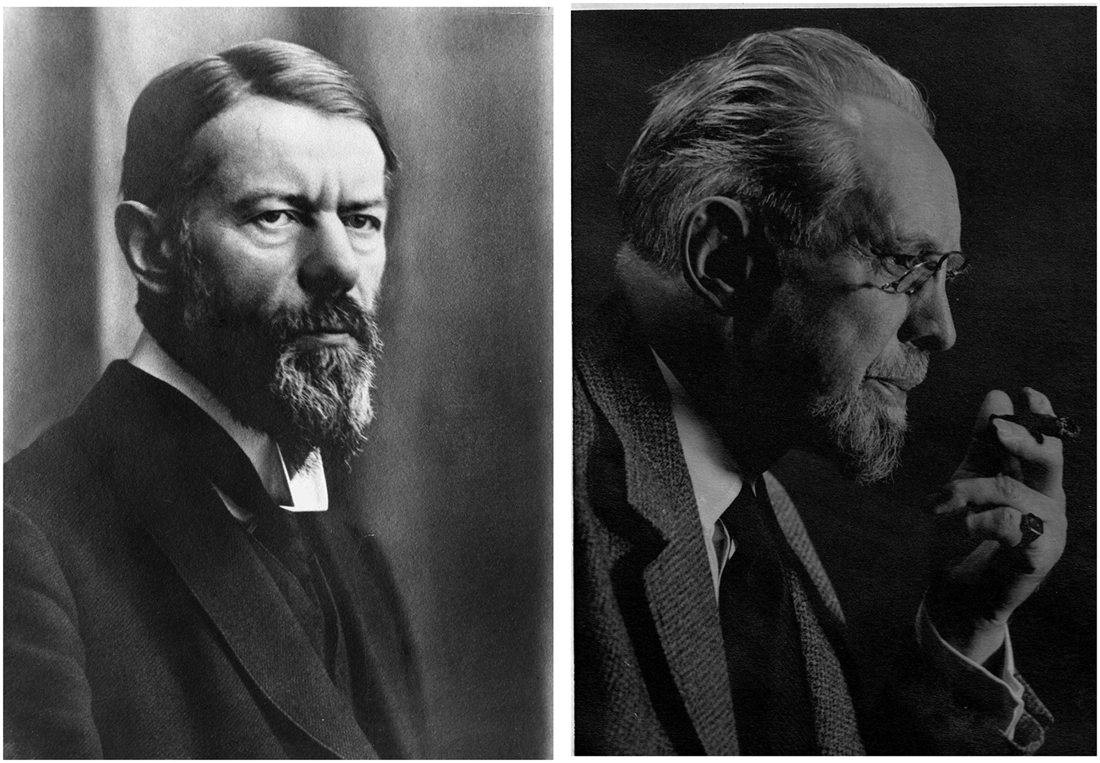
The very rubric under which this special issue is presented, “Italy and the Origins of Capitalism,” will seem, to many nonspecialists, first and foremost an affront to the so-called Weber thesis, which in its vernacular form posits Protestantism—or a “protestant ethic” emerging both from Luther's notion of calling and from the this-worldly asceticism of Calvinism—as a prerequisite for capitalism and its “spirit” to take form. But Weber (Figure 2, left) himself resisted drawing one-way causal connections between the two terms of his title, between Protestantism and capitalism. Instead, he rigorously employed an alchemical or chemical term well known in German literature: “elective affinity,” a topos signifying a kind of kinship or convergence marked by both reciprocal attraction and mutual reinforcement.Footnote 16 And, as such, in Weber (especially in the Weber of the decade after the initial publication of the Protestant Ethic in 1904–1905) the sixteenth century is advanced not as a strict terminus post quem for capitalist practices per se but for a particular type of modern rational capitalism. In 1910 Weber clarified this point in a pointed reply to his critic Felix Rachfahl, who had published a sprawling, ninety-page review the previous year. Stressing that “large-scale capitalist development” was “known throughout history,” Weber noted that the “non-ascetic” type of capitalist had, in fact, “been around since the Pharaohs’ time.” In order to clarify his position, Weber turned, not surprisingly, to premodern Florence:
The merchant of the Florentine early Renaissance did not feel at one with his actions. Here is not the place to analyse the deep inner conflict running through the most serious men of those days, despite all their overflowing energy and apparent inner unity. These men's restitution of property gained usuriously is just one phenomenon that fits this picture, and certainly a rather superficial one. But fit this picture it certainly does. I—and indeed anyone at all impartial—can only see in such means of self-appeasement one of the many symptoms of tension between “conscience” and “action,” of the incompatibility of the ideals of the serious-minded Catholic and the “Deo placere non potest” [he, i.e., the merchant, cannot please God] with “mercantile” striving for profit—an incompatibility unsurmounted even by Luther. One can understand those men's countless practical and theoretical “compromises” precisely as “compromises.”Footnote 17
Weber's psychological phraseology—deep inner conflict, feelings of oneness (or not) with one's actions, compromises of conscience, self-appeasement—is striking, as is his willingness to reduce the mental universe of the Florentine merchant to two existentially conflicting motivations: striving for profit, on one side, and a “serious-minded” Catholicism, on the other. Rachfahl—appropriately, we think—suggested that Weber's conception of the “spirit of capitalism” is, in this way, much too narrow because it excludes other motivations: honor, respect, well-being for one's family and kin, clientelism, power, or even service to the city-state or nation.Footnote 18 And, importantly, for the same reasons, so is Weber's radically circumscribed view of Catholicism as it was practiced in a Mediterranean context bound by long-term traditions concerning family, shame, honor, and power. Perhaps more to the point, although it was easy enough for Weber to find quotations like “the merchant cannot please God” (found in the so-called Opus imperfectum, a commentary on the Gospel of Matthew, once attributed to fourth-century church father John Chrysostom), the merchant was anything but a wholly dishonorable figure in the city-states of late medieval Italy.Footnote 19 In Florence, and other communes, membership in merchant guilds was an essential gateway to civic honors and a requisite for political office holding.Footnote 20 Though not a “calling” in Luther's sense, being a merchant was, for the jurist Baldo degli Ubaldi, in (likely) the first ever legal treatise on the subject of merchants, a professio, a professing or profession, a word with its own strongly religious overtones. And because merchants are men of “upright living and proven credibility and legality,” he could write without running afoul of any Catholic ethic in fourteenth-century urban Italy, “their account books are presumed to be correct and true and faithful.”Footnote 21
Above left, Max Weber; above right, Werner Sombart. (Sources: Weber photograph courtesy Encyclopædia Britannica, accessed 27 Feb. 2020, https://www.britannica.com/biography/Max-Weber-German-sociologist/images-videos#/media/1/638565/32320; Sombart photograph courtesy of Erik S. Reinert.)

Weber was rightly and explicitly uneasy about drawing a clean or bright line between the “traditionalistic” and “acquisitive” economies, but as he became more comfortable with speaking of “Ancient capitalism”—as in his long 1909 dictionary entry on “Agrarian Conditions in Antiquity”—he also became more insistent that his subject in the Protestant Ethic was “modern capitalism” rather than capitalism in some essential and transhistorical sense, just as “modern capitalism” had been the great subject of his friend and rival Werner Sombart (Figure 2, right), a student of Gustav von Schmoller and perhaps the most famous social scientist of his age, whose unfortunate politics traversed an unsteady arc from Marxism to national socialism.Footnote 22 In chapter 20 of the heavily revised 1916–1917 edition of his Modern Capitalism, Sombart described the “spirit of capitalism” with heightened drama:
Capitalism came from the profound depths of the European soul. . . . It is the spirit of earthliness and worldliness, a spirit with a tremendous power for the destruction of old, natural creations, old constraints and barriers, but also a strong power for the reconstruction of new forms of life, of artificial and artistic creations, serving a purpose. . . . It is the Faustian spirit: the spirit of commotion and restlessness that now animates man.Footnote 23
For Sombart, the acquisitive economy is a “whirlpool,” a maelstrom, and men of enterprise—those “unafraid men, non-enjoying men”—are engaged in a ceaseless struggle. Theirs is a spirit of “creative destruction” that foreshadows Schumpeter and participates, explicitly, in a Nietzschean “will to power.”Footnote 24
Though a vocal critic of Sombart, the eminent German economist and social reformer Lujo Brentano, a leading member of the so-called Kathedersozialisten, or “Socialists of the chair,” addressed the origins of capitalism in similar terms. “Today we live in the age of capitalism,” Brentano lectured to the Bavarian Academy of Sciences on March 15, 1913, and while “the word capitalism” was “a monstrosity for many,” it remained that a large number of the very same people practiced “capitalism without even realizing it.” But what was capitalism, really? In a number of seminal essays on the topic, Brentano essentially identified “capitalism” with what Enlightenment writers had called “commercial society,” namely, a growth-oriented economy anchored in “money” rather than “land,” in which “no one consumes only what they themselves have produced.” Like Weber and Sombart, he believed there had been many “capitalist” eras, but he was always resolute in tracing what he called “new capitalism” or “modern capitalism” to the city-states of early medieval Italy, where one could observe how “the mentality of the merchant made its way into all other aspects of life.”Footnote 25 His deepest disagreement with Sombart resulted from the question of when, precisely, human beings began to seek a real “surplus.” Sombart's “fundamental error” had been to follow Marx in locating this impulse for “infinite wealth” only in more recent times after the advent of capitalism, whereas, for Brentano, it was evident from the example of “the Medici,” and, indeed, much earlier, that “the desire for unlimited profit” was “something extremely personal, profoundly rooted in human nature, and in the desire, of all men of all races and of all peoples, to excel over others and dominate them. It did not first appear in the period of the capitalist economy but is rather common to this as to all preceding ones.” Capitalism had simply given this instinctive “desire a new direction,” in a context where it was “money, and not, as before, land, which conferred dominion over others.”Footnote 26 Though Brentano, too, would invoke the emotive power of Goethe's Faust to convey the spirit of capitalism, his emphasis on humanity's instinct for domination led him to formulate a pregnant, if exaggerated, critique of Sombart and earlier theorists of the phenomenon. By focusing so much on “the economy” as such, he observed polemically, his predecessors had “entirely forgotten he who, with his wit and will, first gives life to capital,” to the point of “not mentioning the entrepreneur [Unternehmer] even once.” As such, he concluded, there was every reason to return to the “more acute” Saint Antonino of Florence, who had been archbishop at the time of Cosimo de’ Medici the Elder and who, in his widely read Summa, had argued that “money is in itself only minimally lucrative, nor can it multiply itself, but it becomes lucrative due to the industry of merchants through their commerce.”Footnote 27
Business History
However tempting it may have been to cast a Jacques Coeur or a Cosimo de’ Medici, or, for that matter, a Rockefeller, as a Faustian entrepreneur, Sombart's and Weber's theories are theories inextricably embedded in the historical moment that created them. This has been true of every generation that surveyed the history of premodern capitalism, of us and of the pioneering group that, on the foundation laid by this earlier tradition, launched the field of “business history” at HBS in the 1920s and 1930s.
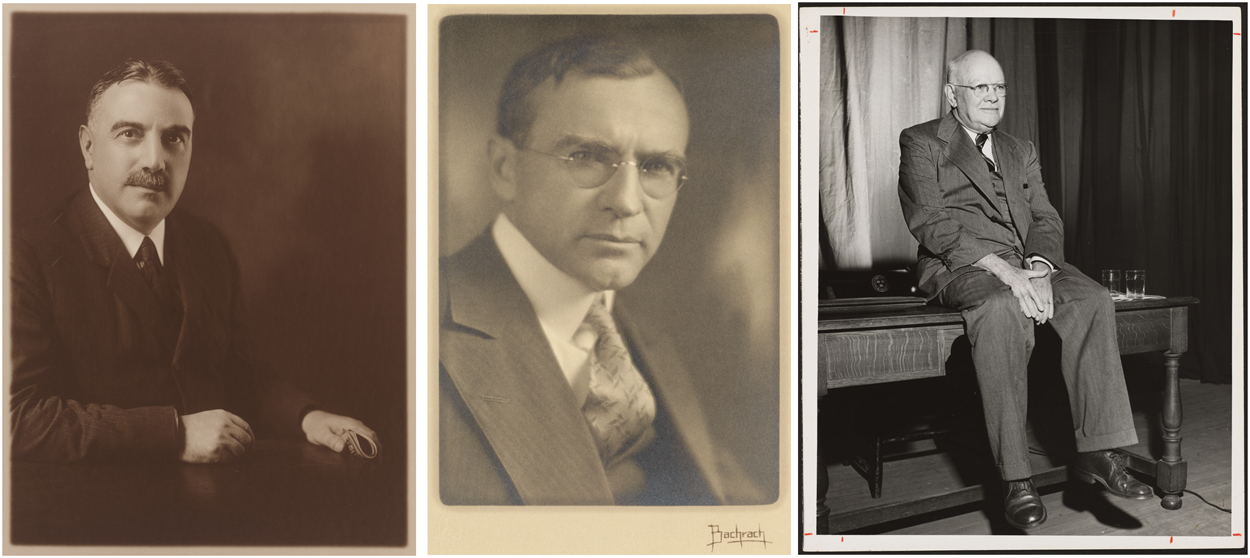
While Gay, Cole, and N. S. B. Gras (Figure 3, center) may have disagreed (as Weber and Sombart, and Sombart and Brentano, had) over how much attention should be paid to entrepreneurs, firms, states, and the environments in which they operated, none of them doubted the pertinence of contextualizing economic history in light of the lives and times of business actors.Footnote 28 History had been a cornerstone of HBS's mission and pedagogy from its origins—indeed, Gay, its first dean, was a medievalist and America's first “economic historian”—but, under the direction of dean Wallace B. Donham (Figure 3, right), the late 1920s saw a concerted push to truly make the institution the world's premier site for studying the history of business. This meant the building of Baker Library's collections and the appointment of Gras, the so-called father of business history, as Isidor Straus Professor of Business History (the first such professorship) in 1927. Gras had been Gay's favorite student and, like Gay, was a medievalist steeped in the German historical tradition, from which he took a keen interest in stadial models of economic change and the notion that the history of individual firms should form the building blocks of a business-inflected economic history.Footnote 29
Above left, Edwin F. Gay; center, N. S. B. Gras; above right, Wallace B. Donham. (Sources: Gay photograph, Schlesinger Library, Radcliffe Institute, Harvard University; Gras photograph, HBS Archives Photograph Collection: Faculty and Staff [olvwork375033]; Donham photograph, HBS Archives Photograph Collection: Faculty and Staff [olvwork399909].)

Although Gras's influence on the field of business history remains well known, the crucial part he played in the origins of Renaissance economic history is little remembered. Nearly sixty years ago, and much closer to the events, the Canadian-American historian and historiographer Wallace K. Ferguson in a historiographical essay on Renaissance economic history stressed the important role played by Gras and by business history. What distinguished business history from economic history more broadly was its source material, to be found “not in guild regulations, city ordinances, state legislation, or treatises on the conduct of business, but in the records of individual business men, partnerships, and firms—in account books, diaries, partnership agreements, notarial records, correspondence, and all the detailed evidence of the way in which a particular business actually operated.” For Ferguson, business history, “in the sense in which Professor Gras envisaged it,” encompassed works including the pathbreaking studies of the Bardi, Peruzzi, and del Bene firms by Armando Sapori (Figure 6, right); most of the work of Raymond de Roover (and, we would add, that of his wife Florence Edler de Roover) (Figure 4, left); Lane's biography of the merchant Andrea Barbarigo; and even Iris Origo's Merchant of Prato.Footnote 30 Gras also had a knack for creating new concepts and coining new terms, which he then imbued with momentous significance in his theoretical works, such as the defining figure of the stage of “mercantile capitalism”: the so-called sedentary merchant, who managed his business from home, using correspondence and intermediaries, in contrast to the earlier “traveling merchant,” who accompanied his own goods to trade fairs, such as the famous Champagne fairs. In the first decades of Renaissance economic history in the United States, in a testament to Gras's impact, the “sedentary merchant” regularly appeared in the field's most important work.Footnote 31
Above left, Raymond and Florence Edler de Roover; above right, Robert S. Lopez. (Sources: De Roovers photograph courtesy of Kathleen Edler Allison; Lopez photograph, Office of Public Affairs, Yale University.)

A unifying aim of the early group of economists orbiting HBS was explicitly to make the study of business and capitalism proper more historical and to push the field of inquiry, and the “roots” of “modernity” as such, deeper into the past. In 1941, Gras delivered a paper entitled “Capitalism—Concepts and History” at the American Historical Association's annual meeting, positing “capitalism” as a “basically psychological concept,” behind which there was a “will to save, to plan, to advance, to accumulate, and to attain security.” In short, he argued, against Weber's more focalized definition, “the essential element in the system of capitalism is administration.”Footnote 32 At the time, Gras asked de Roover to provide the perspective of medieval history as a discussant; de Roover's short discussion, which evidently was inspired by Sapori's earlier work and built upon Gras's interest in “forms of business and problems of management,” did nothing less than posit a new paradigm for medieval capitalism at odds with the views of both Sombart and Weber: a “commercial revolution” occurring in Italy in the late thirteenth century.Footnote 33 This view, and later versions such as that of the Italian émigré and Yale economic historian Robert S. Lopez (Figure 4, right) (whom Gras had helped settle in the United States)—in his famous 1971 book The Commercial Revolution of the Middle Ages, which pushed the revolution further back and expanded its space to the wider Italian Mediterranean—soon became the dominant paradigm in premodern economic history concerning the origins of capitalism.Footnote 34 But what did it matter, really, when “capitalism” emerged?
Already in an internal business school memo of 1928, Nathan Isaacs, professor of business law at HBS, had argued,
The Medici did not belong to a different business civilization, a different dynasty, so to speak, from ours—our methods are built on theirs. The system of bookkeeping prevailing in the modern world today is still known as “Italian.” The capitalist regime was not only foreshadowed—the Medici were the first great capitalists in the modern sense. However the solutions may have differed, problems of their business life were not unlike ours. . . . The problems are different but the differences are instructive.Footnote 35
And when he lectured in Turin in 1974 on the rise of modern business, almost half a century later, Chandler made a similar point: “The American merchants of the nineteenth century and the Italian merchants of the thirteenth century used the same form of partnership or joint ventures, sold in the same way on consignment and commission, and used the same type of double-entry bookkeeping.”Footnote 36 What ultimately and meaningfully would change, for Chandler, was, of course, the scale and scope of firms. Where the Medici bank in 1470 had only seven branches and 57 employees at its main branch, “the BayBank where I have my checking account,” he noted, “operates over 200 branches, has close to 5,000 employees, some 300 managers, and daily clears 1.25 million checks.”Footnote 37 All of Isaacs's and Chandler's specific points can certainly be problematized, but their confidence in the comparative relevance of premodern business outlines the backbone of a venerable tradition of engaging with the phenomenon. If, as the case method they championed often implicitly or explicitly assumes, judgment is developed by knowledge gained through practice, then history remains our most valuable store of such experience by proxy.Footnote 38 It was in this spirit that Gras, in his first HBS lecture on business history, on September 27, 1927, told his students that history “should give a man a perspective. It should give him suggestions. It should provide an interpretation of factors and situations.”Footnote 39 In effect, as Gras wrote only half-jokingly to then HBS dean Donham in 1929, he was simply being more transparent about the historical nature of the case method as such: “It does not seem extravagant to hold that all of the other courses in the School of Business are recent business history. I say this, of course, with my tongue in my cheek, but still I believe there is a good deal of truth in it.”Footnote 40 The history of capitalism, in short, was relevant for Gras and his followers as a repository of experience from which to derive knowledge and, ultimately, with which to refine one's judgment. Yet, even for insiders within this group, the question of how to relate to such historical dynamics across the centuries could be vexing.
The Roots of Modernity
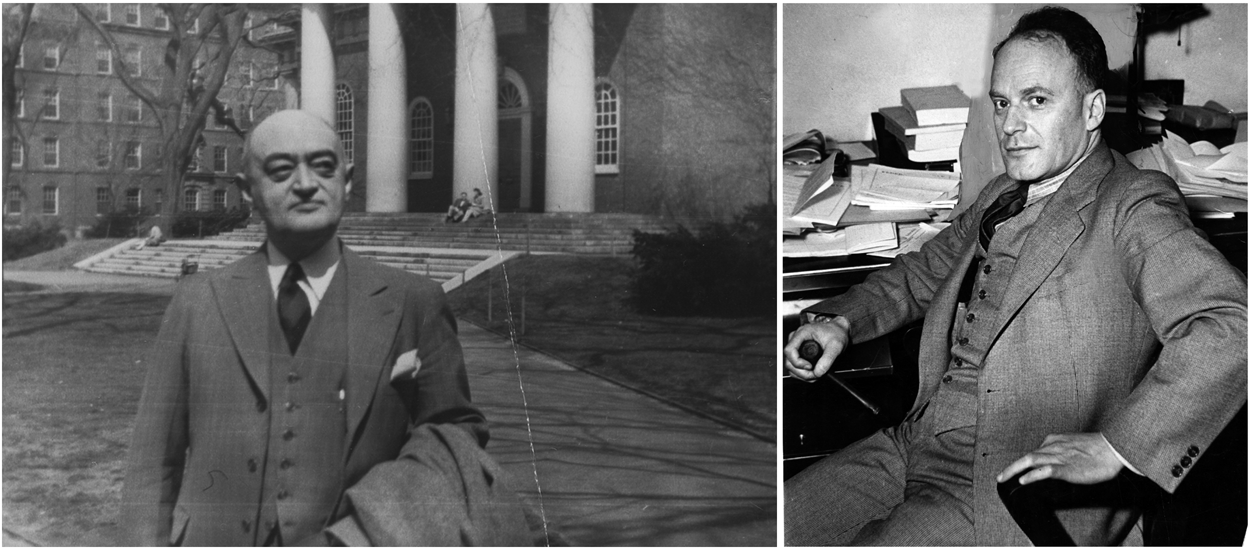
In de Roover's classic 1958 Business History Review article, “The Story of the Alberti Company of Florence, 1302–1348, as Revealed in Its Account Books”—almost the Platonic form of an ideal business history in the mold of Gras: the history of a firm, based on its books—the Belgian-American accountant and historian noted, in a footnote to a discussion of how Leon Battista Alberti's Della famiglia was “only one among several treatises on household management after the manner of Xenophon,” that “one of these treatises, that of Benedetto Cotrugli (Della mercatura e del mercante perfetto), written in 1459, but published only in 1573, actually has a chapter entitled ‘L'uomo economo’ (The Economic Man). Of course, this expression does not have the same meaning as that attached to it by economists today: it refers simply to an efficient household and business manager.”Footnote 41 De Roover had been interested in the Ragusan merchant and humanist Cotrugli for some time and discussed him, among others, with the great Chicago economist Jacob Viner (Figure 5, right).Footnote 42 In a 1956 letter reminiscing about one of their encounters, de Roover recounted how, “in the course of the conversation, I mentioned a book of the XVth century in which I found a chapter actually entitled ‘l'Uomo economico’ (The Economic Man).” The book in question was, of course, Cotrugli's Della mercatura, and, de Roover went on, “as for the chapter on the ‘Economic Man,’ it is by no means an economic man in the modern sense, but an efficient administrator of his private household in the same sense of Xenophon's economics.”Footnote 43 This was, almost verbatim, the insight he soon would publish in his article on the Alberti, neatly differentiating household and economy, ancient and modern, alien and familiar.
Above left, Joseph A. Schumpeter; above right, Jacob Viner. (Sources: Schumpeter photograph, HUGBS 276.90, [olvwork351238], Harvard University Archives; Viner photograph, Special Collections Research Center, University of Chicago Library.)

The following year, however, after discovering Bartolomeo Frigerio's 1629 L'Economo prudente in the catalog of HBS's Kress Library, Viner wrote de Roover to ask whether he was familiar with it, noting that, because it similarly was devoted to the “‘arte infallibe [sic] d'acquistar, e conseruar la robba’ [the infallible art of acquiring, and conserving la robba],” it “seem[ed] close to your item.”Footnote 44 De Roover's reply is worth quoting at some length:
No, I did not know about Frigerio, Bartolomeo, L'Economo prudente, but I shall look it up on my first [by which he meant next] visit to the Kress Library. Many thanks for the reference. This Kress Library is a treasure trove. Yet the Economics Department at Harvard scarcily [sic] knows of it! No professor ever works there and rarely a graduate student. I was the first to have one or two classes each year in the room of the Kress Library. I am now working on Cotrugli, but I have not gotten very far. . . . Roba (one b in modern spelling) has a variety of meanings: stock, merchandise, inventories, wealth. Of course the economic man of these early economists was an efficient manager of the household, but he became more and more an efficient business man. In any case, the accent is on efficiency in the management of worldly affairs. This is not so very different from the modern economic man, though the concept was more concrete and less abstract.Footnote 45
De Roover would never publish this bolder, more adventurous meditation on the relationship between economic men past and present, perhaps in emulation of Frigerio's prudence, but his insight that modernity was somehow related to an “accent” on “efficiency in the management of worldly affairs” certainly informed his work more broadly, as is evident from the opening phrase of his magnum opus, The Rise and Decline of the Medici Bank: “Modern capitalism based on private ownership has its roots in Italy during the Middle Ages and the Renaissance.”Footnote 46 Historians are rightly torn about how, exactly, to engage with such “roots,” simultaneously distant and pertinent, deep and shallow. The past may be a foreign country, but where exactly is it located? How near or far away? On a different continent? Or planet, perhaps? How related are we to our past, and how far can it, really, refine our judgment?
A Usable Past
The problem is, as Gras, de Roover, and Lane all realized, particularly acute with regard to concepts such as “capitalism,” which are habitually considered “modern” by default, however difficult to define in a durable fashion, and which are frequently engrossing precisely because of their perceived connection to present and future concerns—whether with progress, sustainability, or social justice. As Henrietta M. Larson put it in her own comment to Gras's seminal 1941 talk on “Capitalism,” a historical approach to business administration “is to us no mere academic concern.”Footnote 47 The historical profession may today be increasingly challenged to prove its “relevance” in modern academia, but the anxieties surrounding this are old. Marc Bloch, himself no stranger to the question of the “use of history,” felt there was something uniquely American about Gras's program.Footnote 48 Writing in 1929 about the ambitious plans at HBS to patronize work on the economic and business history of the Italian Renaissance, Bloch noted, “Faith in the practical utility of research about the past, confidence in the economic expansion of the United States of America, inheritors and imitators in a much larger world of Italian pre-capitalism, these feelings . . . are worthy . . . of focusing the thoughts of historians.”Footnote 49 Needless to say, not everyone agreed on the virtue or necessity of such a functional approach to the past, and traditions differed internationally.
In a 1947 letter to the Venice-based medieval economic historian Gino Luzzatto suggesting they collaborate on a book in English, for example, Lopez tried to explain that “it will be necessary to consider the mentality and methods of the Americans. Great interest in statistics and in the ‘what for,’ which is to say: what use is it to study this? What lesson can we draw from the past?” Unless one took this realization to heart, the danger was that “an American student or professor would be left disoriented.”Footnote 50 And the case of Lane is here, again, instructive. Following in the footsteps of Italian pioneers like Luzzatto, Lane was a groundbreaking archival historian. But Lane, in an often remarkably open way, squeezed his prodigious archival findings into a politicized schema according to which America inherited and ultimately uplifted the traditions, especially the republican traditions, of Venice. The most striking artifact of Lane's politicized historiography is his 1965 presidential address at the American Historical Association's annual meeting in San Francisco, later published under the title “At the Roots of Republicanism.” Lane's long-time friend Lopez accurately summarized its contents in a congratulatory letter to Lane early the next year: “I have just read your masterly presidential speech and I could not agree more: republicanism was more important than capitalism as a peculiar trait of the Italian medieval town, and that is why the Renaissance is not a surprise.” In another letter, somewhat in jest, written seven years later, Lopez described his and Lane's shared politics: “Like you I am a republican . . . and a moderate anarchist of the Genoa–New England type.”Footnote 51 Lane's magnum opus, Venice: A Maritime Republic, published the next year, was met with uniform praise from Venetianists, but two younger American historians of Florence, Eric Cochrane and Julius Kirshner, published a scathing review. For them, Lane's Venice was a “work of political ideology intended to remind us of our usable past.”Footnote 52 And for Lane, they argued, the task of defending this American ideology fell upon historians and, in particular, American historians since so much European history had been infected by Marxism. The late British economic historian Stephan R. Epstein defended Lane from Cochrane and Kirshner's criticism, stressing the extent to which Lane's central theoretical insight—that is, the positive effect of systematic violence on economic development—emerged from the traditions of the German historical school, and in particular Schmoller and Sombart, and was at odds with (at least the public face of) the twentieth century's “American ideology” in the economic (or political-economic) sphere.Footnote 53 Both Epstein's and Cochrane and Kirshner's cases have merits, but the debate about Lane's Venice and his American ideology raises a more fundamental question for historians: whether uncovering or creating a “usable past”—as in Cochrane and Kirshner's disparaging phrase—is something that they can do and should do. Indeed, in a sort of critical obituary for Raymond de Roover, Kirshner himself warned that “the flight from Anachronism should not lead to Antiquarianism,” but, without ever explaining precisely what that might mean, it remains up for debate exactly where said flight should lead and by what standards one can be deemed to err toward one extreme or the other.Footnote 54 In light of the tempestuousness of academia, nihilism and pusillanimity seem to remain the safe harbors of choice.
Historiographically, in short, we are still seeking the right course to navigate between the Scylla of presentism and the Charybdis of irrelevance, between the philistine and antiquarian impulses that, to differing degrees in different practitioners, inspire historical inquiry. And, often, we have gone to extremes. The decidedly cyclical (even generational) trajectories taken have ranged widely, from the purposeful deployment of historical chimeras as political weapons to what Quentin Skinner has called an “aesthetic response” to the past, whereby the historian becomes a “redeemer of lost time.”Footnote 55 Among the more wonderful examples of the former category, it may be worth remembering the Russian émigré Michael Rostovtzeff (Figure 6, left), who in light of his experiences during the October Revolution recreated a veritable bourgeoisie already operating a “capitalistic” system of trade and industry across the Mediterranean basin in the fifth and fourth centuries before the common era: “to the Hellenistic period, then, we are indebted for many of the economic phenomena which now form the basis of our own economic life.”Footnote 56 Tragically, however, that golden age had fallen at the feet of the marauding Alexander the Great, much, Rostovtzeff warned, as the “capitalist” world of the 1930s might give way to Nazism and Communism. At the opposite extreme, one cannot but mention Carlo Ginzburg's influential work (particularly in the historiography of early modern Italy) emphasizing the radical otherness of a past that is “really dead”—“totally forgotten and completely irrelevant to the present.”Footnote 57 Though positions similar to these two extremes always coexist in the almost infinitely variegated halls of academia, the broader historiography itself can be seen to shift back and forth across the spectrum. As Adam Smith once recalled, “if the rod be bent too much one way, says the proverb, in order to make it straight you must bend it as much the other.”Footnote 58 A trend in the historical scholarship on capitalism since the 2008 crisis has undeniably aimed at being more “usable,” though the how and why of this utility remains a matter of intense dispute.
Above left, Michael Rostovtzeff; above right, Armando Sapori. (Sources: Rostovtzeff photograph, courtesy of the University of Wisconsin-Madison Archives [ID X251709]; Sapori photograph, courtesy of the Baker Old Class Collection, Baker Library, Harvard Business School; image from Studi in Onore Di Armando Sapori, vol. 1, [Milan, 1957], frontmatter.)

Continuing Relevance
It may be best not to formalize a definitive answer to the conundrum, as historical inquiries are too diverse for easy codification, nor to simply fall back to prudently writing with our proverbial cards close to our vests, never letting our readers really know how we secretly connect our argumentative dots to whatever it is that we argue about in the present. Rather, we would suggest actively probing the ways by which historical scholarship can be both methodologically rigorous and relevant to current concerns. And few fields of historical investigation are more promising for such approaches than that vast expanse represented by the interconnected historiographies of the new history of political economy, ranging across business history, the history of capitalism, economic history, intellectual history, legal history, and environmental history, to name only a few.Footnote 59
Since the time of Sombart, the “origins” of “modern” economic conditions, alternatively identified with “capitalism” or even “the economy” as such, have been located not only in Rostovtzeff's Hellenistic period but also in medieval Italy, in the early modern Low Countries, in the Britain of the Industrial Revolution, and in nineteenth-century America.Footnote 60 Though studiously avoiding the term “capitalism,” Michael McCormick recently pushed the Lopez thesis about the European commercial revolution even further back in time, arguing that “the decisive advance of the European commercial economy started in the eighth, not the tenth or eleventh centuries” and that already then “the basic pattern for the commercial development of the European economy over the next half-millennium was set.”Footnote 61 The history of Europe's “decisive advance” and “development” has, in recent years, been increasingly related—sometimes explicitly, sometimes obliquely—both to the origins of capitalism and to the issue of the Great Divergence, that is, the question of why it was that Europeans initiated contact with, and eventually dominated, the rest of the world rather than the other way around. Or, as Samuel Johnson put the question in his 1759 Rasselas, “By what means . . . are the Europeans thus powerful; or why, since they can so easily visit Asia and Africa for trade or conquest, cannot the Asiaticks and Africans invade their coasts, plant colonies in their ports, and give laws to their natural princes? The same wind that carries them back would bring us thither.”Footnote 62 Did Europe conquer the world because it was more “developed,” or did it “develop” because it conquered the world? And where, not to mention why, did this process first start?
In order to begin to answer these questions, it may be worth being more specific about what we are seeking to understand. Terms such as “capitalism” and “socialism” remain endlessly protean, and scholars often operate with “looser,” “less precise,” and even conflicting conceptions of them.Footnote 63 And, as Lane rightly observed, even by stricter standards “capitalism is a matter of degree: it is hard to find a society 100 percent capitalistic or 0 percent capitalistic.”Footnote 64 Given this, it may be worth specifying what we mean when we write about “Italy and the Origins of Capitalism.” As we have tried to make clear already, we are more interested in “capitalism” and its meanings over time than in actually finding “origins,” if such a thing were even possible, except insofar as thinking about “origins” was a remarkably productive way of thinking about premodern capitalism for our intellectual forebears and remains a compelling heuristic.Footnote 65 In a recent synthesis, Larry Neal has suggested that “capitalism . . . can be defined usefully as a complex and adaptive economic system operating within broader social, political, and cultural systems that are essentially supportive,” highlighting private property, enforceable contracts, responsive markets, and supportive governments as its central “four elements.”Footnote 66 By this incredibly capacious definition, “capitalism” is both older and vaster than many would have suspected, and the next question may be what, exactly, we want the term to do for us. What, really, do we want to learn? This is, needless to say, not the first time this question is asked. Lane himself suggested, in his “Meanings of Capitalism,” that the real purpose of understanding the origins of “capitalism” might lay in “finding the causes of ‘modern economic growth’” (i.e., what Simon Kuznets defines as “rates of growth in per capita income rang[ing] mostly from 10 percent to over 20 percent per decade”) and why it first emerged from the “conditions and institutions . . . in Western Europe rather than elsewhere.” For, “whether the institutions are called capitalism or not, the problem remains.”Footnote 67 From this perspective, the purpose of triangulating the “origins of capitalism” really becomes that of discovering how humanity escaped the so-called Malthusian trap by achieving growth in output fast enough to allow for simultaneous demographic and economic development. This has been described as “the most important event in world history,” but few agree on how, why, and where it first happened.Footnote 68
It is in this spirit that we suggest that Italy indeed plays a foundational role in the development of “capitalism,” of “modern economic growth,” and thus of any “modernity” understood in such terms. Kenneth Pomeranz broke crucial new ground in these debates, but we would suggest that the subsequent scholarly insistence on comparing eighteenth-century Britain to parts of China as a means of periodizing the Great Divergence begins the stories of modern economic growth and subsequent global dynamics much too late.Footnote 69 As the best scholarly estimates indicate, in terms both of assumed output and of corollaries such as life-expectancy and literacy rates, the real story of per capita development in human history begins not in Enlightenment Britain but in medieval and Renaissance Italy, and this—as de Roover, Lopez, David S. Landes, and others intuited—is one place where we ought to focus our efforts. Why was Italy the region that first escaped the Malthusian trap in a sustainable manner (understood on a secular rather than millennial scale)? Why did it forge ahead to diverge, not only from the trajectories of other countries and regions but indeed from the material baseline of human history up to that point?Footnote 70 (Figure 7) And what can we learn from this deeper history of business, capitalism, and political economy? The point is of course not to follow Rostovtzeff's example or, as Martha C. Howell recently warned, to make past actors “into infantile—and not very bright—versions of ourselves,” but we may have to risk being less prudent than de Roover was willing to be. For though Howell's point is well taken, it seems facile to simply conclude, as she does, that “economic systems are historically specific sociocultural systems” and that this is as far as we get in terms of history's “implications for the contemporary global economy.” Based on her focus on the Low Countries, Howell concludes that,
like the people in fifteenth-century Bruges or Antwerp, people in Delhi, Lagos, or Beijing today . . . are confronting a world where property is changing form and place with astonishing and unprecedented speed. As it does, their sense of themselves and their relationship with others will change, but just how the changes occur, and what kind of changes they may be, will depend as much on how these people have traditionally used and understood material goods as on any logic inherent in “economic laws.” Unless we understand those traditions, we cannot hope to predict the future. However, we can be sure that these places will experience no “transition” to the kind of capitalist market society that defines the modern West, for they belong to a world economy that looks very little like Europe of 1600.Footnote 71
Yet, may we learn more from the past than simply its alterity? After all, if that truly were the case, we would really not need more than a single example of a different past to do the trick, and then only a collector's impulse could justify a historical profession that undertakes the Sisyphean task of completing a kind of Linnaean catalog of historical moments. Development is by necessity path dependent, but the historical record is replete with cases of more or less deliberate decisions to change tracks, whether out of experimentation or emulation.Footnote 72 And though a lot of ink has rightly been spilled “provincializing” the European experience, showing the multiple and entangled threads to the present, the problem remains that in the end there seem to be certain ways of “developing,” of “forging ahead” and “catching up” in Moses Abramovitz's vocabulary.Footnote 73 With the still dubious examples of a select number of petro-states, the only truly successful stories of economic development understood as rapid and sustained increase in output and human welfare outside of the Western tradition remain China, Korea, Japan, Singapore, and Taiwan, all of which essentially followed or are following a playbook—based on a conscious emphasis on high-value-added industries and “Western” modes of business—codified and theorized already in Renaissance Italy and quite purposefully and explicitly emulated by the Low Countries, Britain, Germany, the United States, and practically everyone else since.Footnote 74 This does not mean that any of them looked anything “like Europe in 1600” or, for that matter, the Europe of the 1950s when they embarked on their new trajectories, but it does suggest that there are economic activities and ways of organizing them that are more conducive to development than others, that these can be purposefully and successfully emulated on the basis of historical examples, and that there ultimately may be limits to how far we can fruitfully provincialize the European experience in global history or, for that matter, stress the uniqueness and incommensurability of our pasts.Footnote 75
Earlier and later divergences. Note: GDP per person in thousands of 1990 international dollars. (Sources: Modeled on “A great leap, for some,” graphic in “China has been poorer than Europe longer than the Party thinks,” The Economist, 15 June 2017, which is based on an early draft of Stephen Broadberry, Hanhui Guan, and David Daokui Li, “China, Europe and the Great Divergence: A Study in Historical National Accounting, 980–1850,” Journal of Economic History 78, no. 4 [2018]: 1–46.)

Indeed, though different sorts of questions demand different periodizations, and studies of all kinds can—and should—contribute to our historical understanding, there are questions that can only be answered over long time periods. Thomas Piketty's identification of what he calls “the central contradiction of capitalism: r > g,” for example—in other words, that the rate of return on capital is higher than the rate of economic growth over the long term, with powerful consequences for income inequality—by definition demanded observations over the long term.Footnote 76 Similarly, though repeatedly presented as an impossibility in theory (with the right assumptions, after all, anything can be argued), the age-old question of whether governments can and should regulate economic life looks ever more curious in light of global economic history over the last millennium. After all, the visible hands of guilds, princes, and governments have been integral to all stories of economic “development” (understood in Kuznetsian terms) since the Middle Ages, from Florence to Britain and the United States to Singapore—indeed, even to the ostensibly “libertarian” Hong Kong.Footnote 77 This is, of course, not to say that interventions and regulations are by necessity good, but it does suggest that it may be more fruitful to ask what sorts of interventions are successful for what purposes in different contexts than to maintain a sterile Manichean opposition between “regulation” and “laissez-faire” as such.Footnote 78 Again, a long-term view of the ebbs and flows of human history can uniquely inoculate us from theoretical and ideological excesses. It can, as Gras declared, provide “perspective.”Footnote 79
This is not to say that long-termism somehow is inherently superior to other forms of historical inquiry—far from it—and we could not agree more with William Caferro that “important ideas and relevance may also be found in the small scale.”Footnote 80 What we are suggesting is that our understanding of capitalism and economic development today does benefit from an awareness of their deeper histories. And we are in the middle of a veritable Renaissance for scholarship about these matters. This is, admittedly, less a “turn” than a “re-turn,” for, as so often before in the wake of crises, the enduring financial collapse of 2008 renewed interest in the histories of economic phenomena.Footnote 81 The “history of capitalism” is today one of the most flourishing subfields of the profession, and related historiographical sectors like “economic history,” “business history,” and “the history of political economy” have similarly experienced a notable resurgence in recent years.Footnote 82 We would argue this is a propitious moment to bring together these different perspectives—drawing also on the more nuanced ways of engaging with sources developed during the linguistic turn and historiography's move toward anthropological and cultural history—to recast and enrich our understanding of the historical dynamics of economic life.
Beneath—or beyond—these cycles of attentiveness to the issues in question, the long-term trajectory of scholarship has, of course, never entirely lost interest in the foundational questions of when, where, and why this thing we have come to call “capitalism” emerged, a mainstream historiography that students and laymen alike continue to trace back to Weber's 1904–1905 The Protestant Ethic and the Spirit of Capitalism.Footnote 83 Weber may, as Daniel Lord Smail recently observed, have been “spectacularly wrong in his argument that the seeds of capitalism lay in an ascetic denial of consumption in favor of capital accumulation,” but crucially no single explanation, or even influential narrative, has arisen to take its place.Footnote 84 Indeed, as scholarship becomes ever more nuanced and specialized, the professional tolerance for grand narratives seems to have diminished. Already in his 1982 The Economist as Preacher, Nobel laureate in economics George J. Stigler noted a central “paradox” in the life of most economists, whereby “the influence of an economist's work and the popular (non-professional) esteem in which he is held are most likely to be negatively correlated,” a dynamic that may be expanded to include a number of popular scholars in contemporary academia.Footnote 85
The essays in this special issue of Business History Review are eminently aware of the deeper historiographies of their inquiries and can all, in different ways, be read as critiques of the overly simplifying grand narratives that continue to dominate the historiography of our economic lives and ideologies. Though they all engage with real and durable transformations that occurred in medieval and Renaissance Italy, and many adumbrate their longer-term consequences for European and indeed world history, together they also show that we are in a moment of historiographical exploration, in which new research opens rather than closes fields of inquiry that are perceived to be pertinent, adding rather than removing nuance. Indeed, the essays suggest that what we ultimately call the constellation of activities and institutions that initiated the Great Divergence may in the end be less interesting than what we can learn from it and that its successful exploration undoubtedly must straddle the habitually separated subfields of business history, economic history, the history of capitalism, and the history of political economy. As this special issue shows, the city-states of medieval and Renaissance Italy remain (as the pioneers of business history argued almost a century ago) good places to begin such a deeper inquiry, which undoubtedly will matter to different people for different and eminently justifiable reasons. On our end, though methodologically and temperamentally ecumenical, we would venture to suggest that these histories matter also for the reasons they mattered to Gay and to Gras, to Schumpeter and to the de Roovers, to Lopez and to Lane, to Isaacs and to Chandler, to mention only some of the early titans of our fields, and that is by virtue of shedding light on one of the greatest challenges that we collectively face: that of enhancing our judgment regarding the natures, pasts, and possible futures of worldly improvement.