Introduction
Lip cancer is the most frequent malignant neoplasm of the oral cavity, although the incidence varies both by geographical region and ethnicity.Reference Vukadinovic, Jezdic, Petrovic, Medenica and Lens 1 – Reference Salgarelli, Sartorelli, Cangiano, Pagani and Collini 5 The incidence of lip cancer is 1.8 per 100 000 in the USA, but 13.5 per 100 000 in Australia.Reference Abreu, Kruger and Tennant 2 , Reference Czerninski, Zini and Sgan-Cohen 3 Squamous cell carcinoma is the most common histopathological type of lip cancer, which frequently involves the lower lip. A strong male predominance is evident, with a male-to-female ratio range of 6‒10:1.Reference Zitsch 6 The major risk factors for lip cancer are ultraviolet radiation, tobacco and alcohol use, and viral infections.Reference Cerezo, Liu, Tsang and Payne 7 – Reference Grant 9 Currently, the ‘gold standard’ treatment is surgery. However, the surgical details are influenced by tumour stage, tumour location, and functional and aesthetic concerns.
The rates of locoregional control and survival are remarkably high in patients with early-stage lip cancer.Reference Shah, Patel and Singh 10 However, neck management in patients with early-stage lip cancer remains controversial. The current strategies are: implementation of a ‘wait and see’ policy, prophylactic neck dissection and sentinel lymph node biopsy. The relevant guidelines recommend implementation of a ‘wait and see’ policy for neck management in patients with early-stage lip cancer. 11 However, the rationale and the long-term outcomes of such a policy have not been widely evaluated. Therefore, the present study aimed to analyse both the locoregional control and survival rates (in terms of risk factors) of patients with early-stage lip cancer who had undergone surgical resection and for whom a ‘wait and see’ policy in terms of neck status had been implemented. Thereby, we sought to identify ideal candidates for implementation of such a policy.
Materials and methods
The research protocol was approved by the local Ethics Committee of Celal Bayar University, Manisa, Turkey (approval numbers 21.05.2014 and 20478486/204).
Study population
We retrospectively reviewed the medical records of patients diagnosed with lip cancer at Celal Bayar University between 2008 and 2014. All patients were treated by the same surgeon (GE). We selected only patients who underwent surgery for early-stage lower lip cancer and for whom an ‘ultrasound-assisted wait and see’ policy in terms of neck status had been implemented. All patients underwent pre-operative ultrasonographic examination and exhibited no sign of cervical lymph node metastasis.
Sociodemographic data, tumour stage, tumour thickness, tumour volume (calculated using the formula of V = ab2 / 2, where a = tumour length and b = tumour width), and histopathological features were analysed in detail.
Statistical analysis
Factors predictive of survival and locoregional recurrence were analysed using the chi-square test and Mann–Whitney U test. The five-year overall survival and disease-free survival rates were determined using the Kaplan–Meier test, and risk factors were compared using the log-rank test. All statistical analyses were performed using SPSS software, version 15.0 for Windows (SPSS, Chicago, Illinois, USA). A p value of less than 0.05 was considered to reflect statistical significance.
Results
Sociodemographic and clinicopathological characteristics
A total of 41 patients who underwent surgery to treat early-stage lower lip cancer, and for whom an ‘ultrasound-assisted wait and see’ policy in terms of neck status had been implemented, were enrolled.
The vast majority of patients were male (36 out of 41, 87.8 per cent). The mean age of the study population was 62.5 years (range, 33‒84 years); 21 patients were aged 65 years or older.
Thirty-one patients underwent wedge resection with primary closure; the remaining patients underwent Abbé–Sabattini (n = 8) and Karapandzic (n = 2) flap reconstruction, respectively.
Most tumours were well-differentiated (low grade (‘G1’) = 20 cases, 48.7 per cent) or moderately differentiated (intermediate grade (‘G2’) = 18 cases, 43.9 per cent). Thirty-three cases were pathological tumour (T) stage T1 and eight were T2. Perineural involvement was evident in only three cases.
The mean tumour thickness and volume were 4.73 ± 5.01 mm (range, 1‒30 mm) and 687.50 ± 2823.08 mm3 (range, 1.5‒18 000 mm3), respectively. The tumour thickness cut-off value was set to 4 mm by reference to the data of clinical studies exhibiting high levels of evidential reliability.Reference Huang, Hwang, Lockwood, Goldstein and O'Sullivan 12 In addition, the cut-off tumour volume was set to 62.5 mm3 (the median value).
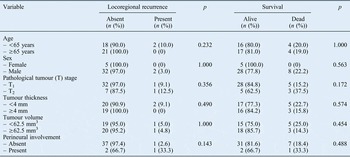
The mean follow-up time was 60.5 months (range, 4‒92 months). During follow up, one patient with pathological stage T1 disease developed locoregional recurrence, and one patient with pathological stage T2 disease developed both locoregional recurrence and distant metastasis (Table I). Thirty-three of the 41 cases remained alive, and 8 died of any cause during follow up.
Possible predictors of locoregional recurrence and survival

Predictors of locoregional recurrence and survival
Age, sex, tumour stage, tumour thickness and volume, and perineural involvement were not predictive of either locoregional recurrence or survival (Table I).
Predictors of overall and disease-free survival
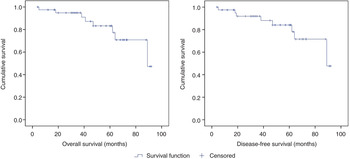
The five-year overall survival and disease-free survival rates of the entire study population were 83.2 per cent and 84.1 per cent, respectively (Figure 1). Survival analysis could not be performed in terms of sex or perineural involvement because of the small numbers of female patients and those with perineural involvement enrolled in the study.
Five-year overall and disease-free survival rates.

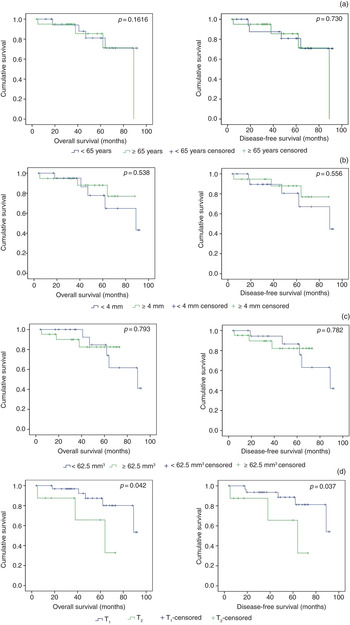
Age (less than 65 years vs 65 years or more) was not prognostic in terms of the five-year overall survival rate (81.1 per cent vs 85.5 per cent; p = 0.616) or disease-free survival rate (80.8 per cent vs 85.5 per cent; p = 0.730) (Figure 2a).
Log-rank analysis of the risks associated with (a) age (less than 65 years vs 65 years or more), (b) tumour thickness (less than 4 mm vs 4 mm or more), (c) tumour volume (less than 62.5 mm3 vs 62.5 mm3 or more), and (d) pathological tumour (T) stage (T1 vs T2), in terms of five-year overall and disease-free survival rates.

The relationship between tumour grade and the five-year overall survival rate (p = 0.166) or disease-free survival rate (p = 0.124) was not statistically significant. Moreover, tumour thickness (less than 4 mm vs 4 mm or more) was not prognostic for either the five-year overall survival rate (p = 0.538) or the disease-free survival rate (p = 0.556) (Figure 2b).
The five-year overall survival rates by tumour volume (less than 62.5 mm3 vs 62.5 mm3 or more) were 84.6 per cent versus 82.5 per cent, respectively (p = 0.793). Tumour volume (less than 62.5 mm3 vs 62.5 mm3 or more) was not prognostic (p = 0.782) for the five-year disease-free survival rate (86.6 per cent vs 82.2 per cent) (Figure 2c).
Tumour stage was the only prognostic factor; the five-year overall survival rates were 87.3 per cent and 65.6 per cent for patients with pathological stage T1 and T2 cancer, respectively (p = 0.042), and the five-year disease-free survival rates were 88.6 per cent and 65.6 per cent, respectively (p = 0.037) (Figure 2d).
Discussion
We retrospectively evaluated 41 patients who underwent surgery to treat early-stage lower lip cancer and for whom a ‘wait and see’ policy in terms of neck status had been implemented. We evaluated the predictive and prognostic utilities of clinicopathological data, including sex, age, pathological T stage and histopathological features (tumour thickness and volume).
Early-stage lower lip cancer is often curable by surgery and reconstruction.Reference Zitsch, Park, Renner and Rea 13 The national USA cancer database indicates a five-year survival rate of 89.7 per cent for patients with early-stage lip cancer.Reference Cooper, Porter, Mallin, Hoffman, Weber and Ang 14 In addition, Jaquet et al. reported a 5-year local control rate of 100 per cent, a 5-year disease-free survival rate of 100 per cent and a 5-year overall survival rate of 94 per cent in 24 patients with early-stage lip cancer.Reference Jaquet, Pasche, Brossard, Monnier and Lang 15 In the present study, eight patients died during follow up; the five-year overall survival and disease-free survival rates were 83.2 per cent and 84.1 per cent, respectively. The relatively poor survival rate may be attributable to the high proportion of older patients (mean age = 62.5 years; range, 33–84 years). Likewise, a German report revealed significantly high mortality among elderly patients with lip cancer (5-year survival rate of 85.7 per cent in patients aged 15–64 years vs 79.9 per cent in those aged 65–74 years).Reference Bucur and Stefanescu 16
A prospective, randomised controlled trial on patients with early-stage oral cavity cancers found better overall survival and disease-free survival rates in those who underwent elective neck dissection than in those who underwent therapeutic neck dissection.Reference D'Cruz, Vaish, Kapre, Dandekar, Gupta and Hawaldar 17 However, the vast majority of patients had tongue cancer, while none had lip cancer.
Unfortunately, neck management in patients with early-stage lip cancer remains controversial; few high-quality clinical trials have been performed. A recent systematic review and meta-analysis focusing principally on patients with clinical node (N) stage N0 lip cancers who underwent elective neck dissection reported an occult metastasis rate in neck specimens of 0.17, and a frequency of delayed nodal metastasis in patients who did not undergo neck dissection of 0.08.Reference Bhandari, Wang, Li, Jiang, Guo and Koirala 18
Proponents of neck dissection emphasise that micrometastasis may be associated with a high rate of regional recurrence, thereby reducing survival. Bucur and Stefanescu reported that the micrometastasis rate was 20 per cent in patients with clinical N0 lip cancer who underwent neck dissection, but the study population was heterogeneous (in terms of tumour stage).Reference Bucur and Stefanescu 16 The authors advocated elective neck dissection to allow regional control in patients with lower lip cancer. In contrast, opponents of neck dissection emphasise that the risk of lymph node involvement is less than 20 per cent, which is the cut-off value for neck dissection, and that neck dissection would constitute overtreatment of early-stage lip cancer. Moreover, no survival difference is yet evident in early-stage lip cancer patients who undergo elective versus therapeutic neck dissection.
Morselli et al. evaluated 57 patients with lip cancer and reported that radical tumour resection was viable for those with T1 stage disease; neck dissection was not necessary in terms of satisfactory oncological outcomes.Reference Morselli, Masciotra, Pinto, Zollino, Brunelli and Carinci 19 Another study detected regional recurrence in only 2 cases (out of 91, 2.1 per cent); the authors suggested that the implementation of an ‘ultrasound-assisted wait and see’ policy was appropriate for clinical stage T1‒2N0 patients.Reference Rena, Lia, Liua, Qianga, Zhang and Gaoa 20 In the present study, all patients with early-stage lip cancer underwent ‘ultrasound-assisted wait and see’ evaluation in terms of neck status; 1 pathological stage T1 patient (out of 33, 3.0 per cent) and 1 pathological stage T2 patient (out of 8, 12.5 per cent) experienced locoregional recurrence during follow up. The difference in locoregional recurrence rate was not statistically significant (Table I). Moreover, the meta-analysis cited above found no rationale for elective neck treatment in patients with clinical stage N0 lower lip cancer.Reference Bhandari, Wang, Li, Jiang, Guo and Koirala 18
The literature presents several risk factors for lymph node metastasis in patients with lower lip cancers. Rodolico et al. examined the clinicopathological and molecular features of patients with lower lip cancer (stages T1‒3).Reference Rodolico, Barresi, Di Lorenzo, Leonardi, Napoli and Rappa 21 Perineural involvement, tumour diameter of more than 2 cm, poor differentiation, tumour thickness of more than 6 mm and p27Ki1 protein expression were major risk factors for lymph node metastasis.
A recent study exploring various histological grading methods for lip cancers suggested an objective, simple and effective method to evaluate the prognosis of patients with lip cancer. Both tumour budding and invasion depth were useful in terms of treatment planning and the prediction of oncological outcomes.Reference Strieder, Coutinho-Camillo, Costa, da Cruz Perez, Kowalski and Kaminagakura 22 Onerci et al. emphasised the predictive utility of tumour thickness in terms of regional lymph node metastasis in patients with lower lip cancer.Reference Onerci, Yilmaz and Gedikoğlu 23 That study examined a homogeneous group of surgically treated patients with early-stage lower lip cancer (pathological stages T1 and T2) for whom a ‘wait and see’ policy in terms of neck status had been implemented; the predictive and prognostic utilities of several risk factors were evaluated individually.
-
• Neck management in patients with early-stage lower lip cancer remains controversial
-
• Lymph node metastasis incidence is low in early-stage lip cancer patients; a ‘wait and see’ neck management policy is recommended
-
• Detection of the best candidates for ‘wait and see’ policy implementation in terms of neck status is critical
-
• Tumour (T) stage affects the prognosis of surgically treated early-stage lip cancer patients under a ‘wait and see’ neck management policy
-
• Locoregional recurrence risk is higher and survival rate is lower in surgically treated patients with pathological stage T2 versus T1 lower lip cancer
We found no significant relationship between clinicopathological data (sex, age, tumour thickness and volume, and perineural involvement) and the locoregional control or survival rate (Table I). However, we found significant decreases in both five-year overall survival and disease-free survival rates (p = 0.042 and p = 0.037) in patients with pathological stage T2 disease (65.6 per cent and 65.6 per cent) compared with those with pathological stage T1 disease (87.3 per cent and 88.6 per cent) (Figure 1). Thus, tumour stage was prognostic for survival in those with early-stage lower lip cancers. Consequently, detailed assessment and close observation are required to detect micrometastases that may compromise the survival of patients with pathological stage T2 lower lip cancer who have previously undergone surgery for early-stage cancer and for whom an ‘ultrasound-assisted wait and see’ policy in terms of neck status has been implemented.
Conclusion
The incidence of cervical lymph node metastasis is remarkably low in patients with early-stage lower lip cancer. However, the risk of locoregional recurrence is relatively high and the survival rate relatively low in surgically treated patients with pathological stage T2 lower lip cancer for whom a ‘wait and see’ policy in terms of neck status has been implemented. Therefore, prospective, randomised controlled trials are required, focusing principally on the question: ‘Which patients with early-stage lip cancer are good candidates for the implementation of a “wait and see” policy in terms of neck status?’.