Introduction
Domestic violence – threatening behaviour, violence or abuse between adults who are relatives, partners or ex-partners – is associated with substantial psychiatric morbidity (Golding, Reference Golding1999; Campbell, Reference Campbell2002). Recent systematic reviews have found a high prevalence of domestic violence among female and male psychiatric service users (Oram et al. Reference Oram, Trevillion, Feder and Howard2013) and, across all diagnostic categories, an increased likelihood of being a victim of domestic violence among women and men with psychiatric disorders (Trevillion et al. Reference Trevillion, Oram, Feder and Howard2012b).
Less than a third of domestic violence cases are detected by psychiatric services (Howard et al. Reference Howard, Trevillion, Khalifeh, Woodall, Agnew-Davies and Feder2010b), and NHS mental health guidance on routine enquiry about a history of abuse may result in a focus on childhood abuse (NHS Confederation, 2008). To date, studies on the identification and response to abuse by mental health professionals although including adult abuse, have tended to focus on childhood abuse. These studies report that clinicians often overlook questions of abuse and cite barriers to enquiry including a fear of offending service users and a fear of inducing ‘false memories’ (Read & Fraser, Reference Read and Fraser1998a; Young et al. Reference Young, Read, Barker-Collo and Harrison2001; Read et al. Reference Read, Hammersley and Rudegeair2007). When violence is detected, these studies have found that clinicians' diagnostic formulations and treatment plans are often incomprehensive (Read & Fraser, Reference Read and Fraser1998b; Agar & Read, Reference Agar and Read2002; Posner et al. Reference Posner, Eilenberg, Friedman and Fullilove2008). Preliminary evidence suggests that mental health professionals' barriers towards the identification and management of domestic violence include a perceived lack of knowledge and expertise to address abuse (Rose et al. Reference Rose, Trevillion, Woodall, Morgan and Howard2011; Trevillion et al. Reference Trevillion, Howard, Morgan, Feder, Woodall and Rose2012a).
In the UK, a recent cluster randomized controlled trial (RCT) of a primary care training intervention and pathway for referral to domestic violence advocacy reported a three-fold increase in clinicians' identification of domestic violence (rate ratio 3.1 [95% CI 2.2–4.3]), and a six-fold increase in rates of referral to advocacy services (rate ratio 6.4 [95% CI 4.2–10.0]) (Feder et al. Reference Feder, Agnew-Davies, Baird, Dunne, Eldridge, Griffiths, Gregory, Howell, Johnson, Ramsay, Rutterford and Sharp2011). Presently, there are no studies that examine domestic violence advocacy interventions for victims in contact with psychiatric services (Feder et al. Reference Feder, Ramsay, Dunne, Rose, Arsene, Norman, Kuntze, Spencer, Bacchus, Hague, Warburton and Taket2009; Howard et al. Reference Howard, Trevillion and Agnew-Davies2010a). Therefore, this study sought to develop and pilot a domestic violence advocacy intervention within community mental health services.
Objectives:
(1) To conduct a preliminary exploration of the intervention's effect in:
i. raising clinicians' awareness, knowledge and readiness to respond appropriately to domestic violence
ii. improving psychiatric service users' outcomes, including frequency and severity of domestic violence, safety behaviours, unmet needs and quality of life.
(2) To explore the feasibility of a future cluster RCT and outcome and cost measures.
Methods
Study design
Quasi experimental controlled design, employing quantitative and qualitative methods. The study is registered on the ISRCTN database (http://www.controlled-trials.com/ISRCTN79430721/).
Setting
Community Mental Health Teams (CMHTs) in a UK south London borough were eligible for participation between May 2009 and May 2011. Five CMHTs were recruited to the study: three were allocated to the intervention arm and two to the control arm (usual care). The five CMHTs had a caseload of around 1220 service users: approximately 600 cases in the control arm and 620 in the intervention arm. As this was a pilot study we did not randomly allocate teams and instead determined allocation by grouping teams that shared the same building (to avoid problems of contamination).
Participants
Clinicians
Clinicians were invited to complete the Physician Readiness to Manage Domestic Violence Scale (PREMIS) (Short et al. Reference Short, Alpert, Harris and Surprenant2006), which assesses their knowledge, attitudes and behaviour towards domestic violence. All clinicians were eligible to participate and no exclusion criteria were assigned.
Mental health service users
Service users were recruited via: (1) referral from care-coordinators (key workers) by post or telephone, whichever was considered safest by the referee; (2) self-referral, via telephone, from study advertisements and (3) face-to-face researcher screening sessions. Screening sessions were conducted at CMHT waiting rooms over 12 (non-consecutive) days. Researchers asked CMHT attendees if they would complete a survey about ‘safety at home’ in a private room; there was no mention of domestic violence to ensure the safety of participants. In private, patients were asked to complete a validated measure of partner violence (the Composite Abuse Scale (CAS) (Hegarty et al. Reference Hegarty, Sheehan and Schonfeld1999, Reference Hegarty, Bush and Sheehan2005).
A standard operating procedure (see Appendix 1) and safety protocol was designed to minimise risk for service users (e.g., establishing safe and secure times to contact service users, provision of information on support services). Service users were interviewed alone in private settings, either at their home (following prior risk assessment) or at CMHTs.
Inclusion criteria: male and female CMHT service users (aged ≥18 years) experiencing domestic violence in the previous year, and scoring above the cut-off point (i.e., ≥3) on the CAS (Hegarty et al. Reference Hegarty, Sheehan and Schonfeld1999, Reference Hegarty, Bush and Sheehan2005). Domestic violence is defined as ‘any incident of threatening behaviour, violence or abuse (psychological, physical, sexual, financial or emotional) between adults who are or have been intimate partners or family members regardless of gender or sexuality’ Home Office (2005). Domestic violence: a national report (p7). Home Office: London. Exclusion criteria: Service users deemed by clinicians to be too unwell to enter the study and those living outside the catchment area.
Intervention
(1) Four hours domestic violence training for clinicians (on entry to study), illustrating how to identify and respond to domestic violence (delivered by a senior clinical psychologist (author RAD) who specializes in supporting victims of domestic violence).
(2) Domestic violence manual for clinicians (developed by the research team), incorporating good practice guidance and local/national domestic violence services.
(3) Six hours mental illness training for domestic violence advisors (who provided domestic violence advocacy), including definitions of disorders, treatments and service provision (delivered by a senior psychiatrist (author LH)).
(4) Direct referral pathway to domestic violence advocacy (developed by the research team) for service users experiencing past year violence.
(5) Provision of integrated domestic violence advocacy for service users, modified for this study and delivered by domestic violence advisors (seconded from a local voluntary sector organization). Advocacy comprised emotional and practical support, including domestic violence education, facilitation of support groups, safety planning and legal/housing support. In this study, each CMHT had a named advisor who was available to discuss/take referrals and feed outcomes back to the team and to regularly attend clinical meetings to discuss cases and provide domestic violence education.
(6) Information campaign (posters and leaflets in waiting rooms and toilets) highlighting the problem of domestic violence and support available.
Usual care
Service users in the two control CMHTs received usual care, which could include referral to domestic violence services. Clinicians were provided with information on domestic violence support services but did not receive the domestic violence training provided to the intervention teams and did not have named domestic violence advisors available.
Measures
Clinicians
PREMIS, demonstrating strong internal consistency (Cronbach's α ≥ 0.65) (Short et al. Reference Short, Alpert, Harris and Surprenant2006), adapted for use in CMHTs. The PREMIS comprises five sections: (1) Respondent Profile, including items on previous domestic violence training; (2) Background, including items on perceived preparedness/knowledge in identifying signs of domestic violence, appropriately asking about and responding to abuse and creating safety plans; (3) Domestic Violence Knowledge, including items on signs indicative of domestic violence, stages of change among victims and knowledge of resources; (4) Opinions, including items on the association between substance misuse and abuse and (5) Practice Issues, including items on experiences of identifying, asking about and making referrals for domestic violence. Data were collected an hour prior to training (baseline) and 6 months later (follow-up).
Service users
Baseline and 3 months follow-up interviews comprised the following measures:
(1) CAS –a 30-item questionnaire assessing the frequency/severity of abuse and harassment in the previous year. Items are rated from 1 = ‘Never’ to 5 = ‘Daily’, with total scores ranging from 0 to 150. A cut-off point of three is assigned, with scores of three or more indicating domestic violence; the measure demonstrated strong internal consistency (Cronbach's α ≧ 0.90) (Hegarty et al. Reference Hegarty, Sheehan and Schonfeld1999, Reference Hegarty, Bush and Sheehan2005). At follow-up, service users were asked to complete a modified version of the questionnaire so that they were only asked about experiences that had occurred since baseline (i.e., the previous 3 months).
(2) Manchester Short Assessment of Quality of Life (MANSA) – a 25-item questionnaire measuring quality of life among people experiencing mental illness. The questionnaire contains items including details of housing/employment status, satisfaction with quality of life and physical/mental health status, rated on a scale between 1 = ‘Couldn't be worse’ and 7 = ‘Couldn't be better’; the measure demonstrated strong internal consistency (Cronbach's α = 0.74) (Priebe et al. Reference Priebe, Huxley, Knight and Evans1999).
(3) Social Inclusion Scale – a 16-item questionnaire assessing three domains: (1) Social Isolation (four items), (2) Social Relations (nine items) and (3) Social Acceptance (five items). Each item is rated from 1 = ‘Not at all’ to 4 = ‘Yes definitely’, with total scores ranging from 16 to 64; the measure demonstrated strong internal consistency (Cronbach's α = 0.85) (Secker et al. Reference Secker, Hacking, Kent, Shenton and Spandler2009).
(4) Camberwell Assessment of Need for Mothers (short version) (CAN-M(S)) – incorporating the full 22 items of the original CAN measure (Phelan et al. Reference Phelan, Slade, Thornicroft, Dunn, Holloway, Wykes, Strathdee, Loftus, McCrone and Hayward1995) plus four additional items measuring the needs of pregnant women and mothers experiencing mental illness (i.e., pregnancy care, practical/emotional demands of childcare); the 22 generic domain items are applicable to men. Scores of either 1 = ‘Met need’, 2 = ‘Unmet need’ or 0 = ‘No problem’ are assigned per item; Spearman's r correlation coefficients were moderate with the GAF-S (−0.36) and GAF-D (−0.52)(Howard et al. Reference Howard, Hunt, Slade, O'Keane, Leese, Thornicroft and Wiseman2008).
(5) Post traumatic stress disorder Scale (PDS®) – a 49-item questionnaire, with six components: (1) PTSD diagnosis, (2) symptom severity score, (3) number of symptoms endorsed, (4) specifiers related to onset and duration of symptoms, (5) symptom severity rating and (6) level of impairment in functioning. Criterion must be met for each of the six components; the measure demonstrated strong internal consistency (Cronbach's α ≥ 0.78) (Foa, Reference Foa1995; Foa et al. Reference Foa, Cashman, Jaycox and Perry1997).
(6) Safety Behaviour Checklist – a 15-item questionnaire measuring use of safety behaviours among people experiencing domestic violence. Items score either ‘yes’, ‘no’ or ‘not applicable’. The total number of behaviours scored are adjusted for applicability, so that each participant's total score falls within the range of ‘No Behaviours Performed’ (0) to ‘All Behaviours Performed’ (15); the measure demonstrated strong internal consistency (Cronbach's α = 0.71) (McFarlane et al. Reference McFarlane, Malecha, Gist, Watson, Batten, Hall and Smith2002).
(7) Adult Service Use Schedule (AD-SUS) – an economic evaluation questionnaire measuring use of resources (i.e., the number and length of contacts with health/social services/criminal justice sector) and productivity losses resulting from time off work due to illness (Byford et al. Reference Byford, Fiander, Torgerson, Barber, Thompson and Burns2000; Barrett et al. Reference Barrett, Byford, Crawford, Patton, Drummond, Henry and Touquet2006; Kuyken et al. Reference Kuyken, Byford, Taylor, Watkins, Holden and White2008). The AD-SUS was adapted through discussions with clinicians and baseline testing, to cover all services relevant to the current population. At baseline, cost data were collected for the 3 months preceding the interview. At follow-up, cost data covered the period from baseline to follow-up.
(8) EQ-5D – a preference-based measure of health-related quality of life measured on five dimensions (i.e., mobility, self-care, usual activities, pain/discomfort and anxiety/depression), each rated on three levels (i.e., no problems, some problems and severe problems). Participants are classified into one of 243 health states, each associated with a score that can be used to calculate quality adjusted life years (QALYs) (EuroQol Group, 1990). The measure has been extensively used in health economic evaluations and its psychometric properties are adequate (see Brooks, Reference Brooks1996 for a summary).
(9) Qualitative Interviews – semi-structured interviews were conducted at follow-up to explore service users' experiences of mental health services response to domestic violence. Interviews were conducted by a trained researcher (KT) and checked for quality and consistency by two senior researchers (DR and LH). Interviews lasted between 15–30 min and were audio-taped and transcribed verbatim.
Process evaluation
Data were collected on the number of clinicians' referrals to domestic violence advocacy and the uptake and engagement of advocacy by service users. Data were also collected on the type/frequency of advocacy delivered (e.g., safety planning, civil/criminal remedies and custody/childcare issues).
Analysis
Statistical analysis
Descriptive statistics were calculated for demographic characteristics and process measures. Medians were calculated as a summary statistic for service user and professional outcomes and Wilcoxon signed rank tests were performed. All analyses were conducted using SPSS 15.
Economic analysis
The economic evaluation took a broad perspective, including all hospital and community health and social services, criminal justice sector resources and service-provided accommodation, such as hostels and refuges. All unit costs were calculated for the financial year 2009–10. Intervention session costs were calculated on the basis of the salary of the domestic violence advisors plus overheads (administrative, managerial and capital) (Curtis, Reference Curtis2010). Indirect time associated with the intervention, including preparation, supervision and training, was based on information provided by the advisors on the ratio of direct face-to-face contact to all other activities. The Department of Health's national reference costs for NHS Trusts (Department of Health, 2011) were applied to hospital contacts. National UK unit costs, inflated where necessary using the retail price index and the pay and price index, were applied to community health and social services, supported accommodation and criminal justice resources (Dubourg & Hamed, Reference Dubourg and Hamed2005; Curtis, Reference Curtis2010; Royal Pharmaceutical Society, 2010; Department of Health, 2011). Discounting was not necessary due to the short follow-up period. Owing to the small sample sizes, cost-effectiveness analysis was not undertaken. Instead, resource use is presented descriptively and changes in total costs over time are analysed using the paired samples t-test with the validity of the results confirmed using bootstrapping (Efron & Tibshirani, Reference Efron and Tibshirani1993). The advantage of this approach, as opposed to non-parametric tests, is the ability to make inferences about the arithmetic mean, a more meaningful summary statistic for cost data than the median (Barber & Thompson, Reference Barber and Thompson1998).
Qualitative analysis
Qualitative analysis was conducted by two researchers (KT and SO) in NVivo8, following the principles of thematic analysis (Boyatzis, Reference Boyatzis1998). Early themes and patterns in the data formed the basis of an initial coding frame, which was iteratively refined and reapplied to earlier transcripts as analysis progressed. Themes were interrogated and a deviant cases analysis was undertaken; at each stage it was ensured that saturation of themes had been achieved.
Ethical approval
This study received ethics approval from the Joint South London and the Maudsley and the Institute of Psychiatry NHS Research Ethics Committee (ref 09/H0807/7).
Results
Sample characteristics
Clinicians
Over half of clinicians in each of the participating teams received domestic violence training: (1) 12/22 (55%); (2) 17/25 (68%) and (3) 33/52 (63%).
Twenty nine clinicians completed both baseline and follow-up interviews: 23 in the intervention arm and six in the control arm. Clinicians' mean age was 43 years (s.d. 6.71), 17 (61%) were female. A total of 13 (50%) nurses, nine (35%) social workers and four (15%) doctors participated, with an average number of 13.5 years (s.d. 5.88) qualified. Nineteen (76%) clinicians had received some previous training on domestic violence.
Service users
Of 139 service users assessed for eligibility, 83 did not meet the inclusion criteria and 13 declined to participate (10 intervention and three control arm participants). We were unable to establish contact with eight service users (see Fig. 1).
Service users recruitment chart. (A colour version of this figure is available online at http://journals.cambridge.org/eps)

Recruitment of service users via care-coordinators was high in the intervention group (21/27) but low in the control arm (1/7); four self-referrals were recruited in both arms. During researcher screening sessions a total of 87 service users (n = 37 in the intervention arm and n = 50 in the control arm) were interviewed: four of the five eligible service users in the intervention arm and two of the four in the control arm agreed to participate.
Results are presented on the 34 service users (27 intervention and seven control participants) who completed interviews at baseline and 3 months follow-up. Service users' mean age was 38 years (s.d. 10.77); 33 (97%) were female, 13 (38%) were white and 21 (62%) were of black and minority ethnic origin. A total of 27 (79%) service users were single/separated or divorced and seven (21%) were married; 17 (50%) lived alone and 12 (35%) with a partner and/or children. In all, 11 women had children. Primary diagnoses included depressive disorder (n = 13 (39%)), bipolar disorder (n = 5 (15%)) and schizophrenia and related disorders (n = 6 (18%)).
Among the intervention arm, 22 of the 27 service users elected to receive domestic violence advocacy. Five of the seven service users in the control arm were referred to domestic violence services.
Outcomes for clinicians
Knowledge, attitudes and behaviour towards domestic violence
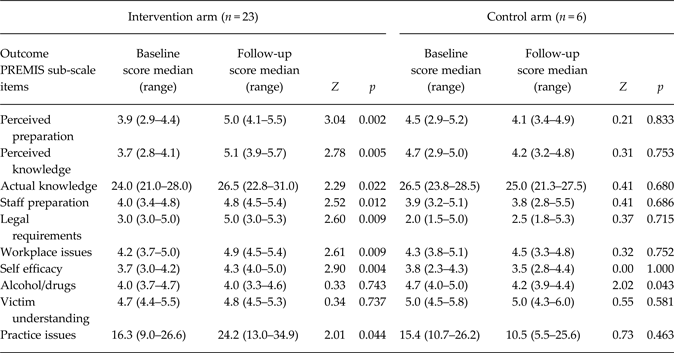
At follow-up, clinicians in the intervention arm reported improvements (across eight of the 10 PREMIS sub-scales) in relation to their knowledge, attitudes and behaviours towards domestic violence (see Table 1).
Clinicians baseline and follow-up PREMIS results by grouping
Outcomes for services users
Frequency/severity of violence
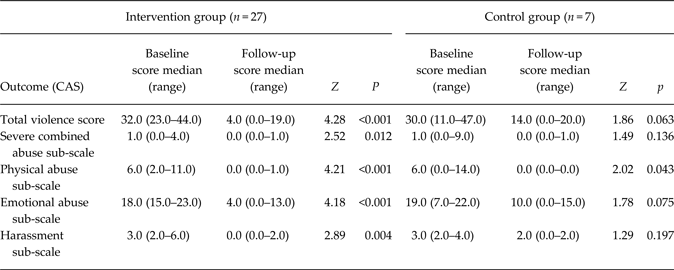
At follow-up, service users in the intervention arm reported reductions in total violence on the CAS (Table 2). Analysis of qualitative interviews was consistent with these findings, and service users described how domestic violence advisors supported them to take actions to reduce their risk of harm:
“They [advisors] discussed what to do in a situation if it got out of hand” (SU22, accessed advocacy)
Service users violence and abuse outcome scores at baseline and follow-up by grouping
Needs
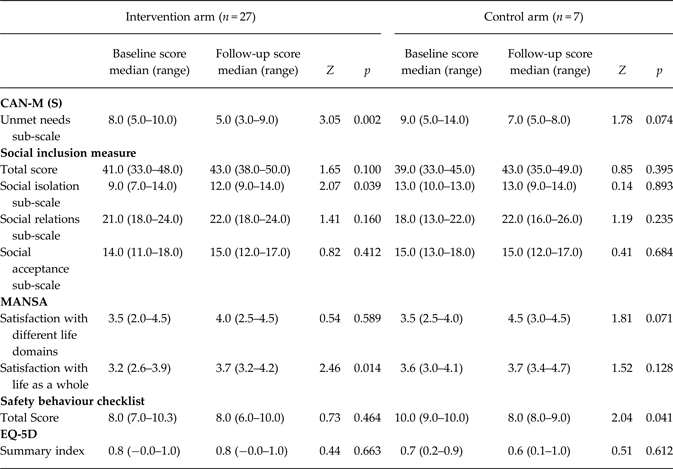
Service users in the intervention arm reported reductions in the number of unmet needs on the CAN-M(S) at follow-up (Table 3). These findings were supported by the qualitative data, and several service users described how domestic violence advisors and trained clinicians provided assistance for their needs:
“She [advisor] looked at other areas of help, like support for the children and things to help me financially… They [advisor and clinicians] knew the right people to put you in contact with” (SU12, accessed advocacy)
Interestingly, however, one woman explained that once clinicians were aware that she was receiving assistance from the advisors they no longer facilitated any discussions about the abuse:
“Knowing that I was already in touch with them [advisors] and I was getting enough support I just think they [clinicians] just dealt with the medical side of things” (SU12, accessed advocacy)
Service users' secondary outcome scores at baseline and follow-up by grouping
Note: CAN-M(S): Camberwell Assessment of Need for Mothers (Short version); MANSA: Manchester Short Assessment of Quality of Life.
Social inclusion
Service users in the intervention arm reported increases in perceptions of social inclusion on the social isolation sub-scale of the Social Inclusion measure at follow-up (Table 3). During qualitative interviews, service users spoke about the importance of the intervention in enhancing their sense of social inclusion:
“He [clinician] said ‘we'll get you to associate with local organisations; get you meeting other people’…There are art classes, shiatsu, and cookery class…I said ‘yes I will try and do that’, try and get involved again with people” (SU31, accessed advocacy)
Quality of life
Service users in the intervention arm reported increases in satisfaction with life as a whole (MANSA) at follow-up, but little change was observed in EQ-5D health-related quality of life scores (Table 3). During qualitative interviews, service users receiving the intervention described how their quality of life had improved, and many reported improvements in their well-being:
“She's [advisor] really helped me…Before I felt like I didn't really care, but now I do care…She's made me care more about myself” (SU20, accessed advocacy)
This was not consistently reported across the sample, however, as six service users identified limited changes in their health-related quality of life at follow-up:
“I feel like an absolute wreck at the moment, but I'm trying to push through, you know, trying to shut the thoughts and the feelings out, but I'm thinking ‘how can I get through this?’” (SU38, accessed advocacy)
Safety behaviour
No changes were observed for utilization of safety behaviours in the intervention arm at follow-up (Table 3). Analysis of qualitative interviews did not provide insights into why the safety behaviour of service users had not improved.
Post traumatic stress
At baseline, 19 (66%) participants in the intervention arm and seven (100%) in the control arm screened positive for PTSD on the PDS®. At follow-up, 21 (72%) participants in the intervention arm and five (71%) in the control arm screened positive for PTSD. No participants in the control arm and only one in the intervention arm had been diagnosed with PTSD by clinicians. Analysis of the qualitative data did not provide further insights into these findings.
Feasibility and acceptability
Of the 99 eligible clinicians, 95 (96%) completed baseline interviews and 29 (31%) completed follow-up interviews. Retention rates among clinicians in the control arm were considerably lower than the intervention arm (n = 6 and n = 23, respectively).
Of the 65 eligible service users, 35 (54%) completed baseline interviews and 34 (97%) completed follow-up interviews. Recruitment of service users via care-coordinators proved to be more difficult in the control arm compared with the intervention arm (n = 1 and n = 21, respectively) and only a small number of service users were identified through researcher screening sessions and self-referrals in each of the arms.
Adverse outcomes
There did not appear to be any direct adverse effects among participants as a consequence of the intervention or the research study.
Process evaluation
Among the intervention arm, 22 (74%) participants chose to receive domestic violence advocacy. On average, service users received seven one-hour meetings and 28 twenty-minute telephone conversations with advisors. The average number of sessions arranged by advisors was nine (s.d. 6.1, range 1–31) and the average number of sessions attended by service users was seven (s.d. 5.8, range 2–26). The advisors provided a range of practical and emotional assistance to service users, including referral to Multi-Agency Risk Assessment Conferences (MARACs), which help to protect victims at high risk of harm by developing coordinated action plans between statutory and voluntary sector organizations (Robinson, Reference Robinson2004). Rates of referral to MARACs during the two year study period exceeded those observed from adult mental health services in the year prior to the study.
Economic evaluation
Resource use
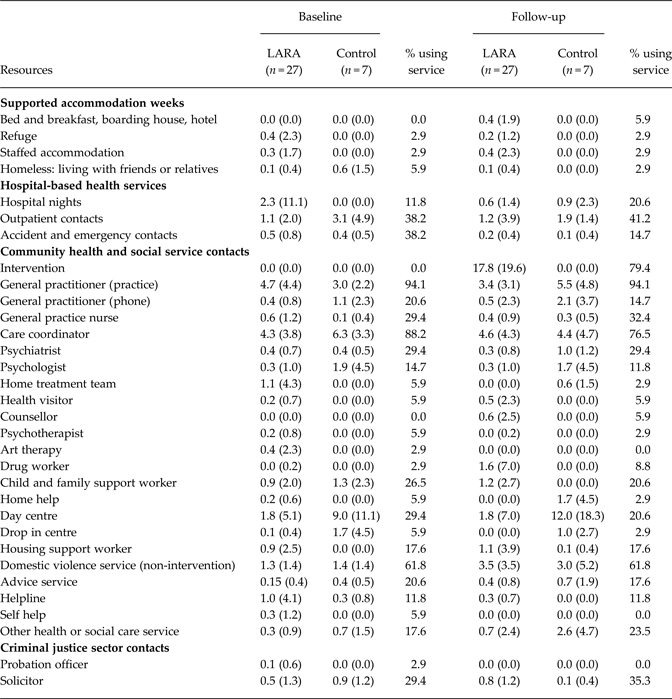
Service users in the control arm made no use of supported or service-provided accommodation, either in the 3 months prior to study entry or over the 3 months follow-up period. Service users in the intervention arm, however, made some use of supported accommodation, refuge and bed and breakfast facilities, both 3 months before and 3 months after entry to the study.
Hospital contacts were low in both arms. Four participants (three intervention and one control participant) reported inpatient hospital stays at follow-up (from one to three nights), following a severe asthma attack, pneumonia, chronic sleep problems or drug misuse. A wide range of community-based services were accessed by service users, most often GPs, care coordinators and domestic violence services (non-intervention). Few differences were observed between baseline and follow-up.
Contacts with the criminal justice sector were low in both arms. Three participants in the intervention arm were charged with committing physical assault and one was charged with breaching a domestic violence injunction order at 3 months follow-up. One participant in the control arm was charged with possession of drugs. Contacts with solicitors increased in the intervention arm between baseline and follow-up (see Table 4).
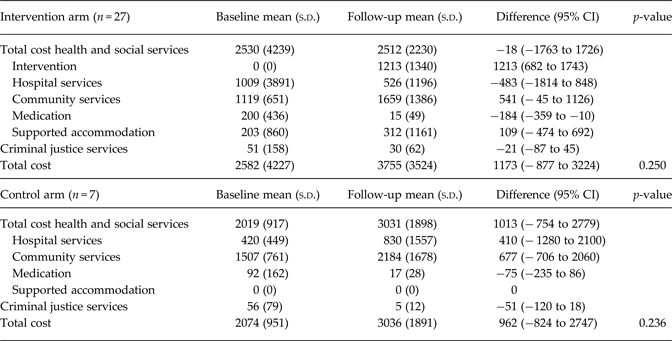
Resource use by participants 3 months prior to intervention and over the 3-month follow-up period
Costs
The LARA intervention was estimated to cost £67 per hour and the total cost of the LARA intervention was £1,213 per participant, on average. Between baseline and follow-up, the total cost of all services per participant in the intervention arm (including the cost of the LARA intervention) increased by almost the same amount as the additional cost of the LARA intervention (£1,173), but this difference was not statistically significant (see Table 5). The total cost of services used by the control arm also increased between baseline and follow-up (mean difference £962), with an increase in the cost of both hospital and community services, but no substantial reductions in any service category. Again, this difference was not statistically significant.
Total cost per participant 3 months prior to intervention and over the 3-month follow-up period (£)
Discussion
This study is the first to our knowledge to pilot a domestic violence intervention involving reciprocal training between mental health and domestic violence services, and a direct referral pathway to domestic violence advocacy for psychiatric service users. This pilot data suggests that the intervention may improve clinicians' knowledge, attitudes and behaviour and improve outcomes for service users.
Clinicians' knowledge, attitudes and behaviours
Baseline PREMIS scores among clinicians in this study were comparable with those reported by nursing, social work and dentistry professionals (Connor et al. Reference Connor, Nouer, Mackey, Tipton and Lloyd2010, Reference Connor, Nouer, Mackey, Banet and Tipton2011) and highlight the lack of preparedness and readiness to address domestic violence among mental health professionals. At follow-up, clinicians in the intervention arm had improved knowledge, attitudes and behaviours across eight of the 10 PREMIS sub-scale items. Findings from this study, therefore, provide further support for implementation of training on domestic violence within the psychiatric curriculum (Morgan, Reference Morgan2007; Hegarty, Reference Hegarty2011). Existing research in mental health settings, which generally focuses on childhood abuse, has shown that clinicians' identification and response to abuse improves following the implementation abuse training programmes (Cavanagh et al. Reference Cavanagh, Read and New2004). Initial findings from this study suggest that a domestic violence training programme may also lead to improvements in clinicians' identification and referral practices for domestic violence.
Service users outcomes
Service users in the intervention arm reported reductions in frequency/severity of violence and unmet needs and an increase in social inclusion at follow-up. Comparable findings on the efficacy of domestic violence advocacy in improving health outcomes among non-psychiatric service users have been reported elsewhere (Feder et al. Reference Feder, Ramsay, Dunne, Rose, Arsene, Norman, Kuntze, Spencer, Bacchus, Hague, Warburton and Taket2009). These findings highlight the benefit of inter-agency working partnerships between mental health and domestic violence sectors in improving outcomes for service users. Research suggests that the maintenance of interdisciplinary networks requires the establishment of common therapy targets, the exchange of experience and education and mutual support (Bramesfeld et al. Reference Bramesfeld, Ungewitter, Böttger, El Jurdi, Losert and Kilian2012).
Little change was observed in service users' use of safety behaviours at follow-up. A reason for this could be due to the fact that the measure focuses on safety behaviours adopted when preparing for separation from the abuser; a process that may not be adequately captured in a three month follow-up period.
Another notable finding was that, although only one service user had been diagnosed with PTSD by a clinician, many service users screened positive for PTSD. These results are consistent with findings that clinicians frequently fail to identify PTSD among patients (Mueser et al. Reference Mueser, Goodman, Trumbetta, Rosenberg, Osher, Vidaver, Auciello and Foy1998; Zimmerman & Mattia, Reference Zimmerman and Mattia1999). These findings provide support for additional education to improve clinicians' identification of PTSD and the incorporation of abuse-related trauma in treatment plans. Indeed, a diagnosis of PTSD can be helpful for patients, as they can identify their symptoms as a common response to life-threatening trauma (Duxbury, Reference Duxbury2006).
Interviews with service users highlight the extent of positive changes to health and quality of life outcomes following support from domestic violence advisors, most notably reductions in experiences of violence. These findings indicate that interventions comprising of practical and emotional support (e.g., domestic violence education, safety planning and legal/housing support), key information (e.g., information on welfare rights, housing options and legal issues) and signposting can lead to improved outcomes for service users. Similarly, a recent systematic review found that personalized support interventions for people with severe mental illness – including advocacy and emotional support – can improve psychiatric outcomes and patient satisfaction with services (Siskind et al. Reference Siskind, Harris, Pirkis and Whiteford2012). Some contrasting findings were identified among service users, however, and a few in the intervention arm reported limited change in perceived quality of life at follow-up. This finding mirrors research on patterns of recovery among victims of domestic violence, which is shown to be a gradual and dynamic process (Krause et al. Reference Krause, Kaltman, Goodman and Dutton2008).
Cost outcomes
The total cost of health, social care and criminal justice sector contacts increased by a similar amount in both arms between the three month period prior to study entry and the three month follow-up period. The intervention arm demonstrated a decrease in the use of hospital services alongside an increase in the use of community, health and social care and supported/service-provided accommodation services. Findings suggest that improvements in outcome may be generated at a relatively small additional cost, but this can only be tested by a larger study.
Study feasibility and process outcomes
This study aimed to assess the feasibility of a future cluster RCT. However, as few people were identified as experiencing domestic violence in control teams it suggests that evaluation of such an intervention using a cluster RCT design would be challenging as recruitment into the control arm would probably be similarly difficult. Nevertheless, we found a very high retention rate among service users (97%) indicating that it is possible to recruit and retain people experiencing severe mental illness and domestic violence in research. Service users were able to participate in multiple questionnaires with high completion rates. Other study designs may therefore be more appropriate when evaluating this type of intervention. Comparisons of routine outcome data such as rates of referrals to advocacy or MARACs and number of unmet needs at yearly multi-disciplinary reviews in areas where the intervention is available compared with areas where it has not been introduced may be helpful.
Limitations
Despite a high retention rate of service users at follow-up (97%), the study sample size was small. Low numbers of service users experiencing domestic violence were identified in the control arm (n = 7) and a low response rate was achieved among clinicians at follow-up (29/95 (31%)).
The information on domestic violence support services provided to clinicians in the control arm may have diluted the effect of the evaluation of the intervention delivered to clinicians and service users in the intervention arm. In addition, only one post-intervention time point measured outcomes among service users (3 months follow-up) and clinicians (6 months follow-up) and the stability of changes thereafter are unknown.
This study was carried out in a socio-economically deprived setting where there are a high proportion of people from black and minority ethnic groups and, therefore, may not be replicable to other settings. The ability to extrapolate findings from qualitative interviews on service users' experience of the intervention may be limited by the focused nature of the topic guide, which sought to address specific items relating to the intervention. Nevertheless, this study provides preliminary evidence that multi-faceted domestic violence intervention in community mental health settings may be effective in improving services user outcomes.
Implications
Further research is needed to assess the feasibility and effectiveness of interventions to improve outcomes for service users experiencing domestic violence. Interventions that address clinicians' response to domestic violence and provide targeted support for service users may lead to improvements in clinical practice. Finally, greater collaboration between mental health and domestic violence sectors may lead to improved health outcomes for service users.
Acknowledgements
The authors would like to thank all the community mental health professionals and service users who participated in the research and acknowledge the important contributions of Bede House organization and specifically the domestic violence advisors.
Financial Support
This research was funded by the National Institute for Health Research (NIHR) under its Research for Patient Benefit (RfPB) Programme (PB-PG-0906-11026). This paper outlines independent research funded by the NIHR under its Research for Patient Benefit Programme. The views expressed are those of the authors and not necessarily those of the NHS, the NIHR or the Department of Health.
Conflict of Interest
LMH and DR are supported by the South London and Maudsley NHS Foundation Trust/Institute of Psychiatry, King's College London specialist Biomedical Research Centre. All other authors have no declarations of interest.
Ethical Standards
The authors assert that all procedures contributing to this work comply with the ethical standards of the relevant national and institutional committees on human experimentation and with the Helsinki Declaration of 1975, as revised in 2008.
This study was conducted at the Health Service and Population Research Department, Institute of Psychiatry, King's College London, De Crespigny Park, London, SE5 8AF, UK.
Appendix 1. Standard operating procedure (SOP)
1.1. Scope
This document is a SOP outlining the process when in contact with mental health service users. This document applies to all researchers undertaking work with mental health service users on the Linking Abuse and Recovery through Advocacy (LARA) study.
1.2. Initial contact with mental health service users
If a service user contacts you on the telephone to arrange an appointment greet them using your pseudonym and establish with him or her that they are currently in a safe environment to speak with you. Ask the service user if it would be beneficial for you to call them back to explain the study and interview process. Ascertain an appropriate contact number and time for future contact between yourself and the service user. If you make contact with an unattended service user at the CMHT base greet them using your pseudonym and ask if they would be willing to answer a few questions related to safety in the home.
During the initial contact:
• Arrange a time and location to meet privately with the service user either in the CMHT or their home, to discuss the participant information sheet, which outlines the full implications of the study and issues of consent. In general, aim to meet at the CMHT unless the service user does not want to.
• If the service user would like to attend the CMHT, ask the team if you can use a room at the time you have agreed with the service user.
1.3. Home visits to mental health service users
Discuss with the care coordinator any safety issues that may affect your visit i.e., discuss with the care coordinator any safety issues regarding:
• the location of the service user's home
• if the service user has any previous history of violence to self or others
• if the service user's partner, family members, or pets may be dangerous
• If the service user (or any other person who is sharing the house with the service user) has a history of drug/alcohol problems
• If there is any danger from any of these sources then again ask the service user if she/he can attend the CMHT team base and ask the CMHT if you could use a room there for the interview.
If the care coordinator confirms that there is no apparent danger in the home visit, then the researchers can prepare to visit the service user's home. If a service user contacts you on the telephone to arrange an appointment, establish with him or her that they are currently in a safe environment to speak with you. Ask the service user if it would be beneficial for you to call them back on their own phone.
• Shortly before you leave for the interview you must tell a responsible person (your administrator or another LARA researcher) the address that you are going to, your mobile telephone number, the time that the meeting is likely to start and be completed and details of who to contact if you do not confirm completion of the meeting. You must be able to confirm that they have this information (leaving a message is not sufficient) and that they will be available to receive your call on completion of the meeting or act if they do not receive a call.
• This person must know the steps to take if you do not contact them on time. In the first instance they should contact you on your phone to check that you are safe. If they cannot get an answer they should contact the administrator of the LARA team or Dr Louise Howard: you must give them the relevant contact details. If they have reason to believe there is a problem they should also contact the police.
• You must have a mobile phone with you – with ‘speed dial’ set for your contact person-and it is advisable that you carry a personal alarm. Furthermore, an alarm phrase should be agreed with your contact. Therefore, if you call your contact and you feel in anyway in danger and say ‘please could you get my red folder’, then the contact will know from this phrase that you are in danger without alarming the service user. Then, your contact may alert the police. Make sure you charge your phone before you do the home visit.
• Assess the area/house that you are going to. If you feel uncomfortable with the location or the circumstances – even if it is at the last minute or during the meeting-make your excuse and leave.
• Make sure that you are dressed appropriately. Take into consideration cultural and gender issues. For women: wear something comfortable and not short skirts/high heels, in case you need to run.
• Do not use the bathroom. It is usually upstairs (not easy access to the front door in case you need to leave the house immediately) or you can be easily trapped in it.
• Make sure that you conduct the meeting in a ‘neutral room’ such as the living room. Avoid doing the assessments in the bedroom or the kitchen (danger of knives etc).
• Make sure you sit next to the door or have easy access to it.
• If you do not feel comfortable with the area/building do not use the lift to go to the service user's house.
1.4. CMHT visits with service users
Arrive at the CMHT shortly before your meeting and inform the receptionist of the purpose of your visit. Sign in at the front desk and establish where the meeting room is and where the panic alarm is located within the room. Inform the receptionist of the start and estimated finish time of the interview and the location of the room you are using. Following completion of the interview, return to reception and sign out before leaving the CMHT.
• Meet the service user in the reception area of the CMHT and greet them using your pseudonym.
• Make sure that you conduct the meeting in a ‘neutral room’ that provides sufficient privacy and ensure that the service user is comfortable in this setting.
• Make sure that you are dressed appropriately. Take into consideration cultural and gender issues. For women: wear something comfortable and not short skirts/high heels, in case you need to run.
• You must have a mobile phone with you, with ‘speed dial’ set for your contact person. If you feel in danger excuse yourself from the room and speak with a member of staff at the CMHT to discuss an appropriate response. If you feel particularly threatened use the panic alarm installed within the room.
• Make sure you sit next to the door or have easy access to it.
• After the meeting ask the service user how they feel and if they would like to discuss anything further with their care coordinator.