There are at least three good reasons for considering HBO’s original European productions from the first original serial productions a little over a decade ago until today. First, we are now expecting the first real changes to the HBO brand after the AT&T acquisition of Time Warner, including the 2020 launch of the new HBO Max. Second, 2020 brings the renewal of the output deal between HBO and Sky on large parts of the European market with uncertain European output platforms for HBO’s productions as a contemporary result. Third, 2020 brings along intensified competition from a range of new players on the global market, including Disney’s and Apple’s streaming services, which calls out 2020 as a quintessential year for fierce competition on the global streaming market. Since the market appears to be changing fast right now, it is timely to overview the past decades of HBO’s European TV drama activities.
HBO has produced 41 seasons of television fiction in European territories in little over a decade. Starting with the local Hungarian production of the tragicomic Született lúzer (Born Loser, 2007–2008), HBO Hungary test-ran the localized production activities with two seasons of original fiction. At that point, HBO Europe had been active as a premium cable television service since 1991 in Hungary, and since then it has spread across different European territories (Imre Reference Imre2019, 174–175). While Born Loser was a project by HBO Hungary, soon after, HBO Europe started to instigate local productions of serial drama. Initially, these productions were remakes of popular television series from, primarily, Israel and Norway, but after three to four years of establishing local talent, HBO Europe ventured into original content created by local screenwriters in each available territory. In this transition from remakes to original content, we also see a gradual shift from privileging psychological drama (in the case of remakes of the Israeli format BeTipul) and romantic drama (in the case of remakes of the Israeli format Matay Nitnashek) to producing localized television crime series, including remakes of two Norwegian series (Øyevitne and Mammon) and a loose remake of a Finnish series (Helppo elämä). Altogether, this decade-long process discloses steadfast local talent development as well as a maturing creative television industry that, according to Steve Matthews, HBO Europe’s VP Executive Producer of Drama Development, at the early stage had strong production services but the screenwriting talent of which was slightly ‘undeveloped’ (Matthews Reference Matthews2019). Overseeing the complete portfolio of original serial content production, it is possible to extract quite a range of interesting development perspectives.
In this article, we analyse developments in HBO’s original European productions based on a quantitative overview of production since Born Loser until the most recent premieres of the Croatian miniseries Uspjeh (Success, 2019) and the transnational co-production, The New Pope (2020). We supplement this overview with a perspective on the generic changes during the past decade as well as a practical producers’ approach to remakes. The intention is, then, not to analyse the specific series’ content; rather, we intend to approach genre, talent and remakes through the perspective of the HBO brand and the creatives behind the series. The main empirical material for this article is interviews with key informants and exploitation of online resources. Footnote 1 The interviews were conducted in 2018–2019 and reflect a contemporary production model for HBO Europe. The online resources supplementing and underlining the points made represent a more cross-temporal view on single series or general institutional perspectives on HBO’s European brand, including HBO Europe’s articulation of local European identities in a transnational media environment. Altogether, this establishes both a historical overview of the productions and an up-to-date idea of how the transnational institution considers its own local endeavours.
Transposing the HBO Brand to Europe
Scholarly work on HBO is expansive, and it is a well-established perspective that the TV institution ‘transformed the creative landscape of television during the first decade (1995–2004) of TV’s current digital era’ (Edgerton Reference Edgerton, Edgerton and Jones2008, 8). Both new technology (cable and satellite distribution) and content (the quality TV brand) made the service provided by HBO stand out in the increasing competition to such an extent that Dean J. DeFino stresses that HBO has had an overall impact on television content worldwide, the so-called ‘HBO effect’ (DeFino Reference DeFino2014). However, as DeFino also points out, HBO has been comparatively late in adopting digital distribution of content. Writing in 2014, when Netflix was conquering the digital television market, he could safely claim that HBO has ‘so far shown no signs of giving up the cable/satellite infrastructure for a web-based distribution model’ (DeFino Reference DeFino2014, 202). The result is that now we speak about ‘the Netflix effect’ rather than HBO impacting the media landscape (McDonald and Smith-Rowsey Reference McDonald and Smith-Rowsey2016).
On the one hand, DeFino is right in stressing that HBO developed its digital distribution model comparatively late, and perhaps rather as a reaction than an innovative technological move. HBO’s European activities started as a pre-internet cable channel in Hungary and HBO has since maintained a wide-ranging exposure of linear television products, both in the US and in its Eastern European territories. According to Amanda D. Lotz (Reference Lotz2017), 2015 market characteristics showed that, at the time, the monthly profit per subscriber was still many times higher for HBO than that of Netflix. On the other hand, HBO instigated digital distribution in 2001, and has slowly developed its brand in most territories with supplementary digital services such as HBO Go and HBO Nordic. DeFino refers to this strategy as HBO’s ‘wait-and-see’ approach and, compared with other digital streaming services, HBO has patiently established its brand as localized content, including locally produced television series since 2007. This may be understood as innovative and far-sighted in relation to Netflix, premiering its first European production, Marseille (2016), significantly later than HBO. Contrary to DeFino’s position, Aniko Imre maintains that
HBO’s virtual map of European ‘territories’ parceled up by nations and regions with a well-calculated recognition for the need to cater to national and regional identities, has brought to life a kind of e-EUtopia under the umbrella of a corporate brand. (Imre Reference Imre2018, 52)
In other words, she claims that HBO has succeeded, at least in Central and Eastern European territories, in establishing ‘a digitally connected communication network’ (Imre Reference Imre2018, 54).
Imre’s broad cultural conclusions may appear slightly wide-ranging, and she disregards that HBO in 2017 held, in the whole EU, a market share of no more than 1%, while Netflix held a staggering market share of 47% of VoD (Video on Demand) subscribers and Amazon Prime a 20% market share (Grece Reference Grece2017). The fact that Sky Atlantic carries much of the content commissioned by HBO may account for some of the differences in market position, but Sky holds no more than a 4% market position in the EU. Measured as a mere market share, HBO is nowhere near the regional impact of Netflix; taking these figures into account, then, it is remarkable that HBO has, to some extent, been able to uphold a cultural pole position, indicating that the HBO brand has penetrated the mindset of users, critics and academics. Basically, in Europe the brand HBO and its cultural impact seem to outweigh the market penetration of the brand and subscriber availability of the HBO product.
HBO’s quality brand is still an active ingredient in HBO’s activities in the European market, including HBO Nordic’s original programming activities. Hanne Palmquist, commissioning editor and VP Original Programming at HBO Nordic, stresses that the ambition is to:
commission original, genre-redefining and thought-provoking content – as is often associated with HBO series: we aim for innovative, edgy, surprising stories that will engage the audience and leave a mark long after the show has ended. As an SVOD service with a Nordic/European audience as first and second priority we can do other kinds of shows than if you were to speak to a broad national audience. We may allow ourselves to be more non-conventional. (Palmquist Reference Palmquist2019) Footnote 2
Such a framing of HBO Nordic’s activities clearly resonates with the widespread corporate branding of HBO as edgy content (nudity, violence, strong language). As HBO Europe’s EVP of Original Programming and Production, Antony Root, said upon the disclosure of HBO’s first Nordic original television series: ‘Clearly we want to do shows that are unique and reflect the HBO brand that stands for authenticity, point of view, authorial voice’ (Pham Reference Pham2016). This perspective is also reflected in our interview with Steve Matthews that, in addition, also stresses the need to have an original voice in order to get attention on a saturated market:
There is so much stuff. So for us, or certainly for me personally, it makes us think hard about genre versus local content. HBO exists by taking risks, by taking genres and flipping them. Nobody knew the surprise and nobody watched The Wire for about five years. In terms of the noisy amount of stuff out there, it reminds us that the banner headline of the HBO philosophy is quality. We do less than a lot of other companies, so what we do better be good, better be very well made, and should really be pushing some envelope or another. That reminds us to not retreat to genre and bland cop shows. I think we keep pushing to find new stuff, but never quite forgetting that people like murders. That game about the commercial versus the artistic, genre versus non-genre, internet versus the local, is what we spend more time thinking about than probably anything else. (Matthews Reference Matthews2019)
The now former creative executive of HBO Hungary, Gábor Krigler, stressed HBO Europe’s role in creating content that works well locally, but at the same time it should also have the potential to reach an audience outside the local territory:
I think every creator is lying if he says he is making something for a narrow audience. This is also important for us, especially because we are working with budgets that are outstanding in Hungary compared to others. The purpose of such an investment is to make the final result interpretable in other countries. I think we can all say, on behalf of all the creators, our ambition to tell a story that is not only valuable but enjoyable beyond our borders. (Klacsán Reference Klacsán2016)
In other words, the intention has clearly been a transfer of the HBO brand and HBO’s edgy quality to European territories, but at the same time the institution has sought out localized content for this production model with attention to local trends and styles. As we shall see below, this has also affected the strategy of developing content and genres for the overall and diversified European territory.
Three Phases in HBO’s European Portfolio
In the period 2007–2020, HBO Europe produced 38 seasons of drama: 36 seasons were developed for Eastern Europe (Hungary, Romania, Czech Republic, Poland and Croatia) and two recently for Scandinavia (Norway and Sweden), highlighting Eastern Europe as the main focus. In addition, we also include the US–European co-productions The Young Pope (2016), Chernobyl (2019) and The New Pope (2020). The result is a portfolio consisting of 25 European titles in total, including three season series for six of these titles and remakes of the same formats in Hungary, Poland, Romania and Czech Republic. Today, Born Loser, the first original European HBO production, has disappeared from the HBO portfolio and it is now only freely accessible through the Hungarian video-sharing platform Videa. Although branded as an HBO production, bearing some traits of quaint narrative style and a clearly localized story, the subsequent strategy of HBO Europe, the series appears to be a stepping-stone towards a more targeted development model from 2010 and onwards.
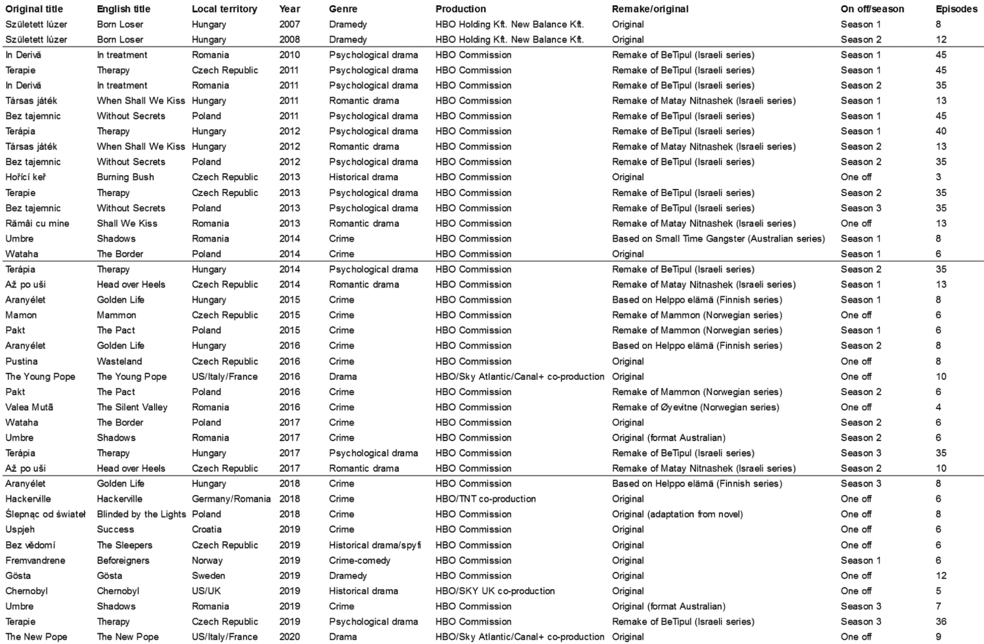
Based on our overview of HBO Europe’s original productions, we distinguish between three phases or trends during the last decade: (1) remakes and talent development (2010–2014); (2) crime and the rise of original HBO productions (2014–2017); and (3) territorial expansion and ensuing co-productions (2018–) (see Figure 1).
European serial fiction productions by HBO 2007–2020.

The first period in HBO’s European history (2010–2014) sees the launch of HBO’s original programming in Eastern Europe with several local versions of two Israeli series, the psychological drama BeTipul (2005–2008), which HBO remade as In Treatment (2008–2010) in the US, and the romantic drama Matay Nitnashek (2007), which ran considerably longer, especially in Poland, in the remade versions. As the first series launched by HBO Europe in Eastern Europe, the BeTipul format exists in Romanian (this was the first series launched in Eastern Europe at the end of 2010), Hungarian, Czech and Polish versions. From 2010 to 2019, a total of 16 seasons based on these formats were broadcast in Eastern European territories, making the formats BeTipul and Matay Nitnashek a through-going trend following the developments of HBO Europe’s local productions from 2010 and onwards. As we see below, these format adaptations strategically sought out local audiences while at the same time developing local talent for television production.
The intermediary phase (2014–2017) is marked by maturation of the local industries and the subsequent launch of more ambitious and complex serials, now moving away from the previously mentioned genres towards, especially, the crime genre. Nevertheless, HBO continues the logic of format adaptation as it produced Czech and Polish remakes of the Norwegian scripted crime format Mammon (2014–2016) and a Romanian remake of the Norwegian crime series Øyevitne (Eyewitness, 2014), together indicating the international impact of Nordic Noir at this time. Nevertheless, even if the series are based on foreign formats, they would increasingly distance themselves from the original versions and develop highly localized adaptations of the plots and themes. As pointed out by Caius Dobrescu and Roxana Eichel, the adaptation of Eyewitness ‘to Transylvania follows a double logic: 1) scouting for land- and cityscapes resembling the original Nordic setting and 2) embedding the plot and its toleration agenda in new and distinctive socio-cultural milieus’ (Dobrescu and Eichel Reference Dobrescu, Eichel, Bengesser, Hansen and Gemzøe2020, 48). As a result, during this phase we see the drift towards local original productions, where the Polish Wataha (The Border, 2014–) and the Czech Pustina (Wasteland, 2016) still clearly bear influential traits from the popular Nordic Noir style (Hansen Reference Hansen, Badley, Nestingen and Seppälä2020). The Romanian series Umbre (Shadows, 2014–) holds a threshold position, as the first season was loosely based on the Australian crime-comedy Small Time Gangsters (2011), while the subsequent seasons are originally scripted Romanian content, stripping away altogether the comedic aspects of the Australian series. Something similar can be said about the Hungarian series Aranyélet (Golden Life, 2015–2018), showing the influence from the Finnish series Helppo elämä (Easy Living, 2009–2011).
In the face of increasing international competition, HBO has for the past few years been seeking new ways to produce content and engage audiences in and outside Europe, cuing a new trend and tendency in HBO’s European enterprises (2018–). While Jean K. Chalaby (Reference Chalaby2016, 170) refers to ‘cost-effectiveness and risk-management’ as the benefits of format trade, Eva Novrup Redvall (Reference Redvall, Hammett-Jamart, Mitric and Redvall2018, 140) also points out that ‘the obvious benefit of co-production is the financial pooling and the risk-sharing’ in co-producing expensive serial drama. For HBO, this is already indicated by the US/Italian/French co-production The Young Pope (2016) as well as HBO’s strategic use of local European production services for large productions such as Game of Thrones (2011–2019). However, during the past years, HBO has shown an increasing interest in international co-productions in Europe, which now include the co-production between HBO Romania and the German pay TV channel TNT on Hackerville (2018), the HBO US and Sky UK co-production of Chernobyl (2019) and the US/Italian/French sequel to The Young Pope, The New Pope (2020). Co-production with Sky in Europe is a new variety of, and the direct result of, HBO’s programming deal with Sky. As part of this new European trend for the institution, HBO has started to expand beyond the initial Eastern European territories and beyond the territories not covered by Sky. HBO Nordic, which covers Norway, Sweden, Finland and Denmark, has released its first local series, including the Swedish dramady Gösta (2019) and the Norwegian crime-comedy Fremvandrerne (Beforeigners, 2019), while HBO Adria, covering Croatia, Montenegro, Serbia, Slovenia and Bosnia-Hercegovina, has released its first local production, the Croatian Uspjeh (Success, 2019). As a result, the new phase from around 2018 shows HBO’s territorial expansion in Europe through new local productions and transnational co-productions.
Filling the Gaps and the Return of the Miniseries
Before the launch of HBO’s local European productions, Al Auster highlighted that in order to ‘understand HBO’s success, one must observe a system that has developed a strong counterprogramming strategy, created by a series of gifted executives […], that filled the gaps that the other networks have left’ (Auster Reference Auster, Edgerton and Rose2005, 245). Essentially, Auster refers to a US context where ‘the major networks’ dramatic series had settled, with rare exceptions, into a routine of family-cop-doc-lawyer shows’ (Auster Reference Auster, Edgerton and Rose2005, 238). In other words, Auster’s point mainly addresses the edgy content and the high production value of HBO’s American series such as The Sopranos (1999–2007). While this also applies to the local series produced in/for European territories, the notion of ‘filling the gaps’ in a European context has also been a geographical strategy. HBO Europe’s programming deal with Sky and the comparatively late arrival of original Nordic content is a result of these territories’ strong televisual output, including strong public service traditions, while the Eastern European market, at the historical time of HBO’s entry, was marked by what Aniko Imre refers to as ‘illiberal political conditions in the post-socialist Eastern European region’ (Imre Reference Imre2019, 170). The slow increase of the geographical presence of HBO in Europe also partly implies the production logic that Auster refers to when he states that ‘HBO actually functions more like a studio than a network’ (Auster Reference Auster, Edgerton and Rose2005, 227). On the one hand, just as in the US, the subscribers’ money frees the company from advertisers and sponsors, and allows its series to find an audience without the risk of an immediate cancellation. On the other hand, setting up local offices around Europe while employing a few central executives (i.e. Antony Root, Steve Matthews and Jonathan Young) presents an opportunity for HBO to ‘import’ the overall development strategies from the US conglomerate, while at the same time cater to new local talent as well as hiring in significant creatives in the various local territories.
In the first of the phases described above, HBO hired the award-winning film director Ildikó Enyedi to direct 45 of 110 episodes of Terápia (2014–2017), the Hungarian remake of BeTipul, while also producing Agnieszka Holland’s Czech miniseries Hořící keř (Burning Bush, 2013). Her affiliation to the Polish director Andrzej Wajda and her internationally acclaimed film career cement her status as a European auteur director, while she also directed episodes of several noteworthy European and US TV series, including David Simon’s HBO series The Wire (2002–2008) and Treme (2010–2013). In this way, Holland should be considered an important link in the implementation of HBO’s production logic in Eastern Europe. Today, it has become much more common for film directors to also direct TV series, and HBO Europe continues to hire acclaimed film directors for new miniseries, such the Bosnian director Danis Tanovic, who won an Academy Award for Ničija zemlja (No Man’s Land, 2001), as the director of the Croatian series Success, and the Swedish director Lukas Moodysson to create and direct the series Gösta (2019). Using well-established film directors in making television is one obvious way to create local content with an international appeal.
As pointed out by Auster, until the late 1990s ‘the miniseries genres […] had, with rare exceptions, been abandoned in favor of less costly programming’. However, HBO changed this by using the miniseries as ‘a magnet for talented producers’ (Auster Reference Auster, Edgerton and Rose2005, 237). As we saw above, this strategy was directly imported into the European context, and over the past decade, since the beginning of the strategic development of European content, we see this affecting the length of the series produced for European territories. In the first phase, series comprise an average of 29 episodes per season, while the second and third phases show an average of nine to ten episodes, respectively. In other words, as part of the shift toward increased production value and a generic shift toward crime dramas, we see a two-thirds decrease of the number of episodes in less than a decade. In fact, the latest phase also includes the final 36-episode season of the Czech remake of BeTipul, and if we subtract that season from recent tendencies in HBO’s European productions, the average length drops to only a little more than seven episodes per season.
The tendency towards fewer episodes per drama not only signals the attraction of well-known film directors; it also indicates the rebirth of the miniseries on the European continent. Executive producer Steve Matthews highlighted a few reasons behind this drift toward the miniseries format:
Firstly, it’s partly financial. We would rather have three series of six episodes than one series of twenty in terms of marketing. Secondly, the longer it is, the harder it is. Particularly in Central Europe the feature, from my idea of it, is quite well-soaked into their heads. They have a tendency, if you are not careful, to see the world as a miniseries and as a single arc with cliffhangers but essentially one story. My personal belief is that six is the max you can play. The more you have, the harder it gets. You see a lot of things on TV where I think it would have been better if it was two episodes shorter, particularly some adaptations actually. (Matthews Reference Matthews2019)
In other words, the miniseries may attract established talent, it is easier to finance, write, produce and, in the end, it is also easier to market. This brings us to HBO’s strategies in talent development.
Remakes as/and Talent Development
By way of Dean J. DeFino’s analyses of the US HBO institution until the early noughties, it becomes clear that the European strategy as described above follows an American precedence: ‘While HBO has drawn on established talent, it has also been a proving ground for young writers, producers and directors who have since spread their talents – and aspects of the so-called “HBO style” – across the channel spectrum’ (DeFino Reference DeFino2014, 8). This includes their European activities too. As an example, DeFino uses Matthew Weiner, who started as a screenwriter for The Sopranos, later became an executive producer, and eventually was the creator of the AMC series Mad Men (2007–2015). Especially in the Eastern European territories, HBO has used a combination of well-established talent from national film production and new talent for the creation of television serial content.
In our interviews with Anna Závorszky, executive producer for HBO Hungary, and Alina David, executive producer for HBO Romania, they both accentuated HBO’s high-level cultural and productional position in Eastern Europe, but indicated the lack of professionals in quality serial television production, enticing a great interest in educating a new generation of talents. In an interview at New Europe Market 2018, Steve Matthews (Reference Matthews2018) described the virgin status of these territories at the arrival of HBO, but at the same time stressed the rewarding side of talent development:
You’re trying to find directors and writers and particularly writers who are ready to step up to the next level. The reward is that when it works, it’s so fresh […]. We’re by definition often working with young writers. When I can bring to them and help them in the areas where they may lack a little bit of experience, then they push back with the rawness of talent and something to say, then you get something that grows organically.
In our interview with Matthews, he highlighted that doing remakes is no longer part of the strategy as they have now moved directly into original productions, also in new HBO territories such as HBO Adria:
We really don’t want to do that anymore. It was good to start with because of the lack of knowledge about what the writers could do, but we’ve been doing it long enough now. The thing that everybody knows naturally is that there is no shortage of writing talent in Romania or Hungary, just a little bit of shortage of experience of how to shape it. So we should know how to do it now as a business model. It means we got to write checks rather than receive checks. Remakes are just not going to be as punchy in the distribution market and it is more fun to make up our own stuff. So when we moved into Adria and the Balkan area that was a point when we constantly said we would do this from scratch, we will not bring in any format. And we try very hard not to bring in British or American writers, we have a couple of consultants now and again, but we try very hard to help the writers get there themselves if we possibly can. (Matthews Reference Matthews2019)
Asked about the pool of talent during New Market Europe 2019, Gábor Krigler, former executive producer for HBO Hungary, responded critically to the notion that Eastern Europe is a less talented territory than elsewhere: ‘I don’t think it’s a fair question. There are talented people everywhere. The stories that come from here they are amazing’ (Krigler Reference Krigler2019). In other words, the discourse around the pool of talent is significantly changing. However, going beyond the mere shift from remakes to making originals allows us to see how HBO’s Eastern European activities display at least two creative sources for discovering new television talents.
First, national theatre industries have had a significant impact on the casts for many HBO productions. In fact, BeTipul was originally a highly theatrical format with very few locations, encouraging the four Eastern European remakes to use actors recognized as a certain ‘actor of the nation’ for the central role. Next to being a well-known international actor, Karel Roden is known as a Czech film and theatre actor who has been awarded the Czech Lion Award (film) and the Alfréd Radok Price (theatre). The Polish actor Jerzy Radziwiłowicz works at the National Theater of Warsaw and is a recognized translator of the playwright Molière. Besides being an international supporting actor, the Romanian Marcel Iureş is a two-time UNITER-awardee and has played a major role in the Romanian alternative theatrical movement. The Hungarian Pál Mácsai is the director and founder of the Örkény István Theater. Behind the camera we find a similar trend: for Golden Life, HBO employed István Tasnádi, an acclaimed theatrical director, as scriptwriter. Because of the size of the local markets, one central reason for such collaboration between the various industries is the difficult career opportunities if you focus only on film and television production. However, the embedded political criticism on the theatrical scene in Eastern Europe is significantly more outspoken than the tone in local television productions, and this may have benefited theatrical players as a voice for HBO’s edgy interest in airing local social, political and economic problems and controversies. Interestingly enough, appealing to the theatrical industry is not a new way to find talent when there is an artistic lacunae; the early silent film industry used the same method to find casts for the boom in film production around 1910, while the early television industry in the 1950s and 1960s followed the same strategy.
Second, the interaction between film and television production is a strong way to find well-developed profiles as well as establishing new talent. Local film industries have been an obvious place for HBO to scout for well-established talents, which we already stressed in relation to directors Enyedi, Holland and Tanovic. Although the crossover from film to TV failed in the case of Born Loser, with directors such as György Pálfi (European Film Award) or Barnabás Tóth (Oscar shortlist for the best Foreign Film in 2020), the Romanian new wave, with a range of internationally award-winning directors, was a serious source of inspiration for Shadows, a series written and partly directed by Bogdan Mirică, who broke new ground in the Romanian new wave with his first feature film Dogs (2016) and won the FIPRESCI prize at Cannes. As Steve Matthews indicated in the above quote, the feature film is a very conspicuous mindset for the Eastern European creatives, and for this reason talent should not be developed as such; it merely needs a gentle nudge and framing in the direction of creating serial television content. In the Nordic region, HBO also sought out already acclaimed film directors, Lukas Moodysson and Jens Lien, for the first two Nordic originals Gösta and Beforeigners.
Developing new professionals especially and directly for the creation of televisual content is, however, not only US HBO strategy; it has also been a very salient aspect of establishing HBO on the European continent. Directors Zsombor Dyga and Áron Mátyássy steadily developed their directorial profiles on Golden Life during the production and also continued to work on televisual content after the three seasons of the series came to an end. Already before working with HBO, the Polish director Kasia Adamik had a name in Polish film and television as mainly an episode director in a country with a considerable local production for television series compared with Hungary and Romania. She entered HBO Europe as an episode director on the third season of Bez tajemnic (Without Secrets, 2011–2013), the Polish remake of BeTipul, and became the main director of The Border after Michel Gazda’s conceptualizing direction of the first four episodes. After this she was the main director on the first Eastern European Netflix production, the Polish series 1983 (2018).
However, the most profiled example of talent development may be that of Gábor Krigler. In the European context, Krigler shows strong similarities with Matthew Weiner in the US. In relation to HBO Europe, Krigler started as one of three screenwriters on Born Loser, venturing into Társas játék (When Shall We Kiss, 2011–2013), the Hungarian remake of Matay Nitnashek, as one storyliner among eight screenwriters. While co-writing this series, HBO hired Krigler as creative executive for HBO Hungary, executively producing Terápia (Therapy, 2012–2017), the Hungarian remake of BeTipul. Eventually, he co-created Golden Life for HBO Europe, and in 2019 he launched his own production company, Joyrider, holding ‘a non-exclusive development deal with HBO Europe’ (Briel Reference Briel2019). HBO Europe usually commissions series locally, but in order to do so, they have a need for local production companies and services, and hiring and developing local talents through remakes has been a strategic method to achieve this. Besides using screenwriting competitions, as pointed out by Steve Matthews (Reference Matthews2018), doing remakes became a laboratory of talent development with a gradual passage into original content development. In the above-mentioned Therapy, a greater narrative autonomy was achieved in the second season, while complete autonomy applies to the third season. As for Shadows and Golden Life, only the plot trigger was adopted from the format, as the writers were free to develop new characters and storylines.
Altogether, in Central and Eastern European territories, HBO functioned as a possibility to break through what Petr Szczepanik refers to as the ‘East-European ceiling’. His perspective is so-called minority co-productions, i.e. ‘a financial definition that frames co-productions from the perspective of the co-producer that provides less than the largest share of financing’. According to Szczepanik, collaboration and minority co-productions
promise to break away from the prevailing conditions of international production […] that segregate local workers from high-level positions in the professional hierarchy, cut them out of the creative decision-making process and divest them of any say in the development stage. (Szczepanik Reference Szczepanik, Hammett-Jamart, Mitric and Redvall2018, 154)
Essentially, HBO’s local productions in Eastern Europe do not fall under the category of minority co-productions, but HBO’s strategic talent development, e.g. the progression/professions of Gábor Krigler, indicate a similar local effect, as production companies such as Joyrider may end up producing local content for HBO in the end, and as a consequence have a clear-cut creative say from the early development stages onward.
Increasing Attention to the Crime Genre
After the early formation phase, where remakes were the overall trend in HBO Europe’s productions, one genre appears to take over. In this sense, the remake of the two Norwegian crime series for the Polish, Czech and Romanian markets occupies a threshold position as it breaks free from the Israeli psychological and romantic dramas and moves towards crime drama, but at the same time still follows HBO’s remake and format import strategy. Not counting the ‘originality’ in the format adaptation of Small Time Gangsters in Shadows and Easy Living in Golden Life, the first original ventures into the crime genre were The Border and Wasteland. These series demonstrate the powerful impact of Nordic Noir in this period, with Wasteland also being strongly influenced by Forbrydelsen (The Killing, 2007–2012). As indicated in the above overview of HBO’s European productions, besides the continuation of the remakes from the first phase, a few historical dramas and the Swedish comedic drama Gösta, everything else is crime drama.
Asked about the omnipresence of the crime genre, Steve Matthews replied:
I mean that is in no way a conscious strategy. We don’t go out looking for crime, but they tend to come in. I wonder what would happen if you took the BBC’s output and worked out the same proportion for them […]. But I think there is a lot of it, and if you include gangsters you’re probably right. There is no conscious strategy, but I don’t see any reason why crime as an engine will go away from television series in any big hurry. (Matthews Reference Matthews2019)
In Hungary, two perspectives motivated the increasing attention going to crime fiction. First, HBO Europe organized a screenwriting contest in 2014 for which it received around 400 scripts, the overwhelming majority of which were crime stories (Krigler Reference Krigler2016), indicating a general bottom-up interest in the genre in the region. Second, HBO Hungary’s Anna Závorszky underlined the genre’s potential to focus on local problems as a main incentive to produce crime dramas. The genre works well on television, according to her, as
it can sustain attention during several seasons. We suggest that it’s time to re-think the genre, but it’s not conceived as a mission. What is important to me is how I can reach catharsis, and the crime genre allows us to reach a cathartic attitude by emphasizing that nowadays our region has these kinds of problems. (Závorszky Reference Závorszky2019)
She also mentions the genre’s capability to travel outside the national borders as a prime motivation for creating crime stories, but still maintains a position where the genre needs spinning in order to reach an audience, a point also stressed by Matthews in our interview with him. Krigler goes so far as to say that ‘Probably in this region people could start dwelling not too much on gangster stuff. I think that’s a little bit overdone’ (Krigler Reference Krigler2019). Using the crime genre appears to strike a careful balance between a recognizable plot engine, local sensibilities, new spins on the genre, and an international interest in crime stories. HBO Romania’s Alina David refers to HBO’s priority to reach generic complexity in each local market, and in Romania the crime stories aimed to represent a multi-layered geographic reality from the capital, in Shadows, to Transylvania, in Valea Mutã (The Silent Valley, 2016) and Hackerville (2018), to Moldavia in the upcoming HBO series Tuff Money (David Reference David2019).
Above, we pointed out the generic features of Eastern European HBO crime dramas, but also through the format imports are we able to detect local differences. A geographical and topical separation from the original format in the Eastern remakes has been crucial. In the case of the Czech series Mamon (Mammon, 2015) and the Polish Pakt (The Pact, 2015–2016) – both variations of the same Norwegian series – some universal plot elements (e.g. the sibling rivalry, broader family tensions and a larger conspiracy theory) were adapted to the local context, but in both series the storyline centres on the investigation made by a journalist interested in uncovering corruption, including an investigation of his own brother. Other series in the Eastern European region are also format adaptations, but in line with Závorszky’s point about social issues in crime fiction, a main characteristic of the remakes is that they adapt the stories to the local cultural context, dealing with important social issues such as minorities (Roma communities in Golden Life and The Silent Valley), homosexuality and gender issues (The Silent Valley) or social stratification (Golden Life).
The situation is somewhat different for HBO in the Nordic region. Here, the crime genre enjoys great popularity among audiences, and both public and private broadcasters and streaming services produce a great range of shows that may be associated with the generic variation referred to as Nordic Noir. At the time when HBO Nordic started to produce originals for the region, Antony Root stated that
I think it’s a brave broadcaster or producer who just falls into the slipstream of Nordic noir, 7–8 years into its success. I am not saying we would not do crime, but I think one has to be clever now about the genre one chooses because Nordic noir is very well established and some people might say it has peaked. (Pham Reference Pham2016)
Commissioning editor Hanne Palmquist (Reference Palmquist2019) also referred to the crime market in the following way:
You do need to stand out in order to grab the audience, even though it looks like the market for crime shows is still insatiable. HBO Nordic’s first Norwegian original Beforeigners expressively utilizes the Nordic Noir style, however more as an engine to tell a bigger, mix-genre story that is inspired by the European refugee situation. The re-definition of or the extended version of the crime genre gives you the opportunity to come up with something new and fresh that the audience can relate to, however also enjoy for being surprising and carrying a message.
Beforeigners spins the genre into a parodic mode, dwelling on a range of recognizable Nordic Noir narrative and stylistic traits, including an obvious spoof of the character relationship between the detectives in Bron│Broen (The Bridge, 2011–2018), but at the same time the series contains a serious discussion of integration policies.
Anna Batori also refers to a ‘post-2010 proliferation and dominance of the crime genre in the region’s quality television’, i.e. the Eastern European region, and finds this to be ‘a surprising and unexpected turn’. She refers to how crime films in the socialist period ‘were mediators of the central ideological message and mirrored a false political context where criminality was considered to be basically non-existent’. For Batori, this attention to crime dramas in the region ‘signals a new start for Eastern European media and collective remembrance’, which once again rests on the genre’s ability to pinpoint social issues. She continues:
What we witness this way, is the birth of a new post-socialist televisual collectivehood that translates and locates the American genre into an Eastern European social reality by reworking its specific historico-political trauma and collective problems, while focusing on the disintegrated institution of the family as a metaphor of the post-socialist, neoliberal crisis. (Batori Reference Batori2018, 38–39)
On the one hand, Batori’s point illuminates how the genre works well as a symbol of the public debate possible in popular culture. As Batori also points out, the genre offers an opportunity to depart from the ideological structures of the socialist period but at the same time criticize ‘the impotent institution of the police’ and ‘the omniscient control of a businessman’ in a capitalistic, neoliberal marketplace. On the other hand, Batori overlooks the important intermediary position of the Nordic crime tradition imported to Eastern European territories in the same period, and with that also a genre evoking social indignation and strong criticism of the neoliberal breakdown of the Nordic welfare state (Nestingen Reference Nestingen2008). In fact, what appears to have been lost, if one trusts the ideological framework of Nordic Noir, is the collectivehood of the welfare state, which indicates that the generic conventions imported into the Eastern European territories in the post-2010 dominance of the crime genre have been reworked through the machinery of the Nordic crime genre.
Conclusion
In this article, we have shown how HBO Europe transposed the US production model to the Eastern European territories, and we have provided a content overview of HBO’s European activities in the period from 2007 until early 2020. Here, we have stressed how HBO strategically sought out well-established talent and used remakes as a production method to develop virgin production cultures, and is now clearly maturing into an international content provider of local and global TV dramas to be reckoned with. During the history of HBO’s European presence we have outlined a noteworthy ‘takeover’ of the crime genre and analysed this as both an import from the successful Nordic region as well as a salient critical voice in a post-socialist era. In this way, local TV drama is shown to be a potential voice of cultural exchange, with the crime genre a very important generic model for voicing social debates and engendering international interest in local issues, stories and common transcultural features, and where differences and similarities may be articulated.
Acknowledgements
Research presented in this article has been financed by the research project DETECt – Detecting Transcultural Identity in European Popular Crime Narratives (Horizon 2020, 2018–21).
About the Authors
Kim Toft Hansen is Associate Professor of Media Studies at Aalborg University, Denmark. His research focuses on TV crime fiction and production research with special attention to relationships between local and global media. He has published extensively on crime fiction and TV locations, including the co-authored book Locating Nordic Noir: From Beck to The Bridge (2017) and the edited volume European Television Crime Drama and Beyond (2018).
Anna Keszeg is Assistant Professor in the Department of Communication, Public Relations and Advertising of Babeş-Bolyai University, Cluj-Napoca, Romania. Her main research interests are contemporary visual culture with a special focus on television and fashion communication. She has published several articles in French and Hungarian on contemporary Eastern European crime series.
Sándor Kálai is Associate Professor in the Department of Communication and Media Studies of the University of Debrecen, Hungary. His research focuses on the history of European media culture and popular genres, such as crime fiction. He has published a book, in Hungarian, on the history of the French crime novel (Fejezetek a francia bűnügyi regény történetéből, 2012) and he edited recently, with Jacques Migozzi, a collection of articles dedicated to European media culture (https://journals.openedition.org/belphegor/2094).