

Introduction
The West Antarctic Peninsula (WAP) is one of the most sensitive regions to climate change on the planet, as indicated by the rise in air temperature, which was four times higher than the global average from 1950 to 2000 (Turner et al., Reference Turner, Bindschadler, Convey, di Prisco, Fahrbach, Gutt and Summerhayes2009), followed by a temperature drop from 2000 to present as a consequence of stronger mid-latitude jets leading to more cyclonic conditions in the northern Weddell Sea (Turner et al., Reference Turner, Lu, White, King, Phillips, Hosking, Bracegirdle, Marshall, Mulvaney and Deb2016). Warming of this region and consequent increase in cloud cover and precipitation reduced ice deposition and sea-ice formation before the late 1990s and enhanced ice melting during the summer, with an ice cap loss of 7% during this period (Montes-Hugo et al., Reference Montes-Hugo, Doney, Ducklow, Fraser, Martinson, Stammerjohn and Schofield2009), and an opposite scenario has been observed after the year 2000 (Turner et al., Reference Turner, Lu, White, King, Phillips, Hosking, Bracegirdle, Marshall, Mulvaney and Deb2016).
In this region, oscillations in weather conditions and consequent changes in physical and chemical features of the marine environment are reflected in changes in the biodiversity and distribution of living organisms (Campos et al., Reference Campos, Barboza, Bassoi, Bernardes, Bromberg, Corbisier, Yoneshigue-Valentin, Verde and di Prisco2013; Gutt et al., Reference Gutt, Barratt, Domack, D'acoz, Dimmler, Gre'Mare and Smith2011), including phytoplankton assemblages (Montes-Hugo et al., Reference Montes-Hugo, Doney, Ducklow, Fraser, Martinson, Stammerjohn and Schofield2009; Schloss et al., Reference Schloss, Abele, Moreau, Demers, Bers, González and Ferreyra2012). As phytoplankton are unicellular organisms, they are characterised by high reproduction/division rates and therefore they can respond rapidly to oscillations in physico-chemical aspects of the water column, which is reflected by dramatic shifts in the dominant taxa (Balech, Reference Balech1977; Setlik, Reference Setlik, Marvan, Pribil and Lhotsky1979). Consequently, phytoplankton populations showed a clear response to climate change in the WAP over 50 years (1950 to 2000), with a biomass decline of 12% following an increase in air and sea-surface temperature, cloud cover, and precipitation, and a decrease in the ice cover. These climatic changes caused an enhancement of wind-driven mixing of the surface ocean and a deepening of the mixed layer depth, mainly in the north portion of the WAP (Montes-Hugo et al., Reference Montes-Hugo, Doney, Ducklow, Fraser, Martinson, Stammerjohn and Schofield2009).
The South Shetland Islands are located north of the WAP, at the edge of the Antarctic atmospheric front, and lying on the boundary of the marine-ice extension (Hofmann et al., Reference Hofmann, Wiebe, Costa and Torres2004). As the largest archipelago of the region, it is composed of 14 islands, of which King George Island (KGI) is the largest. KGI is located in the northern region of maritime Antarctica, close to the limit of the sub-Antarctic region. Because of its location, there is a progressive increase in human presence on KGI, especially scientists and tourists, both visiting and in transit to other Antarctic areas (Campos et al., Reference Campos, Barboza, Bassoi, Bernardes, Bromberg, Corbisier, Yoneshigue-Valentin, Verde and di Prisco2013). Climate conditions at KGI do not show similar variations to the rest of the WAP, with a slight decrease of 0.6°C in air temperature recorded over the last 15 years (Setzer et al., Reference Setzer, Villela, Dechiche, Yoneshigue-Valentin, Dalto, Lavrado and de Carvalho2010). However, the increase in seawater temperature was similar to other areas of the WAP (Clarke et al., Reference Clarke, Barnes and Hodgson2005; Schloss et al., Reference Schloss, Abele, Moreau, Demers, Bers, González and Ferreyra2012).
Intensive study of coastal areas around KGI began in the 1970s with the establishment of scientific stations and other anthropogenic structures (Campos et al., Reference Campos, Barboza, Bassoi, Bernardes, Bromberg, Corbisier, Yoneshigue-Valentin, Verde and di Prisco2013; Peter et al., Reference Peter, Braun, Mustafa and Pfeiffer2008). Such activities increased the vulnerability of these coastal areas to direct (pollution) anthropogenic impact, and there were also indirect anthropogenic influences (climate-related changes). This led to changes that were most pronounced in terrestrial environments, because marine and atmospheric environments are intrinsically dynamic and more resilient to such changes (Campos et al., Reference Campos, Barboza, Bassoi, Bernardes, Bromberg, Corbisier, Yoneshigue-Valentin, Verde and di Prisco2013). However, the marine environment is influenced directly by human activities (Montone et al., Reference Montone, Campos, Alvarez, Ito, Lavrado, Bícego, Weber, Verde and di Prisco2012) and indirectly through the tight interactions between terrestrial and marine (melt water increases nutrient input) (Nedzarek, Reference Nedzarek2008; Pichlmaier et al., Reference Pichlmaier, Aquino, Da-Silva and Braun2004; Schloss & Ferreyra, Reference Schloss and Ferreyra2002) and atmospheric and marine environments (with winds driving water circulation) (Brandini & Rebello, Reference Brandini and Rebello1994; Robakiewicz & Rakusa-Suszczewski, Reference Robakiewicz and Rakusa-Suszczewski1999; Schloss et al., Reference Schloss, Klöser, Ferreyra, Curtosi, Mercuri and Pinola1997). Studies that focused on the response of biodiversity to environmental change in the areas surrounding KGI have shown evident shifts in the biota (Campos et al., Reference Campos, Barboza, Bassoi, Bernardes, Bromberg, Corbisier, Yoneshigue-Valentin, Verde and di Prisco2013; Kopczynska, Reference Kopczynska2008; Peter et al., Reference Peter, Braun, Mustafa and Pfeiffer2008; Sander et al., Reference Sander, Balbão, Polito, Costa and Carneiro2007; Schloss et al., Reference Schloss, Abele, Moreau, Demers, Bers, González and Ferreyra2012), and monitoring change in community structure of natural communities has been recognised as being an important tool to distinguish natural and anthropogenic impacts and to predict the future of life in shallow Antarctic areas (Campos et al., Reference Campos, Barboza, Bassoi, Bernardes, Bromberg, Corbisier, Yoneshigue-Valentin, Verde and di Prisco2013).
Because of its significant environmental, historical, aesthetic and scientific aspects, one of the bays located in KGI, Admiralty Bay (AB), was designated as the first Antarctic Specially Managed Area (ASMA 1) (Campos et al., Reference Campos, Barboza, Bassoi, Bernardes, Bromberg, Corbisier, Yoneshigue-Valentin, Verde and di Prisco2013), being also considered as a reference site in the SCAR EASIZ (1994–2004) Programme, and a case study in the Census of Antarctic Marine Life during the International Polar Year 2007–2008 (Siciński et al., 2011 apud Campos et al., Reference Campos, Barboza, Bassoi, Bernardes, Bromberg, Corbisier, Yoneshigue-Valentin, Verde and di Prisco2013). Brazilian scientists started to contribute to the knowledge of biodiversity in this area in the 1980s, when the Brazilian Antarctic Station Comandante Ferraz (EACF) was installed, but substantial research was performed and published during the International Polar Year, including on the terrestrial (microorganisms, birds, plants) and the marine (mammals, benthic organisms, microorganisms, phytoplankton, fishes) environments (Campos et al., Reference Campos, Barboza, Bassoi, Bernardes, Bromberg, Corbisier, Yoneshigue-Valentin, Verde and di Prisco2013).
The contribution of Brazilian scientists to understanding the ecology of phytoplankton in this area started with the pioneer studies of Frederico Brandini during the 1990s (Brandini, Reference Brandini1993; Brandini & Rebello, Reference Brandini and Rebello1994). Following these studies, phytoplankton samples were collected from research campaigns monitoring the biodiversity in shallow coastal areas of Admiralty Bay (KGI), which started in 2002 through the Brazilian Antarctic Program (PROANTAR). Since then, phytoplankton has been investigated through three projects, all of them also included in the PROANTAR: “Implementation of a strategy for assessment of environmental impacts on coastal shallow water benthic fauna of Admiralty Bay” Network 2 (2002–2007); “Marine Antarctic Biodiversity in Relation to Environmental Heterogeneity at Admiralty Bay, and adjacent areas (MABIREH)" (2007–2011), and “Phytoplankton community structure at Admiralty Bay” - National Institute of Science and Technology - Antarctic Environmental Research (INCT-APA) (2013–present).
The aim of this work is to use these studies to perform a synthesis of the biodiversity and ecology of phytoplankton in coastal areas surrounding King George Island, Western Antarctic Peninsula, and (1) to explore what is known about the phytoplankton species composition and (2) to examine the response of key taxa to environmental variations. The understanding of phytoplankton dynamics today sets the stage for future comparisons in a rapidly ever-changing world.
Study area
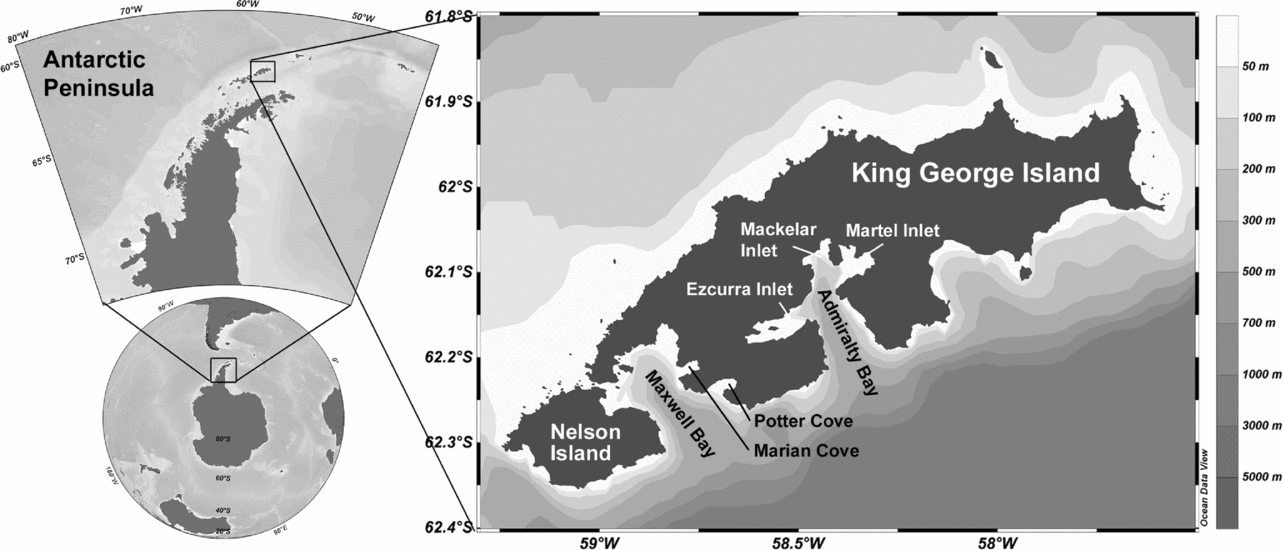
King George Island (KGI) is the largest island of the South Shetland Archipelago, located off the tip of the Western Antarctic Peninsula (Fig. 1). It is under the strong influence of climate change, as indicated by climate anomalies such as the Antarctic Oscillation (AAO) or Southern Annular Mode (SAM), and the El-Niño Southern Oscillation (ENSO) (Lange et al., Reference Lange, Tenenbaum, Tavano, Paranhos and Campos2014; Montes-Hugo et al., Reference Montes-Hugo, Doney, Ducklow, Fraser, Martinson, Stammerjohn and Schofield2009; Schloss et al., Reference Schloss, Abele, Moreau, Demers, Bers, González and Ferreyra2012). The island is surrounded by the Drake Passage on the northern coast and the Bransfield Strait on the southern coast, which consists of a fjord-like indented coastline that forms coves and two large embayments: Admiralty Bay (KGI) and Maxwell Bay (between KGI and Nelson Island) (Fig. 1).
Map of King George Island, Western Antarctic Peninsula, with the location of the main coastal areas (embayments) where phytoplankton was studied (map created using Ocean Data View®).

Topographic and hydrological characteristics of the embayments and coves are very similar: a steep border with the bottom reaching 500 m depth, a wide opening to the south, high nutrient levels (Lange et al., Reference Lange, Tenenbaum, Santis Braga and Campos2007; Lipski, Reference Lipski1987; Nedzarek, Reference Nedzarek2008) derived from terrestrial input (Nedzarek, Reference Nedzarek2008; Nedzarek & Rakusa-Suszczewski, 2004, Reference Nedzarek and Rakusa-Suszczewski2007; Souza et al., Reference Souza, Schaefer, Abrahão, Mello, Simas, Silva and Francelino2012), and the presence of suspended sediments provided by the underground input of freshwater melted from terrestrial ice (glaciers) (Pichlmaier et al. Reference Pichlmaier, Aquino, Da-Silva and Braun2004; Rakusa-Suszczewski, Reference Rakusa-Suszczewski1996; Schloss et al., Reference Schloss, Klöser, Ferreyra, Curtosi, Mercuri and Pinola1997), which greatly affect light penetration in the water column (Chung et al., Reference Chung, Kang, Kang, Lee and Kim2000; Klöser et al., Reference Klöser, Schloss, Mercuri, Laturnus and Curtosi1993). In addition to the glaciers, freshwater is also supplied from the melting of occasionally formed fast-ice, mainly in the inner areas of the coves and inlets (Chang et al., Reference Chang, Jun, Park and Eo1990; Lipski & Rakusa-Suszczewski, Reference Lipski and Rakusa-Suszczewski1990; Schloss et al., Reference Schloss, Klöser, Ferreyra, Curtosi, Mercuri and Pinola1997).
Water circulation is characterised by the inflow of water from Bransfield Strait occurring in two main pathways: (1) through surface layers of the water column in the western portions of the embayments and coves/inlets, induced by geostrophic forces (Chang et al., Reference Chang, Jun, Park and Eo1990) and intensified by westerly winds and tide oscillations (Pruszak, Reference Pruszak1980; Robakiewicz & Rakusa-Suszczewski, Reference Robakiewicz and Rakusa-Suszczewski1999; Roese & Drabble, Reference Roese, Drabble, Wiencke, Ferreyra, Arntz and Rinaldi1998; Schloss et al., Reference Schloss, Klöser, Ferreyra, Curtosi, Mercuri and Pinola1997); and (2) through the deep portion of the bays, leading to topographically and easterly wind-driven upwelling near the eastern coastline in areas where the bathymetry is steep (usually the inner portion of the inlets and coves) (Brandini & Rebello, Reference Brandini and Rebello1994; Kang et al. Reference Kang, Kang, Chung, Lee, Lee, Chung and Kim1997a; Schloss et al., Reference Schloss, Klöser, Ferreyra, Curtosi, Mercuri and Pinola1997). Upwelling events seed phytoplankton populations with benthic species (Fernandes et al., Reference Fernandes, Calixto, Lange, Tenenbaum, Valentin, Dalto and Lavrado2013), providing an input of biomass, which may increase even further given ideal weather conditions (low windspeed leading to water column stabilisation in post-upwelling periods) (Brandini & Rebello, Reference Brandini and Rebello1994; Kang et al., Reference Kang, Kang, Chung, Lee, Lee, Chung and Kim1997a; Lange et al., Reference Lange, Tenenbaum, Tavano, Paranhos and Campos2014; Schloss et al., Reference Schloss, Klöser, Ferreyra, Curtosi, Mercuri and Pinola1997). Water outflow occurs mainly through surface layers of the east portion of these embayments (Chang et al., Reference Chang, Jun, Park and Eo1990; Robakiewicz & Rakusa-Suszczewski, Reference Robakiewicz and Rakusa-Suszczewski1999).
Methods
Dataset assessment
The dataset used in this review (1980–2013) was assembled from studies published between 1980 and 2013 that were available on the internet and/or through direct communication with authors. We considered the following types of publications: peer-reviewed articles, book chapters, technical reports, conference abstracts, and academic monographs. Only those publications that contained species lists or mentioned phytoplankton species were taken into account. Those that considered only pigment and/or phytoplankton biomass data were excluded.
In publications selected for this analysis, species identification was performed based on a variety of sources, including Hasle (Reference Hasle1965), Sournia et al. (Reference Sournia, Grall and Jacques1979), Priddle & Fryxell (Reference Priddle and Fryxell1985), Medlin & Priddle (Reference Medlin and Priddle1990), Tomas (Reference Tomas1997), Round et al. (Reference Round, Crawford and Mann1990), and Scott & Marchant (Reference Scott and Marchant2005) as the most often cited. After the species lists of all publications were assembled, nomenclature was checked and updated according to Guiry & Guiry (Reference Guiry and Guiry2017) and the references cited above.
Methods of phytoplankton analysis
In 65% of the studies, phytoplankton were analysed from seawater taken from surface layers of the water column (down to 60 m) using a Niskin bottle. In 18% of the studies, nets (20 μm mesh) were used to sample phytoplankton cells. Samples were fixed with formaldehyde and/or Lugol, and quantified and identified under an inverted light microscope using the Utermöhl (Reference Utermöhl1958) method. In studies aimed at fine taxonomy (32% of the studies), electron microscopy was used to observe and identify phytoplanktonic and microphytobenthic species, as the latter is the most important component of phytoplankton in these polar coastal environments. In 25% of the studies, microphytobenthos were sampled from the surface sediment and/or scraped from rocks, macroalgae, benthic animals, and sea ice, with samples taken manually by scuba divers.
The results compiled here must be considered with caution, as the analyses of phytoplankton populations by different researchers were performed using a variety of methods and techniques. The most conventional method, using inverted light-contrast microscopy, limits the observation of small phytoplankton specimens due to a limitation in magnification power (usually maximum 400×, occasionally reaching 1000×). Therefore, this method favours the observation of larger organisms (>20 μm) such as diatoms and dinoflagellates, and limits the accurate identification of nano-sized organisms (2–20 μm) such as flagellates. Even when using the same method, it is expected that results may vary due to the quality (brand) of microscope lenses and level of expertise of the microscopist.
In some studies, a known volume of water sample was filtered, depositing phytoplankton cells on the filter membrane, then the dry filters were made translucent using xylene, and after drying these were mounted in Canada balsam (Kozlova, Reference Kozlova1964). This method allows the use of immersion lenses with high numerical aperture both for the quantitative and qualitative research. In order to identify species in light microscopes more accurately, a procedure that uses acid to clean the organic matter of diatoms and mounts these cells in pleurax or hyrax was used.
Results and discussion
Publications
The majority of the 75 publications assembled in the present review came from peer-reviewed journals (38), and abstracts from presentations in scientific conferences (26), followed by reports (4), BSc monographs (3), book chapters (2), and MSc theses (2). Of the 44 peer-reviewed studies (manuscripts in journals, reports, and book chapters), books and reports, 24 were performed at Admiralty Bay (Ezcurra, Martel and Mackelar inlets), one at Admiralty and Maxwell Bays, and 19 at Maxwell Bay (MB), being nine at Marian Cove and 10 at Potter Cove (see Fig. 1 for the location of these areas). When considering abstracts, theses and monographs, the number of studies increases to 56 at Admiralty Bay. Of the studies performed at Marian Cove (MB), nine were by South Korean scientists, and one by Polish scientists. At Potter Cove (MB), phytoplankton was studied by scientists from Argentina (4), Sweden (4), Netherlands (1) and Spain (1). At Admiralty Bay, 31 studies were performed by Brazilian and 25 by Polish scientists; of these, 10 and 15, respectively, were published in peer-reviewed journals and books.
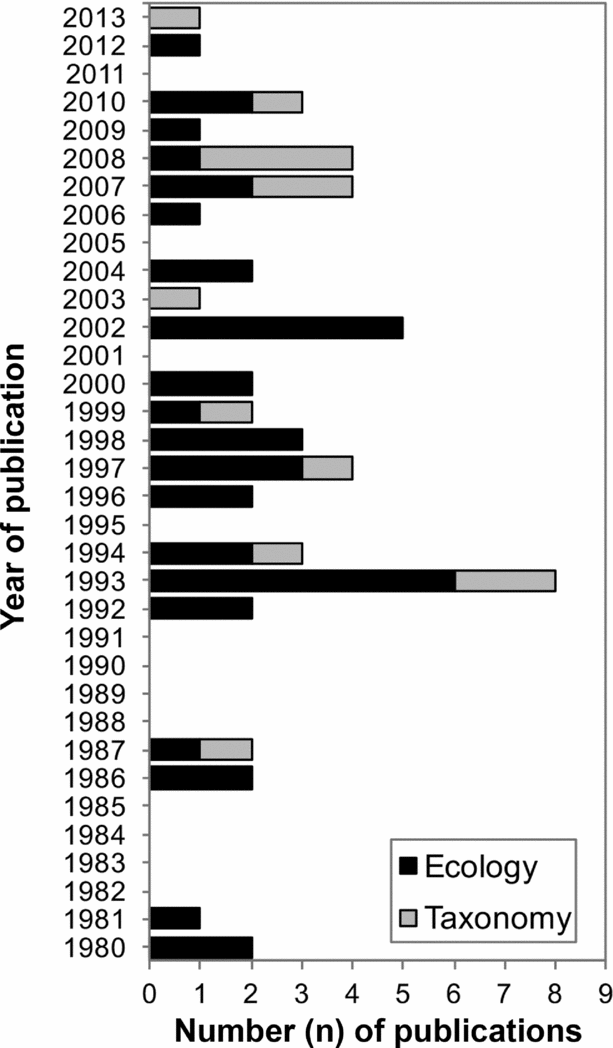
The studies investigating phytoplankton assemblages at the KGI embayments used distinct approaches, with 69% of them focusing on ecological features (comparing phytoplankton populations with environmental aspects) and 31% devoted to taxonomy (identification of new species and fine observation of the existing ones). The number of taxonomic studies increased throughout the years, especially in the 2000s (Fig. 2). The most productive year was 2010, possibly due to the large number of conference presentations related to the International Polar Year.
Approaches of phytoplankton studies in surrounding areas of King George Island, Antarctic Peninsula, throughout the years.

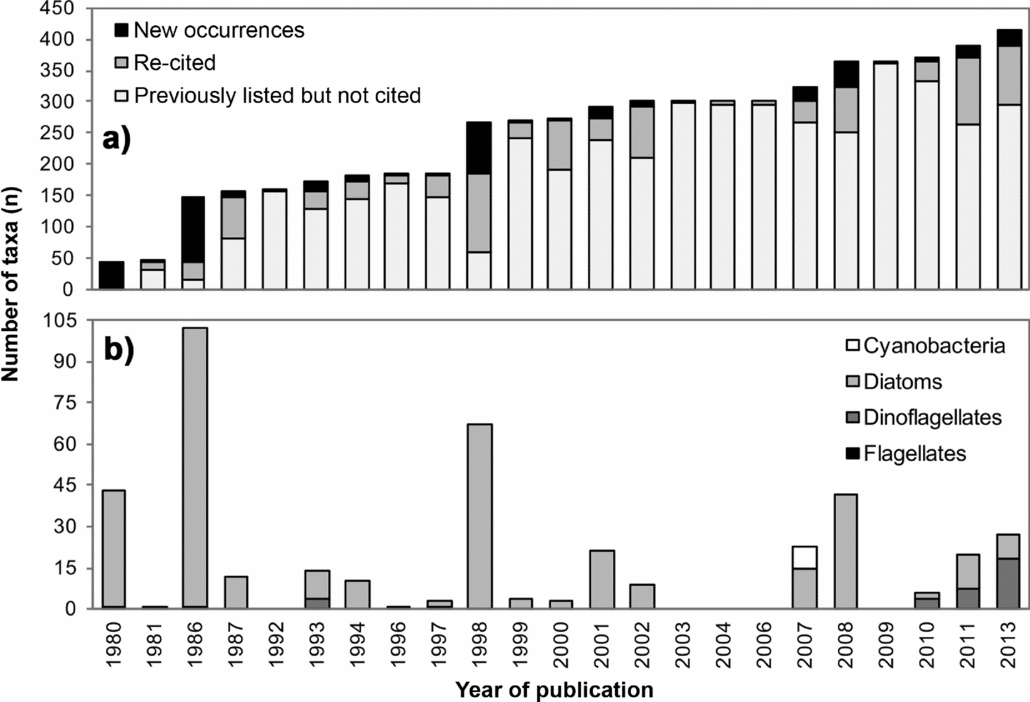
The first studies investigating phytoplankton at KGI were performed at Admiralty Bay (AB) during the 1980s by Polish scientists (Kopczynska, Reference Kopczynska1980, Reference Kopczynska1981; Ligowski, Reference Ligowski1986, Reference Ligowski1987) with the logistical support of the Polish Antarctic Station Henryk Arctowski, installed in 1977 at the entrance of Ezcurra Inlet (AB). These studies generated the first phytoplankton species lists for coastal areas around KGI and, consequently, several citations of new species in the area (Fig. 3). After the inauguration of the Brazilian Antarctic Station Comandante Ferraz at Martel Inlet (AB) in 1984, the South Korean Station King Sejong at Marian Cove (Maxwell Bay) in 1988, and the Argentinean Station Caelini (formerly known as Jubany) at Potter Cove (Maxwell Bay) in 1994, scientific knowledge about KGI increased substantially. In the 1990s, one can find 18 publications about phytoplankton interactions with the environment performed by Brazilian (Brandini, Reference Brandini1993; Brandini & Rebello, Reference Brandini and Rebello1994), Argentinean (Klöser, Reference Klöser1998; Schloss et al., Reference Schloss, Klöser, Ferreyra, Curtosi, Mercuri and Pinola1997), South Korean (Ahn et al., Reference Ahn, Kang and Kang1993, Reference Ahn, Chung, Kang and Kang1994, Reference Ahn, Chung, Kang and Kang1997; Kang et al., Reference Kang, Kang, Chung, Lee, Lee, Chung and Kim1997a, Reference Kang, Kang, Lee, Chung and Lee1997b, Reference Kang, Kang and Lee1999) and Polish researchers (Kopczynska, Reference Kopczynska1992, Reference Kopczynska1993, Reference Kopczyńska1996, Reference Kopczynska1999; Ligowski, Reference Ligowski and Rakusa-Suszczewski1992, Reference Ligowski1993a, Reference Ligowski and Rakusa-Suszczewski1993b, Reference Ligowski, John, Verlag and Ruggell1998; Ligowski & Kopczynska, Reference Ligowski, Kopczynska and Rakusa-Suszczewski1993). The late 1990s marked the beginning of collaborations between countries, such as Spain, Germany and the Netherlands with Argentina, and Sweden with South Korea. After 2000, the number of publications was even higher (22), especially regarding phytoplankton taxonomy and the description of new species in the area (Fig. 3).
Understanding of the biodiversity of phytoplankton and microphytobenthos in coastal areas surrounding King George Island, Western Antarctic Peninsula throughout the years. (a) Cumulative citations per year; (b) absolute number of taxa of each taxonomic group cited in each year.

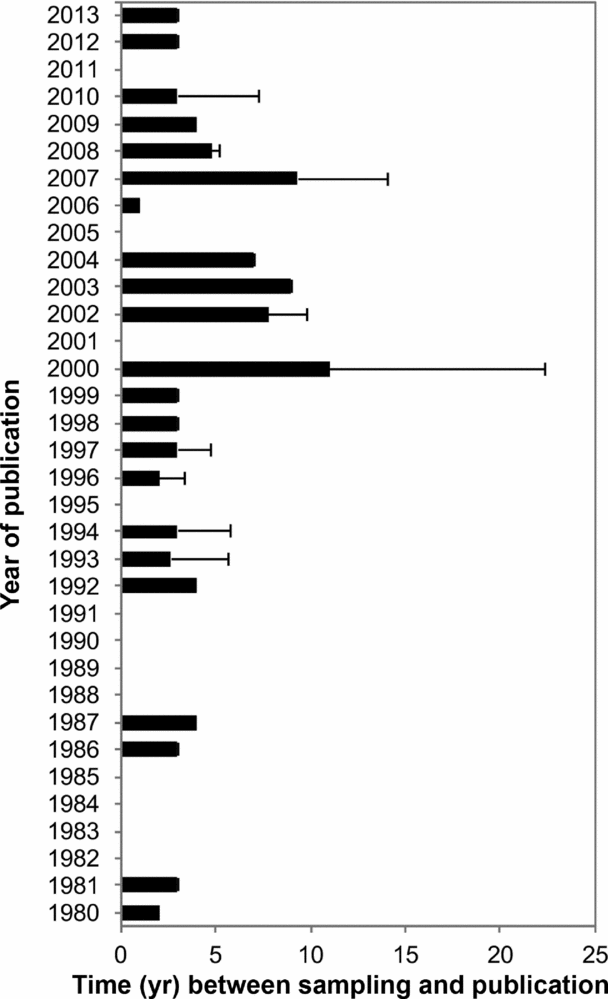
The time between sampling and publication of peer-reviewed articles has been, on average, 5 (±4) years. Starting from a lag-time of 3–4 years, this time gap increased during the 2000s (Fig. 4), coinciding with time-series studies and taxonomic reviews that compiled phytoplankton data collected throughout several years of sampling.
Average time delay between sampling and publication of peer-reviewed articles. Lines show standard deviations.

Environmental and biological controls
The majority of the studies were performed during austral spring and summer, but there are also all-year data from two studies (Lipski, Reference Lipski1987; Tokarczyk, Reference Tokarczyk1986). According to these studies, in the summer sampling period salinity (30.7–35.8) is relatively stable, but seawater temperature (−2 to 3.4°C), nutrients (nitrate+nitrate: 4–46.9 μM, phosphate: 0.2–9.9 μM, and silicate: 20.8–102.0 μM), and chlorophyll a (0.15–17.9 μg l−1) are highly variable (Brandini & Rebello, Reference Brandini and Rebello1994; Kang et al., Reference Kang, Kang, Chung, Lee, Lee, Chung and Kim1997a; Kopczynska, Reference Kopczynska2008; Lange et al., Reference Lange, Tenenbaum, Santis Braga and Campos2007; Schloss et al., Reference Schloss, Ferreyra and Ruiz-Pino2002). Variation in these parameters differed from year to year and seemed to be related to changes in the wind pattern, which, in turn, may influence phytoplankton succession and the intensity of blooms.
In general terms, ideal conditions for phytoplankton growth in the inner inlets and coves of both Maxwell and Admiralty Bays are discussed below.
1) Light (PAR) availability in the water column varies seasonally and is also influenced by the underground input of freshwater melted from glaciers, which is upwelled due to buoyancy and carries particulate matter with it (Pichlmaier et al., Reference Pichlmaier, Aquino, Da-Silva and Braun2004; Schloss & Ferreyra, Reference Schloss and Ferreyra2002). This suspended particulate material increases water turbidity, limiting light availability for primary production (Chung et al., Reference Chung, Kang, Kang, Lee and Kim2000; Klöser et al., Reference Klöser, Schloss, Mercuri, Laturnus and Curtosi1993), thus compromising phytoplankton and bacterial growth (Kang et al., Reference Kang, Kang, Lee and Lee2002). This freshwater upwelling is also responsible for the increased abudance of benthic microorganisms (Kang et al., Reference Kang, Kang, Chung, Lee, Lee, Chung and Kim1997a; Schloss et al., Reference Schloss, Klöser, Ferreyra, Curtosi, Mercuri and Pinola1997) and nutrients (Nedzarek, Reference Nedzarek2008) in the water column, and therefore also limits primary production if absent. In ideal conditions for phytoplankton blooms, winds are moderate.
2) Moderate to low wind speed, preferably easterly winds, favours phytoplankton blooms. On the eastern coast of the bays, strong westerly winds (the most common condition in this region) induce water downwelling in the inner coves/inlets, which contributes to the export of primary production to the bottom, making it available for benthic herbivores (Schloss et al., Reference Schloss, Klöser, Ferreyra, Curtosi, Mercuri and Pinola1997). However, it prevents phytoplankton from accumulating in the water column, reducing planktonic primary production (Schloss et al., Reference Schloss, Klöser, Ferreyra, Curtosi, Mercuri and Pinola1997). When winds are strong and easterly, the intensity of coastal upwellings in the inner eastern coves/inlets is enhanced (Brandini & Rebello, Reference Brandini and Rebello1994; Kang et al., Reference Kang, Kang, Lee and Lee2002; Schloss et al., Reference Schloss, Klöser, Ferreyra, Curtosi, Mercuri and Pinola1997), but the plume of suspended material (and nutrients) is dissipated to the central portions of the bays (outer coves/inlets); as a result, primary production increases in the central channel of the bays, but decreases in the inner portions of coves/inlets (Schloss et al., Reference Schloss, Klöser, Ferreyra, Curtosi, Mercuri and Pinola1997; Schloss & Ferreyra, Reference Schloss and Ferreyra2002). Ideal conditions for phytoplankton blooms in the bays consist of low-speed easterly winds, which are enough to resuspend benthic algae to the water column due to coastal upwelling but do not mix the surface brackish water with the bottom salty layers, causing an increased density gradient that retains these benthic species in surface waters where light and nutrients are ideal for them to bloom (Brandini & Rebello, Reference Brandini and Rebello1994; Schloss et al., Reference Schloss, Klöser, Ferreyra, Curtosi, Mercuri and Pinola1997; Schloss & Ferreyra, Reference Schloss and Ferreyra2002). In contrast, on the western coast of the bays, strong tide- and wind-induced coastal currents (Robakiewicz & Rakusa-Suszczewski, Reference Robakiewicz and Rakusa-Suszczewski1999) hamper the mixing of coastal waters that carry phytoplankton and inorganic suspended material with waters from the central portion of the bays; therefore, blooms that occur in coastal areas do not spread to the central channel (Kopczynska, Reference Kopczynska2008), as occurs on the eastern coast.
3) Nutrient concentrations are usually high enough to sustain primary production in coastal areas (Nedzarek, Reference Nedzarek2008). Euphausiidae zooplankton feed mainly on phytoplankton, but periodically a significant part of the diet is also composed of benthic diatoms (Kittel & Ligowski, Reference Kittel and Ligowski1980; Ligowski, Reference Ligowski2000).
Top-down control by grazers or even secondary consumers as a mechanism controlling the structure of phytoplankton assemblages and accumulation of phytoplankton biomass is not well studied in these shallow areas. It is possible to speculate, however, that the decrease in penguin populations during their breeding seasons (Sander et al., Reference Sander, Balbão, Polito, Costa and Carneiro2007) and shifts in benthic communities (Ahn et al., Reference Ahn, Kang and Kang1993; Montes-Hugo et al., Reference Montes-Hugo, Doney, Ducklow, Fraser, Martinson, Stammerjohn and Schofield2009; Schloss et al., Reference Schloss, Ferreyra, Curtosi, Wiencke, Ferreyra, Arntz and Rinaldi1998) may be correlated with the decrease in diatom production (Kopczynska, Reference Kopczynska2008; Lange et al., Reference Lange, Tenenbaum, Tavano, Paranhos and Campos2014) detected in these shallow areas from 2008 to 2013. Additionally, studies using the physiological state of phytoplankton cells as indicators of environmental parameters are scarce for this region (Chung et al., Reference Chung, Kang, Kang, Lee and Kim2000; Klöser et al., Reference Klöser, Schloss, Mercuri, Laturnus and Curtosi1993; Schloss & Ferreyra, Reference Schloss and Ferreyra2002). For instance, diatom silicification can be used as a good indicator of iron availability in the oceans (Brzezinski et al., Reference Brzezinski, Dumousseaud, Krause, Measures and Nelson2008): under iron starvation, diatoms tend to uptake and accumulate more silica (Hutchins & Bruland, Reference Hutchins and Bruland1998), which is clearly observable in their valves under the microscope. In Admiralty Bay, diatoms are generally poorly silicified (personal communication apud Lange, Reference Lange2011), suggesting that iron does not limit primary production in these waters. However, the closer to the coast the diatoms reside, the more heavily silicified they become (personal communication apud Lange, Reference Lange2011), possibly due to potential ligands present in the suspended particulate inorganic material (Jiang et al., Reference Jiang, Barbeau, Selph, Measures, Buck, Azam and Zhou2013) mostly derived from coastal and glacier melt-water input (Pichlmaier et al., Reference Pichlmaier, Aquino, Da-Silva and Braun2004).
Species composition and seasonal variability
Over 33 years (1980–2013), 415 species from 122 genera have been identified at the species level in the embayments of King George Island: 371 diatoms, 34 dinoflagellates, eight cyanobacteria, one haptophyte, and one silicoflagellate. Some taxa have been identified only to genus, family or order level, mainly those among nano- and pico-flagellates and naked dinoflagellates (Table 1). As new species to science, 10 taxa have been described with local material: the six diatoms Brandinia mosimanniae Fernandes, Cocconeis dallmannii Al-Handal, Riaux-Gobin, Romero & Wulff, C. melchioroides Al-Handal, Riaux-Gobin, Romero & Wulff, C. pottercovei Al-Handal, Riaux-Gobin, Romero & Wulff, C. pinnata var. matsii Al-Handal, Riaux-Gobin, Romero & Wulff, and Melosira brandinii Fernandes & Souza-Mosimann (Al-Handal et al., Reference Al-Handal and Wulff2008, Reference Al-Handal, Riaux-Gobin and Wulff2010; Fernandes & Souza-Mosimann, Reference Fernandes and Souza-Mosimann2001; Fernandes et al., Reference Fernandes, Procopiak and Portinho2007); and the four cyanobacteria Leptolyngbya vincentii Komarek, L. nigrescens Komarek, L. fritschiana Komarek, and L. borchgrevinkii Komarek (Komarek, Reference Komarek2007) (Table 1).
List of species identified for coastal areas around King George Island, Western Antarctic Peninsula, taken from Ahn et al. (Reference Ahn, Kang and Kang1993, Reference Ahn, Chung, Kang and Kang1994, Reference Ahn, Chung, Kang and Kang1997), Alba et al. (Reference Alba, Tenório and Tenenbaum2013), Al-Handal & Wulff (Reference Al-Handal and Wulff2008), Al-Handal et al. (Reference Al-Handal, Riaux-Gobin, Romero and Wulff2008, Reference Al-Handal, Riaux-Gobin and Wulff2010), Bezerra (Reference Bezerra2007), Bezerra et al. (Reference Bezerra, Lange and Tenenbaum2006), Blazewicz-Paszkowycz & Ligowski (Reference Blazewicz-Paszkowycz and Ligowski2002), Brandini (Reference Brandini1993), Brandini & Rebello (Reference Brandini and Rebello1994), Calixto (Reference Calixto2011), Chung et al. (Reference Chung, Kang, Kang, Lee and Kim2000), Corbisier et al. (Reference Corbisier, Petti, Skowronski and Brito2004), Fernandes & Souza-Mosimann (Reference Fernandes and Souza-Mosimann2001), Fernandes & Procopiak (Reference Fernandes and Procopiak2001, Reference Fernandes and Procopiak2003), Fernandes et al. (Reference Fernandes, Procopiak and Portinho2007, Reference Fernandes, Calixto, Lange, Tenenbaum, Valentin, Dalto and Lavrado2013), Gili et al. (Reference Gili, Alva, Pages, Kloser and Arntz1996), Kang et al. (Reference Kang, Kang, Chung, Lee, Lee, Chung and Kim1997a,Reference Kang, Kang, Lee, Chung and Leeb, Reference Kang, Kang and Lee1999, Reference Kang, Kang, Lee and Lee2002), Klöser (Reference Klöser1998), Komarek (Reference Komarek2007), Kopczynska (Reference Kopczynska1980, Reference Kopczynska1981, Reference Kopczynska1992, Reference Kopczynska1993, Reference Kopczyńska1996, Reference Kopczynska1999, Reference Kopczynska2008), Lange (Reference Lange2011), Lange et al. (Reference Lange, Tenenbaum and Campos-Creasey2004, Reference Lange, Tenenbaum and Campos2006, Reference Lange, Tenenbaum, Santis Braga and Campos2007, Reference Lange, Tenenbaum and Campos2008, Reference Lange, Tenenbaum, Campos and Garcia2010), Ligowski (Reference Ligowski1986, Reference Ligowski1987, Reference Ligowski, John, Verlag and Ruggell1998, Reference Ligowski2000), Procopiak (Reference Procopiak2001), Schloss & Ferreyra (Reference Schloss and Ferreyra2002), Schloss et al. (Reference Schloss, Klöser, Ferreyra, Curtosi, Mercuri and Pinola1997, Reference Schloss and Ferreyra2002), Skowronski et al. (Reference Skowronski, Gheller, Bromberg, David, Petti and Corbisier2009), Tatián et al. (Reference Tatián, Sahade, Mercuri, Fuentes, Antacli, Stellfeldt and Esnal2007) and Tenenbaum et al. (Reference Tenenbaum, Lange, Fernandes, Calixto, Alba and Garcia2010). * indicates species that were not present in the list of Guiry & Guiry (Reference Guiry and Guiry2017).

The importance of benthic diatoms as primary producers in coastal waters surrounding the embayments of KGI was evidenced by the frequency of citations of benthic species. Nevertheless, the most frequently cited species was the planktonic, epontic diatom Corethron pennatum, possibly due to its large size and ease of identification, followed by the benthic diatom Pseudogomphonema kamtshaticum and the planktonic Thalassiosira antarctica. The most cited speciose genera were the diatoms Navicula (30), Cocconeis (27) and Thalassiosira (20). In recent years, the citations of new species (Fig. 3a) are attributed to the use of electron microscopy, improving the ability to observe nano-sized diatoms and dinoflagellates, especially naked ones (Fig. 3b).
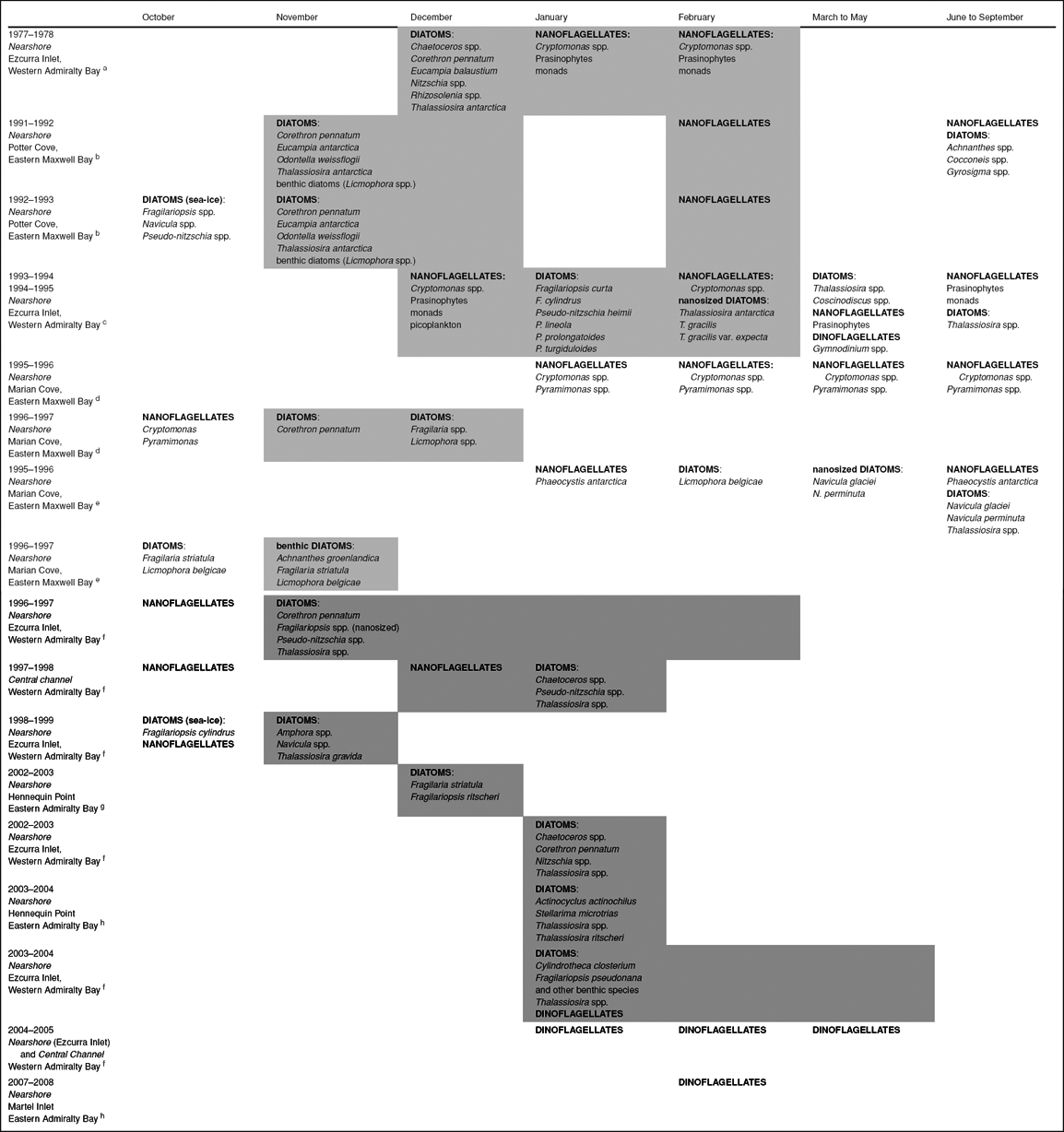
In general, seasonal changes of environmental conditions influence the growth stage of important species such as the diatom Corethron pennatum (Ligowski et al., Reference Ligowski, Ochwanowski, Kostecka, Jasprica, Car and Čalić2008), and also lead to fluctuations in the species composition of phytoplankton assemblages, which normally follow a general pattern (Table 2): Pico- and nano-flagellates (Cryptomonas spp., Prasinomonas spp., Phaeocystis spp.) form a constant biomass background, dominant from March to October; their lowest abundances are observed from June to September, during winter, when they are often accompanied by nano-sized diatoms such as Thalassiosira spp., Navicula glaciei, N. perminuta (Kang et al., Reference Kang, Kang, Chung, Lee, Lee, Chung and Kim1997a, Reference Kang, Kang, Lee and Lee2002; Kopczynska, Reference Kopczyńska1996, Reference Kopczynska2008) (Table 2). During spring and summer, the abundance of small flagellates and monads (flagellates that have lost their flagella) increases drastically, following the seasonality of sunlight. Occasionally, when and where sea-ice is formed during the winter, a small bloom of ice-associated diatoms takes place in the plankton during early spring, as the sea-ice melts (Kang et al., Reference Kang, Kang, Lee and Lee2002; Kopczynska, Reference Kopczynska2008; Schloss et al., Reference Schloss, Klöser, Ferreyra, Curtosi, Mercuri and Pinola1997). With the onset of the summer (November and December) and the initiation of the terrestrial ice melt, there is a drastic increase in diatom biomass in the coastal waters of the bays, which often superimposes the background community of pico- and nanoplankton despite the biomass increase of the latter (Kang et al., Reference Kang, Kang, Chung, Lee, Lee, Chung and Kim1997a, Reference Kang, Kang, Lee and Lee2002; Kopczynska, Reference Kopczynska2008; Schloss et al., Reference Schloss, Klöser, Ferreyra, Curtosi, Mercuri and Pinola1997, Reference Kang, Kang, Lee and Lee2002) (Table 2). These diatom blooms constitute a very important carbon input to local food webs, although the dominant species and intensity of these blooms vary from year to year. A second and less intense phytoplankton bloom, dominated by nanoflagellates, usually occurs in January or February in the central channel of the bays (Kopczynska, Reference Kopczynska1981, Reference Kopczyńska1996; Schloss et al., Reference Schloss, Klöser, Ferreyra, Curtosi, Mercuri and Pinola1997). During these blooms, flagellates can often be accompanied by planktonic diatoms such as Pseudo-nitzschia spp., and nanoplanktonic Thalassiosira and Fragilariopsis (Kopczynska, Reference Kopczyńska1996, Reference Kopczynska2008), which are commonly found in the Bransfield Strait (Kopczynska, Reference Kopczynska2008; Lange et al., Reference Lange, Tenenbaum, Tavano, Paranhos and Campos2014; Mendes et al., Reference Mendes, De Souza, Garcia, Leal, Brotas and Garcia2012; Montes-Hugo et al., Reference Montes-Hugo, Doney, Ducklow, Fraser, Martinson, Stammerjohn and Schofield2009) (Table 2). In the most recent studies (samples taken after 2005), dinoflagellates (Gymnodiniales and Peridiniales) showed an increased importance in the embayments of KGI (Kopczynska, Reference Kopczynska2008; Lange et al., Reference Lange, Tenenbaum, Tavano, Paranhos and Campos2014) and offshore waters surrounding KGI, such as Bransfield Strait and Drake Passage (Mendes et al., Reference Mendes, De Souza, Garcia, Leal, Brotas and Garcia2012), especially during late summer (February and March) when an occasional second bloom of nano- and picoflagellates takes place.
Seasonality of phytoplankton blooms, indicating dominant species and/or taxonomic groups observed in distinct areas around King George Island. Grey cells indicate high biomass events (>104 cells l−1).

a Kopczynska (Reference Kopczynska1981)
b Schloss et al. (Reference Schloss, Klöser, Ferreyra, Curtosi, Mercuri and Pinola1997)
c Kopczynska (Reference Kopczyńska1996)
d Kang et al. (Reference Kang, Kang, Chung, Lee, Lee, Chung and Kim1997a)
e Kang et al. (Reference Kang, Kang, Lee and Lee2002)
f Kopczynska (Reference Kopczynska2008)
g Lange et al. (Reference Lange, Tenenbaum, Santis Braga and Campos2007)
h Lange (Reference Lange2011)
At times of early-summer blooms (November/December), environmental forcing influencing primary production may differ between the eastern and the western shallow shores of the embayments of KGI, resulting in contrasting phytoplankton assemblages (Kopczynska, Reference Kopczynska2008; Lange et al., Reference Lange, Tenenbaum, Santis Braga and Campos2007, Reference Lange, Tenenbaum, Tavano, Paranhos and Campos2014): on the eastern shores, the influence of terrestrial melting and wind-driven upwelling induces the dominance of benthic species such as microplanktonic (> 20 μm) diatoms (e.g. Fragilariopsis spp., Fragilaria spp., Cocconeis spp., Licmophora spp., Corethron spp.) (Kang et al., Reference Kang, Kang, Lee and Lee2002; Lange et al., Reference Lange, Tenenbaum, Santis Braga and Campos2007; Schloss et al., Reference Schloss, Klöser, Ferreyra, Curtosi, Mercuri and Pinola1997), whereas diatoms such as Thalassiosira spp., Pseudo-nizschia spp. and Chaetoceros spp., typical of the Bransfield Strait (Lange et al., Reference Lange, Tenenbaum, Tavano, Paranhos and Campos2014; Montes-Hugo et al., Reference Montes-Hugo, Doney, Ducklow, Fraser, Martinson, Stammerjohn and Schofield2009), are usually the most abundant in blooms of the western shore and central areas of the bays (Kopczynska, Reference Kopczynska1981, Reference Kopczyńska1996; Lange et al., Reference Lange, Tenenbaum, Santis Braga and Campos2007), even though these blooms do not mix (Kopczynska, Reference Kopczynska2008) (Table 2). At some sites, such as Hennequin Point (a very steep corner of the central channel located in the eastern shore of Admiralty Bay), diatom blooms are dominated by benthic species, typical of coastal waters of the eastern shore (Brandini & Rebello, Reference Brandini and Rebello1994; Lange et al., Reference Lange, Tenenbaum, Santis Braga and Campos2007), or by planktonic centric diatoms such as Thalassiosira spp., Chaetoceros spp. and Actinocyclus spp. (Lange, Reference Lange2011) often found in offshore waters. Environmental conditions (wind and current speed and direction, water-column stability) possibly determine which species will dominate blooms at these sites, and therefore changes in species composition can be used as an indicator of environmental change in this region.
Final remarks
Environmental variables govern the accumulation of phytoplankton biomass (Kang et al., Reference Kang, Kang, Lee and Lee2002; Kopczynska, Reference Kopczynska2008; Schloss et al., Reference Schloss, Ferreyra and Ruiz-Pino2002) and the species composition of phytoplankton assemblages (Brandini & Rebello, Reference Brandini and Rebello1994; Kang et al., Reference Kang, Kang, Chung, Lee, Lee, Chung and Kim1997a; Kopczynska, Reference Kopczynska2008) in the coves, inlets and central channels of the embayments of KGI. Changes in species composition, along with physical forcing, lead to distinct sinking rates and photosynthetic performance of phytoplankton populations (Chung et al., Reference Chung, Kang, Kang, Lee and Kim2000; Schloss & Ferreyra, Reference Schloss and Ferreyra2002). The accurate identification of organisms that are becoming ecologically important due to recent changes in the microflora, such as dinoflagellates and cryptophytes (Kopczynska, Reference Kopczynska2008; Lange et al., Reference Lange, Tenenbaum, Tavano, Paranhos and Campos2014; Mendes et al., Reference Mendes, De Souza, Garcia, Leal, Brotas and Garcia2012), is becoming increasingly necessary. Additional studies on the physiology of phytoplankton are also strongly recommended. On-going time-series studies provide a unique opportunity to better understand the dynamic structure of phytoplankton populations, as key species can serve as indicators of climate change in the area and shifts in these dominant taxa may affect this rapidly changing marine ecosystem (Corbisier et al., Reference Corbisier, Petti, Skowronski and Brito2004; Tatián et al., Reference Tatián, Sahade, Mercuri, Fuentes, Antacli, Stellfeldt and Esnal2007).
Acknowledgements
This work integrates the National Institute of Science and Technology Antarctic Environmental Research (INCT-APA). We are very grateful to Dr Elzbieta E. Kopczynska (Polish Academy of Sciences), Dr Maria Celia Villac, and Dr Heather Bouman (University of Oxford) for the reviews, advice and suggestions in relation to this manuscript. In addition, we thank Dr Irene R. Schloss (Instituto Antartico Argentino), Dr Sung-Ho Kang (Korea Polar Research Institute), and again Dr Elzbieta Kopczynska for the supply of publications. We thank Dr Frederico Brandini, Dr Luciano Fernandes, and Dr Jose Juan B. Alba for their important contribution to the Brazilian research on Antarctic phytoplankton at this study area.
Financial support
This work received financial support fromz the National Council for Research and Development (CNPq n° 574018/2008-5) and Research Support Foundation of the State of Rio de Janeiro (FAPERJ n° E-16/170.023/2008).
Conflict of interest
None.
Supplementary material
To view supplementary material for this article, please visit https://doi.org/10.1017/S0032247418000232