Great socioeconomic transitions involve significant shifts in power. Such was the case for universal suffrage, the abolition of slavery, and the end of apartheid. The transition to a postcarbon society will not be different.
Energy systems built around hydrocarbons will have to transition to a zero-carbon paradigm that will entail large shifts in the composition of firms and economic activity. This will inevitably create winners and losers, even if society as a whole is better off. The existential politics of the postcarbon transition (Colgan, Green, and Hale Reference Colgan, Green and Hale2020), notably the $10 trillion worth of assets at risk of stranding (Mercure et al. Reference Mercure, Pollitt, Viñuales, Edwards, Holden, Chewpreecha, Salas, Sognnaes, Lam and Knobloch2018; Tong et al. Reference Tong, Zhang, Zheng, Caldeira, Shearer, Hong, Qin and Davis2019), makes it particularly prone to obstructionism by entrenched interests.
The climate change countermovement (CCCM) has received growing scholarly attention in recent years (e.g., Brulle Reference Brulle2014; Farrell Reference Farrell2016, Vesa Reference Vesa, Gronow and Ylä-Anttila2020; Leonard Reference Leonard2020; Green et al. Reference Green, Hadden, Hale and Mahdavi2021). The CCCM lobby consists of industry associations, carbon-exposed firms, utilities, workers, unions, corporate-funded think tanks, and state-owned enterprises that engage in tactics to weaken climate policies, rather than adapt to them. Finding ways to address this obstructionism is important not only because climate change will affect inequality, conflict, migration, economic development, and governance but also because progress has been stalled in large measure by lobbying and inertia in the political system (Stokes Reference Stokes2020).
The corollary to an active CCCM lobby is the climate movement. The strategic operations of the climate movement have received relatively scant attention in the lobbying literature. To address this gap, we develop a framework that documents five key strategies to overcome obstructionism:
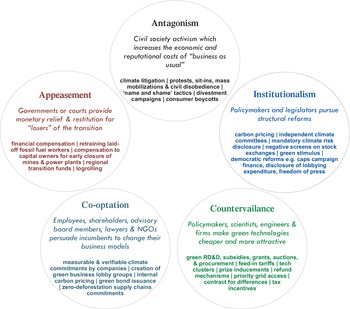
– Antagonism, which increases the reputational and economic costs of participating in obstructionism and “business as usual” activities
– Appeasement, which offers monetary relief, retraining, and restitution to the losers of the transition
– Co-optation, which seeks change from within by co-opting the opposition to reform and diversify their business model
– Institutionalism, which involves regulatory and structural changes at the level of public institutions to make obstructionism harder
– Countervailance, which bypasses direct confrontation with political opponents by supporting alternative technologies and strengthening their disruptive market potential
Each strategy advances a different theory of change, contains distinct tactics, and is best suited to different actors (figure 1). We validate our framework by collecting evidence on the climate movement’s activities and categorizing that by the five strategies (see the database in the Supplemental Material). Finally, we develop a political-economy model of interest group competition and show how the five strategies, and the tactics within them, change a politician’s incentives to enact stronger policy.
Five Political Strategies

We find that the choice of strategy is sensitive to three macrostructural parameters: (1) democratization, which we define as the bargaining power of citizens relative to corporations; (2) climate consciousness, the bargaining power of citizens who support climate policy relative to those who are against it; and (3) green business interests, the bargaining power of businesses that support climate policy relative to those that are against it. Once deployed, the strategies themselves affect these variables, creating feedback dynamics (Farmer et al. Reference Farmer, Hepburn, Ives, Hale, Wetzer, Mealy, Rafaty, Srivastav and Way2019).
Much of the existing literature in climate politics focuses on international climate negotiations. Relatively few studies have investigated how domestic politics and interest group competition constrain climate policy (Keohane Reference Keohane2015). Studies that build on this line of inquiry include Aklin and Urpelainen (Reference Aklin and Urpelainen2013), Meckling (Reference Meckling2019), Brulle (Reference Brulle2014; Reference Brulle2018; Reference Brulle2019), Farrell (Reference Farrell2016), Gullberg (Reference Gullberg2008), McKie (Reference McKie2019), Stokes (Reference Stokes2020), and Mildenberger (Reference Mildenberger2020). Our aim is to build on this literature and make sense of disparate claims on the best path forward toward decarbonization and overcoming obstructionism.
The rest of this article is structured as follows. The next section discusses the issue of climate policy obstructionism and the various forms it takes; we then introduce our theoretical framework, which conceptualizes a politician’s incentives to increase climate ambition and how the five strategies influence these incentives. The following section discusses the five strategies in detail, using a US case study, and the last part looks at strategy choice.
Climate Policy Obstructionism
The history of climate policy reveals the extent to which it has been a tug of war between different interest groups (Stokes Reference Stokes2020). The global policy landscape is replete with examples of the reversal of climate commitments, such as the Australian government’s removal of a carbon price only two years after its enactment, the Bolsonaro government’s accelerated focus on land-grabbing across the Amazon and Cerrado biomes after years of effectively curbing deforestation (Rochedo et al. Reference Rochedo, Soares-Filho, Schaeffer, Viola, Szklo, Lucena, Koberle, Davis, Rajão and Rathmann2018), and the United States’ participation in the Paris Climate Accord, which vacillates according to which party is in power. The persistent difficulty in phasing out global fossil fuel subsidies is a testament to the degree of hysteresis within the political arena (Skovgaard and van Asselt Reference Skovgaard and van Asselt2018).
The CCCM lobby in the United States has swayed politicians through the use of several tactics: such as offering politicians lucrative private sector roles after office (Blanes i Vidal, Draca, and Fons-Rosen Reference i Vidal, Jordi and Fons-Rosen2012), strategically leveraging tax-free corporate philanthropy (Bertrand et al. Reference Bertrand, Bombardini, Fisman and Trebbi2020; Brulle Reference Brulle2018), threatening politicians with competition if they do not acquiesce to demands (Dal Bó and Di Tella Reference Dal Bó and Di Tella2003; Chamon and Kaplan Reference Chamon and Kaplan2013; Stokes Reference Stokes2020), influencing voters by funding advocacy institutions that promote climate skepticism (DellaVigna et al. Reference DellaVigna, Durante, Knight and La Ferrara2016; Farrell Reference Farrell2016; Reference Farrell2019), and inserting representatives into regulatory institutions, such as the Environmental Protection Agency, to dilute climate policy (Leonard Reference Leonard2020).
CCCM lobbying dwarfs climate movement lobbying on all dimensions, including the diversity of tactics, the cultivation of deep political networks (Farrell Reference Farrell2016), and expenditures (Ard, Garcia, and Kelly Reference Ard, Garcia and Kelly2017; Brulle Reference Brulle2018). For example, lobbying expenditures by the CCCM in the US Congress between 2000–16 were more than USD 2 billion (4% of total lobbying expenditures), which is an order of magnitude higher than the political expenditures of environmental organizations and renewable energy companies (Brulle Reference Brulle2018).
However, the effects of CCCM lobbying extend well beyond the paradigmatic US case. Patterns of obstructionism are manifest in other major fossil-fuel-producing countries. For example, in 2013 an estimated one-third of media coverage of climate change in Australia was biased in favor of climate skepticism, with disinformation campaigns openly sponsored by media mogul Rupert Murdoch (Bacon Reference Bacon2013). In India, the government’s majority stake in Coal India Limited, the world’s largest coal company, creates perverse incentives (Burke Reference Burke2015; Nandi Reference Nandi2020). In China, provincial politics is tilted in favor of high-carbon prestige projects (Heerma van Voss and Rafaty Reference Heerma van Voss and Rafaty2022). Even in the European Union, which is considered an innovator in climate policy, carbon-intensive industry associations actively endorsed the emissions trading scheme (ETS) during periods of reform but used it as a Trojan Horse to preempt stricter regulations (Markard and Rosenloom Reference Markard and Rosenbloom2020). Industry also negotiated substantial exemptions, such as the grandfathering of free allowances and the carbon leakage list that exempts trade-exposed carbon-intensive industries from a carbon price altogether (Sato et al. Reference Misato, Rafaty, Calel and Grubb2022).
Passing legislation for decarbonization is difficult because of the sheer value of fossil-fuel assets that will be affected. In monetary terms, the situation is not dissimilar to the abolition of slavery. Slaves made up almost one-fifth of household “assets” in 1860 and, like fossil fuels, were estimated to be worth around USD 10–20 trillion (Hayes Reference Hayes2014). Abolitionists had to deploy a range of tactics to overcome obstructionism.
Several reasons may explain the CCCM’s superior political organization: (1) by virtue of its incumbency, it has greater material resources and political connections at its disposal; (2) the CCCM lobby is a tightly defined group of actors, whereas the climate movement is relatively more dispersed, making organization costlier; and (3) existing laws and institutions cater to a high-carbon paradigm, which creates inertia in the reform process.
Political-Economy Model
To explore interest group competition, we develop a simple political-economy framework that models how a politician’s incentives to enact more stringent climate policy are affected by different agents and institutional factors. Although the literature has looked at political competition from the lens of “green” versus “brown” governments (Aklin and Urpelainen Reference Aklin and Urpelainen2013), we extend it to the case of citizens versus business interest groups (first tier) and, climate-conscious citizens and businesses versus anti-climate citizens and businesses (second tier).
In the model, we assume a politician selects the level of policy ambition,
 $ x $
, such that they maximize the perceived welfare,
 $ W $
, of citizens and business interest groups (equation 1). The politician’s chance of election or reelection increases in
 $ W $
.Footnote
1 The politician cares about citizens because they supply votes and about businesses because they supply campaign finance.
In our model,
 $ x $
represents climate ambition; that is, the target level of emissions reduction. However, in other applications,
 $ x $
may represent the ambition to universalize access to free health care, gain autonomy from a subjugating party, or reform the food industry.
 $$ W(x)=\alpha \underset{\mathrm{Citizenry}}{\underbrace{\left[{\beta}_1{W}_G^C+\left(1-{\beta}_1\right){W}_F^C\right]}}+\left(1-\alpha \right)\underset{\mathrm{Businesses}}{\underbrace{\left[\phi {W}_G^B+\left(1-\phi \right){W}_F^B\right]}} $$
where
 $ \alpha, {\beta}_1,\phi \in \left[0,1\right] $
describe the relative bargaining power of citizens versus businesses, climate conscious citizens versus anti-climate citizens, and green business interests versus CCCM business interests, respectively.Footnote
2 The perceived welfare of
 $ G $
citizens/businesses increases with greater policy ambition (
 $ {W}_G^{\prime }(x)>0 $
) and decreases for
 $ F $
citizens/businesses (
 $ {W}_F^{\prime }(x)<0 $
).Footnote
3
Citizen and business interests are considered separately to capture numerous cases of divergent interests. For example, the interests of the youth who are very active in the climate movement have little overlap with those of large businesses.
We focus on perceived welfare because the true level of welfare an agent experiences in response to different scenarios may differ from how the agent perceives the matter ex ante because of misinformation and biases (Druckman and McGrath Reference Druckman and McGrath2019; Mildenberger and Tingley Reference Mildenberger and Tingley2019). In the case of climate change, evidence shows that weather extremes and the promulgation of scientific information do little to change aggregate opinions in politically polarized countries (Hart and Nisbet Reference Hart and Nisbet2012). Instead, political mobilization by elites and advocacy groups is critical in influencing climate change concern (Brulle, Carmichael, and Jenkins Reference Brulle, Carmichael and Jenkins2012).
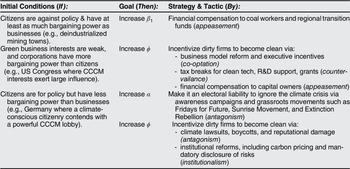
A politician’s incentives to increase policy ambition to advance a social movement’s agenda can be increased via the five strategies, the tactics of which change different parts of the politician’s objective function. From a static perspective, the choice of strategy is sensitive to initial conditions related to democratization (
 $ \unicode{x03B1} $
), climate consciousness (
 $ {\beta}_1 $
), and green business incentives (
 $ \phi $
). From a dynamic perspective, the strategies start to influence these parameters. Table 1 gives an example of how initial conditions influence strategy choice.
The Sensitivity of Strategies to Initial Conditions

Overcoming Resistance Through Five Strategies
Antagonism
Antagonism springs from grassroots movements by civil society, which aim to awaken public consciousness about climate change, diminish the reputational capital and “social license to operate” of CCCM entities, and pressure governments to act with greater urgency to reduce emissions. Advocates pursuing this strategy use tactics that name, shame, sue, and boycott the CCCM lobby, thereby increasing the climate consciousness of the citizenry and threatening the business of hydrocarbons. Mass mobilizations, such as those galvanized by Fridays for Future, Extinction Rebellion, and the Sunrise Movement, fit within the realm of antagonism.
The antagonistic philosophy is well captured by abolitionist Frederick Douglass’s 1857 speech: “If there is no struggle there is no progress. Those who profess to favor freedom and yet deprecate agitation are men who want crops without plowing up the ground; they want rain without thunder and lightning. They want the ocean without the awful roar of its many waters.… Power concedes nothing without a demand. It never did and it never will” (Douglass Reference Douglass1979, 204).
In institutional contexts in which there is “political opportunity” (Gamson and Meyer Reference Gamson, Meyer, McAdam, McCarthy and Zald1996)—that is, a high level of democratization as suggested by citizens having the freedom to assemble, voice demands, exert influence on politicians, and trust the judiciary to remain independent—antagonism may be an effective strategy. One very successful example of antagonism is the Beyond Coal campaign, run by Bloomberg Philanthropies and the Sierra Club, which has retired 60% of US domestic coal-fired power plants (349 of 530 plants to date through public awareness and litigation (Sierra Club Reference Club2021a; Reference Club2021b)).
Similarly, condemnatory exposure of alleged wrongdoing can reduce the social license to operate in a business-as-usual manner. The “Exxonknew” campaign exposed how the company was aware of the dangers of rising CO2 emissions as early as 1968 but publicly sowed doubt and funded climate denialism, thereby delaying decades of climate action (Oreskes and Conway Reference Oreskes and Conway2011; Robinson and Robbins Reference Robinson and Robbins1968). This provided the evidentiary basis for numerous lawsuits filed by states such as New York and California.
Where there is a strong and independent judiciary, climate litigation can also be used by citizens against the government. A high-profile case was the Urgenda Foundation v. the State of the Netherlands (2019), in which Dutch citizens sued their government over its failure to adopt ambitious climate mitigation measures. The court ruled in favor of citizens, arguing that the government was in violation of citizens’ constitutional right to secure adequate protection from environmental harm. Such litigation can not only result in direct changes to government policy but also increase how politicians weigh the welfare of climate-conscious citizens (Wonneberger and Vliegenthart Reference Wonneberger and Vliegenthart2021). There may also be a valid legal case to challenge the issuance of fossil-fuel permits when there are low-cost energy alternatives (Rafaty, Srivastav, and Hoops Reference Rafaty, Srivastav and Hoops2020).
Institutionalism
Institutionalism involves structural changes to incentivize climate-compatible behavior on a system level. Many institutionalists require “windows of opportunity” to push through their reforms, which may arise after elections, mass mobilizations, and exogenous shocks, such as the COVID-19 pandemic: these events may force the system to do things differently (Farmer et al. Reference Farmer, Hepburn, Ives, Hale, Wetzer, Mealy, Rafaty, Srivastav and Way2019). Examples of institutionalist measures that can negatively affect the operations of CCCM corporations include the establishment of independent climate committees, mandatory disclosure of climate risks, green quantitative easing, conditional bailouts, and negative screens on stock exchanges to ensure that listed companies are net-zero compatible (Dafermos, Nikolaidi, and Galanis Reference Dafermos, Nikolaidi and Galanis2018; Farmer et al. Reference Farmer, Hepburn, Ives, Hale, Wetzer, Mealy, Rafaty, Srivastav and Way2019; Hepburn et al. Reference Hepburn, O’Callaghan, Stern, Stiglitz and Zenghelis2020). Institutionalism is a strategy best leveraged by those in government, the judiciary, or the technocrats who advise them.
Institutionalism can also involve the establishment of independent oversight committees that shield climate policy from the vagaries of electoral cycles. For example, under the 2008 Climate Change Act, the United Kingdom established the Committee on Climate Change (CCC), which was tasked with setting science-based carbon budgets every five years, giving independent advice to the government, and reporting to the Parliament on progress. Independent commissions such as the CCC ensure that there are checks and balances against political short-termism. In many political systems, the creation of arm’s-length bodies of this sort may be decisive in enhancing the credibility of long-run emissions targets.
Appeasement
Appeasement provides compensation to the losers of the transition as a means of quelling their resistance. Leveraging this strategy is typically the prerogative of governments, local authorities, and courts. Common forms of appeasement include worker retraining programs, payoffs for workers and asset owners following the early closures of mines, and regional transition funds to support economic diversification in localities that are dependent on climate-forcing assets, such as coal, oil, and gas. Appeasement for workers relies on the theory of change that a successful strategy lifts up the economic hopes and developmental prospects of low-income communities, fostering a just transition. For example, compensation to miners and their communities was a core element of the climate proposal that US president Joe Biden advanced on the 2020 campaign trail when visiting the deindustrialized towns of the Rust Belt. Appeasement for capital owners, in contrast, is based on the idea that it may be politically expedient to compensate powerful lobbyists who may otherwise excoriate important reforms—in the same way that slave owners were compensated during the abolition of slavery.
Starting in 2015, the Climate Leadership Council (CLC) in the United States put forward a national “carbon dividends” proposal that included a provision to establish a legal liability shield, which would statutorily exempt oil and gas companies from all tort liability in court cases seeking restitution for the monetary damages attributed to their historical emissions. This provision was motivated by a theory of change that believed that no comprehensive climate legislation would ever pass Congress without bringing the oil supermajors to the table—and that to bring oil supermajors to the table, the policy must not only provide sticks but also carrots (appeasement). Many environmental groups expressed outrage toward the liability provision. However, another segment of environmentalists preferred to focus on the emissions abatement that could be achieved if “carbon dividends” were adopted. Holding no particularly strong moral conviction about historical liability for emissions, they were willing to endorse the CLC’s proposal as a compromise. In any event, the CLC dropped the proposal in 2019.
Countervailance
Countervailance involves supporting green technologies via industrial policy to create a countervailing power to the CCCM lobby. Governments are best placed to leverage the countervailance toolkit through instituting the following measures: R&D tax credits, innovation incubators, subsidies for green innovation, renewable portfolio standards, renewable energy auctions, government procurement for green technologies, and policies that de-risk green investments. The aim of the countervailance toolkit is to increase the uptake of green technologies and bring down their costs so that they can displace carbon-intensive incumbent technologies.
An example of countervailance is Germany’s feed-in-tariff for solar energy passed in 2000. One of the authors of the feed-in tariff law argued that history would call it the “Birth Certificate of the Solar Age” because it created assured demand for renewable energy that would lead to increased production and learning-by-doing (Farmer and Lafond Reference Farmer and Lafond2016).
Countervailance bypasses head-on engagement with the CCCM lobby and helps dissipate a large portion of the political conflict by enabling market forces to drive rapid deployment (Breetz, Mildenberger, and Stokes Reference Breetz, Mildenberger and Stokes2018). As green technologies acquire market share, novel political realignments tend to emerge (Meckling Reference Meckling2019; Meckling, Sterner, and Wagner Reference Meckling, Sterner and Wagner2017). “Politically active green tech clusters” can become powerful advocates of stronger climate policies, deter policy backsliding, and create further windows of opportunities for institutionalist reform. This feedback dynamic can help advance the energy transition, even in the absence of global coordination (Meckling Reference Meckling2019).
An instructive example occurred in Denmark after a center-right coalition government abandoned several renewable energy commitments in the late 1990s. In response, Vestas, the country’s largest wind turbine manufacturer, threatened to leave Denmark and take its suppliers with it. It then formed an ad hoc green lobbying coalition within the Danish Board of Industry. Quickly realizing that it was in its best interest to heed the demands of the green business coalition, the government reinstated various support measures for the wind industry, admitting that it had underestimated the sentiments of big green businesses.
Co-optation
Co-optation involves bringing climate policy obstructionists to the side of the climate movement. Co-opters can push for a variety of changes within business organizations, such as commitments to stop funding CCCM lobby groups, linking executive pay to measurable emissions reductions, and adopting internal carbon pricing. Co-opters navigate the art and politics of persuasion, and their required skillset is not unlike that of an effective politician.
The theory of change is based on the idea that, by convincing a relatively small number of elite individuals, such as the CEOs of large, energy-intensive companies or top government officials, great sums of capital can be reallocated away from climate-forcing assets. Compared to the other strategies, co-optation is available to relatively few members of the climate movement, and perhaps for this reason, its potential is frequently discounted.
Examples of co-opters in the climate movement include Pope Francis who has used his moral authority to summon oil and gas executives to change strategy; family members of executives who are in a unique position to change hearts and minds; and majority shareholders, high-profile advisers, CEOs, and elite academics who have a sense of climate consciousness (Fink Reference Fink2021; Aguirre Reference Aguirre2021; Brower and Aliaj Reference Brower and Aliaj2021; Engine No. 1 2021; Clark and Crawford Reference Clark and Crawford2012). Co-optation is likely to be a strategy of choice in contexts where ordinary citizens have relatively less bargaining power than corporations.
Looking ahead, strategists of co-optation could move beyond attempts to persuade hydrocarbon businesses and start building new alliances with businesses in sectors that have been largely overlooked in climate policy but can play a pivotal role in precipitating change. Google, Amazon, Facebook (Meta), and other technology companies have plans to eliminate or neutralize their carbon footprints. These companies have market-moving power, and their actions across supply chains, data centers, and global distribution networks could amplify net-zero efforts in other areas of the economy.
Box 1 gives examples of how the five strategies have been deployed in the climate movement in the United States.
US Archetypes of the Five Strategies
Antagonism: Sierra Club (1892–present):
NGO litigating to close 340+ coal plants across the United States
The Sierra Club, founded in the nineteenth century, uses litigation and grassroots campaigns to decommission coal plants across the United States, with 349 plants having closed (amounting to 905 coal-plant production units) and “181 to go” (Sierra Club Reference Club2021a; Reference Club2021b). The Sierra Club claims to have avoided 2,322 miles of gas pipeline (Sierra Club Reference Club2021b).
Institutionalism: Regional Greenhouse Gas Initiative (RGGI) (2009–present):
A cap-and-trade scheme in eastern states
The Regional Greenhouse Gas Initiative Program (RGGI) was the first mandatory, CO2-limiting cap-and-trade program in the United States. Since its inception, the initiative has held 50 auctions, selling 1.11 billion CO2 allowances (worth $3.78bn in total) to electric power generators in the 10 eastern states participating in the program. In 2020, the emissions cap, which drops each year, was 96.2 million tons, with an aim of decreasing to 86.9 million tons in 2030 (Potomac Economics 2010).
Appeasement: The POWER+ Plan (2016–present):
Compensation to coal communities
The Obama administration introduced the POWER+ Plan to invest federal resources in regions that were historically reliant on the coal economy and vulnerable to the energy transition (White House 2015; Congressional Research Service 2019). The plan allocated funds to affected workers ($20m), economic development ($6m), the Environmental Protection Agency ($5m), and rural communities ($97m; White House 2016). Since 2015, the Appalachian region in the Northeast (comprised of Virginia, West Virginia, and Pennsylvania) has received almost $300m in grants to revive and rebuild communities (ARC 2021).
Countervailance: California Solar Initiative (2006–present):
Statewide subsidy for renewable energy
California launched a $3.3bn project to subsidize the installation of solar power generation and displace nonrenewable fuel sources such as natural gas. To date, the scheme has installed 9,671 MW of solar capacity (about five times the program’s initial goal of 1,940 MW; CPUC 2021; Esfahani et al. Reference Esfahani, Chan, Westling, Petrofsky, Litwin, Jimenez-Petchumrus and Francisco2021).
Co-optation: Climate Action 100+ (2018–23):
An investor coalition using signatories’ financial clout to spur climate action
A coalition of 617 investor signatories with more than $60 trillion in assets under management, the Climate Action 100+ engages with companies to reduce their carbon emissions. Signatories concentrate their lobbying on a “focus list” of 167 companies, who are responsible for an estimated 80% of global industrial emissions. The group’s “asks” of companies are to reduce emissions, improve disclosure, and change governance to recognize climate change risk (e.g., in line with the Task Force on Climate-Related Financial Disclosures; Climate Action 100+ 2021).
Choosing Strategies
We now move to a dynamic perspective and consider how the five strategies build off each other. Strategy choice depends, in the first instance, on initial conditions related to the macrostructural parameters: democratization, climate consciousness, and green business interests. Subsequently, it depends on how the deployment of strategies affects these variables. Therefore, from a dynamic perspective, strategy sequencing is important. To see why, consider the following three examples.
Example 1
Consider a setting where the state is heavily captured by business interest groups (
 $ \alpha \approx $
0) and citizens have low climate consciousness (
 $ {\beta}_1<0.5 $
). This setting could, for example, represent a Middle Eastern oil-producing state. In this context, the strategist will want to focus on increasing the strength of green business interests relative to CCCM interests (i.e., increasing
 $ \phi $
) through co-optation or countervailance. Co-optation could be used to convince the ruling elite that the global demand for hydrocarbons is likely to diminish, and there is a need to diversify to fast-growing low-carbon industries. Countervailance could play a role in demonstrating the feasibility and disruptive market potential of low-carbon alternatives. Strategies that require political opportunity such as antagonism are unlikely to succeed because
 $ \alpha $
 $ \approx $
0. If democratic institutional reforms are pursued that increase democratization (i.e.,
 $ \alpha $
= 0.25), then the climate movement’s agenda will still face uncertainties because most citizens are against more ambitious climate policy. The pathway in this case would be to first increase green business interests, which may then translate into greater climate consciousness.
Example 2
Let us now consider a case where democratization and green business interests are low, but citizens’ preferences are tilted strongly in favor of high climate ambition (
 $ {\beta}_1>0.5 $
). This setting could be parts of the United States where citizens favor climate action but the political elite is captured by CCCM lobbies. In this case, if a strategist pursues structural democratic reforms (i.e., raising
 $ \alpha $
) via institutionalism, then the politician will have stronger incentives to support emissions reductions because the voice of climate-conscious citizens suddenly has more weight. If unable to pursue structural democratic reforms that raise
 $ \alpha $
, the strategist could continue pursuing co-optation and countervailance to increase green business incentives.
Example 3
Finally, for a strategist in a setting where most citizens favor stronger climate policy and democratization is high, as in the Netherlands, there is greater political opportunity through which climate-conscious citizens can pursue strong antagonistic tactics such as climate lawsuits. This can directly increase climate policy ambition (e.g., the Urgenda case). The creation of stronger green business interests can also create clusters of green industrial lobbies that can help support institutional reforms such as mandatory disclosure of climate risks and countervailance tactics such as subsidies for green technologies.
Strategy Choice
These examples illustrate how, in a dynamic setting, strategies need to be sequenced appropriately because they can build off each other. Ill-conceived sequencing can lock in stalemates. There are many potential sequencing options depending on the initial conditions and feedback dynamics.
Strategies may also be deployed jointly to increase efficacy. For example, appeasement on its own, without complementary measures, could lead to inefficiently large payouts to CCCM capital owners. It could also create perverse incentives to falsely project continued operations to secure compensation for “early” closures. Germany’s coal exit law stipulates that a total of 4.35 billion Euros in compensation will be paid for planned shutdowns by 2030 (Wettengel Reference Wettengel2020). However, legal challenges are imminent, because the European Commission (2021) has questioned whether “compensating operators for forgone profits reaching very far into the future corresponds to the minimum required.” It is likely that antagonism or institutionalism will be needed as complementary strategies to safeguard public interest and put a reasonable upper bound on compensation to capital owners. Citizens can leverage institutions designed to protect the environment to file antagonistic lawsuits, or alternatively countervailance could be used to create green industrial clusters, which can lobby the government to enact institutional reforms that threaten the CCCM business model.
Our analysis demonstrates that, because of positive feedbacks and mutual reinforcement, each strategy likely has a role to play. Some may initially outperform others because of the institutional context, and others may set the stage for more ambitious action subsequently. Tactics that garner the most success are (1) appropriate to the actors who carry them out, (2) appropriate to the institutional setting in which they are applied, and (3) timely.
Literature in the field has suggested solutions that fall within one ambit or the other: for example, Meckling, Sterner, and Wagner (Reference Meckling, Sterner and Wagner2017) talk about the importance of green industrial policy as a precursor to carbon pricing. By contrast, Zhao and Alexandroff (Reference Zhao and Alexandroff2019) focus on appeasement as a key strategy, highlighting Germany’s compensation efforts as a way to push forward the transition. We combine these perspectives to illustrate how strategy choice and sequencing depend on the initial conditions and the dynamics of three macrostructural parameters—climate consciousness among the citizenry, green industrial incentives, and the level of democratization—and how the deployment of strategies in turn affects these parameters, forming feedback dynamics. Future work could empirically examine how each of these strategies perform in different institutional contexts and explore questions around their sequencing.
Acknowledgement
For thoughtful feedback at various stages of this paper’s development, we thank Cameron Hepburn, Jacquelyn Pless, William O’Sullivan, Matthew Ives, Sam Fankhauser, Thomas Hale, Joris Bücker, Marion Leroutier, Tim Dobermann, Linus Mattauch, Mike Thompson and INET-Oxford EOS seminar participants. Financial support from the Oxford Martin School Programme on the Post-Carbon Transition is gratefully acknowledged. The authors also acknowledge the support of the Climate Compatible Growth Programme at SSEE, Oxford and the Climate Econometrics project at Nuffield College, Oxford.