Littering is a serious environmental issue, with more than 40 years of research into its behavioural motivations (Schultz, Bator, Large, Bruni, & Tabanico, Reference Schultz, Bator, Large, Bruni and Tabanico2013). In terms of awareness and prevention, litter campaigns are often targeted at a national (e.g., Be a Tidy Kiwi, Keep Australia Beautiful) or a city level (e.g., Auckland Council's Waste Minimisation Plan). Schools, however, are another obvious site for such efforts, as there is evidence that younger people tend to litter more frequently than older people (Schultz et al., Reference Schultz, Bator, Large, Bruni and Tabanico2013). In addition, behaviours that develop during youth are likely to extend into adulthood (Hurrelmann & Raithel, Reference Hurrelmann and Raithel2005; Moreno et al., Reference Moreno, Henauw, Gonzalez-Gross, Kersting, Molnar, Gottrand and Marcos2008). However, relatively few school-based littering interventions have been published (see Houghton, Reference Houghton1993, for an exception).
Efforts to reduce littering at school fit within an education for the environment approach, as they assume schools can help create positive environmental impacts (Eames, Cowie, & Bolstad, Reference Eames, Cowie and Bolstad2008; Henderson & Tilbury, Reference Henderson and Tilbury2004). They are also consistent with a holistic approach to sustainability in schools (Eames & Barker, Reference Eames and Barker2011; Henderson & Tilbury, Reference Henderson and Tilbury2004; Shallcross & Robinson, Reference Shallcross, Robinson, Reid, Jensen, Nikel and Simovska2008) that strives for alignment between what is taught in the formal curriculum and what is modelled through other aspects of school life. By creating a ‘culture of sustainability’ (Higgs & McMillan, Reference Higgs and McMillan2006; Schelly, Cross, Franzen, Hall, & Reeve, Reference Schelly, Cross, Franzen, Hall and Reeve2012), schools can increase opportunities for students and staff to genuinely learn about, and participate in, actions to preserve the complex ecosystems we are part of. This article examines a litter-focused project that sat within, and attempted to contribute to, a ‘culture of sustainability’ in a secondary school in Aotearoa New Zealand.
The project took place at a co-educational secondary school in Auckland. The school concerned has an ongoing collaboration with the School of Psychology at the University of Auckland that aims to enhance environmental sustainability at the school, conduct action research on various strategies, and share what is learned (Blythe et al., Reference Blythe, Harré, Sharma, Dillon, Douglas and Didsbury2013). It is also part of New Zealand's Enviroschools network, a whole-school approach to environmental sustainability with a strong emphasis on participation (see Eames et al., Reference Eames, Cowie and Bolstad2008). The school has a sustainability panel consisting of student leaders, staff, a member of the governing board, the Enviroschools coordinator, the research team (including the current authors), and other community partners. The panel is a meeting point for interested people and instigates projects that draw on the values, interests and skills of members.
For some years previously, waste reduction had been a key focus of the panel, and a series of initiatives involving students, teachers, grounds staff, and external supporters resulted in a comprehensive waste management system and a 73% reduction in waste to landfill (Blythe et al., Reference Blythe, Harré, Sharma, Dillon, Douglas and Didsbury2013; Waste Not Consulting, 2013). However, littering was still seen as a problem and a signal that we had ‘missed something’. Hence, we devised a novel littering intervention: the Maui's Dolphin Challenge (MDC). Maui's dolphins live off the coast of New Zealand's North Island, and the species has been described as the most endangered marine mammal in the world with only 55 adults remaining at the time of our project (WWF New Zealand, 2013). The core of the MDC was this: each week for three consecutive weeks, the sustainability panel would donate $200 to the World Wildlife Fund (WWF) to help protect the Maui's dolphin. (This money came primarily from personal donations by adult members of the sustainability panel and the School of Psychology.) However, for every piece of litter we found, $1 would be deducted from the total.
The project drew on a theoretical framework encompassing four psycho-social principles: values, embodied learning, efficacy, and perceived social norms. Essentially, we aimed to elicit and develop protective values toward an endangered animal, create an opportunity for students to act consistently with those values, demonstrate the efficacy of such actions, and convey the sense that these values-based actions were normative within the school. We hoped this would provide a context in which littering would decline and the school's sustainability culture would grow. The psycho-social principles and how they informed the details of the project are now explained.
As noted, the first principle was values. Values are a key part of educating for and inspiring sustainability in schools (Gayford, Reference Gayford1996; Schelly et al., Reference Schelly, Cross, Franzen, Hall and Reeve2012). If an environmentally problematic action is seen as merely breaking the school rules, then students are likely to be emotionally neutral about it. However, if it is seen as harming innocent others, it is considered morally wrong (Nucci, Reference Nucci2001, Reference Nucci2009; Turiel, Reference Turiel2002), and young people often see harming animals in this light (Harré, Reference Harré2011; Kahn, Reference Kahn, Clayton and Opotow2003). Actions that are seen as morally wrong are associated with strong emotions (Haidt, Reference Haidt2007) that serve to strengthen people's desire to avoid the action in question (Mullen & Skitka, Reference Mullen and Skitka2006; Stern, Dietz, Abel, Guagnano, & Kalof, Reference Stern, Dietz, Abel, Guagnano and Kalof1999). In addition, people want opportunities to care (Haidt & Joseph, Reference Haidt and Joseph2004), and framing environmental issues in terms of caring, compassion and a concern for the suffering of others has been linked to increasing pro-environmental attitudes (Feinberg &Willer, Reference Feinberg and Willer2012).
We wanted to shift littering from a practice that was associated with school rules (not only was it against the rules, but picking up litter was an after-school detention activity) to one that was recognised as having real-world implications for the wildlife in our oceans. The project did this in two ways: by providing information about the environmental impacts of littering through posters, assemblies, videos, and the school's daily notices; and by giving students the opportunity to help protect an endangered local animal by putting rubbish in the bin. The national identity of Aotearoa New Zealand is informed by a sense of kaitiakitanga (guardianship) towards local landscapes (Eames & Barker, Reference Eames and Barker2011) and as an island nation, beaches and the ocean are of great significance. Protecting a local dolphin was therefore considered a powerful way to emotionally engage students.
Second, we aimed for this to be embodied learning (see Stolz, Reference Stolz2015), increasing the association between human waste practices and their environmental impact. This was not a hypothetical class exercise; it was a 3-week event that involved real-world actions. We hoped that the embodied nature of the MDC would provoke students into considering more deeply what it means to drop rubbish on the ground. While it may seem punitive to reduce our donation depending on the litter found, we felt this was suited to how littering occurs at the school. The grounds are (reasonably) clean every morning and gradually rubbish appears. We also felt that the game-like structure of the challenge would spark conversation between students and teachers and inspire those who were more enthusiastic about the project to encourage others to participate.
Third, the project aimed to increase students’ sense of efficacy. The structure of the challenge gave students an opportunity to take specific action with a measureable outcome. Feeling your efforts can contribute to positive environmental impacts is important for generating a sense of efficacy in young people (e.g., Blake, Reference Blake1999; Feinberg &Willer, 2011; Hill, Wilson, & Watson, Reference Hill, Wilson, Watson, O'Sullivan and Taylor2004; Monroe, Reference Monroe1991; Wals, Reference Wals1996).
Finally, we drew on the power of perceived social norms. Considerable research in environmental psychology has shown that people are less likely to litter if they believe littering goes against the prevailing norm (Cialdini, Reno, & Kallgren, Reference Cialdini, Reno and Kallgren1990; Kallgren, Reno, & Cialdini, Reference Kallgren, Reno and Cialdini2000; Reno, Cialdini, & Kallgren, Reference Reno, Cialdini and Kallgren1993). We therefore attempted to communicate throughout the MDC that not littering (and perhaps picking up litter) was normal. Given that one clue people use to determine the norm is the state of the local environment (Cialdini et al., Reference Cialdini, Reno and Kallgren1990), we also attempted to pick up all litter from the school grounds before the project began.
The MDC was run twice. The first time around (MDC1) it was led by the university-based members of the sustainability panel, who designed most of the materials and conducted the waste audits. The second time around (MDC2), it was led by students with teacher assistance. The entire project had approval from the University of Auckland Human Participants’ Ethics Committee. We had two specific research questions. The first (RQ1) was: Did the MDC reduce litter? In both iterations, this was measured by waste audits, as will be outlined later. The second (RQ2) concerned the behaviours, motivations and social dynamics that underpinned students’ response to the campaign. In MDC1 we used a questionnaire to explore RQ2, and in MDC2 we had interviews and a focus group with teachers and students to explore this further. Overall, we used an action research cycle (Reason & Bradbury, Reference Reason and Bradbury2006) to develop a case study that we hoped other practitioners and researchers could draw on in their own settings (Stevenson, Reference Stevenson2004). In the discussion section of this article we reflect on the specific findings from our research questions as well as if and how the MDC promoted a culture of sustainability at the school.
Maui's Dolphin Challenge — Iteration One
The first MDC took place towards the end of the school year when only the junior school (approximately 600 enrolled students; Years 9 and 10, aged 13–14 years old) were present. It targeted the most litter prone area of the school, near the canteen.
Procedure and Rationale
Litter audits
Audits were conducted to measure if the campaign had reduced the amount of litter (RQ1). Three audits were carried out in the week preceding the challenge in order to establish a baseline. On the day of each audit, a member of the school's grounds staff picked up the litter in the area prior to lunchtime to ensure a clean foundation. (On the first day the research team also helped to remove old litter, as described earlier.) The audits took place in the last hour of the school day and were conducted by members of the research team or a trained helper. The litter was classified, counted, and recorded. Audits were carried out on the same days during each of the 3 weeks of the challenge and the week after it had finished. This follow-up time period was chosen as we were primarily interested in ascertaining whether there would be an immediate rebound in littering once the challenge was over and the incentive was removed. A comparison area, a popular lunch spot, was also audited each time using the same procedure to see if any reduction in littering had generalised beyond the target area.
Initial communication of the challenge
The challenge was put to students via a poster distributed to form classes (home rooms; see Appendix A). The poster informed students of the challenge and the target area. It also outlined the plight of the dolphins and how they are primarily threatened by fishing nets but, as with all marine creatures, are also vulnerable to litter. It stated that the money would go towards the WWF campaign to protect the Hector's and Maui's dolphins, thereby providing the students with a means to care for these creatures.
Communication of the audit results and donation amount
At the end of each week, the audit that yielded the lowest litter count was used to calculate the donation amount; that is, the number of items found was subtracted from 200. This amount was communicated to students via a form class poster on the first day of the following week (see Appendix B). We communicated the lowest litter count to increase their sense of efficacy with regard to the challenge and to convey the message that not littering (and perhaps picking up litter) was normative. To further reinforce the normative aspect we used statements such as ‘This means hardly anyone is littering’ on the feedback poster (see Appendix B).
Posters and ongoing communication
In week 2 of the project, four posters were placed in the target area. The first poster restated the challenge. The second was a values appeal; it showed a picture of a wounded dolphin with text to encourage students to recognise the harm being done to them and trigger moral concern. The third was a normative appeal; it showed photographs of the target area with no litter and stated that most people were not littering to make salient an anti-littering norm (see Appendix C). The fourth was an efficacy appeal; it gave details of the WWF campaign to show that keeping the school litter free had a meaningful impact. In addition to the posters, reminders about the campaign were placed in the school bulletin every second day and teachers were given links to short videos about the dolphins and were encouraged to show these to their students.
Student questionnaire
A questionnaire was distributed to junior students by willing English or Mathematics teachers 2 weeks after the end of the project. A total of 275 completed surveys were collected (male = 140, female = 105, 30 unknown) representing just under half of the enrolled junior students. In order to measure the reach of the challenge, students were asked to check a box whether they had noticed four types of challenge materials. Specifically, they were asked whether they had seen a form class poster giving feedback on the amount of litter found, a short video about the dolphins, a poster in the canteen area, or heard a reminder about the project in the school bulletin. Students were also asked ‘How many Maui's dolphins are left in total?’, as this number (55) was included in the initial poster communicating the details of the challenge.
To get an indication of students’ response to the campaign (RQ2) they were asked how often they littered and how often they picked up litter during the challenge relative to normal (with a 5-point response scale from (1) much less to (5) much more and the option of ‘I never litter/never pick up other people's litter’). They were also asked to indicate how personally important they considered the MDC (on a 5-point response scale from (1) not important to (5) extremely important). Finally, they were asked: ‘Before the Maui's Dolphin Challenge the amount of litter we found in the target area was up to 175 pieces a day. During the challenge the amount of litter was as low as 28 pieces a day. What do you think led to the reduction in litter during the MDC?’ Students had four lines to write whatever they wished.
Analysis and Results
Campaign reach
Of the four possible modes of communication that were included in the questionnaire, 87.6% indicated they had noticed the school bulletin, 44.8% a canteen poster, 37.8% a video clip, and 36.5% a feedback sheet. Overall, 62% checked two or more modes, and 12.8% checked none (this last group cannot be distinguished from missing responses). In response to the number of Maui's dolphins remaining, 60% of students answered within the 50–55 range.
RQ1: Did MDC1 reduce litter?
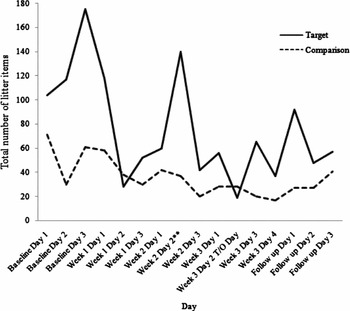
The average number of litter items found in the target area each day during the baseline audits was 136. During the challenge, the average number of litter items reduced to 63. In the follow-up week, an average of 66 items was found in the target area. In the comparison area a very similar trend was shown. This can be seen in Figure 1.
MDC1 litter levels for baseline, duration of the MDC and follow-up weeks in the target and comparison areas.

RQ2: Motivations, behaviours and social dynamics in response to the challenge
There was some evidence that the MDC may have encouraged changes in individual behaviour and the social dynamics regarding littering. When asked about the amount they littered during the challenge relative to normal, 33.5% of students stated that they littered either ‘slightly’ or ‘much’ less than normal (2 or 1 on the scale), while an additional 32.4% indicated that they never litter normally anyway. In regard to picking up litter, 25.9% indicated that they picked up the litter of others ‘slightly’ or ‘much’ more during the course of the challenge (4 or 5 on the scale). Lastly, 83.4% of students responded that they considered the challenge to be either ‘quite’ or ‘extremely’ important to themselves (4 or 5 on the scale).
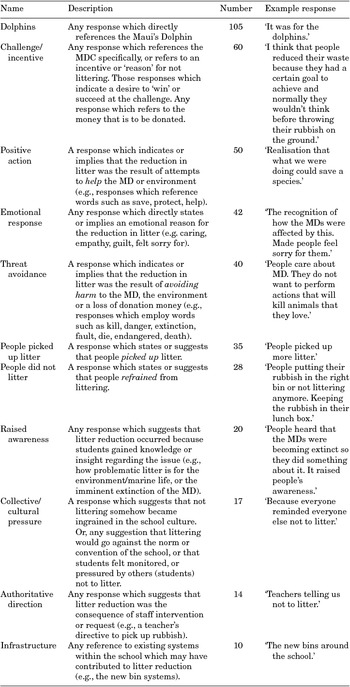
The reasons students gave for what they thought led to a reduction in litter during the campaign were coded into categories that appeared to best capture the data. Author 1 and author 5 independently extracted categories from the responses and then collaborated to establish 11 final categories that can be seen in Table 1. While we did not use a predetermined theoretical lens, we were interested in both the content of the responses and (if appropriate) their affective tone. Three of the categories were related to the latter. ‘Emotional response’ was used for emotional words such as ‘caring’ or ‘guilty’. ‘Positive action’ was used for responses that were about ‘protecting’ the dolphins or ‘increasing’ the amount of the donation. And ‘threat avoidance’ suggested a motivation to avoid a negative outcome, either in relation to the dolphins, using terms such as ‘extinction’, ‘killing’, ‘endangered’, or in relation to the MDC itself; for example, that donation money would be ‘lost’ if people littered. Two of the categories were behavioural observations: ‘people didn't litter’ and ‘people picked up litter’. The remaining six categories each indicated a motivation for not littering or picking up litter; these were ‘dolphins’, ‘authoritative direction’, ‘infrastructure’, ‘raised awareness’, challenge/incentive’, and ‘collective response/pressure’.
MDC1 Categories Allocated for Why Students Thought There Had Been a Reduction in Litter

Authors 1 and 5 then independently categorised all responses into the categories, using multiple categories as necessary. Of the 439 allocated categories (derived from 287 separate responses), both authors initially agreed on 411 (i.e., 93.6%), and came to an agreement on the remaining 28 following discussion. Many responses contained elements that represented multiple categories and were coded as such. For example, the response ‘People were more aware about the impact they had on the environment and littered less to save/help the dolphins’ was coded into four categories: ‘dolphins’, ‘raised awareness’, ‘positive action’, and ‘people didn't litter’. The identified themes, a description of what each entails, the number of responses coded into each theme, and an example response for each category are shown in Table 1.
Summary and Discussion of MDC 1
Results from the litter audits indicated that MDC1 was successful in reducing the amount of litter during the challenge and in the week following, and that this reduction extended to the comparison area. Students’ survey responses indicated good reach of the campaign materials, especially the school bulletin. They also showed reasonable recollection of the number of Maui's dolphins remaining, with this information included in the initial poster outlining the challenge. Many students indicated some decrease in littering and most rated the campaign as of importance to them. Some claimed to increase their picking up of litter. Students’ responses to the open-ended question asking why they thought there was a reduction in litter indicated the dolphins were the primary reason for this, with emotional responses such as ‘caring’ also commonly mentioned. Students also often mentioned the structure of the challenge itself, including the value of having a goal and wanting to maximise the donation amount. It was notable that despite the challenge having an element of negative framing, students used more positive than negative language to describe it. Not only did the ‘positive action’ category outweigh the ‘threat avoidance’ category, but 30 of the 40 ‘threat avoidance’ responses concerned the direct danger facing the dolphins. Only 10 responses concerned not littering or picking up litter to avoid losing donation money. This suggests students generally saw themselves as protecting or saving dolphins, which is consistent with a sense of efficacy. Also of interest were the responses that explicitly indicated raised awareness and a collective response, which significantly outweighed the small number that mentioned teachers instructing them not to litter. One response that nicely captures this was: ‘Probably peer pressure. Also casual pressure from the school. However, it was more convincing than pressuring.’ In summary, there were signs that the challenge raised awareness and captured students’ collective desire to contribute to saving an endangered species.
Maui's Dolphin Challenge — Iteration 2
MDC2 arose from both the promise and limitations of MDC1. From the sustainability panel's perspective, the reduction in litter during and immediately after the project was very positive, and the link between littering and care for an endangered local animal indicated a powerful teaching tool. There was a sense that the MDC had aroused interest and conversation throughout the school. But the challenge only involved junior students, and in the following year littering was still an issue. The new student leaders on the panel were enthusiastic about running it again and therefore took charge of MDC2. The research team helped primarily with the measures, as detailed below.
Procedure and Rationale
The challenge itself was almost identical to the previous year, with the following variations. First, after initial training sessions, student leaders and staff from the school, rather than the research team, carried out the litter audits. Second, given that the students did not appear to have distinguished between the target and comparison areas, the challenge did not specify a target area; instead, it referred to litter found ‘at the school’. Three popular lunchtime areas were identified for the audits. The audits were conducted as in MDC1.
Third, the challenge was introduced by the school's sustainability student leaders during a series of assemblies. Given that MDC1 suggested that emotional responses (e.g., ‘caring’ for the Maui's dolphin) and the desire to protect the Maui's dolphin from harm were particularly motivating for students, the promotional clip for the documentary Midway (Jordan, Reference Jordan2011), directed by Chris Jordan was shown in order to appeal to, and further evoke, these responses. This clip depicts the harm caused to albatrosses from plastic they ingest from the Pacific Ocean.
A fourth variation related to data collection; we did not repeat the student survey. Instead, after the challenge had ended, the first author conducted interviews with the three key staff members involved and a focus group consisting of 11 Year 9 and 10 students (3 male, 8 female) from a science class volunteered by their teacher. Student participation was also voluntary. The discussions were recorded and transcribed, and all identifying characteristics were removed. The staff interviews involved questions relating to general perceptions of the challenge; what aspects they considered most successful; what led to, and detracted from, student engagement with the challenge; and their ideas for improvement. The student focus group similarly focused around their perceptions of how their fellow students responded to the challenge, what aspects may have encouraged and discouraged participation and their ideas for improvement.
Analysis and Results
RQ1: Did MDC2 reduce litter?
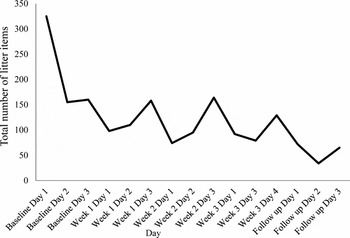
The number of litter items across all three target areas were totalled and compared to the average baseline litter total (see Figure 2). As can be seen, there was less than half the amount of litter by the third week of the campaign and an even more substantial reduction in litter during the follow-up week.
MDC2 litter levels for baseline week, the three weeks of the MDC and the follow-up week.

RQ2: Behaviours, motivations, and social dynamics in response to the challenge
Transcripts from the discussions were analysed using thematic analysis (Braun & Clarke, Reference Braun and Clark2006). In particular, preliminary themes related to RQ2 were identified by author 1 after multiple readings. These themes were subsequently modified in discussion with author 5. As with the categorisation of the open-ended data from MDC1, the analysis was not theoretically based. In this case, we sought broad-based themes that most successfully captured the participants’ reflections on the project. The six themes were: an opportunity to care for the dolphins, the importance of deep understanding, drawing attention to a broader community of action, punishment and shame, peer influence, and teacher buy-in.
An opportunity to care for the dolphins
All staff members were adamant that the plight of the dolphins and the opportunity provided by the challenge to help protect them was essential to its success. As one noted: ‘I think the biggest impact was the dolphins and how things impact them. And then also the positive of how money could support them.’ This suggests the teachers felt the moral appeal and the opportunity students had to act consistently with the moral arousal experienced was critical. Notably, teachers also described ways in which they drew attention to this aspect of the campaign when interacting with students. Sometimes this was in relation to the money they could raise by not littering; for example: ‘It was sort of nice actually to refer to something during the challenge, to actually say “Well, you know, dolphins are dying, they're not going to get money”.’ At other times it was related to the impact of littering on the sea; for example: ‘We had more conversations about why we should pick up rubbish even if it's not ours, because it's going to end up in the circulation and it's going to end up in the sea.’
While the students generally endorsed the appeal of the dolphins, they suggested this was true of ‘some people’ but not everyone. The discussion included reference to peers who did not care because the consequences of littering were ‘not happening to them’.
The importance of deep understanding
Related to this, both teachers and students were aware that there is a distinction between students being exposed to information about the harm of littering and actually understanding it at a deeper level. All the teachers described using the campaign to strengthen understanding. For example, one teacher did so in a very explicit and real-world way:
I take them down to the gate and there's a stormwater kind of area there and it says on it that it leads directly to the sea. And I've got this little slide that shows the waterways and it can actually show you where the litter goes into our stormwater drain and how it flows into the sea and that has had some of the most significant impact on the kids.
From the opposite angle, students referred to their peers’ lack of understanding as being responsible for some not responding to the campaign. For example, one stated: ‘People think if they litter once it's not going to affect [the environment].’
It is of interest that both staff and students believed that the film clip showing harm to albatrosses used in MDC2 was particularly effective in deepening understanding. As one student noted: ‘I knew littering was going to destroy some species but I wasn't exactly aware of like, how much impact it had. When you see the litter inside the bird you recognise it as stuff that you see around here.’ Indeed, a photo we took of the small pieces of rubbish from a waste audit looked almost identical to the contents of an albatross stomach, as photographed by Chris Jordan.
Drawing attention to a broader community of action
While the above theme suggested deep understanding might lead to students keeping the school litter free, some students felt this was not enough, as the problem was so much bigger than them. For example, one noted: ‘We're just high school students, it's not like, our problem because we're young. It doesn't really affect us.’ Others were doubtful that the efforts of one school would make an impact and that this can ‘. . . affect what your mindset is. If you are spending your time on something and it's not going to make a difference you are going to think, why bother?’
However, in an intriguing twist, the students interviewed came up with a solution to this, which was to show other students how their actions were part of a larger community effort. This conversation centred on a recent news item that featured the Maui's dolphin and activist groups’ efforts to protect their habitat. The students discussed how emphasising these items would highlight that it is not just their school that cares about the Maui's dolphin but that many people are taking action. One student reported that reading that article made her aware that: ‘It's actually other people [who are caring] it's not just, our school's doing this, well our school's weird.’
Punishment and shame
The association of picking up litter with punishment and shame was considered a major barrier by teachers. This was seen as related to litter duty being used as a punishment in the past, something that has been phased out over the past 2 years. One teacher noted: ‘The big thing for our kids is, honestly, I don't think we've lived down this culture of picking up litter being shameful and a punishment.’ The concept of shame was also evident in relation to peer influence, discussed next.
Peer influence
Litter was often described by the students as ‘gross’ or ‘disgusting’ and bad for the environment. The staff noted that students often seemed genuinely receptive to the message that littering was harmful when they were being addressed by a teacher, but as one said, ‘put that same child in their peer group and it's a whole different ball game’. Shame seemed a key part of this: ‘There was this conversation [among students] about how they believe littering is bad and how they would put their own litter in the bin but how they won't pick up someone else's litter because they get shamed for it by their peers.’ Students made similar comments. One remarked, ‘If all my friends were doing it [picking up litter] then I'd have to’, while another suggested: ‘It depends on the group, if your friends are likely to get into that sort of thing.’ They also noted that some people might laugh at or antagonise an ‘uncool’ group who were picking up rubbish. Although they did maintain that it would be a minority of students who would be overtly hostile, they considered it likely that fellow students would make verbal remarks. As one student said: ‘Some people would say like, “What are you doing? That's really weird”.’
Staff noted that students would often respond to requests to put their rubbish in the bin with comments such as ‘Why should I when everyone else is littering?’, suggesting that students were unwilling to act against what they perceived to be the norm. Another referred to encouraging student engagement as something of a balancing act, stating: ‘You're playing the game between what is more important, that little voice in their head that says “Don't hurt the dolphins” versus “I need to be cool to fit in”.’ She went on to suggest that the MDC created a situation where students could engage in litter-conscious behaviour more unashamedly, saying: ‘If you can create an environment where they can do that [pick up litter] but keep their pride, then you've got a winner.’
Teacher buy-in
Students also remarked that there was considerable variance in teachers’ involvement. They suggested that this was likely the result of individual teacher interest or knowledge on the subject, with science teachers cited as the most involved. They also discussed how a higher degree of teacher ‘buy-in’ would make the challenge more successful.
General Discussion
Both times it was conducted, the MDC reduced the amount of litter at the school by approximately 50% for the duration of the challenge and the following week. Although the challenge did not eliminate littering, it provoked a response among teachers and students that went well beyond keeping the school tidy or obeying school rules. In important ways it seemed to ‘seep into’ the imaginations and emotions of students. Notably, the school's sustainability student leaders were inspired to run it themselves the second time around. Our study also revealed interesting tensions that prevented a wholesale shift in students’ orientation towards litter and may help explain sticking points in creating sustainability cultures in schools. We discuss the key features of note and their implications below.
First, it seemed that drawing attention to the Maui's dolphin helped associate littering with a moral dimension. This supports the power of a values base to promoting sustainability cultures in schools (Schelly et al., Reference Schelly, Cross, Franzen, Hall and Reeve2012). Most specifically, it indicates that arousing a harm/care dimension (Feinberg &Willer, Reference Feinberg and Willer2012; Haidt & Joseph, Reference Haidt and Joseph2004) in relation to an innocent animal (Kahn, Reference Kahn, Clayton and Opotow2003) can have a powerful effect. As suggested by Gene Myers's research on children's natural affinity to animals, Maui's dolphins were readily seen as having moral relevance (Myers, Reference Myers2007). In retrospect, however, there were some limitations in focusing the challenge on this dolphin. A major appeal for the sustainability panel was that it is a local animal, and we were keen to support action to protect its habitat. However, it is not primarily affected by littering. In the discussions conducted after MDC2, both staff and students talked about the importance of deep understanding in motivating student action, and some staff worked hard to make the link between litter and sea life apparent to students. In light of this, our focus on a species affected predominantly by another problem (fishing practices) may have reduced the coherence of our project and thus limited the opportunity for creating deep understanding. By way of contrast, the albatrosses on Midway Island are directly affected by littering and the students involved in the focus group mentioned how moved they were by the film clip used in MDC2 that featured these birds. Focusing on the albatrosses or another directly affected species may have elicited an even stronger moral response and provided more powerful opportunities for the staff and student leaders to stress how important it is to ensure waste does not become litter.
It is also possible that a second, conflicting moral consideration came into play. While harm/care is one dimension put forward by Haidt and Joseph (Reference Haidt and Joseph2004) another is purity/sanctity. Even though the outcome of a litter-free environment appeals to this dimension, the act of picking up litter may seem to violate it. Students who were part of the focus group after MDC2 frequently described litter as ‘gross’ or ‘disgusting’ and commented on how it depreciates and degrades the environment. As mentioned previously, picking up litter used to be a punishment in the school, supporting its association with the metaphorically ‘impure’; akin perhaps to the untouchables of traditional Hindu culture whose role it is to deal with other people's waste. There appeared, therefore, to be considerable cultural ambivalence in play. On the one hand, a number of responses to the open-ended question on the survey after MDC1 referred to a collective pressure not to litter. For example, someone wrote: ‘People yelled “Save the dolphins!” at anyone who littered.’ Many students also claimed they littered less and picked up litter more during MDC1 (33.5% and 25.9% respectively). From quite a different angle, however, the staff and student discussions after MDC2 suggested that picking up litter was socially censured, and would be considered ‘really weird’, especially if done by an ‘uncool’ group. It is of note that in the survey after MDC1, picking up litter was often attributed to specific groups such as ‘greenies’ or ‘crazy dolphin people’. So, despite students appearing to emotionally resonate with the plight of the dolphins (and albatrosses in MDC2) and generally seeing the MDC as an opportunity to care for them, picking up litter was probably a bridge too far for most. As well as this being influenced by the ‘impurity’ of the act and the social censure around picking up litter, it may also reflect a more general sense that going ‘above and beyond’ for environmental issues is to be a ‘mug’ in some sense. (See Lane, Reference Lane2012, for a discussion of this from a philosophical perspective.)
An obvious solution to the issue at hand is to promote a culture in which no one litters. However, previous psychological research suggests for that to occur the environment must be kept clean, conveying a positive norm (Cialdini et al., Reference Cialdini, Reno and Kallgren1990). And for the environment to be kept clean, at least initially, some people are going to have to pick up after those who do litter. And, furthermore, if those picking up litter are going to be students, the act needs to be seen as socially appropriate, not a mug's game. So, how can a school community be encouraged to embrace those who are willing to go ‘above and beyond’ in service of an environmental good?
Peer leaders are one option for this. These are community members who are educated about an issue and then asked to share this information with their social networks and actively model and encourage the target behaviour. A number of studies have found peer leaders to be effective in promoting change within communities (Story, Lytle, Birnbaum, & Perry, Reference Story, Lytle, Birnbaum and Perry2002; Valente & Davis, Reference Valente and Davis1999) and schools (de Vreede, Warner, & Pitter, Reference De Vreede, Warner and Pitter2014), including on environmental issues (de Vreede et al., Reference De Vreede, Warner and Pitter2014; Hopper & Nielsen, Reference Hopper and Nielsen1991). Teachers could also play a role in modelling anti-littering behaviour and in increasing the social status of this. Our discussions after MDC2 revealed many strategies that some teachers used to increase the salience of the underlying environmental issue and the importance of the related behaviour.
As discussed previously, a sense of efficacy is also important for motivating environmental action (Hill et al., Reference Hill, Wilson, Watson, O'Sullivan and Taylor2004; Wals, Reference Wals1996). Students interviewed did suggest that feeling they were ‘not going to make a difference’ might have inhibited engagement with the campaign. It was particularly interesting, however, that they also discussed how this could be overcome by feeling part of a broader community of action. This suggests that to help build an environmentally responsible waste culture in the school, it is important to show how the school's efforts are aligned with those of others.
There were limitations to the project. We did not attempt to precisely measure the impact of each element of the campaign by trialling each one individually or in different settings. Our primary focus was to run an intervention to disrupt littering habits, based on the local context and our collective knowledge and skills. We also did not solve the litter problem at the school once and for all, as litter continues to accumulate from time to time on the grounds, especially after the chaos of a wet lunchtime. But many teachers and students have talked with us informally about their increased awareness of litter and compulsion to pick it up and talk with others about its potential impact on ecological systems. A peer-education style intervention is currently being discussed by the sustainability panel as a possible next step.
This was a novel challenge that captured the imagination of the school's sustainability leaders and provided opportunities for deep level conversations. It fed into the ‘messy’ process of working within a complex school system (see Chapman, Reference Chapman2004) and encouraging a sustainability culture. In relation to the theoretical framework we proposed in the introduction, this research showed that there is considerable promise in drawing on values and giving students a sense of efficacy with regard to an environmental issue that is meaningful to them. It also showed the importance of social norms. The project attempted to highlight positive social norms, but it must be noted that powerful norms, and even taboos, against picking up litter were also found to be in play. Finally, there was evidence of embodied learning, especially in relation to the emotions aroused by the plight of the Maui's Dolphin and the need for students and teachers take action in order to meet the challenge posed by the project. We invite other researchers and practitioners to explore the utility of these psycho-social principles in their own contexts.
Acknowledgements
Members of the Western Springs College Sustainability Panel are thanked for their involvement, particularly those who led the second iteration of this project: Kathryn Jenkin, Robert Forster, Lily Foote, Sahmay Abplanalp, Lena Trnski, Rhone McCartney and Isabella Lenihan-Ikin. Thanks to all the staff and students who participated in the survey or research discussions. Quentin Atkinson and Douglas Elliffe are thanked for their contribution to the design of the study. Thanks also to those who contributed to the donation fund.
Appendix A Poster outlining challenge for form classes

Appendix B Example of feedback notice delivered to form classes throughout the running of the challenge

Appendix C Example of poster used around the school during the challenge

Author Biographies
Carly S. Townrow is currently a PhD student at the University of Auckland studying political psychology with an emphasis on the repercussions of people's perceptions of inequality. She is also passionate about environmental sustainability and is interested in those factors that encourage action taking and protest behaviours in this area.
Nick Laurence holds a BA in Psychology from Otago University and a BA (Honours) in Psychology from Massey University. He is studying towards a Doctorate of Clinical Psychology at Massey University in Wellington. He is interested in the cross-section between mindfulness, compassion, wellbeing, and climate change.
Charlotte Blythe works as an engagement coordinator in the sustainability and environment team at the University of Auckland. She is completing a PhD exploring student environmental leadership and the potential of university-school partnerships for creating a culture of sustainability in secondary school communities. Charlotte enjoys filmmaking, yoga, and finding ever-more ways to reduce waste.
Jenny Long graduated with a BSc (Hons) in psychology from the University of Auckland and has recently completely her PhD. Jenny's PhD research focused on young people's pro-environmental behaviour within a high school social network. This work applied qualitative and quantitative research methods, including social network analysis, to help understand how environmental behaviour was distributed in the school social network and the potential impact of friends in shaping these behaviours. During her time away from a computer screen, Jenny is an avid cyclist and outdoor enthusiast.
Niki Harré is an associate professor in the School of Psychology at the University of Auckland where she teaches social and community psychology. She also coordinates the sustainability network for the university's Faculty of Science. Her recent research projects have looked at sustainable schools, positive youth development, and political activism. Her most recent book is called Psychology for a Better World: Strategies to Inspire Sustainability. It is free to download from www.auckland.ac.nz/psychologyforabetterworld.