Introduction
In 1978, Edward Said published Orientalism, a critical study of the historical development of the relationship between Occident and Orient. He revealed the relationship between academic knowledge relating to the Orient and power by Western scholars. His criticism of the Western academic tradition and its close relationship with the Western subjugation of the Orient has had a great influence on academic fields relating to post-colonial societies in the Middle East and beyond. Most scholars who engage in studies involving the Middle East and Islam, the direct object of his criticism, have reacted with introspection. For instance, some scholars have traced the “archaeology” or “genealogy” of Orientalism in western countries.Footnote 1 In short, the element of political power in knowledge systems has come to be a more sensitive issue in western academia.Footnote 2
Of course, the problems of Orientalism are not limited to western academic circles. Rather, it is a common problem in much modern scholarship on the Middle East. Western academics have greatly influenced the academics of the non-western world since the modern era. It is no exaggeration to say that western academia has played a central role in shaping the modern knowledge system, and thus that issues concerning power and knowledge have not been limited to western academic circles. In other words, it has been necessary for non-western scholars also to pay attention to the relationship between power and knowledge.
In fact, there was a close relationship between “professional” Middle Eastern studies and power in late-modern Japanese academe. For example, as Hisae Nakanishi has noted, when Iranian studies in Japan began in the 1930s, the motivation was partly political and strategic, since Japan’s military was advancing into Muslim regions in northwest China and Southeast Asia.Footnote 3 In addition to her study, many “archaeological” studies from the Islamic and Middle Eastern studies in Japan of this period have explained how Japanese military strategy in northwest China and Manchuria motivated this early research.Footnote 4 Indeed, not only specific institutions for Islamic and Middle Eastern studies such as Kaikyōken KenkyūjoFootnote 5 (Research Institute of the Islamic World) supported this research, but also the military supported the establishment of friendship associations with Muslims. Middle Eastern studies, including Iranian studies, in 1930s Japan thus had a close relationship between knowledge and power outside the context of Western Orientalism. In other words, according to many “archaeological” studies in Japan, Middle Eastern studies in modern Japan was not directly related to western Orientalism.Footnote 6
However, one should pay more attention to the academic study of Iran in modern Japan before concluding that Iranian studies in modern Japan had no direct relationship with western Orientalism. Nakanishi and other scholars have unconsciously confined Iranian studies or Middle Eastern studies to the academic works of those who were professionally trained in languages and other skills, like the Orientalists, and they have focused only on academic works of the 1930s. In short, they have grasped Iranian studies as a general concept and have discussed the development of Iranian or Middle Eastern studies in Japan by limiting this to professional works. This narrow focus is understandable because now “Iranian studies” refers to an independent discipline of area studies that includes social sciences and humanities in general, but they have neglected the possibility of a more broadly defined Iranian studies, namely the academic study of Iran or the Middle East before the 1930s by those who were not trained in specific academic skills within Middle Eastern studies.
If we focus on the historical development of diplomatic relations between Japan and IranFootnote 7 in the modern period, it is difficult to believe that there were no academic works on Iran or the Middle East before the 1930s. Diplomatic relations between the two countries started with a meeting between the Japanese minister in Russia, Takeaki Enomoto, and Nāṣer al-Din Shāh in Saint Petersburg in 1878.Footnote 8 This was only ten years after the Meiji Restoration of 1868. The Meiji Restoration was a turning point in the modernization of Japan. The new Japanese government actively tried to adopt the western system of governance and values in various social, economic, and industrial spheres. In addition, the government tried to create diplomatic relations with foreign countries, in contrast to the former Edo Shogunate closed-door policy of more than 200 years.
In 1880, following foreign minister Kaoru Inoue’s offer to the Iranian state, a delegation to Iran was planned to investigate the Iranian market and negotiate a trade agreement. As a result, Japan’s first official delegation, consisting of seven members, was dispatched.Footnote 9 The delegation traveled to Tehran from Bushehr via Shiraz and Isfahan and had an audience with Nāṣer al-Din Shāh in 1880. In addition to this first official delegation, other Japanese military officers, merchants, and travelers explored Qajar Iran in the Meiji period (1868‒1912). For example, Yasumasa Fukushima traveled to Iran in 1896, just after the assassination of Nāṣer al-Din Shāh. Toyokichi Ienaga also traveled to Iran for business investigations in 1899.Footnote 10 Likewise, Iranians such as the former prime minister of the Qajar dynasty Atābak-e Aʻẓam Amin al-Solṭān (1858‒1907) traveled to Meiji Japan.
These exchange visits inspired research into both countries. Some Japanese researchers tried to describe their travel experiences in Iran through their travelogues.Footnote 11 Although they succeeded in vividly reconstructing their experiences, it is unclear how Japanese academia at that time was related to Iran. In addition, it is unclear how academia received or reacted to these travelogues at the time. Nonetheless, there were some writings on Iran and the Middle East even in the Meiji era.Footnote 12 Although Iranian studies now denotes an independent discipline of area studies that includes the social sciences and humanities in general, here it is defined more broadly as the study of Iran in modern academic circles.
As mentioned above, the Meiji Restoration was a turning point toward modernity in Japanese history, and Japan tried to adopt the western system, including in academia. In addition, the Meiji government gradually progressed from unequal diplomatic relations with western countries at the beginning of this period to an imperialism of its own by adopting the policies of increasing the wealth and military power of the government. This indicates the possibility that Japanese academia also imported knowledge about the Middle East including Iran. If this were the case, Iranian studies in modern Japan would have at least some relationship to western Orientalism.
This article will explore three questions. First, what kind of knowledge system concerning Iran existed in Japanese academia in the Meiji period, which pioneered the field of professional Iranian studies beginning in the 1930s? Second, how did Japanese academia treat travelogues about Iran? And third, how did the knowledge system regarding Iran relate to western academia and Orientalism? In short, this article explores the relationship between modern western academia and an indigenous academic tradition in a non-western country in the modern period by focusing on the case of the development of Iranian studies in Japan. Specifically, it focuses on two important academic or proto-academic fields regarding foreign countries in that period: (1) geography, which became the academic cultural tradition in Japan, and (2) proto-international politics,Footnote 13 which were shaped by the political conditions.
Geography, Adventure, and Travelogues in the Meiji Period
Modernizing the geographical tradition in the Meiji period
In the premodern Japanese academic tradition, geography played a central role in the knowledge system concerning foreign countries. The Tokugawa Shogunate closed the country to foreigners and limited trade to specific partners and places of association. In this period, geographers collected information on foreign countries through Chinese materials. Although primarily Chinese materials influenced Japanese geographers, Western materials had a gradually increasing influence on Japanese geographers from the early nineteenth century.Footnote 14 In fact, it was western-derived knowledge that contributed to the formation of the Japanese geographical distinctions of Persian, Turk, and Arab.Footnote 15
Geographical trends in the early Meiji period also contained these two aspects: one was a geography that blended Chinese tradition with imperialism, and the other was western geography, mainly physical geography. The former trend spread from the public to the private sector, and the latter spread in the modern university.Footnote 16 Western geography meant mainly physical geography, as modern geography developed as a natural science, and the development of modern geography in the liberal arts and social sciences before the end of World War II was limited.Footnote 17 However, human geography in the early Meiji era played the role of collecting general knowledge on foreign countries, as it did in the late Edo era. In addition, this human geography played a strategic role in the modern state and was the object of much concern.Footnote 18 Indeed, the establishment of the Tokyo Geographical Society (TGS) on 18 April 1879 suggests the importance of human geography at that time.
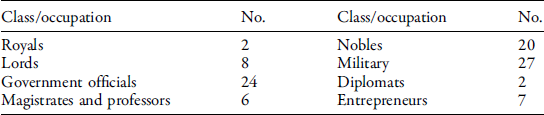
TGS was organized as a society for “geographical studies.” Although the society has since experienced organizational change, it still exists today. Table 1 shows the class and occupation of the original 96 members of the society. More than 20 percent of the members belonged to the privileged royal class and noble class. The rest of the members were commoners, but they belonged to high socio-economic classes. In the year following its establishment, more high-class members were added to the society.Footnote 19 However, the scale of the society was limited. In 1891, a year before its absorption/merger discussed below, there were still only 160 members.
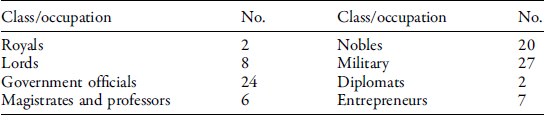
The establishment of the society emulated the Royal Geographical Society (RGS), which was patronized by the British royals.Footnote 20 The royal members in TGS provide one example of this trend. Prince Kitashirakawa Yoshihisa became the society’s first president upon the request of Naohiro Nabeshima and Moriyoshi Nagaoka, members of RGS, as part of establishing the platform of the society. Prince Kan’in Kotohito later succeeded him as president. Furthermore, in 1883 Prince Arisugawa Taruhito and Prince Fushimi Sadanaru participated in the society. In the Taisho era, royal princes were welcomed as honorary members when they came of age. The TGS emulated RGS not only in membership composition but also in sponsorship. For instance, in April 1881 the Imperial Household gave the society 1,000 yen.
In addition to its royal members and patronage, the general members from high socio-economic classes played an important financial role. It was necessary for these members to pay an expensive initiation fee and an annual membership fee. In addition, most members were not involved with geography or academics directly in terms of their occupations. Instead, the society was like a salon for the higher social classes. In fact, some society events were not academic, but were merely for socializing, such as balls.Footnote 21
The society also emulated RGS’s spirit of adventureFootnote 22 and placed great importance on “field studies.” Although some members continued to study documents, reports from field experiences in foreign countries were prized. This is also indicated by the articles in Tōkyō Chigaku Kyōkai Hōkoku (Journal of the Tokyo Geographical Society), an internal bulletin issued by the society from 1879 to 1897. The journal published articles based on speeches in the regular meetings of the society about personal experiences of travel to foreign countries.Footnote 23 In addition, there were paragraph-length articles. Such articles included translations of travel reports published in journals in foreign countries such as the UK and the USA as well as translations of the official gazettes of foreign countries. Articles in the journal were of course not limited to articles relating to foreign countries, however. There were also articles relating to history, geology, meteorology, geodesy, and so on.
Despite initial success, TGS faced the increasingly difficult problem of developing its academic activities because of the limitations of its members. In the end, TGS decided to absorb the Society for Geography (Chigaku kai) in 1893. The Society for Geography had worked to introduce the modern western geographic tradition into Japan, especially physical geography. Members of the society mainly consisted of those who were studying or had studied geology at Tokyo University. They also published an academic journal, Chigaku Zasshi (The Journal of Geography), to present their research. Although the journal influenced officials, their activities were entirely voluntary, and so they faced financial difficulties. Eventually, they agreed to the absorption of their society into TGS. After this absorption, both journals continued to be issued, and the former Society for Geography members also submitted articles to the Journal of the Tokyo Geographical Society.
Finally, due to increasing costs of publication after the First Sino-Japanese War, The Journal of Geography came to be the only journal issued by TGS. Travel reports like those previously found in the Journal of the Tokyo Geographical Society were then included in The Journal of Geography. The next section will focus on articles about Iran in the Journal of the Tokyo Geographical Society, which was issued from 1879 to 1897, and in The Journal of Geography from 1894 to 1912.
The spirit of adventure and travelogues
The first articles on Iran in the Journal of the Tokyo Geographical Society were by Sei’ichi Kawamoto, who contributed two articles on the geography and history of Iran. He had been a teacher in a western-style school patronized by the Tokugawa Shogunate, and he was the son of Komin Kawamoto, who had become famous for studying western sciences by means of the Dutch language in the late Edo period. Just as his father had introduced western sciences, Sei’ichi Kawamoto used western geographical sources to write his articles. Although he based his ancient history of Iran on Chinese history books such as the Records of the Grand Historian by Sima Qian, he primarily used history books, geographical reports, and dictionaries written by western scholars.Footnote 24 He used these to explain the geographical characteristics of Iran such as its climate, specialties, population, demographics, regions, provinces, and cities.Footnote 25
As mentioned above, one of the characteristics of TGS was its spirit of adventure, as inspired by RGS. Kawamoto’s document-based geographic articles on Iran were his only two in the journal, while the rest of the articles on Iran in the journal were based on field experience. The oldest article based on travel experience was the report of Ienori Honjuku, issued in 1880. He was a naval lieutenant and had made a voyage to the Persian Gulf earlier that year. His voyage was part of his practical training for ocean navigation for the Japanese navy. He boarded the Japanese warship Hi’ei and reached Muscat via Hong Kong, Mumbai, and so on, on 4 July 1880.Footnote 26 On 9 July, he arrived at the port of Bushehr and stayed there for twelve days. He briefly reported on the ethno-religious groups, food culture, military service, and local specialties based on his experiences.Footnote 27 His main accounts of Bushehr focused on its hot climate, and he repeatedly reported on the heat to emphasize overcoming the hardship of the adventure.
A year later, in 1881, Nobuyoshi Furukawa and Masaharu Yoshida, who had traveled to Qajar Iran as part of the first diplomatic delegation, also published articles in the journal. Yoshida’s report, “Perusha Kikō: Bagudaddo oyobi Basura Kikō” (Travels to Persia: Baghdad and Basra), unfortunately covered only part of his travels with the official delegation, namely in Baghdad and Basra. In other words, his travelogue does not relate his full experience in Iran. In addition, the style of description is very different from that of his travelogue, which was later published as Kaikyō Tanken: Perusha no Tabi (Exploring the Muslim World: Travels in Persia) in 1894.
In contrast, the reports of Furukawa in the journal were similar to his official report, titled Perusha Kikō (Travels to Persia) and published secretly in 1891. Furukawa’s official report was submitted to the general staff office and gave his account of Iran with a section on general information and one for his daily reports. While his experiences were reflected in his daily reports, the general information had strategic value for the government. It is therefore surprising that his series of eight articles contained a similar account of this general information.Footnote 28
Although there are some differences between the official report and the series of reports,Footnote 29 the contents are nearly identical. He reported on general geographical information, the political system, law, religion, trade, specialties, history, royal families, revenues and taxes, education, the telegraph system, the postal service, the monetary system, weights and measures, the calendar system, transportation conditions, population, climate, and military systems.
After these reports in the journal, there were no articles on Iran in the Journal of the Tokyo Geographical Society. After discontinuance of this journal, however, two travelogues appeared in The Journal of Geography. Footnote 30 One was the travel report of Shiro Kubota and the other was that of Mashizu Suzuki. Upon the request of Nagaoka, the secretary general of the society, Kubota gave a lecture about his travels in Iran at the regular TGS meeting on 15 February 1902. According to his account, he had traveled to Iran in 1901, primarily to research opium there, and he had traveled around areas connected to opium.
There have been scant relations between Persia and Japan, and few Japanese have visited the area. Now there are also scant relations between the two countries. However, relations between the two countries have gradually strengthened since the cession of Taiwan Island as a result of the First Sino-Japanese war because opium from Persia, its principal product, was congenial to the native Taiwanese taste. My visit to and investigations in Persia are based on the same reason. Therefore, I only visited places related to opium in Persia and I could see only a limited part of the whole land of Persia.Footnote 31
According to his account, the cession of Taiwan led to a new relationship between Japan and Iran through the opium trade. Previously, Furukawa had also described opium sales to Taiwan in Shiraz.Footnote 32 In addition, Kubota was a member of Mitsui & Co., a major trading company which handled opium not only in Taiwan but also in mainland China. In fact, his main purpose for visiting Iran was to investigate opium there, but he nonetheless reported about geographical features, the climate, traffic networks, the condition of the telegraph, the postal service, and industry. It is unclear, however, where he traveled in Iran and whether his report was based only on his personal experiences.
Contrary to Kubota’s, the series of reports by Suzuki clearly described his personal experiences.Footnote 33 In his first four reports, he wrote about his travel route to Iran and then within Iran. It is worth noting that his route was different from other Japanese travelers of the time. Yoshida’s official delegation party had traveled to Bushehr by ship and then to Tehran via Shiraz and Isfahan by land. After reaching Tehran, they had traveled to Bandar-e Anzali though Qazvin and Rasht. This was the general route for other Japanese travelers at that time. In fact, Yasumasa Fukushima in 1896 and Toyokichi Ienaga had followed exactly the same route.Footnote 34 Suzuki, however, traced the opposite route to Tehran and traveled from Tehran to Nastarābād in Sistān Province via Mashhad.
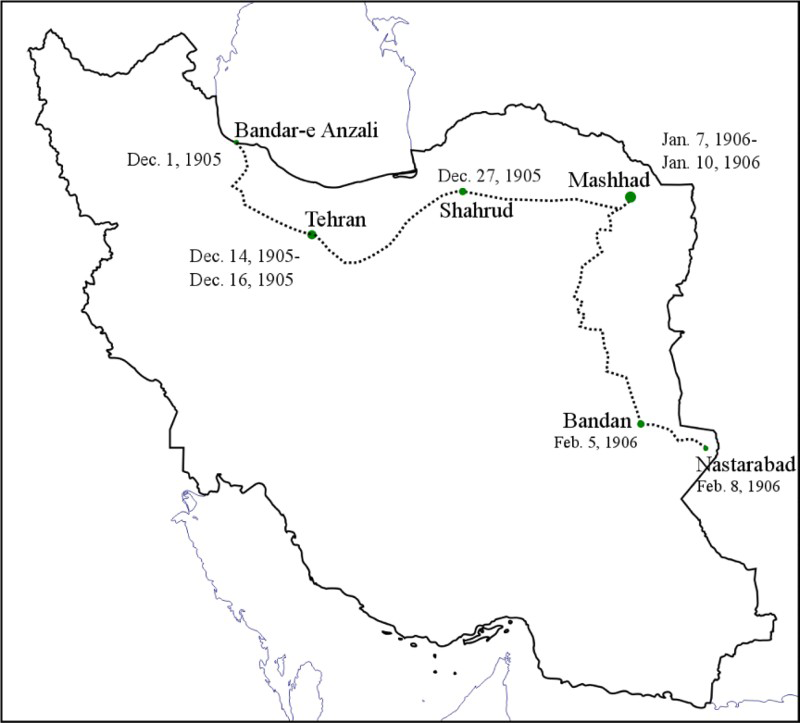
He began his journey to Iran by boarding a ship from Manchester, New Hampshire, USA, bound for Naples, Italy, on 6 October 1905. He then took a side trip to Rome before returning to Naples. From there, he went to Batumi by ship via Piraeus and Constantinople. From Batumi, he traveled to Baku by land. On 29 November 1905, he went by ship from Batumi to Bandar-e Anzali in Iran. From Bandar-e Anzali, he journeyed through Rasht, Kuh Dom, Manjil, Lushān, and Qazvin before reaching Tehran on 14 December 1905. He planned to stay at the English Hotel in Tehran, where Fukushima and some Japanese had previously stayed, but there were no vacant rooms. As a result, he stayed at an Armenian hotel.Footnote 35 He left Tehran for Mashhad on 16 November 1905. He traveled to Mashhad and reached Shāhrūd at the end of the year via Kabud Gonbad, Eyvānekey, Arādā, Lāsjerd, Semnān, Dowlatābād, and Dāmghān.Footnote 36 On 2 January 1906, he left Shāhrūd for Mashhad. He traveled to Mashhad via Mayāmey, ʻAbbāsābād, Sabzavār, Nishāpur, and Sharifābād (Figure 1).Footnote 37
Mashizu Suzuki’s travel route.
Source: Compiled by author by based on Suzuki’s accounts.
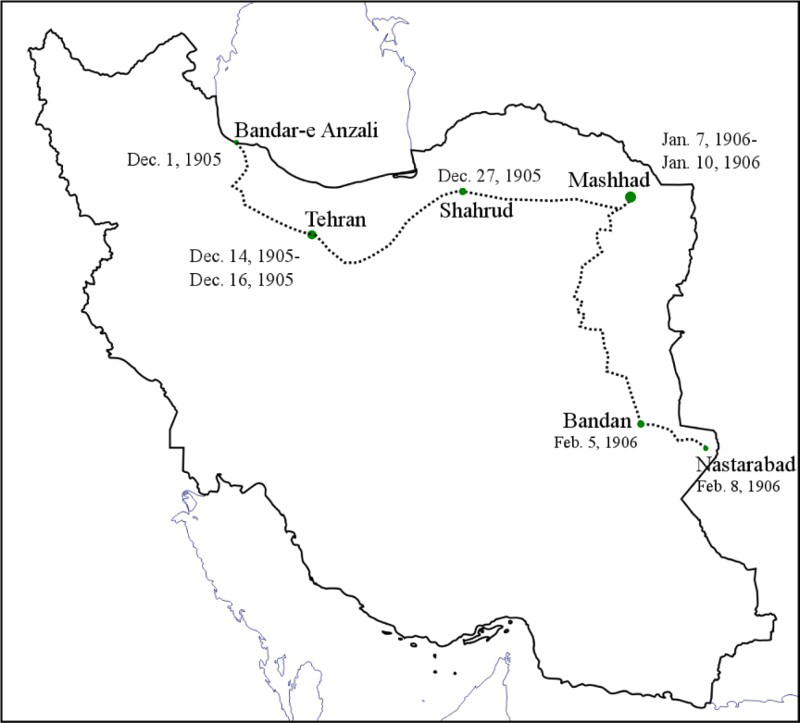
The reason he set out for Mashhad was to travel to Peshawar over the Hindu Kush via Herat in Afghanistan.Footnote 38 Thus, he left Mashhad again and reached Bandān via Sharifābād, Asadābād, Torbat Heydariye, Birjand, Mud, Shusf, and Nehbandān. In Bandān, however, he received a telegram that he should postpone leaving there because the plague had broken out in Sistān province. Then the Qajar governor advised him to travel instead to Bandar Abbas through Kerman and then to India by ship. The governor even offered to shoulder the travel costs.Footnote 39 Although he appreciated this advice and offer, Suzuki decided to travel to India on his own. He finally reached Nastarābād in Sistān on 8 February 1906.
According to his account, Suzuki traveled through Iran for seventy days. He reported on Iranian history up to Mohammad ʻAli Shāh, Iran’s geographical features, ethnic groups, politics, the military system, society, and religions. He thus included some accounts of characteristics, such as descriptions of religions, in his travelogue. He described not only Islam but also Christianity, Judaism, Zoroastrianism, and so on, and he wrote about the history of each religion in Iran. In addition, he included some description of the daily life of ordinary people as well as of other travelers such as Furukawa; these were included as daily reports in his official report.
TGS thus emulated the adventurous spirit of RGS from the beginning. The society treated travelogues as important sources of geographical information on foreign countries. Travelogues, however, were only the raw primary material. Other articles on foreign countries included collections of summaries of official gazettes or translations and summaries of geographical reports in foreign languages. Of course, it is not necessarily the case that TGS’s motivation for adopting RGS’s spirit of adventure derived from an Orientalist wish to subjugate foreign countries. It is necessary to consider this motivation more carefully. Focusing on proto-international political studies helps us to explore more deeply this academic motivation for studying Iran in the Meiji period.
Creating Diplomatic Platforms and Proto-Academic International Politics
Diplomatic interests and creating a diplomatic platform
As mentioned above, diplomatic relations between Meiji Japan and Qajar Iran started in 1878. However, this is not to say that Meiji Japan tried to create complex strategic relations with Iran. In fact, there were only forty-three articles in the official Japanese gazette (Kanpō).Footnote 40 In addition, some of these articles merely concerned international postal services between Japan and Iran. Instead, Japan primarily attended to Iran in terms of analysis of the international political trends of the Russian empire. Most of the articles appearing as foreign news in official gazettes considered Iran in terms of relations involving the Russian empire or British empire. This perspective on Iran was not limited to officials but extended to public opinion. For example, articles in Japanese newspapers after the Russo-Japanese war also indicate this tendency.
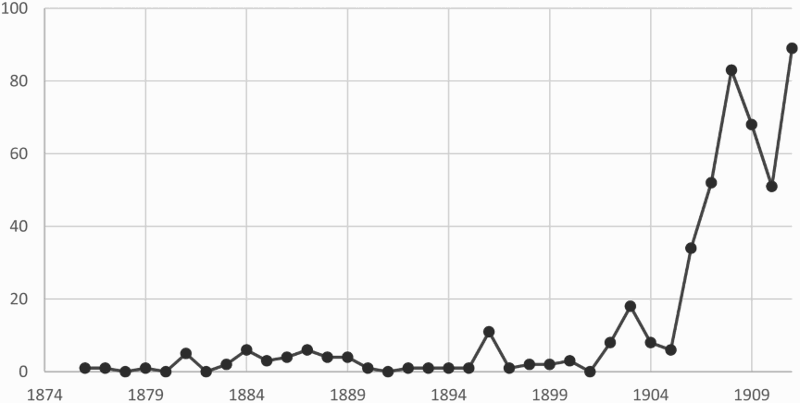
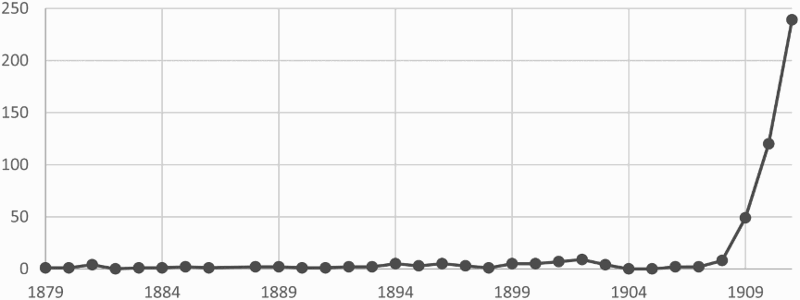
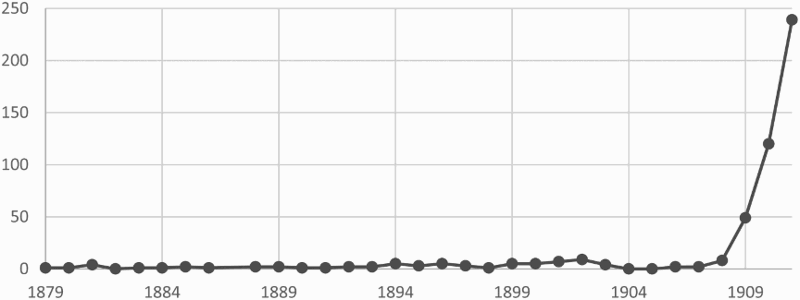
Figure 2 shows the increase in the number of articles on Iran in the popular newspaper Yomiuri Shinbun, which was established early in the Meiji period, in 1874. By 1911, there had been a total of 478 articles on Iran, but only 95 of these were issued before 1905. In other words, about 80 percent of articles were issued after 1905. Figure 3 shows a similar trend in the number of articles on Iran in another popular newspaper, Asahi Shinbun. By 1911, there had been a total of 488 articles on Iran, but more than 80 percent of these were issued after 1908. This indicates that the difficult process of the peace treaty ending the Russo-Japanese war led to increased Japanese popular attention on Iran, which had nearly been invaded by the Russian empire.
Number of articles on Persia in Yomiuri Shinbun.
Source: Based on Yomiuri Shinbun from 1874 to 1912 (https://database.yomiuri.co.jp/rekishikan/).
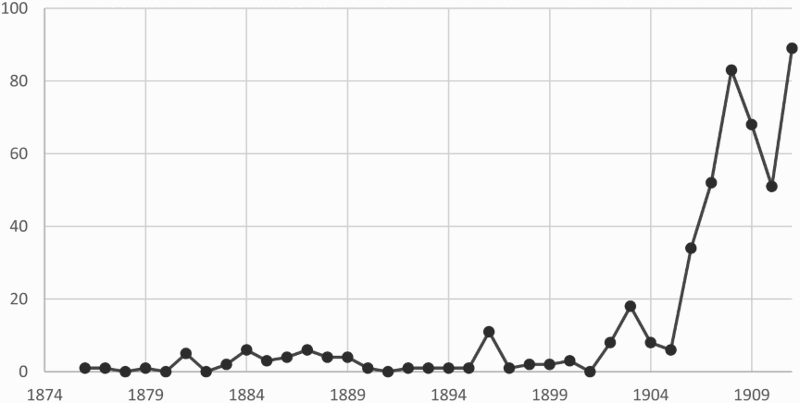
Number of articles on Persia in Asahi Shinbun.
Source: Based on Asahi Shinbun from 1876 to 1911 (https://database.asahi.com/index.shtml).
In addition to this official and popular attention to Iran, academic concern was focused on the field of proto-international political studies, such as in articles in Gaikō Jihō (Revue Diplomatique), a journal on foreign affairs including current news, analytic reports, and so on. Although there were other journals concerning international relations and diplomatic problems, such as Kokusai Chishiki (Journal of Knowledge on the International) and Kokusai Hyōron (International Review), Gaikō Jihō was the most influential journal on diplomatic platforms in terms of the period of issue, the backgrounds of authors, and the quality and quantity of information.Footnote 41
Gaikō Jihō, which started in 1898, was also the oldest journal for foreign news, as Kokusai Chisiki started in 1920 (in the Taisho period) and Kokusai Hyōron started in 1932 (in the Showa period). In addition, there was more variety in the backgrounds of Gaikō Jihō authors. It is possible to divide them into three groups: first, academics; second, government elites, who served as military officers or diplomats; and last, journalists.
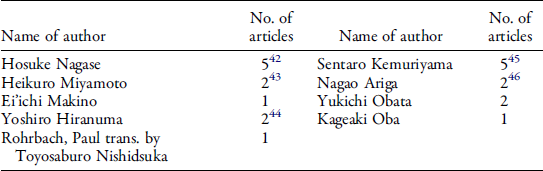
Table 2 shows a list of representative authors along with the number of articles on Iran they contributed to the journal. The personal histories of many authors were quite distinguished. In this table, Nagao Ariga, Sentaro Kemuriyama, Ei’ichi Makino, and Yoshiro Hiramura are classified as academics. Ariga, the first editor-in-chief (February 1898‒October 1911) was a pioneer of diplomatic history and a nominee for the Nobel Peace Prize in 1909. He influenced Kemuriyama’s academic studies. Kemuriyama studied western history, especially as a pioneer of Russian history, and supported Ariga in the journal. Hiramura was an economics expert, and Makino was a criminal law expert.
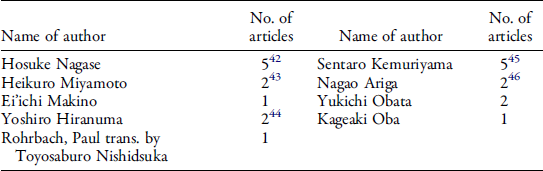
Note: In addition, some authors contributed their articles as news reports on Iran.
Although trained in academia and with a PhD, Yu’kichi Obata belongs to the second group. Obata served as ambassador plenipotentiary in Turkey from 1925 to 1930, and like some others in this group, he used his academic knowledge of the Middle East in his official position. Hosuke Nagase belongs to both groups. He graduated from the Tokyo University of Foreign Studies, continued his studies at Johns Hopkins University in the USA, and then studied modern European history at the University of Berlin. After returning to Japan in 1894, he taught at the Army War College, but he also worked in the General Staff Office and traveled around Central Asia and Turkey.
The final author, Kageaki Oba, belongs to the group of journalists. Oba worked as a reporter for newspaper companies such as Yomiuri Shinbun and Asahi Shinbun. He also became the second editor-in-chief of Gaikō Jihō in November 1911. As discussed in the next section, he traveled to Iran in 1911 and recorded his travel descriptions in that journal.
As the above indicates, there were various contributors with various intellectual backgrounds. This reflects how the diplomatic situation and increasing popular concern about Iran were related at the time. It was in this context that Gaikō Jihō published its articles about Iran. The next section will examine these articles and their analyses of Iran.
Analysis of the political situation and creating a diplomatic platform
Their analyses of the political situation of Iran in international politics were surprisingly accurate, considering that the state changed moment by moment. For example, it is possible in these articles to point to the change from triangular relations to international relations in World War I.
In 1899, before the Russo-Japanese war, relations among the British empire, the Russian empire, and Iran were analyzed as being triangular. Nagase explained the respective strategic meanings of Iran for Britain and Russia.Footnote 47 For Britain, the Russian invasion of Iran related not only to Afghanistan as a defensive barrier for its rule of India, but also to the loss of commercial rights in Iran, which could influence British control of the Indian Ocean. On the other hand, for the Russian empire, its invasion of Iran was part of a strategy for reaching the Persian Gulf and expanding the trans-Caspian railway.Footnote 48
However, the analysis in 1910—four years before the outbreak of World War I—was quite different. For example, Ariga then considered the entire international game, in which Iran figured as an important issue for political conflict in Europe. In other words, he analyzed the problem of Iran in relation to the conflict between the Triple Entente and the Triple Alliance:
The problem of Persia occupies an important position in inter-European diplomacy, because the successful resolution of this problem will be determined by the results of the competition between the Triple Alliance and the Triple Entente.Footnote 49
This astute analysis reflected the changing conditions and possibly relates to the introduction of the state of the art of European analysis.
Some Gaikō Jihō articles were in fact introductions to articles or translations of speeches from foreign languages. For example, Eiichi Makino summarized Captain Alfred Thayer Mahan’s article and discussed its influence on public opinion in the same year.Footnote 50 Mahan’s article has dual importance. One is the creation of the term “Middle East.” Although Makino did not highlight this term, Mahan proposed this label for the trans-India‒Arab region centering on the Persian Gulf.Footnote 51 The other is its influence on political opinion. As reactions quoted from other articles noted, Mahan’s article had a great impact on public opinion and journalism in the UK at that time. In a similar way, Miyamoto’s article summarized an influential French article by d’Avril in Revue des Questions Diplomatiques et Coloniale. Footnote 52 As these indicate, important European articles about Iran were introduced to Japanese readers in real time. Japanese researchers and opinion leaders in the field of diplomacy thus shared in information available to Europeans.Footnote 53
However, analysis and knowledge was not merely borrowed but also became established in Japan. Gaikou Jihou contributors tried to analyze Iranian issues through connections to those in the Far East. For example, Obata clearly regarded the Russian policy toward Iran as similar to that followed in China:
The Russian Empire succeeded in gaining power in Tehran by using their military power. In addition, they built up their influence in the area with money. They increased their power in financial affairs. Those processes are just like the processes involved in their success in China. Therefore, it is possible to say that there are intimate relations between issues in the Far East and those in the Middle East regarding Russian policy for Asia.Footnote 54
After this statement, he explained the Russian colonization of China: the establishment of a national bank, the management of railways, and the annexation of Manchuria.Footnote 55 He concluded that the activities of Russia in Iran followed exactly the same trajectory as its colonization process in China. Like Obata, Ariga also connected issues in the Persian Gulf to those in the Far East.Footnote 56
Although these articles were based on state-of-the-art theories from European countries such as the UK, France, and Germany, it seems that no one actually had experience of Persia at that time. While articles on Iran in the field of geography were mainly accounts of travel in the country, the Gaikō Jihō contributors had little field experience in Iran. It is true that Kageaki Oba traveled to Iran in 1910 and contributed an article to the journal, but even this included very little of his experience:
From Sep. 20 to Oct. 4, I traveled to Northern Persia and the capital city of Tehran on my way back from Moscow. I then reached Krasnovodsk [now Turkmenbashi in Turkmenistan] on the east coast of the Caspian Sea and visited Askhabad [now Ashkhabad], Samarkand, and Toshkent by the Central Asia line of the Russian railway. I transferred to the Orenburg line and went across the western edge of the Urals. I took the Siberian Railway from Chelyabinsk and came back to Tokyo on Oct. 29. I would now like to contribute a brief article on the politics, economics, transportation, and military service system in Persia based on my experience.Footnote 57
Despite his claim that he was contributing his experiences in Iran, it is difficult to point to which part of his later descriptions were actually based on his experience. He outlined the historical development of the construction plan of a railway in Iran and listed the places it passed through according to a German plan of the Baghdad‒Tehran railway. He explained the Persian military system in a similar way. In his description, he described the political situation in detail in terms of Russian political trends, but his explanation insufficiently considered UK political trends. It thus seems that his analysis was based on Russian information and it is possible to say more generally that his article was based on his experience in Russia, not in Iran.
Conclusion
In this paper, I explored the development of the knowledge about Iran in Meiji Japan. Most research on the historical development of Iranian studies in Japan has focused only on “professional” academic works and has claimed that Iranian or Middle Eastern studies started in the 1930s. In contrast, I defined Iranian studies more broadly as studies of Iran in academic circles. I then investigated three questions about Iranian studies in Meiji Japan: First, what kind of knowledge system on Iran existed in Japanese academia in the Meiji period, predating the professional Iranian studies of the 1930s? Second, how did Japanese academia treat travelogues about Iran? And finally, how did the knowledge system on Iran relate to western academia and to Orientalism?
I focused on two important academic fields of foreign studies, namely geography and international politics. To do this, I selected three influential journals: the Journal of the Tokyo Geographical Society and The Journal of Geography from the field of geography and Gaikō Jihō from the field of international politics. This analysis clarified how Iranian studies in Meiji Japan developed. As hypothesized, in both fields, those who contributed articles to the journals were not experts on Iranian studies.
In the geographical field, except for Kawamoto, articles relating to Iran were mainly contributed by not only non-geographers but also people from outside academia. Furthermore, the important section of members in the academic circle of geographical studies also did not directly relate to academia. As discussed, TGS tended to be a salon for the higher social classes. It is thus not surprising that Iranian travelogues appeared in the geography journals. According to their travelogues, it is clear that Japanese traveled to Iran for various reasons. Some of them went there for adventure, some of them went there as official delegations, and some of them went there for opium marketing research. The travelogues were mainly formulizations of their reports in regular meetings. In other words, the travelogues were understood as satisfying the interest and curiosity of the non-academic members.
On the other hand, in the field of international politics, articles relating to Iran were mainly contributed by those who had been trained in academic social sciences, especially international politics. They collected and introduced to Japan the current western political opinions about Iran, such as those of Alfred Thayer Mahan, who coined the term “Middle East.” In short, they tried to absorb the latest theory on Iran from the western world.
It remains a question, however, if this indicates that their activities were closely related to Orientalism, which Said claimed was an issue of relations between the western academic tradition and western subjection of the Orient. Along with their introduction of the latest western theory on Iran, it is certain that these Japanese scholars unconsciously imported the European Orientalist view into their academic activities. In terms of knowledge and power, this was also common in Japanese geographical studies. As mentioned, TGS emulated the RGS of the UK, which held imperial ambitions. Meiji Japan was also transitioning from restoration to imperialism. This suggests that Japanese academic activities were related in some way to western Orientalism and shared an intertwining of knowledge with power.
However, it is doubtful that the Japanese scholars who analyzed Iran in the field of international politics were Orientalist or imperialist in their analyses of Iran. Instead, they tried to make theory fit the situation of Japan in the international politics of the Far East under global imperial power. They tried to analyze the political conditions of Iran by applying state-of-the-art theory to the contemporary situation of Japan. In other words, they regarded Iran as more of an equal, even as a different possible outcome for Japan, which had faced the threat of semi-colonization by the West. In fact, they considered the political conditions of Iran by linking them to the political conditions of Japan, and this provided their strategic approach toward Iran at that time. Thus, while the pioneering Iranian studies scholars before the 1930s were not totally immune to Orientalism, their research on Iran was less closely connected to imperialism than the western scholarship that Said critiqued.