Introduction
In recent decades, there has been a dramatic increase in the prevalence of obesity worldwide. In 2007, 36.6% of Americans were overweight (BMI=25.0–29.90 kg/m2) and 26.3% obese (BMI ≥ 30 kg/m2).Reference Vucetic and Reyes 1 In 2015, the incidence of obesity worldwide among adults was 12.0%, contributing to at least 4 million deaths and 120 million disability-adjusted life years (DALYs).Reference Afshin and Forouzanfar 2 Furthermore, individuals with a high BMI are at a greater risk for developing chronic diseases, such as cardiovascular disease,Reference Singh, Danaei and Farzadfar 3 diabetes mellitus, and various forms of cancers.Reference Lauby-Secretan, Scoccianti and Loomis 4 More importantly and discussed less often is the fact that obesity affects brain structure and function.Reference McIntyre, Mansur and Lee 5 , Reference Mansur, McIntyre and Cao 6 As a result, obesity can lead to brain-based disorders, such as psychiatric illness, including major depressive disorderReference Rajan and Menon 7 and bipolar disorder.Reference McIntyre, Mansur and Lee 5 Furthermore, there is a significant economic burden associated with obesity, with increased healthcare costs and lost productivity as a result of illness. For example, in 2006, the direct costs attributed to overweight and obesity in Canada was $6.0 billion, which was 4.1% of the total health expenditure.Reference Anis, Zhang, Bansback, Guh, Amarsi and Birmingham 8
The major driver of obesity is over consumption of food or the consumption of energy-dense meals, in greater excess than is needed by the body. Historically, excessive food consumption during times of abundance was an evolutionary tactic to ensure survival. However, over recent decades, there has been a shift in food availability, accessibility, and affordability, particularly of poor quality, high-fat, high-caloric foods, contributing to the increasing obesity epidemic around the world.Reference Swinburn, Sacks and Hall 9 Contrary to previous thought, food consumption is simply not a biological behavior to meet the body’s energy needs. Other factors, such as cognitive, emotional, sensory, economic, and environmental factors, are also involved and can influence one’s motivation to eat. The purpose of this review is to highlight the neurobiology of eating behavior and obesity and to describe various neurobiological treatment mechanisms to treat obesity.
Hypothalamic Hunger System
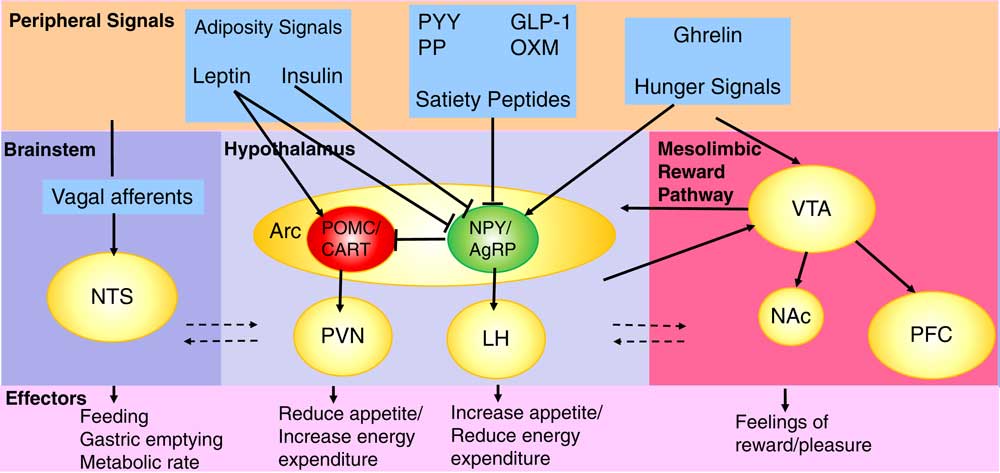
Complex peripheral signals from various regions of the gastrointestinal (GI) tract and surrounding regions (eg, adipose tissue and pancreas) are elicited before, during, and after a meal and are sent to the central nervous system (CNS) to modulate eating behavior (see Figure 1). Specifically, peripheral signals can communicate with the CNS through the afferent vagus nerves lining the GI tract and related regions or by peripheral hormones crossing the blood–brain barrier.
Overview of the pathways involved in regulating eating behaviour. Various peripheral signals project to the a) nucleus tractus solitarius (NTS) via the vagus nerve lining the gastrointestinal tract and surrounding regions, b) arcuate nucleus (Arc) in the hypothalamus, and c) ventral tegmental area (VTA) by crossing the blood brain barrier. Subsequent downstream effects modulate food intake or termination.

Various hunger/satiation-mediated peptides modulate meal initiation and termination. Food-stimulated peripheral signals act on the gut–brain axis, particularly the GI vagus nerve to initiate negative feedback to satiate hunger and prevent further food consumption. Four in particular play a prominent role: cholecystokinin (CCK), leptin, ghrelin, and orexin. CCK is released by enteroendocrine cells in the duodenum in the presence of food and plays a significant role in satiation. CCKA receptors are found in the vagal nerves innervating the stomach and duodenum. Blocking the stimulation of CCKA receptors through the use of antagonists prevents the signaling of food presence, and preclinical studies with rodents have demonstrated that these animals have continued to eat, despite being adequately fed.Reference Mishra, Dubey and Ghosh 10
Leptin is a hormone produced by adipose tissues. Similar to CCK, leptin works to reduce hunger and food intake. Increased levels of leptin reduce the amount of food consumption as a result of the negative feedback through the hypothalamus.Reference Elmquist, Elias and Saper 11 Furthermore, leptin receptors have been found in the ventral tegmental area (VTA), which suggests that they may modulate hunger by acting on dopaminergic neurons. In fact, in an experiment with animals, a direct infusion of leptin into the VTA reduced dopamine release by 35% in the nucleus accumbens (NAc) and subsequently reduced the amount and duration of food intake.Reference Krügel, Schraft, Kittner, Kiess and Illes 12
After a meal, glucagon-like peptide-1 (GLP-1) is produced by enteroendocrine L-cells within the intestine as well as by the nucleus tractus solitarius of the brainstem. As an incretin hormone, GLP-1 is involved in the stimulation of insulin release and the reduction of blood glucose levels. Other hormones produced in the GI tract that decrease the amount of food intake include pancreatic polypeptide (PP), peptide tyrosine-tyrosine (PYY), and oxyntomodulin (OXM).Reference Woods and D’Alessio 13
Conversely, ghrelin is produced in the upper regions of the stomach as well as in pancreatic cells and promotes hunger and food consumption behavior. Ghrelin receptors are also found in the VTA and stimulate dopaminergic neurons in the NAc.Reference Abizaid, Liu and Andrews 14 In preclinical studies, inhibition of the ghrelin receptors has led to a decrease in reward-associated food consumption.Reference Egecioglu, Jerlhag and Salomé 15 Working under similar contexts as ghrelin, orexin plays a role in diet preference and reward-based meal anticipation.Reference Choi, Davis, Fitzgerald and Benoit 16 They are both produced in the lateral hypothalamus as a result of low blood glucose and hunger, as well as by other signals in the body that promote the intake of food. Similar to the previously mentioned peptides, orexin receptors have been also found in the VTA. When orexin was directly injected in this area in rodent experiments, it promoted increased dopamine release in the NAc.Reference Narita, Nagumo and Hashimoto 17 Obesity has been associated, in part, with dysregulation/ineffectiveness of these peripheral markers. For example, greater blood concentration of leptin was found among obese patients. However, as a result of leptin resistance in the hypothalamus, this high concentration of leptin was not able to reduce food intake or increase energy expenditure when compared to lean individuals.Reference Lean and Malkova 18
The hypothalamus is the key integration center in the brain that regulates these peripheral signals and modulates appetite and energy homeostasis. Specifically, these signals are integrated within the arcuate nucleus, a region of the hypothalamus that plays a significant role in balancing the pathways involved in promoting food intake and weight gain with the pathways that inhibit food intake and promote weight loss.Reference Woods and D’Alessio 13 The nucleus tractus solitarius is another important region within the brainstem that plays a critical role in appetite and receives input from vagal afferents. Both the arcuate nucleus and nucleus tractus solitarius produce a precursor protein called proopiomelanocortin (POMC), which is cleaved into the following enzymes: melanocyte-stimulating hormones (MSHs), adrenocorticotropic hormone (ACTH), and β-endorphin.Reference Millington 19 MSH and ACTH bind to the extracellular G-protein coupled melanocortin receptors (MCRs), where select subtypes of this receptor (ie, MC3R and MC4R) are found in abundance in the CNS. The activation of these receptors leads to downstream signaling in the paraventricular nucleus (PVN), which reduces appetite and increases energy expenditure. Furthermore, serotonin 2C receptors also activate POMC neurons. Cocaine- and amphetamine-related transcript (CART) is another anorexic peptide that is produced in the arcuate nucleus, as well as other regions of the CNS, and works similarly to POMC to reduce appetite.Reference Dhillo 20 Conversely, stimulating the neurons that co-express neuropeptide Y (NPY) and agouti-related protein (AgRP) in the arcuate nucleus triggers downstream effects in the lateral hypothalamus (LH) that promote hunger and reduce energy expenditure.Reference Woods and D’Alessio 13
The release of leptin, ghrelin, and orexin is controlled by the hypothalamus. These peptides regulate the homeostatic processes of energy regulation within the mesolimbic reward pathway. Furthermore, these peptides have receptors in the VTA of the midbrain, which activate the neurons that project to NAc, causing the release of dopamine, as well as the neurons that project to the prefrontal cortex. Therefore, the above evidence presents a compelling reason to believe that the homeostatic processes of energy regulation are closely linked with the reward/motivational pathways.Reference Grosshans, Loeber and Kiefer 21
Eating as a Reward-Motivated Behavior
Unlike previously thought, the act of eating is not solely to supply the body with energy and nutrition, but has positively reinforcing and rewarding attributes. Therefore, the pleasurable experiences derived from eating propel and reinforce eating behavior in the future based on earlier experiences. Furthermore, individuals can become sensitized or conditioned to food stimuli, leading to an even stronger behavior in the future. These adaptive behaviors can lead to changes in cognitive processes, such as attentional and cognitive biases towards the stimuli at the expense of other beneficiary behaviors. High-fat, high-carbohydrate foods are very salient, rewarding stimuli and can lead to consumption reinforcement.Reference Epstein, Leddy, Temple and Faith 22
The mesolimbic reward pathway stimulates pleasure by increasing the release of dopamine. Specifically, the stimulation of the VTA in the midbrain leads to the release of dopamine in the NAc, olfactory tubercle, amygdala, hippocampus, and medial prefrontal cortex.Reference Stott and Ang 23 Most drugs of abuse target various parts of this system either directly or indirectly to promote feelings of pleasure and reward. As previously highlighted, food can also stimulate the mesolimbic system to increase the release of dopamine in the NAc. The mesolimbic pathway is also associated with the cognitive processes involved in motivation. As such, the pleasure derived from eating can lead to excessive food seeking behavior through motivation.Reference Berridge 24
However, food salience may not be conscious or have any cognitive processes involved. Therefore, the incentive salience or “craving” of food is driven by the subcortical mesolimbic dopamine pathway, whereas the cognitive appraisal of evaluating the desire for food is managed by the higher order cortical processes, including the orbitofrontal cortex, prelimbic cortex, and insular cortex.Reference Berridge 24 For example, in a study by Castellanos et al,Reference Castellanos, Charboneau and Dietrich 25 obese individuals (n=18) continued to maintain their interest in food images despite having a meal and self-reporting reduction in hunger, when compared to normal-weight individuals (n=18). Therefore, the “craving” or desire to seek food was present among these obese individuals.
The development of obesity can also lead to blunted feelings of reward and pleasure. There is a change in reward homeostasis, where greater consumption of food may be required to experience the same levels of enjoyment. Specifically, Johnson and KennyReference Johnson and Kenny 26 found that dopamine D2 receptors were downregulated in obese rats and acute overfeeding resulted in reduced reward stimulation. Furthermore, there is also some evidence to indicate that obese patients may have fewer dopamine D2-receptors.Reference Wang, Volkow and Logan 27 Therefore, reduced presence or availability of dopamine D2-receptors may indicate that individuals will overeat in order to derive the same levels of pleasure as someone with normal levels of D2-receptors.Reference Wang, Volkow and Logan 27 As such, obesity may lead to food tolerance, where greater consumption of food may be required to experience the same levels of enjoyment.
Genetic polymorphisms resulting in changes in D2-receptors could also alter the reward pathway. For example, a study by Stice et al Reference Stice, Spoor, Bohon and Small 28 demonstrated that individuals with the Taq1-A1-allele, a polymorphism of the coding sequence for the D2-receptor, had reduced functioning of the striatum, which could lead individuals to overeat in order to achieve the same level of pleasure as others without the polymorphism. It is unclear whether reward “hyposensitivity” is the result of genetic factors or malfunctioning of the reward pathway among obese individuals.
Treatment of Obesity
Obesity can be managed in several ways, including diet and exercise, surgery and pharmacotherapy. The most common way that obesity is addressed in the general population is to ask individuals to adopt healthier lifestyle choices, which includes consuming healthy diets and engaging in regular physical activities. However, for obese individuals, diet and exercise alone are not sufficient to induce the extent of weight loss needed to see the desired health benefits,Reference Douketis, Macie, Thabane and Williamson 29 and not all obese individuals are surgical candidates for various health and feasibility reasons. The following discussion will focus on the mechanism of action of pharmacotherapy, as the former two avenues of treatment have been discussed extensively in the scientific literature.
There are 5 classes of U.S. Food and Drug Administration (FDA)-approved medications for weight loss that act at various points of the hypothalamic hunger system, particularly on POMC and CART, and/or the mesolimbic reward system. These 5 classes include appetite suppressants, lipase inhibitors, selective serotonin 2C receptor agonists, glucagon-like peptide 1(GLP-1) modulators, and combination drug therapies, such as phentermine and topiramate ER, and naltrexone HCl and bupropion HCl ER. Appetite suppressants are typically listed for short-term use, whereas the other classes of drugs noted above can be used long term.
Lipase inhibitors block the absorption of fat in the intestine by blocking gastric and pancreatic lipases. As a result, these inactivated enzymes are not able to break down dietary fat in the form of triglycerides to absorbable free fatty acids and monoglycerides.Reference Rubio, Gargallo, Isabel Millán and Moreno 30 However, users often have to contend with the side effects of frequent fecal incontinence and diarrhea. Another peripherally targeting drug is liraglutide, which is a GLP-1 receptor agonist, and works by stimulating insulin release,Reference Madsbad 31 inhibiting glucagon secretion and slowing down gastric emptying and appetite. As such, liraglutide is also used in the clinical management of type 2 diabetes mellitus.Reference Hansen, Knop, Holst and Vilsbøll 32
Psychosocial and behavioral factors that promote weight gain through appetite, enjoyment derived during food consumption, and feelings of satiation can be exploited by pharmacotherapy to minimize the amount of food intake.Reference Halford and Harrold 33 Lorcaserin is a selective serotonin 2C receptor agonist and induces feelings of satiety normally experienced after a meal.Reference Bai and Wang 34 Furthermore, unlike its predecessors, lorcaserin has the added advantage of being selective and not binding to the 2A or 2B receptors, where this nonselectivity in the past has resulted in side effects, such as hallucinations and cardiomyopathy.Reference Xu, Jian and Chu 35
Recently, there have been developments of combined drug therapies to promote more effective weight loss. Qsymia is a combination of phentermine, a sympathomimetic amine anorectic, and topiramate ER, an antiepileptic drug. Phentermine is intended to release catecholamines in the hypothalamus, and reduce appetite, whereas topiramate ER promotes the feeling of fullness.Reference Garvey, Ryan and Look 36
On the other hand, Contrave is a combination of naltrexone HCl, an opioid antagonist, and bupropion HCl ER, an aminoketone antidepressant, which is a dopamine and norepinephrine reuptake inhibitor.Reference Billes, Sinnayah and Cowley 37 This combination is informed by pharmacologic animal studies indicating that these drugs act synergistically in the hypothalamus to promote the firing of POMC neurons, leading to appetite suppression and weight loss.Reference Billes, Sinnayah and Cowley 37 Animal studies have also shown synergistic effects in the mesolimbic reward system, where fasting mice injected with naltrexone and bupropion in the VTA showed reduced food intake compared to mice injected with placebo.Reference Billes, Sinnayah and Cowley 37 Weight loss in short- and long-term studies with this combination therapy has been described in individuals with obesity to be effective.Reference Greenway, Whitehouse and Guttadauria 38 Beneficial outcomes have also been observed in individuals with obesity-associated morbidity (eg, diabetes). Taken together, the weight loss effects noted with the combination of naltrexone and bupropion are in part hypothesized to be via mitigating effects on craving and reward. The foregoing reifies the notion that obesity in many circumstances may be a consequence of aberrant brain-circuit activity in regions subserving reward, appetite, and satiety.
Because excessive eating can be considered analogous to addictive behavior, one possible avenue to treat obesity may be derived and adopted from addiction treatment avenues. In addiction treatment, various drugs have been created that target the mesolimbic system in a way that promotes the feelings of reward and pleasure. For example, the rationale to use naltrexone and bupropion was, in part, derived from the success of these drugs among patients with addiction. Naltrexone is an FDA-approved drug used to treat opioid addiction and alcoholism because it works by blocking opioid receptors in the brain that reinforce the addictive behavior, and thus regions involved in the perceived reward.Reference Hillemacher, Heberlein, Muschler, Bleich and Frieling 39 In addition to being an antidepressant, bupropion is also used for smoking cessation because of its ability to increase dopaminergic activity in various regions of the brain.Reference Wang, Tomasi and Volkow 40
Conclusion
Obesity is becoming an increasingly major problem, both in developing and developed countries. Although weight gain can be sufficiently managed through a balanced and portioned diet and physical exercise, some individuals may need additional support as a result of health consequences that are caused or worsened by the excessive weight. Therefore, an augmented weight loss method could result in subsequent improvements in overall health and well-being for these individuals. There are a number of FDA-approved drugs that target various pathways peripherally and centrally, as well as the hypothalamic hunger and mesolimbic reward systems. These pathways/systems are not only involved in energy homeostasis and regulation, but are the brain regions involved in the motivational, emotional, and behavioral factors that contribute to weight gain.
Disclosures
Roger McIntyre has the following disclosures: Lundbeck, grant; Pfizer, grant; AstraZeneca, grant; JanssenOrtho, grant; Purdue, grant; Otsuka, grant; Shire, grant; Allergan, grant; Eli-Lilly, personal fees; Johnson & Johnson, personal fees; Moksha8, personal fees; Sunovion, personal fees; Mitsubishi, personal fees; Takeda, personal fees; Forest, personal fees; Bristol-Myers Squibb, personal fees. Mehala Subramaniapillai has nothing to disclose.
Optional Posttest and CME Certificate
CME Credit Expires: November 30, 2020
Posttest Study Guide
NOTE: The posttest can only be submitted online. The below posttest questions have been provided solely as a study tool to prepare for your online submission. Faxed/mailed copies of the posttest cannot be processed and will be returned to the sender. If you do not have access to a computer, contact NEI customer service at 888-535-5600.
-
1. The release of leptin, ghrelin and orexin are controlled by the:
-
A. Amygdala
-
B. Hypothalamus
-
C. Medial Prefrontal Cortex
-
D. Hippocampus
-
-
2. Increased desire/cravings to addiction-like behavior, including cravings for food, has been associated with inhibition of the release of dopamine from the mesolimbic system, when:
-
A. High levels of leptin and ghrelin and low levels of cholecystokinin and orexin are present
-
B. High levels of orexin and ghrelin and low levels of leptin and cholecystokinin are present
-
C. High levels of leptin and cholecystokinin and low levels of ghrelin and orexin are present
-
D. High levels of orexin and cholecystokinin and low levels of leptin and ghrelin are present
-
-
3. Which of the following classes of FDA-approved medications for weight loss is typically listed for only short-term use?
-
A. Selective serotonin 2C receptor agonists
-
B. Combination drug therapies, such as Phentermine and topiramate ER, and Naltrexone HCl and bupropion HCl ER
-
C. Lipase inhibitors
-
D. Appetite suppressants
-
E. GLP-1 modulators
-
Optional Online Posttest and CME Certificate Instructions
There is no posttest fee nor fee for CME credits.
-
1. Read the article.
-
2. Complete the posttest and evaluation, available only online at www.neiglobal.com/CME (under “CNS Spectrums”).
-
3. Print your certificate (passing score = 70% or higher).
Questions? call 888-535-5600, or email CustomerService@neiglobal.com