I co-teach a course on the US drug war that we have offered for almost a decade. In the class, my colleague and I explore both the domestic and international aspects of the drug war. We examine the goals that have been established, the methods used, and actual achievements of the government's drug war policies. Then, we turn to policy analysis: after a cost-benefit analysis, we review policy alternatives. Students begin the semester with many different perspectives and questions. Some strongly support the drug war; others are skeptical. By the end of the semester the most consistent question from and the most vexing problem for students is “Why does the US continue to fight the drug war?” More concretely, the students question the absence of serious policy evaluation in Washington, DC.
The research questions are clear: Why does the United States federal government continue to pursue the war on drugs? Why is policy termination not seriously considered? Before beginning this discussion, however, some points need to be clarified. First, is the current policy inadequate or problematic? Second, what exactly, does “policy termination” mean? After considering these questions, I turn to the literature on policy termination. Over the years it has become clear any policy termination is rare. Indeed, most theories of termination are really theories of nontermination (i.e., explanations for why failing programs, policies, and institutions persist). After surveying the literature, I apply the dominant policy termination findings to the drug war. Unlike other works, however, I explore the benefits of drawing on prospect theory in addition to policy termination theory to understand the rarity of policy termination.
Applying insights from prospect theory to the dilemma of the rarity of policy termination is valuable. Although prospect theory has been used as a framework in international relations and foreign policy decision-making research (see, for instance, Jervis Reference Jervis1992 and Welch Reference Welch2005), it has little affect on the research on public policy and policy analysis. Prospect theory further clarifies the dynamics of policy change and resistance to termination. Furthermore, prospect theory, along with policy termination theory, can guide the strategies and tactics of activists who want to end the war on drugs.
THE DRUG WAR IS A FAILURE
The term “drug war” refers to the use of a law enforcement approach to deter or punish users, sellers, and producers of illicit drugs. The policy emphasizes incarceration, eradication, interdiction, extradition, and supply reduction. The drug war focuses on supply; the government argues that market disruption and supply reduction will increase drug prices and decrease drug purity. These two elements combined should result in lower drug use among current users and a decrease in the number of new users. While the prohibitionist orientation of the US government dates from the early 1900s (The Shanghai Conference of the Opium Commission and the Opium Exclusion Act of 1909), the current drug war began when President Nixon stated, “America's public enemy number one in the United States is drug abuse. In order to fight and defeat this enemy, it is necessary to wage a new, all-out offensive” (Reference Nixon1971a). His administration began a law enforcement prohibitionist policy that has been pursued by US presidents since 1971: Ronald Reagan signed the Anti-Drug Abuse Act of 1986; George H.W. Bush signed the Anti-Drug Abuse Act of 1988, which established the Office of National Drug Control Policy; Bill Clinton signed legislation funding “Plan Colombia”; and, George W. Bush expanded “Plan Colombia” into the “Andean Counterdrug Initiative.” Although President Obama's drug czar sought to “banish the idea that the United States is fighting a war on drugs,” the actual policies of the United States have not significantly changed (Kerlikowske Reference Kerlikowske2009).
The overall goal of the drug war has been consistent and simple: reduce drug use in the United States. President Nixon sought to “eliminate drug abuse and all the antisocial activities that flow from drug abuse” (Nixon Reference Nixon1971b). President Reagan spoke of “fighting the crusade for a drug free America” (Reference Reagan1988). The 1998 National Drug Control Strategy identified specific targets of reducing drug demand by 25% by 2002 and by 50% by 2007. The 2010 Drug Strategy outlines a “comprehensive approach to reducing drug use … [with] a balance of prevention, treatment, and law enforcement” (Office of National Drug Control Policy 2010). Thus, from 1971 to 2011, drug policy has sought to reduce drug use.
What has been accomplished in 40 years? The drug war has not accomplished any specific targets established (such as in the 1998 National Drug Control Strategy). Nor have more general goals, like a drug free America or the elimination of drug abuse, been achieved. Data regarding the degree of drug use in the United States (see figure 1) suggest that the drug war has not had a profound impact on drug use.
Current Drug Users in the United States (as a percentage of the adult population)

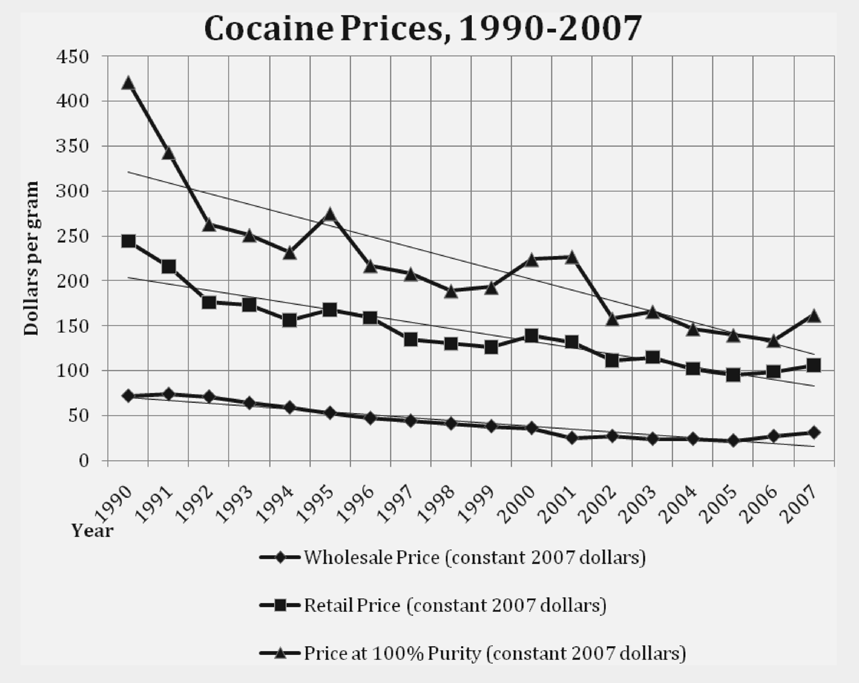
This trend is echoed in the evidence with regard to drug supply. Contrary to predictions, the price and purity of illicit drugs (see figure 2) have not been negatively affected (i.e., price increase and purity decrease). For instance, the 2007 price of 100% pure cocaine is substantially lower than in 1990 (earliest date for price/purity data).
Price/Purity of Cocaine, 1990–2007

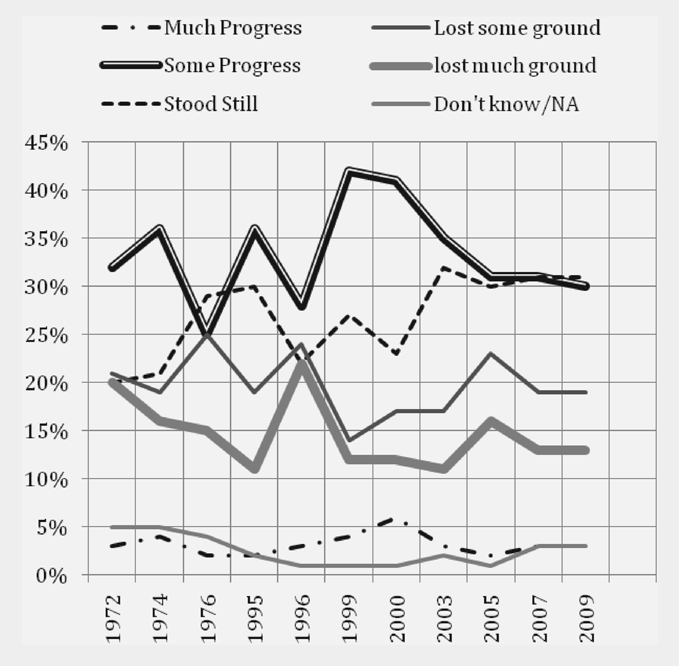
The US public also appears to doubt the success of US drug policy. Data across the years, shown in figure 3, indicates that the public does not believe the government to be successful in its drug policy. In 2009, 63% of the US public thought that the drug war was either stagnant or losing ground. All of these figures combined indicate that current drug war policy has not achieved its goals.This signals policy failure. And, policy failure should lead to policy termination.
US Public Opinion about Progress in Coping with Illegal Drugs (selected years)

To state that drug war policy has failed and should be terminated does not necessarily signify anything more. Those who agree with this point, however, often draw differing conclusions. The termination of the drug policy might entail creating a new policy of prohibition coupled with harm reduction (rather than law enforcement). Others might argue that policy termination should lead to decriminalization of drugs. Yet others might call for policy termination to result in drug legalization. Some of this disparity might be explained by uncertainty about the concept of policy termination.
POLICY TERMINATION
What exactly is meant by the phrase “policy termination”? Does it differ significantly from “policy change” or “policy revision”? Are policy adaptations and modifications variants of policy termination or are they fundamentally different? Looking to the literature on policy termination brings about some clarification. Typically, policy termination “refers to the adjustment of policies and programs that have become dysfunctional, redundant, outmoded, and/or unnecessary” (Brewer Reference Brewer1978, 338). Of course, “adjustment” could encompass policy modifications. Some note that “termination is frequently associated with implementation of a new alternative policy” (Bothun and Comer Reference Bothun and Comer1979, 541), suggestive of policy modification. Others speak of termination—“the deliberate conclusion or cessation of specific government functions, programs, policies, or organizations”—and “partial terminations” that lead government agencies programs, and/or organizations to “redirect their activities so as to remain operant” (DeLeon Reference DeLeon, May and Wildavsky1978, 280). Yet some people remain committed to a strict definition of the term, seeking to exclude instances of cutbacks, reduced size, or scope of policies (Daniels Reference Daniels1997, 5). This article seeks the middle ground. Drug war policy termination entails the deliberate conclusion or cessation of government policies and programs related to the prohibitionist approach to drug use; the continuation of prohibition but with a harm reduction emphasis would be considered partial termination.
THEORIES OF POLICY TERMINATION
As noted earlier, policy termination is a rare political phenomenon. Accordingly, little research exists. Some material can be found in the literature on bureaucracy and bureaucratic resistance to change (see, for instance, Wilson Reference Wilson1989). A review of the literature specifically about policy termination reveals a wave-like pattern: articles and books tend to cluster together, separated by years of relatively inactive research. Over the years, however, some points have emerged, been tested, and found to be useful. Peter DeLeon, one of the first scholars of policy termination, has made lasting contributions to the field, especially in the development of a framework for understanding the absence of policy termination (DeLeon Reference DeLeon, May and Wildavsky1978, Reference DeLeon1983, Reference DeLeon and Palumbo1987). Many people (see, for instance, Frantz Reference Frantz1992; Geva-May Reference Geva-May2004; and Kirkpatrick, Lester, and Peterson Reference Kirkpatrick, Lester and Peterson1999) find DeLeon's schema for explaining the failure of policy termination to be a useful starting point for policy analysis.
DeLeon argues that there are six “reasons why policy termination has been particularly difficult to plan and execute:” (1) intellectual reluctance, (2) institutional permanence, (3) dynamic conservatism, (4) anti-termination coalitions, (5) legal obstacles, and (6) high start-up costs (Reference DeLeon, May and Wildavsky1978, 286). For DeLeon, intellectual reluctance encompasses the disinclination of individuals to acknowledge their mistakes as well as a general political tendency to shun contraction of government services. Frantz (Reference Frantz1992) notes that the Reagan administration and neoliberal ideology embraced the concept of smaller government; this modifies part of the intellectual reluctance noted by DeLeon. Institutional permanence refers to that well-established characteristic of institutions: longevity. As DeLeon and others (Kaufman Reference Kaufman1976; Wilson Reference Wilson1989) noted, bureaucracies are designed to persist; in Kaufman's words, institutions aim for immortality. DeLeon's notion of “dynamic conservatism” is meant to capture the activities of institutions and their supporters as they respond to the political and policy environment that might be detrimental to their survival. Antitermination coalitions are “significant political groups … [who] can arise in opposition to termination” (Daniels Reference Daniels1997, 26). Legal obstacles frequently surface; the right to due process means that such challenges often have standing and must be resolved before termination can proceed. Finally, DeLeon argues that pursuit of policy termination demands “the political resources necessary to counter the coalitions … that shield organizations and programs from the termination axe” (DeLeon Reference DeLeon, May and Wildavsky1978, 291).
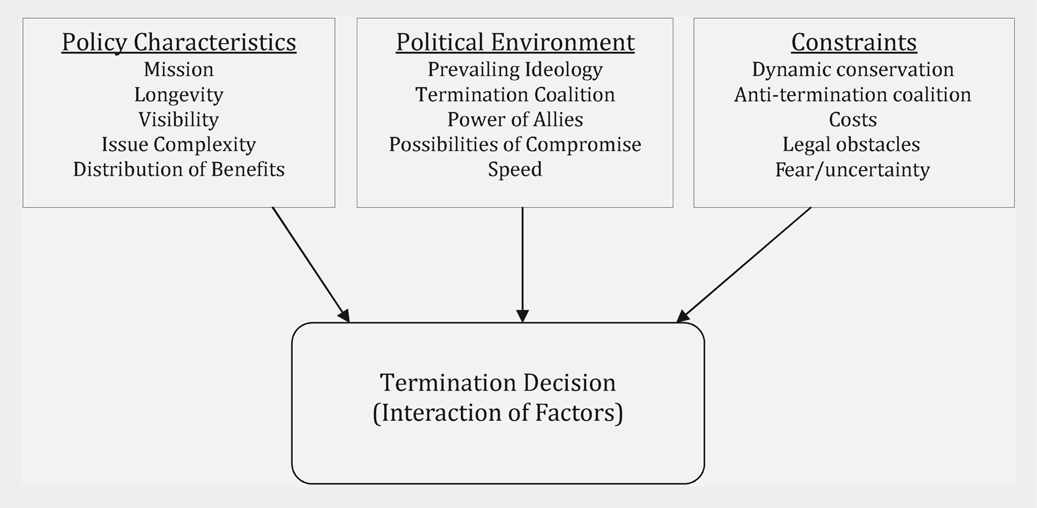
Following up on DeLeon's work, Kirkpatrick, Lester, and Peterson (Reference Kirkpatrick, Lester and Peterson1999) construct a model that creates a conceptual framework for understanding the policy termination process. While using DeLeon as a starting point, the authors draw on additional case studies and policy termination analysis (for example, Behn Reference Behn1978; Daniels Reference Daniels1997; Frantz Reference Frantz1992) to extract additional variables that shape the dynamics of policy termination. They argue that the process is influenced by three categories of variables: inherent characteristics, the political environment, and constraints (Kirkpatrick, Lester, and Peterson Reference Kirkpatrick, Lester and Peterson1999, 211–213).
For these authors, inherent characteristics are aspects of the policy that shape its response to termination. The authors note five consistently significant characteristics: (1) the stated mission/purpose of the policy, (2) the longevity of the policy, (3) the public visibility of the policy, (4) the complexity of the policy, and (5) the distribution of policy benefits (Kirkpatrick, Lester, and Peterson Reference Kirkpatrick, Lester and Peterson1999, 213–214). The impact of each characteristic varies. The mission of the policy must be relevant; its purposes must not appear to be out-dated or illegitimate. Clearly, policies that have missions considered critical by the public and politicians are more impervious to termination. Unsurprisingly, the greater the longevity of a policy, the more resistant to termination it proves. Public visibility inversely influences termination; “organizations that are largely invisible to the public have a greater chance of surviving to a ripe old age” (Kirkpatrick, Lester, and Peterson Reference Kirkpatrick, Lester and Peterson1999, 214). Likewise, a complex policy dealing with complex issues appears to be more resilient against termination pressures. The last characteristic is one that has long been noted in public policy and political science research: policies with many beneficiaries or with widely dispersed beneficiaries pose a much greater challenge to termination.
The next category of variable influencing policy termination is the political environment. Kirkpatrick, Lester, and Peterson identify what they consider to be five key elements of the context within which the effort to achieve policy termination occurs: (1) the prevailing political ideology; (2) the size, strength, and determination of the forces marshaled for termination; (3) the quality and character of the allies arrayed by termination and anti-termination coalitions; (4) the existence of possibilities of compromise; and (5) the speed of the termination process (Kirkpatrick, Lester, and Peterson Reference Kirkpatrick, Lester and Peterson1999, 215–216). As with inherent characteristics, the impact of each variable within the category varies. Some variables are relatively self-apparent: if the prevailing political ideology is supportive of change, this increases the possibility of termination. Similarly, when the size, strength, and determination of termination forces are great, the likelihood of termination increases. Allies are critical: which faction has the more powerful allies may determine whether termination or antitermination forces prevail. Kirkpatrick, Lester, and Peterson argue that case studies suggest compromise is a basic survival tactic of institutions and programs; thus, the greater possibility of compromise, the less likely termination becomes. Finally, case study research noted by the authors supports the contention that a speedy termination process is more likely to succeed than a slow one.
The final category of variables is constraints. This category draws heavily from DeLeon and follow-up studies that used his framework (Kirkpatrick, Lester, and Peterson Reference Kirkpatrick, Lester and Peterson1999, 216–218). The five constraints that limit policy termination are (1) the anti-termination coalition, (2) dynamic conservatism, (3) legal obstacles, (4) costs, and (5) fear/uncertainty. Most of these variables are described above. The one variable noted by the authors not discussed by DeLeon is “uncertainty and fear.” The authors argue “it is fear of the termination's impact, due to uncertainties, that prevents decisive action from being taken” (Kirkpatrick, Lester, and Peterson Reference Kirkpatrick, Lester and Peterson1999, 218). Overall, this variable is not well developed; but, it suggests elements of the decision making process under conditions of uncertainty analyzed by prospect theory (Kahneman and Tversky Reference Kahneman and Tversky1979).
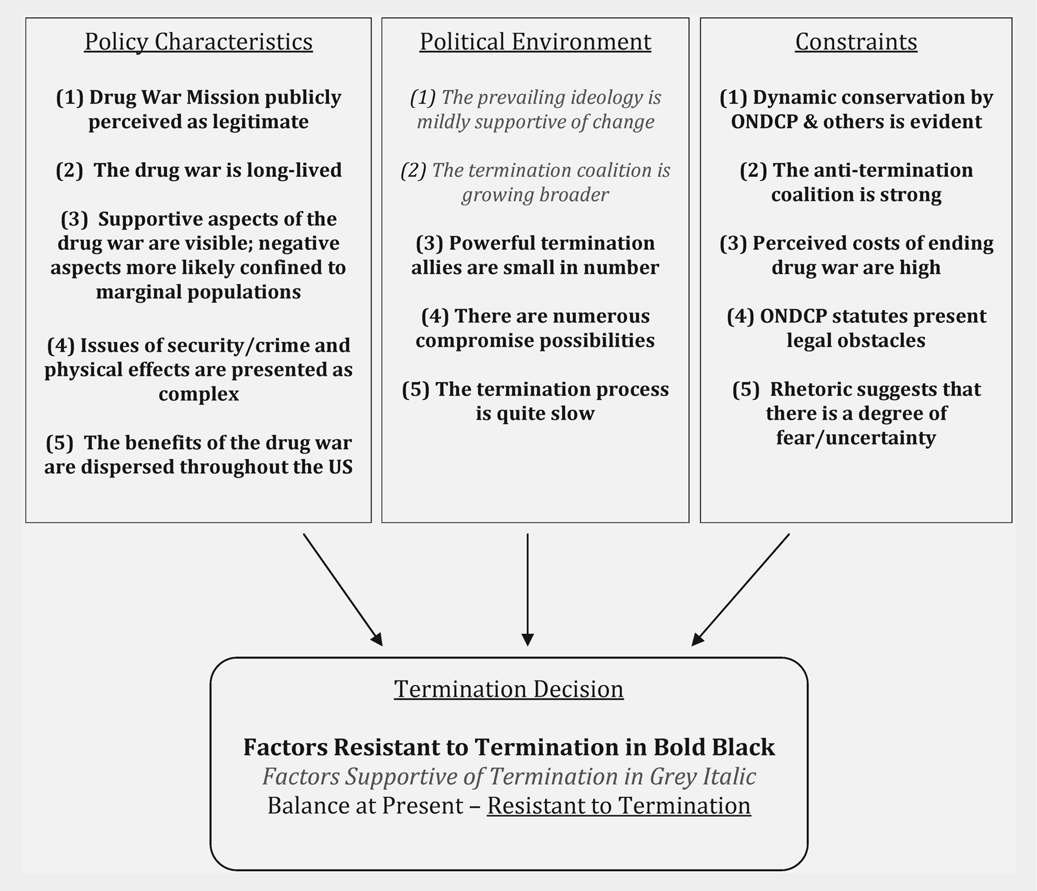
Figure 4 summarizes the conceptual framework developed by Kirkpatrick, Lester, and Peterson. This framework, coupled with prospect theory, can explain the persistence of drug war policy in the face of its failure to achieve its goals.
Conceptualizing the Policy Termination Process

PROSPECT THEORY
First presented in a research article in 1979, prospect theory develops a model for understanding decision-making under conditions of risk and uncertainty (Kahneman and Tversky Reference Kahneman and Tversky1979). The theory challenges the assumptions held by expected utility theory and rational choice. The authors are concerned (in part) with understanding peoples' evaluation of loss and gain and how people weigh these assessments in conditions when the outcome is uncertain. In experiments with people, a consistent pattern is revealed: people are risk adverse when they confront choices perceived to involve sure gains; in contrast, people are risk acceptant when they confront choices perceived to involve sure losses. Risk aversion and risk acceptance are not constant; the experiments demonstrated that individuals could not be labeled one or the other, regardless of the circumstances. Rather, people view risk differently depending on whether or not they perceive the situation to be one of gain or loss. Frames are one method of establishing the “gain/loss” domain (Kahneman, Knetsch, and Thaler Reference Kahneman, Knetsch and Thaler1991). A policy framed as successful (even mildly so) places it in a gain domain; this is associated with risk aversion and thereby decreases the likelihood of policy termination. In contrast, a frame that places policy in a loss domain opens the door to a greater possibility of policy change because loss domain is associated with risk acceptance. Thus, framing—creating perceptions of gain or loss—has profound policy termination implications. The frame can generate the fear and uncertainty noted by Kirkpatrick, Lester, and Peterson. Framing should also influence the coalitions that line up in the termination struggle. Prospect theory research suggests that a policy within the gain domain will have more allies; conversely, termination forces will have less support.
Framing is an underdeveloped aspect of prospect theory. The theory accepts, however, that frames are constructed. Thus, forces aligned both for and against termination probably work to frame the policy in a manner that is supportive of their cause.
EXPLAINING THE PERSISTENCE OF THE DRUG WAR
Ironically, the war on drugs begun by President Nixon was presented as an emergency response. The policy was seen having a set limit: the Special Action Office of Drug Abuse Prevention (the first federal government agency of the contemporary drug war) was “established to operate only for a period of three years from its date of enactment … the President would have the option of extending its life for an additional two years if desirable” (“Excerpts … 1971, 22). Forty years later, the drug war continues unabated and unsuccessful. Does the policy termination process detailed above, enhanced by prospect theory, help explain its survival?
The Inherent Characteristics of the Drug War
The five characteristics of policy that influence its ability to defy termination suggest that the drug war has a strong foundation to fight against termination. The mission of the drug war is fairly strong and legitimate. For instance, a 2007 national survey found that 73% of Americans described the country's problem as either “extremely” (35%) or “very” (38%) serious (Gallup 2007). As we have seen, the longevity variable favors policy continuation: the offensive against drugs and drug use declared in 1971 by Richard Nixon has been pursued by most presidential administrations. The Office of National Drug Control Policy also has been reauthorized twice (1998 and 2006) since its establishment in 1989. The public visibility of the drug war is an interesting variable. Research suggests that opinions about the drug war correspond to race, class, and age. Incarceration and adverse consequences from drug war policy also have race, class, and age correlations. This suggests that “negative” visibility is limited to marginal groups, for the most part. The one exception would be members of the law enforcement and judiciary. Law Enforcement against Prohibition (LEAP) and outspoken judicial opponents (such as former judges James Gray and Robert W. Sweet) indicate that familiarity with drug war policy can lead to support for policy termination. Perceptions about the complexity of the drug war are hard to assess. Many people view drugs and drug use in a relatively straightforward (albeit negative) light. However, the public does not appear to have a concrete sense of possible alternatives. The distribution of drug war benefits is extensive. Drug prohibition and its mechanisms are located across all 50 states. It influences city, county, and state law enforcement; asset forfeiture laws make drug war prosecution a key source of law enforcement and judicial funding. People who work in corrections as well as in law enforcement have job security issues to consider when evaluating the continuation of the drug war.
The Political Environment of the Drug War Policy Termination Process
At present, one could argue that there is a mildly positive prevailing political ideology with regard to drug war termination. Most notably, the drug czar stated in an interview with The Wall Street Journal that he was committed to “completely and forever end[ing] the war analogy, the war on drugs” (Kerlikowske Reference Kerlikowske2009). The Obama administration has stated publicly that it will support needle exchange programs and it will no longer support federal raids on medical marijuana facilities in states that have legalized medical use of marijuana. This discussion indicates some openness to change. However, no one in the administration openly supports “policy termination.” Much of this change is presented as modifications; this suggests that opposition to the drug war has compromises short of complete termination. Medical marijuana could be considered a compromise move; in terms of the policy termination process, this lessens the likelihood of policy termination. The coalition in favor of termination grows annually; for instance, StoptheDrugWar.org (DRCNet), established in 1997, is now a 27,000-person online network (based on membership figures). The Drug Policy Alliance has 76,619 subscribers. The coalition, however, has yet to attract powerful political allies. A review of the advisers or honorary board members (likely indicators of alliance) show numerous “formers:” … former governors, former district attorneys, former surgeon generals, and former judges. For instance, the recent “Report of the Global Commission on Drug Policy” issued in June 2011 condemning the war on drugs has an impressive roster of participants: the former president of Brazil, Fernando Henrique Cardoso; the former president of Mexico, Ernesto Zedillo; the former president of Colombia, Cesar Gaviria; and the former US secretary of state, George P. Shultz. Sitting political actors rarely, if ever, voice support for policy termination. The final factor, speed, is clearly not a characteristic of the drug war policy termination process.
All of the constraints noted by DeLeon restrain the drug war policy termination process. The antitermination coalition still has considerable size and strength. Many people might argue that the changes supported by the Obama administration (needle exchange, increased emphasis on public health) are a sign of dynamic conservation. The Office of National Drug Control Strategy is still legally prohibited from considering legalization or decriminalization. The costs associated with policy termination are typically presented as high. The cost-savings of drug war termination (and potential taxation of drugs) is frequently questioned:
The only way the State can effectively get rid of the black market for marijuana, and thus save these law enforcement dollars, is to take away the substantial profits in the market and allow the price of marijuana to fall to an amount close to the cost of production. Doing so, however, will mean a substantially smaller tax revenue than currently anticipated from this change in policy
(Pacula Reference Pacula2009).Lower price is equated with increased drug use. And, as stated in this testimony to the California State Assembly, “if use increases, known harms will also increase” (Pacula Reference Pacula2009). While opponents of the drug war emphasize the cost of the war, supporters of the war emphasize the cost of legalization.
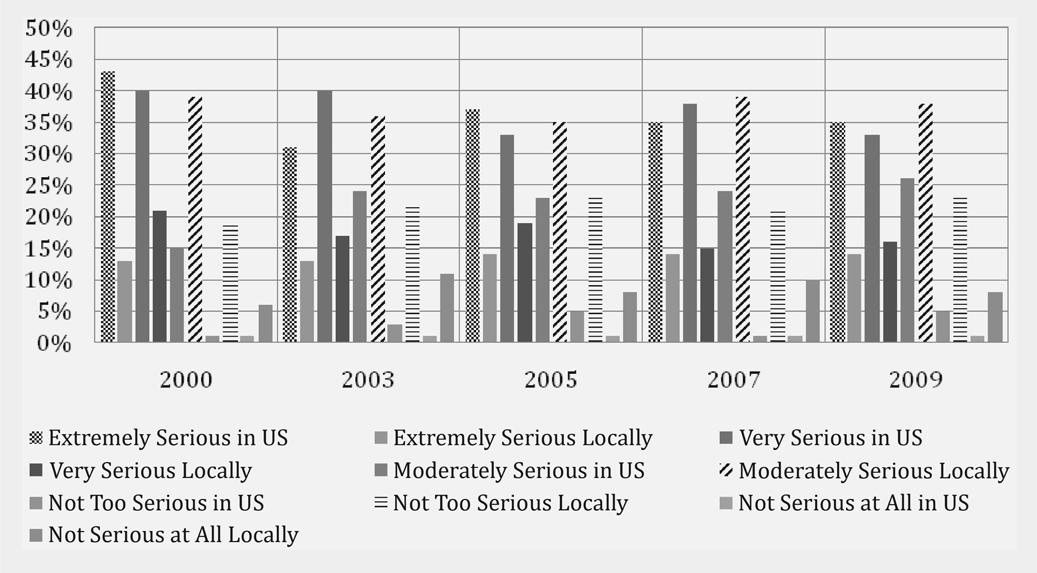
Increased crime, rising health costs, and other significant costs are all linked to drug policy termination. This framing of the end of the drug war clearly contributes to significant fear and uncertainty. This fear manifests itself in public opinion. A review of Gallup Opinion Poll data (see figure 5) reveals concern about the severity of the drug problems in the United States, although less concern about drug problems within people's own locale is indicated (where you could anticipate that respondents have first-hand information). This suggests that framing of the situation by others is shaping views of the drug war.
Attitudes toward Drug Problem in the United States and Locally

The policy termination process model (see figure 6) readily explains the failure of efforts to terminate the drug war. For many, the flaws of the drug war are clear; at a minimum, the failure to achieve its goals after almost four decades calls for policy change. The investigation into the policy termination process highlights that policy termination is a political act rather than a rational policy decision. The political factors—at present—are weighed against policy termination.
The Drug War Policy Termination Process

CONCLUSION: SO WHAT?
The drug war is expensive, damaging, and ineffective. Yet, as both Behn (Reference Behn1978) and DeLeon (Reference DeLeon and Palumbo1987) noted, arguments about economics and efficiency are not sufficient to result in termination. Apparently, failure is not sufficient either. This analysis suggests that understanding the causes of the drug war persistence is essential for the design of a victorious termination strategy. What can be done?
The analysis of the drug war policy termination process highlights the role that opinion about drugs, drug use, and the consequences of policy termination are central to the drug war's persistence. In terms of prospect theory, drug war framing is the crucial element. There is presently a low probability of policy termination; the public and politicians prefer the status quo to the risks of policy termination. However, if domain perceptions can be altered, the prospects for termination grow stronger. Policy termination entails risk; the future is an unknown while the present is not. If pursuit of the present course were presented as leading to sure loss (in prospect theory terms, shifting perceptions to the loss domain), then people would become more risk acceptant. Another method would be to offer an alternative policy as a “sure bet.” The result would be to place perceptions of policy change into the gains domain. Again, this would lead to greater support for policy change.
How can proponents of policy termination change public perception? Prospect theory experiments review that language is central. Highlighting prospective gains (for example, emphasis on tax revenue to be generated by policy termination) while emphasizing current losses (for example, persistent failure to achieve goals) could prove to be effective.
The policy termination process analysis also suggests reasons for the success of medical marijuana legislation. Technically, medical marijuana laws require policy termination (ending the status of marijuana as a Schedule 1 drug—a drug without medical use). In practical terms, medical marijuana movements have presented themselves as new policy, thus avoiding some of the problems that arise from policy termination. The framing of the issue makes the public and politicians more risk acceptant. Currently, without medical marijuana, people are suffering (a certain loss); the adoption of medical marijuana should help these people (risky). Prospect theory has consistently found that people are more risk acceptant in loss domains (situations of certain loss with maintenance of status quo). The ONDCP efforts to counter medical marijuana (arguments that it will increase youth drug use and drug-related violence; it is ineffective) have not proven effective. The ONDCP is highlighting the risks of change; its failures to understand that the current debate is framed in such a way that participants are more risk acceptant than in other circumstances.
To move toward complete drug war policy termination, the terms of the debate need to be reframed. When the public and politicians become more risk acceptant, support for the status quo will evaporate.