Introduction
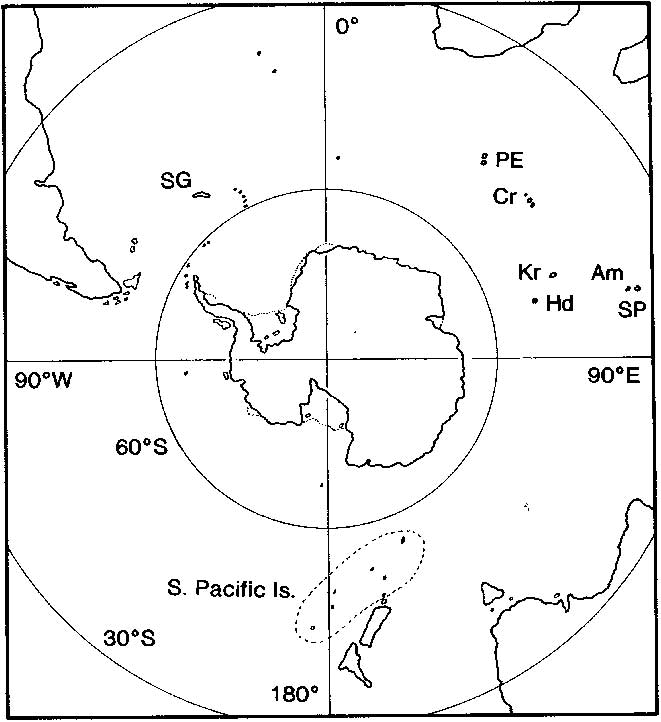
The islands of the Southern Ocean (Fig. 1) harbour only 41 species of endemic and introduced terrestrial slugs and snails (Gastropoda: Mollusca) (Pugh & Scott Reference Pugh and Scott2002). Twenty-seven species occur on the South Pacific Province (SPP) Antipodes, Bounty, Campbell, Chatham, Macquarie and Snares islands, while the South Indian Province (SIP) Amsterdam, Crozet, Heard, Kerguelen and Prince Edward islands are colonized by two exotics and a single endemic species - Notodiscus hookeri (Reeve) (Charopidae) (Fig. 1). The impoverished South Atlantic Province (SAP) fauna is confined to three slugs and snails introduced to the Falkland Islands, and a single snail on South Georgia.
Location of South Georgia (SG) relative to the South Pacific and South Indian Ocean islands of Amsterdam (Am), Crozet (Cr), Heard (Hd), Kerguelen (Kr), Prince Edward (PE) and St. Paul (SP).
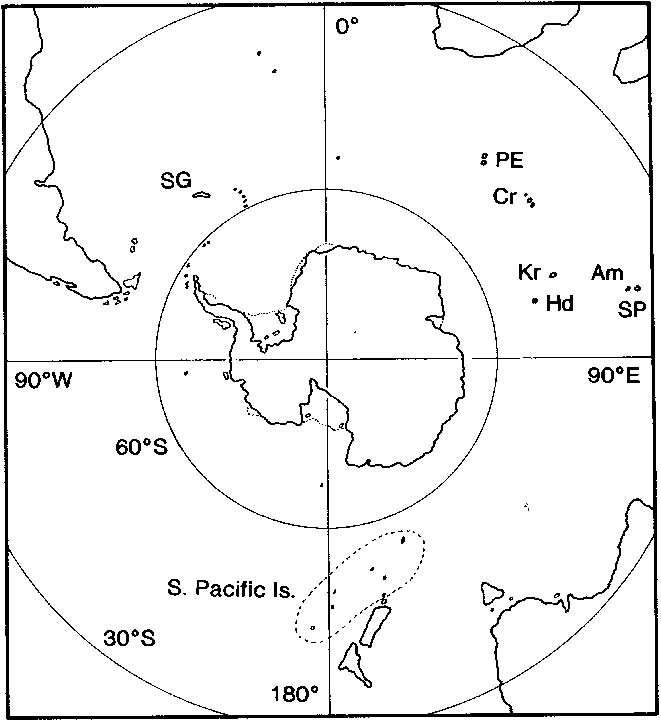
This South Georgian snail, discovered by RILS in January 1970, was first reported as an unidentified terrestrial mollusc (Smith & Walton Reference Smith and Walton1975), and subsequently tentatively ascribed to the genus Stephanoda (Endodontidae) or Notodiscus (Charopidae). Stephanoda (sensu Block Reference Block1984, Headland Reference Headland1984), was based on a 1978 personal communication from F.C. Naggs (British Museum, London) and Notodiscus (sensu Pugh & Scott Reference Pugh and Scott2002), on further personal communications from F.C. Naggs (British Museum, London 1981), M. Vogel (Philipps-Universität, Hamburg 1985), the late A. Solem (Field Museum of Natural History, Chicago 1986), and P. Mordan (Natural History Museum, London 1999). We subsequently confirmed Notodiscus (Pugh et al. unpublished), a genus previously known only from the SIP sub-Antarctic islands of Kerguelen, Possession (Iles Crozet), Heard, Amsterdam, Marion and possibly Prince Edward Island (Prince Edward Islands) (Fig. 1), and containing a single variable species, N. hookeri Reeve, 1854 (Solem Reference Solem1968, Smith Reference Smith1992, Madec & Bellido Reference Madec and Bellido2007). The primary focus of this study is a morphometric comparison of the snails on South Georgia with those of N. hookeri collected on the Iles Crozet and Iles Kerguelen by Madec & Bellido (Reference Madec and Bellido2007).
Methods
Field observations
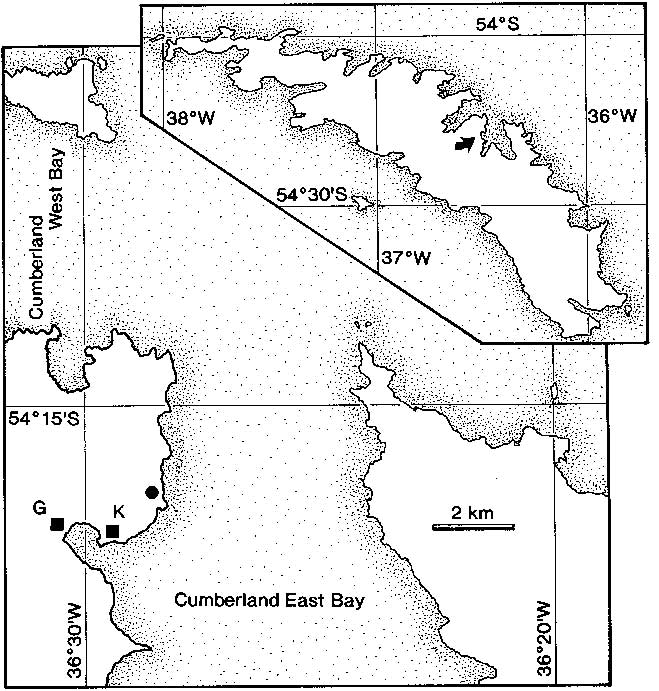
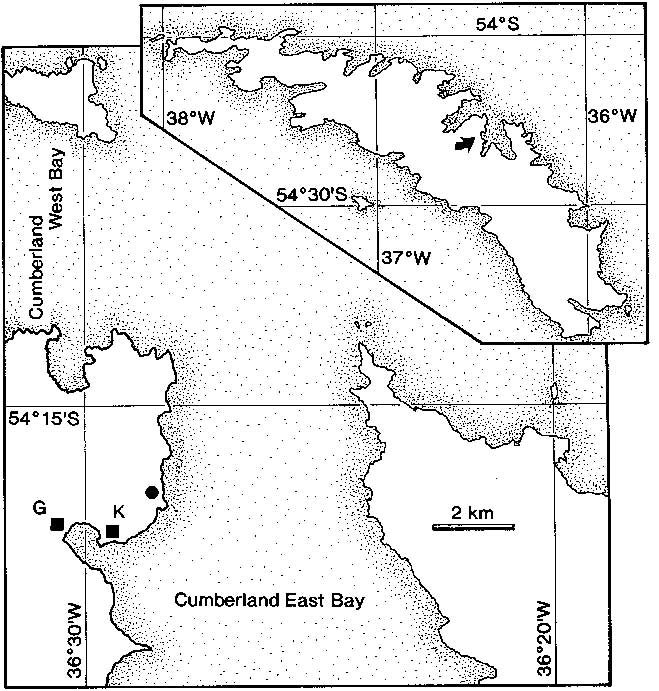
The snail occurs c. 1 km north of Hope Point, King Edward Cove, Cumberland East Bay, South Georgia (54°16′S, 36°23′W) (Fig. 2). The site, c. 25 m above sea level and 15–20 m inland from a narrow pebble beach, was the lower 5 m of a high, vertical shaded cliff with a south-east aspect. Ledges and crevices on this cliff face were colonized by liverworts (including Pachyglossa dissitifolia), lichens (Cladonia spp., Rhizocarpon geographicum, Tephromela atra), mosses (Andreaea spp., Bartramia patens, Grimmia, Pohlia nutans, Racomitrium spp.), and small vascular plants (Cystopteris fragilis, Deschampsia antarctica, Festuca contracta, Phleum alpinum). Moist areas of rock were coated by a film of microalgae and cyanobacteria, and the snails appeared to be feeding on these organisms. The soil and scree at the base of the cliff were covered by Acaena magellanica and A. tenera, scattered Festuca and mosses (especially Syntrichia robusta). Many empty shells were observed at the base of the cliff face while live snails were confined to c. 30 m2 of the cliff and particularly abundant at 1–3 m above the cliff base on mosses, in crevices and pockets of soil on ledges. Associated invertebrates included Enchytraeidae (Oligochaeta), mites (Acarina) and beetles (Coleoptera: Hydromedion and Perimylops spp.). Similar habitat, flora and fauna occur throughout much of the north-east coast of South Georgia yet many years of detailed ecological surveys and searches specifically for the snail have so far failed to locate evidence of other populations.
Offset: South Georgia showing Cumberland East Bay (arrow). Main map: Cumberland East Bay showing collection site (●) and the settlements of Grytviken whaling station (G) and King Edward Point (K).
Little can be gleaned from the published literature about the ecology of Nothodiscus hookeri throughout its sub-Antarctic distribution. It is widespread from near sea level to > 700 m altitude in the sub-Antarctic islands of the Indian Ocean. Madec & Bellido's (Reference Madec and Bellido2007) samples from Iles Crozet were collected between 10 and 70 m, while those from Iles Kerguelen were from c. 190–700 m altitude. From Dall's (Reference Dall1876) and Dell's (Reference Dell1964) accounts the Kerguelen populations appear to be associated with stony habitats and moss (i.e. fellfield) and also with the megaherb Pringlea antiscorbutica in wetter sheltered habitats. On Marion Island N. hookeri typically frequents fellfield habitats at lower altitudes (RILS, personal observation). However, no accounts refer to the snails occurring on cliff faces, as on South Georgia, although such a habitat could be construed as “vertical fellfield”.
Subsequent summer (January 1981 and February 2000) observations by RILS suggested the snails aggregated (5–20 per dm2 over several square metres) in crevices and beneath overhangs during sunny, dry weather but dispersed onto open rock and compact moss cushions during overcast or wet conditions. Specimens kept for several weeks in a Perspex container at laboratory temperature (c. 15–18°C) at South Georgia appeared to be more active at night. RILS fixed a total of 40 live specimens in 70% laboratory ethanol for anatomical study, although some subsequently dried out.
Specimen preparation
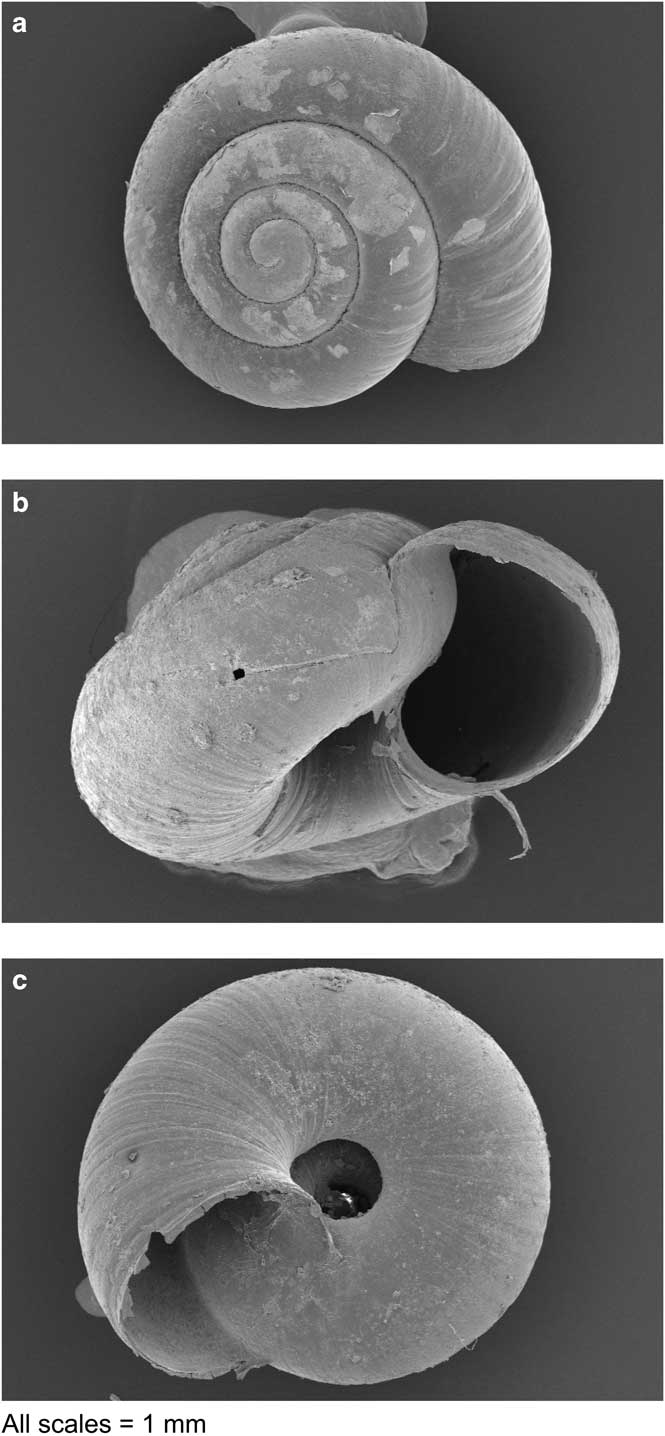
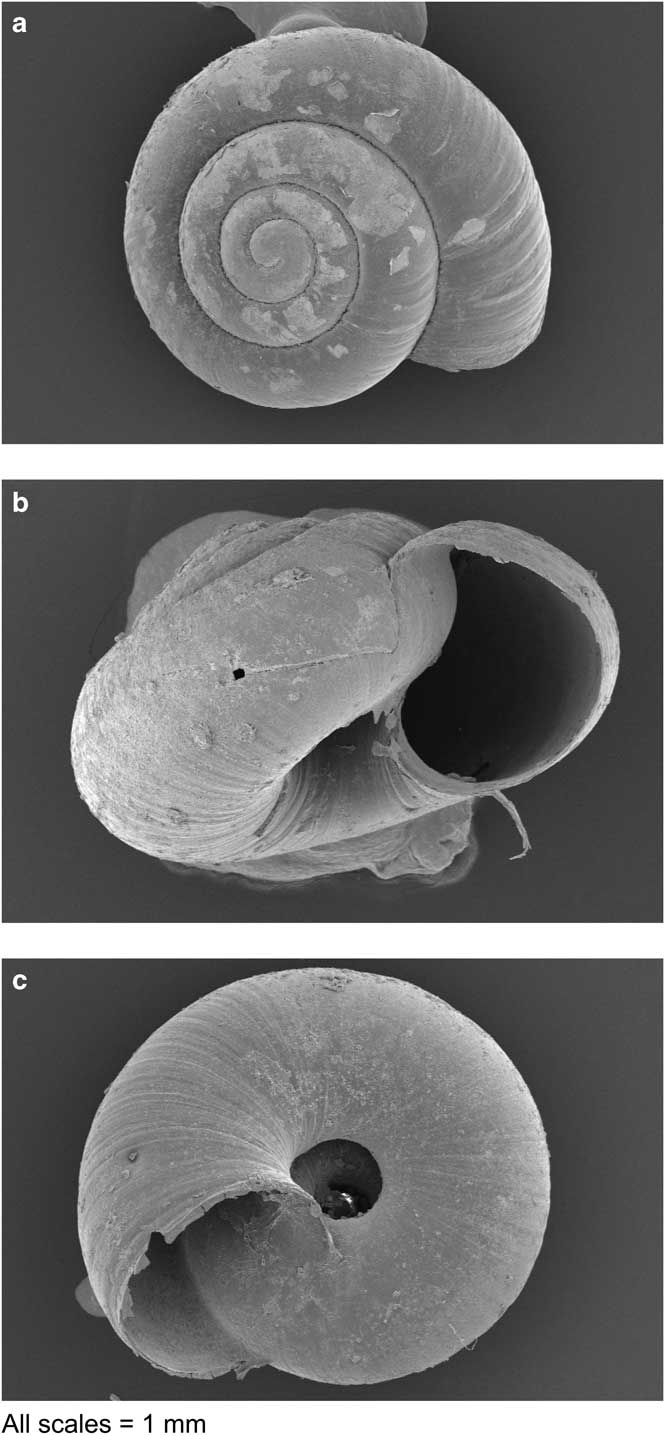
We cleaned several of the dried snails collected in March 1981 and prepared them for scanning electron microscopy. Shells were soaked in absolute ethanol for 48 hours and cleaned of adherent debris in low viscosity ethanol, to minimize mechanical risk for fragile shells, in an ultrasound bath at 47 kHz delivered in 15 second ‘bursts’ to prevent alcohol ignition. Loose debris was removed with a trimmed no. 3 artist's brush. Cleaned individual shells were mounted on conventional aluminium SEM stubs via double-sided adhesive carbon disks (a clean background for imaging) and a small spot of colloidal silver (for optimum grounding), then gold-coated in a Biorad SC502 sputter-coating unit. We imaged the shells in a Leica-Cambridge S360 scanning electron microscope configured for maximum depth of field at a 10 kV acceleration voltage, 120 pA probe current and a 20 mm working distance, capturing secondary electron images via an electronic frame store (Fig. 3).
Notodiscus sp. a. Dorsal. b. Lateral. c. Ventral. Scale bars: 1 mm.
Morphometric analysis
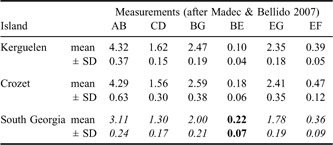
We briefly dried the 36 ethanol fixed specimens, collected in 2000, on laboratory tissue, mounted them aperture uppermost on a small bead of ‘Blu-Tack’ pressure sensitive adhesive and measured via a dissection microscope fitted with calibrated eyepiece graticule at x30. Our analysis focused on six principal measurements of maximal diameter (AB), spire diameter (CD), maximum height (BG), spire elevation (BE), penultimate whorl height (EF) and maximal aperture height (FG) (Table I), as used by Madec & Bellido (Reference Madec and Bellido2007). We combined measurements of the 36 South Georgia snails with the summary data for the four Iles Crozet and 13 Iles Kerguelen populations presented in Madec & Bellido (Reference Madec and Bellido2007). The data were analysed using the Multivariate Statistical Package (MVSP 3.1 - Kovach Reference Kovach1999), loge- transformed to allow comparison of ‘size’ and ‘shape’ attributes of the Iles Crozet, Iles Kerguelen and South Georgia snails via cluster analysis and principal components analysis (PCA).
Simple comparison of shells from Iles Kerguelen, Iles Crozet (after Madec & Bellido Reference Madec and Bellido2007) and South Georgia (current study).

Note: notable South Georgia values are italic (low) or bold (high).
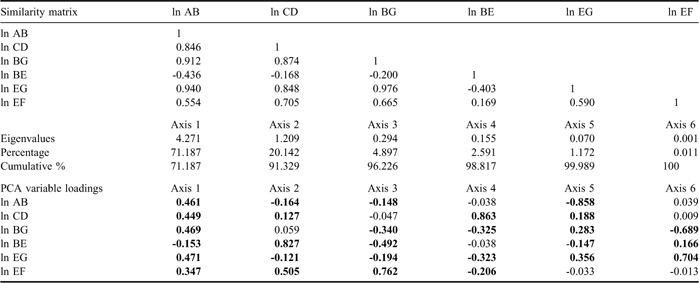
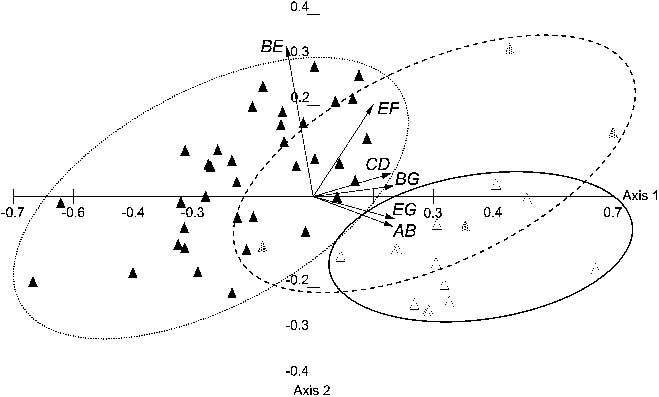
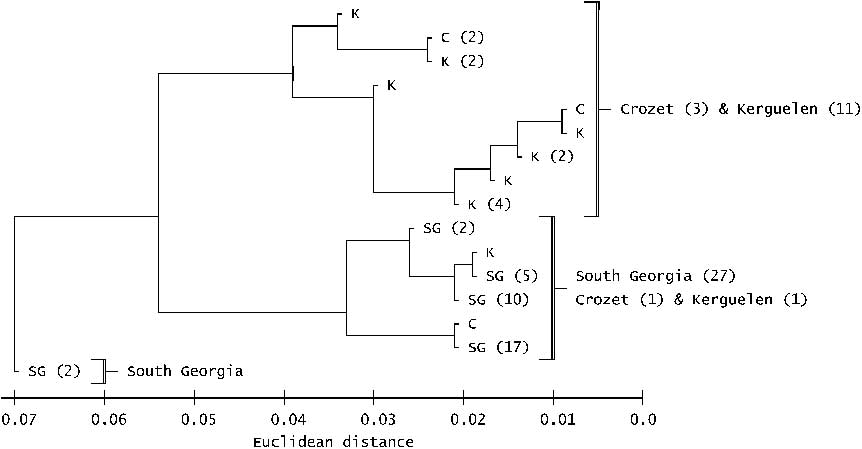
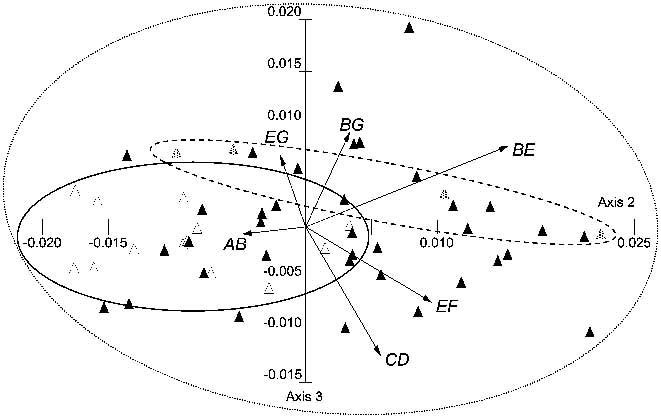
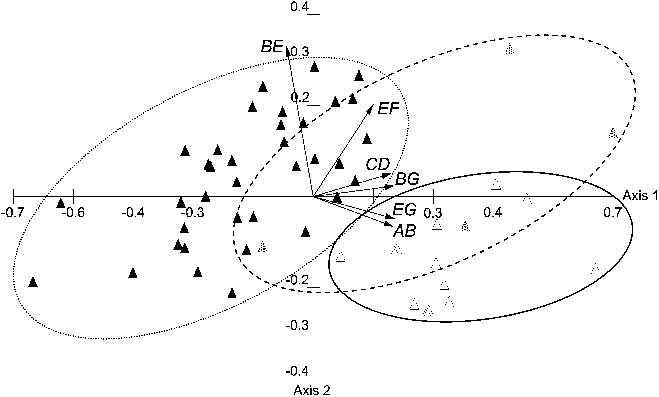
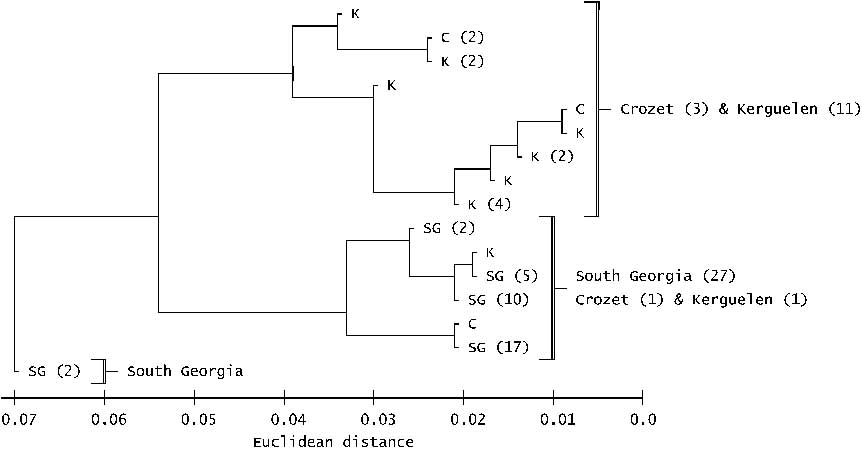
Exploring possible ‘size’ attributes via a centred PCA correlation ‘X-matrix’ (Table II) in which axes 1 and 2 extract 91.3% of total variance, left a residual 8.7% spread across the four remaining axes. We superimposed Euclidean vectors, as measure of factor direction and magnitude, on the axis 2/axis 1 scatter-plot (Fig. 4). To further differentiate between the Crozet, Kerguelen and South Georgia populations we compiled a clustergram (Fig. 5) computed from a matrix of Euclidean distances of the first three correlation matrix axes (after Madec & Bellido (Reference Madec and Bellido2007).
Correlation matrix.

Significant variable loadings (< ± 0.1) are shown in bold.
Scatterplot of PCA case scores for a standardized data/correlation matrix. Data for both Iles Crozet (stippled triangles/dashed line) and Iles Kerguelen (white triangles/solid line) are based on populations (after Madec & Bellido, Reference Madec and Bellido2007), while those for South Georgia (black triangles/dotted line) denote individual shells. Euclidean (loge-) vectors are listed in Table I; vector scaling: 0.4.
Clustergram performed using Euclidean distance (Edij) computed from PCA correlation matrix axes 1, 2 and 3 (96.2 of total variance). Numbers of snails/populations are shown in parentheses.
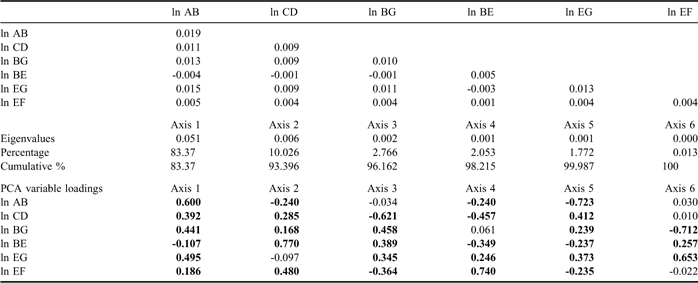
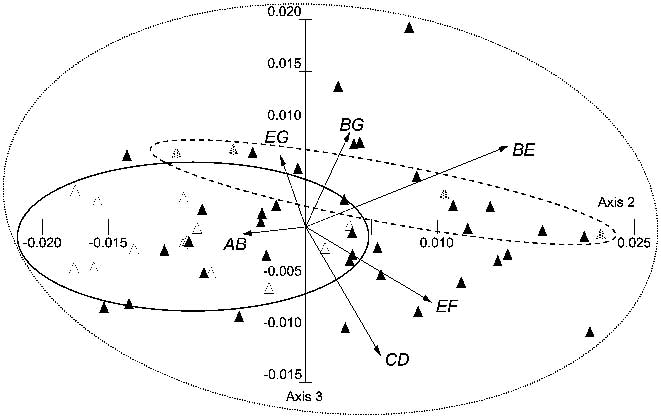
Using the Cadima & Jolliffe (Reference Cadima and Jolliffe1996) protocol to identify any ‘shape’-based components, axis 1 of the centred PCA covariance ‘X-matrix’ (Table III) extracted 83.4 of variance and (except spire elevation) included only positive variable loadings. This left 12.8% of variance on axes 2 and 3 from which we derived a scatter-plot upon which we superimposed Euclidean measurement vectors (Fig. 5).
Covariance matrix.

Significant variable loadings (< ± 0.1) are shown in bold.
We were naturally wary of applying PCA to population means but ruled out any major axial interactions in terms of (clearly absent) ‘horseshoe-effect’ or ‘arch-effect’ artefacts (Palmer Reference Palmer2008). We verified this via axis 2 vs axis 1 variable loading least squares linear regressions noting r 2 values of < .01 for both correlation (size) and covariance (shape) matrices.
Results & discussion
Both ‘size’ (Fig. 4) and especially ‘shape’ (Fig. 6) PCA scatter-plots show that the Iles Crozet and Iles Kerguelen snail populations overlap with the South Georgia snails confirming that the latter represent a Notodiscus hookeri population. The South Georgian shells consistently differ from those of both SIP populations in that they are smaller in all dimensions except spire elevation (BE) which is invariably high (Tables I & II). ‘Size’ PCA (Fig. 4) confirms that three of the four Crozet and all Kerguelen populations are ‘large’, i.e. positive with respect to axis 1, along which all shell dimensions except BE are aligned. The clustergram (Fig. 5) shows an entirely coherent Kerguelen/Crozet cluster (EDij < 0.040) and a largely coherent South Georgia cluster (EDij < 0.034) containing single Kerguelen and Crozet populations. Analysis of ‘shape’ shows all vectors, except BE, are positive confirming that axis 1 is indeed a size vector. But whereas the Crozet and Kerguelen populations are clearly discrete, the South Georgian snails are scattered across both axes. We cannot however rule out the possibility that this is an artefact of combining data from populations and individual shells within the same analysis.
Scatterplot of PCA case scores for a non-standardized data/covariance matrix. Data for both Iles Crozet (stippled triangles/dashed line) and Iles Kerguelen (white triangles/solid line) are based on populations (after Madec & Bellido, Reference Madec and Bellido2007), while those for South Georgia (black triangles/dotted line) denote individual shells. Euclidean (loge-) vectors are listed in Table II; vector scaling: 0.02.
Identification
We previously identified the South Georgian snail as a new Notodiscus species (Pugh et al. unpublished), but hesitate to confirm this here because while raw measurements suggest that the South Georgia snails are smaller than those from the SIP populations, PCA fails to discriminate the South Georgian and SIP snails in terms of shape attributes. Notodiscus hookeri exhibits considerable size variation, indeed that of the larger ‘subspecies’, N. hookeri heardensis (Dell Reference Dell1964), was subsequently shown to be within the variation of the nominate species and so reduced to a synonym (Solem Reference Solem1968). This factor alone dissuades us from raising the South Georgian snail to a new specific or even sub-specific taxon.
The following features discriminate the South Georgia population from those described from the SIP islands. Adult shell small at 2.5–3.5 mm diameter;  to 4 whorls; umbilicus 0.48–0.70 mm and narrow at c. one sixth of overall shell diameter (D/U 4.8–6.5). Shape is sub-globose with rounded periphery and deeply impressed sutures; aperture wide, ovate to sub-circular, with no barriers and margin almost entire. Apical whorls often eroded and the remaining whorls with a fairly heavy periostracum. Sculpture variable, comprising fine radial lines with traces of micro-reticulation, to smooth and shining with irregular growth wrinkles. Colour greenish-yellow with a suggestion of irregular darker streaks following the growth lines. The South Georgian snails are thus smaller, more tightly coiled, with (relative to shell diameter) a higher spire and wider umbilicus that their SIP siblings.
Origin
Notodiscus hookeri is widespread throughout the SIP islands (Solem Reference Solem1968, Madec & Bellido Reference Madec and Bellido2007), yet the South Georgia population is very limited and probably derived. How then did it become established at its current location?
The broad South Indian Ocean distribution of N. hookeri has been suggested as being a remnant of a once widespread (Gondwanan) distribution (Powell Reference Powell1960). However, both the SIP islands and South Georgia are derived from oceanic crust or volcanism (Dalziel et al. Reference Dalziel, Dott, Winn and Bruhn1975, Nur & Ben-Avraham Reference Nur and Ben-Avraham1982, Tanner Reference Tanner1982, Giret Reference Giret1987), which would preclude a vicariant origin. South Georgia is c. 120 million years old with c. 60% of current terrain covered by permanent ice. During the Pleistocene (1.8 million to 12 000 years ago) this ice cover extended to over 100 km offshore, inundating all fjords and bays, including Cumberland East Bay (Dalziel Reference Dalziel1984, Clapperton et al. Reference Clapperton, Sugden, Birnie and Wilson1989, Tingey Reference Tingey1991). The montane ice-free refugia, which persisted throughout the Pleistocene on mainland Antarctica, South Shetland and South Orkney islands (Convey et al. Reference Convey, Gibson, Hillenbrand, Hodgson, Pugh, Smellie and Stevens2008, Reference Convey, Stevens, Hodgson, Smellie, Hillenbrand, Barnes, Clarke, Pugh, Linse and Cary2009), were probably absent on South Georgia (Clapperton et al. Reference Clapperton, Sugden, Birnie and Wilson1989), and there were certainly no coastal refugia that could have supported land snails. Extensive glaciation and the absence of co-occurring Tertiary species imply that the South Georgia N. hookeri population, like all other South Georgian invertebrates, represents post-glacial (late Pleistocene or Holocene) ‘waif’ colonists (Pugh & Convey Reference Pugh and Convey2000).
The distribution of Notodiscus records require minimum oceanic transits to South Georgia of between c. 4400 km (from Prince Edward Islands) and c. 6000 km (Heard Island) via rafting on ocean currents, anthropogenic introduction or seabirds. Airborne drift or ballooning is an improbable vector for minute flightless arthropods (Pugh Reference Pugh2003), let alone a relatively large snail. Although rafting has been postulated for some South Pacific Charopidae (e.g. Smith & Djajasasmita Reference Smith and Djajasasmita1988, Preece Reference Preece1995), all native Southern Ocean land snail records relate to vicariant distributions (Pugh & Scott Reference Pugh and Scott2002) in which habitat, and a particular altitude, are incongruent with ocean rafting as a viable vector. Furthermore, the Antarctic Circum-Polar Current, or West Wind Drift, would carry ocean-borne colonists to the west coast of South Georgia not to east coast Cumberland Bay. This leaves introduction by anthropogenic and avian vectors as the only alternative modes of introduction.
The distributions of flightless exotic insects (two Carabidae and one Perimylopidae - Coleoptera) and mites on South Georgia are confined by glaciers (Ernsting et al. Reference Ernsting, Block, Macalister and Todd1995, Reference Ernsting, Brandjes, Block and Isaaks1999, Pugh Reference Pugh1997, Brandjes et al. Reference Brandjes, Block and Ernsting1999). These arthropods, and the high proportion (11 of 56) of exotics among the Southern Ocean terrestrial molluscs (Pugh & Scott Reference Pugh and Scott2002), could not rule out this single Notodiscus site record being regarded as an anthropogenic introduction. The collection site is 3 km from the abandoned Grytviken whaling station which operated from 1904 to 1965, and 1.5 km from the small South Georgia Government settlement at King Edward Point, which has been occupied since 1912 (Headland Reference Headland1984).
However, exotic invertebrates on isolated islands are usually devolved from embarkation ports (Barker Reference Barker1979, Smith Reference Smith1992, Smith & Stanisic Reference Smith and Stanisic1998) which, in this case, would be in northern Europe or South America. There are no records of sealing, or indeed other, vessels having made transits between South Georgia and the SIP islands (Bonner Reference Bonner1968, Headland Reference Headland1984). Furthermore, anthropogenic import of terrestrial molluscs to tropical, temperate and sub-polar islands is usually attributed to a limited range of ‘exotic’ or ‘invasive’ species, particularly the temperate genera Arion (Arionidae), Helix, Otala, Theba (Helicidae), Deroceras (Limacidae), Milax (Milacidae) Testacella (Testacellidae), Oxychilus and Vitrea (Zonitidae) (Holdgate Reference Holdgate1965, Barker Reference Barker1979, Smith Reference Smith1992, Cooper & Ryan Reference Cooper and Ryan1994, Preece Reference Preece1995, Reference Preece2001, Martins Reference Martins1999). This, albeit indirect, evidence further mitigates against N. hookeri on South Georgia being an anthropogenic exotic, i.e. human-mediated, introduction.
Post-glacial avian dispersal is postulated for some Mollusca, including Helicarionidae, Succineidae and Vitrinidae on isolated islands (Rees Reference Rees1965, Vagvolgyi Reference Vagvolgyi1975) and, indeed, for N. hookeri on Marion Island (Falla Reference Falla1960, Dell Reference Dell1964, Van Zinderen Bakker Reference Van Zinderen Bakker1971). Gittenberger et al. (Reference Gittenberger, Groenberg, Kokshoorn and Preece2006), using molecular phylogenetics, ascribe the endemic Clausiliidae on the Trista da Cunha–Gough Island group in the mid-South Atlantic to Balea, a genus otherwise known only from Palaearctic islands in the North Atlantic Ocean. They suggested passive dispersal, probably involving an avian vector. RILS found the South Georgia snails close to a number of nesting seabirds (blue-eyed shags (Phalacrocorax atriceps (King)), Dominican gulls (Larus dominicanus Lichtenstein), and light mantled sooty albatrosses (Phoebetria palpebrata (Forster))), which also breed on other SIP and SPP islands (e.g. Harrison Reference Harrison1983). However, only P. palebrata is known to circumnavigate the Southern Ocean and possibly make landfall at any of these island groups. While we are unable to prove a three way location/snail/seabird connection, avian zoochory remains the most parsimonious, indeed only, solution to account for this highly disjunct distribution.
Conclusions
We have confirmed our original suggestion that the South Georgia land snail is a member of the genus Notodiscus which was previously known only from the South Indian Ocean islands with Notodiscus hookeri heardensis (sensu Dell Reference Dell1964) now reduced to a synonym (representing a locally endemic ‘giant’) of the nominal N. hookeri. We believe that the South Georgian snail may simply be a local ‘tall dwarf’ variant of the nominal species. Only a comprehensive molecular analysis can reveal the true affinities of the South Georgia snail and its relationships with the other Southern Ocean Notodiscus populations.
Acknowledgements
We would like to thank F.C. Naggs and P. Mordan, Natural History Museum, London; M. Vogel, Philipps-Universität, Hamburg Marburg and (the late) A. Solem, Field Museum of Natural History, Chicago for providing comments on the possible identity and affinities of the South Georgian snail; R.K. Headland, formerly of the British Antarctic Survey, Cambridge, for collecting additional specimens; B.J. Smith, formerly of the Queen Victoria Museum, Launceston, Tasmania, for assistance in specimen identification; and two anonymous referees for their invaluable comments.