Antimicrobial resistance (AMR) is driven by various factors such as inappropriate antimicrobial use resulting from prescribers’ lack of knowledge and poor attitudes, insufficient diagnostic tools and monitoring systems, and poor infection control.Reference Nguyen, Thi and Chandna 1 – Reference Buke, Hosgor-Limoncu and Ermertcan 5 Recent qualitative studies among final-year medical students in high-income countries have revealed high recognition of the importance of appropriate antimicrobial use as well as eagerness to learn more about rational antimicrobial use.Reference Abbo, Cosgrove and Pottinger 6 , Reference Dyar, Pulcini, Howard and Nathwani 7 Based on data from a UK study, although knowledge of infection control and aseptic techniques have been included in the course syllabus for a UK medical degree since the 1970s, these topics are rarely formally evaluated.Reference Mann and Wood 8
Until now, data on perception, attitude, and knowledge regarding antimicrobial resistance, appropriate antimicrobial use, and infection control in low-income countries have been limited. Therefore, we conducted a multicenter questionnaire-based study among final-year medical students to evaluate these issues.
MATERIALS AND METHODS
Study Settings and Design
A questionnaire-based study was conducted among sixth-year medical students in 3 medical schools in Thailand: (1) Faculty of Medicine Siriraj Hospital, Mahidol University, Bangkok (Siriraj); (2) Faculty of Medicine, Chiang Mai University, Chiang Mai (CMU); and (3) Faculty of Medicine, Naresuan University, Phitsanulok (NSU). In Thailand, the medical degree course is conducted over 6 years: 3 preclinical years and 3 clinical years. The protocol for this study was approved by the Institutional Review Board in all 3 institutions. Closed-ended questions, open-ended questions, and questions using a 5-point Likert scale (ie, 5=strongly agree, 4=agree, 3=neutral, 2=disagree, and 1=strongly disagree) were included in the questionnaire. The questionnaire included 4 important sections: perception and attitude, knowledge, learning source, and baseline characteristics. All questions were posed in the Thai language. The questionnaire was distributed to all final-year (ie, sixth-year) medical students during their institutes’ last orientation sessions (March–April 2014). Participation was voluntary and anonymous. After completing the questionnaire, each participant was given a sweepstakes coupon.
Categorical variables were reported as frequencies and percentages. Continuous variables were reported as mean±SD, median, and range according to the distribution. All analyses were performed using STATA/IC version 14.0 (STATA Corp, College Station, TX).
RESULTS
Baseline Characteristics
Of 636 total participants, 455 (71.5%) completed the questionnaire. Of these, 57% were female, with a mean age of 24.5±2.2 years. More than 25% of the participants from NSU (27.2%) had another educational degree prior to entering medical school. The 3 leading preferred specialties for future training were medicine (14.1%), surgery (13.0%), and pediatrics (9.0%).
Perception and Attitude
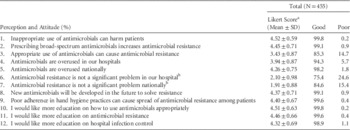
Nearly all participants (99.8%) perceived that prescribing broad-spectrum antimicrobial agents could lead to the emergence of AMR and can harm the patient. More than 90% of participants acknowledged that antimicrobial overuse is a problem in their hospital as well as on a national level. Nearly all participants reported that they would like to learn more about rational antimicrobial use, AMR, and infection control. Details regarding the perception and attitudes of all participants are shown in Table 1.
Good and Poor Perception and Attitude Regarding Appropriate Antimicrobial Use, Antimicrobial Resistance, and Infection Control

NOTE. Good perception was noted if a participant agreed or strongly agreed in a positive question or disagreed or strongly disagreed in a negative question.
a All questions used a 5-point Likert scale (5=strongly agree, 4=agree, 3=neutral, 2=disagree, and 1=strongly disagree).
b Questions 6 and 7 are negative questions. All other questions are positive questions.
Nearly all participants (98.0%) reported that they were able to prescribe the appropriate antimicrobials to patients. However, 71.4% reported feeling anxious when they had to prescribe antimicrobial agents. Details regarding perception of, attitude toward, knowledge of, and preparedness for antimicrobial use among sixth-year medical students in Thailand are presented in Supplemental Table 1.
Knowledge
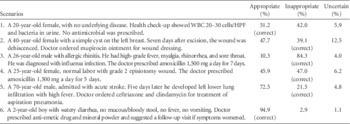
Mean knowledge scores on resistance mechanism, AMR clinical scenarios, and infection control were 1.61±1.00 points (full score=5), 3.39±1.20 points (full score=6) and 8.02±1.13 points (full score=10), respectively. Nearly all participants had correct knowledge of hand hygiene. However, 52.1% incorrectly indicated that a combination of surgical mask and N-95 mask should be used when in contact with patients with multidrug-resistant tuberculosis. Details regarding the assessment of appropriate treatments in 6 clinical scenarios are presented in Table 2.
Assessment of Appropriate Treatments in 6 Clinical Scenarios

Educational Activities and Hospital Structure
Participants with questions regarding antimicrobial use preferred asking the ward resident (62.6%), followed by their attending staff (57.4%) and the infectious disease (ID) specialist (10.1%). The international antimicrobial handbook (52.1%) was preferred as a reference over the Thai antimicrobial handbook (11.9%).
To learn about appropriate antimicrobial use, bedside teaching with medical staff (85.0%) was considered the best modality, followed by grand rounds (79.1%) and lectures (71.8%). During their pre-clinical years, most participants (89.6%) reported that they learned about AMR; 79.9% reported learning about appropriate antimicrobial use; and 58.3% reported learning about infection control. Overall, 70.0% of participants reported that they learned about AMR during their clinical years, whereas 85.9% reported that they learned about appropriate antimicrobial use and 85.2% reported that they learned about infection control during this period. Data regarding learning each of these topics are shown in Supplemental Table 2.
Furthermore, the existence of an ASP program, availability of an ID specialist, and the presence of an infection control (IC) nurse were recognized by only 55.0%, 81.5%, and 41.4% of participants, respectively.
DISCUSSION
Most participants recognized the problem of antimicrobial overuse at the hospital and national levels and also agreed or strongly agreed that antimicrobial overuse could lead to the emergence of AMR. Despite their perception of and attitude toward the AMR issue, these future prescribers felt that they still needed more education on rational antimicrobial use, AMR, and infection control. Additionally, these students received a relatively low score in the knowledge section. Only ~50% correctly answered the questions regarding antimicrobial use.
Bedside teaching was considered the best modality for learning appropriate antimicrobial use. Furthermore, when students had questions regarding antimicrobial use, only 27.7% of participants accessed information on the Internet. In contrast, in a study conducted among US medical students, ID staff (72%) and the UpToDate resource website were voted the favorite self-study sources regarding antimicrobial use.Reference Abbo, Cosgrove and Pottinger 6 These differences may result from limited accessibility to the Internet and a lack of an updated version of the Thai antimicrobial handbook.
Although the topics AMR, appropriate antimicrobial use, and infection control are mandatory components of the Thai medical degree, >10% of our participants reported that they had never learned about AMR and the appropriate use of antimicrobial therapy. This may be due to poor student perceptions or to the fact that these 3 important components are not taught in all medical schools.
ASP, ID specialists, and IC nurses were available in all the participating institutes. However, the existence of the ASP, the ID specialists, and IC nurses in institutes were recognized by only 55.0%, 81.5%, and 41.4% of participants, respectively. Poor recognition of these 3 important resources is considered a great obstacle for combating AMR.
In conclusion, AMR, antimicrobial overuse, and lack of infection control in Thailand are challenges that are generally well recognized by future practitioners. However, their knowledge of these 3 important subjects is substantially limited. Additional efforts should be made to ensure that Thai medical students have access to all vital information regarding AMR, are skilled in rational antimicrobial use, and are aware of appropriate infection control before graduating.
ACKNOWLEDGMENTS
The authors wish to thank all participants for their contributions to our study. Furthermore, we would like to thank all personnel from the Division of Undergraduate Education of all 3 medical schools for their support.
Financial support. This study was primarily supported by Health Systems Research and Development Project, Faculty of Medicine Siriraj Hospital, and Health Systems Research Institute, Thailand.
Potential conflicts of interest. All authors report no conflicts of interest relevant to this article.
SUPPLEMENTARY MATERIAL
To view supplementary material for this article, please visit http://dx.doi.org/10.1017/ice.2016.8