The majority of research on phonological and orthographic parafoveal processing of words when reading has been conducted on Roman script, and only limited research has been conducted on other orthographies. Thai has a distinctive alphabetic orthography with homophonous consonants, visually similar orthographic consonants, vowels occurring in both horizontal orthographic position (HOP) and vertical orthographic position (VOP), and tone markers occurring in VOP. These characteristics allow us to selectively manipulate the availability of consonant, vowel, and tone information in the parafovea, so that the relative contribution of orthographic and phonological information extracted during word recognition when reading Thai can be investigated. Four experiments were conducted to investigate parafoveal processing of consonants, vowels, and tones when reading Thai sentences silently for meaning, using an eye-contingent display change known as the boundary change paradigm (Rayner, Reference Rayner1975), which involves rapidly changing a preview word or stimulus to the target word when the eyes cross an invisible boundary. The word change occurs rapidly during the saccade, so that readers are largely unaware of the change, and cannot identify the preview word or nonword that they had actually begun to process parafoveally. Typically, when the preview word and target word are identical, there is the largest preview benefit effect indicated by a subsequent decrease in fixation duration on the target word. The foveal region extends to approximately 6 to 8 letters, whereas the parafoveal region typically extends to about 15 to 20 letters (Rayner, Reference Rayner1998).
PARAFOVEAL PROCESSING EFFECTS IN ROMAN ORTHOGRAPHIES
Numerous studies indicate that lexical processing begins parafoveally before the eyes actually fixate on the word (e.g., Ashby, Treiman, Kessler, & Rayner, Reference Ashby, Treiman, Kessler and Rayner2006; Deutsch, Frost, Pollatsek, & Rayner, Reference Deutsch, Frost, Pollatsek and Rayner2005; Kambe, Reference Kambe2004; McConkie & Rayner, Reference McConkie and Rayner1975; Rayner, Well, Pollatsek, & Bertera, Reference Rayner, Well, Pollatsek and Bertera1982). The parafoveal preview benefit effect is greatest when the entire word is available in the parafovea, but is also found in some manipulated preview conditions. It has been widely reported that orthographic components of language are able to enhance word processing when viewed parafoveally (e.g., Balota, Pollatsek, & Rayner, Reference Balota, Pollatsek and Rayner1985; Binder, Pollatsek, & Rayner, Reference Binder, Pollatsek and Rayner1999; Johnson, Perea, & Rayner, Reference Johnson, Perea and Rayner2007; Lee, Binder, Kim, Pollatsek, & Rayner, Reference Lee, Binder, Kim, Pollatsek and Rayner1999; Rayner, Reference Rayner1998; Williams, Perea, Pollatsek, & Rayner, Reference Williams, Perea, Pollatsek and Rayner2006). Moreover, phonological components of words have been found to enhance word processing in Roman orthographies when viewed in the parafovea prior to fixation (e.g., Ashby et al., Reference Ashby, Treiman, Kessler and Rayner2006; Chace, Rayner, & Well, Reference Chace, Rayner and Well2005; Miellet & Sparrow, Reference Miellet and Sparrow2004; Pollatsek, Lesch, Morris, & Rayner, Reference Pollatsek, Lesch, Morris and Rayner1992; Slattery, Pollatsek, & Rayner, Reference Slattery, Pollatsek and Rayner2006). For example, Pollatsek et al. (Reference Pollatsek, Lesch, Morris and Rayner1992), using the boundary change paradigm found that homophone parafoveal previews, for example reins, facilitated reading of the target word rains more than the orthographically similar word ruins. The identical preview facilitated reading the most, which also indicates that orthographic coding was playing a role. Similarly, Miellet and Sparrow (Reference Miellet and Sparrow2004) found phonological effects using nonword previews in French. They presented target words preceded by a preview that was either identical (e.g., maison), a nonword homophone (e.g., maizon), or a nonword control (e.g., mailon). The identical and homophone conditions had similar reading times, which were faster than the control, which indicates that phonology is playing a role.
PARAFOVEAL PROCESSING EFFECTS IN LOGOGRAPHIC ORTHOGRAPHIES
In alphabetic writing systems, such as English, it is difficult to conclude that homophone or pseudohomophone effects are phonological rather than orthographic, as there are vowel letter overlaps (Ashby et al., Reference Ashby, Treiman, Kessler and Rayner2006). Chinese, a logographic orthography, is particularly suitable for investigating this further, as the same syllable can be written with orthographically different characters. Studies on Chinese (Liu, Inhoff, Ye, & Wu, Reference Liu, Inhoff, Ye and Wu2002; Pollatsek, Tan, & Rayner, Reference Pollatsek, Tan and Rayner2000; Tsai, Lee, Tzeng, Hung, & Yen, Reference Tsai, Lee, Tzeng, Hung and Yen2004) have revealed that phonological information is processed parafoveally. Pollatsek et al. (Reference Pollatsek, Tan and Rayner2000), using the boundary change paradigm, found that a homophone viewed parafoveally aided in the identification of a target character. Orthographic information from the preview was also used. They concluded that both lexical and sublexical phonological codes are involved in the early processing of Chinese characters. Similarly, Liu et al. (Reference Liu, Inhoff, Ye and Wu2002) found preview benefits for targets when presented with both graphemically similar phonetic radicals and phonologically similar previews. Results support the proposition that both visual orthographic and phonological codes cooperate in the identification of a word.
THE CONTRIBUTION OF CONSONANTS, VOWELS, AND TONES IN READING
Consonants, vowels, and lexical tones are all crucial in identifying words when reading. However, it is possible that early representations of a word during silent reading do not represent all of these properties equally. One view is that in English, vowel information plays a relatively minor role in early phonological processing, as vowel spelling can correspond to several potential phonemes, and is more variable in spelling–sound relationships than consonants (Kessler & Treiman, Reference Kessler and Treiman2001). According to Berent and Perfetti (Reference Berent and Perfetti1995), consonants and vowels are processed in separate cycles during word recognition, with the assembly of consonants finishing before the assembly of vowels. Implications from this theory are that phonology may not be processed linearly from left to right, as suggested by the dual route model (Coltheart, Rastle, Perry, Langdon, & Ziegler, Reference Coltheart, Rastle, Perry, Langdon and Ziegler2001), and there may be a temporal distinction between consonants and vowels in their contribution to visual word identification. Furthermore, according to the minimality principle (Frost, Reference Frost1998), there are distinct roles for vowels and consonants, and the representation used for lexical access contains the minimal amount of phonological information that is necessary to activate a unique lexical item. So according to this viewpoint, the representation used to access words initially in reading may consist primarily of consonant information.
Support for a temporal difference in contribution between consonants and vowels when reading English comes from eye movement studies (Lee, Rayner, & Pollatsek, Reference Lee, Rayner and Pollatsek2001, Reference Lee, Rayner and Pollatsek2002). Lee et al. (Reference Lee, Rayner and Pollatsek2001), using a delayed letter paradigm, found that there was a temporal distinction between the contribution of consonants and vowels during the early phases of reading, with consonants playing a more prominent role. Recent research by Ashby et al. (Reference Ashby, Treiman, Kessler and Rayner2006) has found shorter reading times for nonword concordant vowel previews (e.g., cherg) rather than discordant previews (e.g., chorg) for a target word (e.g., chirp). Consequently, it appears from this study that English readers do include vowel information in early phonological representations to identify words, although it is not conclusive whether there is a temporal distinction between the contribution of consonants and vowels.
Further support for the view that vowels and consonants are processed differently comes from event-related potential and functional magnetic resonance imaging paradigms. Carreiras and Price (Reference Carreiras and Price2008) used functional magnetic resonance imaging in a lexical decision and naming task and found that vowels and consonants activated different regions of the brain. Carreiras, Duñabeitia, and Molinaro (Reference Carreiras, Vergara and Perea2009) recorded event-related potentials while participants read words in a masked priming semantic categorisation task. They found that the relative position priming effect held for consonants (csn-CASINO) but not for vowels (aia-ANIMAL). They suggest that a differentiation is made between consonants and vowels at an early stage in processing, with consonants playing a more prominent role than vowels in word recognition.
Additional insights into the role of consonants and vowels have emerged from research on transposed letter effects. Transposed letter priming effects have been shown to occur for adjacent letter positions (e.g., jugde-JUDGE) using the masked priming paradigm (e.g., Castles, Davis, & Forster, Reference Castles, Davis, Forster, Kinoshita and Lupker2003; Forster, Davis, Schoknecht, & Carter, Reference Forster, Davis, Schoknecht and Carter1987; Perea & Carreiras, Reference Perea and Carreiras2006) and for nonadjacent letter positions (e.g., relovution-REVOLUTION; e.g., Perea & Carreiras, Reference Perea and Carreiras2006; Perea & Lupker, Reference Perea and Lupker2004). Transposed letter effects have also been found in continuous reading while eye movements are monitored (e.g., Acha & Perea, Reference Acha and Perea2008; Johnson, Reference Johnson, van Gompel, Fisher, Murray and Hill2007; Johnson et al., Reference Johnson, Perea and Rayner2007; Rayner, White, Johnson, & Liversedge, Reference Rayner, White, Johnson and Liversedge2006). Recently, differential roles of consonants and vowels have been found for transposed letter priming effects; researchers have found effects for consonants but not vowels (Carreiras, Vergara, & Perea, Reference Carreiras and Price2007, Reference Carreiras, Vergara and Perea2009; Perea & Lupker, Reference Perea and Lupker2004). Perea and Lupker (Reference Perea and Lupker2004) used a masked priming technique with manipulations involving nonadjacent consonants (e.g., caniso as the prime for CASINO) and vowels (e.g., anamil as the prime for ANIMAL). Faster lexical decision times were found for consonants but not vowels. However, Johnson (Reference Johnson, van Gompel, Fisher, Murray and Hill2007) used the boundary change paradigm to examine parafoveal processing of transposed letter effects of consonants and vowels and did not find a difference in processing between consonant C–C and vowel V–V transpositions at this early stage of processing. Reading times for C–C transpositions (e.g., fosert-forest vs. fonewt-forest) and for V–V transpositions (e.g.. flewor-flower vs. flawur-flower) were comparable. She suggests that these transposed letter effects occur at a very low level of visual word recognition prior to the phonological encoding of vowels and consonants. Following on from this study, Perea and Acha (Reference Perea and Acha2009) used a lexical decision task and a cross-case same–different masked priming paradigm to examine consonant and vowel transposition effects. The same–different task is considered to be a low-level perceptual task that taps very early lexical processes and is unaffected by phonology (based on the evidence that nonwords show robust masked priming effects; Besner, Coltheart, & Davelaar, Reference Besner, Coltheart and Davelaar1984; Norris & Kinoshita, Reference Norris and Kinoshita2008). In the lexical decision task, they found, as in previous studies, a transposed letter priming effect for consonants but not vowels. However, in the cross-case same–different task they found a comparable effect for both consonant and vowel transpositions, which is similar to Johnson's (Reference Johnson, van Gompel, Fisher, Murray and Hill2007) results. They concluded that letter coding takes place prior to the differentiation between consonants and vowels, which occurs at a later phonological stage.
Cross-language research suggests that orthography-specific effects may play a role in the processing of vowels dependent on the particular characteristics of the language and its orthography (Colombo, Reference Colombo, Kennedy, Radach, Heller and Pynte2000; Frost, Katz, & Bentin, Reference Frost, Katz and Bentin1987). Italian has fewer and more consistent vowel forms than English, and spelling sound correspondences are equally reliable for both consonants and vowels. Colombo (Reference Colombo, Kennedy, Radach, Heller and Pynte2000), using a backward masking paradigm did, not find an advantage for consonants but an advantage for vowels in Italian.
In many languages such as Thai, Vietnamese, and Chinese, tone forms an integral element of the syllable, as it serves an essential function in distinguishing meanings of syllables and words with identical phonological structure. There has been much debate over whether the processing of suprasegmental (tone) and segmental (consonants and vowels) units involves separate neural and cognitive processes or mechanisms. Results from neurological studies are somewhat contradictory, but the consensus appears to be that there is a dissociation of neurological structure between suprasegmental and segmental units (Liu et al., Reference Liu, Peng, Ding, Jin, Zhang, Li and Chen2006). Liu et al. (Reference Liu, Peng, Ding, Jin, Zhang, Li and Chen2006) investigated tone and vowel production in Chinese and found greater activation of the right frontal gyrus for tones in comparison to vowels. Tone production was also less lateralized than vowel production. The role of tone in phonological processing when reading has so far not been investigated to a great extent. Xu, Pollatsek, and Potter (Reference Xu, Pollatsek and Potter1999) found facilitatory effects dependent on having same tone homophony in Chinese. They found, using a semantic-relatedness judgement task (whereby participants had to judge whether the two words presented on the screen were semantically related) that a distractor that shared the consonant and vowel with the target word but not tone did not interfere as much as full representation. In fact, characters that shared the vowel and consonant with the target but not the tone produced no more interference than unrelated distractors. They concluded that tonal information in conjunction with consonant and vowel information is an essential part of phonological representation in Chinese. If consonant and vowel information is activated in conjunction with tonal information, then this dramatically narrows the number of items potentially activated in a tonal language. These cross-language studies highlight the role that orthography-specific factors are likely to play in phonological representation and word recognition.
CHARACTERISTICS OF THAI LANGUAGE AND ITS ORTHOGRAPHY
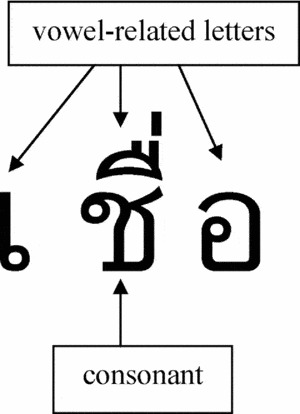
Thai, a tonal language, has its own distinctive alphabetic script with 44 basic consonants plus 4 archaic consonants for 21 consonant sounds. Thai consonants, including the homophonous consonants (e.g., /s/  ), are listed in Appendix A. Thai consonants are written in a linear order, but vowels can be written nonlinearly above, below, or to either side of the consonant, and commonly combine across the syllable to produce a single vowel or dipthong, as illustrated in Figure 1. Vowel length is linguistically significant in Thai, as Thai has both short and long vowels. Thai vowels are complex graphemically in their expression, but have consistent grapheme to phoneme mapping. In contrast, Thai consonants are less consistent in their mapping and are feedback inconsistent due to having homophonous consonants. There are no spaces between words; instead, occasional spaces in Thai text may indicate the end of a clause or sentence.
An example illustrating how vowel-related letters combine across the syllable for the word  /tçhɯa2/ “believe.”

There are five tones (five different F0 contours) in Thai but only four tone markers; maj3 e:k1 ่, maj3 tho:0  , maj3 tri:0
 , and maj3 tça1ta1wa:0 +, which occur above the consonant. (In examples cited the unmarked midtone is represented as “0,” the low tone as “1,” the falling tone as “2” the high tone as “3,” and the rising tone as “4” based on the system developed at the Linguistics Research Unit of Chulalongkorn University (Luksaneeyanawin, 1993). Tone forms an integral element of the syllable in Thai, and serves an essential function in distinguishing meanings of syllables and words with identical phonological structure. The tone determination of a syllable is complex, as it is influenced by a combination of the class of initial consonant, the type of syllable (open or closed), the tone marker, and the length of the vowel. Hence, it can be seen that the expression of tone in Thai involves complex rules that are an integral part of the syllable and operate at that level.
Thai offers a unique opportunity to further investigate phonological and orthographic parafoveal processing effects in an alphabetic orthography, as it has distinctive characteristics: homophonous consonants as well as consonants that are orthographically visually similar (see Appendix A). Furthermore, Thai has vowels that vary in length and are orthographically distinct (e.g., there is a short  /a/ and long vowel
 /a:/), which are termed concordant vowels in the current study (a similar terminology is used by Ashby et al., Reference Ashby, Treiman, Kessler and Rayner2006; however, the meaning is somewhat different), and tone markers or diacritics that are placed above the syllable and indicate the tone of the syllable. These components can be separately manipulated and thus give us an opportunity to investigate if useful phonological and/or orthographic representation of consonants, vowels, and tone is obtained from the parafovea and contributes to early word recognition when reading Thai. In the four experiments reported in this paper we investigated whether readers use parafoveal input to gain information about the phonological or orthographic forms of consonants, vowels, and tones when reading Thai silently.
Experiment 1 investigates if there is a phonological facilitatory effect when homophonous consonants are presented in the parafovea. If phonological information assembled from the parafoveal preview of consonants aids in the word recognition process, then we can predict that there should be a greater preview benefit for the homophonous consonant preview than the control preview (phonologically and orthographically different consonant) and the orthographically similar preview (phonologically different but orthographically similar). On the other hand, if the identical and also orthographically similar previews have a facilitatory effect, then we can conclude that orthographic information is playing a role.
Experiment 2 investigates if vowels have a facilitatory effect on target word processing when previewed in the parafovea. If phonological information assembled from the parafoveal preview of vowels aids in the word recognition process, then we can predict that there should be a greater preview benefit for concordant vowels (the vowels are the same but vary in length and are orthographically distinct) than the control preview (phonologically and orthographically different). We can expect at least partial activation from the concordant vowel previews, which will be reflected in shorter fixations on the target word than the control preview.
Experiment 3 aims to investigate if parafoveal lexical tone information contributes to the subsequent processing of the target word. The tone marker is manipulated so that it is either identical or different from the target word. If useful tone information is obtained from parafoveal input of the tone markers, then we can expect the identical preview to have a greater facilitatory effect on processing of the target word than the control preview (phonologically and orthographically different).
Finally, Experiment 4 manipulates vowels occurring in VOP above the main text line to examine if position of vowel matters in parafoveal processing when reading Thai. If there is a preview benefit from parafoveal processing of the VOP vowels, then we can expect the fixation times on the target word to be less in the identical preview than the control preview condition. By comparing results from the HOP vowels in Experiment 2 and the VOP vowels in this experiment, we can investigate if vowel position is an important factor in the parafoveal processing of vowels in Thai.
Based on the notion of relative “islands of reliability” (Brown & Besner, Reference Brown, Besner and Coltheart1987; Carr & Pollatsek, Reference Carr, Pollatsek, Besner, Waller and MacKinnon1985; Perfetti & McCutchen, Reference Perfetti, McCutchen and Lass1982) and the notion of minimality of phonological representation necessary for retrieval of a lexeme, drawn from research on English (Frost, Reference Frost1998), we can conversely predict that as vowels are relatively more consistent than consonants in Thai, then vowels will play a more prominent role than consonants in word recognition, as occurs in Italian (Colombo, Reference Colombo, Kennedy, Radach, Heller and Pynte2000). However, it is important to note that Thai consonants are feedback inconsistent rather than feedforward inconsistent; therefore, there are different mechanisms at play.
GENERAL METHOD
Participants
The participants for the four experiments were all Thai native speakers, either students or staff based at Chulalongkorn University. They participated in the experiment for payment. The participants were aged between 18 and 32 years old. All participants had normal or corrected vision.
Equipment and procedures
Eye movements were recorded using the Eyelink 1000 (SR Research Ltd, Canada), a video-based eye tracking device with cameras that sample pupil location at a rate of 2000 Hz for monocular viewing. The movements of the right eye only were monitored. The monitor used to display the sentences was a 21-in. ViewSonic P227f with a refresh rate of 160 Hz. The sampling rate of the eye tracker resulted in display changes occurring within 4 ms. Participants were seated 78 cm from the monitor. Three letters approximately subtended 1 degree of visual angle.
Each participant was required to sit in front of the computer monitor, placing his or her face on the chin rest. The chin rest and seating were adjusted to ensure participant comfort. Each trial started with a fixation point on the left-hand side of the monitor; the location corresponded with the first letter of the sentence. Instructions requested participants to read the sentence silently for comprehension, and then to press a game-pad button when they had finished reading the sentence to trigger the next trial. Before proceeding, the eye tracker was calibrated, and then 10 practice sentences were displayed. The experimental sentences were then displayed on a single line of text to the participant. Twenty percent of the sentences were followed by a yes/no question to ensure sentences were being read for meaning. The mean scores on these comprehension questions were 98%.
Stimuli and design
The bisyllabic and trisyllabic target words were each placed near the center of each sentence, and were never placed at the beginning or last two words of the sentence. As Thai does not have interword spaces, the boundary was placed immediately before the final letter of the pretarget word, so that the change occurred before the reader fixated on the target word (see Figure 2). The target words, which consisted of nouns, verbs, or adjectives, ranged from four to eight letters in length. The mean word frequencies for the target words for Experiment 1 was 122 words per million, for Experiment 2 was 183 words per million, for Experiment 3 was 133 words per million, and for Experiment 4 was 154 words per million (Luksaneeyanawin, Reference Luksaneeyanawin2004). Target word frequency is important in relation to preview benefit effects as researchers (Inhoff & Rayner, Reference Inhoff and Rayner1986) have found that there is more likely to be a parafoveal preview benefit effect with high-frequency words. Pronounceable nonword previews were used to investigate the representations of consonants, vowels, and tones formed prior to lexical access during sentence reading (a similar method was used by Ashby et al., Reference Ashby, Treiman, Kessler and Rayner2006, and Miellet & Sparrow, Reference Miellet and Sparrow2004). Test sentences from each experiment were presented with sentences from other experiments. The total number of sentences presented to each participant was 96. The skipping rate of the target words was not significantly different between conditions in all experiments. The word before the target word was on average three horizontal letters in length. This is relatively short in comparison to reading research conducted on Indo-European orthographies. However, it is important to note that Thai text, because of its nonlinear arrangement of letters and diacritics and lack of interword spaces, is more densely packed than Roman script, which is reflected in the eye movement measures with a relatively greater number of fixations and shorter saccades compared to Roman script, as occurs in Chinese script (Rayner, Reference Rayner1998).
An example of the parafoveal preview technique used in the current series of experiments. The fixation point is depicted by an asterisk (*). The invisible boundary that triggers the display change is marked with a vertical bar (I). The target and preview words are in bold.

Eye movement measures
For all experiments, the two eye movement measures computed were (a) first fixation duration and (b) gaze duration, as these are the most commonly used and reliable measures of parafoveal effects on foveal word processing (Rayner, Reference Rayner1998). Prior to conducting these analyses, trials were removed if first fixation duration on the target word was less than 100 ms, because short fixations do not seem to reflect cognitive processing of the target word (Lee et al., Reference Lee, Rayner and Pollatsek2001; Rayner, Reference Rayner1998), and if first fixation duration or gaze duration on the target or pretarget words were skipped or display changes occurred too early. This resulted in removal of 9% of the data from Experiment 1 with 8.1% due to skipped target words, 8.5% from Experiment 2 with 7.2% due to skipped target words, 5.6% from Experiment 3 with 5.0% due to skipped target words, and 10.8% from Experiment 4 with 9.4% due to skipped target words. The relatively high skipping rate of the target words could be due to the properties of N-1 words; in particular, word frequency and length, can influence target word skipping rates (Henderson & Ferreira, Reference Henderson and Ferreira1990; White, Rayner, & Liversedge, Reference White, Rayner and Liversedge2005). In addition, for each of the measures outliers more than 2.5 SD above the mean for each participant were replaced by the cutoff value (Deutsch et al., Reference Deutsch, Frost, Pollatsek and Rayner2005).
EXPERIMENT 1: THE CONSONANT MANIPULATION
Stimuli and design
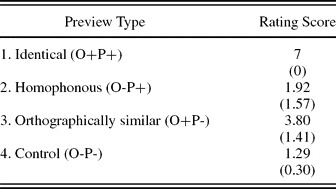
In Experiment 1, the relative contribution of phonological and orthographic information in consonant processing when presented as a preview in the parafovea was investigated. The sentences were divided into four lists. Each consonant-related list contained 30 sentences with sentences from each of the four experimental conditions presented in a fixed random order. The stimuli were rotated within the four conditions in a Latin-square design. There were 36 participants with 9 participants tested on each list, which allowed participants to provide data in each of the experimental conditions. For the nonword previews, the two consonants at the beginning of the first two syllables of the target words were manipulated in terms of orthographic (O) and phonological (P) information, to form the four preview conditions illustrated. For the homophonous consonant preview, a homophonous consonant was substituted for the target word consonants, so that the phonology of the consonant was retained but the orthography was altered. For the orthographically visually similar preview a graphemically similar consonant was substituted that was phonologically different. The control preview consisted of an orthographically and phonologically different consonant. In order to ascertain the degree of similarity between the letters selected in the four different preview conditions, similarity ratings using a Likert scale (1 = visually very different, 7 = visually very similar) were collected from 36 Thai participants, who did not participate in the experiments. The results are listed in Table 1. Of particular relevance was that the homophonous preview was rated as being significantly more similar to the identical condition than the control, t (35) = 2.51, p < .05, the orthographically visually similar preview was more similar to the identical condition than the homophonous preview, t (35) = 4.60, p < .001, and the identical preview was rated significantly higher than the orthographically visually similar preview, t (35) = 13.66, p < .001. As tone determination of a syllable is influenced by a combination of the class of initial consonant, the type of syllable (open or closed), the tone marker, and the length of the vowel, it was not always possible to maintain the same tone realisation in all previews, but the tone markers occurring above the consonant were always the same.
1. Identical (O+P+), (e.g.
 /khe:m2khɛ:ŋ2/ ‘strong’)
2. Homophonous consonant (O-P+), (e.g.
/khe:m3khɛ:ŋ3/)3. Orthographically visually similar (O+P-), (e.g.
/tçhe:m3 tçhɛ:ŋ3/)4. Control (O-P-), (e.g.
/phe:m2phɛ:ŋ2/)


Mean (standard deviations) rating scores using a Likert scale for the relative degree of similarity of consonants in the four previews with the identical condition used in Experiment 1

Note: 1 = visually very different, 7 = visually very similar.
Results and discussion
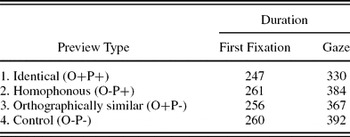
A four-factor (preview type: identical, homophonous, orthographically similar, control) repeated-measures analysis of variance (ANOVA) was conducted by participants (F 1) and items (F 2) for first fixation duration and gaze duration. Planned contrasts were also performed to compare preview effect sizes. The mean fixation durations for the different preview types are listed in Table 2. There was a marginally significant effect of preview type for first fixation duration in the participants analysis, F 1 (3, 35) = 2.44, p = .069, η2p = 0.065, but not in the items analysis (F < 1). There was a significant difference for gaze duration, F 1 (3, 35) = 8.26, p < .001, η2p = 0.191; F 2 (3, 118) = 3.11, p < .05, η2p = 0.075, min F ′ (3, 151) = 2.26, p = .083. However, the min F ′ value was only marginally significant. Planned contrasts were conducted. Gaze durations were 62 ms shorter on average for target words preceded by the identical preview than the control preview, t 1 (35) = 4.77, p < .001; t 2 (58) = 2.65, p = .01. Furthermore, the identical preview was 54 ms shorter on average than the homophonous consonant preview, t 1 (35) = 3.80, p = .001; t 2 (35) = 2.72, p < .01, but the homophonous preview was not significantly different from the control preview (8 ms) or the orthographically similar preview (17 ms). The identical preview was 37 ms shorter than the orthographically similar preview, which was significant for the participants analysis, t 1 (35) = 3.05, p < .01, but the effect was only marginal in the items analysis, t 2 (35) = 1.89, p = .063. Furthermore, the orthographic preview was 25 ms shorter than the control preview, but this was not significant (ps > .3).
Fixation measures (ms) for the target words for the preview types for Experiment 1 for the consonant manipulation

As the homophonous consonant preview was not significantly different from the control or the orthographically similar preview, we can infer that the homophonous consonants did not facilitate subsequent processing of the target word, which suggests that phonology is not playing a major role. Instead, orthography, as indicated by the identical preview, is playing a more prominent role in the parafoveal processing of consonants and word recognition in Thai. In relation to the orthographically similar consonant preview, a slight facilitatory trend was apparent in comparison to the control preview, but it did not reach significance. This concurs with the similarity rating scores, as the orthographically visually similar consonant (3.80) was rated as significantly more similar to the identical condition than the control (1.29) but rated as significantly less similar than the identical condition (7) (Table 1).
EXPERIMENT 2: THE VOWEL (HOP) MANIPULATION
Stimuli and design
In Experiment 2, the relative contribution of phonological and orthographic information of vowels (HOP) when presented in the parafovea was investigated. The sentences were divided into three lists. Each vowel-related list contained 30 sentences with sentences from each of the three experimental conditions in a fixed random order. The stimuli were rotated within the three conditions in a Latin square design. There were 27 participants, with 9 participants tested on each list, which allowed participants to provide data in each of the experimental conditions. In the concordant vowel preview, the two vowels (a short vowel  /a/ and a longer vowel
 /a:/) occurring in each of the first two syllables of the target word were interchanged. The control consisted of a vowel that was neither phonologically nor orthographically related to the target vowel. The following three previews were presented to participants.
1. Identical (O+P+), (e.g.
/na:ŋ0fa:3/ “angel”)2. Concordant (O-P+), (e.g.
/naŋ0fa3/)3. Control (O-P-), (e.g.
/nɔ:ŋ0fɔ:3/)


Results and discussion
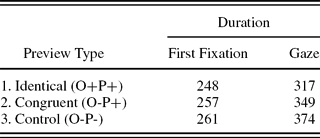
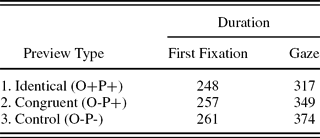
A three-factor (preview type: identical, concordant, control) repeated-measures ANOVA was conducted. The mean fixation durations and standard deviations for the different preview types are listed in Table 3. There was not a significant effect of preview type for first fixation duration (ps > .2). However, there was a significant difference for gaze duration, F 1 (2, 26) = 8.82, p = .001, η2p = 0.253; F 2 (2, 89) = 3.56, p < .05, η2p = 0.076, min F ′ (2, 113) = 2.54, p = .084. The min F ′ value was only marginally significant. Gaze durations were 57 ms shorter on average for target words preceded by the identical preview than the control preview, t 1 (27) = 4.36, p < .001; t 2 (58) = 2.22, p < .05, and 32 ms shorter for the identical preview than the concordant preview, which was significant in the participants analysis, t 1 (27) = 2.31, p < .05, but not in the items analysis (p > .1). Furthermore, gaze duration was 25 ms shorter on the target word for the concordant preview than the control preview, which was marginally significant for the participants analysis, t 1 (27) = 1.91, p = .068, but not for the items analysis (p > .1). These results suggest that phonology as represented by the concordant vowel preview did not play a major facilitatory role, but as indicated by the identical preview benefit, orthography is playing a prominent role in vowel representation and word recognition. There was a slight facilitatory trend for the concordant vowel preview, however, that did not reach significance.
Fixation measures (ms) for the target words for the preview types in Experiment 2 for vowel (HOP) manipulation
EXPERIMENT 3: THE TONE MANIPULATION
Stimuli and design
In order to investigate if tone information in the parafovea contributes to early word recognition, tone information via the tone markers that occurred above the first two syllables in the target word was manipulated to form an identical and control preview. The sentences were divided into two lists. Each list contained 24 sentences with sentences from each of the two experimental conditions in a fixed random order. The stimuli in the two lists were counterbalanced. There were 20 participants with 10 participants tested on each list, which allowed participants to provide data in both the experimental conditions. The tone markers maj3 e:k1  and maj3 tho:0 ่ were used as substitutes, as the tone markers maj3 tri:0 and maj3 tçha1ta 1wa:0 are rarely used, and only occur in words beginning with midclass consonants. The two tone markers occurring above the first two syllables of the target word were substituted. Target words were selected that did not have VOP vowels. The two preview conditions are illustrated.
1. Identical (O+P+), (e.g.
/na:2ta:ŋ 1/ ‘window’)2. Control (O-P-), (e.g.
/na:1taŋ2/)


Results and discussion
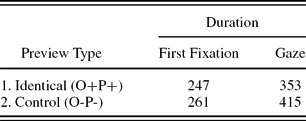
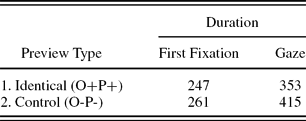
For the tone test sentences, a two-factor (preview type: identical, control) repeated-measures ANOVA was conducted for first fixation duration and gaze duration. The results for the reading time measures are presented in Table 4. First fixation durations were 14 ms shorter on average for target words in the identical preview than the control preview, which was significant for the participants analysis, F 1 (1, 19) = 4.75, p < .05, η2p = 0.200, but not for the items analysis F 2 (1, 47) = 2.65, ns, η2p = 0.055, min F ′ (1, 64) = 1.70, p = .20. The min F ′ value was not significant. Gaze durations were 62 ms shorter on average for target words in the identical preview than the control preview, which was significant, F 1 (1, 19) = 15.42, p = .001, η2p = 0.448; F 2 (1, 47) = 7.60, p < .01, η2p = 0.142, min F ′ (1, 65) = 5.09, p = .028. The advantage for the identical preview over the control preview indicates that tone does play a facilitatory role in parafoveal processing and word recognition in Thai, as when the correct tone markers were previewed subsequent processing of the target word, as reflected in fixation durations, was substantially facilitated. These results suggest that Thai readers begin activating lexical tone parafoveally and integrate this representation with foveal information to subsequently read the target word.
Fixation measures (ms) for the target words for the preview types for Experiment 3 for the tone manipulation
EXPERIMENT 4: THE VOWEL (VOP) MANIPULATION
Stimuli and design
In Experiment 4, in order to investigate if position of vowel matters in the parafoveal processing of words, vowel (VOP) information was manipulated. The sentences were divided into two lists. Each list contained 24 sentences with sentences from each of the two experimental conditions in a fixed random order. The stimuli in the two lists were counterbalanced. There were 20 participants with 10 participants tested on each list, which allowed participants to provide data in each of the experimental conditions. Two preview types were presented to participants: an identical and a control preview. In the control preview the two vowels occurring above the first two syllables of the target word were substituted for orthographically and phonologically different vowels. Vowels selected for the target words consisted of simple single VOP vowels (see Appendix B), and did not include complex combinations of vowels. The two preview conditions are illustrated.
1. Identical (O+P+), (e.g.
/pit0baŋ0/ ‘conceal’)2. Control (O-P-), (e.g.
/pat0biŋ0/)


Results and discussion
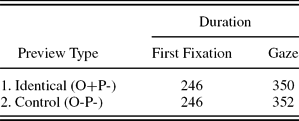
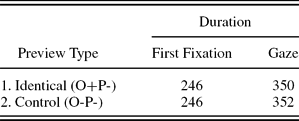
For the vowel (VOP) test sentences, a two-factor (preview type: identical, control) repeated-measures ANOVA was conducted for first fixation duration and gaze duration. The results for the reading time measures are presented in Table 5. There was not a significant effect of preview type for first fixation duration or gaze duration (Fs < 1). These results indicate that VOP vowel information is not playing a substantial role in parafoveal processing and the subsequent reading of the target word.
Fixation measures (ms) for the target words for the preview types for the Experiment 4 for the vowel (VOP) manipulation
GENERAL DISCUSSION
The four experiments in the present study investigated the relative contribution of phonological and orthographic information of consonants, vowels, and lexical tone in early word recognition while reading Thai, employing the boundary change paradigm. In relation to the processing of consonants (Experiment 1), there was no evidence that phonological information from the homophonous consonant preview facilitated target word reading. However, orthographic information from the identical preview did facilitate subsequent processing of the target word. These results indicate that orthographic information is playing a more prominent role than phonological information in the early processing of consonants in Thai. The orthographically similar preview was also not significantly different from the control preview (although a facilitatory trend was apparent), which suggests that the consonants selected were not producing a substantial orthographic effect in comparison with the identical consonant preview. The consonants selected for the orthographically similar preview condition varied in their degree of similarity to the target word consonants, which could account for the weak facilitatory effect found. The similarity rating scores reflected this trend, as the mean similarity rating score for the orthographically similar consonant to the identical consonant was 3.80 on a Likert scale (1 = visually very different, 7 = visually very similar). In skilled Thai readers, it is presumably important to develop well-honed visual skills to distinguish between both homophonous consonants and visually similar consonants, as selection of different consonants can change the tone as well as meaning of the word, and so is an essential skill for effective lexical retrieval. This could be an explanation for the lack of significant results found for phonological effects of homophonous consonants in the current study.
In relation to vowels (HOP), the evidence for phonological representation in Thai was also not robust. However, there was a significant effect of the identical vowel preview in comparison to the control preview, which indicates that orthography is playing a facilitatory role. There was a slight indication, although not statistically significant, that the concordant vowel preview (25 ms) had a phonological facilitatory effect on the target word in comparison with the control preview. An additional consideration is that the vowels used in the concordant preview were not exact homophones as there is a vowel length difference, so there is likely to be only partial activation. Essentially, it appears from this preliminary study that the phonological representation of vowels (HOP) is weak and is not playing a prominent role in parafoveal processing and word identification. Instead, orthography seems to be playing a more prominent role. As stated by Perea and Perez (Reference Perea and Peretz2009) languages may differ in their reliance on phonology in visual word recognition, and possibly Thai similar to Japanese (Kinoshita, Reference Kinoshita1998), has a lesser involvement of phonology compared with Roman script at this early stage of processing.
Tone information, as conveyed by tone markers, plays a prominent role in early word recognition in Thai. The incorrect tone marker preview substantially retarded the subsequent processing of the target word. This is in striking contrast to the effect of the VOP vowels (Experiment 4), in which no significant difference was found between the identical and control preview conditions. This is of particular significance as the tone markers and VOP vowels take the same VOP above the syllable. These results indicate that tone is playing an important role in early word recognition in Thai. The tone markers could also be functioning as salient word or syllable segmentation cues (e.g.,  /na:2ta:ŋ/ “window”), as Thai does not have interword spaces to serve this function (Winskel, Radach, & Luksaneeyanawin, Reference Winskel, Radach and Luksaneeyanawin2009). These findings concur with results from Chinese that tonal information is an essential component for word processing (Xu et al., Reference Xu, Pollatsek and Potter1999). When consonant and vowel information is activated in conjunction with tonal information, then this dramatically narrows the number of items potentially activated in tonal languages. Lexical tone in Thai is important as it can change the meaning of the word, as typically there are many syllables that are phonologically the same apart from the assigned tone.
The comparable orthographic effects found for consonants and vowels in the current study are aligned with recent findings from letter transposition research, which has found that consonants and vowels are not distinguished in early lexical processing (Johnson, Reference Johnson, van Gompel, Fisher, Murray and Hill2007; Perea & Peretz, Reference Perea and Peretz2009). It is only at a later phonological stage of processing that they are distinguished and differences emerge. In foveal visual word recognition evidence indicates that consonants and vowels play different roles, whereas in parafoveal processing these units appear not to be differentiated (Johnson, Reference Johnson, van Gompel, Fisher, Murray and Hill2007).
Furthermore, transposed letter effects could be operating in Experiments 3 and 4, where the tone markers and vowels (VOP) in the two preview conditions are interchanged. However, it is important to note that these manipulations did not always result in transposition of letters or diacritics in the previews (e.g., when tone markers or vowels were the same in the target word). Research on transposed letter and relative position priming effects has found a flexible coding of letter position during early word processing in Roman script and Katakana (e.g., Carreiras et al., Reference Carreiras, Vergara and Perea2007, Reference Carreiras, Vergara and Perea2009; Johnson et al., Reference Johnson, Perea and Rayner2007; Perea, Duñabeitia, & Carreiras, Reference Perea, Duñabeitia and Carreiras2008; Perea & Lupker, Reference Perea and Lupker2004), although not in Hebrew (Velan & Frost, Reference Velan and Frost2009). Based on the current evidence, transposed-letter effects do not appear to be operating in the case of Thai tone markers, although an effect could be occurring in the VOP vowels. Velan and Frost (Reference Velan and Frost2009) propose a model of reading for Hebrew that is primarily morphologically rather than orthographically driven. In Hebrew the coding of root morphemes requires precise letter-by-slot coding for correct word identification. These researchers have suggested that lexical space in alphabetic orthographies may be structured quite differently. Transposition letter effects have been found predominantly in linear scripts, Roman script, and Katakana, but not so far for scripts such as Thai with nonlinear orthographic or suprasegmental units. Neurological research suggests that there is a dissociation between segmental and suprasegmental units (Liu et al., Reference Liu, Peng, Ding, Jin, Zhang, Li and Chen2006), so possibly this effect does not apply to tone markers. Further research is needed to investigate transposition letter effects in Thai.
Evidence from the current experiments reveals that readers of Thai use predominantly orthographic rather than phonological representations for segmental components, consonants and vowels, in early word representation. This strong orthographic effect for segmental units provides support for a direct access model for reading Thai (i.e., the semantics of a printed word are accessed by its orthographic input rather than phonological). Nonlinear writing systems such as Thai, with vowel and tone expressions operating at the syllable level, pose significant challenges to standard visual word recognition models (e.g., Coltheart et al., Reference Coltheart, Rastle, Perry, Langdon and Ziegler2001; Grainger & Jacobs, Reference Grainger and Jacobs1996; McClelland & Rumelhart, Reference McClelland and Rumelhart1981) that assume that letters are processed in a linear manner in the particular orthographic position that they are placed. Currently, visual word recognition models are not able to satisfactorily account for nonlinear orthographic units and suprasegmental features. In the SOLAR (Davis, Reference Davis1999, Reference Davis and Andrews2006), the SERIOL (Whitney, Reference Whitney2001, in press), and the overlap (Gomez, Ratcliff, & Perea, 2008) models, there is serial activation of letters across a spatial gradient. In the SERIOL model, letters are initially coded in parallel, followed by a temporal sequential coding of letters forming open bigrams. Open bigrams directly activate lexical representations. This model could be modified to include larger open syllabic units as well as bigrams, so that nonlinear scripts such as Thai with complex vowel combinations operating across the syllable (refer to Figure 1) can also be accommodated. It appears from the current findings that the VOP vowels are processed at a later stage than the HOP consonants and vowels. Hence, vowel information in the main text line seems to weigh more or contribute more to early vowel representation than vowel information above the main text line. This vowel orthographic position effect could be argued to support the minimality principle, as proposed by Frost (Reference Frost1998). Orthographic vowel representation in the main text line (and not in VOP) in conjunction with consonant and tone information may provide sufficient information initially for activation and retrieval of the lexeme in Thai. Tone markers play an important role in early parafoveal processing, as stated previously, they appear to function as syllabic/lexical segmentation cues as well as in distinguishing between closely related orthographic syllabic/lexical units.
We also made the prediction, based on the minimality principle (Frost, Reference Frost1998), that as vowels are more consistent than consonants in Thai, then vowels might play a more prominent role than consonants in early phonological representations, as occurs in Italian (Colombo, Reference Colombo, Kennedy, Radach, Heller and Pynte2000). In relation to this prediction, results from the current series of experiments were inconclusive. However, Thai consonants are feedback inconsistent and not feedforward inconsistent, which could also account for these results. There was a slight suggestion that the concordant vowel (HOP) preview may have a facilitatory effect; however, further empirical studies are needed to validate this.
This is the first study on Thai that has investigated parafoveal processing of consonants, vowels, and tones in this distinctive alphabetic orthography, using the boundary change paradigm. The main findings from this preliminary study are that primarily, orthographic codes of consonants and vowels (HOP) in conjunction with lexical tone information are assembled from parafoveal input and integrated across the saccade for word recognition in Thai. These results give support to the view that orthography-specific processing constraints are exerted by different writing systems, dependent on the particular characteristics and features of the orthography. Skilled experienced readers develop skills that are aligned with the specific demands of the orthography. Clearly, further research is needed to clarify the relative contribution that phonology and orthography of segmental and suprasegmental units contribute to parafoveal processing and word identification when reading Thai.
APPENDIX A
Thai initial consonants

Note: IPA symbols are in parentheses.
ACKNOWLEDGMENTS
I thank Dr. Sudaporn Luksaneeyanawin and Dr. Wirote Aroonmanakun, Center for Research in Speech and Language Processing, Linguistics Department, Chulalongkorn University, Bangkok, for use of the laboratory facilities. Thanks also to Kanyarat Iemwanthong and Chalong Saengsirivijam for assisting with stimuli preparation and participant recruitment. I also express my appreciation to the anonymous reviewers of this article.