Introduction
Bald eagles (Haliaeetus leucocephalus (Linnaeus); Accipitriformes: Accipitridae) have long been a significant icon in the history of nations around the world. Bald eagles also play important ecological roles and hold significant cultural values to indigenous people of North America. For some indigenous people, bald eagles are a direct link to the creator and act as the messenger that carries expressions of thanks (Elder Carl Stone, University of Manitoba, personal communication). Although the bald eagle breeds predominately in the northern and coastal regions in North America, it is widely distributed over most of the continent (Buehler Reference Buehler, Poole and Gill2000). Patterns of migration and dispersal are varied and complex (Buehler Reference Buehler, Poole and Gill2000), and radio-tagged individuals have been reported to travel up to about 100–200 km in a day (McClelland et al. Reference McClelland, McClelland, Yates, Caton and McFadzen1996; Buehler Reference Buehler, Poole and Gill2000). Through the years, the fitness and population dynamics of bald eagles have been put at risk by many contaminants that persist and bioaccumulate in the bodies of animals. Widespread use of dichlorodiphenyltrichloroethane in North America at one time put populations of bald eagles at risk through egg shell thinning and egg breakage (Newton Reference Newton1979), but since its ban, populations have rebounded (Buehler Reference Buehler, Poole and Gill2000). Mercury is a heavy metal of more recent concern; it acts as a neurotoxin and also has the ability to reduce reproductive success (Rutkiewicz et al. Reference Rutkiewicz, Nam, Cooley, Neumann, Padilla and Route2011).
Parasites also have the potential to affect the health and fitness of wildlife (Goater et al. Reference Goater, Goater and Esch2014). Among these, chewing lice (Phthiraptera: Amblycera and Ischnocera) are obligate ectoparasites of birds (Aves) and mammals (Mammalia). Price et al. (Reference Price, Hellenthal, Palma, Price, Hellenthal, Palma, Johnson and Clayton2003) compiled a world catalogue of host–parasite and parasite–host associations of chewing lice, many of which have been collected widely in North America. However, there are relatively few quantitative data for the association of ectoparasites with their hosts (Marshall Reference Marshall1981a). This is particularly surprising for bald eagles because of their ecological importance and cultural significance. The louse fauna of bald eagles in North America has been described by several authors (e.g., Emerson Reference Emerson1972; Tuggle and Schmeling Reference Tuggle and Schmeling1982). There are five genera of chewing lice that infest bald eagles in North America, all of which have been subject to revision: Laemobothrion Nitzsch (Amblycera: Laemobothriidae; Nelson and Price Reference Nelson and Price1965), Colpocephalum Nitzsch (Amblycera: Menoponidae; Price and Beer Reference Price and Beer1963a), Kurodaia Uchida (Amblycera: Menoponidae; Price and Beer Reference Price and Beer1963b), Craspedorrhynchus Kéler (Ischnocera: Philopteridae; Emerson Reference Emerson1960), and Degeeriella Neumann (Ischnocera: Philopteridae; Clay Reference Clay1958). Recent molecular analyses have addressed phylogenetic relationships in Degeeriella (Catanach and Johnson Reference Catanach and Johnson2015) and in Colpocephalum and Kurodaia (Catanach et al. Reference Catanach, Valim, Weckstein and Johnson2018).
The collection of lice on bald eagles has been part of an ongoing survey of ectoparasites of birds and mammals in Manitoba, Canada. The objectives of this study were to identify the diversity of species of lice infesting bald eagles in Manitoba, and to determine infestation parameters of these lice. For operational reasons, two sampling methods were used. Some birds were dry-ruffled, while others were washed using techniques described by Galloway and Lamb (Reference Galloway and Lamb2016). Dry-ruffling is a far less efficient method for obtaining quantitative data (Clayton and Drown Reference Clayton and Drown2001). Here we also compare the efficiencies of dry-ruffling versus washing birds for estimating both prevalence and mean intensity.
Methods and materials
Bald eagles were obtained from Manitoba Conservation (now Manitoba Sustainable Development), Wildlife Haven (Manitoba Wildlife Rehabilitation Organization) and the Prairie Wildlife Rehabilitation Centre from 1992 to 2017. Injured birds available for our study came into rehabilitation centres and either died soon after entering or assessed as unfit for rehabilitation and euthanised. All casualties were bagged, labelled after death and immediately frozen (–20 °C) for at least 48 hours, which killed all chewing lice. The sex and age of bald eagles were recorded inconsistently; these data are not included in our study.
Birds were brought to the laboratory and thawed, so the wings were pliable and the body easy to manipulate. Prior to 1999, birds were dry-ruffled until no additional lice were seen falling from the bird. From 1999 to 2004, 40 bald eagles were washed twice in soapy water and once in clear water, each time pouring the wash water through a 90-μm sieve. The residue was then rinsed into a container with 70% or 95% ethanol. In 2004, this practice was discontinued as a token of respect for the birds and to reduce damage to the feathers because eagles were subsequently conveyed to Manitoba Conservation for distribution to the indigenous community for ceremonial purposes. One hundred and seven bald eagles were dry-ruffled. Because of the size of bald eagles, dry-ruffling was always conducted by two or three people, one of whom (T.D.G.) was always the same. Dry-ruffled birds were held over a large sheet of paper, and our hands were run through the feathers over the entire body and head. This was repeated three times, or until the return of lice collected on the paper was no longer considered efficient. Lice were preserved in 70% or 95% ethanol. For both collection methods, lice were identified to genus, sorted, sexed, and aged (adults versus nymphs) under a stereomicroscope, and stored in 70% or 95% ethanol. A sample of males and females of each genus from infested birds was mounted onto microscope slides (Richards Reference Richards1964) for identification. In cases where the sample size was small, all specimens were mounted. For larger samples, representative specimens were prepared as required for identification purposes. Voucher specimens were deposited in the J.B. Wallis/R.E. Roughley Museum of Entomology in the Department of Entomology, University of Manitoba (Winnipeg, Manitoba, Canada).
Calculations of prevalence and mean intensity (± 95% confidence interval) of infestation (see Bush et al. Reference Bush, Lafferty, Lotz and Shostak1997 for definitions of terms) and statistical comparisons were made using Quantitative Parasitology 3.0 (Rózsa et al. Reference Rózsa, Reiczigel and Majoros2000).
Results
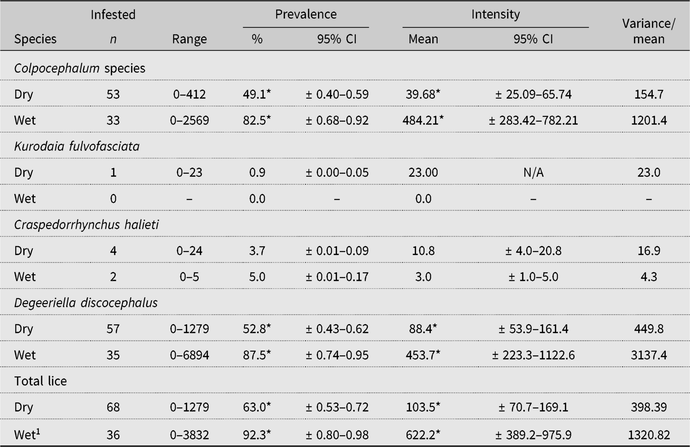
We examined 147 bald eagles from 92 locations in Manitoba and one from northwestern Ontario, Canada. Of these, 107 were dry-ruffled and 40 were washed. Infestation parameters for both dry-ruffled and washed birds are presented in Table 1. Six species of chewing lice were found: Colpocephalum flavescens (De Haan), C. napiforme (Rudow), C. turbinatum (Denny) (Phthiraptera: Menoponidae), Craspedorrhynchus halieti (Osborn) (Phthiraptera: Philopteridae), Degeeriella discocephalus (Burmeister) (Phthiraptera: Philopteridae), and Kurodaia fulvofasciata (Piaget) (Phthiraptera: Menoponidae). No eagles were infested with Laemobothrion vulturis (Fabricius) (Phthiraptera: Laemobothriidae). The total number of these lice infesting eagles was 39 066 (Colpocephalum species – 18 082; D. discocephalus – 20 912; Craspedorrhynchus halieti – 49; K. fulvofasciata – 23). The most heavily infested bald eagle, with no obvious deformity or injury, was infested with 9463 lice.
Summary of infestation parameters for chewing lice infesting bald eagles in Manitoba. Lice were collected by two methods, dry-ruffling (dry, n = 107) or washing birds (wet, n = 40). CI, confidence interval.

1 One bird infested with 9463 or 24% of all lice was excluded as an outlier.
* Comparisons of prevalence and intensity between dry-ruffled birds and washed birds, for Colpocephalum species, D. discocephalus, and for total lice, differed significantly (P < 0.05).
Colpocephalum flavescens was by far the dominant species of Colpocephalum infesting bald eagles in Manitoba, accounting for >95% of adult Colpocephalum identified. Because of the small number of specimens other than C. flavescens, and our inability to identify nymphs to species, data for all three species of Colpocephalum were combined for statistical analyses. Degeeriella discocephalus was the most prevalent louse infesting bald eagles (Table 1), although prevalence was not statistically different (Fisher’s exact test (two-sided) P-value = 0.552) from Colpocephalum species. Similarly, the mean intensity of infestation by Degeeriella was slightly higher but not statistically greater than for Colpocephalum species (bootstrap P-value (two-sided) = 0.882) (Table 1). The prevalence and intensity of K. fulvofasciata and C. halieti were low (Table 1). The variance-to-mean ratios for all species and collection methods were high, indicating that none of them were distributed normally (Table 1).
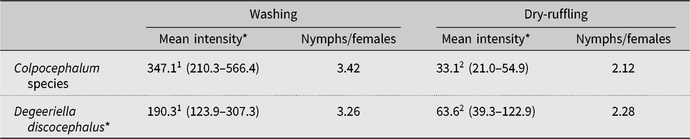
Sex ratios were compared only among washed birds, where we were confident of having the most precise estimate of numbers of lice infesting each bird. Sex ratios were calculated only for Colpocephalum species and D. discocephalus, where numbers of lice were adequate. Total male:female ratio for Colpocephalum species from washed birds was 0.997 (2942 males; 2950 females), and not significantly different from 1 (χ 2 = 0.96, P > 0.05, df = 1). The total male-female ratio for D. discocephalus from washed birds was 1.005 (2542 males; 2529 females), not significantly different from 1 (χ 2 = 0.93, P > 0.05, df = 1). Nymph-to-female ratios were close to 3.3 for both Colpocephalum species and D. discocephalus (Table 2).
Mean intensity (95% confidence interval) of infestation for nymphs and nymph-to-female ratios for two genera of chewing lice infesting bald eagles in Manitoba, using two different collecting techniques, washing and dry-ruffling

1,2 Mean intensities with different numbers within rows significantly are different (P < 0.05), bootstrap two-sample t-test, 2000 replicates.
* One bird with 5287 nymphs or nearly 40% of all Degeeriella nymphs was excluded as an outlier.
Mean intensity and prevalence of Colpocephalumspecies and D. discocephalus were significantly greater (P < 0.05) in washed (n = 40) versus dry-ruffled (n = 107) birds (Table 1). Ratios of juveniles:females for Colpocephalum species and D. discocephalus were greater in washed versus dry-ruffled eagles. For the former, the mean intensity of infestation by juveniles was significantly greater in washed birds (bootstrap two-sample t-test, P = 0.02, Table 2), as were ratios of 3.42 versus 2.12 for dry-ruffled birds. For D. discocephalus, the mean intensity of infestation by juveniles was significantly greater in washed birds (bootstrap two-sample t-test, P = 0.03) only when juveniles from the most heavily infested washed eagle (n = 5287) were deleted. Juvenile:female ratios were similarly affected, 4.27 (3.26 when juveniles and females from the most heavily infested eagle are deleted) versus 2.28 for dry-ruffled birds. Total juveniles of Colpocephalumspecies for washed birds significantly outnumbered adults (11 212 nymphs, 3388 males, 3482 females; χ 2 = 528.94, df = 1, P < 0.01) as did total juveniles for D. discocephalus for washed birds (13 416 nymphs, 3821 males, 3621 females; χ 2 = 855.08, df = 1, P < 0.01).
Several additional species of chewing lice were found in small numbers on bald eagles in this study. Myrsidea Waterston (Phthiraptera: Menoponidae) species (typically infests Aves: Passeriformes), Colpocephalum kelloggi Osborn (Phthiraptera: Menoponidae) (a true parasite of the turkey vulture, Cathartes aura (Linnaeus); Cathartiformes: Cathartidae), Pectinopygus tordoffi Elbel and Emerson (Phthiraptera: Philopteridae) and Colpocephalum unciferum Kellogg (Phthiraptera: Menoponidae) (both parasites of American white pelican, Pelecanus erythrorhynchos Gmelin; Pelecaniformes: Pelicanidae), Philopterus corvi (Linnaeus) (Phthiraptera: Philopteridae) (a parasite of Passeriformes: Corvidae), Strigiphilus oculatus (Rudow) (Phthiraptera: Philopteridae) (a parasite of great horned owl, Bubo virginianus (Gmelin); Strigiformes: Strigidae), and Ornithobius Denny species (Phthiraptera: Philopteridae) (a parasite of Anseriformes) are all stragglers or contaminants. One bald eagle from Blumenort, 18 August 2014, was infested with one larva of the rabbit tick, Haemaphysalis leporispalustris Packard (Acari: Ixodidae), perhaps the result of the eagle having fed previously upon a rabbit or hare. One male hippoboscid, Icosta americana (Leach) (Diptera: Hippoboscidae), infested the same bald eagle. Unidentified Ceratopogonidae (Diptera) were occasionally found, bald eagles presumably being a typical blood host for female flies. Two species of feather mites, Aetacarus phylloproctus (Mégnin and Trouessart) (Acari: Gabuciniidae) and Pseudalloptinus aquilinus (Trouessart) (Acari: Pterolichidae), infested bald eagles in this study (Galloway et al. Reference Galloway, Proctor, Mironov, Cárcamo and Giberson2014).
Discussion
Lice infesting eagles have been documented in many parts of the world (e.g., Emerson Reference Emerson1972; Tuggle and Schmeling Reference Tuggle and Schmeling1982; Smithers et al. Reference Smithers, Palma, Barker and Mound1996; Price et al. Reference Price, Hellenthal, Palma, Price, Hellenthal, Palma, Johnson and Clayton2003; Göz et al. Reference Göz, Dik, Orunç Kilinç, Yilmaz and Aslan2015; Tomás et al. Reference Tomás, Palma, Rebelo and da Fonseca2016); however, quantitative data are seldom gathered on the ectoparasites of bald eagles. Bald eagles are large and awkward to handle. Specimens can be difficult to obtain, contour feathers of the body are stiff, and there is considerable down, posing a challenge to efficient collection of chewing lice. We are aware of no other quantitative studies on chewing lice of bald eagle, and none where sample size is as large as in the current study (n = 147).
Three species of chewing lice in this study are specific to bald eagles, though not necessarily to bald eagles (Price et al. Reference Price, Hellenthal, Palma, Price, Hellenthal, Palma, Johnson and Clayton2003), and were present in varying abundance across Manitoba; these include Colpocephalum flavescens, Craspedorrhynchus halieti, and D. discocephalus. Colpocephalum turbinatum, C. napiforme, and K. fulvofasciata infest a variety of Accipitriformes, including bald eagles (Price et al. Reference Price, Hellenthal, Palma, Price, Hellenthal, Palma, Johnson and Clayton2003). Kurodaia fulvofasciata was found on only one bird in our samples. That infestations by these latter three species of Accipitriformes lice were the result of contamination at the rehabilitation centres or in processing is unlikely; however, this possibility cannot be entirely ruled out.
There are many different techniques for collecting lice from birds (Clayton and Walther Reference Clayton, Walther, Clayton and Moore1997; Clayton and Drown Reference Clayton and Drown2001; Koop and Clayton Reference Koop and Clayton2013), each of which has different efficiency in the extraction of lice. Dry-ruffling has been used extensively in quantitative studies and is generally believed to give an accurate assessment of the prevalence of infestation. This technique by itself is not thought to be effective for determining the intensity. Serial washing has been shown to provide the most accurate estimate of intensity of louse infestation (Clayton and Walther Reference Clayton, Walther, Clayton and Moore1997; Clayton and Drown Reference Clayton and Drown2001). In our study, both the prevalence, by a factor of 1.5, and mean intensity, by a factor of 6.0, of total lice were greater in washed versus dry-ruffled birds (Table 1). There is further evidence of the greater efficiency of washing versus dry-ruffling in comparisons of mean intensities of nymphs. For Colpocephalum and Degeeriella, mean intensities in washed birds were about 10 times and three times greater, respectively (Table 2). The greater intensity of infestation in washed birds was anticipated, but the greater prevalence in washed birds was not. The bald eagle is a very large bird, with large, stiff contour feathers covering the body, especially the dorsal surfaces, with abundant down over most of the ventral regions. Pfaffenberger and Rosero (Reference Pfaffenberger and Rosero1984) reported similar difficulties in collecting lice from a golden eagle (Aquila chrysaetos (Linnaeus; Accipitriformes: Accipitridae)). These structural characteristics made dry-ruffling difficult, and no doubt affected the efficiency of collection, especially when louse intensity was low. It appears that host size may affect the estimates of infestation parameters when methods of collection are restricted, for example, to dry-ruffling.
Based on published results and results in the laboratory (T.D.G., unpublished data), we have attributed the differences in prevalence and intensity between washed and dry-ruffled birds to the different techniques. However, since we have no temporal controls for our study, i.e., the two different collections were used at different times, with no means of direct comparison between techniques, it is possible that the lower prevalence and intensity were the result of lower louse populations during the time eagles were dry-ruffled. Declines in louse populations are not without precedent. Galloway and Lamb (Reference Galloway and Lamb2015) found that the prevalence of infestation of a species of chewing louse on common nighthawks (Chordeiles minor Forster; Caprimulgiformes: Caprimulgidae) in Manitoba was significantly lower during more recent years of their study, when common nighthawk populations were in decline. Lice were collected consistently by washing throughout the study. They also found that there was no difference in the intensity of infestation over the same time period, an indication that once a host is infested, the infrapopulation develops in an expected trajectory, regardless of a decline in prevalence. In our study, both prevalence and intensity of infestation by chewing lice on bald eagles were significantly lower on dry-ruffled birds, consistent with a difference attributed to the collection method rather than to lower louse populations.
The species with the highest prevalence on bald eagles was D. discocephalus followed by Colpocephalum species, Craspedorrhynchus halieti, and K. fulvofasciata. Based on habitus of Degeeriella discocephalus and Colpocephalum species, it is expected that they are found generally over most of the body surface of the host, while Craspedorrhynchus halieti is found almost entirely on the neck and head (Johnson and Clayton Reference Johnson, Clayton, Price, Hellenthal, Palma, Johnson and Clayton2003). The specific host body regions occupied by K. fulvofasciata were not observed, but its morphology suggests that it is a body louse. None of these species were observed to contain blood in the gut.
Numbers of female lice are most often equal to or significantly greater than numbers of male lice (Marshall Reference Marshall1981a, Reference Marshall1981b; Clayton et al. Reference Clayton, Gregory and Price1992). In our study, there were no significant differences in the sex ratios for either Colpocephalum species or D. discocephalus infesting bald eagles in Manitoba. A female bias in sex ratio has been interpreted mainly as sampling bias or evidence that females live longer than males (Marshall Reference Marshall1981a). Because we analysed data from bald eagles that had been washed, sample bias should not have been an issue, and because mean intensities of infestation were relatively high, it is possible that recruitment of adults from developing nymphs swamped the effects of differential mortality. Some authors have discussed support for local mate competition (Clayton et al. Reference Clayton, Gregory and Price1992; Rózsa et al. Reference Rózsa, Rékási and Reiczigel1996; Pap et al. Reference Pap, Adam, Vágási, Benkö and Vincze2013) affecting sex ratios in lice. Bald eagles can disperse widely (Gerrard et al. Reference Gerrard, Whitfield, Gerrard, Gerrard and Maher1978; Buehler Reference Buehler, Poole and Gill2000), and the prevalence and intensity of Colpocephalum and Degeeriella were high (at least in our study), so it is also possible that gene flow among infrapopulations of lice favoured substantial outbreeding and thereby maintenance of a 50:50 sex ratio.
We do not know why L. vulturis was not collected in Manitoba, but we suspect it is not present on bald eagles in the province. Bald eagles came from at least 92 locations across Manitoba and one from northwestern Ontario. Because bald eagles were sampled so widely, and sample size was relatively large (n = 147), L. vulturis is probably not present, or present only at very low prevalence in the province. We know this species of louse occurs elsewhere in North America on this host, but there are large-scale biogeographical inconsistencies that warrant further investigation. It is possible that low relative humidity (see Moyer et al. Reference Moyer, Drown and Clayton2002; Bush et al. Reference Bush, Harbison, Slager, Townsend Peterson, Price and Clayton2009) or some other environmental abiotic variable may affect the reproduction and survival of L. vulturis. Four additional species of Laemobothrion infest other species of birds in Manitoba (Galloway et al. Reference Galloway, Proctor, Mironov, Cárcamo and Giberson2014), but generally at very low prevalence (T.D.G., unpublished data). There are records of L. vulturis from bald eagles in British Columbia, Canada (Spencer Reference Spencer1956; T.D.G. unpublished data, Wallis/Roughley Museum) as well as Toronto, Ontario (United States National Museum, Washington, District of Columbia, United States of America).
The lack of quantitative data on the louse fauna of bald eagles is consistent with our lack of similar knowledge of chewing lice on other birds (Marshall Reference Marshall1981a). Although the taxonomy and nomenclature among eagles are somewhat unsettled in some subfamilies, there are more than 60 species of eagles (Accipitriformes: Accipitridae: Aquilinae, Circaetinae, Haliaeetinae and Harpiinae: Lerner and Mindell Reference Lerner and Mindell2005). Of these, just under one-quarter of the species are ranked as vulnerable (12 species) to critically endangered (two species) (International Union for Conservation of Nature 2017). Populations of these species are sometimes small, and direct access to birds for lice examination restricted. Even for species not at risk, such as the bald eagle, quantitative data are difficult to obtain. To make a valid ecological comparison of infestation parameters for chewing lice in our baseline study to any other host–parasite interactions among species of eagles, more intensive study is needed. Results will be helpful not only for ecological and evolutionary analyses for Accipitriformes lice, but for conservation efforts for bald eagles as well. Parasites play an important role in the evolution and fitness of their hosts, so conservation measures for hosts should ideally take specific parasites into consideration where possible. To do this is difficult unless quantitative data in natural populations are available.
Acknowledgements
C.D.L thanks the Natural Sciences and Engineering Research Council of Canada – Undergraduate Student Research Awards for the opportunity to work on the ectoparasite project on bald eagles. The authors thank Alejandro Costamagna for his support to this project. We especially thank the staff at the rehabilitation hospitals of the Wildlife Haven and the Prairie Wildlife Rehabilitation Centre for their work handling bald eagles prior to examination for lice. Thanks to the Manitoba Sustainable Development, Wildlife and Fisheries Branch for supplying the permits throughout the study. We also thank Blaire Barta (Manitoba Department of Sustainable Development, Wildlife and Fisheries Branch), who was our liaison with the indigenous community, for all her work in getting the bald eagles distributed and used for ceremonial purposes. We also thank Dave Holder and all the students who that have assisted with this project over the years. We thank Ken Langleier for specimens of L. vulturis from British Columbia. Thank you to the late Bob Dalgleish for providing scanned images of slides of Laemobothrion from the United States National Museum. Bob Lamb kindly offered valuable suggestions on a draft of the manuscript. Special thanks go to Elder Carl Stone and Dr. Justin Rasmussen for sharing their knowledge of the bald eagle and its significant status within the indigenous community in Manitoba. This study was funded in part by a Natural Sciences and Engineering Research Council of Canada Discovery Grant (T.D.G). We thank the Department of Entomology and the Faculty of Agricultural and Food Sciences at the University of Manitoba for their continued support.