Introduction
Collections of plants made during my most recent expeditions to Cambodia and Vietnam have allowed me to identify two new species of the family Gentianaceae: Exacum darae Hul and Canscora bidoupensis Hul. This family has previously been revised for the Flora of the Malay Peninsula (Ridley, Reference Ridley1923), the Flora of Thailand (Ubolcholaket, Reference Ubolcholaket, Smitinand and Larsen1987) and the Flore du Cambodge, du Laos et du Viêtnam (Hul, Reference Hul and Morat2003). The two new species, together with the recently described Gentiana khammouanensis Hul (Hul, Reference Hul2007), add to the great richness of Gentianaceae in the Indo-Chinese Peninsula.
Species Descriptions
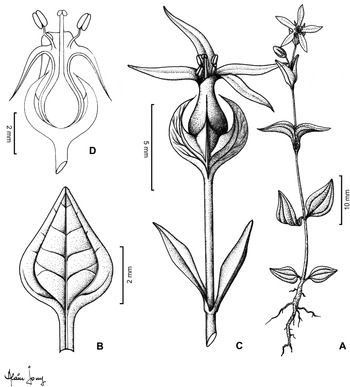
Exacum darae Hul, sp. nov.Fig. 1.
Thailandiae Birmaniaeque Exacum sutaepensi Hosseus ex Craib proximissima, sed clare gracili habitu atque ad 25 cm altitudine, floribus 7–8(–8.5) mm in longitudine, praesertim minutissimis antheris 0.5–1 mm in longitudine (versus E. sutaepensi, habitu minus gracile ad 15–16 cm in altitudine, floribus 10–11 mm in longitudine, antheris 1.5–2.5 mm in longitudine) praecipue differt. – Type: Cambodia, Kompong Speu, Phnom Knang Veal, Mt. Aural, Cardamom Mts., c.1000 m, 11°48′28″N, 103°51′38″E, 25 xi 2004, Hul & Khou Eang Hourt 1979 (holo P (P00739948); iso P (P00739949), RUPP).
Exacum sutaepense Hosseus ex Craib var. gracile Toyokuni, Acta Phytotax. Geobot. 32(5–6): 198–203 (1981). – Exacum sutaepense Craib forma gracile (Toyokuni) Toyokuni, Acta Phytotax. Geobot. 36(4–6): 124 (1985). – Type: Thailand, Ranong, Khao Pawta Luangkaeo, Kaper District, 1200–1300 m, 10 xii 1979, Shimizu et al. T-26864 (holo KYO!; iso BKF, S, SHIN).
Exacum sutaepense auct. non Hosseus ex Craib: Klack., Opera Bot. 84: 57 (1985), quoad van Beusekom & Phengklai 2607 (AAU!); Garrett 1104 (AAU!, K); Geesink, Hiepko & Phengklai 7618 (BKF, C!, P!); Hosseus 194 (P!).
Exacum darae Hul. A, habit; B, leaf; C, flower; D, flower dissection (Hul & Khou Eang Hourt 1979).

Slender herb, 3–25 cm high, stems simple, sometimes ± branched, quadrangular or subquadrangular, 4-winged or marked with fine lines. Leaves sessile to shortly petiolate; lamina ovate or ovate-elliptic, 5–7(–9) × 3–5 mm, base attenuate, apex acute; petiole 0–2 mm. Inflorescences terminal, rarely axillary. Flowers 4- or 5-merous, blue, blue-violet or white, in simple cymes, sometimes appearing solitary, due to the maturation sequence, 7–8(–8.5) mm long, pedicel 5–15 mm long. Bracts leafy, narrowly ovate, 4–5 × 1–2 mm. Calyx with 4 or 5 sepals, fused for 1/4 to 1/3 of their length; lobes narrowly ovate, 2.5–3.5 × 1 mm, acute-acuminate at apex, bearing a dorsal wing 1(–1.5) mm wide, somewhat accrescent in fruit. Corolla with 4 or 5 petals, tube 3.5–4 mm long; lobes narrowly ovate to ovate-elliptic, reflexed, 3–4.5 × 1(–2) mm, acute or acute-acuminate at apex. Stamens 4 or 5, filaments glabrous, c.1.5 mm long, inserted below the sinuses of the corolla lobes; anthers 0.5–1 mm long, dehiscing by 2 apical pores, then enlarging into longitudinal slits. Ovary subglobulose, glabrous, 2.5 × 2 mm, style straight, 2–2.5 mm long, glabrous; stigma bilobed. Fruits: capsules subglobulose, 3 × 2.5 mm, included in the corolla tube, surrounded by the persistent calyx. Seeds numerous, minute.
Distribution. Exacum darae is present in Cambodia, in the Cardamom Mountains, at Phnom Knang Veal on Mount Aural, Kompong Speu Province, c.1000 m altitude. It has also been collected in Thailand in the mountains of the northwest, Chiang Mai Province, between Me Tawn and Me Sawi (c.1550–1700 m), at Doi Suthep (around 1680 m), at Doi Pui (c.1600 m), and in the peninsula, at Khao Pawta Luang Keow, c.1200–1300 m in Phangnga and Ranong Provinces.
Habitat and ecology. Open, humid environments in rocky places in mountains, 1000–1700 m.
Taxonomic note. The duplicate Hosseus 194, housed at P, is annotated in error as an isotype of Exacum sutaepense Hosseus ex Craib; material of this collection housed at P belongs to Exacum darae.
Additional specimens examined. Thailand.Chiang Mai: Doi Pui, 18°45′N, 99°00′E, c.1600 m, 19 xii 1969, van Beusekom & Phengklai 2607 (AAU); Me Tawn – Me Sawi, 1550–1700 m, 1938, Garrett 114 (AAU); Doi Suthep, 1680 m, 2 xii 1914, Hosseus 194 (P). Phangnga: Khao Pawta Luang Keow, 8°30′N, 99°00′E, 1300 m, 27 xi 1974, Geesink, Hiepko & Phengklai 7618 (C, P).
Exacum darae closely resembles E. sutaepense Hosseus ex Craib, known from eastern Burma and northwestern and peninsular Thailand. Exacum darae may be distinguished by its more slender habit with very thin and gracile stem and the plant reaching to 25 cm high (to 15–16 cm high in E. sutaepense although the overlap for smaller plants is large); its ovate or ovate-elliptic leaves (E. sutaepense has elliptic to broadly ovate leaves); its blue, blue-violet or white flowers (E. sutaepense has pink flowers); the flowers are 4- or 5-merous, 7–8(–8.5) mm long (5-merous, 10–11 mm long in E. sutaepense); the calyx with sepals bearing a dorsal wing 1(–1.5) mm wide (1.5–2 mm wide in E. sutaepense); the anthers not exceeding 1 mm long (anthers are 1.5–2.5 mm long in E. sutaepense); and the subglobulose capsules (capsule globose in E. sutaepense).
Exacum darae differs from E. pteranthum Wall. ex G.Don principally by its narrower leaves, 3–5 mm wide (0.6–2.5 cm in E. pteranthum); its calyx bearing a dorsal wing 1(–1.5) mm wide (2–2.5 mm in E. pteranthum); and its small anthers (2 mm long in E. pteranthum).
This new species, along with Exacum pteranthum and E. tetragonum Roxb., brings to three the number of species in this genus that occur in the area covered by the Flore du Cambodge, du Laos et du Viêtnam.
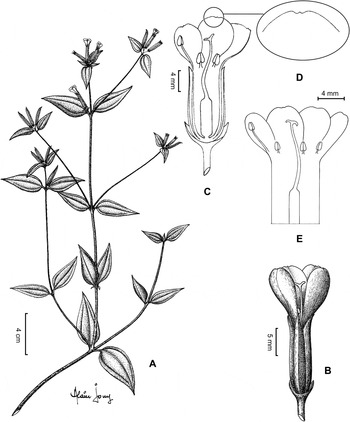
Canscora bidoupensis Hul, sp. nov.Fig. 2.
Ut videtur C. andrographioidi Griff. ex C.B.Clarke affinis, sed brevissimo (0–)1–4 mm pedicello, plerumque 20–22(–26) mm in longitudine floribus, ± aequaliter prope corollae faucem affixis, inaequalibus (una 3–3.5(–4) mm in longitudine filamento, tribus alteris brevissimo filamento 0.5(–1) mm) staminibus (C. andrographioide longo (0–)1–2(–3) cm pedicello, plerumque 15–20(–23) mm floribus, unico stamine cum 2.5–3.5 mm filamento in corollae fauce affixo, alteris tribus staminibus cum 1.5–2 mm filamento 2–2.5 mm infra faucem affixis) praecipue differt. – Type: Viêtnam, Lâm Dông, 60 km from Dalat, Bidoup-Nui Ba National Park, Hôn Giao forestry station, 12°11′11″N, 108°42′50″E, c.1500–1600 m, 11 vi 2008, Hul & Ly Ngoc Sam 3537 (holo P (P00739963); iso E, P (P00739964), RUPP, VNM, and National University of Laos, Faculty of Science).
Canscora andrographioides auct. non Griff. ex C.B.Clarke: Hul in Morat (ed.) Flore du Cambodge, du Laos et du Viêtnam 31: 76 (2003), quoad Chevalier 1535 (leg. Poilane) (E, P, RUPP, VNM); Chevalier 38737 (E, P); J. & M.S. Clemens 4229 (NY, P); Poilane 6919 (P), 29052, 29687, 29950 and 31207 (P).
Canscora bidoupensis Hul. A, habit; B, flower; C, flower cross-section; D, corolla lobe apex; E, dissection, flower detail (Hul & Ly Ngoc Sam 3537).

Herb 10–25(–50) cm high, stems branched from the base, quadrangular. Leaves subsessile to shortly petiolate; lamina ovate, ovate-elliptic or elliptic, 1.5–4 × 0.5–2.5 cm, base obtuse or ± attenuate, apex acute; petiole 0.5–2 mm long. Inflorescences terminal or axillary, forming lax cymes. Flowers 4-merous, white, 20–22(–26) mm long; pedicel (0–)1–4 mm long. Bracts leafy, narrowly ovate, 2–4 × 0.5–1 mm. Calyx of 4 sepals; tube 12–14 mm long, 8-ribbed; lobes narrowly triangular, 2.5–3 × 0.5 mm, apex acuminate. Corolla of 4 petals; tube 15–16 mm long; lobes unequal, two wider, obovate, (8–)9–10 × 5–7 mm, apex obtuse sometimes slightly mucronate. Stamens 4, inserted near the throat of the corolla tube, one of them 1–1.5 mm above the other three and with a filament 3–3.5(–4) mm long; the other three with filaments 0.5(–1) mm long; anthers ovoid, c.1.5 mm long, dehiscing by 2 apical pores, widening by longitudinal slits. Ovary subcylindrical, 4–5 mm long, style 12–15 mm long; stigma bilobed. Fruits: capsules ellipsoid-oblong, 5–6(–7) × 1–2 mm. Seeds numerous, minute.
Distribution. Canscora bidoupensis is currently known only from Vietnam, in Khanh Hoa Province, Hon Bà Range, 1000–1500 m; in Lâm Dông Province, 60 km from Dalat, around the area of Mount Bidoup, 1500–1600 m; in Quang Nam-Dà Nang Province, Mount Ba Na, 1400–1500 m; and in Thua Thiên-Huê Province, Nui Bach forestry station, 1000–1500 m.
Habitat and ecology. Understorey of mixed forest, on clay–sand soil over granite, on mountains.
Additional specimens examined. Vietnam. Khanh Hoa: Massif du Hon Bà, 1000–1500 m, 26 viii 1918, Chevalier 38737 (P (P00656783)). Lâm Dông: c.50–60 km from Dalat, around Bidoup-Nui Ba National Park, Hôn Giao forestry station, c.1600 m, 17 vii 2007, Hul, Le Cong Kiêt, Luu Hong Truong & Yok Lin 3000 (E, P (P00739970), RUPP, VNM, and National University of Laos, Faculty of Science); ibid., 12°11′11″N, 108°42′50″E, c.1500–1600 m, 11 vi 2008, Hul & Ly Ngoc Sam 3538 (E, P (P00656642, P00656643), VNM), 3539 (E, P (P00739967, P00739968), RUPP, VNM, and National University of Laos, Faculty of Science). Quang Nam-Dà Nang: Mt. Ba Na, 1400 m, 6 vi 1920, Chevalier 1535 (leg. Poilane) (E, P (P00656784), RUPP, VNM); ibid., 16 viii 1927, J. & M.S. Clemens 4229 (NY, P (P00347834)); near Tourane (Dà Nang), 1500 m, 8 vii 1923, Poilane 6919 (P (P00347839, P00347840)); ibid., c.1500 m, 25 ii 1939, Poilane 29052 (P (P00347841)). Thua Thiên-Huê: Mt. Bach Ma, near Huê, 1450 m, 14 iv 1939, Poilane 29687 (P (P00347842)); ibid., 1000 m, 23 iv 1939, Poilane 29950 (P (P00347843)); ibid., 1200–1500 m, 18 xii 1940, Poilane 31207 (P (P00347844)).
Canscora bidoupensis closely resembles C. andrographioides Griff. ex C.B.Clarke, but is distinguished principally by its flowers being generally 20–22(–26) mm long, borne on a short pedicel (0–)1–4 mm long (flowers generally 15–20(–23) mm long, borne on long pedicels (0–)1–2(–3) cm long in C. andrographioides); the 4 unequal stamens are inserted near the throat of the corolla tube, one of them 1–1.5 mm above the other three and a filament 3–3.5(–4) mm long, the other three much shorter, 0.5(–1) mm long (the longer filament 2.5–3.5 mm long and inserted at the throat of the corolla tube and the other three 1.5–2 mm long, inserted c.2–2.5 mm below the throat in C. andrographioides).
Canscora bidoupensis, along with C. andrographioides, C. alata (Roth) Wall. and C. diffusa (Vahl) R.Br. ex Roem. & Schult., brings to four the number of species in the genus that are known from the area covered by the Flore du Cambodge, du Laos et du Viêtnam.
Acknowledgements
I thank Dr Jenny Daltry (Fauna & Flora International), coordinator of the Cardamom Mountains Wildlife Sanctuaries Project, for inviting me to join the botanical survey from 17 to 27 November 2004. This study also benefited from the financial support of the Sud-Expert-Plantes programme of the French Ministère des Affaires Etrangères.
My warm thanks to Professeur Le Cong Kiêt (National University of Viêtnam) and other colleagues from the Institute for Tropical Biology, Hô Chi Minh City, and to the Director and staff of Bidoup Nui Ba National Park, for organising expeditions in the Dalat-Bidoup area. I am grateful to Jacques Florence, who wrote the Latin diagnoses, to Alain Jouy, who drew the plates, and to Mark Newman, who translated the text into English.