Over the last two decades, mortality among children awaiting cardiac transplantation has decreased by 69%, while the use of ventricular assist devices in this population has more than doubled. Reference Power, Sweat and Dykes1 Descriptions of haemolysis during ventricular assist device support in children are limited, especially among patients supported with pulsatile para-corporeal ventricular assist device (Berlin EXCOR [Berlin Heart, Inc., Berlin, Germany]). Reference Ghbeis and Vander Pluym2,Reference Hetzer, Alexi-Meskishvili and Weng3 In 2006, Hetzer and colleagues described no significant haemolysis in their cohort supported with Berlin EXCOR. Reference Hetzer, Alexi-Meskishvili and Weng3 However, over the last decade, there has been an increasing complexity in the profile of patients supportedsupported with Berlin EXCOR. Reference Philip, Powers and Machado4–Reference Rohde, Antonides and Dalinghaus6 Furthermore, haemolysis has been well identified as a risk factor for adverse events and mortality in adults supported by ventricular assist devices. Reference Cowger, Romano and Shah7–Reference Ravichandran, Parker and Novak10 The goal of this study is to better characterise haemolysis and its implications in children supported with the Berlin EXCOR.
Materials and methods
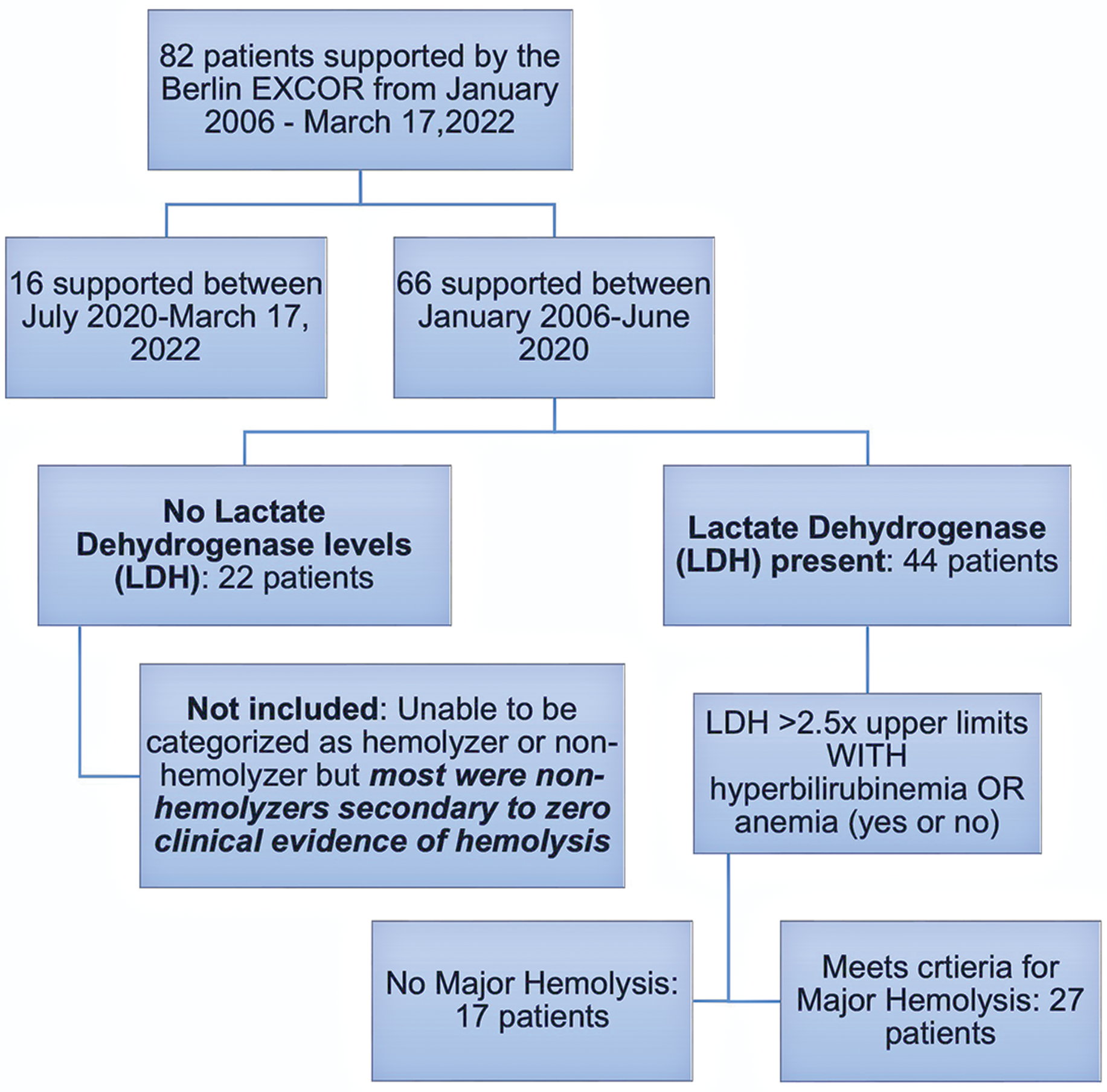
The University of Florida Institutional Review Board (IRB-01) approved this single-centre retrospective chart review entitled “Hemolysis among pediatric patients with heart failure supported by pulsatile para-corporeal ventricular assist devices (VADs) as a bridge-to-transplant” on 05/27/2020 (IRB202001434). Informed consent was waived by the IRB, and the study followed the ethical standards in accordance with the IRB and the Helsinki Declaration of 1975. In 2023, we published a review of our outcomes in all 82 consecutive patients supported with the Berlin Heart pulsatile ventricular assist device at University of Florida, with the first patient cannulated on September 29, 2006 and the most recent patient in this consecutive series cannulated on March 17, 2022. Reference Bleiweis, Stukov and Philip11 The study period for this current analysis reported in this current manuscript was January 2006 through June 2020, inclusive. During this study period, (between January 2006 and June 2020), 66 patients were supported with Berlin Heart at University of Florida (the first 66 of the 82 that we reported in 2023). We evaluated all 66 of these patients for inclusion in this current study, and 22 patients were excluded because lactate dehydrogenase was not collected during their period of support with ventricular assist device (Fig. 1). Thus, our final analytic cohort is the remaining 44 children who were supported by Berlin Heart EXCOR between January 2006 and June 2020.
Patients were divided into two groups based on The Pediatric Interagency Registry for Mechanical Circulatory Support (Pedimacs) definition of haemolysis. Reference Rosenthal, Almond and Jaquiss12 Major haemolysis was defined as having lactate dehydrogenase > 2.5× the upper limit of normal (i.e., > 500 U/L), with either total bilirubin > 2 mg/dL or anaemia that is inordinate to chronic illness or usual post-ventricular assist device state > 72 hours on ventricular assist device support. Anaemia was defined as haemoglobin value of 8 mg/dl in patients with biventricular physiology and 11 mg/dl in patients with univentricular physiology. This definition is in the context of no other indicators of haemorrhage. Plasma-free haemoglobin was not collected at our institution until 2018; and therefore, plasma-free haemoglobin was not used as a marker of haemolysis in this study. Non-major haemolysis was defined as lactate dehydrogenase less than or equal to 500 U/L or lack of other supportive data, such as elevated bilirubin or anaemia, in the setting of elevated lactate dehydrogenase.
Data collection included demographics, pre-ventricular assist device factors, ventricular assist device features, including transfusions, neurological outcomes, and survival. We extracted data from days 0, 3, 7, 14, 21, and 28 after ventricular assist device implantation. Creatinine clearance was calculated using the Modified Schwartz formula. Reference Schwartz, Muñoz and Schneider13 Respiratory failure was defined as reintubation within 72 hours of extubation or ongoing need for mechanical ventilation six days after ventricular assist device insertion. Reference Rosenthal, Almond and Jaquiss12 A neurological event was defined as a non-traumatic subdural/epidural haematoma or stroke demonstrated on CT imaging.
Single-ventricle ventricular assist device indicates patients supported with inflow cannula in the systemic ventricle/common atrium and outflow cannula in a systemic/pulmonary artery, in the context of functionally univentricular anatomy along with parallel pulmonary flow. Biventricular assist device indicates right ventricular assist device (inflow from the right atrium and outflow into the pulmonary artery) plus left ventricular assist device (inflow from the left ventricle and outflow into the aorta). Left ventricular assist device is inflow from the left ventricle and outflow into the aorta.
Fisher’s exact test and unpaired t-test using GraphPad Prism were used for categorical data and continuous data, respectively. Mann–Whitney U tests were used to compare the haemolysis groups on pump size and total transfusion volume after ventricular assist device implant. For end-organ function and transfusions, mixed-effects linear models were used to assess the difference in trend over time between major haemolysers and non-major haemolysers. Model fixed effects were time, group, and the interaction between time and group. A random intercept for patients was included to account for the clustering of observations on patients. When required to meet linear model assumptions, the natural log of the outcome was modelled rather than the raw data. Statistical significance was defined as a p-value < 0.05.
Results
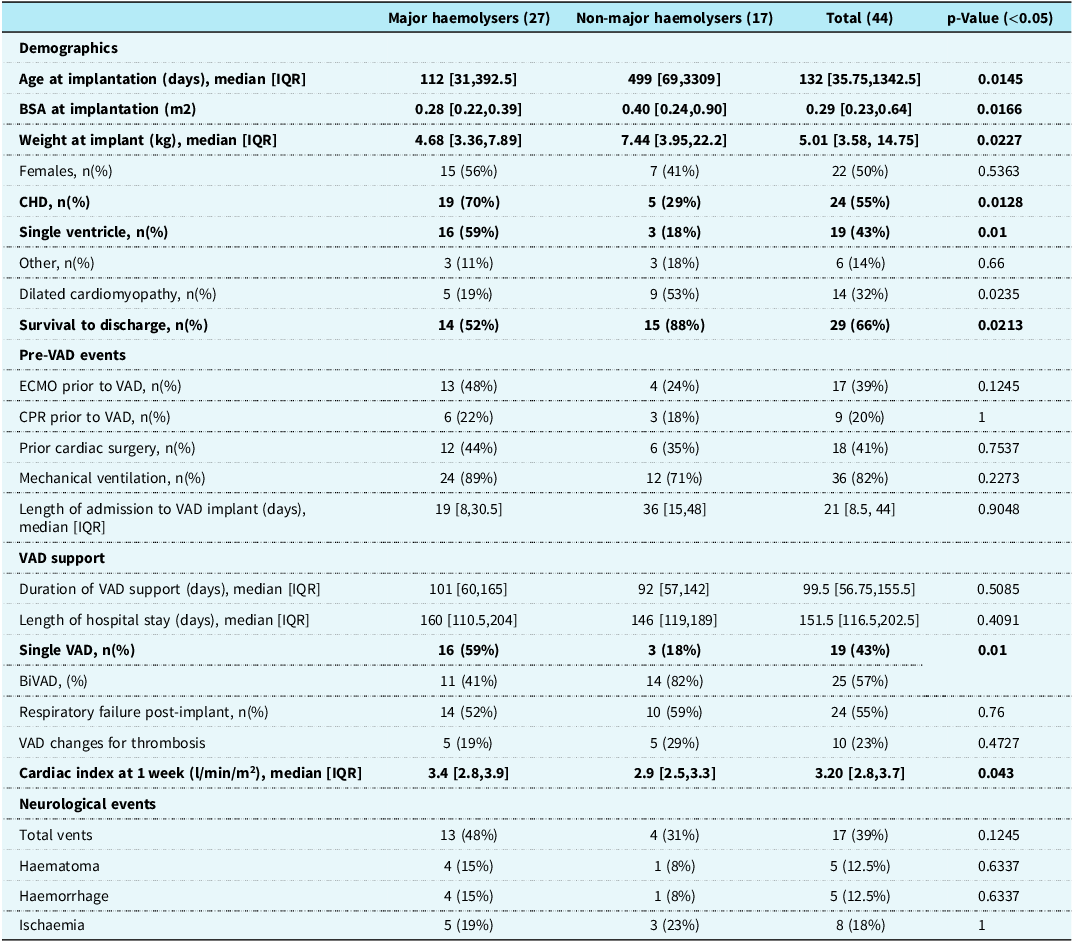
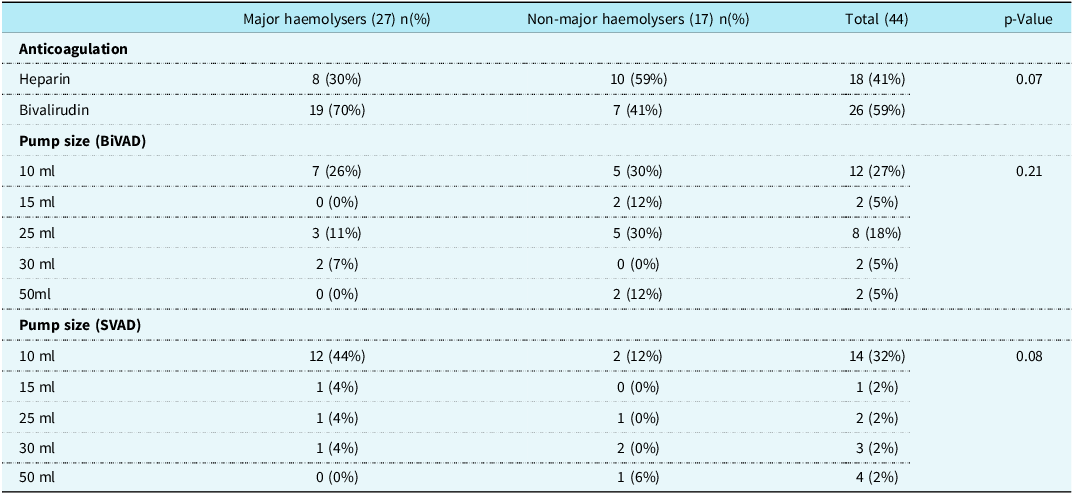
Forty-four patients supported by Berlin EXCOR were included in the study: 27 major haemolysers and 17 non-major haemolysers. The median age at implantation was 132 days [interquartile range = 36–1343 days]. Overall, survival to discharge was 66% (n = 29/44). Twenty-four patients had CHD with a survival of 46% (n = 13/24). Among the patients with acquired heart disease, survival was 90% (n = 18/20). Survival was 52% (14/27) in major haemolysers versus 88% (15/17) in non-major haemolysers (p = 0.02) (Table 1). Haemolysis was higher in patients supported with single-ventricle ventricular assist device versus those supported with biventricular assist devices, p = 0.01. There were no patients with a left ventricular assit device in our series. Major haemolysers had significantly lower body surface area in comparison to non-major haemolysers (0.28 versus 0.40, p = 0.0166). Median cardiac index at one-week post-ventricular assist device implantation was significantly different among haemolysers and non-haemolysers (p = 0.043). Pump size comparison among single-ventricle ventricular assist device and biventricular assist device groups did not indicate a statistical increase in haemolysis among the smaller pump sizes (Table 2).
Comparison of demographics, pre-VAD factors, VAD support, and neurological outcomes between major haemolysers and non-major haemolysers

BSA = body surface area; VAD = ventricular assist device, BiVAD = biventricular ventricular assist device [Values in squared brackets represent interquartile range = IQR].
Comparison between pump size and anticoagulation modality between major haemolysers and non-major during ventricular assist device support.

SVAD = single-ventricle ventricular assist device.
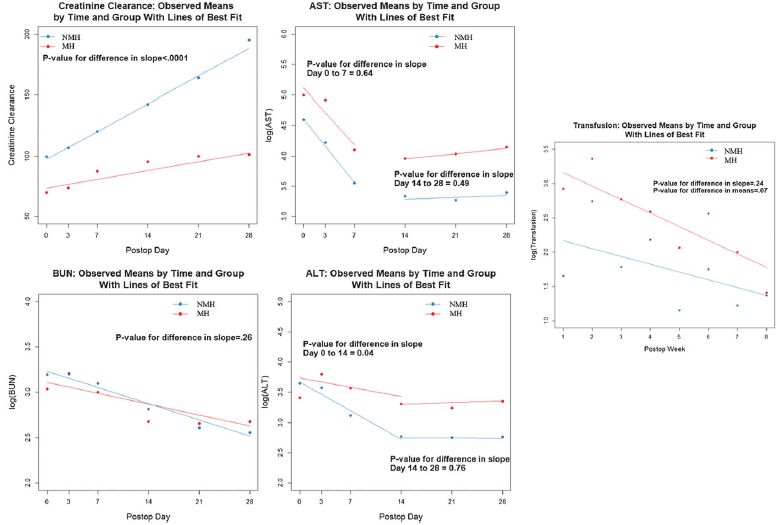
Respiratory failure post-implant was similar among both cohorts (p = 0.76) (Table 1). Alanine aminotransferase was statistically different between major haemolysers and non-major haemolysers during the first 14 days of ventricular assist device support and subsequently normalised. Aspartate aminotransferase was not statistically different between the two cohorts (Fig. 2). Volume of transfusions between the two cohorts did not reach statistical significance (Fig. 2). No difference was observed between major haemolysers and non-major haemolysers for adverse neurological events (Table 1). Among the end-organ function, the rate of improvement in creatinine clearance after initiation of ventricular assist device support was significantly less in major haemolysers throughout the first month of ventricular assist device support (p < 0.0001).
Exclusion/inclusion criteria and categorization of patients documented in a CONSORT (CONnsolidated Standards Of Reporting Trials) diagram.

Comparison of end-organ function and volume of transfusions between major haemolysers and non-major haemolysers during ventricular assist device support.

Amongst the cohort of major haemolysers who died, only three (3/13) 23% had severe severe haemolysis with a notable increase in haemolysis and bilirubin compared to the other patients. All three had lactate dehydrogenase > 2000 units/L with total bilirubin > 10 mg/dL. The first patient was a neonate with hypoplastic left heart syndrome who underwent combined Hybrid (Stage 1) procedure and ventricular assist device insertion. Liver biopsy documented neonatal haemochromatosis. The other two were neonates with functionally univentricular ductal-dependent pulmonary circulation with a Y-graft polytetrafluorethylene shunt as a source of pulmonary blood flow. Overall, only 2/7 of the total patients supported with Y-graft experienced haemolysis and 5/7 survived to transplant. The other causes of death amongst patient with major haemolysis included multiorgan failure despite ventricular assist device support (8/13, 61%) and two from thrombotic complications.
Of the 22 patients who were excluded with no measured lactate dehydrogenase, 16 were supported with biventricular assist device, 5 with single-ventricle ventricular assist device, and 1 with left ventricular assist device. Three were supported with ventricular assist device for < 72 hours. Seventeen of these 22 excluded patients had no clinical evidence of haemolysis but did not meet criteria for inclusion secondary to not having a measured level of lactate dehydrogenase. Survival to discharge from the hospital in this excluded cohort was 86% (19/22) (Supplementary Table 1).
Discussion
Haemolysis was primarily seen in younger, smaller, functionally univentricular patients supported with single-ventricle ventricular assist device. The reasons for increased haemolysis in children supported with single-ventricle ventricular assist device is likely secondary to the following factors: Functionally univentricular patients with single-ventricle ventricular assist device require a higher cardiac index to maintain adequate end-organ perfusion in comparison to those with biventricular circulations supported with left ventricular assist device or biventricular assist device. This higher cardiac index must traverse a complex pathway consisting of cannulas, device(s), polytetrafluorethylene and/or Dacron grafts, and metal stents in the context of a smaller patient, which could result in increased haemolysis from turbulent flow. In our series, patients with single-ventricle ventricular assist device receive more transfusions. In addition, inflow for left ventricular assist device in biventricular hearts is the left ventricle apex, while inflow for the majority of single-ventricle ventricular assist devices is the common atrium, which could also contribute to haemolysis.
End-organ functions were comparable between both groups. The decreased rate of renal recovery could contribute to overall mortality of our patients with major haemolysis. Reference Katz, Jensen and Chang14,Reference de Nattes, Litzler and Gay15 De Nattes and colleagues reported that haemolytic kidney injury in adults supported by ventricular assist device led to proximal tubular dysfunction. Reference de Nattes, Litzler and Gay15 This haemolytic kidney injury and proximal tubular dysfunction eventually leads to progressive kidney injury, similar to chronic pathologies with haemolysis, such as paroxysmal nocturnal haemoglobinuria. In addition, renal injury could be a reflection of the overall state of illness. Ongoing severe haemolysis despite optimised ventricular assist device support, anticoagulation, and increasing intervals from implant warrants close monitoring. Ongoing severe haemolysis could indicate that the current state of ventricular assist device support is unmasking either unknown end-organ dysfunction like neonatal haemochromatosis or the need for a change in support strategy.
The use of bivalirudin and revised antiplatelet protocols have decreased the incidence of stroke and pump exchange for thrombus burden in children supported with ventricular assist device. Reference VanderPluym, Cantor and Machado16 In our cohort, 90% of the patients who required ventricular assist device pump exchanges for thrombosis were anticoagulated with heparin. However, when comparing the anticoagulation strategy utilized in major haemolysers versus non-major haemolysers, no statistical difference was observed (Table 2). These improvements in strategies for anticoaguation (including the use of bivalirudin) make thrombotic complications less likely in our population, although their role in increasing haemolysis and mortality remains unclear. Both patients with mortality due to thrombotic complications were prior to the institution of bivalirudin as our primary anticoagulant and our current antiplatelet regimen.
In our recently published single-centre experience with the Berlin Heart EXCOR, survival with a single-ventricle ventricular assist device configuration for functionally univentricular hearts has continued to improve when compared to historical cohorts. Reference Bleiweis, Stukov and Philip11 We believe that “high-risk patients with functionally univentricular hearts who are suboptimal candidates for conventional palliation, or who have failed conventional palliation, can be successfully stabilised with pulsatile ventricular assist device insertion.” Reference Bleiweis, Stukov and Philip11 Our goal is to improve the outcomes of functionally univentricular patients supported with single-ventricle ventricular assist device. One strategy is to increase our understanding and management of haemolysis while supported by the ventricular assist device and to understand the subset of patients with increasing haemolysis in the major haemolyser group leading to morbidity and mortality.
Limitations
Our analysis is limited by the retrospective nature of our study and relatively small sample size. Some patients who were supported by a ventricular assist device between 2006 and 2020 were excluded due to the inability to categorise as major haemolyser or non-major haemolyser (n = 22 patients). Lactate dehydrogenase and plasma-free haemoglobin were not collected on these patients as this was not part of our routine post-implant laboratory tests during the initial part of our experience. Of these 22 patients who were excluded from our current analysis, 17/22 had no clinical evidence of haemolysis, and survival was 19/22 (86%).
Conclusion
Major haemolysis in patients supported by pulsatile ventricular assist device is more likely with single-ventricle ventricularassist device support and smaller body surface area. If there is an exacerbation of haemolysis, it should warrant further investigation. Acute kidney injury in combination with worsening haemolysis could be a harbinger of mortality.
Analysis of data from multicentre forums like PEDIMACS, ACTION, and ISHLT will help delineate aetiology and pattern.
Supplementary material
The supplementary material for this article can be found at https://doi.org/10.1017/S1047951124025137.
Financial support
The study is partially funded by NCATS grant UL1 TR000064 and NIH (National Institutes of Health) T35 Grant HL 7489-37.
Competing interests
None.