1. Introduction
We construct meaning from texts out of a wide range of elements, from the semantic representations of the linguistic items to world knowledge about how events normally take place. The current studies focus on the meaning of one piece of language – grammatical aspect – and examine several factors that might influence a choice between perfective and imperfective forms. Of particular interest is the relative force of factors tied closely to the semantic representation of aspect, compared with those tied via inference (of either a semantic or real world nature), and those connected through aspect’s narrative functions. Although prior work has found connections between grammatical aspect and world knowledge (e.g., locative information), the current results suggest that aspectual choice and the construction of situation models more generally is guided primarily by semantically motivated and functional narrative dimensions of meaning.
Grammatical aspect is one of a core set of semantic constructs that organizes grammars and, cross-linguistically, the primary division is between the imperfective and the perfective. In English, the perfective form is the simple past tense form and the imperfective form is the progressiveFootnote 1be v-ing construction. Comrie (Reference Comrie1976) has articulated the basic intuitions that underlie these meanings: the perfective refers to an event as a completed whole while the imperfective views an event from within as ongoing, and these intuitions have been cashed out in several formal accounts (De Swart, Reference De Swart1998; Klein, Reference Klein1994; Moens & Steedman, Reference Moens and Steedman1988; Smith, Reference Smith1991). The imperfective/perfective distinction can be seen in a variety of linguistic tests (see Dowty, Reference Dowty1979; Klein, Reference Klein1994; Smith, Reference Smith1991). For example, when a naturally bounded event description is presented in the perfective, the statement entails the completion of the event (1a); trying to continue such a sentence with an explicit statement of non-completion (1b) sounds like a contradiction. However, when the same event description is presented in the imperfective (2a), no such entailment exists and the same continuation is now possible (2b).
(1) a. Mariah sang the national anthem
b. #… but she didn’t finish it (she was interrupted)
(2) a. Mariah was singing the national anthem
b. … but she didn’t finish it (she was interrupted)
There are many other examples of interpretative differences between perfective and imperfective aspect that stem from their different semantic representations: imperfective forms combined with semelfactives often lead to iterative interpretations, while this is more rare with perfective forms (Harry was snapping suggests repeated snaps, but Harry snapped does not); imperfective forms combined with achievements can suggest a preparatory state, while perfective forms refer to the completion of the event (Candice was reaching the top refers to the time she was approaching the top, but Candice reached the top refers to the culmination). These interpretative differences have been discussed widely in the literature by many researchers.
Beyond the formal entailments of grammatical aspect, researchers have also considered its discourse and narrative functional uses (e.g., Hopper, Reference Hopper and Givon1979; Hopper & Thompson, Reference Hopper and Thompson1980; Smith, Reference Smith1991; Ter Meulen, 1995; see Carruthuers, 2012, for some complex examples of how tense and aspect markers construct narrative timelines). Most notably, perfective aspect foregrounds an event in a narrative: when a series of events are described in the perfective, the events are interpreted as happening in sequence, with each event moving the plot further along the timeline. For example, a natural interpretation of (3), with both forms in the perfective, is that the two events happened one after the other. By contrast, imperfective aspect typically serves a backgrounding function in discourse and describes or elaborates on an event without advancing the timeline of the plot forward; it provides the background information against which the foregrounded event happens. A common consequence of this backgrounding function is that event sequences involving imperfective forms are often interpreted as happening simultaneously. Thus in (4) the events are most naturally interpreted as happening at the same time, with the picking up event providing background for the clapping event.
(3) Keith picked up his guitar. The audience clapped.
(4) Keith was picking up his guitar. The audience clapped.
It has been suggested (Klein, Reference Klein1994; Smith, Reference Smith1991; Ter Meulen, Reference Ter Meulen1995) that these narrative functions of grammatical aspect fall out from the entailment properties of the perfective and imperfective: the absence of completion entailments for the imperfective allow for the possibility of overlap in a way that the completion entailments of the perfective do not. However, these narrative functions do not have the same force as entailments, and they can be overridden with appropriate contextual cues. Moreover, it has been suggested (e.g., Emmott, Reference Emmott1997) that the cross-linguistic connection between the perfective and foregrounding, and between imperfective and backrounding, may simply be correlational and could arise for a variety of reasons.
Both the semantic representation and the narrative functional dimensions of grammatical aspect have been investigated psycholinguistically. In terms of the basic meanings, Wagner (Reference Wagner2009) found that adults, like preschool-aged children, will reliably match an imperfective sentence to an ongoing depiction of an event and a perfective one to a completed depiction of the event (see also Madden & Zwaan, Reference Madden and Zwaan2003; Yap, Chu, Yiu, Wong, & Kwan, Reference Yap, Chu, Yiu, Wong and Kwan2009). Using a quite different paradigm, Morrow (Reference Morrow1990) found that adults who heard a description of a directed motion event (e.g., John walked from the kitchen to the bedroom) would mark the actor’s position on a map consistently with the meaning of the aspect used: when the description was in the imperfective (was walking), they placed the actor along the middle of the path of the motion, and with the perfective (walked) or present perfect (has walked) forms, they placed the actor much closer to the endpoint of the event.
Finally, with respect to narrative function, Carreiras, Carriedo, Alonso, and Fernandez (Reference Carreiras, Carriedo, Alonso and Fernandez1997) found that grammatical aspect influenced how accessible information was as participants read a story. The idea is that as readers interpret a sequence of events, they keep the event that is currently under discussion active in memory; once an event is completed, processing resources move to the next event in a sequence. An event in the imperfective is interpreted as being in the background, and readers therefore do not move the narrative forward; the backgrounded event stays active in memory. By contrast, an event in the perfective is foregrounded, and advances the narrative sequence forward; readers shift their processing resources toward the next event in the sequence. When a description of a person was placed in imperfective aspect, participants were faster to recognize the person’s name several sentences later in the story relative to descriptions that had been foregrounded with a past perfect form. Additional studies on the narrative function of aspect have found similar results (Magliano & Schleich, Reference Magliano and Schleich2000).
These psycholinguistic results validate the established linguistic analyses: adults know the meaning of grammatical aspect and use it to interpret sentences on-line. However, many researchers conducting these studies have adopted a stronger claim. They argue that when we interpret sentences, we create a mental simulation of the event situation (Zwaan, Reference Zwaan2008; Zwaan & Radvansky, Reference Zwaan and Radvansky1998). These simulations are constructed out of the semantic elements in the sentence but, once created, they can take on a life of their own. In particular, these ‘situation models’ support a variety of inferences that can go beyond what is explicitly mentioned in the sentence. For example, Madden and Therriault (Reference Madden and Therriault2009) showed that participants were faster to identify an instrument in-use (e.g., an open umbrella) for a description in the imperfective aspect (It was raining), and faster to identify an out-of-use instrument (e.g., a closed umbrella) for a description in the perfective (It rained). Even though instruments were not mentioned in the target sentences, participants included them in their mental models; moreover, the specific ways in which they were included depended on the semantics of the particular grammatical aspect forms used (e.g., an open umbrella for an ongoing rain event, a closed umbrella for a completed rain event). The completion entailments of the perfective led to a model in which the event was finished and, by inference, the instrument was no longer in use (and vice versa for imperfective aspect). Other researchers have gone further, and investigated more extended implications of constructing imperfective vs. perfective models on assessments of political candidates (Fausey & Matlock, Reference Fausey and Matlock2010), car accidents (Matlock, Sparks, Matthews, Hunter, & Huette, Reference Matlock, Sparks, Matthews, Hunter and Huette2012), and on persistence in tasks (Hart & Albarracin, Reference Hart and Albarracin2009).
All of the examined inferences noted so far have one important element in common: they all depend on the core meaning of perfective and imperfective aspect. The direct implication of this meaning difference is that perfectively described events are complete and imperfectively described events may not be.Footnote 2 The situation models support a rich interpretation of these different event perspectives, one that includes our knowledge of what actions look like when they are in-progress as opposed to completed, as well as our knowledge about the role of intentions in directing ongoing actions towards their endpoint. But in all cases, these rich interpretations are fundamentally constrained by the temporal and event semantics involved.
However, one set of results goes further, and it is these particular results that are of interest to the present studies. Ferretti et al. (Reference Ferretti, Kutas and McRae2007) found that imperfective aspect (relative to the past perfect construction) led participants to draw inferences about the location in which an event occurred. Specifically, across three studies with different participants, Ferretti et al. found that participants who read an imperfective sentence (vs. a past perfect sentence) were faster to name a related location and were more likely to continue the sentence with a locative phrase; in addition those who heard a sentence in the imperfective (vs. the past perfect) followed by an atypical location produced significantly larger N400 responses, indicating greater semantic surprise (Kutas & Hillyard, Reference Kutas and Hillyard1980; Kutas & Iragui, 1998). In summary, participants preferred in a variety of ways sentences of the form The girl was skating at the rink over The girl has skated at the rink. Footnote 3
These results are particularly notable because there is no straightforward way that the semantic representations of grammatical aspect predicts a link to location information for either form. Ferretti et al. (Reference Ferretti, Kutas and McRae2007) offer the intuition that a focus on the ongoing portion of an event (as happens with the imperfective) will naturally lead to a focus on where the action is happening. This intuition, however, does not have a basis in any linguistic account, since the distinction between perfective and imperfective aspect has to do with differences in temporal intervals and not spatial locations. However, Ferretti and colleagues are operating within an emergentist framework (see, for example, Elman, Reference Elman2009), and, from that perspective, there is no a priori semantic organization of grammatical aspect that one can or should appeal to. The results in Ferretti et al. (Reference Ferretti, Kutas and McRae2007) suggest that our interpretive situation models link locations to ongoing actions and that functionally makes location information a semantic property of grammatical aspect as much as any other property. It is worth noting that Ferretti et al. argue that the grounding for this property comes from our knowledge about how events work; it emerges from our understanding of how things happen in the world. Interestingly, this grounding suggests that our access to world knowledge comes with specific interpretative constraints: in this case, thinking about actions specially invokes the location where they occur, while thinking about the outcomes of actions does not similarly invoke world knowledge about location.
The claim in Ferretti et al. (Reference Ferretti, Kutas and McRae2007), therefore, is stronger than the claims made in related work, and it is a claim we do not believe is warranted. The theoretical question at stake is whether or not people form links between specific linguistic elements (such as perfective and imperfective aspect) and pieces of world knowledge that are not primarily mediated by the meanings of the linguistic elements themselves. A strongly emergentist view of situation modeling would argue that such links are indeed possible: the traditional semantic representations of grammatical aspect are simply one set of emergent relations, but those semantics are not privileged and other properties can also emerge.
The current studies examine how people link grammatical aspect to location information, as well as how they link it to other features more closely motivated by the semantic representation of grammatical aspect, specifically transitivity, telicity, and subject animacy. We consider each feature in turn and lay out the way it is connected to grammatical aspect, considering principled links stemming directly from the semantic representations of the features as well as inferential links that depend to varying degrees on a speaker’s knowledge about how events typically unfold. Moreover, when available, we note evidence from psycholinguistic and language acquisition studies to support the psychological validity of these connections. We do not intend to make strong claims about how these connections are accessed or processed on-line, but do hypothesize a hierarchy among the connections such that those which stem from the semantic representations directly are stronger than those which require inferential steps across the semantic representations; and finally, that those connections which require inferential information from beyond the semantic elements themselves will be least strong.
The first feature was telicity: half the test sentences were telic and half were atelic (see Dowty Reference Dowty1979; Smith Reference Smith1991; Vendler Reference Vendler1967, inter alia). Telic predicates refer to events with natural endpoints, including events of creation and change of state (e.g., bake a cake, die). Atelic predicates refer to events without specific endpoints, such as manners of motion (e.g., push a cart, flow).Footnote 4 Telicity is intimately connected with grammatical aspect in linguistic accounts; it has even been suggested (Comrie, Reference Comrie1976) that the telic/atelic distinction is the lexical encoding of the same conceptual information coded grammatically by the perfective/imperfective distinction. More formally, the truth-conditional entailment patterns of grammatical aspect depend on the telicity of the event description. The examples in (1) and (2) showed how the entailments work for telic descriptions (Mariah was singing the national anthem does not entail Mariah sang the national anthem, although the reverse is true); but because atelic descriptions do not specify natural endpoints, the semantic effect of grammatical aspect is different (Ryan was talking does entail Ryan talked, and the reverse is also true). All linguistic accounts of grammatical aspect are sensitive to telicity distinctions and, indeed, in some accounts, the relationship between the two plays an integral role (e.g., Bohnemeyer & Swift, Reference Bohnemeyer and Swift2004; De Swart Reference De Swart1998).
In addition to the representational connection, links between telicity and grammatical aspect have been well established in the domain of language acquisition (Bloom, Lifter, & Hafitz, Reference Bloom, Lifter and Hafitz1980; Weist, Wysocka, & Lyttinen, Reference Weist, Wysocka and Lyytinen1991; Wagner, Reference Wagner2009, inter alia), and in adults’ understanding and processing (Wagner Reference Wagner2009; Andersen & Shirai, Reference Andersen, Shirai, Ritchie and Bhatia1996; Yap et al., Reference Yap, Chu, Yiu, Wong and Kwan2009, inter alia). The overwhelming finding from these literatures is that across a variety of tasks, languages, and situations, people prefer telic descriptions to be in perfective aspect and atelic descriptions to be in imperfective aspect. For more detailed documentation and discussion of this phenomenon, see Wagner (Reference Wagner and Binnick2012) and Li and Shirai (Reference Li and Shirai2000). We predicted, therefore, that participants in the current studies would similarly prefer the imperfective form for atelic sentences and the perfective form for telic sentences.
The second feature tested was transitivity: half of the test sentences were syntactically transitive (i.e., contained a direct object) and half were intransitive (i.e., did not contain a direct object). Semantically, Hopper and Thompson (1980) argue that both syntactic transitivity and grammatical aspect are elements used to construct larger event prototypes. Specifically, transitive structures and perfective aspect are part of one prototype (along with telic descriptions), and intransitive structures and imperfective aspect are part of the opposing prototype (along with atelic descriptions). Other researchers have argued for a link between transitivity and telicity (Tenny, Reference Tenny1994; van Hout, Reference van Hout, Tenny and Pustejovsky2000), noting that the presence or absence of a direct object often corresponds with the presence or absence of an event boundary point. Moreover, the link between telicity and transitivity appears to be one that helps guides children’s early word learning (Wagner, Reference Wagner2006, Reference Wagner2010). Thus, although the connection between transitivity and grammatical aspect may not be as direct as the one from telicity, we predicted that participants in the current studies would prefer the imperfective form with intransitive sentences and the perfective form with transitive sentences.
The third semantic feature tested was subject animacy: half of the test sentences contained an animate subject (e.g., a girl, a cop) and half contained an inanimate subject (e.g., a plane, a river). The relationship of subject animacy to grammatical aspect requires several inferential steps that are similar to those needed to link location information to grammatical aspect (see below). First, we assume that imperfective aspect specially focuses the action part of the event (while perfective aspect focuses the endpoint). Next, we assume that a focus on the action brings the agent of the action into focus as well. Finally, we assume that animate agents are better examples of agents than inanimate ones. There is general linguistic support for each of the steps in this inferential chain. The semantic representation of the imperfective does involve focusing on the interior of an event, and Madden and Therriault (Reference Madden and Therriault2009) suggest that such a focus does evoke general properties of the event in progress. The idea that actions are intimately connected to their agents is well supported by linguistic work on selectional restrictions (Fillmore, Reference Fillmore, Bach and Harms1967; Jackendoff, Reference Jackendoff1990). Finally, the notion that animate actors make better agents of actions has been suggested as an explanation for various syntactic transformations and assignments of linguistic cases (Dowty, Reference Dowty1991), and has also received psycholinguistic support (Kako, Reference Kako2006). Moreover, Wagner (Reference Wagner2002, Reference Wagner2009) found evidence that the presence of an animate actor facilitated both child and adult interpretations of imperfective aspect. Thus, although there is a 3-step inferential chain involved, each step in the chain is also supported by linguistic analyses. We predicted that participants would prefer the imperfective aspect in the presence of an animate agent and perhaps would prefer the perfective aspect with an inanimate agent.
The fourth factor tested was the presence or absence of a related location phrase. The inferential chain linking location information to grammatical aspect goes like this. First, we assume that imperfective aspect specially focuses the action part of the event (while perfective aspect focuses the endpoint). As noted for the case of subject animacy, this link is supported both by the semantics of grammatical aspect as well as psycholinguistic evidence. Second, we must assume that actions of events are specially linked to locational information and that the focusing on the action will evoke the location in which the action typically occurs. As noted previously, this step in the inferential chain is one for which we have found no linguistic support; there is, however, the psycholinguistic support provided by Ferretti et al. (Reference Ferretti, Kutas and McRae2007). If this chain of inference holds, then we predict that participants will prefer the imperfective aspect when location phrases are present and will prefer the perfective aspect when location phrases are absent. However, if a more direct connection to the semantics system is required – either because such a connection is different in nature or different in strength – we predict that the presence or absence of location will have little effect on participants’ choices.
We manipulated these four factors (telicity, transitivity, subject animacy, presence/absence of location information) in all three of the following experiments. In addition, Experiments 2 and 3 also considered the narrative functions of aspect and examined different ways to promote a backgrounded interpretation: the fronting of location information (Experiment 2 and 3) and the presence of a formulaic narrative opener, Once upon a time (Experiment 3). The specific nature of the connections between grammatical aspect, location information, and narrative function will be discussed as they are introduced in the later studies.
2. Experiment 1
A forced-choice sentence completion task asked participants to choose whether a target verb should be in the imperfective form (the past progressive) or the perfective form (the simple past tense). This task draws primarily on comprehension processes, as participants are given almost complete sentences which they must understand in order to choose the missing element; however, it may also invoke some production processes inasmuch as their choice reflects a preference for how to complete the creation of the sentence. This method allowed us to vary sentences along several different dimensions at once while tightly constraining participants’ response types.
Each test sentence exemplified a specific combination of telicity (telic or atelic), transitivity (transitive or intransitive), and subject animacy (animate or inanimate). The combination of these three semantic elements, each with two levels, led to a total of eight different types of sentence. We did not attempt to control the specific words within the sentences, and each one described a completely different event (but see the corpus analysis in the ‘Methods’ section). The final factor of location information was integrated into the experiment in a slightly different fashion. A relevant location phrase was created for every one of the test sentences. Each participant saw half of all the sentences with a location phrase present and half without one, but across participants it was possible to make a direct comparison for each sentence. In Experiment 1, the location phrases were all placed at the end of the sentences, as was done in Ferretti et al. (Reference Ferretti, Kutas and McRae2007).
Based on previous work showing that adults are sensitive to the meaning of grammatical aspect, we predicted that all three factors motivated from the semantic representations would influence aspectual choice. If Ferretti et al. (Reference Ferretti, Kutas and McRae2007) are correct, and world knowledge not linked to the semantics can also influence interpretations, then the presence or absence of location phrases should also influence aspectual choice.
2.1. methods
2.1.1. Participants
Thirty-two native English-speaking undergraduate students participated and received partial course credit. An additional sixteen participants were excluded because they were not native English speakers (11), did not complete all trials (3), or provided too many wrong answers on check trials (2).
2.1.2. Stimuli
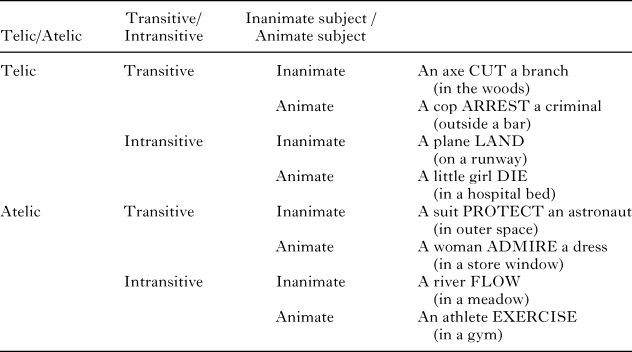
The test items consisted of single clause sentences using everyday vocabulary. Six token sentences were made for every combination of the three binary semantic elements (telicity, transitivity, subject animacy) for a total of forty-eight sentences (see Table 1).
Example sentences used in all three experiments and their associated semantic features. The locative phrase used with each sentence is shown in parentheses. There were six tokens of each combination of semantic features. All participants saw half of the token sentences with the locative phrase and half of them with no locative phrase

Sentences were classed as being telic or atelic on the basis of standard linguistic tests, such as their behavior with the adverbial phrases in/for an hour and almost (Dowty, Reference Dowty1979; Smith, Reference Smith1991). Sentences were classed as transitive if they contained an overt direct object and intransitive if they did not. Sentences were classed as having an animate subject if the subject of the sentence was a human being and inanimate if the subject was a non-animate object. Because each token sentence contained a different lexical verb and described a different event, we wanted to insure that our sentence types were not a priori biased toward a particular aspectual form from a history of exposure. We checked every verb in the Corpus of Contemporary American English (Davies, Reference Davies2008), which contains 450 million words from spoken and written language sources (e.g., television programs, fiction, magazines, etc.) produced between 1990 and the present. We extracted all verb forms in the past progressive (was v-ing) and in the simple past form (-ed or irregular), yielding a total of 823,637 tokens. For each verb, we calculated a bias toward the perfective: the proportion of simple past forms as a function of the total number of forms. The overall bias towards the perfective was quite high, with 97.5% of the extracted forms being in the simple past. Looking at the specific factors, there was no difference in perfective bias for the two levels of transitivity (F(1,47) = 0.002, n.s.), nor for the two levels of subject animacy (F(1,47) = 0.054, n.s). However, verbs from telic sentences were significantly more likely to appear in the simple past than the verbs from atelic sentences (M telic = .99, M atelic = .96; F(1,47) = 22.2, p < .001). Moreover, we replicated these qualitative results using a larger set of imperfective forms, including those in the present progressive. The corpus analysis, therefore, raises the possibility that any effects of telicity on aspectual choices could be (at least partially) the product of the existing frequency distributions, but that would be an unlikely explanation for effects of either transitivity or subject animacy. We take up the question of frequency more thoroughly in the ‘General discussion’.
Each one of these token sentences had two versions, one with a locative phrase present and one without a locative phrase. All locations were typical for the event being described, as judged by our own intuitions. Participants saw all forty-eight of the sentences, half of each combination type with the locative phrase and half without. Different subjects saw different sentences with the locative phrase, so that, across participants, both the locative present and locative absent versions were equally represented.
2.1.3. Procedure
The task was a forced-choice sentence completion task. Participants saw each test sentence with a blank line in place of the verb. After two seconds, the two options for the blank were presented side-by-side below the test sentences. One option was the target verb in the simple past tense (e.g., arrested) and the other option was the target verb in the progressive form (e.g., was arresting). Participants chose by pressing the ‘A’ key (to indicate the verb on the left) or the ‘L’ key (to indicate the verb on the right). All the words remained on the screen until participants responded. After their selection, a fixation point appeared on the screen for 250 ms, followed by the next sentence. Participants were instructed to “fill in the blank” with the right word. They were also told that sometimes both answers would be acceptable, and in those cases they should choose the one that seemed the ‘best’ to them.
In addition, participants saw fifty-eight filler/distraction sentences interspersed among test trials, and also ten ‘check’ sentences to ensure attention. Filler sentences contained a blank, and required participants to choose between two grammatically appropriate word choices (e.g., He is quite/very attractive; The military attacked the bunker/forest). For the check sentences, one of the choices led to an ungrammatical sentence (e.g., A game/games was being played; He go/goes to school on Thursday); participants who made an ungrammatical choice on more than two check sentences were removed from the analysis (see ‘Participants’ section).
All sentences were presented on PC computers using DirectRT software. The order of the sentences was randomized by the software and the sides of the choice options were counterbalanced across subjects. The experiment took approximately 15 minutes to complete.
2.2. results
Our dependent variable in all analyses was the proportion of imperfective verb choices – that is, the was v-ing form of the verb. Participants showed an overall preference for the perfective (e.g., the simple past tense form), favoring it 69.5% of the time (t(31) = 6.33, p < .01). However, there was sufficient variability in responding to allow for an investigation of the influence of the different sentential properties on participants’ choices.
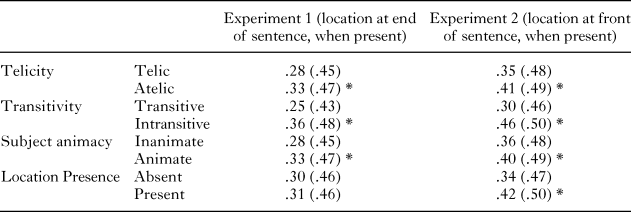
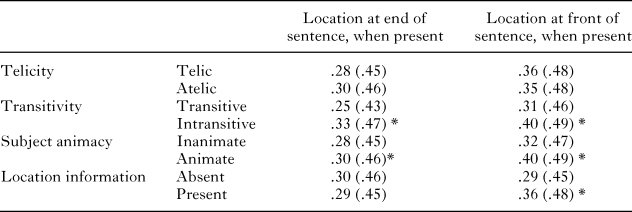
The mean rate of imperfective responding for each level of each factor is shown in Table 2. An ANOVA was conducted with all four binary features defining the sentences as independent variables: Telicity (2) × transitivity (2) × subject animacy (2) × locative presence (2). Main effects were found for all factors, except location presence. Participants selected the imperfective verb form more with atelic than telic sentences (F(1,31) = 5.25, MSE = .066, p = .029), with intransitive than transitive sentences (by subjects: F(1,31) = 23.30, MSE = .069, p < .001; by items: F 2(1,40) = 7.21, MSE = .043 p = .011), and with sentences containing animate subjects over those containing inanimate subjects (F(1,31) = 5.41, MSE = .041 p = .027). The presence of a locative phrase, however, had no impact on participants’ choices (F(1,31) = 0.15, n.s.).
Mean rate (SD) of imperfective choices for each level of each factor across Experiments 1 and 2. By hypothesis, the values of atelic, intransitive, animate subject, and location present should all lead to higher rates of imperfective responding. Experiment 1 found that all the factors except location presence were consistent with this hypothesis. However, when location information was placed at the beginning of the sentence (Experiment 2), it did significantly increase imperfective responding. Asterisks indicate that a particular level led to significantly increased rates of imperfective choices relative to the other level of that factor
In addition, there were significant 2-way interactions between telicity and transitivity (F(1,31) = 8.02, MSE = .048, p = .008), telicity and subject animacy (F(1,31) = 5.13, MSE = .043, p = .031), and between transitivity and subject animacy (F(1,31) = 4.90, MSE = .065, p = .034). In all cases, the essential character of the interaction was the same: When the levels of both factors were the ones predicted to be linked to the imperfective – atelic, intransitive, animate subject – there was a marked increase in imperfective responding. Specifically, sentences that were both atelic and intransitive received 41% imperfective responses compared to a mean rate of 26.8% for items that contained any perfective-linked levels among those two factors (atelic + transitive, telic + intransitive, telic + transitive). Similarly, sentences that were both atelic and had an animate subject received 37% imperfective responses compared to a mean rate of 28.2% for items that contained any perfective-linked levels among those two factors (atelic + inanimate subject, telic + animate subject, telic + inanimate subject). And, further, sentences that were both intransitive and had an animate subject received 41% imperfective responses compared to a mean rate of 27.0% for items that contained any perfective-linked levels among those two factors (intransitive + inanimate subject, transitive + animate subject, transitive + inanimate subject). There were no significant interactions involving location presence, and no significant higher-order interactions.
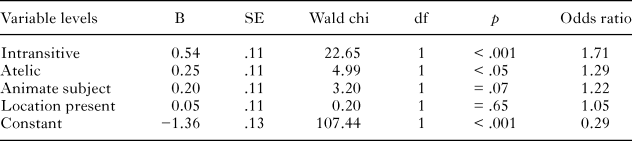
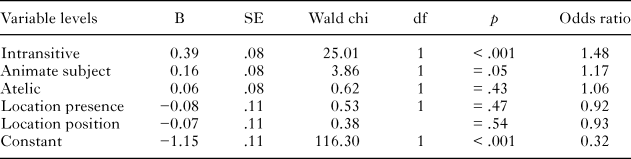
Finally, we conducted a binary logistic regression using telicity, transitivity, subject animacy, and location presence as variables. Table 3 lists the variables in order from most to least predictive of the choice of imperfective aspect; the table lists the level of each variable that leads to increased imperfective responding. As can be seen, transitivity was the strongest predictor, followed by telicity; subject animacy was marginally predictive and location presence was non-significant. These results largely confirm the results of the ANOVA, but suggest that some caution is warranted in interpreting subject animacy as a relevant factor in this task.
The results from the binary logistic regression on the data from Experiment 1. Positive beta weights indicate that the level of the factor listed increased the rate at which participants chose the imperfective form
2.3. discussion
The three factors examined in this study that possessed principled semantic connections to grammatical aspect all influenced participants’ choice of grammatical aspect form. Telicity, transitivity, and, to a lesser extent, subject animacy all had significant influences on aspectual choice, and in all cases the direction of the influence was predicted by the specific semantic relationship of the factors to grammatical aspect. Moreover, having multiple cues pointing in the same direction appeared to increase the effects of these cues. We did not predict any specific additive nature of the cues, but the significant interaction effects suggest that there is some additional power in having cue consistency above and beyond the cues themselves. The only factor that did not influence participants at all was the presence vs. absence of location information. In effect, this study failed to replicate the findings of Ferretti et al. (Reference Ferretti, Kutas and McRae2007) that there is a reliable connection between imperfective aspect and the presence of location.
There is some evidence that the existing frequency distributions in the language may be having some impact on the task. Participants’ overall preference for choosing the perfective form mirrors the general perfective bias that was found in the corpus analysis. Similarly, the influence of telicity was also presaged by the corpus analysis showing that the verbs from the telic sentences were more likely to appear in the perfective forms. However, appeals to a frequency analysis are incomplete for two reasons. First, the corpus examination failed to find a perfective bias for either level in the case of transitivity and subject animacy, but these factors nevertheless influenced participants’ choices. Second, and more importantly, the frequency distributions that exist do so for a reason. It would seem quite possible that the linguistic factors that we have hypothesized to account for aspectual choice within this task would similarly influence aspectual choice outside of it. We might reasonably expect some correspondence between the factors that influence participants’ choices and the factors that influence the choice of the people who produced the language in the corpus. The fact that the correspondence is not perfect suggests that outside of the controlled environment of this task, many more factors may be at play.
In Experiment 2, we consider an alternative reason for participants to disprefer the imperfective choice in this study. In out-of-the-blue contexts, such as experiments like this one, sentences in the imperfective can seem a bit odd (see Wagner, Reference Wagner2009). Although there is no linguistic reason that taking the internal perspective of the imperfective should be any harder than adopting the external perspective of the perfective, there is a pragmatic reason based on the narrative functions of the two markers. As noted previously, the function of the imperfective in a discourse is to background material relative to other pieces of the discourse. Backgrounding is an inherently dependent function (an event can only be in the background if another event is in the foreground), and it requires context to receive a natural interpretation. The overall dispreference for the imperfective choice suggests that this experiment did not provide a relevant larger context. In the following experiments, we consider the possibility that the connection between location information and the imperfective is mediated by the backgrounding function of the imperfective, and therefore that backgrounding is critical for linking location information to imperfective aspect.
3. Experiment 2
To produce a context that would encourage backgrounding with a minimum of changes to the test sentences, we simply preposed the locative information when it was present. Thus, the sentence The cop ARREST the criminal outside the bar was changed to Outside the bar, the cop ARREST the criminal. The idea that fronted location phrases are good markers of backgrounded information comes from a general intuition that they are a common way to begin stories such as fairy tales (In a cabin by the woods …). Analyses of nursery tales (Hasan, Reference Hasan1984) identify ‘Placement’ information – that is, locative information – as the first functional element in such stories. To begin a simple tale, one should begin it by stating where it happened. Moreover, psycholinguistic evidence has found that the order in which information is provided matters: information that comes first guides the building of our interpretations (Gernsbacher, Reference Gernsbacher1990, Reference Gernsbacher1997). Our location phrases are descriptive elaborations on the event – a canonical piece of backgrounded information. Placing that information at the very beginning of the sentence should encourage participants to see the location phrase as serving a backgrounding function. Since previous work has found that adults are sensitive to the backgrounding function of imperfective aspect (Carreiras et al., Reference Carreiras, Carriedo, Alonso and Fernandez1997; Magliano & Schleich, Reference Magliano and Schleich2000), connecting location information to a strong backgrounding function may in addition encourage the link between location and grammatical aspect.
3.1. methods
3.1.1. Participants
Thirty-four native English-speaking undergraduate students participated and received partial course credit An additional twelve participants were excluded because they were not native speakers of English (9), or did not complete all trials (3). None of the participants in this experiment had been in the previous experiment.
3.1.2. Stimuli
The stimuli used in this experiment were identical to those in Experiment 1, except for the fact that when location information was present, it was preposed in the sentence.
3.1.3. Procedure
The procedure was identical to that used in Experiment 1.
3.2. results
The dependent variable in all analyses was again the proportion of imperfective verb choices (the was v-ing form of the verb). As with Experiment 1, there was an overall preference for choosing the perfective form, favoring it 62.1% of the time (t(31) = 4.24, p < .01). The mean rate of imperfective responding for each type of sentence is shown in Table 2.
An ANOVA was conducted with all four binary features defining the sentences as independent variables: Telicity (2) × transitivity (2) × subject animacy (2) × locative presence (2). Main effects were found for all factors, including for locative presence. Participants selected the imperfective verb form more with atelic than telic sentences (F(1,31) = 7.27, MSE = .058, p = .011), with intransitive than transitive sentences (by subjects: F(1,31) = 36.64, MSE = .09, p < .001; by items: F 2(1,40) = 13.82, MSE = .043, p < .01), and with sentences containing animate subjects over those containing inanimate subjects (F(1,31) = 3.50, MSE = .072, p = .07). In addition, unlike the previous experiment, location information also produced a main effect, with sentences in which location was present leading to more imperfective choices than sentences in which location was absent (by subjects: F(1,31) = 3.96, MSE = .206, p = .055; by items: F 2(1,40) = 15.06, MSE = .011, p = .011). The only significant interaction found was between telicity and subject animacy (F(1,31) = 10.80, MSE = .071, p < .01). Sentences that were both atelic and had an animate subject received 47% imperfective responses compared to a mean rate of 35.0% across the remaining combinations of telicity and subject animacy.
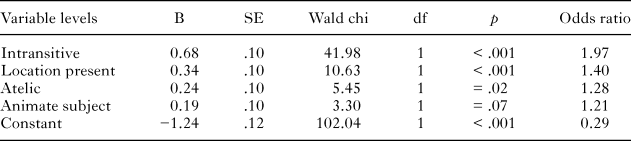
Finally, as location presence was a significant effect in the ANOVA, we investigated its predictive strength relative to the other factors. We conducted a binary logistic regression using telicity, transitivity, subject animacy, and location presence as variables. Table 4 lists the variables in order from most to least predictive of the choice of imperfective aspect; the table lists the level of each variable that leads to increased imperfective responding. As can be seen, transitivity was the strongest predictor, followed by location presence, telicity, and subject animacy.
The results from the binary logistic regression on the data from Experiment 2. Positive beta weights indicate that the level of the factor listed increased the rate at which participants chose the imperfective form
3.3. discussion
Experiment 2 replicated the primary results from Experiment 1 with respect to the factors that were motivated through the grammar: as before, telicity, transitivity, and subject animacy all influenced participants’ choice of aspectual form of the verb. In addition, however, this experiment also found that the location presence information influenced participants as well. When location information was presented at the front of the sentence, it did increase participants’ rates of imperfective choices; indeed it was the second strongest predictor of participants’ choices. Interestingly, there were fewer significant interactions among the grammatically motivated cues, suggesting that cue consistency was less potent in this study.
The finding with location information is consistent with Ferretti et al. (Reference Ferretti, Kutas and McRae2007), but strongly suggests that the backgrounding function of the imperfective is a critical part of location’s influence. Indeed, if backgrounding is taken to be the key mediator, these results provide a sort of mirror image to those of Ferretti et al. (Reference Ferretti, Kutas and McRae2007). In both cases, participants are provided with a strong cue to backgrounding and then use that cue for later interpretation and choice. In Ferretti et al.’s work, the cue was the presence of the imperfective and this cue licensed an expectation for location information (location being a prime piece of background information); in Experiment 2, the cue was fronted location information and this cue licensed the choice of imperfective aspect. Interestingly, it appears that the mere presence of a relevant location is not, in and of itself, a good cue for backgrounding. The importance of order of mention in constructing discourse models will be raised in the ‘General discussion’ (see Gernsbacher, Reference Gernsbacher1990, Reference Gernsbacher1997).
4. Experiment 3
In the previous experiment, the method for encouraging a backgrounded reading on the sentence was to front the location phrase. Experiment 3 asks if another kind of contextual cue would work. The sentences in this study all began with the standard fairy tale formula phrase, Once upon a time. The inclusion of this phrase allows us to see if any sort of narrative context can encourage backgrounding; moreover, we can also further test the connection between location information, backgrounding, and the imperfective. Across participants, both fronted and non-fronted location information were included in this study. If the formulaic phrase is sufficient to create a general narrative background, then we not only expect it to promote higher rates of imperfective choices overall, but we may also find that imperfective choices are preferred in the presence of location information regardless of the position of that location information. On the current analysis, the reason that Ferretti et al. (Reference Ferretti, Kutas and McRae2007) found that adults expect location information at the end of a sentence was because it was in the context of backgrounding; if the formulaic phrase establishes the background function, it should promote the expectation for location information, and when that information is present, it should reinforce the backgrounded interpretation, ultimately creating a stronger cue for the imperfective choice.
4.1. methods
4.1.1. Participants
Sixty-four native English-speaking undergraduate students participated and received partial course credit. An additional twenty-one participants were excluded because they were not native speakers of English (15), or did not complete all the trials (6). None of the participants in this experiment had been in either of the previous experiments.
4.1.2. Stimuli
The stimuli used in this experiment were identical to those in Experiments 1 and 2, except that all sentences were prefaced with the phrase Once upon a time. The location of the location phrase in the sentence (at the end, as in Experiment 1 vs. at the front, as in Experiment 2) was varied between subjects. Thus, when participants saw a location phrase, it was always in the same position in the sentence.
4.1.3. Procedure
The procedure was identical to that used in Experiments 1 and 2.
4.2. results
The dependent variable in all analyses was again the proportion of imperfective verb choices (the was v-ing form of the verb). As with the previous experiments, there was an overall preference for choosing the perfective form, with participants favoring it 69.1% of the time (t(63) = 5.79, p < .01). The formulaic narrative introduction, therefore, did not lead to a general increase in imperfective responding; indeed, the overall preference for the perfective form is not significantly different than what was found in the previous two experiments (F(2,130) = 1.28, n.s.). The mean rate of imperfective responding for each type of sentence is shown in Table 5.
Mean rate (SD) of imperfective choices for each level of each factor in Experiment three. The factors in the rows were all within-subjects while the two columns show the between-subjects variable. There was no significant effect for the position of the location phrase. Asterisks indicate that a particular level led to significantly increased rates of imperfective choices relative to the other level of that factor. All sentences began with the formulaic introduction, Once upon a time
An ANOVA was conducted with the four binary features defining the sentences as within-subjects independent variables: telicity (2) × transitivity (2) × subject animacy (2) × location presence (2); the factor of position of the locative phrase (2) was a between-subjects independent variable. Please note that the between-subjects variable of locative position collapses across cases in which the locative phrase is both present and absent: all participants saw a locative phrase in half of their sentences and each participant always saw the locative phrases in the same position; a participant in the fronted-locative group was one who received the locative phrases, when they appeared, in the fronted position.
Main effects were found for transitivity and subject animacy, but not for telicity. Participants selected the imperfective form more for intransitive sentences than transitive ones (F(1,62) = 24.98, MSE = .071, p < .01; by items: F 2(1,80) = 13.60, MSE = .025, p < .01), and also for sentences containing animate subjects over those containing inanimate subject (F(1,62) = 5.26, MSE = .053, p = < .05). However, unlike the previous two experiments, they selected the two forms approximately equally with both telic and atelic sentences (F(1,62) = .726, n.s). Moreover, there were no significant interactions involving any of these factors.
There was no main effect for location presence (F(1,62) = 1.32, n.s.), nor for the position of the locative phrase (F(1,62) = 0.17, n.s). There was, however, an interaction between the two factors (F(1,62) = 3,84, MSE = .117, p = .055; by items: F 2(1,80) = 7.50, MSE = .011, p < .01). This interaction essentially replicated the findings from the first two experiments: the presence of locative information led to increased imperfective choices only when it was seen in the fronted position. There were no interactions between either of the location factors and any of the other factors.
Finally, we conducted a binary logistic regression using telicity, transitivity, subject animacy, location presence, and location position as variables. Table 6 lists the variables in order from most to least predictive of the choice of imperfective aspect; the table lists the level of each variable that leads to increased imperfective responding. Similar to the ANOVA, transitivity and subject animacy were significant predictors and the remaining factors were not significant as independent predictors.
The results from the binary logistic regression on the data from Experiment 3. Positive beta weights indicate that the level of the factor listed increased the rate at which participants chose the imperfective form
4.3. discussion
This experiment generally replicated the main findings of the previous two experiments: participants’ choice of aspectual form was guided by the grammatically based factors of transitivity and subject animacy; in addition, the presence of location information also guided choice, but only when it was presented in the fronted position. Moreover, there were no interaction effects among the grammatically motivated factors, contra the previous experiments (especially Experiment 1). We had suggested in Experiment 1 that this effect reflected an added value in having cue consistency within the sentences, but that value was reduced in Experiment 2 (when location information was fronted), and here was totally eliminated. As we had no a priori predictions regarding the potency of cue consistency, we have no strong explanation regarding its change across these studies. Future work should investigate whether such consistency effects are just weak overall or whether integrating location information as a cue interferes with participants’ ability to connect the grammatically motivated cues.
One general prediction that was not borne out was the idea that a formulaic narrative introduction would provide a context that supported a backgrounded interpretation overall. Indeed, the reverse appeared to be true: participants were somewhat less likely to choose the imperfective aspect in the presence of the Once upon a time introduction than when it had been absent. Another unexpected consequence of using the formulaic introduction is that it appeared to make the task somewhat less sensitive overall: unlike the previous two experiments, participants in this study did not use telicity to guide their choices, nor did they show any increases when multiple grammatical factors reinforced each other.
In retrospect, the choice of formulaic introduction was perhaps not ideal. Although it is a quite common way to begin stories, the specific terms used (especially once) may actually have lead readers to expect that a single, specific event was about to be described. Such an expectation is more consonant with a foregrounded interpretation that might reinforce the overall preference for choosing the perfective aspect. Nevertheless, even with this introduction present, the fronting of location information was still able to promote imperfective choices. These results suggest that there is a great deal more to investigate in the realm of narrative introductions, but more generally the results replicate and reinforce the findings from the first two experiments.
5. General discussion
When people read sentences, what kinds of information guide their interpretations and are readily encoded in their semantic models? Looking at what factors guide the choice of one particular piece of language – grammatical aspect – we found that participants were influenced by elements that were directly tied to the semantic representations of grammatical aspect or could be connected to those representations from linguistically motivated inferences. Participants were also influenced by factors tied to the discourse narrative functions of grammatical aspect. Specifically, we found that participants’ choice of imperfective vs. perfective aspectual forms was influenced by telicity, transitivity, and subject animacy. In addition, contra Ferretti et al. (Reference Ferretti, Kutas and McRae2007), participants were not generally influenced by the presence of relevant location information, but they were when that location information clearly contributed to the narrative function of backgrounding.
The success of grammatically motivated elements in guiding aspectual choice is not particularly surprising as it builds on a large body of work showing that adults know the semantics involved and use it in a variety of tasks (e.g., Madden & Zwaan, Reference Madden and Zwaan2003; Morrow, Reference Morrow1990; Wagner, Reference Wagner2009; Yap et al., Reference Yap, Chu, Yiu, Wong and Kwan2009.). The particular method used here was somewhat different than methods used previously – it tapped not only comprehension, but possibly also production abilities, as well as a potentially metalinguistic process of consistency matching. The fact that this method replicated established results linking grammatically motivated elements to aspectual forms provides critical validation that this methodological innovation does indeed tap into the linguistic system in sensible ways.
A corpus analysis of these grammatically motivated factors found that only one of the three factors tested − telicity − showed a frequency pattern of usage in the language that paralleled the predicted result patterns: among the language people regularly hear, telic predicates are significantly more likely to be in the perfective aspect than atelic predicates. Interestingly, telicity was one of the weaker influences in these studies, and did not rise to the level of significance in Experiment 3, although it was a significant influence on aspectual choice in the first two experiments. Instead, the other two grammatically motivated factors – transitivity and subject animacy – were significant influences throughout these studies, despite the fact that their values were not linked to aspectual forms in the corpus. This loose correspondence between the frequency data and the experimental choice data highlights the fact that we cannot account for the current data by any simple appeal to ‘what people hear’.
The results with location information are also quite difficult to link directly to frequencies in the input. Although we did not collect such frequency data here, the fact that the relative cue strength of location information depends on its position within the sentence points to the importance of considering how grammatical aspect and location information contribute to structuring discourse. The lack of a semantic connection between grammatical aspect and location accounts for the null effect in Experiment 1: there is no general linguistic connection between those two items. However, the fact that both grammatical aspect and location information are connected to the same discourse function − specifically, both location information and imperfective aspect contribute to backgrounding an event in a narrative discourse – creates a secondary connection between those two items.
These results further suggest that imperfective aspect and location information may contribute to backgrounding in different ways. Such a difference would not be particularly surprising as the two mean quite different things. The results from Ferretti et al. (Reference Ferretti, Kutas and McRae2007) showed that imperfective aspect leads to a preference for related location information, but when we reversed the contingency in Experiment 1 and asked if the presence of related location information led to a preference for imperfectivity, it did not. This pair of results suggests that imperfective aspect may be a more powerful cue to backgrounding than location information, which is very much in line with theories that define foregrounding and backgrounding in terms of how they do (or do not) advance events along a timeline (e.g., Hopper & Thompson, Reference Hopper and Thompson1980; Smith, Reference Smith1991). The fronting of the location information, however, creates a different general construction, one that is itself linked to the discourse function of backgrounding, and therefore one that encourages the choice of other backgrounding elements such as imperfective aspect.
Why is a fronted location phrase a good cue to backgrounding? We motivated the analysis through our intuitions of how that construction is used in children’s stories and formal investigations of the structure of such stories (Hasan, Reference Hasan1984). In addition, initially presented information appears to have a strong impact on readers’ representations more generally. Gernsbacher’s structure building framework (Gernsbacher, Reference Gernsbacher1990, Reference Gernsbacher1997) argues explicitly that readers lay the foundation of their discourse model with the first information they are given, and therefore models are highly influenced by the order in which information is received. Even when given a single sentence, participants are influenced by the order in which information is presented, above and beyond the syntactic or semantic roles the information plays. In particular, information mentioned first is more quickly accessed, especially over delays (Kim, Lee, & Gernsbacher, Reference Kim, Lee and Gernsbacher2004). By placing location information at the beginning, its natural tie to the backgrounding function may have been made stronger and more accessible, at least sufficiently to encourage the use of other backgrounding features such as the imperfective. Moreover, structure building is sensitive to the specific information provided: as discovered in Experiment 3, not all narrative introductions are equivalent. Backgrounding specifically involves setting the stage for other events going forward: location information can play that functional role but a generic opening phrase does not necessarily imply the same function.
This pattern of results highlights the fact that situation models are not necessarily models of how we construct meaning in general, but are models of how we construct it in a discourse setting. Many studies examining situation models are quite explicit on this point and use connected discourse as the domain of interpretation (e.g., Carreiras et al., Reference Carreiras, Carriedo, Alonso and Fernandez1997; Magliano & Schleich, Reference Magliano and Schleich2000; Zwaan, Reference Zwaan2008). The current results suggest that, even with isolated sentences, participants are using discourse-relevant cues for their interpretations. In understanding how specific semantic elements assist in constructing mental models, therefore, it is critical that we consider not only the linguistic semantic contribution of those elements, but also their functional roles within discourses. We note, however, that these discourse functional roles are themselves motivated from the semantic representation of their meaning.
We do not mean to suggest through this work that real world knowledge does not interact with our construction of semantic models. The point of understanding language is to understand what it means in context, and associations and real world implications are clearly an important part of how we make sense of the world. But when we consider the building blocks that allow us to construct these meanings, particularly when these blocks are abstract in nature, it is important that we know what these blocks do and do not contribute to the model. The semantic representation of grammatical aspect is abstract, but it is also specific. By focusing on the specific meaning that it has, we are better able to understand what it does when people interpret language in context.