More than 60 years ago, Angus Campbell offered an explanation for why the president’s party regularly loses congressional seats in midterm elections. He argued that peripheral voters “surge” to the polls in presidential elections and support the president’s congressional co-partisans but “decline” to turn out in the midterm. Campbell’s surge and decline theory is part of long line of research on coattail effects that explains outcomes in concurrent elections (Broockman Reference Broockman2009; Erikson, Folke, and Snyder Reference Erikson, Folke and Snyder2015; Hogan Reference Hogan2005; Key Reference Key1964; Meredith Reference Meredith2013; Miller Reference Miller1955) and helped spur a rich debate concerning the puzzle of midterm loss (Alesina and Rosenthal Reference Alesina and Rosenthal1989; Erikson Reference Erikson1988; Kernell Reference Kernell1977; Tufte Reference Tufte1975).
Voters’ decisions are central to each the surge and decline and alternative explanations of midterm loss, but a key distinction between these explanations is the extent to which midterm loss is attributable to a voter’s decision to turn out at the polls. In empirical tests of surge and decline theory, political scientists often assume that turnout depends on whether an election is a high-stimulus presidential contest or a low-stimulus congressional midterm election (Campbell Reference Campbell1985; Denardo Reference Denardo1987; Erikson Reference Erikson1988). Presidential and midterm elections, however, differ along many confounding dimensions, which limits direct comparisons between these contests. To evade the inferential difficulties that existing studies encounter, I offer a new test of Campbell’s theory. Instead of comparing presidential and midterm elections to capture differences in turnout, I used an identification strategy that employs an exogenous source of variation in the cost of voting. I found that when voting is more costly—during rainstorms—presidential candidates’ coattails shorten. This result suggests that midterm loss and the sizes of congressional majorities are partly attributable to certain voters surging to the polls in presidential contests.
MIDTERM LOSS, COATTAILS, AND RAINCOATS
To explain midterm loss, Campbell (Reference Campbell1960) argued that different types of voters turn out in presidential and midterm elections, ultimately influencing the outcomes in down-ballot, US House elections (Campbell Reference Campbell1985; Mattei and Glasgow Reference Mattei and Glasgow2005). In high-stimulus presidential elections, winning presidential candidates draw a surge of support for their congressional co-partisans from peripheral voters. In low-stimulus congressional midterm elections, peripheral voter turnout declines, leading to results that more closely conform to the normal vote or underlying partisanship of the electorate (Campbell Reference Campbell1960, 399–400). Because voters’ partisanship and political interest remain relatively stable, surge and decline explanations of election outcomes hinge on who turns out to vote.
Other theories focus on how voters cast their ballots to explain midterm loss. Tufte (Reference Tufte1975) characterized congressional elections as a “referendum” on the president in which “voters reward or punish the party of the president by casting their votes for representatives in line with their perceptions and evaluations of the president” (Abramowitz, Cover, and Norpoth Reference Abramowitz, Cover and Norpoth1986; Cover Reference Cover1985; Kernell Reference Kernell1977; Tufte Reference Tufte1975, 826). Alesina and Rosenthal (Reference Alesina and Rosenthal1989) asserted that voters who prefer divided government use midterm elections to “balance” the executive and legislative branches by voting for the president’s opposition in Congress (see also Bailey and Fullmer Reference Bailey and Fullmer2011; Fiorina Reference Fiorina1996; Scheve and Tomz Reference Scheve and Tomz1999).
A critical distinction between “surge and decline” and “referendum” or “balancing” is whether midterm loss is attributable to certain individuals deciding to turn out to vote versus their decision-making process when casting their ballot. Disentangling the electoral effects of turnout versus candidate-choice decisions is difficult because the socioeconomic and institutional variables that typically explain voters’ turnout also explain how voters vote (Blais Reference Blais2006). Individuals’ incomes, for example, influence voters’ propensity to go to the polls as well as how they cast their ballots. Thus, to evaluate predictions regarding coattails outside of comparisons of presidential and midterm elections, it is necessary to identify a variable that influences who wins elections through only its relationship with turnout.
Gomez, Hansford, and Krause (Reference Gomez, Hansford and Krause2007) provided evidence that such an exogenous variable exists. Their county-level analyses of turnout in presidential elections from 1948 to 2000 showed that one inch of rain reduces voter turnout by approximately 0.8%. When discussing turnout, Campbell’s original work (1960, 399) forecasted that “[b]ad weather or an epidemic may affect the vote in restricted areas or even nationally on occasion” but largely dismissed weather’s utility to test his theory. The exogenous costs that rainfall imposes on voting, however, can have an impact on turnout decisions similar to the decreased benefit or stimulus of voting in a midterm election.Footnote 1 Consistent with the assumption that “peripheral” voters are less likely to turn out during a rainstorm, a 2012 survey conducted by The Weather Channel found that 35% of undecided voters stated “bad weather will impact whether they make it to the polls” as compared to 19% of already-decided voters (Boockoff-Bajdek Reference Boockoff-Bajdek2016). Partisan or “core” voters also are more likely to vote in both the presidential and subsequent midterm election. The decline in turnout between presidential and midterm elections is at least 17% among independent voters but only 12% for strong partisans (Keith et al. Reference Keith, Magleby, Nelson, Orr, Westlye and Wolfinger1992, tables 3.4 and 3.5; see also Campbell Reference Campbell1960; Cover Reference Cover1985, table 2). If rainfall keeps peripheral voters from the polls, an Election Day downpour may be bad news for the president’s co-partisans in midterm elections.
To better understand how turnout affects outcomes in concurrent elections, I used rainfall as an exogenous source of variation in the cost of voting in the 14 presidential elections from 1948 to 2000.
To better understand how turnout affects outcomes in concurrent elections, I used rainfall as an exogenous source of variation in the cost of voting in the 14 presidential elections from 1948 to 2000. Similar to Campbell, I expected a party’s congressional candidates’ vote shares to surge in areas where their presidential nominee receives a greater percentage of the vote. However, if peripheral voters are less likely to turn out as the cost of voting increases, the strength of the relationship between presidential and congressional vote share should decline or weaken in areas where it rains more heavily than normal and instead resemble the partisan preferences of “core” voters.
To test these hypotheses, I evaluated how the relationship between congressional and presidential votes varies depending on the levels of rainfall.Footnote 2 My dependent variable was county-level vote share received by Republican US House candidates (Clubb, Flanigan, and Zingale Reference Clubb, Flanigan and Zingale2006; ICPSR 2013; Klarner Reference Klarner2012; Lublin and Voss Reference Lublin and Voss2001).Footnote 3 My key independent variables of interest were county-level vote share for the Republican presidential candidate; the difference between Election Day rainfall within a county and average rainfall within a county (labeled “Election Day Rain–Normal Rain”; see Gomez, Hansford, and Krause Reference Gomez, Hansford and Krause2007, 654, for a more detailed description); and an interaction of these measures. I used the difference between Election Day rainfall and average rainfall within a county because some voters may choose to live in drier or wetter climates. The impact of rainfall on turnout, then, is not effectively random, whereas deviations from normal rainfall are. To account for a county’s partisanship or “core” voters, analyses included a measure of the moving average of the Republican presidential vote share within a county over the previous three elections (also referred to as “Normal Vote”).
Analyses also accounted for socioeconomic and institutional sources of variation in election outcomes and voter turnout. These included the percentage of a county that was African American, the percentage of a county that graduated from high school, and the median household income in a county, as well as whether a state had poll taxes, literacy tests, property requirements to vote, and a version of a motor-voter program (see Gomez, Hansford, and Krause Reference Gomez, Hansford and Krause2007 for a more detailed description of variables). Readers should be cognizant that socioeconomic and institutional influences—although not randomly assigned similar to deviations to average rainfall—also could uniquely influence the levels of peripheral voters who participate in elections.Footnote 4
Equation 1:
 $$\eqalign{ & CongressionalVoteShar{e_i} \cr & \,\,\,\,\,\,\,\,\,\,\,\,\,\,\,\,\,\,\,\,\,\,\,\,\,\,\,\,\,\,\,\, = {\beta _1}\left {Presidential\,Vot{e_i}} \right + {\beta _2}Normal\,Vot{e_i} \cr & \,\,\,\,\,\,\,\,\,\,\,\,\,\,\,\,\,\,\,\,\,\,\,\,\,\,\,\,\,\,\,\, + {\beta _3}\left {{{\left( {Election\,Day\,Rain - Normal\,Rain} \right)}_i}} \right \cr & \,\,\,\,\,\,\,\,\,\,\,\,\,\,\,\,\,\,\,\,\,\,\,\,\,\,\,\,\,\,\,\, + {\beta _4}\left[{Presidential\,Vot{e_i} \times {{\left( {Election\,Day\,Rain - Normal\,Rain} \right)}_i}} \right \cr & \,\,\,\,\,\,\,\,\,\,\,\,\,\,\,\,\,\,\,\,\,\,\,\,\,\,\,\,\,\,\,\, + {\beta _5}\left {Normal\,Vot{e_i} \times {{\left( {Election\,Day\,Rain - Normal\,Rain} \right)}_i}} \right \cr & \,\,\,\,\,\,\,\,\,\,\,\,\,\,\,\,\,\,\,\,\,\,\,\,\,\,\,\,\,\,\,\, + {\beta _{6 - 12}}[Socioeconomic\,and\,Voting\,Law\,Controls] + {\delta _{t[i]}} + {\alpha _{k[i]}} + { \in _\iota } \cr}$$
 $$where\,\alpha \simN\left( {{\mu _\alpha },\sigma _\alpha ^2} \right)$$
I estimated the relationship between presidential and congressional voting using a linear cross-sectional model with fixed effects for years  $({\delta _t})$ and random effects for counties
 $({\alpha _k})$, as specified in equation 1. To facilitate interpretations of interactive effects and reduce incidence of multicollinearity, all predictors are mean-centered (Aiken and West Reference Aiken and West1991, 32–33; Brambor, Clark, and Golder Reference Brambor, Clark and Golder2006). A positive relationship between presidential and congressional vote (
 ${\beta _1}$) suggests that presidential candidates have coattails that congressional candidates ride in presidential elections. To support the hypothesis that the lengths of coattails are partly attributable to those who surge to the polls when the net costs of voting are lower (e.g., on a day with normal rainfall), the coefficient on the “Presidential Vote x (Election Day Rain–Normal Rain)”
 $({\beta _4})$ should be less than zero. When there is above-average rainfall, I expected peripheral voters to be more likely to stay home, and congressional election results instead should be more influenced by the underlying partisanship of a county, as reflected by a positive coefficient on the interaction of “Normal Vote” and “Election Day Rain–Normal Rain”
 $({\beta _5})$.
My analyses provided a new test of surge and decline theory but have limitations common to existing studies about the impact of coattails and weather on elections. Using aggregated election results to study individual voter behavior subjects my analyses to ecological inference problems (Burden and Kimball Reference Burden and Kimball1998; Cho and Gaines Reference Cho and Gaines2004; Kramer Reference Kramer1983) similar to other studies of weather and voting behavior (Fowler Reference Fowler2015; Fraga and Hersch Reference Fraga and Hersh2011; Gomez, Hansford, and Krause Reference Gomez, Hansford and Krause2007). I additionally studied congressional elections at the county-level rather than the district-level due to a lack of a measure of “core” voters that is independent from traditional measures of “peripheral voters.” Counties, however, may include multiple congressional districts, which makes it more difficult to account for factors known to impact congressional vote totals (e.g., whether a contest had two major-party candidates or featured an incumbent). I therefore excluded counties in which one of the major political parties received the entire congressional vote and there was greater than a 10% difference in the raw number of votes cast in the presidential and congressional contests within a county. To account more directly for uncontested races and factors unique to specific races (e.g., incumbency), the online appendix provides comparable analyses using congressional districts.
RESULTS
Similar to previous estimates of coattail effects (Calvert and Ferejohn Reference Calvert and Ferejohn1983; Ferejohn and Calvert Reference Ferejohn and Calvert1984; Mondak Reference Mondak1993), statistical analyses in the first column of table 1 suggest that a 1% increase in support for a presidential candidate in a county results in an approximate 0.5% predicted gain in vote share for that candidate’s congressional co-partisans. A comparable 1% increase in district partisanship also results in an approximate 0.5% shift in congressional vote share.
With this identification strategy, I showed that the strength of the relationship between presidential and congressional election outcomes decreases when the costs of voting are higher on Election Day due to a rainstorm.
Relationship between Congressional and Presidential Votes Conditional on Deviation from Normal Rainfall
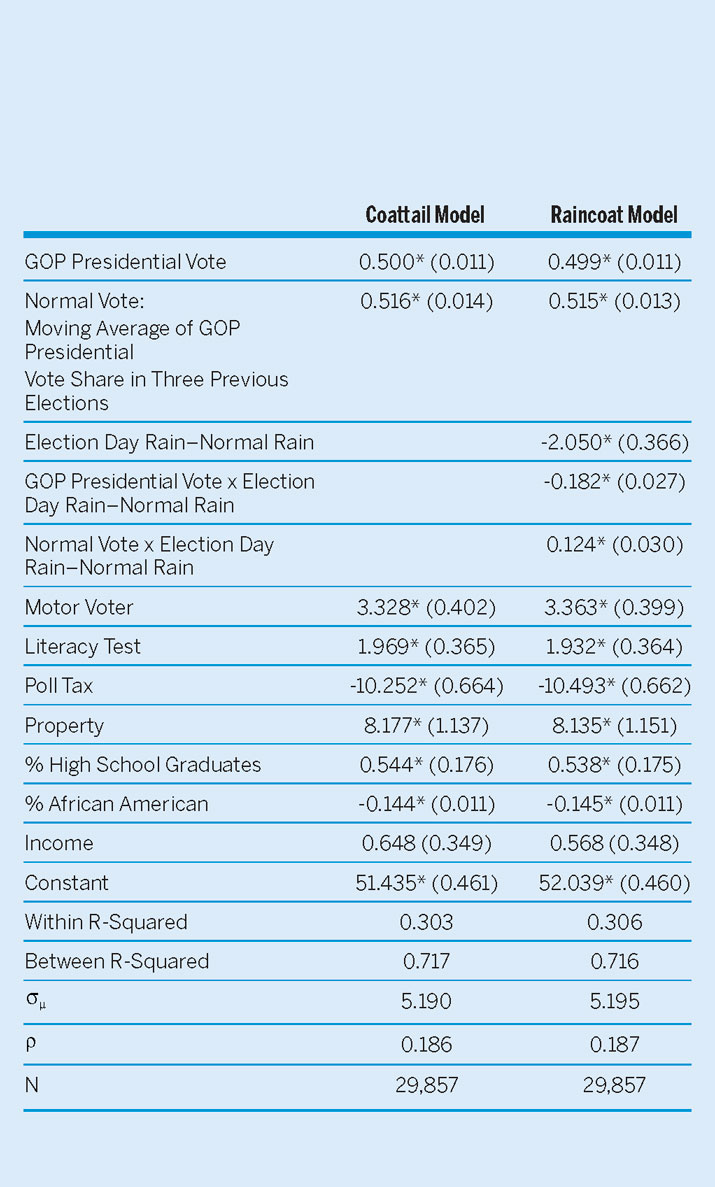
Notes: Estimations include fixed effects for years and random effects for counties. Robust standard errors are in parentheses. *p<0.05.
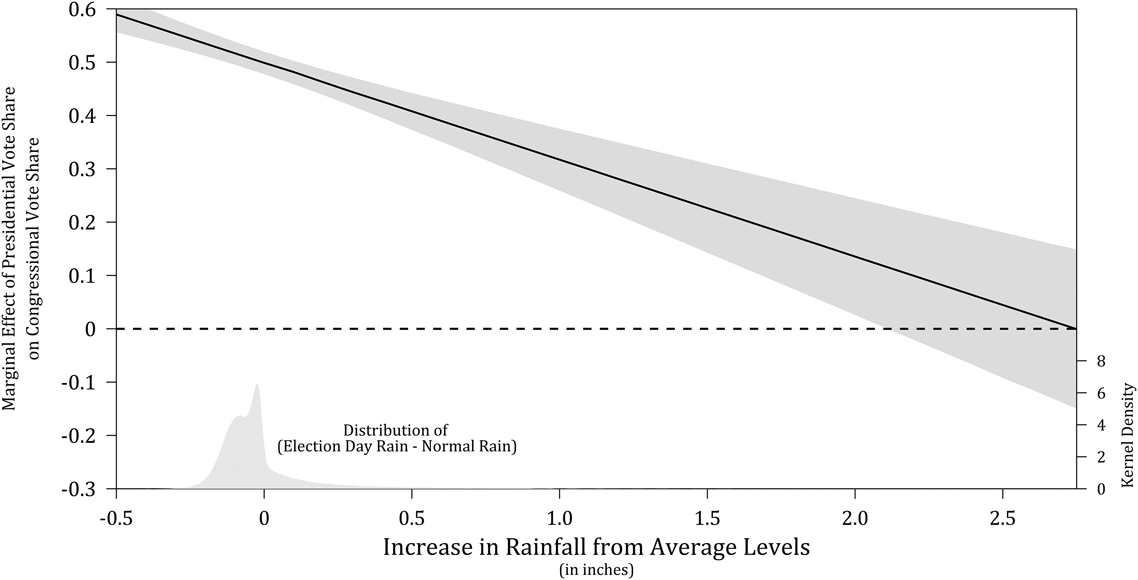
Statistical analyses in the second column of table 1 account for deviations from average rainfall within a county on Election Day and suggest that presidential candidates’ coattails shorten during a storm. Consistent with the surge and decline account of midterm loss, the negative coefficient on “Election Day Rain–Normal Rain x Presidential Vote” serves as evidence that when it rains, congressional vote has a weaker relationship with presidential vote in the concurrent election. Meanwhile, the positive coefficient on the “Election Day Rain–Normal Rain x Normal Vote” measure indicates that there is a stronger relationship between the “normal” vote and congressional election outcomes in counties that experience wetter than normal weather on Election Day. To illustrate the magnitude of these conditional effects, figure 1 plots the marginal effect that presidential vote has on congressional vote under different levels of the “Election Day Rain–Normal Rain” measure. When a county has average levels of rainfall on Election Day (see figure 1: X-Axis, 0 point), a 1% increase in Republican presidential vote results in a 0.499% increase in Republican congressional vote.Footnote 5 However, when it rains approximately 0.21 inch or a standard deviation more than normal, a 1% increase in Republican presidential vote results in only a 0.461% increase in Republican congressional vote, which indicates that the relationship between presidential vote and congressional vote decreases as deviation from average rainfall increases.
Marginal Effect of Presidential Vote Share on Congressional Vote Share
Plot of the marginal effect that presidential vote share has on congressional vote share under different levels of rainfall, as measured by the “Election Day Rain–Normal Rain” variable. The light-gray region is the kernel density of this rainfall measure, and the dark-gray regions are 95% confidence intervals for the marginal effects.

Presidential candidates then appear to need a raincoat for their congressional co-partisans to fully ride their coattails, but readers should be cognizant that it would take a torrential downpour to eliminate coattail effects altogether. The light-gray region at the bottom of figure 1 illustrates the kernel density of the “Election Day Rain–Normal Rain” measure. It rained 0.21 inch more than normal on Election Day in fewer than 10% of cases. It also would take more than 2 inches of above-average rainfall to completely wash out the coattail effect, which rarely happens.
DISCUSSION
When responding to Campbell’s (Reference Campbell1960) original work concerning why the president’s party regularly loses congressional seats in the midterm election, some claimed that “[t]he coattail explanation requires that short-term forces return to normal at midterm. Only with a dampening of short-term forces at midterm (e.g., to reflect the normal vote and nothing else) would a coattail-driven surge in the presidential year guarantee a midterm loss” (Erikson Reference Erikson2010, 5). Instead of the midterm election, I employed rainfall to provide the necessary “dampening” to test “surge and decline” during the presidential year. With this identification strategy, I showed that the strength of the relationship between presidential and congressional election outcomes decreases when the costs of voting are higher on Election Day due to a rainstorm.
These analyses provide evidence for Campbell’s turnout-based explanation of midterm loss, but it is important to be cognizant of ecological inference problems that arise when using aggregated observational data to study individual voting behavior. To overcome these shortcomings, I encourage future work to build on causal studies of coattails (Godbout Reference Godbout2013; Meredith Reference Meredith2013) and combine meteorological and survey data to better identify how rain affects the turnout behavior of particular voters with varying levels of political interest or partisanship. Furthermore, findings concerning voter turnout matter for policy only to the extent that they explain which candidates win elections. A president’s coattails, for example, affect the extent to which he or she has allies in Congress, and if the president wants to have a more successful first hundred days in office, the findings presented here suggest some of his or her peripheral supporters need umbrellas on Election Day.
SUPPLEMENTARY MATERIAL
To view supplementary material for this article, please visit https://doi.org/10.1017/S1049096518002135