


Students with learning disabilities (LD) are among the groups with special needs that school counsellors may frequently encounter in the school environment (Bell, Reference Bell2012). Because students with LD make up 38% of the population of school-age students with special needs (U.S. Department of Education, 2017) and 5–15% of the general population (American Psychiatric Association [APA], 2013), the academic, social and behavioural characteristics of students with LD may require greater support from school counsellors. On the other hand, lack of such an awareness on the part of school counsellors may prevent them from contributing to the academic, career and personal-social development of students with LD (Reis & Colbert, Reference Reis and Colbert2004). Accordingly, the aim of the present study was to investigate the impact of a training course on LD provided to school counsellors at a university in Turkey on their attitudes towards the students with LD.
Characteristics of Students With LD
Various academic failures and behavioural problems experienced by students with LD can be primary reasons for their referral to school counsellors (Thompson & Littrell, Reference Thompson and Littrell1998). It has been found that students with LD may generally experience difficulties in learning the fundamental academic skills such as reading, writing and mathematics (Büttner & Hasselhorn, Reference Büttner and Hasselhorn2011). Reading skill is among the leading academic areas (80%) in which students with LD experience difficulties (Gersten et al., Reference Gersten, Fuchs, Williams and Baker2001). Indeed, longitudinal studies have found that students with LD display lower performance compared with their typically developing peers in the acquisition of the reading skill that continues in the later years of school life (McNamara et al., Reference McNamara, Scissons and Gutknecth2011; Quinn et al., Reference Quinn, Wagner, Petscher, Roberts, Menzel and Schatschneider2020). Moreover, there is a general consensus that students with LD experience greater difficulties in acquiring the skills of writing compared with their peers (Graham et al., Reference Graham, Harris, McKeown, Swanson, Harris and Graham2013). As an example, Graham et al. (Reference Graham, Collins and Rigby-Wills2017) carried out a meta-analysis that reported that students with LD receive lower scores in writing skills compared with their peers. Similarly, it has also been observed in other studies that students with LD display lower performance in mathematics skill compared to their typically developing peers, which also continues in future school processes (Desoete et al., Reference Desoete, Ceulemans, De Weerdt and Pieters2012; Mazzocco & Thompson, Reference Mazzocco and Thompson2005).
In addition to weaker academic skills, it has also been found that students with LD experience difficulties with their sense of self and their self-competency perceptions (Dadandı & Şahin, Reference Dadandı and Şahin2018; Lackaye et al., Reference Lackaye, Margalit, Ziv and Ziman2006; Vukman et al., Reference Vukman, Lorger and Schmidt2018). For example, Lackaye et al. (Reference Lackaye, Margalit, Ziv and Ziman2006) determined that students with LD have lower academic and social self-competence. It has also been reported that students with LD have more negative moods and that they put in less effort in academic studies compared with typically developing peers. These difficulties are followed by the insufficiency of social skills of students with LD (Estell et al., Reference Estell, Jones, Pearl, Van Acker, Farmer and Rodkin2008; Kavale & Mostert, Reference Kavale and Mostert2004). It has been determined that 75% of students with LD lack social skills that will enable them to develop healthy social relations with their parents, teachers and peers (Kavale & Forness, Reference Kavale and Forness1996). Similarly, it was also concluded in previous studies that students with LD are less successful in being part of a group of friends and being accepted by their peers when compared with their typically developing peers (Fırat, Reference Fırat2020; Schmidt et al., Reference Schmidt, Prah and Čagran2014; Schwab, Reference Schwab2019; Yu et al., Reference Yu, Zhang and Yan2005).
Various behavioural (McKinney, Reference McKinney1989; Metsala et al., Reference Metsala, Galway, Ishaik and Barton2017; Yu et al., Reference Yu, Buka, McCormick, Fitzmaurice and Indurkhya2006) and mental disorders (Bender & Golden, Reference Bender and Golden1990; Mammarella et al., Reference Mammarella, Ghisi, Bomba, Bottesi, Caviola, Broggi and Nacinovich2016; Margari et al., Reference Margari, Buttiglione, Craig, Cristella, de Giambattista, Matera and Simone2013; Nelson & Harwood, Reference Nelson and Harwood2011) may also be observed in students with LD. Gallegos et al. (Reference Gallegos, Langley and Villegas2012) found that a greater percentage of students with LD are at risk of anxiety (22.3% vs. 11.5%) and depression (32% vs. 18%) compared with their typically developing peers. It was reported in recent studies that about 50% of students with LD have attention deficit and hyperactivity disorder (Çakıroğlu, Reference Çakıroğlu, Melekoğlu and Sak2017a). In addition, problems such as substance abuse, suicide and abuse may be encountered more frequently in students with LD (Bender et al., Reference Bender, Rosenkrans and Crane1999; Margari et al., Reference Margari, Buttiglione, Craig, Cristella, de Giambattista, Matera and Simone2013; Romano, Reference Romano2006).
The fact that students with LD are frequently subjected to peer bullying is encountered as another problem in school environments (Denault, Reference Denault, Nicholas, Christine and Teresa2018). As an example, Carlson et al. (Reference Carlson, Flannery and Kral2005) determined that the number of cases in which students with LD are subject to peer bullying is greater at a significant level compared with the number of cases of typically developing students. Moreover, it has been shown that the lack of protective factors such as school counsellors and number of friends are correlated negatively with the reported increase in aggrievement and bullying behaviours (Carlson et al., Reference Carlson, Flannery and Kral2005). All these negativities may result in higher ratios of school drop-out (Kortering & Christenson, Reference Kortering and Christenson2009; Thurlow et al., Reference Thurlow, Sinclair and Johnson2002), meaning that these students are unable to complete their education. Indeed, it has been found that the number of students with LD who are able to start a university education is very low (Cortiella & Horowitz Reference Cortiella and Horowitz2014; Murray et al., Reference Murray, Goldstein, Nourse and Edgar2000). Aro et al. (Reference Aro, Eklund, Eloranta, Närhi, Korhonen and Ahonen2019) determined that a higher proportion of individuals with LD had mental health problems compared to individuals without LD, and a notable share of them had not attained a degree after compulsory education and had been unemployed for an extended period.
As can be seen, students with LD struggle in many areas in the school environment, including academic, emotional and behavioural aspects. However, students with LD may also have strengths. Indeed, some may even be exceptional children (see Bildiren & Fırat, Reference Bildiren and Fırat2020; Reis et al., Reference Reis, Baum and Burke2014). These students are gifted individuals with LD. Although some of their characteristics result in them being seen as gifted, other characteristics are regarded as LD (Baum, Reference Baum1990; Maddocks, Reference Maddocks2018; Ruban, Reference Ruban2005). Failure to properly identify these students and the inability to provide a proper education to these individuals may emerge as another problem (see Bildiren & Fırat, Reference Bildiren and Fırat2020). Determining the strengths and weaknesses of these students and providing the required educational and social support to these areas are of significant importance. All these negative factors make it necessary for professionals working with students with LD to have sufficient knowledge about these students as well as the required positive attitudes towards them.
The School Counsellor’s Role
In Turkey, school counsellors have important responsibilities for the education and training process of students with LD, including: (a) planning and conducting family education for the families of students in need of special education, as well as cooperating with related people, institutions and organisations when necessary; (b) cooperating with the Individualised Education Plan (IEP) Development Department, teachers and related staff members in the preparation of forms for evaluating the individual development of students in need of special education; (c) cooperating with teachers and families in preparing individual development reports; and (d) collaborating with the Guidance and Counselling Services Commission, IEP Development Department, Monitoring and Guiding Board, as well as teachers, in meeting the special education needs of these children (Ministry of National Education in Turkey [MoNE], 2012). As recommended by the American School Counseling Association (ASCA; 2010), school counsellors: (1) collaborate with special education staff regarding students with disabilities; (2) act as an advocate for students with special needs; (3) consult with support staff to best meet the unique needs of each student. In this context, it can be stated that there is a requirement for school counsellors to be cooperative, leading, informative, supportive and advising (ASCA, 2003).
Durodoye et al. (Reference Durodoye, Combes and Bryant2004) indicated that school counsellors provide guidance to students with LD on personal, social and academic subjects. In this context, school counsellors have important duties with regard to the planning of the transition processes for students with LD (e.g., from high school to university) and providing them the required information (Milsom & Hartley, Reference Milsom and Hartley2005), because adjusting to change can be particularly difficult for students with LD (Buckley & Mahdavi, Reference Buckley and Mahdavi2018). Moreover, counsellors may play an active role in the career planning and development of students with LD (Kurz, Reference Kurz2015). Similarly, Fiorini (Reference Fiorini2001) defined the duties of school counsellors regarding students with LD as identification and working with multidisciplinary teams, guidance services, career and transition services, and teachers and parents. When school counsellors misinterpret or misunderstand the actions that they should take regarding students with special needs, they may consider the services provided for these students as complex, inconsistent, inappropriate and costly (Romano et al., Reference Romano, Paradise and Green2009).
On the other hand, there is very little information available on the attitudes and previous experiences of school counsellors regarding students with LD (Bell, Reference Bell2012; Fiorini, Reference Fiorini2001). Previous studies have demonstrated that many school counsellors insufficiently meet the needs of students with LD (Fiorini, Reference Fiorini2001; Milsom, Reference Milsom2002; Milsom & Akos, Reference Milsom and Akos2003; Romano et al., Reference Romano, Paradise and Green2009; Tait, Reference Tait2013). For example, Fiorini (Reference Fiorini2001) carried out a study that determined that while school counsellors strive to accomplish their goals with regard to students with LD, they do not have the required education to enable them to do so. Similarly, Romano et al. (Reference Romano, Paradise and Green2009) determined that school counsellors do not feel ready to provide the services that students with LD require, even though they have a strong desire to meet the needs of these students. Moreover, 27% of the participants in Romano et al.’s (Reference Romano, Paradise and Green2009) study indicated that they did not receive any education on working with students with LD.
The Context in Turkey
In Turkey, the graduates of the Guidance and Psychological Counselling program are eligible to work as a school counsellor. Although education in universities to train school counsellors began in the 1960s, these programs did not see the interest expected until the beginning of the 2000s (Ültanır, Reference Ültanır2005). On the other hand, it has been one of the most interesting programs in the last 15 years (Sakız & Sarıçalı, Reference Sakız and Sarıçalı2019). For example, while there were 20 universities to train school counsellor candidates in the early 2000s, today this number has exceeded 100 (see Council of Higher Education, 2021). On the other hand, the Council of Higher Education made various changes in the programs of education faculties in 2018. In line with these changes, school counsellor candidates take compulsory and elective courses listed under three headings: field education, professional knowledge and general culture (Sönmez & Koçyiǧit-Özyiǧit, Reference Sönmez and Koçyiǧit-Özyiǧit2020). In addition, the compulsory, three-hour weekly Learning Disabilities course, which was given in the old program for school counsellor candidates, was reorganised in the new program to be an elective and is only two hours a week.
School counsellors may provide educational, occupational and personal and/or social guidance services to the students within the framework of guidance services in Turkey (MoNE, 2017). These services may take place either individually or as group guidance services. Moreover, school counsellors also provide services such as knowing the individual, application of psychological measurement tools, guidance and placement, psychosocial protection, prevention and crisis intervention, implementation of guidance measures and family guidance services (MoNE, 2017). It is of course expected that students with LD will benefit from these services. It has been emphasised in the studies carried out that there is confusion regarding the roles played by school counsellors in inclusion implementation (Polat, Reference Polat2001; Sakız, Woods et al., Reference Sakız, Woods, Sart, Erşahin, Aftab, Koç and Sarıçam2015). These studies found that the school counsellors’ lack of sufficient knowledge about students with LD poses another problem. Dadandı et al. (Reference Dadandı, Dadandı, Avcı and Şahin2016) determined that school counsellors feel inadequate when working with students with LD. The course on LD given to school counsellor candidates as part of the Guidance and Psychological Counselling departments in Turkey are no longer compulsory following the revisions in the undergraduate programs in 2018. While it was mentioned in studies carried out on students with LD that there are important problems related to their identification and education (Fırat & Koçak, Reference Fırat and Koçak2020; Özmen, Reference Özmen and Diken2008; Sakız, Sart et al., Reference Sakız, Sart, Börkan, Korkmaz and Babür2015), it is considered that school counsellors’ knowledge about students with LD is important for overcoming these problems. In this context, providing information on LD to school counsellor candidates is important for revealing their attitudes on students with LD.
In this regard, the purpose of this study was to determine the change in the perceptions of school counsellor candidates towards students with LD. The study aimed to address the following research questions:
-
1. What are the metaphors that school counsellor candidates use for students with LD prior to the education?
-
2. What are the metaphors that school counsellor candidates use for students with LD after the education they receive?
-
3. How do the metaphors that school counsellor candidates use for students with LD differ before and after the education they receive?
Method
This section focuses on the study pattern, the characteristics of the participants, the structure of the data collection tools, and the methods used for data analysis.
Research Design
This was an experimental study examining the changes in the perceptions of school counsellor candidates towards students with LD following the education they received. The study is also qualitative since it takes into consideration the participants’ metaphors; or, in other words, their opinions towards students with LD. The purpose of such studies is to conduct interviews with individuals who can express themselves in relation to a situation or concept, in order to record and analyse the opinions and experiences of those individuals regarding the situation or concept (Yin, Reference Yin2011).
Participants
The study group was comprised of a total of 51 students in their final year of education in the Counselling and Psychological Guidance Department at a university in southeastern Turkey during the 2018–2019 academic year. Although a total of 61 senior-level students were initially included in the study, data could only be acquired from 51 students, with voluntary participation according to purposive and convenience sampling after eliminating students who could not participate in the two applications due to various reasons, including students who could not provide acceptable answers, and students who did not want to participate. Of the initial cohort of students, 67% were female (n = 34) and 33% were male (n = 17). Participant names were changed to coding note pseudonyms, S1, S2, S3, …, S51, in order to maintain participants’ anonymity and keep their identities secret.
Procedure
The participants responded to an open-ended question. The school counsellor candidates were asked to fill out short forms by completing the following statement: ‘Students with learning disabilities are like … Because …’. The participants were asked to write down a proper metaphor in the first blank and a short sentence in the second blank that briefly described or justified the metaphor that they chose. The students were provided a total of 10 minutes to fill out the form. This form was applied in the same manner both before and after training.
Implementation Process
Following the collection of pretraining data, the participants were subjected to a 12-week training on LD, facilitated by the researcher for three lesson hours (40 + 40 + 40 min) per week. The courses in the education program were applied in two stages every week. The participants were provided information on learning disabilities during the first two course hours (40 + 40 min). During the second stage — that is, during the third course hour — they were asked to think about and develop ideas and carry out discussions on sample cases.
Sample Practice
Implementation week: Seventh week.
Objectives:
-
1. Explain the reasons for the difficulties in reading comprehension.
-
2. Explain the characteristics of students with LD in reading comprehension.
-
3. Explain the support that should be provided to students with LD in reading comprehension.
Sessions: 40 + 40 min
Materials: Suggested books and articles, videos, graphic editors, strategy worksheets
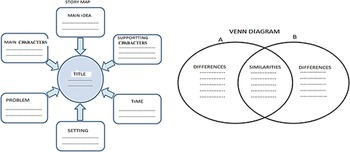
Implementation: The importance of reading comprehension and requirements for successfully understanding what is read was explained, as well as the failures related with reading comprehension. The characteristics of students who experience this difficulty were described, and activities and strategies to help these students was outlined. In addition, it was also shown how graphics as strategies for reading comprehension can be used. Some examples of graphics are shown in Figure 1.
Examples of graphics to use as strategies for reading comprehension.

Session: 40
Materials: Videos, voice records of students with LD.
Implementation: Sample cases were presented during this session and the participants were given the chance to encounter actual problem situations. As an example, the participants were encouraged to provide suggestions by way of questions such as: ‘Ali is a 4th-grade student identified with LD. Even though Ali can read fluently, he has difficulties in reading comprehension. What can be the reasons for why Ali has difficulties in reading comprehension?’ ‘What can be done as a school counsellor for developing the skills of Ali related with reading comprehension?’ The participants were encouraged to provide effective solutions for these problems by way of brainstorming. Moreover, a dramatisation method was used to ensure that the participants internalised the experienced problems.
Data Analysis
Content analysis was used for the analysis of qualitative data in this study, while statistical analyses comparing the pretest-posttest frequencies and percentages were used for the quantitative data. Content analysis is the process of transforming the acquired data into certain categories by way of codes and themes within the scope of a certain system (Yin, Reference Yin2011). Data on the metaphoric perceptions of school counsellor candidates towards students with LD were collected through a short form in this study. Afterwards, the collected metaphors were coded to generate themes as to the level at which the participants considered students with LD as a problem. The frequencies of these themes were then recorded, compared with the pretest-posttest results, and interpreted. The z test for comparing two means was used for two ratios when comparing the pretest-posttest results.
The reliability of the study was examined within the framework of consensus in order to overcome the problem of generalising the results, which is one of the most significant problems facing qualitative studies; thus, a pretest-posttest experimental design was used and the results were compared statistically. The reliability form developed by Miles and Huberman (Reference Miles and Huberman1994) was used for evaluating consensus in this study. According to this formula, the sum of the consensus of two experts (with a doctorate degree in the field of special education) that the classification is in the correct category is divided by the total number of opinions. Using this formula, the pretraining reliability of the study was calculated as 0.84, while the posttraining reliability was 0.92. After all data were recorded and saved, the data were examined and, in order to increase the reliability of the study, the acquired data were supported by interviews carried out during the implementation stage. Additionally, the personal impact of the researchers was minimised as much as possible, and the coding categories were well defined in order to ensure that other researchers could understand the results and potentially replicate the study under similar conditions.
Results
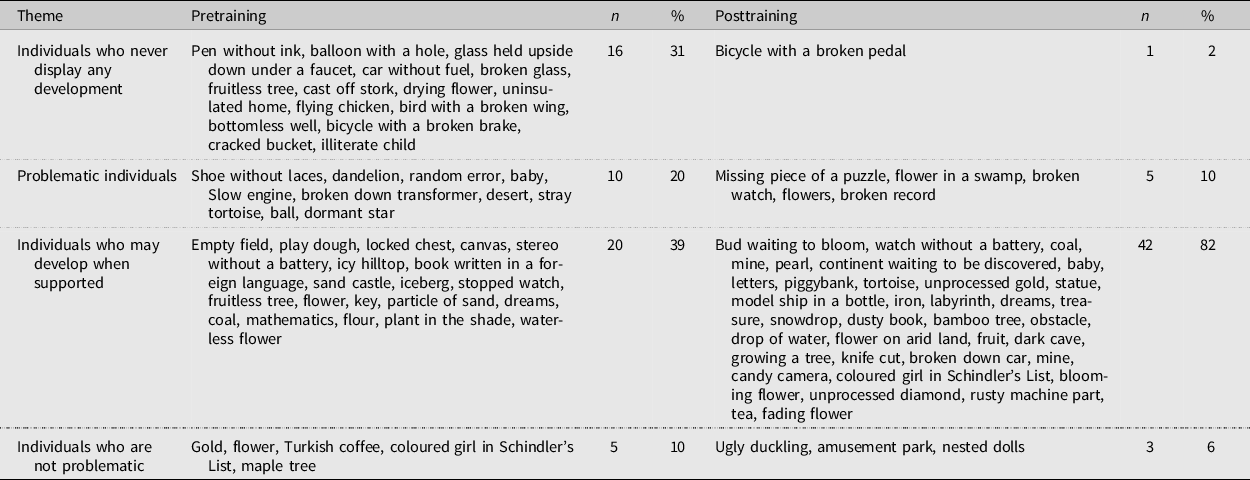
The themes generated during the end of the analyses identified students with LD as persons who never display any development, who are problematic, who may develop when supported, and who are not problematic. Metaphors related to the pre- and posttraining themes are provided in Table 1.
Theme-based metaphors

The study findings were reported separately for each study problem. These findings are provided below in detail.
Pretraining Metaphors Used for Students With LD
Individuals who never display any development
Table 1 illustrates that almost a third of the participants used various metaphors indicating that students with LD may never develop. The metaphors included under this theme, when evaluated together with their explanations, demonstrate that it is mostly seen as a fruitless effort to develop individuals with LD, and that these individuals are insufficient and unproductive. Some examples of the participants’ statements are as follows:
Students with LD are like pen without ink. Because we cannot write anything using a pen without ink no matter how hard we try. (S4)
Students with LD are like glass held upside down under a faucet. It would not fill up regardless of the amount of water flow. (S8)
Students with LD are like drying flower. You would try to make it live but to no avail. (S31)
Students with LD are like bicycle with a broken brake. It would not ride the way we want it to no matter how hard we try. (S47)
Problematic individuals
Although the participants indicated by way of the metaphors used in this theme that students with LD are problematic, they did not express any opinion on whether these problems could be solved or not. The metaphors included under this theme, when evaluated together with their explanations, indicate perceptions that individuals with LD are mostly unpredictable, insufficient and weak. Some examples of statements are presented below.
Students with LD are like random error. Because there is a problem without a definite source. (S6)
Students with LD are like stray tortoise. Because straying off into wrong roads will have a larger impact due to its slowness. (S26)
Students with LD are like a ball. Because everyone thinks it has a different problem and throws it to someone else. (S51)
Individuals who may develop when supported
School counsellor candidates indicated with the metaphors under this theme that although students with LD are problematic, their problems can be solved. The metaphors included under this theme, when evaluated together with their explanations, indicated that the majority of the participants thought that individuals with LD may develop when supported with a proper approach, and that they are waiting to be discovered. Some statements are as follows:
Students with LD are like particles of sand. Because a lot of effort is required to transform them into glass. (S32)
Students with learning disabilities are like coal. Because it may transform into a diamond if the required care is given. (S34)
Students with LD are like mathematics. Because it is complex but can be learned when repeated continuously. (S35)
Individuals who are not problematic
The metaphors included under this theme, when evaluated together with their explanations, indicated that the participants were of the opinion that individuals with LD can be strong and can develop when the right approach is used. Examples of statements are presented below.
Students with LD are like gold. Because the more you process it the higher its value becomes. (S19)
Students with LD are like Turkish coffee. Because a different taste every time we drink. (S40)
Students with LD are like coloured girl in Schindler’s List. Because it does not mean that it is missing or wrong just because it is different. (S42)
Posttraining Metaphors Used for Students With LD
Individuals with LD as those who never display any development
When the only metaphor included under this theme during the posttraining period was evaluated together with its explanation, the participant indicated that it is a fruitless effort to try and develop these individuals.
Students with LD are like bicycle with a broken pedal. Because learning is never completed regardless of how much they learn. (S47)
Individuals with LD are problematic individuals
When the metaphors included under this theme were evaluated together with their explanations, it was found that school counsellor candidates indicated that individuals with LD are mostly unpredictable, insufficient and weak. Examples of their statements are presented below.
Students with LD are like a missing piece of a puzzle. Because the missing piece of the puzzle cannot be realised at first glance. (S2)
Students with LD are like a broken watch. Because it shows the wrong time even though there is no problem with it at first glance. (S37)
Individuals with LD may develop when supported
When the metaphors included under this theme were evaluated together with their explanations, it was found that majority of the participants were of the opinion that individuals with LD may develop when supported with a proper approach, that patience and effort are required for this, that they are waiting to be discovered, and that they have strong aspects even though they are weak in some areas. Some statements are as follows:
Students with LD are like a daisy waiting to bloom. Because the more you support it, the more it grows and blooms. (S4)
Students with LD are like a mine. Because these individuals will find meaning when others reach out and use their abilities. (S6)
Students with LD are like treasure. Because someone has to realise it and take it out of the soil. (S19)
Students with LD are like tea. Because proper conditions are required in order for it to come into leaf. (S48)
Individuals with LD are not problematic
When the metaphors included under this theme were evaluated together with their explanations, it was found that these school counsellor candidates were of the opinion that students with LD have strong aspects and they can develop when the right approach is used. Examples of their statements are presented below.
Students with LD are like an ugly duckling. Because they are thought to be insufficient just because they look differ. (S27)
Students with LD are like an amusement park. Because they have a lot of places to walk around in and discover. (S46)
Findings on How the Metaphors Used by School Counsellors Candidates Differ
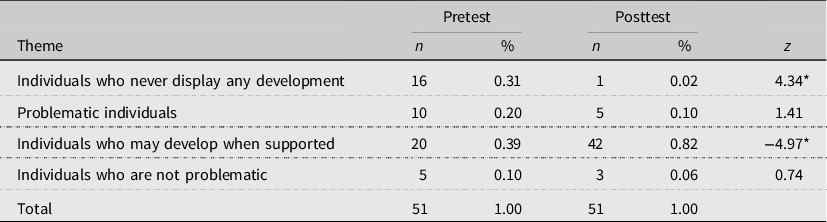
Findings on how the metaphors used by school counsellor candidates for students with LD differ before and after training are shown in Table 2.
Pretest-posttest change in the theme-based metaphor ratios

According to Table 2, while the percentage of metaphors indicating perceptions of students with LD as ‘individuals who never display any development’ accounted for 31% (n = 16) of all the metaphors used by participants, the posttraining ratio was 2% (n = 1).The z test results for the two means indicate that the ratio of the metaphors used by school counsellor candidates for stating that individuals with LD are ‘individuals who never display any development’ decreased at a statistically significant level (p < .05). Accordingly, a significant number of school counsellor candidates started thinking that individuals with LD were not actually individuals who never displayed any development, after those candidates received training on LD. While the number of metaphors used for the ‘problematic’ category of individuals with LD accounted for 20% (n = 10) of the total metaphors, the posttraining ratio was 10% (n = 5). The z test results for the two means indicate that even though the ratio of metaphors used by school counsellor candidates for stating that individuals with LD are ‘problematic individuals’ had decreased, this decrease did not occur at a statistically significant level (p > .05).
According to Table 2, while the number of metaphors used for the category of ‘individuals who may develop when supported’ accounted for 39% (n = 20) of the total metaphors in the pretest, the posttraining percentage was 82% (n = 42). The z test results for the two means indicate that the ratio of metaphors used by school counsellor candidates for stating that individuals with LD ‘may develop when supported’ increased at a statistically significant level (p < .05). Accordingly, a significant number of school counsellor candidates started thinking that individuals with LD are individuals who develop when supported. While the number of metaphors included in the category of ‘individuals who are not problematic’ comprised 10% (n = 5) of all metaphors in the pretest, the posttraining percentage was 6% (n = 3). The z test results for the two means indicate that even though the ratio decreased for metaphors used by school counsellor candidates stating that individuals with LD are ‘not problematic’, this was not at a statistically significant level (p > .05).
Discussion
The purpose of this study was to determine the change in the perceptions of school counsellor candidates towards students with LD. Upon examining the pretraining metaphors used by participants, the study indicates that more than half of these candidates (51%) were of the opinion that students with LD will never learn, or that they considered these students as problems. It can be stated that school counsellor candidates have problems related with their attitudes towards students with LD. Such thoughts may also have an adverse impact on counsellors’ ability to provide academic, social and emotional support to students who have LD. This result obtained in the present study is worrisome when we consider the fact that school counsellor should provide support to teachers and families as well (Geltner & Leibforth, Reference Geltner and Leibforth2008). Besides, the statements of the participants suggest that they have very low expectations for these students. For example, S8 used the glass held upside down under a faucet metaphor, stating, ‘It would not fill up regardless of the amount of water flow’. This result supports the findings of previous studies, which assert that school counsellors are not able to provide sufficient support due to their lack of knowledge about LD (Dadandı et al., Reference Dadandı, Dadandı, Avcı and Şahin2016; Falzon & Camilleri, Reference Falzon and Camilleri2010; Fiorini, Reference Fiorini2001; Milsom & Akos, Reference Milsom and Akos2003; Romano et al., Reference Romano, Paradise and Green2009). This lack is attributed to the inadequacy of school counsellor undergraduate courses for students with LD and inclusive education (see Dadandı et al., Reference Dadandı, Dadandı, Avcı and Şahin2016; Sakız, Sart et al., Reference Sakız, Sart, Börkan, Korkmaz and Babür2015). On the other hand, research shows that training school counsellors about services for students with special needs increases their positive attitudes and self-efficacy towards these students (Çimşir, Reference Çimşir2019; Sönmez & Koçyiğit-Özyiğit, Reference Sönmez and Koçyiǧit-Özyiǧit2020). Thus, increasing the knowledge of school counsellor candidates regarding LD will have a significant impact on the level of support that they provide to such students in the school environment.
Second, the posttraining metaphor analysis concluded that after intervention, the majority of participants (82%) considered students with LD as individuals who can develop when supported. This result is in accordance with the results of studies emphasising that having knowledge of LD affects the attitudes and thoughts of school counsellor towards these students (Milsom, Reference Milsom2002; Romano, Reference Romano2006). It is known that especially the training of school counsellors about LD during undergraduate education increases the quality of the services they provide for students with LD (Milsom, Reference Milsom2002; Milsom & Akos, Reference Milsom and Akos2003). Cimsir and Carney (Reference Cimsir and Carney2017) determined that the training of school counsellors about students with special needs significantly predicted their preparedness for inclusion. In the current study, the participants were informed during the training period about the characteristics of students with LD, the identification stage, and these students’ requirements in education. Although the participants may have still considered LD as a problem at the study’s conclusion, they were of the opinion that it can be solved; this development foregrounds the notion that these students may overcome the disabilities they are experiencing. Therefore, a program of study will contribute to these participants putting in more effort to the education of children with LD and help them develop more positive attitudes towards these children.
Third, while the majority of the study participants considered students with LD as impossible to develop or as problems prior to the training, they expressed after the training that these students are individuals who can develop when supported. After the training, participants used words such as ‘discover’, ‘realise’ and ‘determine’ when crafting metaphors to describe children with students with LD. For example, S21 explained: ‘They await to be discovered with telescopes in the hands of the teachers.’ From this data it can be inferred that after the training that they received, school counsellor candidates realised the importance of their role in the process of identifying students with LD. This result shows that the participants are willing to take an active part in the determination and identification stages for these students in the school environment. The studies also emphasised that there are serious problems in the identification and diagnosing of students with LD in Turkey (Fırat & Koçak, Reference Fırat and Koçak2020; Sakiz, Reference Sakiz2018). While the ratio of students with LD among students with special needs in the United States is 38% (U.S. Department of Education, 2017), this ratio is 3% in Turkey (Çakıroğlu, Reference Çakıroğlu, Melekoğlu and Çakiroğlu2017b). The impact of failure to accurately identify students with LD is apparent in this ratio for Turkey. This can be related to the lack of sufficient knowledge of school counsellors about students with LD. Falzon and Camilleri (Reference Falzon and Camilleri2010) pointed out that the fact that school counsellors are not equipped with sufficient education about students with LD creates an obstacle in determining these students. On the other hand, that this percentage is low in Turkey cannot be explained only by the lack of knowledge on the part of school counsellors, since the low level of knowledge of families and other teachers, as well as the insufficiency of standard tests for LD, may also lead to such results (Fırat, Reference Fırat and Şahbaz2018). However, it remains important for school counsellors to have enough knowledge about LD so that they in turn can provide information to parents and other teachers.
In addition, after the training, a majority of the participants explained that by using different metaphors that students with LD can indeed learn and be successful, and that they may have different abilities. As an example, S44 used the following expression: ‘Not valuable because they are thought to be insufficient, diamonds that require processing.’ This result demonstrates the emphasis made by the participants indicating that students with LD may have strong aspects in addition to their weaknesses. Previous literature states that students with LD may have different abilities, and that they may even display superior performance in certain areas (Baum, Reference Baum1990; Baum & Owen, Reference Baum and Owen2004; Silverman, Reference Silverman2009; van Viersen et al., Reference van Viersen, De Bree, Kalee, Kroesbergen and De Jong2017). School counsellors will not only focus on the weaknesses of students with LD when they realise this. Also, school counsellors can encourage these students’ teachers and parents to emphasise students’ abilities and talents, as opposed to focusing only on their deficits (Reis & Colbert, Reference Reis and Colbert2004). Thus, this new perspective will enable school counsellors to discover different abilities in students with LD and to play important roles in supporting them and their development.
When all these results are considered as a whole, it can be concluded that whereas the school counsellors were of the opinion prior to training that students with LD are problematic and that they cannot learn, after training they believed that it is possible to overcome this problem and that such students may indeed develop. Moreover, the counsellor candidates expressed various opinions on the identification of these students and supporting their different abilities. Hence, it seems that the lack of sufficient knowledge about students with LD at the university level should be taken into consideration when making educational reforms in Turkey.
Limitations and Implications
There are various limitations that should be taken into consideration when evaluating the results of this study. First, the data were acquired only by way of metaphors. In this regard, different data may be acquired from school counsellor candidates by using different qualitative and quantitative data acquisition tools. Thus, the attitudes of school counsellor candidates towards students with LD can be examined in more depth. Second, the study group used for data acquisition was comprised of final year students. It is not known for certain how these individuals will behave in their professional lives. Accordingly, the metaphors used by school counsellor candidates in their final year of education and those used after starting their profession could be compared to shed light on how these perceptions change over time. In this way, the long-term effects of the applied training program can be determined. Third, the absence of a control group in the study can be considered as another limitation. In this context, it may be possible to compare the attitudes of school counsellor candidates who took the LD course and those who did not, towards students with LD. With such a research, the effects of the education program can be determined better.
Moreover, the importance of the services provided by school counsellors to all students, including students with special needs, is emphasised (ASCA, 2003). On the other hand, sufficient knowledge is required for students with special needs (e.g., those with LD) in order to provide them the required academic, social and emotional support. In this context, it is considered important to include courses on the education of students with LD in the curricula of school counsellor candidates at both the undergraduate and postgraduate level.