We are grateful to the commentators for providing interesting suggestions and raising several important issues that might help to refine work in this area. In this response, we try to address as many of their comments as possible, but we focus particularly on those that (a) are most important for the field and (b) offer the most serious criticism of our framework.
R1. Do we need to control for underlying mechanisms?
We note that few of the commentators have disputed our central claim, that musical emotions cannot be studied without regard to how they are evoked. Indeed, many have explicitly agreed with our claim. Bharucha & Curtis, for example, observe that:
By disaggregating the variety of musical experiences that we call emotion, and by unearthing the numerous causal mechanisms responsible for this multiplicity, a messy field starts to sort itself out. Many of the apparent contradictions and inconsistencies in the literature are due to the failure to recognize that all these mechanisms – not just one – are at work. Collectively they account for a wide spectrum of emotional experiences in music. The target article therefore constitutes an immensely important contribution, and enables future research on music and emotion to be more lucidly framed.
Other commentators are more skeptical. Scherer & Zentner argue that our claim that the nature of the induction mechanism is essential for understanding musical emotions is “unsubstantiated if it means that the induction mechanism determines the nature of the ensuing emotion” (emphasis in their commentary). Yet the framework that we outlined clearly implies that the underlying mechanism will influence the kind of affective state that is evoked. To take a simple example: It seems quite clear that brain stem reflexes initiated at the level of the inferior colliculus are not able to evoke complex emotions such as nostalgia. Thus, the nature of the mechanism (i.e., the way in which the emotion is evoked) does influence the ensuing emotion. Preliminary evidence that specific mechanisms are associated with specific emotions has already been reported (Juslin & Liljeström, in press). We are surprised that Scherer & Zentner question our claim, because it is a crucial implication of Scherer's previous work on appraisal (Scherer Reference Scherer, Scherer, Schorr and Johnstone2001) that the stimulus object, and in particular how it is processed, will strongly influence the precise affective state evoked. Yet somehow this important principle is abandoned by Scherer in the case of music. Note further that the importance of controlling for underlying mechanisms does not concern only the experienced feeling: It concerns a range of characteristics that were captured by our set of hypotheses.
Even more puzzling in some ways are Peretz's comments. She claims that she finds our framework “sound and clear” (para. 1 of her commentary), yet what she proposes goes entirely against the message of our article. She basically argues that researchers can continue to investigate musical emotions simply by looking at direct relationships among physical characteristics (e.g., dissonance) and emotions, without any consideration of underlying mechanisms: “Future research should rather focus on perceptual determinants of each basic emotion” (Peretz's Abstract). Note that which acoustic cues are associated with the perception of basic emotions in music has already been mapped in previous research (Gabrielsson & Juslin Reference Gabrielsson, Juslin, Davidson, Scherer and Goldsmith2003; Juslin & Timmers, in press). Still, which emotions are evoked in the listener by such music is a different question that, we believe, cannot be explained simply in terms of acoustic characteristics. One person's “favorite music” is another person's “noise.” Hence, an approach that focuses only on the perceptual characteristics of the music is doomed to fail in explaining the wide variety of emotions evoked by music (Juslin, in press).
This problem remains even if we consider a fairly simple psychophysical aspect such as dissonance. Peretz calls for a deeper understanding of the acoustic correlates of dissonance in non-musical sounds. There are in fact several psychoacoustic models that deal with roughness perception – the basis of dissonance perception (e.g., Hutchinson & Knopoff Reference Hutchinson and Knopoff1978; Kameoka & Kuriyagawa Reference Kameoka and Kuriyagawa1969; Pressnitzer & McAdams Reference Pressnitzer and McAdams1999; Terhardt Reference Terhardt1974) – but such models do not always correlate highly with emotional reactions (Mashinter Reference Mashinter2006). Indeed, a recurrent finding in psychoacoustic research is that focusing solely on the acoustic determinants captures only a small percentage of variance in emotional responses to sounds, whereas including non-acoustical factors (e.g., listener, situation) dramatically increases the explained variance (e.g., Västfjäll et al. Reference Västfjäll, Kleiner and Gärling2003). Peretz argues that, “contrary to J&V's claims, dissonance has been controlled for in these studies” (para. 4). However, what we actually claimed was that the underlying mechanism has not been controlled for – dissonance is not a mechanism. Also, surely there is more to musical emotions than merely the perception of dissonance. Is Peretz suggesting that musical emotions that do not involve the perception of dissonance should be ignored in future research? Peretz's suggestion to focus on the acoustic determinants of unpleasantness appears strange in view of the fact that music evokes mostly positive emotions (see Fig. 1 and 2 in sect. R6.2 further on).
Trehub suggests that, “Given widespread disagreement on the existence and nature of musical emotions, their links to non-musical emotions, and the conditions under which they are elicited, Juslin & Västfjäll's (J&V's) attempt to specify induction mechanisms for such disputed emotions may be unwarranted or premature.” This comment seems to entirely miss our point that the widespread disagreement in the field is precisely the result of a neglect of underlying mechanisms. Therefore, continuing to neglect the underlying mechanisms is not likely to improve the situation. Trehub's view of music as a “dishonest signal” designed mainly to influence the affective state of the listener does not explain how music evokes emotions. Accordingly, it is not directly relevant to the current discussion.
Konečni did not directly oppose our claim that music cannot be studied without regard to mechanisms, but challenged three “erroneous premises” of our article. First, he claims that our statement that “research indicates that people value music primarily because of the emotions it evokes” (target article, Abstract) was based only on studies of adolescents. This claim is simply incorrect: a reading of some of the references included to support our statement, such as Juslin and Laukka (Reference Juslin and Laukka2004) and Sloboda and O'Neill (Reference Sloboda, O'Neill, Juslin and Sloboda2001), would reveal that these studies feature data based on adults.
Second, Konečni claims that the disagreements among various researchers of musical emotions could be explained simply in terms of an opposition between brain researchers and researchers who emphasize “subjective experience.” This is also inaccurate. Although Konečni creates the impression that there is “agreement” among “others (Gabrielsson, Kivy, Konečni, Scherer),” who “consider subjective experience indispensable” (para. 2 of the commentary), in fact the authors cited do not agree at all: Konečni (Reference Konečni, Juslin and Sloboda2003), for instance, claims that music cannot directly induce emotions; Scherer (Reference Scherer and Bresin2003) claims that music evokes emotions, but not basic emotions; and Gabrielsson (Reference Gabrielsson, Juslin and Sloboda2001) claims that music evokes both basic and complex emotions. All of these are psychologists who consider subjective experience “indispensable,” and none is a brain researcher. Even so, they clearly disagree. Numerous other examples could be offered. However, the important point is that the disagreements in the field cannot be dismissed that easily.
Finally, Konečni claims that a third “inaccurate premise” is our statement that, providing evidence that music has effects on all of the components in Table 2 of the target article would demonstrate that music can induce “real” emotions. He notes that “most of the studies in Table 2 are limited to a single component.” The operative word here is “most,” because clearly there are studies that provide evidence of so-called synchronization or coherence among several emotion components in response to music (Lundqvist et al., in press; Steinbeis et al. Reference Steinbeis, Koelsch and Sloboda2006). For example, Lundqvist et al. (in press) report evidence of a coherent manifestation in the experiential (feeling), expressive (facial electromyography), and physiological components (e.g., skin conductance, finger temperature) of the emotional response system, demonstrating that music can evoke happiness and sadness under controlled laboratory conditions using non-classical music. However, not all emotion researchers today believe that an emotion (necessarily) requires a synchronized response (Frijda Reference Frijda, Kahneman, Diener and Schwarz1999; Russell Reference Russell2003); and Konečni himself appears content with self-reports (Konečni et al. Reference Konečni, Brown and Wanic2008), in which case current evidence based on self-report (see sect. R6) should suffice to convince him that music can evoke many different emotions. One cannot argue that subjective experience is indispensable for an understanding of responses to music, while simultaneously dismissing all evidence that music evokes emotions based on such experience.
R2. Is the framework internally consistent?
In this section, we address comments regarding overall aspects of our framework, such as terminology and internal consistency. Scherer & Zentner argue that we “confound levels of analysis by addressing phenomena (emotional contagion), content (memory schemata), procedures (visual imagery), and substrata (brain stem).” This is not really accurate, because, as the philosopher Malmgren notes, “to be fair to the authors, it is clear that they intend these labels to stand for psychological mechanisms.” Scherer & Zentner's “confounding” charge is faulty also in other ways: First, their claim that emotional contagion is a “phenomenon” and not a “mechanism” is strange, considering that they have labeled it a mechanism themselves: “a mechanism often called emotional contagion” (Scherer & Zentner Reference Scherer, Zentner, Juslin and Sloboda2001, p. 369). Our use of the term is consistent with previous definitions of contagion as a form of automatic “mimicry”:
the tendency to automatically mimic and synchronize facial expressions, vocalizations, postures, and movements with those of another person and, consequently, to converge emotionally. (Hatfield et al. Reference Hatfield, Cacioppo and Rapson1994, p. 5)
We agree with Scherer & Zentner that “memory schemata” might be regarded as a form of “content” – but our mechanism was labeled “episodic memory,” not “memory schemata.” The latter is involved in the process by which music may evoke an emotion through the recall of a memory, but it cannot be equated with the memory process, as a whole. Scherer & Zentner also refer to visual imagery as a “procedure.” This is puzzling because imagery has been studied as a psychological mechanism for many years (Kosslyn Reference Kosslyn1994). Each of the mechanisms in our target article was explicitly defined as an induction process. Thus, Scherer & Zentner's claim that we confound levels of analysis is not convincing. However, we admit that it can be tricky to separate various levels of analysis in the field. Indeed, highlighting this difficulty is the fact that Scherer and Zentner's (Reference Scherer, Zentner, Juslin and Sloboda2001) own overview is guilty of the charge of confounding levels of analysis, since it divides the “routes” into “appraisal” (clearly a mechanism) and “empathy” (which is rather a phenomenon that occurs through many different mechanisms, including but not limited to emotional contagion), as well as “facilitating existing emotions” (which is not a mechanism at all).
We emphasize that we think Scherer and Zentner's (Reference Scherer, Zentner, Juslin and Sloboda2001) review was excellent in many ways, though when Scherer & Zentner claim that their overview is reminiscent with our framework, we disagree. Their review includes four “routes” (mechanisms), if we exclude “facilitating existing emotions” (which is not actually a mechanism), whereas our framework includes seven mechanisms, if we include appraisal. They do not clearly distinguish different memory systems, whereas we separate evaluative conditioning from episodic memory. Most importantly, however, Scherer & Zentner provide a casual theoretical overview, whereas our attempt was to develop an integrated framework featuring a set of hypotheses.
Malmgren states that “an important desideratum on any classification is that it uses a uniform principle,” but that “it is not obvious that J&V's classification fulfills this desideratum … Despite their careful attempt in section 3.2 to describe the mechanisms in terms of a number of dimensions, it never becomes clear which of these dimensions are essential, in cases of conflicts between criteria, for distinguishing one mechanism from another.” Malmgren fails to recognize that the essential and uniform principle that serves to distinguish the mechanisms lies in the definitions of the mechanisms themselves: that is, the process by which each mechanism evokes emotions. Although some mechanisms may share certain characteristics, they do not share the basic principle by which they evoke an emotion.
Similarly, we are not convinced by Malmgren's critique of our (single) use of the word “empathy.” He neglects the fact that emotional contagion is commonly regarded as one of many forms of empathy (Preston & de Waal Reference Preston and de Waal2002), as recognized by Patel, who refers to contagion as “part of the brain's mechanisms for empathy.” Malmgren also appears to confuse empathy, as commonly defined, with sympathy. Hoffman (Reference Hoffman, Lewis, Haviland-Jones and Feldman Barrett2008) defines empathy as “an emotional state triggered by another's emotional state … in which one feels what the other feels” (p. 440). That is, the experienced feeling is the same – not a contrasting one.
Malmgren also suggests that we should consider incorporating ideas from a recently presented doctoral dissertation, by Vickhoff (Reference Vickhoff2008), into our theoretical framework. The most original aspect of this dissertation seems to be the notion of perspective: that music listeners implicitly or explicitly choose a certain perspective, which then functions as a “filter” whereby “some information becomes relevant and some becomes irrelevant … We are presented with only one proposal at the time” (p. 64). There are two problems with the perspective metaphor in our view: First, it implies that only one mechanism can operate at a time, since one perspective per definition excludes another perspective. This may not be conducive with how the mechanisms work (in principle, more than one mechanism could be activated at different levels) and makes it hard to explain the occurrence of “mixed” emotions in listeners' reactions to music (Gabrielsson Reference Gabrielsson, Juslin and Sloboda2001). Second, the idea that a listener chooses a specific perspective introduces the problem of how, precisely, this choice is made – something that the dissertation does not quite explain. Further, we find it problematic to propose that the choice – if that is the appropriate word – lies entirely with the listener, since each mechanism in our framework is dependent on certain information in the music, and how this information relates to personal characteristics of the listener. If certain required information is not available, the mechanism cannot be activated, no matter what the listener would like to “choose.” As suggested by our hypotheses in Table 4 of the target article, many of the mechanisms cannot be influenced by the listener's will. Hence, with the exception of, for instance, the visual imagery mechanism, the “choice” of mechanism is largely made by the music, rather than by the listener as implied by Vickhoff's notion of perspective choice.
The foregoing discussion raises the important question of which labels to use – for instance, to refer to different mechanisms. This question admittedly does not have a simple answer. We selected labels that we thought would help researchers to quickly grasp the nature of each mechanism, and it is our impression that most commentators have done that: Only a few of the commentators have expressed any concerns over the labels we used in our article. Malmgren argues that brain stem reflexes is “anatomically a misnomer” (para. 4) for responses that may also involve the thalamus, and Thompson & Coltheart suggest that the term is confusing, “because the brain stem has multiple functions” (para. 2). Although the mechanism could easily be renamed “reflexes,” the above arguments miss the point that the responses in question are the only ones that can be initiated at the level of the inferior colliculus of the brain stem. Hence, labeling the mechanism in terms of its “substrata” (Scherer & Zentner) serves to highlight a defining characteristic of the mechanism not shared with other mechanisms. In principle, we are open towards other labels that may improve the communication among music-emotion researchers, though we note that none of the commentators proposed alternative labels.
R3. How could particular mechanisms be elaborated?
R3.1. Emotional contagion
Several commentators elaborate on the emotional contagion mechanism. Some have offered evidence for the mechanism (Fritz & Koelsch, Provine), whereas others have offered evidence against it (Simpson, Oliver, & Fragaszy [Simpson et al.]). Patel provides suggestions on how we could test some of the assumptions associated with contagion, and Gardiner provides a way of framing the mechanism in terms of communication of emotions, where encoding and decoding are strongly related. (This is consistent with the views on expression of emotions in music performance and the nonverbal aspects of speech suggested by Juslin & Laukka [Reference Juslin and Laukka2003].) Bharucha & Curtis, Malmgren, Holochwost & Izard, Madison, and Provine suggest that emotional contagion in musical contexts could also occur as a result of catching the emotions of other persons present. We agree that this is an interesting possibility that may be particularly relevant in contexts such as rock concerts. This should perhaps not be described as an emotional reaction to music, however. It is rather one of many contextual factors that may modulate musical emotions. Thus, we focus here on those comments that concern emotional contagion from music.
Fritz & Koelsch provide a valuable discussion of empirical support for the emotional contagion mechanism in relation to music, in terms of recent findings of an auditory “mirror” mechanism (i.e., premotor activation of the larynx representation), which was activated by the perception of expressive music (Koelsch et al. Reference Koelsch, Fritz, von Cramon, Müller and Friederici2006). We are intrigued by their proposal that the contagion mechanism could have a more complex time resolution, or temporal dynamic of activation, such that the emotional “resonance” is gradually increasing. We welcome further research that may clarify this feature, but note that Koelsch et al.'s result seems to contradict results from previous studies of emotional contagion involving facial expressions, where the response is faster (Dimberg & Thunberg Reference Dimberg and Thunberg1998). Time aspects of musical emotions are also discussed by Agostino, Peryer, & Meck [Agostino et al.], who note that there was virtually no consideration in our target article of how events unfold over time, or of how the timing of events relates to emotional responses. Agostino et al. neglect, however, that our framework included explicit hypotheses about the speed of the emotion-induction process (Table 4) for different mechanisms, thus highlighting how different mechanisms could have different time frames.Footnote 1
Patel's suggestion to test patients with receptive aprosodia with regard to both musical stimuli and speech stimuli, in order to check whether emotion recognition in music relies on the same resources as emotion recognition from vocal affect, is highly interesting. (However, it should perhaps be noted that, in principle, the neural mechanism responsible for the induction of the emotion could be the same, even if the neural mechanisms for the recognition are different.) Designing relevant tests is not entirely straightforward, as indicated by Patel's carefully stated requirements. However, when he proposes that “in testing such patients, one could use stimuli from previous studies of musical emotion recognition in normal individuals (e.g., Krumhansl Reference Krumhansl1997),” Patel is neglecting the fact that the stimuli used in studies such as Krumhansl (Reference Krumhansl1997) feature several expressive features beyond those cues that are shared with the voice. Thus, in principle, emotions in such stimuli could be recognized based on non-voice cues (e.g., harmonic progression), even if the voice-based emotion recognition module is damaged. Hence, we would like to add one further requirement: Musical stimuli must be designed such that the recognition of different emotions involves only acoustic cues shared with vocal affect expressions; for instance, by asking music performers to play the same musical composition in different versions by manipulating tempo, sound level, and timbre (Juslin Reference Juslin2000). This is in accordance with the boundary conditions of our hypothesis about speech-music parallels (Juslin & Laukka Reference Juslin and Laukka2003, p. 774).
Simpson et al. discuss evidence that they regard as problematic for the emotional contagion mechanism, particularly evidence that the brain distinguishes voices from music at early stages of processing. We are aware of such findings, but do not necessarily regard them as problematic, either for the “super-expressive voice” theory or the contagion mechanism in general. It should be noted that most music heard today involves voices (in singing), which eliminates the problem altogether, and renders emotional contagion via music even more likely. To be fair to Simpson et al., they focus on the case of instrumental music. They seem to be forgetting, however, that our theory involves the notion of an independent module and that it is part of the notion of a module that it is information-encapsulated (Fodor Reference Fodor1983),Footnote 2 which means that it is perfectly plausible that the module treats the expressive instrument in the music as a voice, even if other parts of the brain “know” that this is a musical instrument, not a voice. However, Thompson & Coltheart's comment about the importance of defining modularity explicitly is well taken. Support for a modular theory, in terms of Fodor's (Reference Fodor1983) description of modules as being domain specific, fast, innately specified, autonomous, “hard-wired,” automatic, and information-encapsulated, was described by Juslin and Laukka (Reference Juslin and Laukka2003, p. 803).
Simpson et al. also argue that it is a problem that emotional contagion cannot explain cases where the experienced emotion is not the same as the emotion expressed in the music; but this is not a problem at all: There are six other mechanisms that can explain emotional responses to music that the contagion mechanism cannot account for. All of the mechanisms require certain information and depend on certain “brain resources.” Thus, contrary to what is claimed by Scherer & Zentner, our framework may clearly contribute to an understanding of why music does not evoke emotions in some instances. This can be explained in terms of lack of certain information or available brain resources. We did not claim that emotional contagion (or any other of the mechanisms for that matter) is always involved during music listening. In cases where the evoked emotion is different from the one expressed in the music, the emotion was simply evoked by another mechanism, such as musical expectancy.
R3.2. Musical expectancy
Many of the commentators (e.g., Krumhansl & Agres, Longhi, Rozin & Rozin, Vuust & Frith) appeared to advocate a “privileged role” for musical expectancy in the induction of emotions to music. It is easy to see why, given the extensive research on musical expectancy (albeit mostly not related to emotion) in the field of musicology (Huron & Hellmuth Margulis, in press; Meyer Reference Meyer1956; Narmour Reference Narmour1992). We appreciate Krumhansl & Agres's elaboration on the musical expectancy mechanism, delineating some if its characteristics in a manner that we were unable to do within the space limitations of our target article. However, we do not agree with their statement in the commentary Abstract, that “when examining how emotions are evoked through music, the role of musical expectancy is often surprisingly under-credited.” We find that few papers on music and emotion fail to mention Meyer's (Reference Meyer1956) seminal book. A literature search would probably reveal that it is the single most-cited source in this field. We further think that Huron's (Reference Huron2006) revisit to Meyer's theory is interesting, original, and laudable, though it may be over-reaching in its attempt to cram in all different kinds of affective response under the umbrella of “music and expectancy.” Hence, while Thompson & Coltheart argue that our view on expectancy is narrow because it (in line with Meyer's original work) focuses mainly on syntactic relations, we might counter that Huron's view is over-inclusive by featuring responses that we believe are better characterized in terms of other mechanisms. However, to be fair to Huron (Reference Huron2006), he did acknowledge that “music can also evoke emotions through many other means – apart from whether sounds are expected or not” (p. 365).
Krumhansl & Agres argue that concentrating on the musical expectancy mechanism is good, because it “focuses attention on the music itself and how it is constructed.” What about the listener? All mechanisms require both a musical structure and a listener who perceives the structure. Moreover, we sense a common misconception that mechanisms other than musical expectancy do not involve musical structure, but, clearly, all mechanisms in the target article relate to musical structure in their own particular way. One obvious example is the emotional contagion mechanism, which depends on the emotional expression of the music, as specified by numerous global and local acoustic cues in the music (Juslin Reference Juslin, Miell, MacDonald and Hargreaves2005). Our recommendation for the future is that, instead of limiting musical emotion studies to expectancy, musicologists should expand their structural analyses to include the other mechanisms also. Which features of the musical structure are important in establishing a conditioned response? Which features of the musical structure tend to facilitate some mental images rather than others? The analysis of musical structure in musical emotions does not begin or end with expectancy.
Vuust & Frith suggest that musical expectancy is the most fundamental mechanism in our framework, although they fail to convince us why the expectancy mechanism is most fundamental. It is not sufficient to invoke anticipation as the special feature of the expectancy mechanism: All human cognition and behavior are future-oriented. Profound as this may seem, this human characteristic could hardly be different. It simply reflects that time is moving in a forward direction. We remain reluctant to consider any mechanism more important than the others. We argued in our target article that all six mechanisms in the framework (even musical expectancy) have their origins outside the musical domain. To assign a higher “value” to some mechanisms because they are more commonly investigated in musicology appears to us questionable. Note also that, depending on their background, different commentators propose different mechanisms as the most important. Gardiner, for example, argues that the emotional contagion mechanism “seems the most important,” whereas Bezdek & Gerrig emphasize the mechanisms evaluative conditioning and episodic memory, because of their focus on music in film. Hence, researchers regard particular mechanisms as important depending on their focus, not because of evidence of the mechanism's large impact on listeners' responses.
For instance, empirical evidence from a number of studies indicates that those emotions that we would expect from the musical expectancy mechanism, based on previous and current theoretical models (Meyer Reference Meyer1956: apprehension/anxiety, p. 27, hope, p. 29, disappointment, p. 182; Huron Reference Huron2006: surprise, anticipation, awe, boredom, p. 356), occur only rarely in listeners' emotions to music (e.g., Juslin & Laukka Reference Juslin and Laukka2004; Juslin et al., in press; Zentner et al., in press). If musical expectancy is really of particular significance, would we not expect to see more of its impact on listeners' emotions? One could counter that musical expectancy does not evoke what we call “emotions,” but that would largely exclude it from the current discussion.Footnote 3
The strong emphasis on musical expectancy in several commentaries may partly reflect the training of musicologists, who spend much of their time analyzing musical scores. We get the impression that they sometimes forget that not all listeners hear music in the same way as music theorists do. Music psychologists – simply due to the nature of their discipline – might get closer to the way that music is actually heard and used to evoke emotions in everyday life (e.g., Juslin et al., in press; Sloboda & O'Neill Reference Sloboda, O'Neill, Juslin and Sloboda2001). By studying music listening in its real-world contexts, we can explore a larger view that may include a wider range of mechanisms.
R4. Are there additional mechanisms?
In our target article, we outlined seven mechanisms through which music may evoke emotions. However, we remain open to proposals about other mechanisms that could be relevant. Several commentators have addressed this question, and their proposals can be grouped in terms of mere exposure, semantic association, and rhythmic entrainment.
R4.1. The mere exposure effect
Schellenberg argues that “exposure represents an additional mechanism, ignored by the authors, that helps to explain emotional responses to music” (his commentary Abstract). Clearly, however, the term mere exposure refers to a phenomenon and a certain paradigm (Zajonc Reference Zajonc2001), not a psychological mechanism. In principle, this effect may be explained by more than one mechanism. This is recognized by Moors & Kuppens, who note that “mechanisms that are overlooked are those underlying the mere exposure effect.” They do not specify any of these mechanisms, though. Fortunately, the mere exposure effect can actually be explained by our theoretical framework, without adding any further mechanisms. According to Zajonc, who is arguably the first to bring the mere exposure effect to psychologists' attention (e.g., Zajonc Reference Zajonc1968), the exposure effect is “a robust phenomenon that cannot be explained by an appeal to recognition memory or perceptual fluency” (Zajonc Reference Zajonc2001, p. 224) (The latter, i.e., perceptual fluency, is invoked in Schellenberg's commentary.) Instead, Zajonc (Reference Zajonc2001) argues that the exposure effect can be regarded as a form of conditioning if one assumes that the absence of aversive events constitutes the “unconditioned stimulus.” In other words, stimuli that we have encountered repeatedly, without suffering negative consequences, will produce positively valenced responses. Thus, the mere exposure effect may be accounted for by the evaluative conditioning mechanism in our proposed framework. The fact that mere exposure effects have been obtained even when the stimuli exposed are not accessible to the participants' awareness (Zajonc Reference Zajonc2001), and even prenatally (Rajecki Reference Rajecki1974), is consistent with our theoretical hypotheses about the evaluative conditioning mechanism (Table 4 in the target article). Indeed, exposure effects are even more pronounced when subliminal, like some of the results obtained in evaluative conditioning studies (De Houwer et al. Reference De Houwer, Baeyens and Field2005). We do not agree with Schellenberg's argument that the evaluative conditioning response outlined by Zajonc is substantially different because it involves “learned safety.” It may be argued that all positively valenced associations by definition are indicative of “safety.” We conclude that our framework may account for the mere exposure effect without adding further mechanisms.
R4.2. Semantic association
Fritz & Koelsch propose an additional mechanism which they refer to as “semantic association.” They suggest that music can “activate meaningful concepts that give rise to an emotional response.” We agree. The emotional contagion mechanism, for instance, focuses on information in the music that might be described as “semantic.” Indeed, Steinbeis and Koelsch (Reference Steinbeis and Koelsch2008) reported evidence suggesting that affect expressed in music is represented in the brain in a manner slightly similar to how language meaning is represented. Clearly, however, music does not have a “semantics” in the same sense that language has it (Davies Reference Davies, Juslin and Sloboda2001; Patel Reference Patel2008, Ch. 6). Moreover, we feel that Fritz & Koelsch do not actually explain how such meaning in music might produce an emotion. Is it not likely that these semantic associations gain their emotional impact through mechanisms such as evaluative conditioning and episodic memory? Notable in this respect is Bezdek & Gerrig's discussion of how these two mechanisms might explain the associations that listeners make between music and the narrative content in films. Both Fritz & Koelsch and Bezdek & Gerrig have dealt with how listeners assign meaning to music and how this can create an emotional response.Footnote 4 However, we maintain that such associations rely on the individual's previous learning history (including culture). Hence, the phenomena described by Bezdek & Gerrig and Fritz & Koelsch can probably be subsumed under some of the mechanisms in our framework. We conclude that it is unclear whether semantic association is really an additional mechanism, though we welcome further research that may elucidate this aspect.
R4.3. Rhythmic entrainment
Another suggestion for a neglected mechanism, which we find more plausible, is that of rhythmic entrainment. This is mentioned by several commentators, such as Agostino et al., Alcorta, Sosis, & Finkel [Alcorta et al.], Bharucha & Curtis, Madison, and Scherer & Zentner. We have mentioned entrainment as a possible induction mechanism in previous articles (Juslin & Laukka Reference Juslin and Laukka2004), and it is also discussed in many ethnographic accounts of musical ceremonies (Becker Reference Becker2004). However, we submit that this candidate for a mechanism is currently not well understood, and that there is not yet any strong evidence that rhythmic entrainment through music can induce an emotion. Yet, in principle, we remain open to the idea of expanding the framework to include a rhythmic entrainment mechanism. Further study is needed to elucidate the characteristics of this mechanism, such that hypotheses similar to those included in Table 4 of our target article may be formulated and subjected to testing. Bharucha & Curtis have proposed that “motion” may be an additional mechanism, though without specifying how. We argue that motion effects on the listener could be due to rhythmic entrainment – perceived motion in music stimulates self-movement, which through entrainment and its effects on the physiology of the listener evokes an affective response (see also Agostino et al.).
R5. How should emotions and mechanisms be distinguished?
Several commentators have offered distinctions to help organize and distinguish subsets of emotions and mechanisms. Although we may not agree with these proposals, we regard all of them as interesting, because they have forced us to deeply consider the similarities and differences among different mechanisms.
R5.1. “Mediated” versus “unmediated” emotions
Konečni makes a distinction between “mediated” and “unmediated” emotions. However, this distinction does not make sense in the current framework (and probably not in any other framework either), because there is no such thing as an unmediated emotion. There can be no emotion without some kind of information processing (and hence “mediation”) of the stimulus features. Even very simple brain stem reflexes to music involve some information processing. What distinguishes the mechanisms is partly what kind of information is processed, as well as how it is processed. Hence, we argue that all emotions are “mediated,” one way or the other, and that it could hardly be any other way (for further discussion, see Lazarus Reference Lazarus, Dalgleish and Power1999).
R5.2. “Cognitive” versus “non-cognitive” states
A different suggestion, although equally problematic, is to separate “cognitive” emotions from “non-cognitive” moods. Thus, Robinson argued that “some of the mechanisms are non-cognitive.” This obviously raises the question of what “cognitive” means here. Davies (Reference Davies, Juslin and Sloboda2001) has pointed out that “the term ‘cognitive’ has a somewhat different meaning in philosophical theories of emotion than it has in psychological theories. In the latter, the term implies a focus on underlying information-processing mechanisms, whereas in philosophical theories, it refers to beliefs, imaginings, thoughts, intentions, desires, and like states of consciousness” (p. 26, footnote 2). Indeed, that this is how Robinson is using the term is confirmed by her rejection of three mechanisms as “non-cognitive” because they “typically operate beneath awareness,” whereas, for instance, musical expectancy is regarded as “cognitive” because the listener is “focusing consciously on the way the music unfolds.” (The latter is not necessarily true, since musical expectations may evoke responses pre-attentively; see Koelsch et al. Reference Koelsch, Schroger and Gunter2002b.)
In contrast, as psychologists, we are not inclined to equate the term cognitive with the contents of our conscious awareness, but rather with various forms of information processing in the brain and in particular the “functional design” of such processing (see Sloboda & Juslin Reference Sloboda, Juslin, Juslin and Sloboda2001). In this sense of the term, Robinson's distinction becomes problematic because there is, of course, no simple or clear-cut boundary between “cognitive” and “non-cognitive” processes, as suggested by the Lazarus-Zajonc debate (see Lazarus Reference Lazarus, Dalgleish and Power1999). This is a matter of arbitrary definition, and, as explained in an endnote in our target article, we have hence avoided the use of the term cognitive to not rule out subcortical information-processing mechanisms.
Perhaps, the same terminological confusion underlies Robinson's discussion of “intentional objects” of emotions. We wrote in our target article that: “what the mechanisms discussed here have in common is that they become activated by taking music as their ‘object’” (sect. 1, para. 5); that is, it is the mechanism that takes the music as its “object.” In contrast, Robinson seems to emphasize conscious awareness of an intentional object. The latter usage would rule out the notion of “unconscious emotions” – a phenomenon that is recognized by psychologists (Öhman Reference Öhman, Dalgleish and Power1999). A distinction in terms of conscious awareness of stimulus objects cannot distinguish emotions from moods. Hence, we find that the distinction between “cognitive” emotions and “non-cognitive” moods is not likely to advance our understanding of musical emotions.
R5.3. “Signal detection” versus “amplifiers”
Thompson & Coltheart proposed that we should distinguish between signal detection and amplifiers, but their distinction is not wholly convincing. First, several of their claims about the so-called amplifiers appear inaccurate. For example, they claim that imagery and episodic memories are “rarely an independent cause of musically induced emotion but primarily amplify emotional experience,” yet they offer no evidence to support this view, so this is merely speculation. In fact, what evidence currently exists indicates that episodic memories are among the most common causes of musically induced emotions (Juslin et al., in press). In Sloboda and O'Neill (Reference Sloboda, O'Neill, Juslin and Sloboda2001, p. 420, Table 18.1), “reminder of valued past event” was the single most commonly reported function of the music. Therefore, Thompson & Coltheart's suggestion that ordinary music-listening activities offer little opportunity for episodic memory seems empirically false. Thompson & Coltheart further argue that contagion is an amplifier simply because “such music-speech associations must be established in the first place through conditioning.” This neglects that emotional contagion may involve an innate code, rather than learned associations (e.g., Juslin Reference Juslin, Juslin and Sloboda2001; Juslin & Laukka Reference Juslin and Laukka2003), based on how emotions influence physiological responses, which in turn affect various aspects of the voice production (Juslin & Scherer Reference Juslin, Scherer, Harrigan, Rosenthal and Scherer2005). Indeed, this biological basis might explain the reported difficulty of re-training individuals to express basic emotions in ways different from the innately specified expressive patterns (Clynes Reference Clynes1977, p. 45).
Second, we are slightly concerned over whether and how one could define anything in the music as an “emotional signal” independently of the individual listener. For instance, if we consider the evaluative conditioning mechanism, it is clear that information in the music may be a source of emotion for one listener, but not for another – in which case there is no inherent “signal” in the music to be “detected” for any listener. In this sense, then, the notion of “signal” is misleading. In addition, grouping brain stem reflexes, evaluative conditioning, and musical expectancy together appears suboptimal, given that they have such different characteristics (see Table 4 in the target article). In the case of musical expectancy, it is inaccurate to say that this involves “directly detecting emotive signals in music” (Thompson & Coltheart) in an unmediated fashion, because it is apparent that emotional responses to music based on schematic expectations (Meyer Reference Meyer1956) depend on semantic memory schemata, which are different for different listeners. In sum, it is not clear to us what the distinction between signal detection and amplifiers is achieving.
R5.4. “Type 1” versus “Type 2” emotions
Moors & Kuppens suggest that our theoretical framework would benefit from making a distinction between “Type 1” and “Type 2” emotions, where the former take the music as their object at the reality level (e.g., we are glad that we happen to come across music that we like at a store), while the latter are a response to the music's content at a more symbolic level (e.g., reacting to the emotion expressed in the music). This distinction is interesting and was in fact present in our target article in our division between emotions induced by cognitive appraisals and emotions induced by our “alternative” mechanisms. We noted that,
for example, a person may be trying to sleep at night, but is prevented from doing so by the disturbing sounds of a neighbor playing loud music on his or her stereo. In this case, the music becomes an object of the person's irritation because it blocks the person's goal: to fall asleep. Although there is nothing particularly “musical” about this example, it is clear that music can sometimes induce emotions in listeners in this manner. (target article, sect. 1, para. 7)
We added, in the sentence immediately following, that: “Such responses can easily be explained by traditional theories of emotion.” This comment implicitly referred to appraisal theories.
However, we also pointed out in our target article that the evidence to date suggests that emotions to music are very rarely evoked by cognitive appraisals relative to goals in life (e.g., Juslin et al., in press; submitted), which is precisely why musical emotions have seemed to require “some special explanation” (Kivy Reference Kivy1990, p. 149). Thus, “Type 2” emotions are more important in a musical context, and our framework focused on this type. Moors & Kuppens argue that both types of emotions require appraisal at some point. We strongly disagree. For instance, it seems clear to us that, if music evokes emotion through the emotional contagion mechanism, there is no cognitive appraisal involved, whatsoever. (That musical emotions do not require cognitive appraisals is acknowledged by some appraisal theorists, such as Ellsworth [Reference Ellsworth, Ekman and Davidson1994].)
Moors & Kuppens claimed that our conception of appraisal is “narrow.” We think that their conception is overly broad, incorporating appraisal into virtually every mechanism. We argue that such an excessively broad definition of the term appraisal runs the risk of making the term meaningless – because it could cover anything. If the appraisal process could be both “automatic” and “voluntary,” both “conscious” and “subconscious,” both “fast” and “slow,” both involve “a very large number of appraisal dimensions” and “only a few appraisal dimensions,” both involve “innate goals” and “momentary goals,” and both occur “at the moment of induction” and as “reinstated” by other processes, then what exactly does appraisal refer to? How could a theory ever be tested if it can always have it both ways? Although Scherer (Reference Scherer, Scherer, Schorr and Johnstone2001) has argued that appraisal could also involve “widely different mechanisms” (p. 371), fortunately most of Scherer's extensive research program on this topic actually seems to equate the term appraisal with a rather specific process, through which a situation, object, or event is evaluated in terms of its personal significance on a number of dimensions or criteria that usually concern its goal significance, the coping potential of the person, and the compatibility with internal or external standards (Scherer Reference Scherer, Dalgleish and Power1999). We believe that a “narrow” definition of appraisal renders the term more useful and the theory more amenable to scientific investigation. The notion of appraisal is important and useful, and even more so if its meaning is not overextended so as to include widely different phenomena that are better described by other terms. A precise definition also suggests that appraisal is rarely the mechanism underlying emotional responses to music.
R5.5. “Aesthetic” versus “utilitarian” emotions
Scherer & Zentner propose one further distinction between “aesthetic emotions” and “utilitarian emotions.” Our thesis that all emotions are not created equal is directly relevant to this distinction. Indeed, it turns out that the distinction largely corresponds to the aforementioned one between appraisal-based emotions (which involve evaluations in relationship to goals and action-oriented coping) and emotions evoked by other mechanisms (which do not involve goals). Appraisal-based emotions (Type 1) may indeed lead to goal-oriented action responses even with music (e.g., getting your neighbors to turn off that loud music!), whereas non-appraisal emotions (Type 2) mostly do not. Scherer & Zentner's mistake is to assume that the latter kind of emotions is “unique” to music – or art more generally. Clearly, it is not. (Most) musical emotions differ from (most) non-musical emotions in that they do not depend on cognitive appraisals, and this aspect may indeed affect their characteristics to some extent. However, the critical feature is the mechanism and not the music, because non-musical emotions can also be evoked through mechanisms other than appraisal. That this type of “non-appraisal” emotion is not unique to art becomes clear if we consider which emotions music evokes in everyday life.
R6. Which emotions does music evoke?
R6.1. Inclusive versus reductionist approaches
Current views on which emotions music might evoke could be placed along a dimension ranging from the most inclusive to the most reductionist. Among the most inclusive approaches is our own framework, which posits that music may evoke a wide range of basic and complex emotions, ranging from mere arousal and pleasantness via discrete emotions to more complex emotions such as nostalgia, as well as “chills.” Other examples of a similarly inclusive approach are presented by Huron (Reference Huron2006, p. 25): “Listening to music can give rise to an enormous range of emotions”); and by Gabrielsson (Reference Gabrielsson, Juslin and Sloboda2001), whose “strong experiences with music” (p. 446) feature a wide variety of emotions. Slightly more reductionist in approach are Zentner et al. (in press), who exclude a number of emotions that, in our view, might be induced by musical events. (In particular, Zentner et al. seem to forget that we routinely experience negative emotions to music we do not like in everyday life.) Considerably more reductionist is Peretz's argument to limit future research to basic emotions. Even further on the reductionist side, we find those commentators who argue that music may induce only a few emotional (or “quasi-emotional”) states, such as “being moved” or “awe” (see Konečni). Researchers who endorse a dimensional approach limited to pleasure (valence) and activation (arousal) (Trehub et al., in press) also belong to the reductionist side. We prefer to let the evidence do the talking in resolving this issue.
R6.2. Prevalence of musical emotions
While speculation is rife about which emotions music can induce, few studies have explored the prevalence of musical emotions.Footnote 5 Such studies are important, however, because they provide a sense of the phenomena that any theory of musical emotions must be able to explain. Scherer & Zentner argue that theory building about mechanisms might go astray without empirical knowledge about the phenomenon under investigation. We could not agree more. However, they also suggest that their approach differs from ours because they offer a more solid basis for theory building by studying musical emotions empirically. This is simply inaccurate. We have conducted four separate studies of the prevalence of emotional responses to music (i.e., Juslin & Laukka Reference Juslin and Laukka2004; Juslin et al., in press; submitted; Laukka Reference Laukka2007), using both survey and experience sampling techniques, and representative random samples of listeners and real-life situations, respectively. This is perhaps the most ambitious attempt thus far to examine which emotions are evoked by music. Because the findings from these studies are relevant to the current debate, we briefly outline some results in the following.
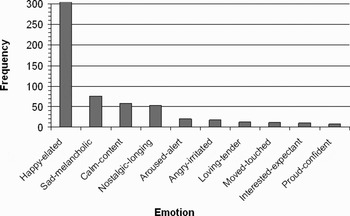
In a recent survey study based on a randomized and statistically representative sample of the Swedish population, 763 participants described their most recent emotional experience of music (Juslin et al., submitted). The resulting reports, of which 70% referred to an emotion episode that had occurred less than 24 hours before answering the survey, produced the distribution of emotions experienced to music shown in Figure R1. Note that the listeners could describe their emotions in their own words rather than by using a pre-selected list. As can be seen in Figure R1, the self-reports featured a wide range of both basic and complex emotions.
Prevalence of freely reported emotions to music from a randomized and statistically representative sample of the Swedish population (N=763). Note: Only the ten most common emotions are shown.

To estimate the prevalence of musical emotions as reliably as possible, one may need to capture the emotions as they spontaneously occur. An experience sampling study of emotions in everyday life by Juslin et al. (in press) provided estimates of the prevalence of emotions in response to music, as well as to other stimuli, during a two-week period. The emotion labels included basic emotions typical of discrete emotion theories, such as anger, surprise, interest, and fear (Izard Reference Izard1977); covered all four quadrants of the circumplex model in terms of arousal and pleasure (Russell Reference Russell1980); and featured terms often discussed in regard to music, such as pleasure, nostalgia, and expectancy. Furthermore, participants could select the alternative “other emotion” if none of the emotion terms provided was found suitable. A broad range of emotions was included in order to not prejudge the issue of which emotions music might evoke.
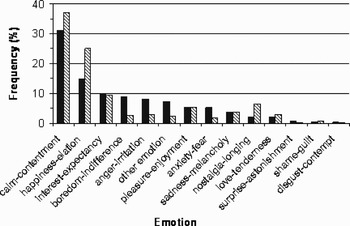
Figure R2 presents the prevalence (percentage) of emotions caused by music and emotions caused by other stimuli, respectively. As can be seen, emotions such as calm-contentment, happiness-elation, and interest-expectancy were common in general, whereas emotions such as disgust-contempt were not so common. A comparison of musical with non-musical emotion episodes suggested that happiness-elation and nostalgia-longing were significantly more frequent in episodes with musical emotions, whereas anger-irritation, boredom-indifference, and anxiety-fear were significantly more frequent in episodes with non-musical emotions. The remaining differences were not significant. In only 3% of the musical emotion episodes did the listener select the “other emotion” alternative, suggesting that the emotion labels provided covered the listeners' responses reasonably well. Overall these results highlight that musical emotions and non-musical emotions differ mainly with regard to their frequency distributions.
Relative frequency (in percent) of specific emotions in nonmusical emotion episodes (dark bars) and musical emotion episodes (striped bars). From Juslin et al. (in press).

R6.3. Are there music-specific emotions?
Scherer & Zentner claim that they have offered evidence of music-specific emotions, but clearly this is not the case: The states mentioned (e.g., tenderness, nostalgia, peacefulness, tension) are not unique to music, but occur in several other spheres of life as well. We agree that these emotions could be more common in regard to music, and this is what we claimed in our target article. Interestingly, however, even Zentner et al. (in press) are forced to concede that “results from Study 2 showed that emotion states relating to nostalgia, love, wonder, and transcendence [all part of their music-specific emotion scale] are not experienced much less often in everyday life contexts compared to music contexts” (p. 34). Hence, the hypothesis of music-specific emotions remains unproven to date.
However, because of the different frequency distributions of musical and non-musical emotions (Figure R2), it could in some circumstances be suitable to measure musical emotions by using other instruments than the traditional scales used in research on emotion. We discussed this issue previously in Juslin and Laukka (Reference Juslin and Laukka2004) and proposed, based on our prevalence findings, a list of 15 terms that could be useful in measuring musical emotions. This list is quite similar to the terms included in the emotion scale subsequently presented by Zentner et al. (in press).
There are some problems with this kind of domain-specific approach, however. First, because the emotion labels have been pre-selected, a domain-specific scale cannot be used to study the prevalence of different musical emotions and to support the basis of the scale itself. Any result that would run counter to the approach is prevented since other possible emotions have been removed from the scale. We are concerned that 80% of the emotion terms reported in Alf Gabrielsson's (Reference Gabrielsson, Juslin and Sloboda2001) studies of “strong experiences with music” are not featured in Zentner et al.'s scale. Gabrielsson himself notes that “hasty conclusions should be avoided” (p. 446) when deciding which emotions music may evoke. It may ultimately be too early to limit ourselves to a restricted set of domain-specific labels. However, since evidence shows that music may evoke a wide range of emotions, long lists of emotion labels are more useful than lists with only a few emotion labels or dimensions. This is not evidence of music-specific emotions, however, as implied by Scherer & Zentner. Furthermore, there is a danger in developing a musical emotion scale in the “bottom-up,” theory-less fashion used by Scherer & Zentner. We believe it is more fruitful to develop a novel measurement scale based on both theoretical considerations and prevalence data from several listening contexts.
R6.4. “Being moved”: When? How? Why?
Konečni, Trehub, and Scherer & Zentner discussed the state of “being moved” as one of the most characteristic emotional states induced by music. We find this notion problematic. First, it seems to us that, so far, the concept of “being moved” has brought us nowhere in our understanding of musical emotions. Despite scholars having suggested the importance of this concept for approximately 20 years (Kivy Reference Kivy1990), we still do not have any definition of the state. We do not know how it is evoked, and we do not know what function, if any, it serves. Moreover, some scholars (Zentner et al., in press) appear to regard it as a specific emotion; others take it to mean simply that one is emotionally affected (Robinson Reference Robinson2005). Still others such as Konečni regard it as a “quasi-emotion” rather than an emotion, which would seem to remove the concept from the scope of the current discussion of music and emotion altogether. Although music listeners regularly mark this label in studies using pre-selected emotion terms (Juslin & Laukka Reference Juslin and Laukka2004; Zentner et al., in press), it is noteworthy that when listeners may describe the induced states in their own words, the frequency of the term drops markedly. Indeed, only 11 of 763 listeners in the extensive survey study by Juslin et al. (submitted) mentioned “being moved” as their response. Hence, Konečni's suggestion that emotional responses to music should be limited to only the state of “being moved” is not supported.
R6.5. Chills, thrills, and frisson
One of the last resorts for those who believe that there are music-specific emotions has been the finding that music may evoke a certain sensation alternatively referred to as “chills” (Panksepp Reference Panksepp1995), “thrills” (Goldstein Reference Goldstein1980), or “frisson” (Huron Reference Huron2006; Sloboda Reference Sloboda, Riess-Jones and Holleran1992). This reaction involves a “bodily rush” commonly described as “a spreading gooseflesh, hair-on-end feeling that is common on the back of the neck and head, and often moves down the spine” (Panksepp Reference Panksepp1995, p. 173). In our framework, “chills” are most likely to be induced by the musical expectancy mechanism, as argued by Huron (Reference Huron2006) and Sloboda (Reference Sloboda1991). Patel (Reference Patel2008) suggests that this may be an emotional state that is uniquely evoked by music, in contrast to “everyday emotions” such as happiness and sadness, and Konečni (Reference Konečni2005) argues that “thrills” along with “being moved” and “awe” are the most “profound” states evoked by music. Clearly, it is somewhat of an irony, then, that the most elaborate and sophisticated theoretical account of musical “chills” so far shows that both “chills” and “awe” are strongly related to the very basic emotion of fear: “spine-tingling chills, and the expansive sensation of ‘awe’ begin by engaging the physical machinery for fear” (Huron Reference Huron2006, p. 373). Further, such “chills” are not restricted to music in any way. They may be encountered “standing on the edge of a cliff, encountering a snake, observing a thunder storm” (Huron Reference Huron2006, p. 288). It appears, then, that the more some researchers attempt to advocate an “elitist aesthetic” view of musical emotions, the closer they get to the primitive core of human affect. Note further that only about 50% of the population experiences “chills” to music, and that “awe” also occurs rarely in responses to music (e.g., Huron Reference Huron2006, p. 290; Juslin et al., submitted). We can hardly base a theory of musical emotions only on affective states that occur rarely in response to music.
R6.6. Implications for emotion approaches
It is difficult to review evidence on the prevalence of musical emotions without touching on its implications for different emotion approaches – several commentators have addressed this issue. First, let us be clear about one thing: Neither the first author (Juslin) nor the second author (Västfjäll) has ever suggested that music evokes only “basic” emotions or even that music evokes mostly basic emotions (or “discrete” or “primary” emotions, which are usually used as synonyms for basic emotions). Hence, Trehub's claim that discrete emotions theory is “central” to our approach is incorrect. It is also ironic that, after dismissing discrete emotions, Trehub focuses on the emotion “interest,” which was included in Izard's (Reference Izard1977) and Tomkins's (Reference Tomkins1962) discrete emotions theories, but that has been neglected in most other theories of emotion. As seen in Table 4 (induced affect) of our target article, we propose that two of the six mechanisms in our framework induce mainly basic emotions. This implies, in turn, that four (or actually five, if cognitive appraisal is included) of the mechanisms are not tied to basic emotions in any way.Footnote 6
Thus, the framework presented in our target article is not limited to discrete emotions or basic emotions, nor is it limited to a dimensional approach in terms of valence and arousal. As noted in the target article, the existence of mixed emotions to music speaks against using the “circumplex model” (Russell Reference Russell1980) to study musical emotions, since it precludes feeling both sad and happy at the same time (Larsen et al. Reference Larsen, McGraw and Cacioppo2001). Beyond that, however, we recommend that researchers adopt an open attitude and do not restrict themselves to a particular approach, whether it is discrete emotions, prototype approaches, cognitive appraisal theories, or domain-specific approaches. To capture the wide range of affective states evoked by music, we cannot afford to cling to one approach rigidly.
R7. What is the relationship between perceived and felt emotions?
An important distinction, known since ancient Greece, is that music may both “express” or “represent” emotions (that are perceived by the listener) and “induce” emotions (that are felt by the listener). Thompson & Coltheart noted that this distinction is worthy of discussion in the present context. Indeed, the theoretical framework outlined in the target article has several implications for this relationship. For example, whether a given piece of music that expresses a particular emotion will induce the same emotion or a different emotion is not a simple issue, but rather depends on the precise mechanism involved. For instance, emotional contagion will per definition involve the same emotion, whereas this is not necessarily the case for episodic memory: A “happy” piece might evoke a “sad” episodic memory. Furthermore, it should be noted that we frequently perceive music without actually feeling any emotion at all – at least not one evoked by the music. According to recent estimates, music evokes emotions in only about 55%–65% of the music episodes (Juslin & Laukka Reference Juslin and Laukka2004; Juslin et al., in press).
A few laboratory studies recently compared perception and induction of emotions by using music mostly unfamiliar to the listeners. These studies found that emotions evoked tended to be similar to emotions perceived (Kallinen & Ravaja Reference Kallinen and Ravaja2006; Schubert Reference Schubert2007). This is the kind of pattern we would expect if emotional contagion is involved, but not if episodic memory or musical expectancy is involved. Unfortunately, it is rarely realized that the context will affect the results. The artificial laboratory environment will create conditions that permit only some mechanisms and emotions to occur. In real life, musical emotions can be evoked by different mechanisms in different situations, and different mechanisms can evoke different emotions. Thus, only by sampling a variety of situations can we hope to capture all relevant mechanisms and thereby achieve an accurate understanding of the relationship between perceived and felt emotions in music.
R8. How do musical emotions develop?
Several commentators addressed developmental aspects of our framework. Holochwost & Izard have reported a pilot study which used the framework of our target article to help interpret the results, and found that the results supported various aspects of the framework. Their study is interesting because, instead of relying on self-report, it utilized several nonverbal measures of emotions, such as facial expressions, vocalizations, and body movements. This highlights a promising avenue for studies regarding our predictions about the ontogenetic development of musical emotions, although it might be added that, ideally, such studies should involve stimuli created to selectively activate particular mechanisms, rather than interpreting the results from experiments in a “post hoc” manner.
Longhi notes that infants' emotional responses to music are strongly modulated by the multimodal information they perceive in interactions with their mothers (or caregivers). We agree with this point, and propose that this is one of the early “scenarios” in which emotional responses to music are beginning to be shaped by learning (via the evaluative conditioning mechanism). Longhi also argues that emotions to music that involve the musical expectancy mechanism are observed earlier in life than what we suggested. This argument contrasts with Holochwost & Izard's claim that, “with limited exposure to classical music, children would not possess the knowledge requisite to forming an expectation.” Although the specific age at which musical expectancy is fully developed is still debated, we would like to point out that Longhi's findings that mothers “emphasize the hierarchical structure of the songs” in their singing, and that infants synchronize “significantly more often with certain beats rather than others” (see Longhi's commentary, para. 4) are not themselves evidence that infants respond emotionally to the thwarting of style-specific musical expectancies – it is important to be precise about what is hypothesized. Further research will hopefully indicate precisely at which age the musical expectancy mechanism is beginning to produce emotional responses to pieces of music within a particular culture.
None of the commentators picked up on the fact that our framework is consistent with developmental theories of emotion, which hypothesize that the development of affect begins with relatively broad affective reactions of arousal, as well as pleasure and displeasure, followed by basic emotions such as happiness, sadness, and anger, which in turn are followed by more complex emotions (Harris Reference Harris1989). Our framework is also consistent with the finding that people tend to experience more emotional complexity as they grow older (Magai Reference Magai, Lewis, Haviland-Jones and Feldman Barrett2008). However, Alcorta et al. observe that it is during adolescence “that emotional response to music seems to peak. Adolescent brain changes, including the heightened activity of limbic and dopaminergic reward systems, and the maturation of temporal and prefrontal cortices (Spear Reference Spear2000), are likely to drive this heightened emotional response to music” (para. 5 of their commentary). It is only natural, then, that many studies of musical emotions have focused on adolescents and their emotional uses of music (e.g., Roe Reference Roe1985; Wells & Hakanen Reference Wells and Hakanen1991; Zillman & Gan Reference Zillman, Gan, Hargreaves and North1997).
R9. What can evolutionary perspectives offer?
Alcorta et al. acknowledge that our research “represents an important step forward in our understanding of the proximate mechanisms involved in emotional responses to music,” but argue that we failed to integrate our findings into a comprehensive evolutionary framework. It should be noted that this was not the aim of our article or the framework. These commentators also state that we had argued that humans seem to be genetically predisposed to anatomically and emotionally respond to music. That is incorrect: We did not claim that humans are predisposed to react emotionally to music. Our evolutionary claims focused solely on the survival value of the proposed psychological mechanisms in regard to non-musical behaviors. Accordingly, our framework is not dependent on assumptions about evolutionary functions of music, but rather involves a broader range of stimuli – including sounds in general.
Lenti Boero & Bottini have offered some valuable observations on sound perception. They argue that “hominids' evolutionary past (Orians & Heerwagen Reference Orians, Heerwagen, Barkow, Cosmides and Tooby1992) shaped, at least in part, our sound preferences” (note the use of the word “sound” here, not “music”), based on how sounds signaled potential “harm or advantage our ancestors could experience.” Lenti Boero & Bottini note that basic psychoacoustic parameters such as loudness, sharpness, and inter-aural time difference may reflect attributes such as size, distance, and openness of the space. We concur that many of the basic sound parameters that activate brain stem reflexes may do so because they signal alarm (Västfjäll & Kleiner Reference Västfjäll and Kleiner2002). The extent to which evolution shaped this is, however, a matter of debate (Beament Reference Beament2001; Västfjäll Reference Västfjäll2002b), and a more parsimonious explanation is that the auditory system is sensitive to “deviations from the normal.” Thus, we react to loud, aperiodic, and harsh sounds because they represent change and potential danger rather than danger in itself. However, we do agree that the relationship between emotional response and sound deserves much more attention. It should perhaps be noted that these observations are mainly relevant to one of the mechanisms in our framework – brain stem reflexes – which is based on the kind of innately specified sound preferences discussed by Lenti-Boero & Bottini. The focus on functions of sound perception in Lenti-Boero & Bottini's commentary contrasts with the views of other commentators.
Madison suggests that we should consider the functions of music from an evolutionary perspective. However, this is problematic, because – as Madison acknowledges – researchers have not been able to agree on what “function” music might have. This appears to render any basing of a theory of musical emotion on music's functions highly arbitrary. Moreover, it has been questioned whether music is an evolutionary adaptation (i.e., whether human bodies and brains have been shaped by natural selection for music). Patel (Reference Patel2008, Ch. 7) reviewed the evidence to date, and concluded that, although the issue is not settled yet, there is currently no compelling evidence that music represents an evolutionary adaptation. Thus, Madison neglects to consider the possibility that music does not have any evolutionary function at all, but rather is a human invention that has transformed human existence (see Patel Reference Patel2008, pp. 400–401).
If music is not actually an evolutionary adaptation, then it also appears unlikely that the psychological mechanisms that underlie musical emotions have been shaped by biological functions of music. In contrast, it seems more plausible that the mechanisms have been shaped by natural selection with respect to emotional behaviors. That music does not appear to be an evolutionary adaptation could, of course, explain the ultimate failure in finding music-specific emotions (see sect. R6.3).
R10. Is music special?
Of course, music is special in many ways. The first author of this article (Juslin) would not have spent the whole of his adult life so far on this topic if it were not a fact that music is very fascinating. Both of us, Juslin and Västfjäll, also play music. But the facts that we love music, that music is a unique art form, and that many circumstances surrounding music are peculiar, should not automatically lead to the conclusion that the mechanisms that underlie music are “unique.”
A crucial principle in science is that of parsimony: We should not invoke a complicated explanation if a simpler one suffices to explain the phenomenon. In this context, there is no need to postulate music-unique mechanisms or emotions if our emotions to music can be explained within current theories of emotion. Even Meyer's (Reference Meyer1956) theory was based on contemporary theories of emotion in psychology. The null hypothesis should be that music induces common emotions (even if it is usually a subset of those emotions) through common mechanisms (even if their relative importance may be different in music), and we should abandon this null hypothesis only in the face of strong evidence. As we have demonstrated in this response, such evidence is missing.
Madison asserts that our framework is “relevant to the measurement and understanding of emotion in general.” We agree, and, as suggested in our target article, we believe that this is a good thing. As stated by Provine in his commentary, “We may think more clearly about music when we make it less special.” This sentiment is “echoed” by one of the other commentators, Gardiner, who observes that: “Music in its totality is a unique component of human ecology and experience … Nevertheless, there is evidence that how the brain engages … with music may well include adaptations of, and connections to, brain mechanisms not unique to music alone.” Gardiner suggests that “an important strategy within our development of mental engagement is learning how to adapt similar, though typically not identical, brain processing components and strategies to different applications.” This boils down to the need to separate music as a unique cultural artifact from its underlying mechanisms, which may have a longer evolutionary history. The unique thing about music may be the way that music can recruit and combine mechanisms according to the intentions of composers, performers, and listeners.
We agree with Bharucha & Curtis and Rozin & Rozin that there are several important aspects of musical experiences that are not captured by the concept of emotion, but the goal of our framework was to explain emotions, not musical experience as a whole. The latter is a far greater and immensely more complex domain. We should hardly be faulted for not addressing other aspects than those we explicitly set out to address in our target article. We are intrigued by Bharucha & Curtis's proposal to expand our framework to cover other forms of “feelings” evoked by music. This may be possible with some of the mechanisms, whereas others may be more strongly tied to specifically emotional response systems. We think it is true that musical experiences are rich and multifaceted, and that we experience many sensory qualities that are not emotions. However, referring to these other aspects as “feelings” may be unfortunate since the notion of “feeling” is so strongly tied to emotion (see the working definitions in Table 1 of our target article that are based on current views in the “affective sciences”). Perhaps we should be more open to the possibility that much of what makes musical experiences “special” are truly non-emotional aspects, such as the conscious perception of musical form and its dynamic changes over time. By avoiding referring to such experiential qualia as “affect,” “emotion,” or “feeling,” we can also avoid some of the controversy that surrounds such concepts in the context of music.
R11. Concluding remarks: Reaching beyond the traditional disputes
As illustrated by some of the discussion raised by our target article, research on musical emotions has sometimes a tendency to fall into the trap of asking overly simplified questions: Are musical emotions learned or innate? Are musical emotions “unique”? Are musical emotions categorical, dimensional, or domain-specific? Are musical emotions “cognitive”? Are musical emotions passive reactions or active constructions? As we have explained in the target article and in our response to the 25 commentaries, there are no simple “yes” or “no” answers to these questions: Ultimately, the answers depend on what mechanisms are involved in particular musical events. Hence, we hope that future research in this field can rise beyond these outdated and simple disputes that in many cases have already been empirically resolved, such that further speculation is not necessary. We recommend that researchers focus on more subtle issues concerning the nature of the musical emotion-induction process, in a hypothesis-driven effort that involves both field studies that capture musical experiences as they naturally occur in “real life” and experiments that test causal relationships under controlled conditions. Exploring how musical emotions are evoked through the interactions of multiple mechanisms, as well as various factors in the listener, the music, and the situation, is an exciting endeavor that has only just begun.