Introduction
Close to 50 per cent of those over the age of 65 years in the world today are retired (Fronstin Reference Fronstin2010). The magnitude of this category makes it inevitable that ‘Retirement happens to many different kinds of people in very different settings and can therefore be expected to have very different meanings’ (Reference Neugarten and NeugartenNeugarten 1996 p. 227).
In this study, we considered whether the meaning that individuals give to retirement can influence their life expectancy. The possibility of this influence has not been previously examined. It has been shown, however, that those with positive self-perceptions of ageing, measured two decades earlier, had a median survival advantage of 7.6 years (Levy, Slade, Kunkel and Kasl, Reference Levy, Slade, Kunkel and Kasl2002). Other studies have demonstrated that positive self-perceptions of ageing are associated with better health outcomes over time, including better functional health (Levy, Slade and Kasl Reference Levy, Slade and Kasl2002; Wurm, Tesch-Romer and Tomasik Reference Wurm, Tesch-Romer and Tomasik2007). To the extent that views of retirement comprise a subset of self-perceptions of ageing (Luborsky and LeBlanc Reference Luborsky and LeBlanc2003), these views may serve as predictor of mortality.
Research examining the influence of retirement on health outcomes has produced contradictory sets of findings; this may reflect the failure to take into account differing views of retirement. One set of studies has found that retirement leads to worse health, as in a retrospective Japanese study and a prospective Greek study (Bamia, Trichopoulou and Trichopoulos Reference Bamia, Trichopoulou and Trichopoulos2008; Ohrui et al. Reference Ohrui, Matsui, He, Ebihara and Sasaki2004). However, research undertaken in 11 European and Scandinavian countries concluded that retirement had a beneficial effect on health (Coe and Zamarro Reference Coe and Zamarro2011). In contrast, a review of multiple studies found that, overall, retirement did not impact health and functioning (Kasl and Jones Reference Kasl, Jones, Berkman and Kawachi2000).
Traditionally, much of the retirement research has focused on the transition from work to retirement (Henretta Reference Henretta1997). Consistent with this approach, an extensive analysis of the retirement literature found ‘the multiple change patterns of retiree's psychological well-being can be predicted by individual and contextual variables' related to this transition from work to retirement (Wang Reference Wang2007: 470). Instead of concentrating on this dichotomy between work and retirement in the present study, our focus on views of retirement allowed us to look at a variable that is found at both of the life stages.
Considerable variability is found among views of retirement, both within and between countries (e.g. Atchley and Barusch, Reference Atchley and Barusch2004). This between-country variability was illustrated by a study that found in the United States of America (USA), 40 per cent of the respondents associated retirement with poor health and 78 per cent associated retirement with freedom; whereas in Hong Kong, 71 per cent of the respondents associated retirement with poor health and 57 per cent associated retirement with freedom (Taylor Reference Taylor2006).
In the present study, we considered whether life expectancy would be influenced by the views of retirement held both by participants who were still employed at the time these views were measured and by those who were retired. We predicted that participants with positive attitudes toward retirement would live significantly longer than those with negative attitudes toward retirement, even after adjusting for relevant variables including age.
Methods
Participants
This study was conducted with the Ohio Longitudinal Study of Aging and Retirement (OLSAR) dataset that assessed attitudes toward retirement at baseline in 1975, and followed participants' survival over the next 23 years. The OLSAR was designed as a longitudinal study of residents of a small American town (Oxford, Ohio) (Atchley Reference Atchley1999). Potential participants were identified with the use of voter registration records, welfare records, a postal-card census that was mailed to all addresses in the area, and a review of the telephone directory by long-standing members of the community.
For participation in the OLSAR, individuals had to be residents of the community, at least 50 years of age, and without cognitive impairment. Of those 1,157 who met these criteria, 64.1 per cent agreed to participate in the OLSAR. For the present study, we added two additional inclusion criteria (see Figure 1): confirmed survival status as of 1 January 1998, and completed responses to both the attitudes toward retirement predictor and the covariates. These additional criteria excluded 286 participants. The included participants did not significantly differ from the excluded individuals on attitudes toward retirement (F = 0.72, p = 0.4).
Attitude towards retirement (ATR) predicts survival.
The final sample of 394 participants ranged in age from 55 to 99 (mean = 62.8, standard deviation = 9.3). As representative of this town and age group, the sample was mainly female (55%), white (98%), and married (74%).
Measures
Independent variable
The independent variable, attitudes toward retirement, was assessed by asking participants, ‘What best describes what you think about your life in retirement and how your life is or will be during your retirement’ (Atchley Reference Atchley1999). Participants were instructed to rate 14 pairs of adjectives which consisted of: sick–healthy, bad–good, inactive–active, sad–happy, immobile–mobile, uninvolved–involved, unable–able, dependent–independent, hopeless–hopeful, worthless–worthy, dissatisfied–satisfied, empty–full, idle–busy, and meaningless–meaningful. For each pair, participants were instructed to select the score on a scale of 1 to 7 that best reflected their actual or anticipated life in retirement; a higher score indicated a more positive evaluation of retirement. For example, the meaningless–meaningful pair was scored from 1 (extremely meaningless) to 7 (extremely meaningful). This resulted in an overall score that ranged from 14 to 98, with a higher score indicating more positive attitudes toward retirement.
Participants who reported positive attitudes toward retirement did not differ from those who reported negative attitudes toward retirement by gender, marital status, or working status. Those who reported a positive attitude toward retirement tended to be younger (F = 5.10, p = 0.03), had a better functional health status (F = 30.04, p < 0.01) and were from a higher socio-economic status (F = 1.49, p = 0.016). These factors were included as covariates in the multivariate models, in order to adjust for these differences.
Outcome
Date of death was ascertained from the National Death Index, a compilation by the National Center for Health Statistics of all death-record information recorded by state-level vital-statistics offices in the USA.
Covariates
Baseline characteristics, including age, employment status, functional health, gender, marital status, race/ethnicity, and socio-economic status, were entered into the analyses as covariates. Marital status was classified into two groups: married; and never married, widowed, separated, or divorced. Employment status was categorised into two groups: retired; and employed or housewife. Socio-economic status was based on the Hollingshead Two-factor Index of Social Position, which takes into account educational attainment and occupation, or, in the case of retirees, former occupation. Lower scores indicate a higher social status (A. B. Hollingshead, personal communication, 1965). Functional health was measured with Rosow and Breslau's (Reference Rosow and Breslau1966) Six-item Health Scale for the Aged.
Analyses
Chi-square tests and analyses of variance were used to assess demographic differences, measured at baseline, between those with positive and negative attitudes toward retirement scores.
Kaplan–Meier survival curves were calculated to assess differences in survival between the two attitudes-toward-retirement groups, and were based on a follow-up period of 23 years with mortality as the endpoint. The curves were compared to each other with the use of the log-rank statistic. Tests of the assumptions for proportional hazards were then conducted. These included visually assessing the Kaplan–Meier plot and incorporating time-dependent variables into the Cox-proportional-hazards regression model. Once these assumptions were met, both univariate and multivariate Cox-proportional-hazards regression models were generated to test the hypothesis that having a more positive attitude toward retirement would be associated with better survival. All the covariates were included in the multivariate analysis. Both the univariate and multivariate analyses were repeated using the continuous version of the attitudes-toward-retirement variable. In addition, to examine whether attitudes toward retirement operated similarly among those who had already retired and those who were still working and between the young-old and older participants, the survival analyses were repeated in these groups.
Results
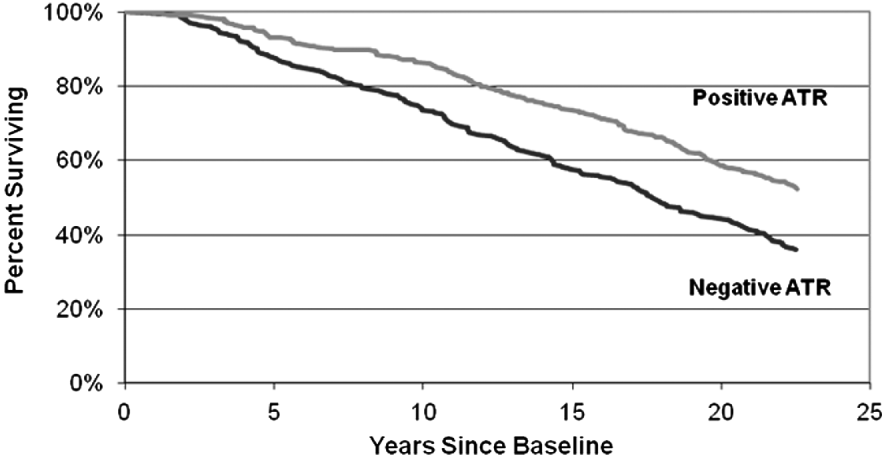
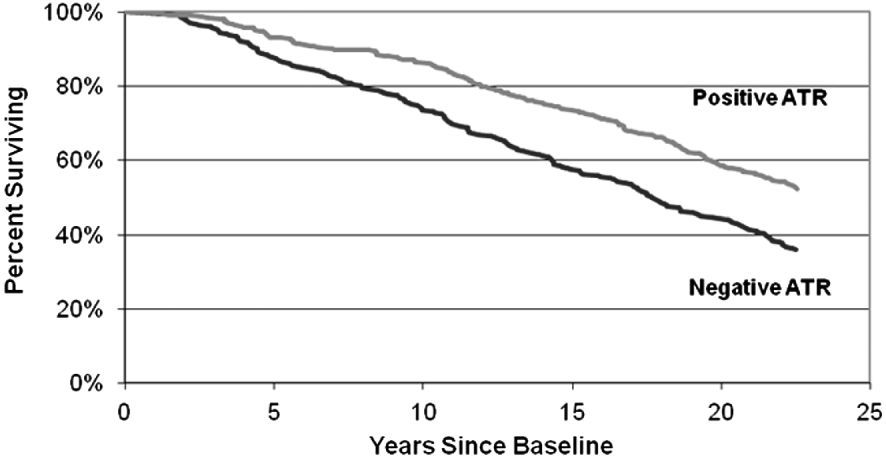
As predicted, participants with positive attitudes toward retirement tended to live significantly longer than those with negative attitudes toward retirement, even after controlling for relevant variables. Over the 23 years of follow-up, 48 per cent of those in the positive attitudes-toward-retirement group died and 64 per cent of those in the negative attitudes-toward-retirement group died. Based on a Kaplan–Meier analysis of participants' survival times, those with positive attitudes toward retirement had a 52 per cent probability of surviving, but among those with negative attitudes toward retirement, it was reduced to 36 per cent (see Figure 1).
Participants with positive attitudes toward retirement had a median survival benefit of 4.9 years, relative to those with negative attitudes toward retirement. The two groups were compared through the use of the log-rank statistic, which indicated a statistically significant difference in survival (p < 0.001). This was confirmed with a univariate Cox-proportional-hazards regression model in which the dichotomous version of the positive attitudes toward retirement was entered as the sole explanatory variable and mortality served as the outcome. The hazard ratio for all-cause mortality was 0.62 (p < 0.001), indicating that those with positive attitudes toward retirement were 1.38 times more likely to survive during the study, relative to those with negative attitudes toward retirement.
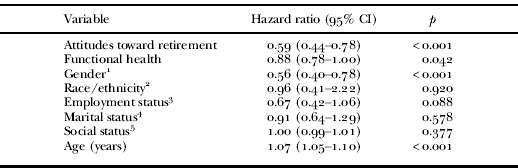
In the multivariate Cox-proportional-hazards regression model, participants in the positive attitudes-toward-retirement group tended to survive longer than those in the negative attitudes-toward-retirement group (hazard ratio = 0.59, p < 0.001), after controlling for all covariates (see Table 1). Based on this model, with covariates included, those in the positive attitudes-toward-retirement group were 1.41 times more likely to survive, relative to those in the negative attitudes-toward-retirement group.
Protective effect of positive attitudes toward retirement on survival
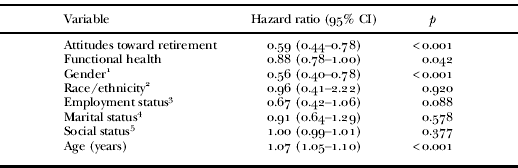
Notes: CI: confidence interval. 1. Males are the reference category. 2. Whites are the reference category. 3. Being retired is the reference category. 4. Being single is the reference category. 5. Higher values represent lower status.
When we examined the relative contribution of each variable to survival in the multivariate model, we found attitudes toward retirement had the third greatest contribution, following age and gender. Attitudes toward retirement, thus, made a greater contribution to survival than all other covariates including functional health.
With attitudes toward retirement as a continuous variable, more positive attitudes toward retirement were associated with better survival (hazard ratio = 0.98, p = 0.001), after controlling for all of the covariates. This indicates that each one unit increase in the positivity of the attitudes-toward-retirement score was associated with a 2.2 per cent decrease in risk of death over the 23-year follow-up.
For those working, having positive attitudes toward retirement was associated with better survival (hazard ratio = 0.64, p < 0.001), after controlling for all the covariates. This indicates that those with positive attitudes toward retirement were 1.36 times more likely to survive during follow-up, relative to those with negative attitudes toward retirement. The log-rank test confirmed that these groups significantly differed at p < 0.05.
For those retired, after controlling for covariates, having positive attitudes toward retirement was also associated with better survival (hazard ratio = 0.55, p < 0.001). This indicates that those with more negative attitudes toward retirement were 1.45 times more likely to die during follow-up, relative to those with more positive attitudes toward retirement. The log-rank statistic indicated a significant difference in survival experience (p < 0.001).
In addition, the advantage of positive attitudes toward retirement was found for both the younger and older participants in our sample. After stratifying the sample into those less than the mean age of 63 years and those 63 and above, we found that for the younger group, in the multivariate Cox-proportional-hazards regression model, participants' positive attitude toward retirement was a significant predictor of survival with a hazard ratio of 0.612, p=0.03, after controlling for all covariates. Those in the positive-attitudes-toward-retirement group were 1.39 times more likely to survive, relative to those in the negative-attitudes-toward-retirement group.
Similarly, in the older group, positive attitudes toward retirement was a significant predictor of survival with a hazard ratio of 0.650, p=0.02, after controlling for all covariates. Those in the positive-attitudes-toward-retirement group were 1.35 times more likely to survive, relative to those in the negative-attitudes-toward retirement group.
Discussion
Participants with more positive attitudes toward retirement at baseline tended to live longer over the subsequent 23 years. Those with positive attitudes toward retirement had a 1.41 lower risk of death, as compared to those with negative attitudes toward retirement, after controlling for relevant variables.
The association of attitudes toward retirement with mortality of retirees was greater than it was with mortality of workers. This greater attitude-toward-retirement survival advantage of those who are already retired may be explained by a self-fulfilling prophecy, whereby the perception of retirement becomes reality. That is, the expectation of an unsatisfactory retirement, as reflected by negative attitudes toward retirement, may contribute to experiencing a more unsatisfactory retirement – which, in turn, may compound the negativity of attitudes toward retirement.
This retirement expectation, as assessed by negative attitudes toward retirement, dealt specifically with health itself (i.e. sick), as well as generally with the capacity to cope with matters relating to health (e.g. dependent). Concomitantly, the opposite attitudes toward retirement pairs (e.g. healthy and independent) may begin a loop of expecting and experiencing satisfactory retirement, leading to compounding the attitudes toward retirement in a positive direction.
Although previous research has stressed the importance of considering how individual differences impact retirement (e.g. Wang Reference Wang2007), we found that the effect size of attitudes toward retirement was greater than functional health, marital status, race/ethnicity, and socio-economic status. This suggests there are overarching cultural influences in attitudes toward retirement that transcend these individual attributes.
Although future research is needed to identify the precise mechanisms by which the attitudes toward retirement contribute to mortality, it is likely that health behaviours are at least partially responsible. It has been shown that individuals with negative self-perceptions of ageing are less likely to engage in healthy behaviours, such as adhering to prescribed medications and eating nutritional meals (Levy and Myers Reference Levy and Myers2004). A sense of fatality about the chances for successful ageing acts as a disincentive for healthy behaviours' and this may equally apply when successful retirement is considered unlikely.
Another potential pathway would result if the negative attitudes toward retirement generate stress by defining retirement in terms that are a threat to wellbeing. Consistent with this, many of the participants categorised as having negative attitudes toward retirement in our study endorsed the terms empty and hopeless as indicative of retirement. Insofar as attitudes toward retirement are part of views of ageing, research suggests that response to stress may mediate the impact of these attitudes on health. One study found that when older individuals had their negative views of ageing activated, they demonstrated an exacerbated cardiovascular response to stress (Levy et al. Reference Levy, Hausdorff, Hencke and Wei2000). Another study found that individuals with more negative views of ageing were more likely to experience cardiovascular events decades later (Levy et al. Reference Levy, Zonderman, Slade and Ferrucci2009). Stress is a well documented risk factor for cardiovascular events and cancer (e.g. Jiang et al. 1996; Reiche, Nunes and Morimoto Reference Reiche, Nunes and Morimoto2004).
In future research, it would be interesting to examine the development of attitudes toward retirement. This might include establishing how early-in-life attitudes toward retirement are acquired and an examination of the cultural sources of attitudes toward retirement – for example, the role of the media. Ideally, such aspects of the attitudes toward retirement development would be considered cross-culturally, both in terms of looking at disparate groups within a country, and by comparing disparate countries.
Traditionally, preparations for retirement have focused on financial matters, but our findings indicate that psychological preparedness also deserves attention. Insofar as the attitudes-toward-retirement survival effect was found among participants who were workers as well as retirees when it was assessed, this suggests there is a linkage between these lifestages that is often overlooked. Accordingly, it would be appropriate to begin an intervention for a more positive attitude toward retirement prior to retirement. This offers the prospect of benefiting both the quality of retirement and its duration.