Risky sexual behavior (RSB) in adolescence, which are behavioral patterns that increase risk for sexually transmitted infections (STIs) and unintended pregnancy, constitute a serious adolescent health problem. Sexual activity has become normative among American teenagers, with more than two-thirds of adolescents engaging in sexual intercourse before age 19 (Terry-Humen, Manlove, & Cottingham, Reference Terry-Humen, Manlove and Cottingham2006). Despite this prevalence, only a small proportion (10%–20%) of sexually active adolescents use condoms consistently (Kotchick, Shaffer, Forehand, & Miller, Reference Kotchick, Shaffer, Forehand and Miller2001). These alarmingly high rates of unprotected sexual activity are compounded by behavioral patterns that include multiple short-term sexual partners in adolescence (Overby & Kegeles, Reference Overby and Kegeles1994; Terry-Humen et al., Reference Terry-Humen, Manlove and Cottingham2006). Among the ramifications are high rates of adolescent pregnancy and STI. Indeed, in the United States, approximately 7%–11% of girls between the ages of 15 and 19 become pregnant each year (Cheesbrough, Ingham, & Massey, Reference Cheesbrough, Ingham and Massey1999; Ventura, Abma, Mosher, & Henshaw, Reference Ventura, Abma, Mosher and Henshaw2008) and 26% of girls between the ages of 14 and 19 are infected with at least one of the most common STIs (Forhan et al., Reference Forhan, Gottlieb, Sternberg, Xu and Berman2008). Given the pervasiveness and consequences of teenage pregnancy and STI, it is critical to understand the life experiences and pathways that increase risk for or protect against RSB in adolescents. This understanding would have great relevance to the long-term goal of informing early prevention–intervention strategies for high-risk youth.
Many correlational studies have identified (a) biological family disruption/father absence (i.e., separation/divorce of the birth parents followed by absence of the birth father from the home) and (b) low-quality parent–child relationships (e.g., harsh–conflictual parent–child relationships, low parental warmth or supportiveness, lack of parental monitoring or supervision) as risk factors for RSB in adolescence (Biglan et al., Reference Biglan, Metzler, Wirt, Ary, Noell and Ochs1990; Coley, Medeiros, & Schindler, Reference Coley, Medeiros and Schindler2008; Coley, Votruba-Drzal, & Schindler, Reference Coley, Votruba-Drzal and Schindler2009; Davis & Friel, Reference Davis and Friel2001; Ellis et al., Reference Ellis, Bates, Dodge, Fergusson, Horwood and Pettit2003; Huebner & Howell, Reference Huebner and Howell2003; Longmore, Manning, & Giordano, Reference Longmore, Manning and Giordano2001; McBride, Paikoff, & Holmbeck, Reference McBride, Paikoff and Holmbeck2003; Miller, Forehand, & Kotchick, Reference Miller, Forehand and Kotchick1999; Ream & Savin-Williams, Reference Ream and Savin-Williams2005; Rodgers, Reference Rodgers1999; Romer et al., Reference Romer, Stanton, Galbraith, Feigelman, Black and Li1999; Rose et al., Reference Rose, Koo, Bhaskar, Anderson, White and Jenkins2005; Zimmer-Gembeck & Helfand, Reference Zimmer-Gembeck and Helfand2008). Moreover, the earlier family disruption/father absence occurs, the earlier daughters tend to initiate sexual activity and become pregnant (Ellis et al., Reference Ellis, Bates, Dodge, Fergusson, Horwood and Pettit2003). Although this body of research has established replicable empirical phenomena, it has not determined causality because extant correlational designs have not been able to rule out third-variable confounds. Specifically, there are three competing classes of explanation for the observed relations between family environments and RSB:
1. Family disruption/father absence and/or low-quality parent–child relationships may actually cause higher levels of RSB. An array of theories in the field of human development—attachment-based theories (e.g., Bowlby, Reference Bowlby1988; Cassidy & Shaver, Reference Cassidy and Shaver1999), social learning theories (e.g., Bandura, Reference Bandura1977), evolutionary–developmental theories (e.g., Belsky, Steinberg, & Draper, Reference Belsky, Steinberg and Draper1991), and life-stress models (e.g., Fergusson & Woodward, Reference Fergusson and Woodward2000; Scaramella, Conger, Simons, & Whitbeck, Reference Scaramella, Conger, Simons and Whitbeck1998)—converge on the hypothesis that childhood exposures to family disruption/father absence and dysfunctional parenting, including but not limited to dysfunctional fathering, induce emotionally and behaviorally dysregulated psychological functioning in adolescence, including elevated levels of RSB. Within this context, the focus of the current study on father presence–absence and the quality of father–daughter relationships (FDRs) was guided by an evolutionary–developmental model—paternal investment theory (Draper & Harpending, Reference Draper and Harpending1982, Reference Draper, Harpending and MacDonald1988; Ellis, Reference Ellis2004; Geary, Reference Geary2000)—that posits a unique role for fathers in families in regulating daughters' sexual development and behavior (see Discussion, for an extended treatment of paternal investment theory). This emphasis on the unique effects of fathers, independent of the effects of mothers and other sources of stress and support in and around the family, distinguishes paternal investment theory from the other theories cited above. Although paternal investment theory has been programmatically tested in past research in our laboratory and has garnered reasonable support (Ellis & Essex, Reference Ellis and Essex2007; Ellis et al., Reference Ellis, Bates, Dodge, Fergusson, Horwood and Pettit2003; Ellis & Garber, Reference Ellis and Garber2000; Ellis, McFadyen-Ketchum, Dodge, Pettit, & Bates, Reference Ellis, McFadyen-Ketchum, Dodge, Pettit and Bates1999; Tither & Ellis, Reference Tither and Ellis2008; see also Coley et al., Reference Coley, Votruba-Drzal and Schindler2009; Ream & Savin-Williams, Reference Ream and Savin-Williams2005; Rodgers, Reference Rodgers1999), past studies have not provided adequate tests of the causal influence of family disruption/father absence and FDR quality on the timing, incidence, or diversity of sexual behavior in adolescent daughters. Thus, the current study was designed to test the specific hypothesis, drawn from paternal investment theory, that higher quality FDRs uniquely decrease risk for (are protective against) RSB in daughters.
Although this hypothesis is not inconsistent with any of the major theories cited above, it could still be wrong. As a cautionary note, consider that these same theories have posited that harsh parenting causes aggressive behavior in children; yet, the well-established empirical correlation between corporal punishment and child conduct problems is apparently spurious (i.e., accounted for by children's heritable characteristics; Jaffee et al., Reference Jaffee, Caspi, Moffitt, Polo-Tomas, Price and Taylor2004; Moffitt, Reference Moffitt2005).Footnote 1
2. “Effects” of family disruption/father absence and/or low-quality parent–child relationships on RSB may derive from a family-wide environmental confound. Family-wide environmental effects are causal factors that differ between families but are shared within families (e.g., socioeconomic status [SES], religion, race, parental psychopathology). A family-wide environmental confound could cause family disruption/father absence and/or low-quality parental investment, on the one hand, and RSB, on the other. For example, poverty is associated not only with elevated rates of family disruption/father absence (e.g., Ellis et al., Reference Ellis, Bates, Dodge, Fergusson, Horwood and Pettit2003) and elevated levels of conflict and coercion within families (e.g., Conger, Ge, Elder, Lorenz, & Simons, Reference Conger, Ge, Elder, Lorenz and Simons1994; Ellis et al., Reference Ellis, McFadyen-Ketchum, Dodge, Pettit and Bates1999) but also with heightened levels of RSB (e.g., Chandy, Harris, Blu, & Resnick, Reference Chandy, Harris, Blum and Resnick1994; Coley et al., Reference Coley, Medeiros and Schindler2008; Ellis et al., Reference Ellis, Bates, Dodge, Fergusson, Horwood and Pettit2003). If poverty (or some other family-wide environmental factor) is the underlying cause of the relations between either family disruption/father absence or low-quality parental investment and RSB, then the “effects” of these variables on RSB are in fact spurious (i.e., they arise from a third environmental variable).
3. “Effects” of family disruption/father absence and/or low-quality parent–child relationships on RSB may derive from a genetic confound. Behavior geneticists refer to this type of association as a gene–environment correlation. Parents who have aggressive, coercive, conflictual personalities may pass on genes for these personality traits to their children (e.g., Moffitt, Reference Moffitt2005; Rhee & Waldman, Reference Rhee and Waldman2002), as expressed in externalizing behavior problems. Such parents are also at increased risk of becoming single parents or absent parents (e.g., Emery, Waldron, Kitzmann, & Aaron, Reference Emery, Waldron, Kitzmann and Aaron1999; Sampson & Laub, Reference Sampson and Laub1990). In turn, children who display externalizing behavioral problems early in life are at elevated risk for a variety of negative psychosocial outcomes in adolescence, including RSB (e.g., Bardone, Moffitt, Caspi, Dickson, & Silva, Reference Bardone, Moffitt, Caspi, Dickson and Silva1996; Ellis et al., Reference Ellis, Bates, Dodge, Fergusson, Horwood and Pettit2003; Quinton, Pickles, Maughan, & Rutter, Reference Quinton, Pickles, Maughan and Rutter1993; Timmermans, van Lier, & Koot, Reference Timmermans, van Lier and Koot2008; Woodward & Fergusson, Reference Woodward and Fergusson1999). Thus, children who experience family disruption/father absence and/or dysfunctional parenting may display elevated levels of RSB because of higher genetic loading for externalizing behavior problems. Indeed, any genetic factor that is shared by parents and offspring that influences RSB and correlates with family disruption/father absence or low-quality parenting could account for the relations between these variables.
Past Attempts to Address Potential Environmental and Genetic Confounds
Because children cannot be randomly assigned to parenting conditions, past attempts to distinguish between these opposing classes of explanation (causal vs. spurious) have generally relied on establishing temporal precedence through longitudinal analysis and/or incorporating appropriate control variables. Some investigations have demonstrated that family disruption/father absence or low-quality parenting in early to middle childhood (prior to the onset of RSB) predicts subsequent levels of RSB (e.g., Ellis et al., Reference Ellis, Bates, Dodge, Fergusson, Horwood and Pettit2003; McBride et al., Reference McBride, Paikoff and Holmbeck2003). Even in such longitudinal analyses, however, third-variable confounds remain problematic. To address this issue, various studies have tested for associations between family disruption/father absence or low-quality parenting and RSB while statistically controlling for such potential confounds as SES, race/ethnicity, gender, family size, stressful life events, child emotional and behavioral problems, pubertal development, preadolescent hugging and kissing, and early adolescent sexual behavior (Biglan et al., Reference Biglan, Metzler, Wirt, Ary, Noell and Ochs1990; Chandy et al., Reference Chandy, Harris, Blum and Resnick1994; Coley et al., Reference Coley, Medeiros and Schindler2008, Reference Coley, Votruba-Drzal and Schindler2009; Ellis et al., Reference Ellis, Bates, Dodge, Fergusson, Horwood and Pettit2003; Friedrich, Lysne, Sim, & Shamos, Reference Friedrich, Lysne, Sim and Shamos2004; McBride et al., Reference McBride, Paikoff and Holmbeck2003; Metzler, Noell, Biglan, Ary, & Smolkowski, Reference Metzler, Noell, Biglan, Ary and Smolkowski1994; Mezzich et al., Reference Mezzich, Tarter, Giancola, Lu, Kirisci and Parks1997). Although the effects of family disruption/father absence and of low-quality parenting remained statistically significant in most extant studies after incorporating appropriate controls, the covariate adjustment method necessarily relies on a somewhat arbitrary and incomplete set of control variables that the researcher has measured; it cannot account for unmeasured environmental or genetic factors. This limitation highlights the need for genetically and environmentally controlled research designs that incorporate environmental measures.
One previous research group (D'Onofrio et al., Reference D'Onofrio, Turkheimer, Emery, Slutske, Heath and Madden2006; Mendle et al., Reference Mendle, Harden, Turkheimer, van Hulle, D'Onofrio and Brooks-Gunn2009) examined the effects of family disruption/father absence on an indicator of RSB, which is age at first sexual intercourse, using a research design that controls for environmental and genetic influences that are shared by cousins as a result of having mothers who are sisters. The method compares sisters/mothers (first generation) who have each married and had children (second generation: cousins), but who are discordant for divorce. Although the cousins share either 25% or 12.5% of their genetic makeup through maternal descent (depending on whether the mothers are identical twins or full siblings), they have different environmental exposures to family disruption/father absence. Examining the potential impact of this differential exposure, D'Onofrio et al. (Reference D'Onofrio, Turkheimer, Emery, Slutske, Heath and Madden2006) and Mendle et al. (Reference Mendle, Harden, Turkheimer, van Hulle, D'Onofrio and Brooks-Gunn2009) found mixed support for a causal effect of family disruption/father absence on sexual initiation in cousins. Although the children of sisters design constitutes an important methodological advance, the design does not control for either (a) the genetic and environmental influences of the sisters' spouses (Eaves, Silberg, & Maes, Reference Eaves, Silberg and Maes2005) or (b) genetic and environmental risk factors that influence only one of the adult sisters. Family-wide environmental confounds are a major challenge for this design because the children grow up in different homes. Further, the children of sisters methodology has only been used to examine the effects of the social address of father presence–absence and has not been applied to the quality of fathering.
The Current Sibling Design
The potential causal influence of exposure to family disruption/father absence and quality of fathering on RSB can be tested through the use of a differential sibling–exposure design, as developed by Tither and Ellis (Reference Tither and Ellis2008) and extended here. Because this design compares siblings who have the same biological father and mother and grow up in the same home, but are differentially exposed to levels and types of investment from their father (which are measured and analyzed), it does not share the limitations of children of sisters approach. Indeed, other than adoption methods, the current differential sibling–exposure design is the only causally informative method available for examining the impact of natural variation in quality of fathering on child developmental outcomes.
The logic of the differential sibling–exposure design is as follows. Past longitudinal research has demonstrated that girls who spend more of their childhoods in biologically father-absent households are at greater risk for early sexual activity and teenage pregnancy (Ellis et al., Reference Ellis, Bates, Dodge, Fergusson, Horwood and Pettit2003). Given this dose–response relationship: within families in which (a) full biological sisters are discrepant in age; (b) a divorce/separation occurs, resulting in disruption of the biological family unit and departure of the father from the home; and (c) consequently, younger sisters in the family spend a larger proportion of their childhood living in a biologically disrupted/father-absent home than do their older sisters, the younger sisters should engage in more RSB (Hypothesis 1). This is because the younger sisters receive a larger dose of family disruption/father-absence and associated factors (i.e., factors that differ between sisters after, and as a result of, family disruption/father absence).
In addition, this should not be explicable as a birth-order or birth-spacing effect because sisters of different ages from biologically intact families should not systematically differ in RSB because they do not systematically differ in exposure to their fathers. The differential sibling-exposure design, therefore, necessitates inclusion of a control sample of sisters from biologically intact families whose birth spacing and birth order match the study sample of sisters from biologically disrupted/father-absent families. According to the genetic transmission model, and in direct contrast with Hypothesis 1, full biological sisters should not systematically differ in RSB as a function of birth order or birth spacing (even if they have spent different amounts of their childhoods in biologically disrupted families).
The differential sibling-exposure design enables testing of Hypothesis 1 through the following three-way interaction: the effect of birth order of sisters (younger vs. older) on RSB should be moderated by a combination of family type (biologically disrupted vs. biologically intact) and the age gap between sisters (with age gap corresponding to the minimum difference between sisters from divorced/separated families in the amount of time that they resided in biologically intact vs. biologically disrupted homes). The causal hypothesis is that differences between younger and older sisters in RSB will be greatest in divorced/separated families when there is a large age gap between the sisters (thus maximizing differential exposure to family disruption/father absence), with younger sisters at greater risk.
This social address approach to father presence–absence assumes that being there is what counts. However, because all fathers are not equal, it is unlikely that living in a biologically intact versus biologically disrupted family is always either good or bad for children. Rather, the effects of fathers in families are likely to be moderated by what fathers do. Using the same differential sibling-exposure design that was employed in the current study, Tither and Ellis (Reference Tither and Ellis2008) found that the effects of differential exposure to fathers on daughters' age at menarche depended on the father's level of social deviance. Specifically, younger sisters from biologically disrupted families who were exposed to serious paternal dysfunction in early childhood, followed by the exit of that father from the home, attained menarche about 11 months earlier than either their older sisters or other younger sisters from biologically disrupted families who were not exposed to such dysfunction. Likewise, Jaffee, Moffitt, Caspi, and Taylor (Reference Jaffee, Moffitt, Caspi and Taylor2003) and Blazei, Iacono, and McGue (Reference Blazei, Iacono and McGue2008) found that the potential benefits of living with two biological parents was contingent on the father's behavioral adjustment (see also DeGarmo, Reference DeGarmo2010). Among children and adolescents whose fathers engaged in low levels of antisocial behavior, coresidence with the father was associated with lower rates of conduct problems. Conversely, among children and adolescents whose fathers engaged in high levels of antisocial behavior, coresidence was associated with higher rates of conduct problems.
These theory and data suggest that Hypothesis 1, and the three-way interaction specified to test it, should be conditioned by quality of fathering. Because older sisters in divorced families have more residential exposure to their fathers than do their younger sisters, the impact of quality of fathering and associated factors on RSB should be significantly greater in older than younger sisters (Hypothesis 2). In addition, this should not be explicable as a birth order/birth spacing effect because the influence of quality of fathering on RSB should not significantly differ across older versus younger sisters in biologically intact families. In contrast, according to the genetic transmission model, the effect of quality of fathering on RSB should not differ between sisters as a function of how long they lived with their father while growing up.
In total, we predicted and tested for the following four-way interaction: the effect of quality of fathering on RSB should be moderated by a combination of family type (biologically disrupted vs. biologically intact), the birth order of sisters (older vs. younger), and the age gap between sisters. The causal hypothesis is that differences between older and younger sisters in the effect of quality of fathering (harsh–coercive fathering, warm–supportive fathering) on RSB should be greatest in biologically disrupted families when there is a large age gap between the sisters (thus maximizing differential exposure to fathers). In this family context, the influence of higher quality fathering should be significantly stronger (operate as a greater protective factor against RSB) in older than younger sisters (Hypothesis 2).
A methodological advance of the current sibling design is that it controls for confounding variables, which are factors that differ between sisters prior to family disruption/father absence, at three levels. First, family-wide environmental effects are controlled through within-family analyses. Specifically, direct comparisons between biological siblings in the same home obviate confounding effects associated with comparisons between individuals from different homes, such as differences between individuals in race/ethnicity, SES, and religion (Rodgers, Cleveland, van den Oord, & Rowe, Reference Rodgers, Cleveland, van den Oord and Rowe2000; Sulloway, Reference Sulloway1996; Tither & Ellis, Reference Tither and Ellis2008). Second, genetic effects are controlled through randomization. Because the breaking up and reshuffling of parental genomes through meiosis randomly distributes alleles of the parents' genes across offspring, genetic differences between sisters should be randomly distributed across birth order. Specifically, there is no reason to expect that either younger sisters or older sisters, as a group, have systematically greater genetic liability for anything. (For example, imagine 100 families that have four children and a genetic risk for alcoholism. On average, the 100 first borns of each family will have the same genetic risk for alcoholism as the 100 second borns, and so on.) Third, including sister pairs from biologically intact families as a comparison group controls for birth order and birth spacing effects. By controlling for all three levels of confounding variables, the current differential sibling exposure design enabled us to test whether the different (nonshared) experiences of sisters within biologically disrupted families caused differences in RSB. The measured nonshared environmental variables were differential exposure to family disruption/father absence (Hypothesis 1) and quality of fathering (Hypothesis 2).
A further advantage of the differential sibling exposure design is that it enables examination of father effects independent of mother effects (which is critical to testing paternal investment theory). Because comparisons are within-family, and both daughters have the same mother and live with her throughout their childhoods, the design stringently controls for maternal characteristics and behavior. Nonetheless, it is possible that the effects of FDRs could be confounded by mother–daughter relationships (MDRs). To address this issue, quality of MDRs was measured and controlled for in testing Hypothesis 2 (regarding the effects of fathering quality).
Method
The current research necessitated a retrospective design. On the one hand, the methodology requires that pairs of sisters are several years apart in age (so as to ensure large within-pair differences in amount of exposure to their fathers). Following Tither and Ellis (Reference Tither and Ellis2008), we set the minimum age difference between sisters at 4 years. On the other hand, the design requires outcome information about the same stage of development—adolescence—so as to obtain equivalent and uncensored information about RSB from each sister. To meet both requirements, all participants had to be at least 18 years old. To limit the span of retrospective recall, we set the maximum age of participants at 36 years.
The foremost challenge of this research design is obtaining a sample of full biological sister pairs who are at least 4 years apart in age, experienced the dissolution of their parents' relationship when the younger sister was under age 14 (before the likely onset of RSB), and then lived primarily or in joint custody with their mother. Because such sister pairs are rare, they are very difficult to obtain through standard sampling methods and instead must be located through targeted advertising. Although advertising results in a self-selected sample, this is not a major issue in the current research design because all analyses compared sisters in the same family to each other, thus controlling for the confounding effects of genetics and environmental differences between families. Further, as summarized below, the demographics of the sample were largely representative of the United States, and the pattern of covariation among variables was consistent with past family research.
Participants
Recruitment
To solicit participation of sisters from both biologically disrupted families and biologically intact families, the following advertisement was placed on Craigslist (www.craigslist.org) in several major US cities over a 6-month time period:
SISTERS WANTED! (and their parents) to complete a questionnaire. Are you from a family in which there are two sisters who are at least 4 years apart in age? Are both sisters currently between the ages of 18 and 36? Did the birth parents separate or divorce while the younger sister was under 14 years of age? [Sentence deleted when recruiting biologically intact families.]
Compensation is provided for completing a simple questionnaire that takes about 1 hr. We are looking for sisters and their parents to participate in a paid research study on behalf of the University of Arizona investigating the influence of family relationships on behavior. Sisters will complete a questionnaire that asks about your teenage years, your life now, and your family relationships. Parents will complete a questionnaire that asks about your family relationships and behavior. Your responses to this research are strictly confidential. This study has been reviewed and approved by the University of Arizona Human Subjects Protection Program.
Respondents to the advertisement were screened by telephone for age, demographics, and family composition. Of the 274 respondents (families), 130 sister pairs met eligibility criteria, were invited to participate in the study, and were mailed questionnaires; 144 sister pairs failed to meet eligibility criteria (e.g., sisters too close in age, sisters had different fathers or mothers, younger sister too old at time of divorce, participants currently too old or young) and were excluded. Of the 130 eligible pairs, 101 were successfully recruited into the study and 29 were not (either one or both sisters did not complete the questionnaire). The final analytic sample included 42 sister pairs from biologically intact families and 59 sister pairs from biologically disrupted families (N = 202 individuals). At prescreening, all respondents were asked about their race/ethnicity, number of siblings, mother's highest education level, father's highest education level, and general SES while growing up (poor, lower middle class, middle class, upper middle class, wealthy). Independent samples t tests and chi-square analyses were conducted, as appropriate, to test for differences between the 101 participating families and the 173 families who were screened but did not participate; no statistically significant differences emerged on any of the screening variables. Thus, the analytic sample appears to be representative of the total population of individuals responding to the advertisements. Although we did not ask about languages spoken in the home, all participants were fluent in English.
In the 42 biologically intact families, the parents were married or cohabitated throughout both of the sisters' childhoods (birth to age 18). In the 59 biologically disrupted families, the parental union terminated through divorce or separation when the younger sister was under 14 years of age. In the biologically disrupted families, the average age of the younger sisters was 6.42 years (SD = 4.01) and the older sisters was 13.10 years (SD = 4.37) at the time of divorce/separation. The average age difference between sisters was 6.58 years (SD = 2.17) in biologically disrupted families and 6.48 years (SD = 1.99) in biologically intact families. After the divorce/separation, sisters lived primarily with their mother (84%) or jointly with their mother and father (16%). At the time of data collection, age of the younger sisters ranged from 18 to 32 years (M = 23.44, SD = 4.10) and age of older sisters ranged from 22 to 36 years (M = 29.89, SD = 4.05).
We also sought to recruit mothers into the study. Although we obtained the participation of a high percentage of the mothers from the biologically intact families (86%), we were less successful in recruiting mothers from the biologically disrupted families (66%). Because analysis of disrupted families was critical to the current research design, and because one-third of mothers from disrupted families did not participate, mother data were not used in the multivariate analyses. However, mothers in disrupted families may be in a unique position to report on the amount of time that daughters spent with their biological fathers before and after family disruption (given that some of the younger sisters in our study would have been too young to remember levels of predivorce paternal involvement). Thus, as described below, we report descriptive data from mothers regarding amounts of time that fathers spent caring for their daughters before and after the separation/divorce.
Demographics
Because the current sample was obtained through advertising, it is important to show that its demographic characteristics are not unusual. Accordingly, we report demographic comparisons between the current sample and US Census data (United States Census, 2000). The present sample was racially and ethnically diverse (59% Caucasian [non-Hispanic], 18% Hispanic, 16% African American, 7% other) and parallels the racial–ethnic profile of the US population (Census data: 63% Caucasian [one race, non-Hispanic]; 13% Hispanic or Latino [of any race], 12% African American [one race]). To gauge family SES, sisters reported on father's occupational status and mother's education. Using the Hollingshead (Reference Hollingshead1975) system, families were classified into nine groups on the basis of paternal occupation. For the present purposes, the Hollingshead coding was reduced to a three-level classification as follows: Levels 1/2/3 (21%; laborers, semiskilled, service Industry workers); Levels 4/5/6 (46%; craftsmen, small business owners, clerical, technicians); Levels 7/8/9 (33%; professional, managerial, executive, large business owners). These numbers again closely matched population statistics (Census data for full time workers over age 16: Levels 1/2/3 [22%]; Levels 4/5/6 [46%]; Levels 7/8/9 [32%]). Finally, mothers' highest level of education was coded into five levels: no high school diploma or GED (8%); high school diploma or GED (23%); some college (36%); Bachelor's degree (22%); advanced degree (12%). These numbers also approximated population statistics (census data for individuals 40–45 years old: no high school diploma or GED [15%]; high school diploma or GED [29%]; some college [31%]; bachelor's degree [17%]; advanced degree [9%]). In sum, the demographics of our sample were largely representative of the United States. Nonetheless, the relatively low number of mothers with no high school diploma or GED suggests that the current sample may not adequately represent very low socioeconomic or impoverished subpopulations.
Measures
Quality of FDRs and MDRs
Two scales were used to create measures of the quality of FDRs and MDRs. The first scale measured harsh–coercive fathering/mothering and was derived from a subset of items from the parent–child version of the Conflict Tactics Scale (Jouriles, Mehta, McDonald, & Francis, Reference Jouriles, Mehta, McDonald and Francis1997; Straus, Reference Strauss1979), adapted for use in this study. Using a 4-point scale (0 = very unlike, to 3 = very like), participants answered the following questions about their father and mother separately: “My father/mother swore (cursed) at me”; “. . . insulted me or put me down”; “. . . acted in a way that made me afraid that I might be physically hurt”; and “. . . pushed, grabbed, or slapped me.” Participants were instructed to report the extent to which each item described their father/mother during the first 16 years of their lives. Scores on the four items were averaged together to form a composite measure of harsh–coercive fathering (biologically disrupted families: M = 0.55, SD = 0.78; biologically intact families: M = 0.39, SD = 0.61; α = 0.86) and harsh–coercive mothering (biologically disrupted families: M = 0.47, SD = 0.65; biologically intact families: M = 0.36, SD = 0.56; α = 0.80). Although retrospective reports by adults of coercive parental behavior are likely to underestimate the incidence of abuse/neglect, Hardt and Rutter (Reference Hardt and Rutter2004) conclude that these reports are still sufficiently valid to warrant their use. The validity of the current harsh–coercive parenting measures is supported by the moderate to strong correlations between younger and older sisters: harsh–coercive fathering: r (101) = .67, p < .001; harsh–coercive mothering: r (101) = .41, p < .001; collapsed across family type.
The second scale, which measured paternal/maternal warmth–supportiveness, was the 12-item care subscale of the Parental Bonding Inventory (Parker, Tupling, & Brown, Reference Parker, Tupling and Brown1979). Using a 4-point scale (0 = very unlike, to 3 = very like), participants answered the questions about their father and mother separately (e.g., “My father/mother spoke to me with a warm and friendly voice.” “My father/mother appeared to understand my problems and worries.”). Participants were again instructed to report the extent to which each item described their father/mother during the first 16 years of their lives. Scores on the 12 items were averaged to form a composite measure of warm–supportive fathering (biologically disrupted families: M = 1.55, SD = .89; biologically intact families: M = 2.05, SD = 0.80; α = 0.96) and warm–supportive mothering (biologically disrupted families: M = 2.15, SD = 0.70; biologically intact families: M = 2.39, SD = 0.71; α = 0.94). The validity of the current warm–supportive parenting measures is supported by the strong correlations between younger and older sisters: warm–supportive fathering: r (101) = .66, p < .001, warm–supportive mothering: r (101) = .51, p < .001; collapsed across family type. Further, the care subscale of the Parental Bonding Inventory has demonstrated high test–retest reliability over a 10-year period (Wilhelm & Parker, Reference Wilhelm and Parker1990) and correlates with many forms of adolescent behavioral adjustment and mental health (e.g., Chambers et al., Reference Chambers, Power, Loucks and Swanson2001; Gerra et al., Reference Gerra, Angioni, Zaimovic, Moi, Bussandri and Bertacca2004; Martin, Bergen, Roeger, & Allison, Reference Martin, Bergen, Roeger and Allison2004).
The measures of harsh–coercive parenting (reverse coded) and warm–supportive parenting were then standardized across sister and family type, for fathers and mothers separately, and averaged together to form overall measures of FDR quality (α = 0.72) and MDR quality (α = 0.76). To achieve grand mean centering, the composite measures were then standardized separately for fathers (biologically disrupted families: M = −0.18, SD = 1.03; biologically intact families: M = 0.25, SD = 0.91) and mothers (biologically disrupted families: M = −0.12, SD = 1.00; families with two biological parents: M = 0.16, SD = 0.98) for use in multivariate analysis. Higher scores indicate higher relationship quality.
Paternal care before and after family disruption
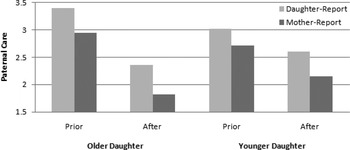
An assumption of the current research design is that paternal involvement declines following separation/divorce. To assess the amount of paternal care provided before and after family disruption, older and younger sisters in disrupted families were asked to report the number of hours per week their father spent taking care of them before and after their parents' separation/divorce. Responses were coded on a 5-point scale (1 = none, 2 = 1–2 hr, 3 = 3–5 hr, 4 = 6–19 hr, 5 = 20 hr or more). In addition, mothers from disrupted families (n = 39) also answered this question with respect to each of their daughters. Descriptive information on this variable is presented in Figure 1.
Mother and daughter reports of the amount of paternal care prior to and after family disruption.

RSB
RSB was based on number of sexual partners and amount of high-risk sexual activity. Participants reported the frequency of these sexual behaviors when they were high school age (14–17 years old). The first scale assessed number of sexual partners: “How many different partners did you have sex with before age 19?” To reduce the influence of outliers and induce a unimodal distribution, the open-ended reports of number of sexual partners were recoded into the following scale: 0 = none, 1 = one to two, 2 = three to five, 3 = six or more). In the metric of this recoded scale, the average number of sexual partners for sisters from biologically intact families and biologically disrupted families was 0.81 (SD = 0.92) and 1.14 (SD = 1.02), respectively. The second scale assessed frequency of high-risk sexual activity (behaviors that increased risk for STIs or pregnancy): “Did you ever have unprotected sex (i.e., sex without any method to prevent pregnancy or sexually transmitted disease)?” “Did you ever use alcohol and/or drugs prior to or in conjunction with participation in sexual activity?” “Did you ever engage in or experience sexual intercourse with an injection drug using partner?” “Did you ever engage in or experience sexual intercourse with someone who was physically forceful, hurting, or threatening to you?” “Did you ever engage in or experience concurrent (overlapping) sexual relationships with different partners?” “Did you ever receive money, drugs, or a place to stay in exchange for sexual activity with someone?” (0 = no, 1 = once or twice, 2 = three times or more). These six items showed good internal consistency (α = 0.72). Overall, 48.3% of sisters from biologically disrupted families and 33.3% of sisters from biologically intact families reported engaging in at least one of these high-risk behaviors between 14 and 17 years of age. The six items were standardized and averaged to form a composite measure of high-risk sexual behavior.
To create an overall measure of RSB, number of sexual partners was standardized and then combined with amount of high-risk sexual behavior in a unit-weighted composite (α = 0.69). Graphical inspection of the composite variable revealed two outliers (high scores), which were truncated. The final RSB measure was standardized to achieve grand mean centering with a mean of 0 and SD = 1. Mean levels of RSB were 0.13 (SD = 1.02) in biologically disrupted families and −0.18 (SD = 0.95) in biologically intact families. Although there is no gold standard for validating self-reports of sexual behavior, available evidence solidly supports the validity of such reports (Dunne et al., Reference Dunne, Martin, Statham, Pangan, Madden and Heath1997; Fishbein & Pequegnat, Reference Fishbein and Pequegnat2000; Hamilton & Morris, Reference Hamilton and Morris2010).
Data analysis
Data from sisters reared within the same household are likely to violate the assumption of independence (i.e., uncorrelated error terms) that is required for standard analysis of variance and regression approaches. Nonindependence of errors can result in inaccurate significance tests and erroneous conclusions if not modeled accordingly (Kenny, Kashy, & Cook, Reference Kenny, Kashy and Cook2006). To address this we used a commonly recommended technique for cross-sectional distinguishable dyads (described in detail in chapter 4 in Kenny, Kashy, & Cook, Reference Kenny, Kashy and Cook2006; see also Campbell & Kashy, Reference Campbell and Kashy2002; Kashy & Kenny, Reference Kashy, Kenny, Reis and Judd1997; Maguire, Reference Maguire1999). For the fixed predictor portion of the model, this technique is similar to the indistinguishable dyad model in that it makes use of a single dyad-level intercept. For the error covariance portion of the model, however, this technique differs from the indistinguishable dyad approach in that it specifies within-dyad correlated residuals (rather than including a random dyad-level intercept). In addition, because dyad members in the present analysis possess a distinguishable feature (older vs. younger sister), the indistinguishable dyad model was extended to include a dummy coded fixed-effect variable (older vs. younger sister) to model differences between sisters within families. This approach makes use of software designed for multilevel modeling to implement a generalized form of a mixed analysis of variance that (a) allows for both categorical and continuous predictors; (b) permits modeling of between-family effects (i.e., biologically intact vs. biologically disrupted; age gap between sisters), within-family effects (i.e., older vs. younger sister; quality of the FDR experienced by each sister), and their interactions; and (c) adjusts outcome scores for measurement error (Sayer & Klute, Reference Sayer, Klute, Bengtson, Acock, Allen, Dilworth-Anderson and Klein2005).
In this analysis, the REPEATED command in SAS PROC MIXED was used to specify a compound symmetric covariance structure for the residuals from sisters nested within families, and the Satterthwaite degrees of freedom estimation was used to adjust the degrees of freedom based on the amount of interdependence. Initial results showed a significant correlation for RSB between sisters within families, r (101) = .25, p < .05, indicating that the error terms for the dependent variable for sisters within families were indeed nonindependent. Having accounted for this interdependence between sisters within families, hypothesis testing can be conducted by specifying appropriate fixed effect models in the same way as is done in standard multiple regression. Parameters that are reported are from models that included all relevant covariates, predictors, and interaction effects.
Results
Preliminary analyses
Between-family correlations
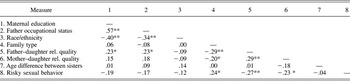
Because the current sample was recruited through targeted advertising, resulting in possible self-selection biases, it is important to show that the sample is not unusual, either in its demographics (as reviewed in the Method section) or in the pattern of relations among variables. Table 1 shows the between-family correlations (with older and younger sister reports averaged within families) for the study variables. As can be seen in the table, the pattern of between-family correlations largely conforms to expectations. Specifically, family SES was cohesive (i.e., paternal occupation and maternal education were strongly correlated). Lower SES families were more likely to be racial/ethnic minorities and to be characterized by lower quality FDRs and MDRs. Further, there was a positive correlation between quality of FDRs and MDRs. In addition, families in which girls engaged in more RSB were characterized by lower quality FDRs and MDRs. Finally, girls from biologically disrupted homes experienced significantly lower quality MDRs and FDRs and engaged in significantly more RSB. The one seemingly anomalous correlation was that SES was not associated with family structure (biologically disrupted vs. biologically intact). The likely explanation is that our sample did not include any single-mother families or short-term, unstable separated/divorced families. Instead, all of our biologically disrupted families were intact for many years prior to the divorce/separation (so as to produce two daughters who were several years apart in age). Paternal occupational status and maternal education simply did not discriminate between the long-term biological families that eventually did or did not dissolve.
Between-family correlations

Note: N = 101. Race/ethnicity (0 = Caucasian [non-Hispanic], 1 = other); Family type (0 = biologically intact, 1 = biologically disrupted). Correlations with race/ethnicity are point biserial; correlations with family type are biserial. Significance tests are two tailed.
*p < .05. **p < .01.
Changes in paternal care following family disruption
An assumption of the current differential sibling exposure design is that amount of contact with the father diminishes following biological family disruption. To test this assumption, we conducted paired samples t tests comparing levels of paternal care by the father (based on both daughter and mother reports) before and after family disruption. As shown in Figure 1, both older daughters, t (57) = 5.39, p < .001, and younger daughters, t (58) = 2.45, p < .05, reported that their fathers spent significantly more time caring for them prior to the divorce/separation than after it. Likewise, as shown in Figure 1, mothers reported that the fathers spent significantly more time caring for both their older daughters, t (37) = 5.13, p < .001, and younger daughters, t (38) = 2.29, p < .05, prior to the divorce/separation than after it. In total, consistent with past research showing greatly diminished contact between children and noncustodial fathers following divorce (e.g., Furstenberg & Nord, Reference Furstenberg and Nord1985; Fox, Reference Fox1995), these results support the assumption of diminished interaction with fathers following biological family disruption. Accordingly, younger sisters, who spent substantially more time in biologically disrupted/father-absent homes, experienced longer periods of diminished paternal care than did their older sisters. This finding serves as an important “manipulation check” for the current natural experiment on differential sibling exposure to fathers.
Between-family versus within-family variation
The differential sibling–exposure design enables analysis of the causes of within-family variation in child outcomes. The method depends, however, on substantial within-family variation in relevant outcome variables. As a first step in the analyses, therefore, we ran an unconditional means model to assess within- and between-family variance in RSB. The results indicated significant variance in RSB both within (σ2 = 0.75, p < .0001) and between (σ2 = 0.24, p < .05) families. With 75% of the variance in RSB occurring within families, there was ample room for within-family analyses.
Primary analyses
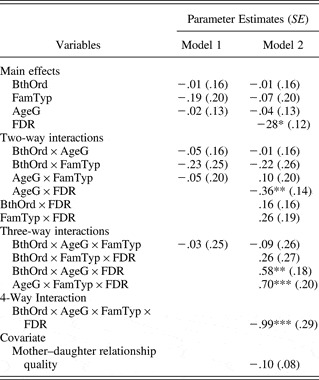
To test the study hypotheses, two separate models were assessed. Model 1 tested Hypothesis 1 (that greater exposure to family disruption/father absence causes more RSB in daughters); Model 2 tested Hypothesis 2 (that greater exposure to lower quality FDRs increases RSB). Although Table 2 shows all parameter estimates and standard errors for both models (with birth order coded as 0 = older, 1 = younger; family composition coded as 0 = biologically disrupted, 1 = biologically intact; and continuous predictors mean centered), we only interpret those parameters that are directly relevant to testing the hypotheses.
Parameter estimates (standard errors) for models predicting risky sexual behavior

Note: N = 101 sister pairs (202 individuals). Birth order of sisters (0 = older, 1 = younger). Family type (0 = biologically disrupted, 1 = biologically intact). All other covariates and main effects are continuous and mean centered. BthOrd, birth order of sisters; FamTyp, family type; AgeG, age gap between sisters; FDR, father–daughter relationship quality.
*p < .05. **p < .01. ***p < .001.
Model 1
As specified by Hypothesis 1, the effect of birth order of sisters (older vs. younger) on RSB should be moderated by a combination of family type (biologically disrupted vs. biologically intact) and the age gap between sisters; specifically, differences between younger and older sisters in RSB should be greatest in biologically disrupted families when there is a large age gap between the sisters (thus maximizing differential exposure to family disruption/father absence), with younger sisters in this context engaging in more RSB. Model 1 thus tested for a three-way interaction between the specified independent variables as follows:
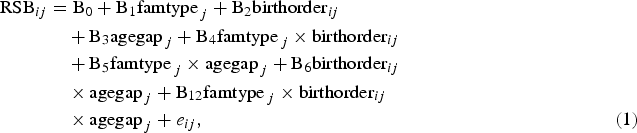
where i represents sister and j represents family with e ij assumed to be distributed normally, with a mean of zero and a compound symmetric covariance structure.
Hypothesis 1 was not supported: differences between sisters in amount of exposure to family disruption/father absence was not associated with differences in RSB, as evidenced by the nonsignificant three-way interaction, F (1, 97) = 0.02, ns. In total, there was no evidence in our data that greater exposure within families to family disruption/ father absence, without taking into account quality of fathering, increased RSB in daughters. This null finding should be interpreted with caution, however, because our relatively modest sample size did not provide adequate power to guarantee the detection of small effects. As such, our failure to detect an impact of family disruption/father absence may be purely due to limited statistical power.
Model 2
To test Hypothesis 2, we examined whether the three-way interaction tested in Model 1 was conditioned by quality of FDRs. Quality of MDRs was included as a covariate in Model 2. Simple effects included the three predictors from Model 1 (family type, birth order of sisters, and age gap between sisters) plus quality of FDR. The formula for Model 2 was as follows:

where i = sister, j = family with e ij assumed to be distributed normally with a mean of zero and a compound symmetric covariance structure.
Although Model 2 included all possible interaction terms, the a priori causal hypothesis targeted the four-way interaction (quality of the FDR in each sister × family type [biologically intact vs. biologically disrupted] × birth order of sisters [older vs. younger] × age gap between sisters), which the theory stipulated should be statistically significant, and two of the simple three-way interactions that were directly relevant to interpreting the four-way interaction. The targeted simple three-way interactions were between quality of FDR, birth order of sisters, and age gap between sisters (in biologically disrupted families and biologically intact families, respectively). We predicted that this simple three-way interaction would be significant in the biologically disrupted families but not in the biologically intact families. Specifically, in biologically disrupted families, differences between older and younger sisters in the effect of quality of the FDR on RSB should be greatest when there is a large age gap between the sisters (thus maximizing differential exposure to fathers).
We tested for the four-way interaction in the full model; it was statistically significant, F (1, 115) = 11.53, p < .001. To examine the effect size of the four-way interaction, a pseudo-R 2 was calculated from the within-person residuals comparing models with and without the four-way interaction (see Singer & Willett, Reference Singer and Willett2003). Results indicated that adding the four-way interaction explained an additional 9.4% of the variance in the within-person residuals. Our theoretical model guided our prediction that the four-way interaction would be a fairly large effect and thus detectable even with relatively low power. The relatively large effect size we observed supports this assumption and makes this finding even more notable.
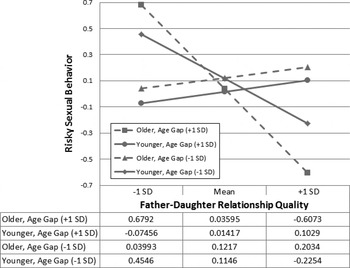
To interpret the interaction, we examined the two relevant simple three-way interactions. As predicted, the four-way interaction arose from the presence of a statistically significant simple three-way interaction (between quality of FDRs, birth order of sisters, and age gap between sisters) in the biologically disrupted families, t (118) = 3.27, p < .01, but not in the biologically intact families, t (113) = 1.78, ns. The simple three-way interaction in the biologically disrupted families is illustrated in Figure 2.
The Effects of father–daughter relationship (FDR) quality on risky sexual behavior (RSB) in daughters in biologically disrupted families. RSB is standardized. The set of 12 numbers at the bottom of the figure are the predicted values for RSB at the mean (0), low (−1 SD from the mean), and high (+1 SD from the mean) levels of FDR quality for older and younger sisters, respectively, with large and small age gaps between them.

The significant simple three-way interaction in the biologically disrupted families indicates that the effect of quality of FDRs on RSB depended on the birth order of sisters and the age gap between them. For older sisters that had a large age gap with their younger sisters (and thus resided with their father for a substantially longer period of time), there was a strong linear effect of FDR quality on RSB: simple slope: b = −0.64 (95% confidence interval [CI] = −1.01 to -0.28), t (183) = 3.45, p < .001. That is, among these older sisters, a 1 SD increase in FDR quality was associated with approximately 0.66 of a SD decrease in levels of RSB (Figure 2). In contrast, for younger sisters that had a large age gap with their older sisters (and thus resided with their father for much less of their childhood), there was not a statistically significant effect of FDR quality on RSB: simple slope: b = 0.09 (95% CI = −0.29 to 0.47), t (184) = 0.46, ns. Of importance, these simple slopes were significantly different from each other: interaction term: b = .73 (95% CI = 0.24 to 1.23), t (123) = 2.93, p < .01.
In contrast, for sisters from biologically disrupted families with small age gaps (who thus more closely resembled each other in amounts of time spent living with their father while growing up), the simple slopes of RSB on quality of FDRs were neither significantly different from zero nor significantly different from each other. Further, among sisters from biologically intact families, none of the simple slopes of RSB on FDR quality were statistically significant, regardless of whether the sisters were older or younger or had small or large age gaps between them.
In total, as specified by the theory, the effect of quality of FDRs on RSB was moderated by a combination of family type (biologically disrupted vs. biologically intact), the birth order of sisters (older vs. younger), and the age gap between sisters. Specifically, the effect of quality of FDRs on RSB was greatest in biologically disrupted families when there was a large age gap between the sisters (thus maximizing differential exposure to fathers). This differential exposure elevated risk more steeply in older sisters than younger sisters, as predicted by Hypothesis 2.
To genuinely demonstrate unique fathering effects, it is important to show that comparable results would not be obtained if we switched out FDR quality and MDR quality in the analyses. Accordingly, we reran the four-way interaction analysis exactly as described above, but included FDR (rather than MDR) quality as the covariate and included MDR (rather than FDR) quality at the level of main effects, two-way interactions, three-way interactions, and the four-way interaction. Neither the four-way interaction, F (1, 137) = 1.28, p = .26, nor the three-way interaction in biological disrupted/father-absent families, t (181) = .80, p = .43, was statistically significant. In total, quality of MDRs was not interchangeable with quality of FDRs, indicating a unique effect of fathering.
To further demonstrate unique fathering effects, it is also important to show that comparable results would not be obtained if we switched out FDR quality with a more general parenting measure (the average of FDR and MDR quality). Accordingly, we reran the four-way interaction analysis as described above, but included the averaged father–mother measure (rather than FDR quality) at the level of main effects, two-way interactions, three-way interactions, and the four-way interaction. There was no covariate in this analysis. Neither the four-way interaction, F (1, 133) = 1.20, p = .27, nor the three-way interaction in biological disrupted/ father-absent families, t (166) = 1.23, p = .22, was statistically significant. Thus, a global measure of parent–child relationship quality (averaging mothers and fathers) was not interchangeable with quality of FDRs, again indicating a unique effect of fathering.
Secondary analyses
According to the theory, quality of FDRs should predict RSB in biologically intact families because daughters have maximum exposure to their fathers in this context. However, as noted above, none of the simple slopes of RSB on FDR quality were statistically significant in biologically intact families. Such effects may have been obscured by low statistical power, however, and so additional analyses were conducted to explore these null results for the purpose of directing future research. Given that sisters from biologically disrupted families reported significantly lower quality FDRs than did girls from biologically intact families (Table 1), it may be that variation in quality of fathering only predicts RSB when that quality is low and does not predict RSB when that quality is high. We examined this possibility in the 101 older sisters in our study (all of whom had high levels of residential exposure to their fathers while growing up). For the 41 older sisters who reported below average FDR quality (scores below 0), the correlation between quality of FDRs and RSB was −.32 (p < .05). In contrast, for the 60 older sisters who reported above average FDR quality (scores above 0), the correlation between FDR quality and RSB was −.02 (ns). Thus, only variation around the lower end of fathering, as was typical of biologically disrupted families, was associated with RSB.
Discussion
The results of the current study suggest that it is not how long daughters live with their fathers that influences RSB, but rather what the fathers do. Specifically, the present analyses support the hypothesis that higher quality FDRs are uniquely protective against RSB in daughters, with the caveat that variation around the lower end of FDR quality appears to have greatest influence. This finding converges with past research establishing an association between higher quality fathering and less RSB in daughters (Ream & Savin-Williams, Reference Ream and Savin-Williams2005; Rodgers, Reference Rodgers1999; Coley et al., Reference Coley, Votruba-Drzal and Schindler2009). Extending past research, however, the current quasi-experimental design, which examines differential sibling exposure to paternal behavior within families, enabled a plausible test of causality. In families in which older and younger sisters experienced large differences in length of residence with their father (biologically disrupted families with large age gaps between the sisters that maximized differential exposure to fathers), the protective effect of higher quality FDRs against RSB substantially and significantly differed across sisters. Specifically, in this family context, where the older sisters had high exposure to their fathers while the younger sisters had low exposure, there was a strong negative effect of FDR quality on RSB in older sisters (b = −0.64) but not younger sisters (b = 0.09). In contrast, in families in which older and younger sisters both lived with their father throughout childhood (biologically intact families) or only experienced moderate differences in length of residence with their father (biologically disrupted families with relatively small age gaps between the sisters), the regression slopes of RSB on quality of FDRs did not significantly differ between older and younger sisters. Taken together, these within-family results, which cannot plausibly be explained by genetic or family-wide environmental confounds, provide support for a causal interpretation. Further, the data indicate that these results are not an artifact of birth order or birth spacing, which were controlled through comparisons with biologically intact families.
Although the differential sibling exposure design randomizes genetic influences across siblings, it is not impervious to gene–environment (G–E) processes. Older sisters, who live with their fathers for substantially longer periods of time than do their younger sisters, not only have more environmental exposure to their fathers but also more opportunity for reactive G–E processes (where the child's heritable characteristics influence parental behaviors such as harsh–coercive or warm–supportive fathering). However, the degree to which fathering effects are either amplified or dampened by reactive G–E processes should be equivalent across older and younger sisters. For example, suppose that an older and younger sister lived with their father for 10 and 4 years, respectively (resulting in a 10:4 ratio of exposure to harsh–coercive fathering), and that the effects of this differential exposure were doubled by reactive G–E processes (resulting in 20 and 8 units of impact on the RSB in the older and younger sister, respectively). The result is that the ratio of differential exposures and its consequences remains the same across sisters.
Among sisters who had extensive exposure to their fathers (as did all sisters in biologically intact families and older sisters in biologically disrupted families), the theory predicted that higher quality FDRs would reduce RSB. Secondary analyses, however, suggested that this prediction was only supported in sisters who experienced variation around the lower end of FDR quality. Among sisters from biologically intact families, who generally experienced variation around the higher end of FDR quality, none of the simple slopes of RSB on fathering were statistically significant, regardless of whether these slopes were calculated for older or younger sisters with large or small age gaps. These results may be interpretable in a “good enough” parenting framework (Scarr, Reference Scarr1992). Scarr (Reference Scarr1992) has emphasized that children's developmental trajectories are fairly robust against ordinary variations in parental behavior (e.g., variation around the high end of fathering quality) and may be most susceptible to family experiences outside of the normal range (e.g., variation in neglectful or abusive paternal behavior). Building on previous research on the impact of fathers on daughters' age at menarche (Tither & Ellis, Reference Tither and Ellis2008), it appears that exposure to paternal behavior in the deficient or socially deviant range has the most influence on sexual development and behavior.
The current study did not find an effect of amount of exposure within families to family disruption/father absence, irrespective of the quality of fathering, on RSB in daughters. Descriptive longitudinal studies of community samples or cohorts in New Zealand and the United States have established that earlier onset of (i.e., more exposure to) family disruption/father absence is associated with higher rates of early sexual activity and teenage pregnancy in daughters (Ellis et al., Reference Ellis, Bates, Dodge, Fergusson, Horwood and Pettit2003). The causal status of these associations has been challenged, however, by recent analyses employing the children of sisters design (see Introduction), which suggest that the association between family disruption/father absence and age at first sexual intercourse may be attributable to confounded genetic and environmental risks (Mendle et al., Reference Mendle, Harden, Turkheimer, van Hulle, D'Onofrio and Brooks-Gunn2009). Consistent with much past research, we found that girls from biologically disrupted/father-absent homes engaged in significantly more RSB than did girls from biologically intact homes (Table 1). However, using the environmentally and genetically controlled differential sibling-exposure design, we found no support for the causal hypothesis that differences between younger and older sisters in RSB would be greatest in biologically disrupted families when there was a large age gap between the sisters (thus maximizing differential exposure to family disruption/father absence).
This null effect should be interpreted with caution, however, for several reasons. First, due to our small sample size, we had limited power to detect within-family effects. Second, these analyses were limited to the social address of father presence–absence and did not take into account differences between sisters in the amount of interaction they had with their fathers following the divorce/separation. Nonetheless, it is worth noting that older and younger sisters' reports of postdivorce/separation contact with their fathers were substantially correlated, r (58) = .47, p < .001, and not significantly different from each other, paired t (57) = 1.44, ns, indicating a similar overall pattern of paternal investment in both sisters following divorce/separation. Third, and most critically, the study design necessitated a restricted range of exposure to family disruption/father absence. Because all of our families had to be together long enough to produce two children who were at least 4 years apart in age, the present research necessarily excluded girls who were either born into single-mother families or who resided in short-term, unstable separated/divorced families—the very family structures that are characterized by the highest rates of RSB in daughters (Ellis et al., Reference Ellis, Bates, Dodge, Fergusson, Horwood and Pettit2003). In past studies, early father absence has generally been defined as occurring in the first 5 years of life (e.g., Bereczkei & Csanaky, Reference Bereczkei and Csanaky1996; Draper & Harpending, Reference Draper and Harpending1982; Ellis et al., Reference Ellis, Bates, Dodge, Fergusson, Horwood and Pettit2003; Hetherington, Reference Hetherington1972). In the current study, the average age of the younger sisters at time of family disruption/ father absence was 6.4 years, effectively excluding early father-absent families. In other words, our within-family analyses compared younger sisters who generally experienced family disruption/father absence beginning in middle childhood with their older sisters who generally experienced it beginning in late childhood to adolescence.
Paternal investment theory
As noted in the Introduction, attachment-based theories, social learning theories, evolutionary–developmental theories, and life-stress models are all consistent with the notion that high-quality parent–child relationships are protective against RSB in offspring. Operating within the evolutionary–developmental framework, paternal investment theory more specifically posits a unique role for fathers in regulating daughters' sexual behavior. The theoretical basis for emphasizing father effects is (a) that the quality and quantity of paternal investment is, and presumably always has been, widely variable across and within human societies; (b) this variation recurrently and uniquely influenced the survival and fitness of children during our evolutionary history (Geary, Reference Geary2000; cf. Sear & Mace, Reference Sear and Mace2008, for an opposing view); and (c) variability in paternal investment, much more than maternal investment, was diagnostic of the local mating system (degree of monogamy vs. polygyny) and associated levels of male–male competition (Del Giudice, Reference Del Giudice2009; Kanazawa, Reference Kanazawa2001). The mating system is important because more polygynous cultures and subcultures are characterized by heightened male intrasexual competition, dominance-striving, and violence, with concomitant diminution of paternal involvement and investment (Draper & Harpending, Reference Draper and Harpending1982, Reference Draper, Harpending and MacDonald1988). In turn, female reproductive strategies in this context are biased toward earlier sexual debut, reduced reticence in selecting mates, and devaluation of potential long-term relationships with high-investing males, all of which translate into more RSB. In total, paternal investment theory links low male parental investment to more aggressive and hypermasculine behavior in sons and more precocious and RSB in daughters (Draper & Harpending, Reference Draper and Harpending1982, Reference Draper, Harpending and MacDonald1988). The assumption is that natural selection has designed boys' and girls' brains to detect and encode information about their fathers' social behavior and role in the family as the basis for calibrating sociosexual development in gender-specific ways.
Consistent with paternal investment theory, extant correlational research has documented specific associations between quality of father–child relationships (father knowledge and oversight of peers and activities, father–daughter closeness, low psychological control by fathers) and indices of RSB in daughters (Coley et al., Reference Coley, Votruba-Drzal and Schindler2009; Ream & Savin-Williams, Reference Ream and Savin-Williams2005; Rodgers, Reference Rodgers1999). These studies, however, have not employed causally informative designs and in most cases not employed adequate controls for maternal behavior to demonstrate unique fathering effects. The current research thus provides two important legs of support for paternal investment theory. First, it used a quasi-experimental design that goes beyond past correlational studies to establish a plausible causal effect of FDR quality on RSB in daughters. Second, it very stringently controlled for maternal effects: not only did the sisters in the study all have the same mother and live with her throughout their childhoods, but the analyses also controlled for the measured quality of MDRs. Further, the effects of mothering versus fathering, and of global parenting quality versus fathering quality, were not interchangeable in the analyses. Thus, the current research established a unique effect of quality of fathering on RSB, above and beyond the effects of mothers and general parenting quality. These data offer support for a key assumption of paternal investment theory: that girls detect and encode information specifically about their fathers' behavior as a basis for calibrating reproductive strategies (Ellis, Reference Ellis2004; Ellis et al., Reference Ellis, Bates, Dodge, Fergusson, Horwood and Pettit2003). Nonetheless, future research could provide a stronger test of the theory by investigating the differential effects of quality of father–child relationships on RSB (and aggression and dominance-striving) in daughters versus sons.
A note on causal inference
Causation cannot be definitively established without a randomized experimental design. The current differential sibling-exposure design is quasi-experimental; it can only support soft rather than hard causal inferences (Tither & Ellis, Reference Tither and Ellis2008). For example, imagine an idiosyncratic trait, perhaps arising from a set of allelic variations, which causes both RSB and associated behavioral problems that bring about parental separation/divorce. Although such a trait should be randomly distributed across older and younger sisters, if an older sister has the trait, it reduces the probability that the parents will stay together long enough to produce a younger sister, whereas possession of the trait by the younger sister is independent of the probability of there being an older sister. This type of trait, therefore, could be more common in younger than older sisters in the current study, which would bias parameter estimates. In total, without random assignment, the current research design does not enable us to make definitive causal inferences.
Testing for the influence of fathers in families
A potentially powerful method for demonstrating environmental causation while controlling for genetic confounds is the “natural experiment,” which involves the introduction or removal of an environmental risk factor by circumstances outside of the control of the affected individuals (Rutter, Reference Rutter2005). The current differential sibling–exposure methodology provides a strong natural (quasi) experimental design: older and younger sisters were differentially exposed to an environmental factor—family disruption/father absence—due to circumstances beyond their control.Footnote 2 This differential exposure created a context in which older and younger sisters had systematically diverging opportunities to be influenced the quality of FDRs. This differential exposure, which is the natural experiment, was confirmed by the significant diminution in father–daughter contact following divorce/separation (Figure 1), with relatively high levels of contact with fathers while living together as a family unit and relatively low levels thereafter. Consequently, the older sisters, who lived with their fathers for longer periods of time than did their younger sisters had systematically greater exposure to their fathers' physical presence and paternal behavior. The effects of this differential exposure were then empirically evaluated.
This methodology holds considerable promise for future research on the influence of fathers in families. There has been decades of research on fathers (see reviews in Booth & Crouter, Reference Booth and Crouter1998; Lamb, Reference Lamb2004; Tamis-LeMonda & Cabrera, Reference Tamis-LeMonda and Cabrera2002), but almost none of it has been causally informative. The current differential sibling–exposure methodology enabled stronger tests of the impact of fathers on age at menarche (Tither & Ellis, Reference Tither and Ellis2008) and RSB than had been achieved in past research, resulting in new knowledge about modifiable determinants of RSB that could be targeted for intervention. Looking forward, this method could be widely applied to other questions regarding the causal role of fathers in child development (e.g., Does greater exposure to harsh–coercive fathering cause more conduct problems in adolescents? Does more exposure to warm–supportive fathering promote better peer relationships in children?)
Limitations and future directions
Limitations of the present study should be noted because they provide important directions for future research. First and foremost, the current research was based on a relatively small sample and could thus have generated unreliable parameter estimates. It will be especially important in future research to study larger numbers of biologically disrupted families in which older and younger sisters are differentially exposed to important dimensions of paternal behavior. Second, the current research employed extensive screening procedures to find qualified families that enabled relevant sibling comparisons. We do not know the extent to which the results from these screened-in families generalize to screened-out families. This is probably not a major issue in the current research, however, because (a) the demographics of our sample closely paralleled US population statistics and (b) the relations between variables conformed to expectations. Third, the assessments of fathering and RSB relied on retrospective reports by siblings. This is potentially problematic because such reports may be affected by time and life experience (e.g., perceptions of fathering may differ when daughters are 16 vs. 36 years old). Nonetheless, high levels of agreement between sisters in ratings of the parenting constructs support the validity of the current assessment method. Unfortunately, there is no way to independently verify reports of RSB. Fourth and finally, the current study did not test for mediating mechanisms: factors that differ between sisters after, and as a result of, family disruption/father absence and may explain how variation in FDRs affects RSB. Following family disruption, this could include such factors as differential exposure to stepfathers and sexual abuse, differential exposure to socioeconomic conditions, different experiences of parental monitoring, and so forth. Future research is needed to identify these intervening pathways.