




1. Introduction
The measurement of economic welfare in preindustrial societies has advanced considerably in recent decades. Better price and wage series, a closer understanding of labor markets, greater attention to women’s role in household economies, and more accurate estimates of working time have sharpened our picture of past living standards. However, much of this progress has focused on the income side of the welfare equation, while estimates of the cost of living has remained anchored to stylized consumption bundles calibrated to caloric subsistence, with less attention to its broader social dimensions. This article reconstructs a different benchmark: a socially recognized form of respectability that captures the material requirements of a life considered minimally decent by contemporaries, rather than those of mere subsistence.
Humphries (Reference Humphries2025) has proposed an alternative that is both conceptual and empirical. Her premise is that there is an implicit consensus in every society as to what constitutes a respectable standard of consumption and the set of goods it comprises. This consensus becomes measurable through what she calls maintenance costs, which include the monetary and in-kind expenses needed to sustain a lifestyle recognized as respectable. By expanding the consumption bundle beyond food and clothing to include services, this approach captures aspects of welfare that subsistence-based metrics miss. Humphries’s framing differs from Allen’s use of the term. The latter’s respectability line, which was originally devised as a poverty threshold and only later relabeled (Allen, Reference Allen2001, Reference Allen2009, Reference Allen2015), remains closer to a sort of dignified subsistence than to the socially recognized form of living identified by Humphries. This article takes this distinction as its starting point. In mid-eighteenth-century Spain, notions of respectability were embedded in language that linked social standing to materially appropriate forms of consumption. The Diccionario de Autoridades (1732) defined decoro as the honor and regard owed to a person by virtue of rank, while decente referred to what was appropriate to one’s condition, neither deficient nor excessive.Footnote 1 These were not merely moral categories. They also pointed to material boundaries separating subsistence from a minimally respectable social position.Footnote 2
European historiography has shown that in the eighteenth century, concerns about the social image conveyed through dress, domestic furnishings, and everyday consumption extended well beyond the wealthy. In north-western Europe, the effects of the consumer revolution reached parts of the lower classes, excluding only the very poorest (McKendrick, Reference McKendrick1997; Styles, Reference Styles2007; Ryckbosch, Reference Ryckbosch2012; Spliet and McCants, Reference Spliet and McCants2025). In Spain, studies primarily based on postmortem inventories have documented an increase and diversification in textile consumption, especially in the latter half of the century (Ramos Palencia, Reference Ramos Palencia2001, Reference Ramos Palencia2003, Reference Ramos Palencia2010; Yun Casalilla and Torras Elias, Reference Yun Casalilla and Torras Elias2003). However, these sources tend to overrepresent households of middling and upper status, making it difficult to generalize their conclusions to the broader population (Marfany, Reference Marfany2011; Hernández García, Reference Hernández García2012). The case of Madrid offers simiilar evidence but also shows the limits of this process. Cruz and Sola Corbacho (Reference Cruz, Sola Corbacho, Casalilla and Elias1999, p. 353) note rising consumption among the city’s commercial and professional classes, although they question how far the idea of a consumer revolution applies, given its narrow social reach. López Barahona and Nieto (Reference López Barahona and Nieto Sánchez2012, pp. 34–37) identify an increase in textile consumption among working-class households, but primarily through long-used second-hand garments, far removed from middle-class patterns. Social differentiation shaped diet in equally revealing ways: preferred cuts of meat, fresh fish, and colonial products like sugar and chocolate served as visible signs of social position. While tea and coffee became more widespread across social strata in northern Europe (McCants, Reference McCants2007, Reference McCants2008), chocolate in Spain remained largely confined to the upper classes (Fernández de Pinedo, Reference Fernández de Pinedo, Blockmans, Boone and de Hemptinne2011, Reference Fernández de Pinedo, Garcia and De Sousa2018).
Seville provides a particularly suitable setting for examining the relationship between respectability and subsistence in mid-eighteenth-century Spain. Once the gateway to the Americas and a major center of imperial trade, the city lost much of its former prominence when colonial trade was transferred to Cádiz in 1717. By the mid-eighteenth century, its population had stabilized at around 80,000 inhabitants, roughly half its late sixteenth-century peak. This did not, however, diminish the city’s economic importance. It retained considerable economic importance as the center of a fertile agricultural hinterland and benefited from substantial investment under the Bourbons. The Royal Artillery Factory, which was expanded from the 1720s, and the Royal Tobacco Factory, which began operations in 1758, made Seville one of the main centers of royal manufacturing in southern Spain (Domínguez Ortiz, Reference Domínguez Ortiz1984; Aguilar Piñal, Reference Aguilar Piñal1989). Its stratified labor market, marked by sharp inequalities of income and social standing, made the boundary between respectability and subsistence particularly visible. The central question is what a decent standard of living cost in this setting and how many households could attain it through labor earnings alone.
While Spanish scholarship has made considerable progress in reconstructing household consumption budgets, most existing estimates rely on fixed-composition baskets calibrated to subsistence or near-subsistence lines (Diez, Reference Diez1989; Moreno Lázaro, Reference Moreno Lázaro and Martínez Carrión2002; Feliu, Reference Feliu2004; Llopis Agelán et al., Reference Llopis Agelán, García-Hiernaux, García Montero, González Mariscal and Hernández García2009; Llopis Agelán and García Montero, Reference Llopis Agelán and García Montero2011; Andrés Ucendo and Lanza García, Reference Andrés Ucendo and Lanza García2014, Reference AndrésUcendo and Lanza García2020; Calderón Fernández et al., Reference Calderón Fernández, García Montero and Llopis Agelán2017; Pérez Romero, Reference Pérez Romero2019; López Losa and Piquero, Zarauz, Reference López Losa and Piquero Zarauz2021). This emphasis on subsistence reflects the constraints of the available sources as much as a methodological choice. The Seville evidence examined here makes it possible to move beyond this approach and reconstruct a level of consumption grounded in observed expenditure rather than in fixed minimum quantities tied to a poverty threshold.
This article is organized around three bodies of evidence. The first is the household budget set out by the Basque economist Nicolás de Arriquibar in his Recreación política (Reference Arriquibar1779), a contemporary estimate of the cost of maintaining a middling family in mid-eighteenth-century Spain. Although Arriquibar’s model was largely based on observations from Madrid, it was intended as a national point of reference, which makes it useful for interpreting the Seville evidence. The second source is the detailed expenditure records of the Royal Seminary College of San Telmo in Seville (1760–1764), which allow a direct comparison with Arriquibar’s budget across individual expenditure categories. Comparing these two distinct sources situates the estimated cost within a historically plausible range and helps identify the expenditure profile associated with respectable living in mid-eighteenth-century Seville. The third is the reconstruction of annual labor incomes by occupation and household type from the payroll records of several Sevillian institutions and set them against two versions of the threshold: one that includes the cost of domestic service, and a reduced one that does not. The results, while necessarily illustrative rather than representative, suggest that both versions were difficult to attain through labor earnings alone for a large share of working households. The concluding section considers some implications for the narrow scope of domestic demand in eighteenth-century urban Spain.
2. Socially respectable consumption and expenditure patterns in Nicolás de Arriquibar’s recreación política
Nicolás de Arriquibar y Mezcorta (1714–1775) was a Basque merchant and economist whose only published work, the Recreación política (Reference Arriquibar1779), appeared posthumously (Astigarraga, Reference Astigarraga Goenaga2024). The book engaged directly with Mirabeau’s physiocratic theories, rejecting agriculture as the primary source of wealth in favor of manufacturing. Arriquibar’s principal concern was the promotion of national industry and market, both of which he believed had been weakened by the growing presence of foreign manufactures. The result, in his view, was reduced productive employment and a narrower fiscal base (Barrenechea and Astigarraga Goenaga, Reference Barrenechea and Astigarraga Goenaga1987; Astigarraga Goenaga, Reference Astigarraga Goenaga2024). Accordingly, he proposed tax reforms designed to reduce the burden on essential goods and increase household purchasing power (Feo Parrondo, Reference Feo Parrondo2002).
Arriquibar used the household as the basic unit of his analysis of national wealth and economic conditions. His method owed much to Charles Davenant’s political arithmetic and to its later reformulation in the writings of de Uztáriz (Reference Uztáriz1757), Zavala Auñón (Reference Zavala Auñón1732, Reference Zavala and Auñón1749). Drawing on Uztáriz’s estimate of 7.5 million inhabitants distributed across 1.5 million families, he devised a functional classification intended to capture the country’s social and economic diversity. He then linked fiscal and development policies to each group’s effective contribution to aggregate consumption (Arriquibar, Reference Arriquibar1779, Vol. I, pp. 63–65; Vol. II, pp. 43–49). While Recreación política was not a treatise on living standards, it introduced the category of a family that was “neither rich nor poor, but rather in a middling state that encompasses all classes” (Arriquibar, Reference Arriquibar1779, Vols. I, VII). This notional household served as the benchmark for a representative expenditure pattern and for the broader economic argument built around it. To estimate its annual spending, Arriquibar examined consumption across four social categories: landowning farmers, urban artisans, families with incomes of around 15,000 rs. vn., and families of high social standing. His close attention to manufactured goods, especially textiles, reflected both his concern with domestic industry and the political purpose of his notional estimates.
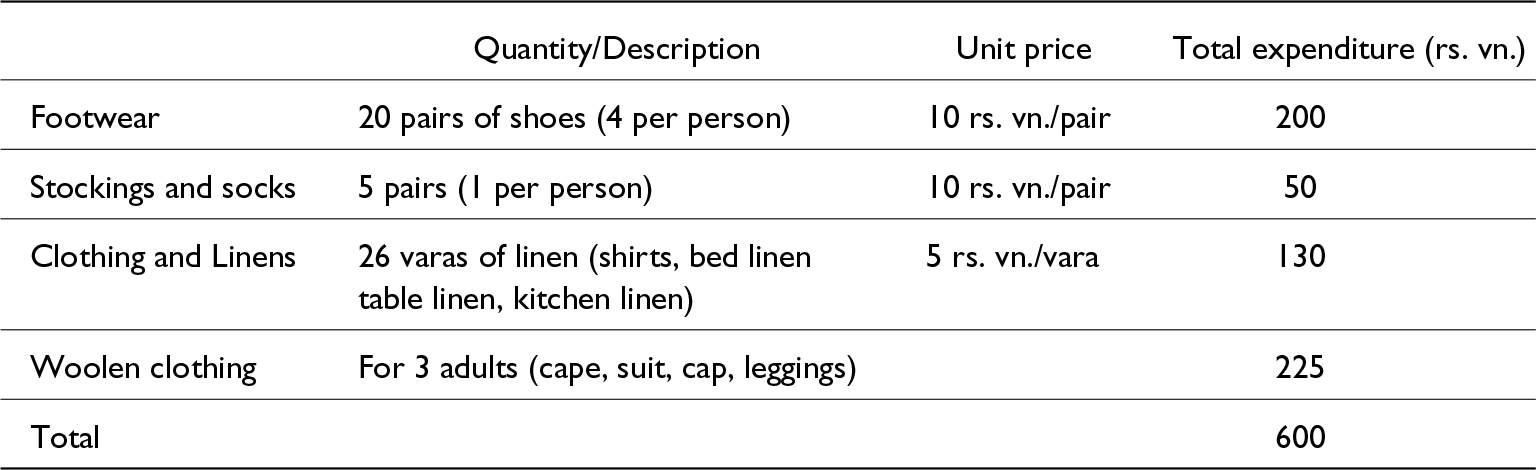
For the lower-income groups, represented here by a farming family, Arriquibar estimated annual expenditure on dress and domestic equipment at nearly 600 rs. vn., covering basic clothing, footwear, and domestic linen, but excluding tools (Table 1). However, this figure, based on a budget of a family that, in his words, “lives from field work with only what is necessary” (Arriquibar, Reference Arriquibar1779, Vol. II, p. 54), represented more than mere subsistence: it denoted the minimum expenditure required to maintain a middling level of material and social decency. Arriquibar deliberately excluded from this benchmark a substantial share of working households, represented by the “poor worker, whether journeyman or farmer,” whose annual expenditure he estimated at roughly 2,000 rs. vn., about a third below the middling norm (Arriquibar, Reference Arriquibar1779, Vol. II, p. 100). These families consumed broadly similar staples, including bread, meat, bacon, vegetables, and fruit, but went without wine, ate little or no salted cod, and lived in simpler dwellings, with very limited expenditure on manufacturated goods.
Basic clothing consumption for a farming family of five (married couple, son, daughter, and servant)

Table 1 Long description
The table lists annual clothing items, quantities, unit prices, and total spending for a five-person farming household, with costs in reales de vellón. Total expenditure is 600. Woollen clothing for three adults is the largest single category at 225, even though no unit price is provided. Footwear is next at 200 for 20 pairs of shoes priced at 10 per pair. White linen goods total 130 for 26 varas at 5 per vara. Stockings and socks are the smallest expense at 50 for five pairs at 10 per pair. Comparisons should be made cautiously because the woollen clothing line lacks a stated unit price and includes multiple garments bundled together.
Source: Arriquibar (Reference Arriquibar1779, Vol. II, pp. 52–53).
Note: rs. vn. = reales de vellón; 1 vara ≈ 0.8359 m.
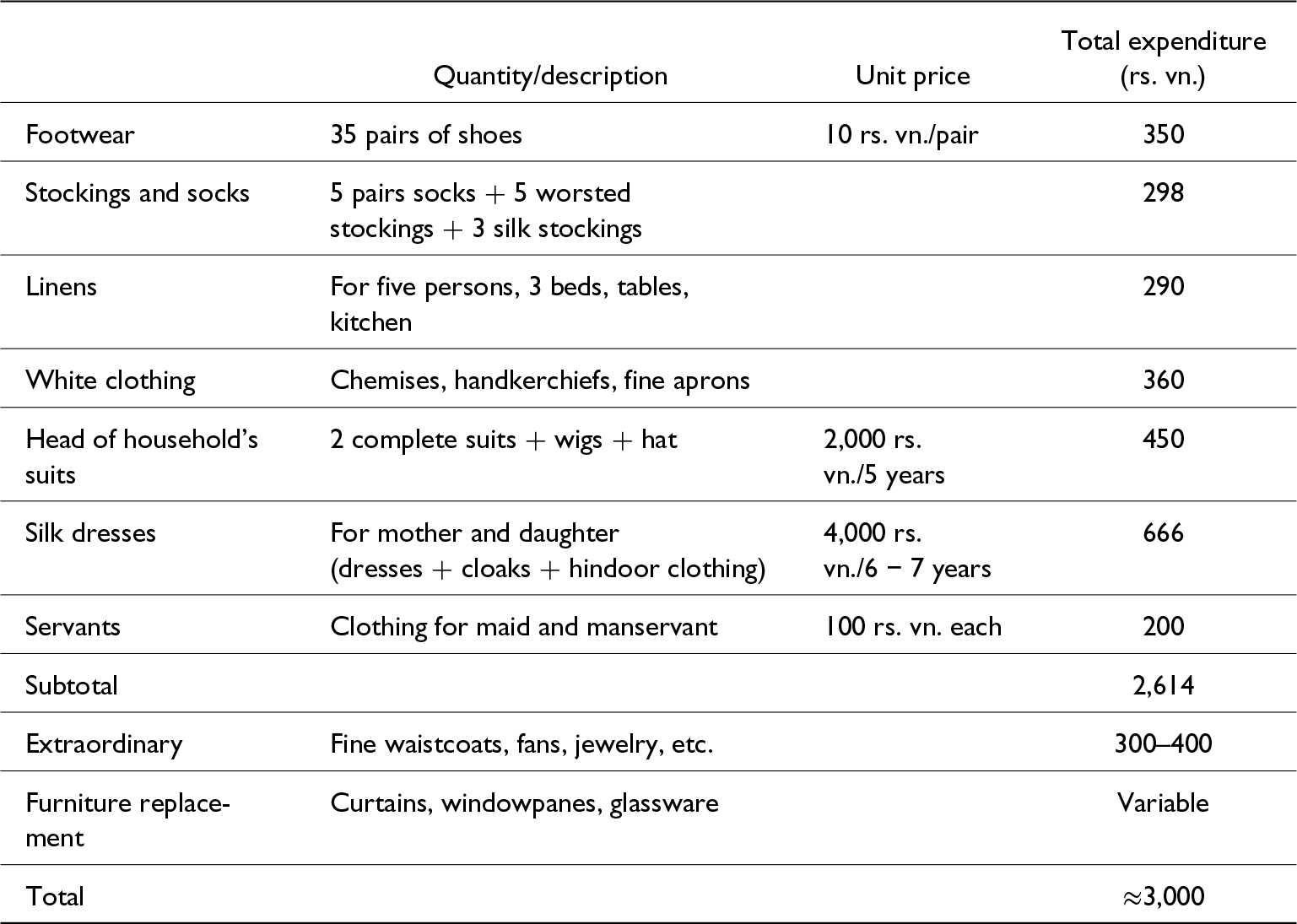
Urban professionals faced greater pressure to maintain a respectable appearance than their rural counterparts, which was reflected in higher expenditure and the consumption of better-quality goods.Footnote 3 Spending on manufactured goods rose sharply among the higher-income groups, from families with annual incomes of around 15,000 rs. vn. (Table 2) to large landowners and rentiers earning at least ten times as much. These requirements for dress and domestic equipment were associated with household structures that included servants and large dwellings with multiple rooms. On clothing alone, these households spent roughly five times as much as the farming family.
A comfortable family (15,000 rs. vn. average annual income). Married couple, adolescent daughter, maid and manservant

Table 2 Long description
The table lists annual household spending in rs. vn. for clothing, footwear, and related items for a family with two servants, plus a few additional categories. The main clothing and footwear subtotal is 2,614 rs. vn. The largest single line item is silk dresses for the mother and daughter at 666 rs. vn., followed by the head of household’s suits, wigs, and hat at 450 rs. vn. Other notable costs include white outer clothing at 360, footwear at 350 for 35 pairs of shoes, stockings and socks at 298, and white inner clothing at 290. Servants’ clothing is 200 rs. vn. combined. Beyond the subtotal, “extraordinary” items add about 300 to 400 rs. vn., while furniture replacement is listed as variable. The overall total is given as approximately 3,000 rs. vn., and some entries reflect multi-year purchase cycles rather than strictly yearly buying.
Source: Arriquibar (Reference Arriquibar1779, Vol. II, pp. 55–56).
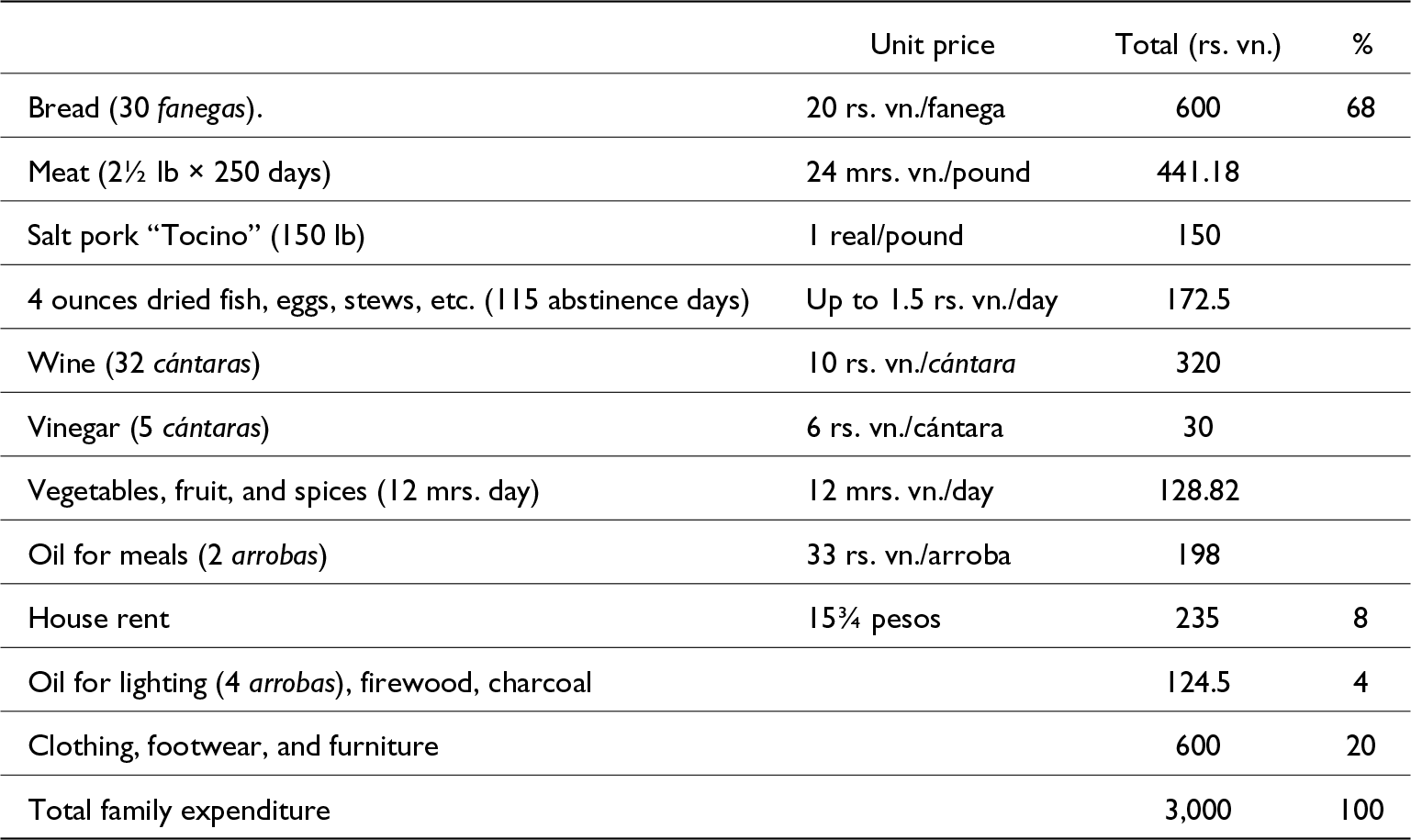
Despite these differences, these items accounted for roughly 20 percent of total expenditure across all the household types examined. Using this share, Arriquibar calculated a theoretical annual budget for a representative household “encompassing all classes,” intended as a benchmark for his national consumption estimates (Table 3). This family, composed of a married couple, two children, and one servant, had an annual expenditure of about 3,000 rs. vn. The model was based on the consumption patterns of the respectable farmer and the urban artisan but also included salaried employees in higher-ranking families whose incomes “barely … suffice for decency” (Arriquibar, Reference Arriquibar1779, Vol. II, p. 56). The resulting budget was not merely an accounting exercise. It represented a recognizable pattern of consumption for a middling stratum, marked by modest comforts and adequate furnishings rather than the ostentation of wealthier groups that Arriquibar explicitly criticized, particularly their preference for foreign manufactures.
Annual expenditure budget for a middling family of five (married couple, two children, and servant)

Table 3 Long description
The table lists an annual household budget for a family of five, giving unit prices where available and total spending in reales de vellón, plus percent shares for selected categories. Total yearly expenditure is 3,000 reales de vellón. Bread is the largest cost at 600 reales, shown as about 68 percent of the total. Clothing, footwear, and furniture are also 600 reales, listed as 20 percent. House rent is 235 reales, listed as 8 percent, and lighting fuel plus firewood and charcoal total 124.5 reales, listed as 4 percent. Other food and drink costs include wine at 320 reales, oil for meals at 198, meat at 441.18, salt pork at 150, abstinence-day foods at 172.5, vegetables and spices at 128.82, and vinegar at 30. Some percentage entries are missing for several rows, so comparisons by share are limited to the items that include a percent value.
Source: Arriquibar (Reference Arriquibar1779, Vol. II, pp. 57–58).
Note: mrs vn. = maravedís de vellón. 1 rs. vn. (real de vellón) = 34 mrs. vn.Standard Castilian measures: 1 fanega = 55.5 L; 1 lb = 0.460 g; 1 cántara = 16.3 l; 1 arroba of olive oil = 25 lb–12.65 L.
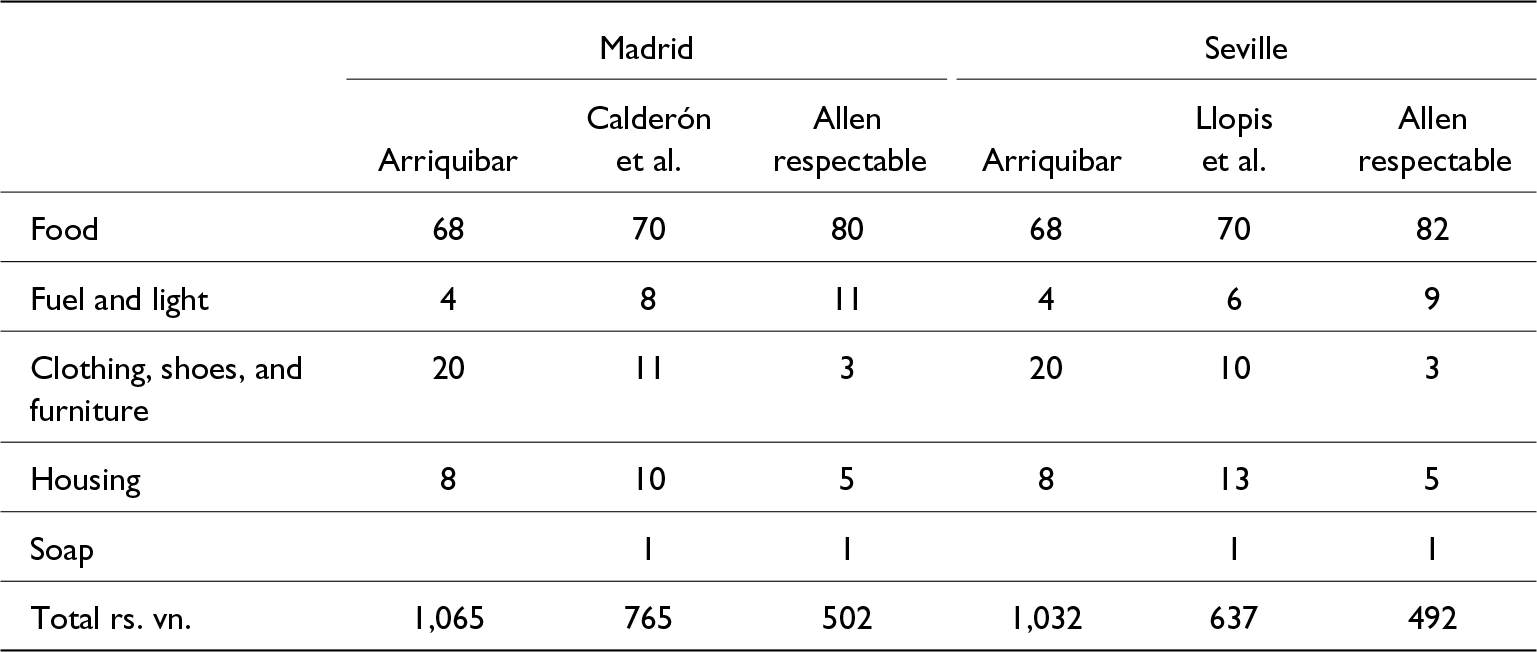
However, these prices require adjustment. Arriquibar identified the figures he used simply as those observed in Madrid, likely in the early 1760s (Arriquibar, Reference Arriquibar1779, Vol. II, p. 58), but they differed substantially from those recorded in Madrid institutions and later used as the basis for price indices and real wage series (Llopis Agelán and García Montero, Reference Llopis Agelán and García Montero2011; López Losa, Reference López Losa2013; Calderón Fernández et al., Reference Calderón Fernández, García Montero and Llopis Agelán2017; López Losa and Piquero Zarauz, Reference López Losa and Piquero Zarauz2021). To estimate the actual cost of this budget, I have used average prices for 1760–1764 drawn from institutional sources. For items without documented prices, such as housing and clothing, I have maintained Arriquibar’s original expenditure shares. Table 4 compares the adapted budgets for Madrid and Seville with other available estimates, showing the composition of expenditure and the annual per capita cost in rs. vn.
Comparison of expenditure structure and annual per capita cost of Arriquibar’s adapted budgets and other estimates in Madrid and Seville at 1760–1764 prices

Table 4 Long description
The table compares the spending shares by category and the total annual per capita cost for three budget sources in Madrid and three in Seville at the same price level. In both cities, food is the largest component: 68 percent in Arriquibar, 70 percent in the local author estimates, and 80 percent in Allen’s basket for Madrid; and 68, 70, and 82 percent respectively for Seville. Nonfood patterns differ by source: Arriquibar assigns 20 percent to clothing, shoes, and furniture in both cities, while Allen assigns 3 percent and the other authors assign about 10 to 11 percent. Fuel and light is small in Arriquibar at 4 percent in both cities, higher in the other author estimates at 8 percent in Madrid and 6 percent in Seville, and highest in Allen at 11 percent in Madrid and 9 percent in Seville. Housing ranges from 8 percent in Arriquibar to 10 percent in Madrid and 13 percent in Seville in the other author estimates, and 5 percent in Allen for both cities; soap appears only in the non-Arriquibar columns at 1 percent. Total annual costs are highest for Arriquibar at 1065 in Madrid and 1023 in Seville, mid-range for the other author estimates at 783 in Madrid and 747 in Seville, and lowest for Allen at 551 in Madrid and 547 in Seville. Comparisons should be read as differences in budget construction as well as prices, since categories and estimation methods vary across sources.
Notes: For Allen’s (Reference Allen2015) respectability basket, and for the adapted prices in Arriquibar, see López Losa (Reference López Losa2013), López Losa and Piquero Zarauz (Reference López Losa and Piquero Zarauz2021), and Bartolomé et al. (Reference Bartolomé Rodríguez, García-Zúñiga, González-Mariscal, López Losa, Ongaro, Stephenson and Mocarelli2026). Cost calculated using prices of candeal bread. The value of the Seville baskets in Llopis Agelán et al. (Reference Llopis Agelán, García-Hiernaux, García Montero, González Mariscal and Hernández García2009) and of Madrid for skilled construction workers in Calderón Fernández et al. (Reference Calderón Fernández, García Montero and Llopis Agelán2017, p. 358) was estimated from the share allocated to bread (30-36 percent respectively), using the average prices of white wheat bread in both cities.
These estimates amount to 1,065 rs. vn. per capita in Madrid and 1,032 per capita in Seville, which suggest that living costs in both cities were similar at these consumption levels.Footnote 4 These figures exceed those derived from Calderón Fernández et al. (Reference Calderón Fernández, García Montero and Llopis Agelán2017) for Madrid and by Llopis Agelán et al. (Reference Llopis Agelán, García-Hiernaux, García Montero, González Mariscal and Hernández García2009) for Seville by around 30-40 percent respectively. Wider is still the gap between Allen’s respectability baskets and Arriquibar’s budget, with the latter being twice as costly in both cities, a difference similar to that identified by Humphries (Reference Humphries2025) for Britain. Much of the discrepancy stems from the composition of the budget. Clothing, footwear, and furnishings account for 20 percent of Arriquibar’s total, roughly double the shares reported by Calderón et al. (11 percent) and Llopis et al. (10 percent), and more than six times Allen’s figure of 3 percent, which covers linen expenditure alone. This pattern is consistent with a conception of respectability in which dress and domestic furnishings served as publicly legible markers of status and social belonging, rather than merely as functional necessities.
Food and housing, by contrast, account for a smaller share of total expenditure than in other reconstructions, even though consumption levels and the nominal expenditure allocated to them are higher in absolute terms. The food basket includes quantities broadly comparable to those reported by Calderón Fernández et al. (Reference Calderón Fernández, García Montero and Llopis Agelán2017) for bread, but those of meat and wine are substantially larger, at around 60 kg and 100 L per capita annually, respectively, compared with 25 kg and 68 litres. The smaller share devoted to food, 63 percent as against 70 percent in Calderón et al. and 80–82 percent in Allen, thus reflects the greater weight of nonfood items in the budget, rather than a more frugal diet. The same applies to housing. Arriquibar assigns 8 percent of total expenditure to rent, compared with 10 to 13 percent in Calderón et al. and Llopis et al. As with food, this lower share mainly reflects the larger relative weight of other components in Arriquibar’s budget, rather than lower housing costs in absolute terms.
However, Arriquibar’s reformist agenda raises the question of the reliability of the 20 percent share. He may have had incentives to overstate household spending on manufactured goods in order to strengthen the case for protecting domestic industry. He believed Spanish textiles faced severe competitive pressure from cheaper foreign imports that benefited from an unequal fiscal burden, and a higher textile share in household budgets reinforced this argument (Arriquibar, Reference Arriquibar1779, Vol. II, XIII; p. 26). The accounts of José Cornejo (Reference Cornejo1768) provide an independent comparative source. Unlike Arriquibar, he was not writing from a reformist perspective, and his record of the expenditure patterns of three Madrid families with annual incomes of around 8,800 rs.vn. was purely descriptive. Cornejo’s reference household comprised a married couple and one servant. It was somewhat simpler than Arriquibar’s five-member model household, but nonetheless comparable. At this level, clothing and domestic goods accounted for 20.3 percent of total spending, which is virtually identical to the 20 percent figure for a household with roughly a third as much income. The stability of this share across different income levels suggests that it was not an artifact of Arriquibar’s reformist argument but rather a broader feature of middling-class consumption patterns. Food, by contrast, accounted for a smaller share in Cornejo’s records, around 54 percent, compared with Arriquibar’s 63 percent. This difference is consistent with the expectation that higher-income households devoted a larger proportion of their budget to non-food items.
3. The cost of respectable living: expenditure records at the Royal Seminary College of San Telmo, Seville 1760–1764
The Royal Seminary College of San Telmo, founded in Seville in 1681, trained sailors for the Carrera de Indias and the Royal Navy, combining charitable provision with professional instruction. It was created to address a persistent shortage of qualified seafarers, a problem the Hispanic Monarchy had faced since the early phases of Atlantic expansion.Footnote 5 Although this institution was formally intended for “poor orphans native to these kingdoms,” from 1721 it applied strict admission criteria based on blood purity (limpieza de sangre) and the exclusion of the descendants of those who practised “vile and mechanical” trades. These restrictions operated on two levels. Candidates had to come from “Old Christian” families, free from any “taint” of Moorish, Morisco, mulatto, Berber, Gypsy, or Jewish ancestry, and they could not be recent converts to Catholicism or have been punished or subjected to penance by the Holy Office of the Inquisition. At the same time, the College excluded those whose parents or ancestors had practiced occupations which were “held in low esteem in the republics” and therefore incompatible with the decorum and noble character attributed to the Universidad de Mareantes and, by extension, to San Telmo itself.Footnote 6 The tension between training “poor orphans” and imposing conditions of social and genealogical respectability reveals the institution’s own hierarchy of values: limited means were compatible with dignity of birth, but not with its absence, and the institution’s expenditure reflected this distinction.
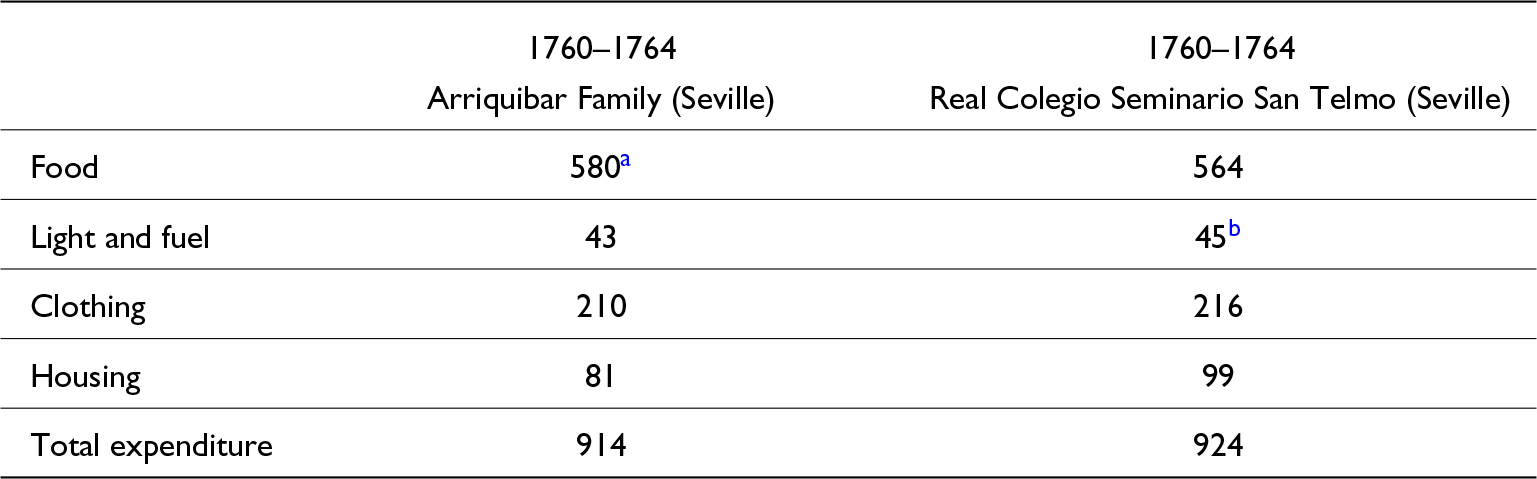
San Telmo’s account books record expenditure on food, clothing, wages, pensions, gratuities, supplies, and other items, allowing observed consumption patterns to be directly compared with the benchmark derived from Arriquibar’s model. The weekly ledgers specify quantities and prices for individual items, making it possible to reconstruct both the structure and the cost of consumption in unusual detail. Table 5 presents per capita expenditure figures from both sources side by side, adjusted to Seville prices for 1760–1764. The two columns are not directly comparable since one is a notional household budget, whereas the other is taken from the accounts of a functioning institution with its own organizational constraints and expenditure structure. Some of the differences reflect these specific conditions: San Telmo did not serve wine to students, and its lighting costs were those of a collective residential setting rather than an individual household. Nonetheless, San Telmo purchased most items at prevailing market prices, which limits the downward bias that collective procurement might otherwise introduce. The broad similarity in both the magnitude and composition of expenditure across these two sources places the reconstructed estimate within a historically plausible range, above subsistence but below the consumption standards of wealthier households.
Estimated annual per capita expenditure in rs. vn. in Seville (1760–1764): Arriquibar’s budget with per-student expenditure at the Royal Seminary College of San Telmo

Table 5 Long description
The table reports estimated annual per‑capita expenditure in rs. vn. in Seville for 1760–64, comparing Arriquibar’s family budget with per‑student spending at the Colegio de San Telmo. Total spending is close between the two: 912 for the family and 925 for the school. Food is the largest category in both cases, at 580 for the family and 574 for San Telmo. Clothing is the next largest item, slightly higher at San Telmo (216) than in the family budget (209). Housing is also higher at San Telmo (90) than for the family (80), while light and fuel are similar (43 versus 45). Comparisons should be read with caution because some items are excluded in the underlying figures and the food amounts have been adjusted to local prices for those years.
3.1. Dietary patterns and respectability at San Telmo
Institutional account books have long served as a primary source for the history of food and nutrition, though their use has raised methodological questions. One recurring limitation in the historiography is that many studies based on such sources rely on prescribed rations rather than observed consumption. on prescribed rations rather than observed consumption. Nutritional analyses, moreover, have not always treated diet as a culturally shaped practice with its own social logic (Aymard, Reference Aymard1975; Flandrin, Reference Flandrin1987). San Telmo’s records are unusual on both counts: they document prescribed rations and actual weekly consumption, including the quantities of food served to students and staff. This allows us to reconstruct dietary patterns and examine the social dimensions of food in mid-eighteenth-century Seville.
The 1779 administrative manual for the Royal Seminary College of San Telmo provides a precise account of the daily rations served.Footnote 7
Ration for breakfast. It shall be at all times four ounces of bread to each Student, with one ounce of cheese, or four ounces of raisins, or four of figs, or half a pound of plums, apples, grapes or other green fruit. When soups are given, they shall be made at the rate of three ounces of bread for each seminarian, with two ounces more given dry.
Ration for dinner on Flesh Days. It shall consist of eight ounces of bread, one dish of broth, a dish of greens, one ounce of bacon (of the thirty-and-two that make a butcher’s pound), four ounces of boneless beef, suet, or other waste, equal in weight the bacon; in want of beef there shall be four ounces of mutton; and when hogs are killed, four ounces of lean pork shall be given.
Ration for Supper on the said Day. The amount of bread shall be eight ounces; one dish of sallet, and four ounces of beef or mutton, equal to those served at dinner; and during the slaughering season, four ounces of pluck, loin or lean pork.
Ration for Dinner on Fish Days. It shall be eight ounces of bread; and what three ounces of dried Cod do yield when dressed, with a dish of pottage, which when made of chickpeas, beans, or lentils, shall yield three dishes from each cuartillo; when made of chestnuts, six dishes to the pound, and when it is rice, twelve dishes to the pound.
On Sundays and Fridays in Lent, in place of the three ounces of Cod, four butcher’s ounces of fresh fish shall be given, which is to say being a quarter of a butcher’s pound.
Ration for Supper on the said Day. Eight ounces of bread, a dish of sallet, and a dish of pottage which is different from that served at noon, but equal in quantity; or in its stead a dish of boiled salad, Guinea pompion, chards or spinach.
To those who are fasting, only four ounces of bread, the dish of sallet, and two ounces of raisins shall be given.
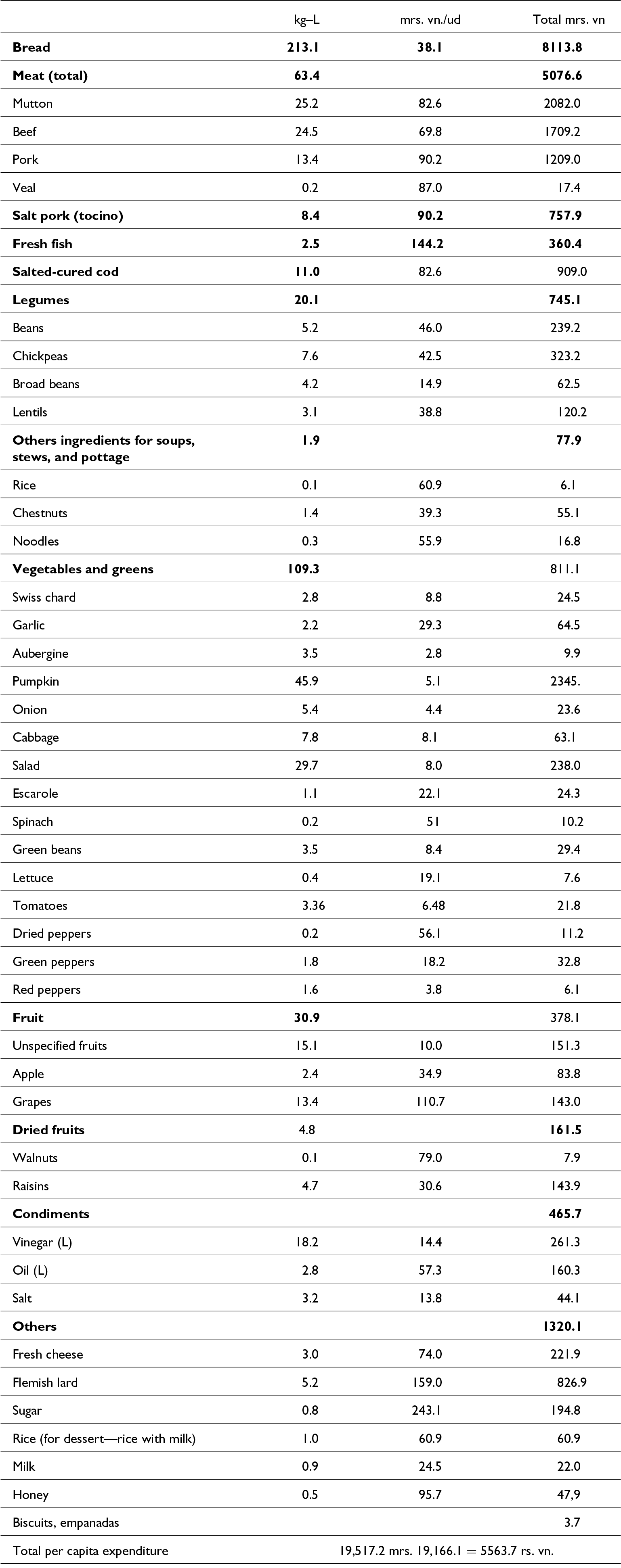
Table 6 shows per capita consumption and average prices from the records for 1760-1764. The quantities generally match the prescribed rations, with some variation reflecting seasonal availability and price fluctuations. In nutritional terms, this diet would have provided between 2,600 and 3,000 kcal and around 120 g of protein per day, although such estimates must be treated with caution, given the limitations inherent in applying modern composition tables to historical diets, the fact that students were not served wine, and the gap between what was served and what was actually consumed (Contreras Hernández, Reference Contreras Hernández1993). More revealing than the caloric content of the diet, however, is what its composition shows about the social, cultural, and symbolic dimensions of foods (Flandrin, Reference Flandrin1987).
Per capita consumption in 1760 (kilograms/liters) in 1760 and average prices in 1760-64 (mrs.vn.) at the Royal Seminary College of San Telmo

Table 6 Long description
Per-person consumption quantities (in kilograms or litres, with eggs listed by dozen) are paired with unit prices and total per-person cost in maravedís for each food item. Bread is the largest line item, with 213.1 kilograms per person and a total cost of 8,113.8 maravedís. Total meat consumption is 63.4 kilograms costing 5,017.6 maravedís; within meats, mutton and beef are the biggest components by quantity and cost, while veal is negligible. Vegetables and greens are high in quantity at 109.3 kilograms but comparatively low in total cost at 811.1 maravedís, with pumpkin and salad contributing much of the volume. Fruit totals 30.9 kilograms and 378.1 maravedís, while dried fruits add 151.8 maravedís despite very small recorded quantities. Condiments include vinegar, oil, and salt totaling 465.7 maravedís, and an “others” group totals 1377.7 maravedís, led by Flemish lard at 826.9 maravedís. Some rows are category totals or have missing quantity or unit-price entries (for example eggs, legumes totals, and some subitems), so comparisons should rely on the provided totals where available. Overall per-capita expenditure sums to 19,166.1 maravedís.
Source: AHUS, Libros 0091-0095.
San Telmo’s diet broadly followed the pattern of Mediterranean institutional provisioning, with bread and meat as the principal staples. Both had social significance, but meat consumption was particularly important as a marker of economic standing, through the type and quality of what was served as well as its frequency. Arriquibar noted that the lower classes rarely ate meat, while the upper classes tended to prefer game and poultry to beef and mutton (Arriquibar, Reference Arriquibar1779, Vol. I, pp. 101–102). His budget assumed that half a pound per person was consumed on each of the 250 permitted days, amounting to around 57.5 kg per capita annually. This figure is close to San Telmo’s 63.4 kg, nearly double Calderón Fernández et al.’s (Reference Calderón Fernández, García Montero and Llopis Agelán2017, p. 358) estimate for a mason in eighteenth-century Madrid, and well above the quantity included in Allen’s respectability basket. Per capita quantities for items such as cooking oil, vinegar, and salt pork are less easily derived from Arriquibar’s budget, but the figures differ only marginally from those recorded at the College.
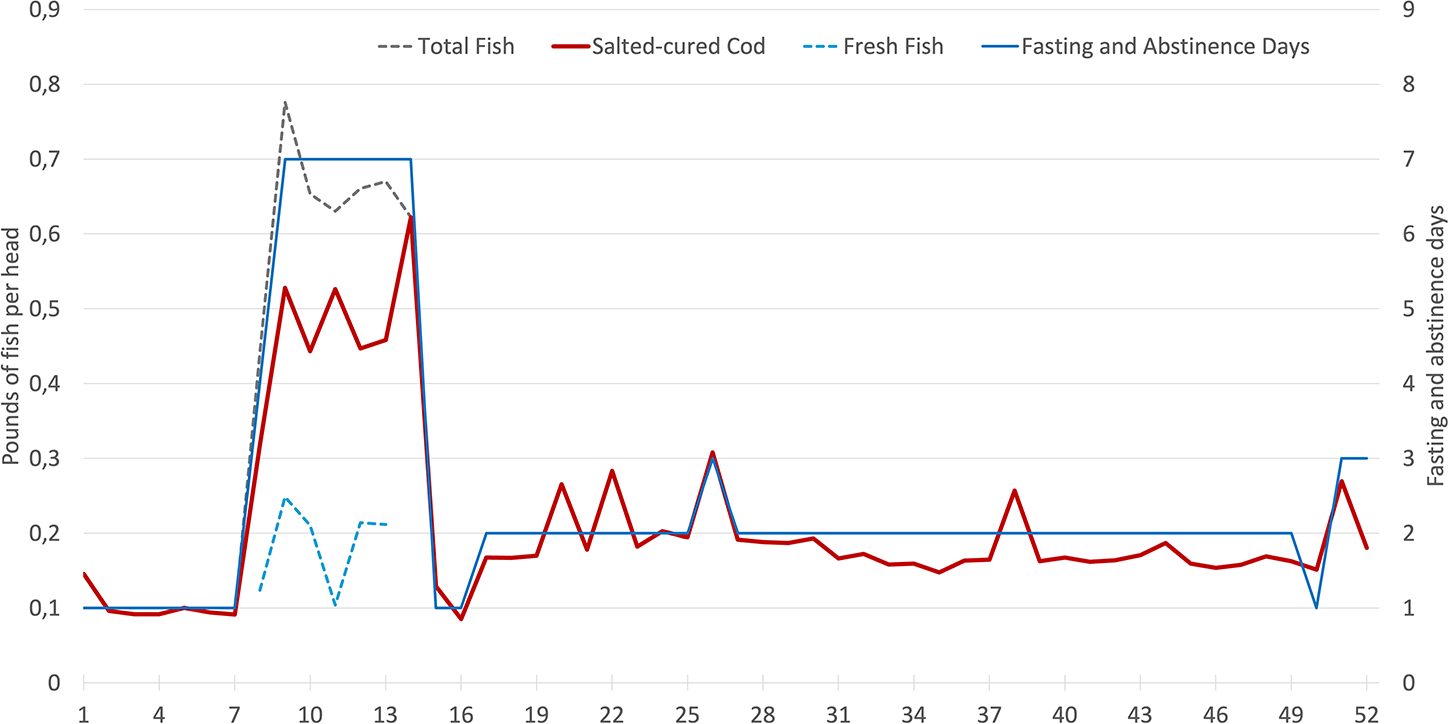
The only notable difference between Arriquibar’s estimates and San Telmo’s records lies in fish consumption, a category shaped less by economic constraints than by religious obligation. The prohibition of meat on fasting and abstinence days had implications that went beyond nutrition. Observance demonstrated religious orthodoxy, while the type and quality of the fish consumed also signaled social standing. Arriquibar estimated a ration of four ounces per person on each of 115 fast days, equivalent to around 2,65 kg per capita annually, based on Uztáriz’s (Reference Uztáriz1757, p. 272) estimates of apparent consumption in the 1720s. For a household at the income level assumed in his model, however, this figure was probably too low. San Telmo’s records offer a more precise picture. In 1760, the college observed 129 days of abstinence; per capita consumption reached 10.96 kg of dried codfish per capita plus 1.11 kg of fresh fish (Figure 1). Fresh fish was served only on special days during Lent; and no fish was consumed outside designated fasting and abstinence days.
Weekly fasting and abstinence days and fish consumption (kg per head) at San Telmo College, 1760.

Figure 1 Long description
The graph displays two lines representing dried codfish consumption per capita and fast days in 1760. The x-axis is labeled 'Weeks' ranging from 1 to 52. The y-axis on the left shows 'Kg per capita' ranging from 0 to 1, while the y-axis on the right indicates 'Days of fasting per year' ranging from 0 to 7. The solid blue line represents dried codfish consumption per capita and the dashed red line represents fast days. The blue line shows a peak at week 10 with approximately 0.9 kg per capita, followed by a sharp decline to around 0.2 kg per capita at week 15. The red line shows fluctuations with peaks at weeks 10, 22, 37 and 52, each reaching around 6 days of fasting. The graph illustrates the relationship between fish consumption and fasting days throughout the year, highlighting significant variations and trends in both datasets.
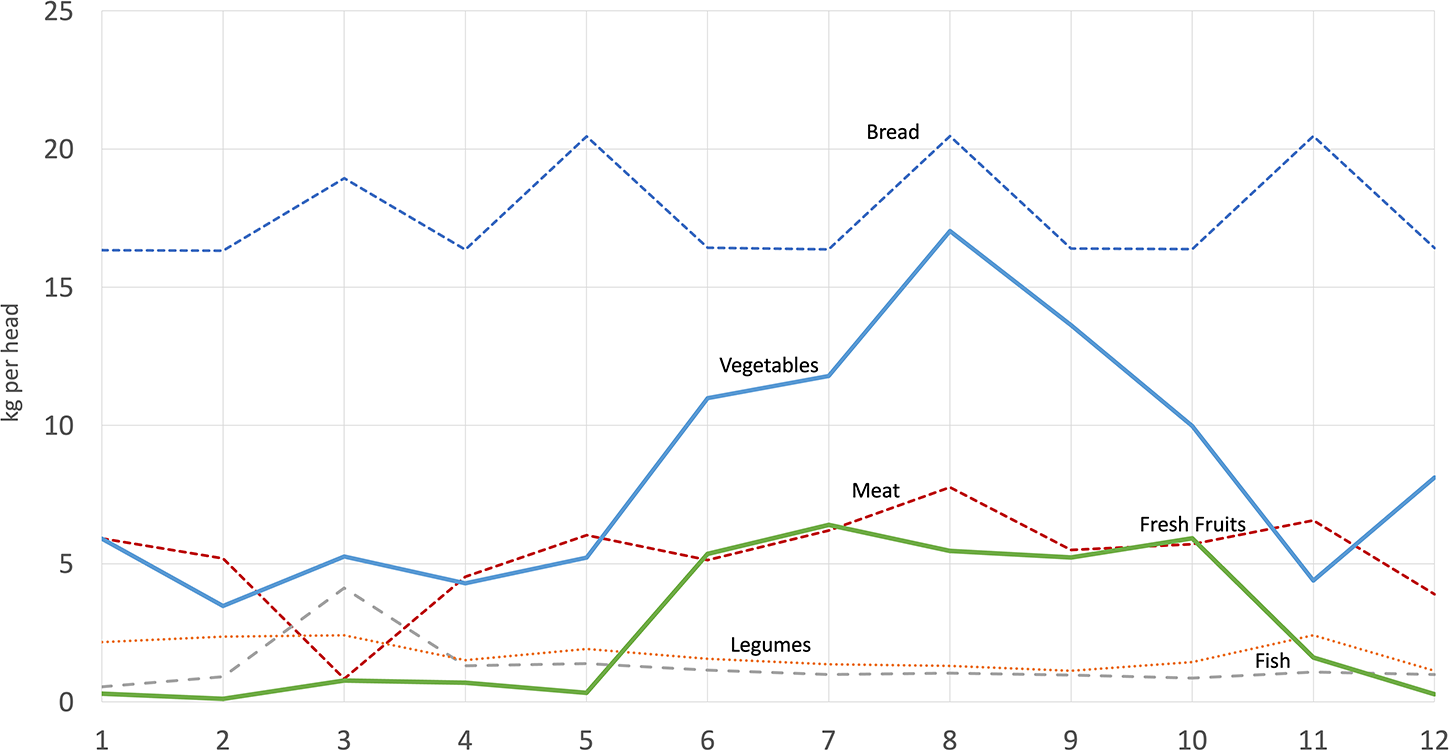
The dietary picture that emerges from San Telmo’s account books contrasts sharply with the apparent monotony of the diet described by Eiras Roel and Enríquez Morales (Reference Eiras Roel and Enríquez Morales1975, p. 459) for the colleges of Santiago de Compostela. Meat, legumes, fruit, and especially vegetables, together with clear seasonal patterns of consumption, point to a more diverse diet than many institutional sources suggest. In most such sources, vegetables appear only as an aggregate expenditure item, which obscures both the variety and the quantities consumed. San Telmo’s weekly ledgers, by contrast, record more than fifteen distinct varieties of vegetables and show that, although these accounted for only 5 percent of total expenditure, consumption exceeded 109 kg per capita annually, revealing how misleading a modest cost share can be as a guide to their importance in the diet. Figure 2 further illustrates the monthly distribution of consumption by food group in 1760. While bread remained fairly stable throughout the year, vegetables and greens exhibited clear seasonality, peaking in spring and summer at nearly 18 kg per month before falling sharply in winter. Fresh fruit followed a similar pattern, concentrated in summer and autumn. The substitution of fish for meat during Lent is also clearly visible, as is the steady presence of legumes, at around 2 kg per month, as a regular source of protein. This pattern reflects San Telmo’s close integration with local market cycles. With the exception of items that could be stored for long periods, such as legumes, oil, or dried cod, bread, vegetables, and fruit were purchased in the market, so the recorded prices reflect retail rather than institutional procurement prices.
Per-capita consumption (kg) by food groups at the Colegio Seminario San Telmo in 1760.

Figure 2 Long description
Insufficient visual information to describe this element accurately.
3.2. Student clothing at San Telmo: a proxy for respectable dress
San Telmo’s account books provide detailed records of the clothing issued to each student, includingthe manufacturing costs of each garment and the type of fabric used. The uniform functioned as a status maker: its symbolic value identified its wearers as belonging to the hierarchy associated with the Universidad de Mareantes and, by extension, the College itself. The cut and fabric of the uniforms thus provide an indirect estimate of what Arriquibar’s “neither rich nor poor” condition could entail in practice. Although school uniforms were not civilian dress, both the structure and the estimated cost of the San Telmo uniform closely resemble a typical male wardrobe of the period.
According to the 1786 ordinances, students were expected to have two suits, one for summer and one for winter. The summer outfit comprised an undyed linen shirt and kerchief, a waistcoat and breeches of imported raw linen, and blue wool stockings, worn with black cordovan leather shoes and a brown Carmona cloth cape and hat. The winter suit replaced the linen waistcoat and breeches with the same articles made from blue dieciocheno (eighteen-count) broadcloth. Upon entering the College, students also received a pillow with its case, two sheets, and a blanket (Real Colegio de San Telmo, Reference San Telmo1786, pp. 63–64). The basic composition of the uniform, particularly the linen shirt and the waistcoat and breeches, was typical of masculine dress in this period, as documented in multiple sources (Alcázar, Reference Alcázar2007; Cabrera, Reference Cabrera2019; Rosillo Fairén, Reference Rosillo Fairén2019).Footnote 8 The meaningful distinctions lay not in the type of garments worn but in the quality of the fabrics and how often articles were replaced (García Fernández, Reference García Fernández2017a, Reference García Fernández2017b, Reference García Fernández2024). A respectable appearance required keeping clothing in acceptable condition “for greater decency and cleanliness.” The contrast between the San Telmo uniform and the clothing worn by the pupils of the Toribios Children’s Hospice illustrates the point. At the latter institution, inmates they dressed similarly in a “short jacket and raw linen breeches, with a broadcloth doublet that covers and keeps them warm,” but the acquisition of clothing depended on alms and reduced-price purchases, which likely meant they wore lower-quality fabrics (Baca, Reference Baca1766, p. 25).
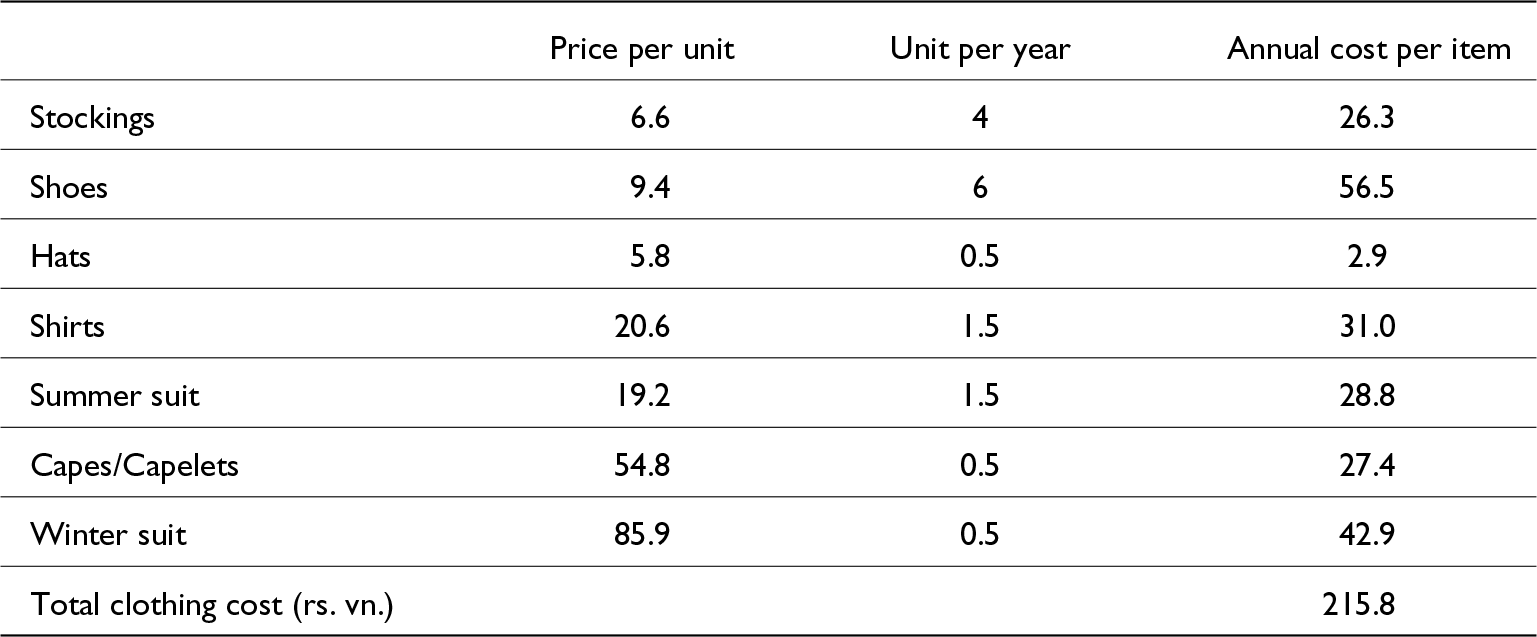
Calculating the annual cost of a wardrobe requires knowing not only the price of each garment, but also how often it was replaced and how much its upkeep cost. The San Telmo ordinances provide this information with a degree of precision rarely found in institutional sources. Shoes were replaced every two months and stockings every three months; hats, capes, cloth waistcoats, and breeches were renewed every two years; and shirts, kerchiefs, and linen waistcoats and breeches were renewed three times every two years. Clean shirts and kerchiefs were issued twice a week; on Saturdays, students received their laundered clothing, including waistcoats, breeches, and stockings. Bed linen was changed once a month (Real Colegio de San Telmo, Reference San Telmo1786, pp. 48, 63–64). Table 7 reconstructs the annual clothing cost for a San Telmo student from these records.
Average a cost of a San Telmo College student’s clothing in rs. vn. average 1760–1764

Table 7 Long description
The table estimates a San Telmo College student’s average annual clothing expenses in rs.vn. for the years 1760 to 1764, listing price per unit, units used per year, and annual cost by item. Total annual clothing cost is 215.8 rs.vn. Shoes are the largest expense at 56.5 rs.vn., followed by winter suits at 42.9 rs.vn. Mid-range costs include shirts at 31.0, summer suits at 28.8, stockings at 26.3, and capes or capelets at 27.4 rs.vn. Hats are the smallest expense at 2.9 rs.vn., reflecting a low annual quantity. The figures are estimates and may vary because material use and manufacturing costs were based on large-sized garments.
Source: AHUS, Libros 0091–95.
Note: Both raw material consumption and manufacturing costs were estimated based on large-sized shirts, suits, and capes.
3.3. Housing costs: rental allowances as a proxy for urban rents
Housing costs remain one of the most elusive components of preindustrial consumption baskets. Allen’s standardized models allocate 5 percent of total expenditure to housing, and this figure has been widely used despite being a general benchmark rather than one grounded in empirical evidence. Drawing on samples of dwellings rented by institutions in Madrid and Seville, other authors have proposed somewhat higher figures: between 7.5 and 8 percent for unskilled workers and around 10 percent for construction craftsmen (Andrés Ucendo and Lanza García, Reference Andrés Ucendo and Lanza García2014; Calderón Fernández et al., Reference Calderón Fernández, García Montero and Llopis Agelán2017; González-Mariscal, Reference González-Mariscal2017). Drelichman and González Agudo (Reference Drelichman and González Agudo2014, Reference Drelichman and González Agudo2026) have documented substantial variation in housing costs by location and socio-professional status in Toledo, providing the most systematic quantification of this component available for preindustrial Spain.
Urban property in Seville, as in Toledo, was concentrated in ecclesiastical hands.Footnote 9 Carmona García (Reference Carmona García1986, pp. 73–75) reconstructed rental values by geographic location using the portfolio of the Hospital del Espíritu Santo. In the mid-eighteenth century, 31 percent of the 242 dwellings belonging to this institution were rented for between 21 and 30 rs. vn. per month and 26 percent exceeded 40 rs. vn. Only 17 percent fell into the lowest bracket (20 rs. vn. per month or less). Central parishes commanded the highest rents: there, around 60 percent of dwellings rented for between 21 and 40 rs. vn., with between a quarter and a third exceeding that figure. Data from 1781 point in the same direction, confirming that rent per unit of surface area depended strongly on location, with central districts fetching considerably higher prices than peripheral areas (Carmona García, Reference Carmona García1986, pp. 81–82).
San Telmo’s records provide a complementary perspective on housing costs through the allowances paid to staff and dependents. These payments were graded by occupational rank and length of service, reflecting the same hierarchy that structured wages and expected living conditions.Footnote 10 Some widows and orphans received monthly rent payments for a room or dwelling in the city. The daughters of Tiburcio Mendieta, a former primary schoolmaster who died in 1748, received 30 rs. vn. per month until the mid-1770s, and the same allowance was granted to Bernardo de Coria, a retired assistant primary schoolmaster, in 1772.Footnote 11 The 1786 ordinances codified these stipends in a clear hierarchy: high-ranking employees received 1,100 rs.vn. annually for room and kitchen services, intermediate employees 660 rs. vn., and widows and lower-category workers 330 rs. vn. (Real Colegio de San Telmo, Reference San Telmo1786, p. 54). The lower figure allocated to widows and lower-ranking workers provides a plausible lower bound for a middling household, while the 660 rs. vn. assigned to intermediate employees offers an upper reference point. The midpoint between the two, 495 rs.vn., is therefore adopted as a reasonable approximation, close to the upper end of the range documented by Carmona García for the central parishes.
Descriptions of workers’ lodgings though not directly linked to these cash allowances, offer suggestive rather than conclusive evidence of how occupational rank was reflected in domestic space. At the lower end, the errand boy occupied modest quarters, with a sitting room, an alcove, and a partition for a kitchen, while the accounting officer had five rooms, a corridor, a kitchen, and a pantry. San Telmo’s accountant lived in even larger quarters still, comprising seven rooms, a roof terrace, a mirador, a patio, and a kitchen (García Garralón, Reference García Garralón2008, pp. 240–241).
4. The respectability threshold: estimated costs and labor incomes in Seville, 1760–1764
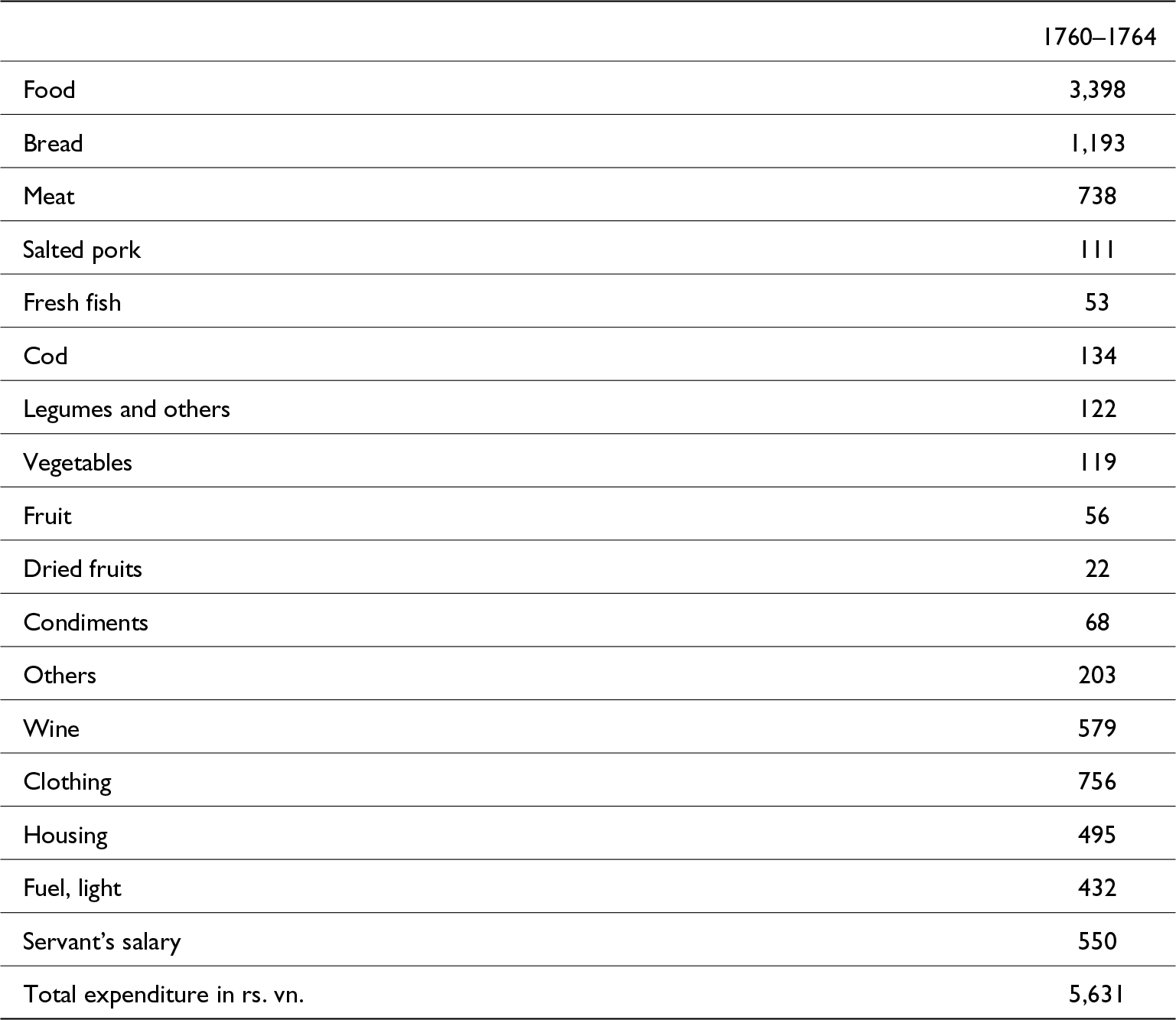
Establishing what a decent standard of living actually cost for a working family in mid-eighteenth-century Seville requires moving from per capita estimates to a complete household budget. Table 8 presents a hypothetical annual budget for a family of five: a married couple, two children, and one domestic servant. The calculations draw primarily on San Telmo’s account books, with three exceptions. Wine, which was not served to students, is taken from Arriquibar’s adapted budget (Table 4). For lighting and fuel, where institutional accounts offer no direct equivalent for private homes, Cornejo’s (Reference Cornejo1768, pp. 49, 56) daily consumption estimates for Madrid households serve as the reference; converted to Seville prices, this bundle amounts to approximately 432 rs. vn., close to the 400 rs. vn. estimated from Arriquibar’s budget. Housing is set at 495 rs. vn., following the estimate discussed above. The clothing figure is based on male dress documented at San Telmo; since Cornejo (1768, 18, 51) suggests broadly similar expenditure for men and women among households with somewhat greater spending capacity, the difference is unlikely to have been substantial, and the estimate should therefore be treated as a reasonable approximation.
Hypothetical annual expenditure in rs. vn. for a respectable for a household of four plus one servant in Seville

Table 8 Long description
The table lists hypothetical annual household spending in Seville for the years 1760 to 1764, reported in rs. vn., with totals and a detailed food breakdown. Total expenditure is 5,631, and food is the largest category at 3,389, well above clothing at 756, housing at 495, fuel and light at 432, and the servant’s salary at 550. Within food, bread is the biggest item at 1193, followed by meat at 738 and wine at 579. Smaller food costs include salted pork at 111, fresh fish at 53, cod at 134, legumes and others at 122, vegetables at 119, fruit at 56, dried fruits at 22, condiments at 68, and other food items at 203. The table provides a single period summary and does not show changes over time within 1760 to 1764.
The budget also includes the cost of a servant (550 rs. vn.), based on the monetary salaries paid to assistants and helpers at San Telmo. and calculated separately from the ration allocated equally to all household members. Including domestic service is best understood here as an analytical device rather than as an indispensable feature of every respectable household budget. Servant wages provide one way to approximate maintenance costs that would otherwise remain largely invisible in historical budgets (Humphries, Reference Humphries2025). Essential tasks such as food processing, cleaning, and market provisioning could be carried out by unpaid female labor, often obscured in the sources, through fragmented market purchases of individual services, or through the direct employment of domestic servants. Estimating these costs through servant wages therefore yields a more complete picture of what household reproduction actually entailed. Beyond its methodological function, domestic service also had a practical role and carried social meaning: in Arriquibar’s typology, every household above that of the poor worker, from the respectable farming family to the comfortable urban household, employed at least one servant. The servant’s presence signaled that the family had crossed into a socially recognized status and distinguished it from the poor laboring household. Its absence, however, did not automatically classify a household as poor, since similar domestic tasks could be absorbed into unpaid household labor. The reduced scenario presented in Table 9 reflects this distinction by showing that a socially meaningful standard of respectability remained attainable without domestic service, provided maintenance costs were met through other means.
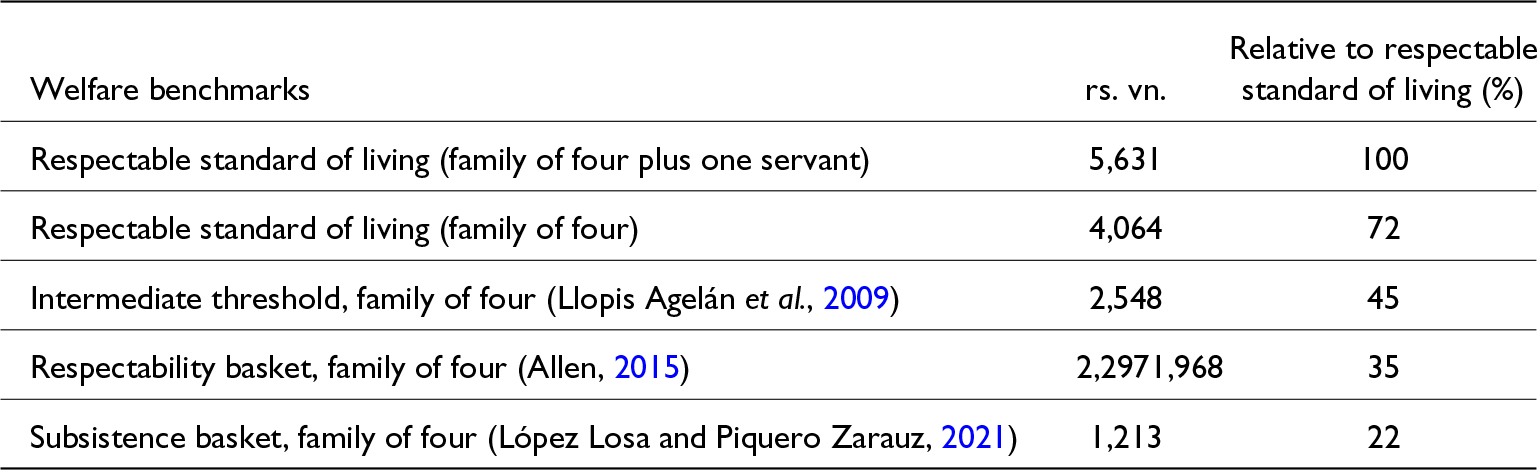
The hierarchy of living standards: the cost of maintaining a family across welfare benchmarks. Seville, 1760–1764 average (rs. vn.)

Table 9 Long description
The table compares annual welfare benchmarks in Seville in the early 1760s, listing costs in rs. vn. and each benchmark’s cost relative to a “respectable” standard for a family of four plus one servant. The highest benchmark is the respectable standard with a servant at 5,631 rs. vn., set as the full reference level. A respectable standard for a family of four costs 4,064 rs. vn., about seven-tenths of the reference. Mid-range thresholds include an intermediate family-of-four benchmark at 2,548 rs. vn., just over half of the reference, and a respectability basket at 1,968 rs. vn., about two-fifths. The lowest benchmark is a subsistence basket at 1,213 rs. vn., about one-fifth of the reference. Overall, costs decline steadily as the benchmark moves from “respectable” to “subsistence,” and the percentages depend on the chosen reference standard and the basket definitions used by different sources.
Table 9 situates respectable living within the broader hierarchy of welfare benchmarks available for eighteenth-century Spain. The budget for a family of four members with one servant, amounting to 5,631 rs. vn., represents the upper variant of the standard reconstructed here. The reduced estimate isolates the cost of domestic service, lowering the annual total to 4,064 rs. vn., or 72 percent of the full version. Below that, the remaining benchmarks in the table represent progressively lower positions in the welfare hierarchy: the intermediate line proposed by Llopis Agelán et al. (Reference Llopis Agelán, García-Hiernaux, García Montero, González Mariscal and Hernández García2009) for a family of four stands at 2,548 rs. vn. (45 percent), Allen’s respectability basket (Reference Allen2015) at 1,968 rs. vn. (35 percent), and the subsistence basket estimated by López Losa and Piquero Zarauz (Reference López Losa and Piquero Zarauz2021) at 1,213 rs. vn. (22 percent). The nearly fivefold gap between the subsistence basket and the more demanding version reconstructed here illustrates the wide material distance separating bare subsistence from socially credible forms of decency in eighteenth-century Seville.
The question of which workers and families could attain this level of consumption through labor income alone poses significant methodological challenges. For casual day laborers, no reliable information on the number of days actually worked is available, and many occupations were organized on a piece-rate, task-based, or part-time basis, making it difficult to estimate annual income. Even for workers on annual contracts who received both cash and in-kind payments, it is often unclear whether they also engage in other forms of employment. Moreover, higher up the socio-professional hierarchy, labor earnings were more likely to be supplemented by other sources of income. In short, wage income cannot always be treated as equivalent to total household resources. Dowries, household credit, and premarital savings (Tusell, Reference Tusell2025) were well-documented mechanisms through which working families could supplement labour earnings in early modern Spain. Their contribution is difficult to quantify, but they may have helped some households cover part of the gap between wages and the respectability threshold, a possibility that the comparisons below canot rule out.
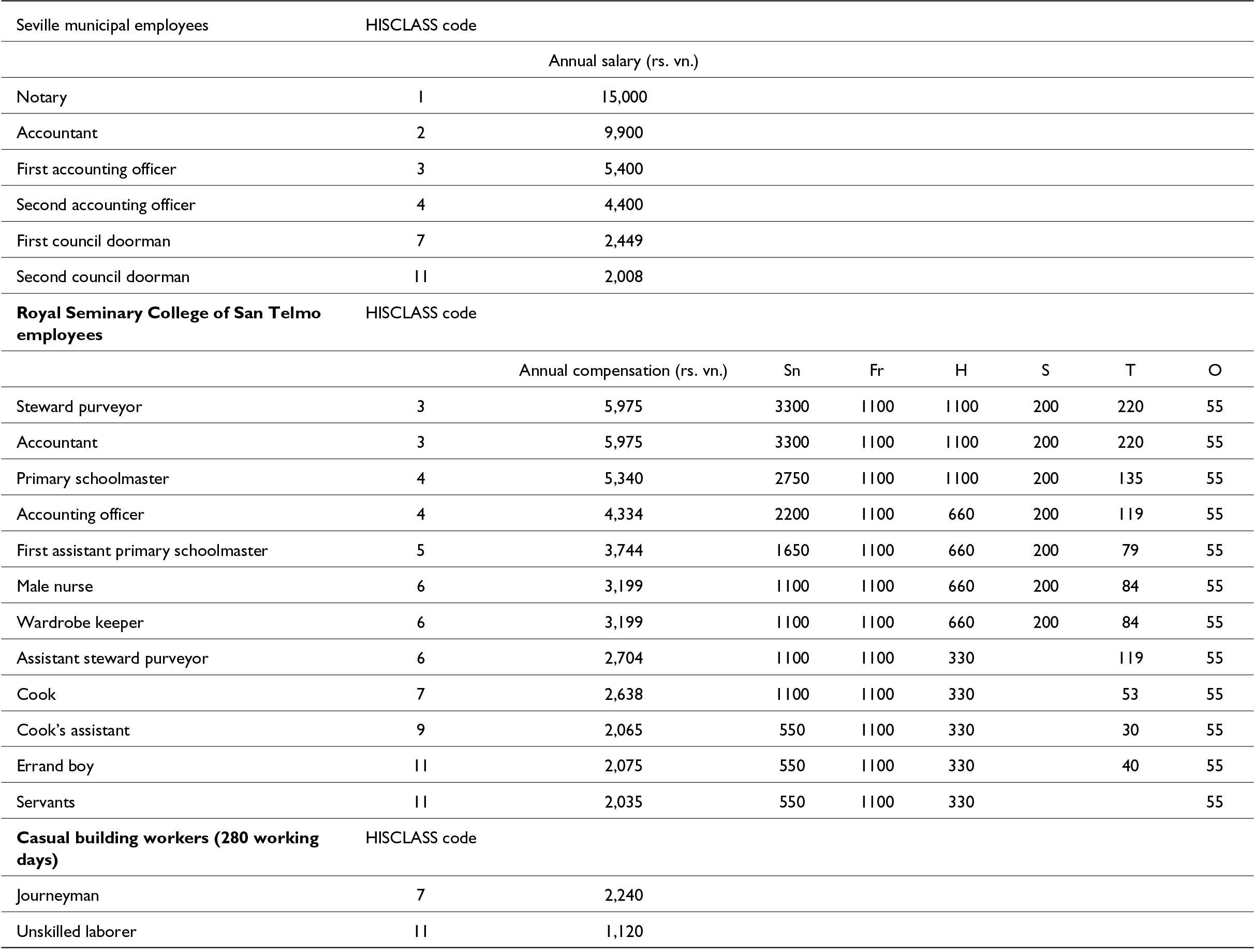
For the reasons oulined above, the analysis is limited to workers for whom employment conditions and annual remuneration can be established with reasonable confidence. They include municipal employees as well as San Telmo College employees who, according to the salary registers and the 1786 ordinances, resided on site and received rations. Restricting the sample in this way makes it possible to estimate total labor compensation with greater precision. For San Telmo employees, monetized maintenance costs have been added to nominal wages based on institutional expenditure records and employee rank, as follows:
Annual salary = Sn + Fr + H + S + T + O,
where
Sn: Nominal cash salary.
Fr: Value of the daily food ration (100 ducados = 1,100 rs. vn).
H: Estimated housing cost by employee category: 100 ducados (1,100 rs. vn.) for high-ranking employees; 60 ducados (660 rs. vn.) for officers and assistants, and 30 ducados (330 rs. vn.), for employees with assigned rooms (cooks, servants, attendants), equivalent to the allowance paid to widows and other dependents for a room in the city.
S: Value of services provided by helpers, assistants, doormen and, in later years, servants. Since these workers served San Telmo employees collectively rather than individually, this item is estimated at 200 rs. vn.
T: Cash gratuities and year-end bonuses.
O: Value of other institutional services, including laundry, religious services, cooking, and the surgeon’s salary, estimated at 55 rs. vn. per capita.
These monetised benefits should be understood as total labour compensation rather than disposable cash income. Housing allowances are treated as household-related benefits. Food rations and institutional services, by contrast, primarily covered the employee’s own maintenance; by doing so, they may have allowed him to devote a larger share of his cash wages to the household or, in some cases, to share part of the ration with his family.
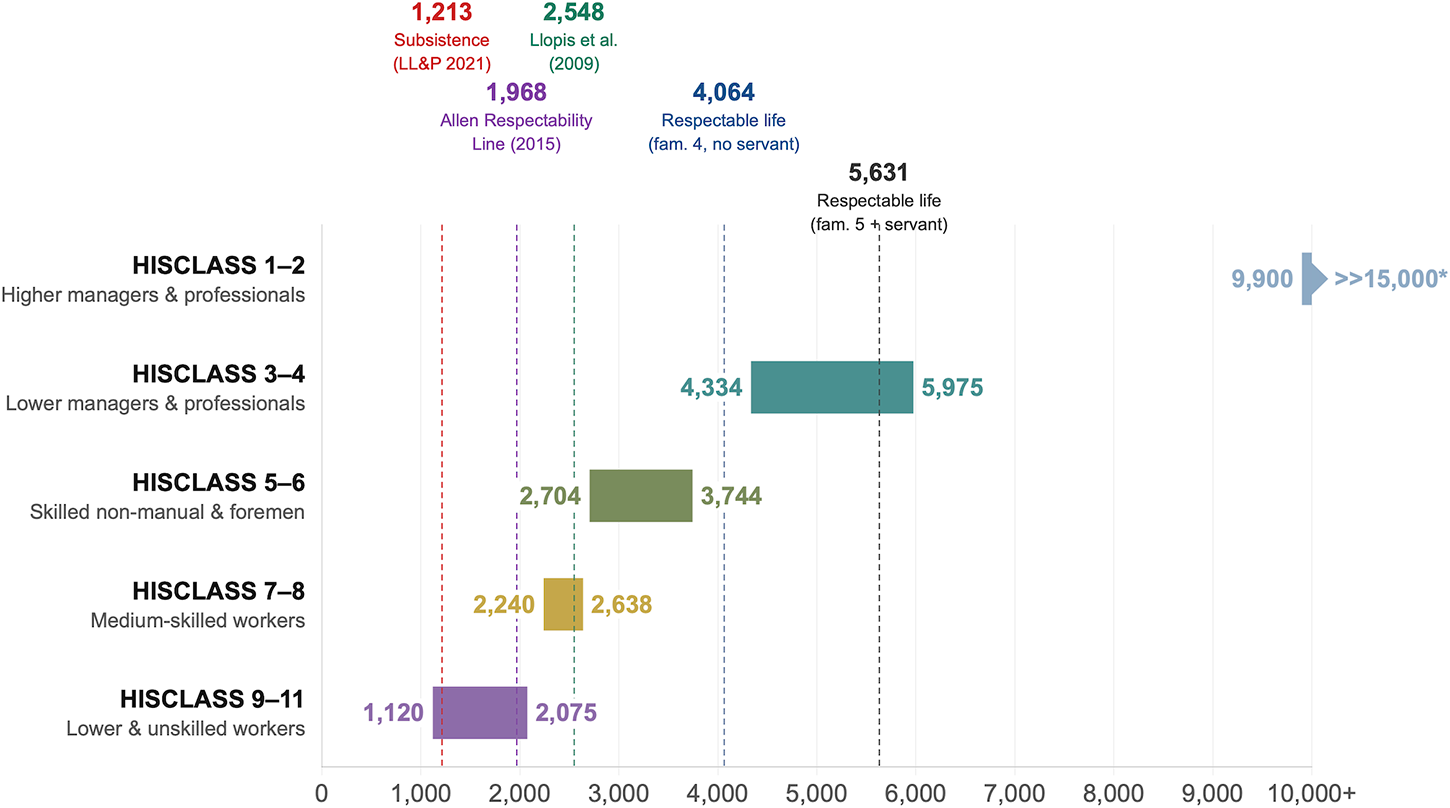
Figure 3 presents the resulting compensation ranges by HISCLASS category. Table 10 provides the full breakdown of each component by employee, documenting the hierarchy of institutional compensation in mid-eighteenth-century Seville. It also shows annualized earnings for casual construction workers, calculated by multiplying observed daily wages (4 rs. vn. for laborers and 8 rs. vn. for masons) by 280 days, the modal figure observed across a range of building projects in Seville (Bartolomé Rodríguez et al., Reference Bartolomé Rodríguez, García-Zúñiga, González-Mariscal, López Losa, Ongaro, Stephenson and Mocarelli2026). Of the eighteen full-time employees considered here, only a small minority earned enough to support a family at the respectability threshold of 5,631 rs. vn.: the municipal Notary, Accountant, and First Accounting Officer, along with the two highest-ranking positions at San Telmo, the Steward Purveyor and the College Accountant. A second group, comprising the municipal Second Accounting Officer and San Telmo’s Primary Schoolmaster and Accounting Officer, earned more than the reduced threshold of 4,064 rs. vn. and could therefore support and could therefore attain this standard through labour earnings alone. A third group included the First Assistant Primary Schoolmaster and the male nurse and wardrobe keeper, whose earnings surpassed Llopis Agelán et al.’s (Reference Llopis Agelán, García-Hiernaux, García Montero, González Mariscal and Hernández García2009) intermediate benchmark of 2,548 rs. vn. but fell short of both upper lines. The remaining San Telmo staff, such as cooks, assistants, errand boys, and servants, was around or below Allen’s respectability basket of 1,968 rs. vn. Their total earnings placed them closer to a form of dignified subsistence accorded to their position in the labor and social hierarchy than to any level of consumption associated with respectable social representation. Casual construction workers occupied the lowest positions in this hierarchy. The journeyman barely reached Allen’s line, while the unskilled laborer fell below even the bare subsistence threshold. The evidence underlines how difficult it was to reach the standard reconstructed here: : even full-time institutional employees with substantial in-kind benefits rarely crossed it.
Annual compensation of institutional employees by HISCLASS category and welfare thresholds, Seville, 1760–1764 (rs. vn.).

Figure 3 Long description
The bar graph shows annual compensation by HISCLASS category. The horizontal axis is labeled 0 to 10,000 plus. The vertical axis lists: HISCLASS 1 dash 2, HISCLASS 3 dash 4, HISCLASS 5 dash 6, HISCLASS 7 dash 8, HISCLASS 9 dash 11. Reference lines are labeled 2,297, 2,988, 4,016 and 5,682. Data values shown by category: HISCLASS 3 dash 4 has a horizontal range bar from 3,744 to 5,975. HISCLASS 3 dash 4 also has a single labeled value 2,449. HISCLASS 5 dash 6 has a single labeled value 3,199. HISCLASS 7 dash 8 has single labeled values 2,240 and 2,704. HISCLASS 9 dash 11 has single labeled values 1,120 and 2,075. A separate horizontal range is labeled 9,900 to 15,000. Largest labeled range is 9,900 to 15,000. The HISCLASS 3 dash 4 range 3,744 to 5,975 is higher than the single labeled values 3,199, 2,704, 2,449, 2,240, 2,075 and 1,120.
Annual salaries and total compensation of institutional employees, Seville, 1760–1764 (rs. vn.)

Table 10 Long description
The table lists institutional jobs in Seville with a HISCLASS code and pay in rs.vn., covering municipal employees, Colegio Seminario San Telmo staff, and casual building workers. Municipal salaries range from 2,008 for the second council doorman to 15,000 for the notary, with accountants at 9,900 and accounting officers at 5,400 and 4,400. At San Telmo, total annual compensation is broken into cash plus in-kind components labeled Sn, Fr, H, S, T, and O; the highest totals are 5,975 for the steward purveyor and the accountant, and the lowest totals are around 2,035 to 2,075 for servants and an errand boy. Several San Telmo roles share identical totals and component patterns, such as steward purveyor and accountant, and male nurse and wardrobe keeper. Casual building workers are paid 2,240 for a journeyman and 1,120 for an unskilled labourer, based on 290 working days. Overall, higher-status administrative roles earn several times more than service roles and day labor, but comparisons should note that some entries are salary only while others include both cash and in-kind compensation.
Source: Aguilar Piñal (Reference Aguilar Piñal1989, p. 165); Bartolomé Rodríguez et al. (Reference Bartolomé Rodríguez, García-Zúñiga, González-Mariscal, López Losa, Ongaro, Stephenson and Mocarelli2026); AHUS, Libros 0091; 0212.
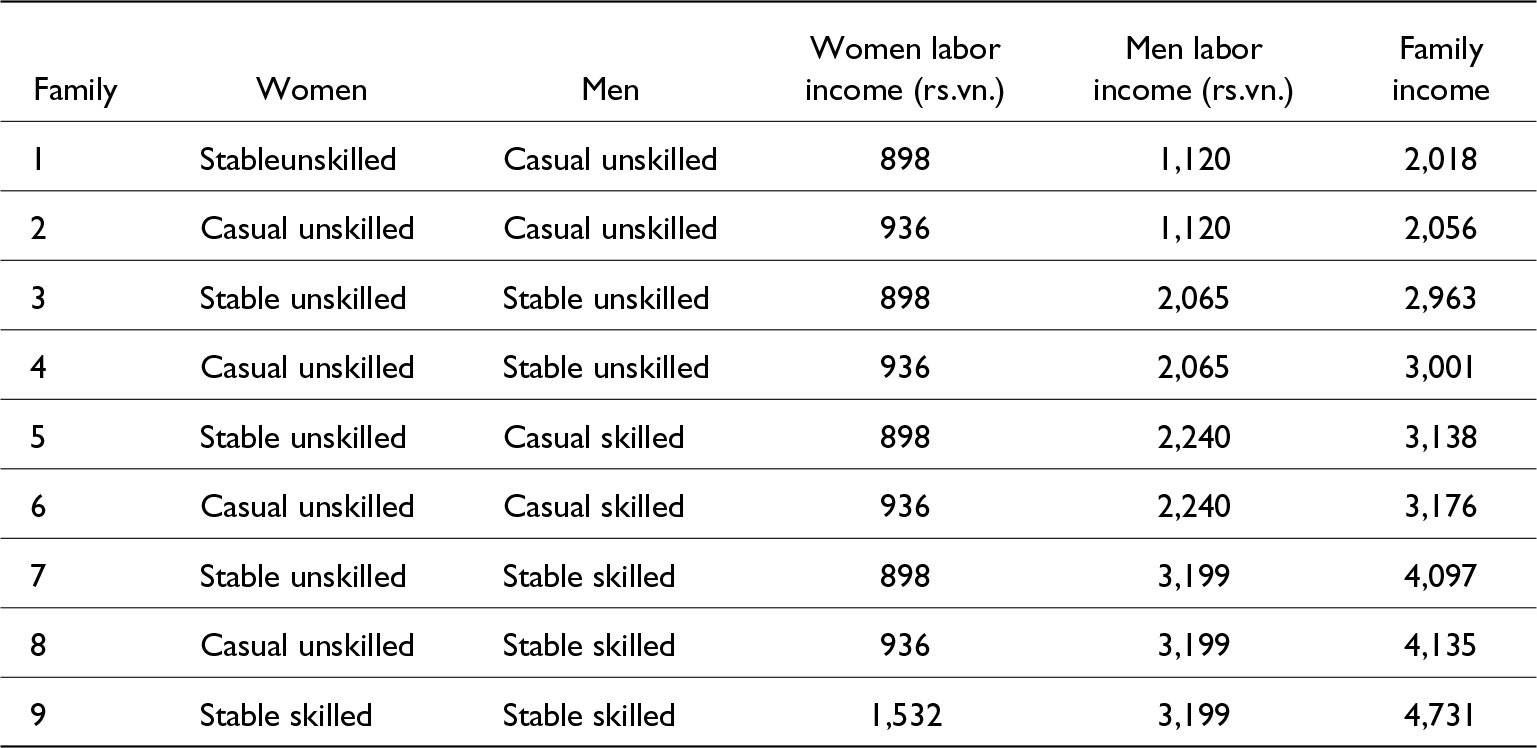
The income simulations that follow extend the analysis from individual earnings to working households, using the model proposed by Bartolomé Rodríguez et al. (Reference Bartolomé Rodríguez, García-Zúñiga, González-Mariscal, López Losa, Ongaro, Stephenson and Mocarelli2026). For male casual workers, daily wages have been multiplied by 280 annual working days. For stable unskilled and skilled male workers, the reference point is the annual salary of the male nurse and wardrobe keeper at San Telmo. For women in casual unskilled work, the estimate is based on the 155 days worked annually by laundresses at San Telmo, who earned 3 rs. vn. a day plus a ration valued at 2.5–3 rs. vn. These women likely worked elsewhere, but any additional income is undocumented and cannot be quantified. This estimate, therefore, represents a lower bound for female casual earnings. For unskilled and skilled women in stable employment, annual income is derived from the cash salaries and the value of rations received by assistant housekeepers and the housekeeper at the Hospital de las Cinco Llagas in Seville (Calderón Berrocal, Reference Calderón Berrocal2016).
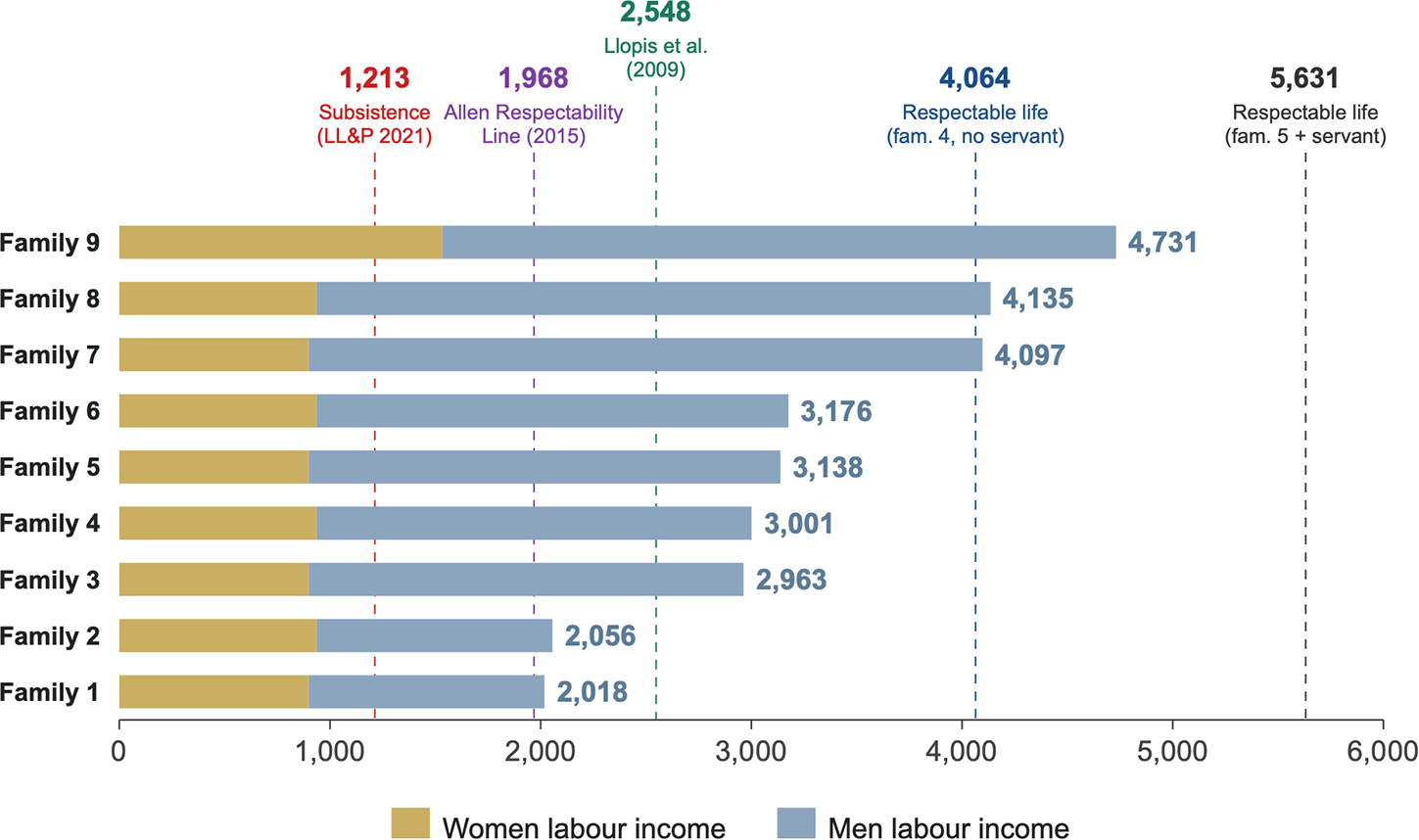
Figure 4 compares the nine simulated household configurations with the welfare thresholds established above, with Table 11 providing the underlying values. This exercise shows both the importance of women’s labor income and the narrow margins within which working families operated. A household in which both spouses depended on casual unskilled work barely reached Allen’s respectability basket (family type 2). None of the nine family configurations attained the higher threshold of 5,631 rs. vn. When the reference point is the reduced model for a family of four without a servant, three household types surpass it (family types 7–9), all of which combine stable skilled male employment with female earnings. Even the highest-earning household (family type 9) reached only 84 per cent of the full threshold. A modest but socially meaningful level of respectability was therefore within reach only for a narrow segment of working families with stable skilled employment. The higher standard required either high-ranking institutional positions or access to supplementary resources such as dowry income, household credit, or property rents, to which most working families had limited access. The domestic servant, a visible marker of status in contemporary society, remained beyond the reach of all simulated household types.
Simulated annual income of working-family households relative to welfare thresholds in rs. vn. Seville, 1760–1764.

Figure 4 Long description
The horizontal bar graph has nine rows labeled Family 9, Family 8, Family 7, Family 6, Family 5, Family 4, Family 3, Family 2 and Family 1. The horizontal axis shows tick labels 0, 1 comma 000, 2 comma 000, 3 comma 000, 4 comma 000 and 5 comma 000. The vertical axis lists the family labels. Each row contains a stacked horizontal bar with two segments. A legend shows Women labour income and Men labour income. Numeric labels at the right end of each stacked bar show total family income values: Family 9: 4 comma 731. Family 8: 4 comma 135. Family 7: 4 comma 097. Family 6: 3 comma 176. Family 5: 3 comma 138. Family 4: 3 comma 001. Family 3: 2 comma 963. Family 2: 2 comma 056. Family 1: 2 comma 018. Three vertical reference lines are labeled: 1 comma 213, Subsistence, L P S P 2022. 2 comma 297, Allen Respectability, Line 2010. 5 comma 682, Respectable life, 4 comma 0 servants. A separate label near the upper right reads 2 comma 300, Loose, 4 comma 0 servants.
Simulated annual income of working-family households, Seville, 1760–1764 (rs. vn.)

Table 11 Long description
The table lists nine simulated working-family households in Seville during the early 1760s, showing women’s and men’s job stability and skill level alongside each partner’s labour income and the combined family income in rs.vn. Women’s incomes range from 898 to 1,532, while men’s incomes range from 1,120 to 3,199. The lowest combined income is 2,018 when a stable unskilled woman is paired with a casual unskilled man, and 2,056 when both are casual unskilled. When the man is stable unskilled, family income rises to about 2,963 to 3,001 depending on whether the woman is stable or casual unskilled. Pairing an unskilled woman with a skilled man increases totals further, reaching about 3,138 to 4,135, with higher totals when the man is stable skilled rather than casual skilled. The highest total, 4,731, occurs when both partners are stable skilled, combining a woman’s 1,532 with a man’s 3,199. Overall, men’s skill and stability drive most of the variation in family income, while women’s stability changes totals modestly within the same male category. Values are simulated and represent modeled household scenarios rather than observed incomes for specific families.
Source: Aguilar Piñal (Reference Aguilar Piñal1989, p. 165); Bartolomé Rodríguez et al. (Reference Bartolomé Rodríguez, García-Zúñiga, González-Mariscal, López Losa, Ongaro, Stephenson and Mocarelli2026); AHUS, Libros 0091; 0212.
Evidence from Madrid and Palencia also points in this direction. López García (Reference López García2003) estimates that in mid-eighteenth-century Madrid, only about 3,000 middle-class families, including those headed by lawyers, physicians, architects, and notaries, earned more than 5,000 rs. vn. per year; four-fifths of the population fell below this figure, and 70 percent earned less than 2,000 rs. vn. Ramos Palencia (Reference Ramos Palencia2001) found that only 5 percent of Palencia’s inhabitants earned more than 4,000 rs. vn., while 88 percent made less than 2,000 rs. vn. These figures are not enough to establish a general rule for urban Spain, but they do suggest that the pattern of limited affordability identified here was not peculiar to Seville. The consumption horizon of most working families was closer to the dignified subsistence that Allen’s respectability basket represented than to the threshold reconstructed here. The reduced scenario qualifies this conclusion: dispensing with domestic service and absorbing maintenance costs through unpaid household labor brought this level within reach of some households, although the higher threshold remained elusive. However, even under this reduced form of respectable living, the sope for market expansion and demand-led growth in eighteenth-century Seville, and by extension in urban Spain, likely remained constrained.
5. Conclusions
This article reconstructs a socially recognised benchmark of respectable living in mid-eighteenth-century Seville that goes beyond the measurement of subsistence levels. The annual cost of maintaining that standard exceeded 5,000 rs. vn., roughly double Allen’s respectability line and well above other estimates in Spanish historiography. This gap reflects both the greater weight of manufactured goods in the budget and the explicit inclusion of domestic service, two components that poverty-based metrics tend to undervalue. Rather than representing a normative ideal, this benchmark corresponds to a form of living that contemporaries would have recognised as minimally decent.
The disparity between this threshold and the incomes levels available to most working families was substantial. Among the institutional employees examined here, only those in the highest-ranking positions earned enough to sustain a family at the upper threshold. The reduced benchmark assumed that domestic maintenance was provided through unpaid household labour, lowering the cost substantially. It nevertheless remained attainable only for a narrow segment of households combining stable skilled male employment with female earnings. For most families, the consumption horizon remained closer to a level of dignified subsistence approximated by Allen’s respectability basket than to the more demanding standard identified here.
Taken together, these findings suggest that limited household purchasing power may have constrained demand-led growth in eighteenth-century Spain. If most urban working families could not afford this standard, the domestic market for the manufactured goods that Arriquibar regarded as essential for economic development likely remained narrow. This, in turn, may help to explain why the consumer revolution appears to have had a more limited reach in Spain. More broadly, the results point to the limits of subsistence-based metrics as proxies for welfare in preindustrial urban economies. Once socially recognised standards of decent living are reconstructed, the distance between subsistence and respectability appears considerably wider than subsistence-based approaches alone would suggest, and the limits of effective demand become easier to identify.
Acknowledgements
This research was supported by Grant PID2021-124378NB-100 from the Spanish Ministry of Science, Innovation and Universities (MICIU)/State Research Agency (AEI)/10.13039/501100011033 and the European Regional Development Fund (ERDF/EU), as well as by the Basque Government through the Consolidated Research Group GIC21/38. The author thanks Emiliano Fernández de Pinedo, Santiago Piquero and Mario García-Zúñiga, and the three anonymous reviewers for their comments on earlier versions of this paper. Much of this work was carried out during a research stay at the Unit of Economic History, University of Gothenburg. The author is grateful to Svante Prado and the other members of the unit for their hospitality and for providing a stimulating environment for research and discussion.
Supplementary material
Supplementary material for this article is available at https://doi.org/10.82518/WANHUK and on the journal’s website.

 Open access

