Ellis–van Creveld syndrome (Online Mendelian Inheritance in Man 225500), also known as chondroectodermal dysplasia, is a rare autosomal recessive disorder with cardiac, skeletal, dermatologic, gastrointestinal, and respiratory manifestations.Reference Baujat and Le Merrer 1 Although quite rare in the general population (1 in 20,000 births), its incidence is much more common in Amish populations because of founder effect and concentration of the recessive gene in a closed society.Reference McKusick, Eldridge, Hostetler and Egeland 2 First described in 1940,Reference Ellis and van Creveld 3 the Ellis–van Creveld syndrome is well known to have a high incidence and prevalence of congenital malformations of the heart. Approximately 60–70% of patients with Ellis–van Creveld syndrome are affected with significant congenital malformations of the heart, with atrial, ventricular, and atrioventricular septal defects, common atrium, and abnormalities of the pulmonary and systemic veins most commonly encountered.Reference McKusick, Eldridge, Hostetler and Egeland 2 , Reference Digilio, Marino, Ammirati, Borzaga, Giannotti and Dallapiccola 4 , Reference Hills, Kochilas, Schimmenti and Moller 5 Cognitive development is normal, and premature mortality beyond infancy is unusual.Reference McKusick, Eldridge, Hostetler and Egeland 2 Although cardiac surgery is generally offered to children with Ellis–van Creveld syndrome and congenital malformations of the heart, relatively high morbidity and mortality have been demonstrated in some small, single-centre series.Reference O’Connor, Rider, Collins, Hanna, Morton and Strauss 6 The cause of this excess morbidity and mortality is not entirely clear, but may involve the additive risk of features specific to Ellis–van Creveld syndrome such as thoracic cage abnormalities, respiratory insufficiency, and an increased risk of pulmonary hypertension.Reference O’Connor, Rider, Collins, Hanna, Morton and Strauss 6 We sought therefore to investigate measures of morbidity, mortality, and healthcare utilisation in a contemporary population of patients with Ellis–van Creveld syndrome cared for in United States children’s hospitals.
Materials and methods
Following approval by the institutional review board of the University of Arkansas for Medical Sciences, data were obtained from the Pediatric Health Information System, a large inpatient administrative database of 43 participating free-standing, tertiary care children’s hospitals in the Child Health Corporation of America, a children’s hospital consortium. The Pediatric Health Information System data include detailed, de-identified information on each inpatient’s demographics, diagnoses, procedures, medications, and outcomes. Data quality assurance is ongoing and data from individual hospitals are accepted when classified errors for a given quarter occur less frequently than a criterion threshold of 2%. The study design was a multi-centred, retrospective cohort investigation of all patients cared for in the children’s hospitals within the Child Health Corporation of America network with an International Classification of Diseases (9th revision code), principal or secondary, for chondroectodermal dysplasia (756.55). Data were limited to the time period between 1 January, 2004 and 31 December, 2011. For the purposes of this study, information abstracted from the Pediatric Health Information System database included demographic data, primary and secondary diagnoses, primary and secondary procedures performed, hospital length of stay, use and duration of mechanical ventilation, and charges applied to each admission.
To aid in data analysis, both diagnoses and procedures were grouped into the following categories: infectious, haematology-oncology, endocrine, nutrition and metabolism, fluid and electrolyte, immunology, psychiatric and development, neurologic and otolaryngologic, cardiovascular, dermatology, pulmonary, gastroenterologic, renal and genitourinary, gynaecologic, rheumatologic and orthopaedic, genetic, trauma and accidental injury, and symptoms.
All data were analysed using R v2.15.1 (R Foundation for Statistical Computing, Vienna, Austria). We hypothesised that patients who underwent any cardiovascular surgical or interventional catheterisation procedure during an admission would have higher morbidity, mortality, and healthcare utilisation than patients who did not undergo cardiovascular procedures. Summary statistics were expressed as mean±standard deviation and/or median (1st quartile, 3rd quartile) for continuous variables, and frequency and percentage for categorical variables. The means of continuous variables were compared using the mixed model by taking into account the correlated admissions from the same patient, and the correlated patients from the same hospital unit. The proportions of binary variables were compared using the generalised estimating equations after taking into account the nested clustering. The length of stay was considered to be time-to-event outcome, whereas discharge from the hospital was treated as the event, and the patients who died during the hospital stay were censored. Similar analyses were carried out to assess the difference across years (2004–2011). All hospital charges are reported in 2011 United States dollars. p-values<0.05 were considered to be statistically significant.
Results
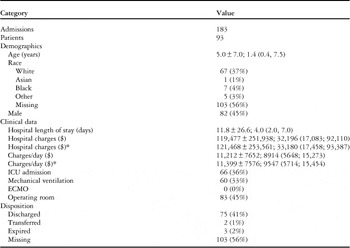
Between 1 January, 2004 and 31 December, 2011, there were 183 admissions in 93 patients with the diagnosis code for chondroectodermal dysplasia. In all, 33 hospitals admitted patients with Ellis–van Creveld syndrome during the study period, representing 77% of hospitals within the Pediatric Health Information System sample. A total of 41 (44%) patients had multiple admissions, with a median of 3 admissions per patient (range 2–8). Demographic and clinical outcomes data are presented in Table 1. Of the 93 patients, three (3.2%) expired before discharge; however, data regarding disposition were missing in 103 admissions (56% of total admissions).
Demographic and hospital resource utilisation data in patients with Ellis–van Creveld syndrome.

ECMO=extracorporeal membrane oxygenation; ICU=intensive care unit
Values are presented as count (%) or mean±standard deviation; median (1st quartile, 3rd quartile)
* After excluding charges with “0” value
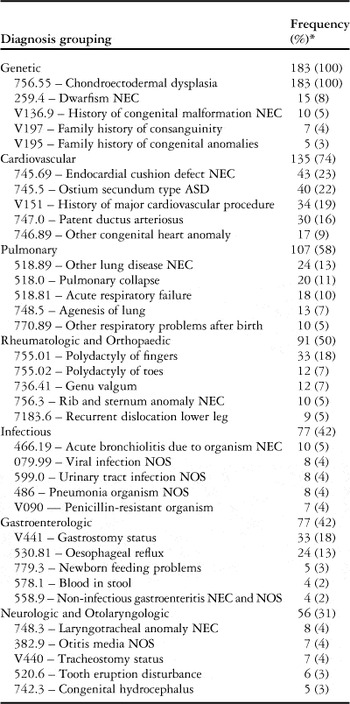
Diagnostic categories and their relative prevalence for all admissions are displayed in Table 2. All patients carried the diagnosis code for chondroectodermal dysplasia, and were thus classified as having a genetic diagnosis. The second most commonly encountered diagnostic category, present in 74% of admissions, was cardiovascular. Pulmonary and orthopaedic diagnoses were also commonly encountered, comprising 58% and 50% of admissions, respectively.
Most commonly encountered diagnostic codes for hospital admissions in patients with Ellis–van Creveld syndrome (n=183).

ASD=atrial septal defect; NEC=not elsewhere classified; NOS=not otherwise specified
Diagnostic codes under the categories haematology–oncology, symptoms, fluid and electrolyte, psychiatric and development, nutrition and metabolism, trauma and accidental injury, endocrine, immunology, renal and genitourinary, and gynaecologic were not included in this table because of their relative infrequency of occurrence
* Patients may have had more than one diagnosis
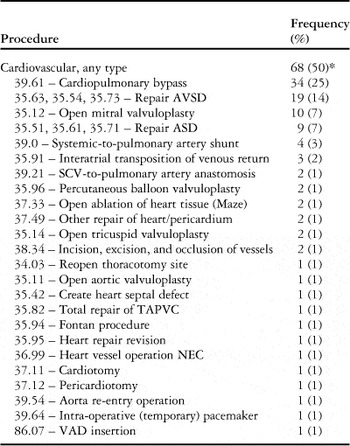
Cardiovascular procedures were performed most commonly, occurring in 50% of admissions. The cardiovascular procedures performed most commonly are listed in Table 3. The most common cardiovascular surgical procedures performed, in descending order, included repair of endocardial cushion defect, repair of atrial septal defect, systemic-to-pulmonary artery shunt, and interatrial baffle of transposed venous return. No patient was supported with extracorporeal membrane oxygenation, although one patient underwent placement of a ventricular assist device. Pulmonary procedures were performed in 36% of admissions, the majority of which involved endotracheal intubation and mechanical ventilation. In all, 27% of the procedures were orthopaedic in nature, most of which involved lower extremity reconstructive surgeries.
Interventional and surgical cardiac procedures (n=137).

ASD=atrial septal defect; AVSD=atrioventricular septal defect; NEC=not elsewhere classified; NOS=not otherwise specified; SCV=superior caval vein; TAPVC=total anomalous pulmonary venous connection; VAD=ventricular assist device
* The listed procedures do not sum to the total number of procedures, as patients may have had more than one procedure performed
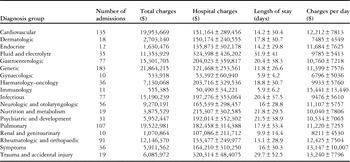
Hospital charges and length of stay for each diagnosis group with stratification by year are displayed in Table 4. No significant differences in hospital charges per day and length of stay were noted between diagnostic groups or study years.
Hospital length of stay and charges per day according to diagnosis group.

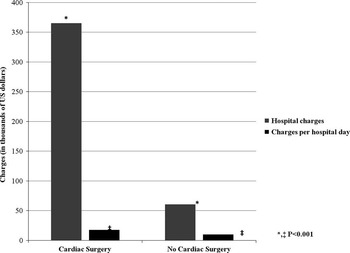
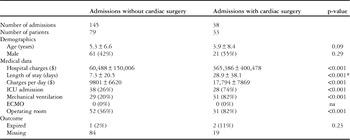
Differences in outcomes between patients who underwent cardiac surgical or interventional procedures during a single admission versus those who did not are presented in Table 5 and Figure 1. Patients who underwent cardiac procedures during hospitalisation had significantly higher hospital charges per day ($17,794±7869 versus $9801±6620) and length of stay (28.9±38.1 days versus 7.3±20.5 days) than those whose admissions did not involve cardiac procedures. In addition, there was a higher incidence of intensive care unit admission and mechanical ventilation in patients who underwent a cardiac procedure. Meaningful analysis of hospital survival between groups could not be performed because of the high rate of missing disposition data.
Comparison of total hospital charges and hospital charges per day in patients with Ellis–van Creveld syndrome who underwent cardiac surgical or interventional procedures versus those who did not.

Comparison of outcomes in admissions in which cardiac surgery was performed versus those in which cardiac surgery was not performed.

ECMO=extracorporeal membrane oxygenation; ICU=intensive care unit
* The three patients who died during the hospital stay were excluded from the comparison for length of stay
Discussion
To our knowledge, the present study represents the largest cohort of patients with Ellis–van Creveld syndrome reported to date in the literature. In this study, demographic, clinical, and healthcare utilisation data are presented, with specific analysis of in-hospital outcome and resource utilisation measures in those with coexisting congenital malformations of the heart. Although Ellis–van Creveld syndrome is a rare diagnosis that tends to be clustered in specific geographic regions of the United States of America, an understanding of how the treatment of congenital malformations of the heart may be different in individuals with Ellis–van Creveld syndrome is important, on account of the very high reported incidence of congenital malformations of the heart. Our relatively robust sample size (93 patients) allows for some conclusions and generalisations to be drawn from this special patient population.
Nearly 75% of the study population carried a diagnosis of congenital malformations of the heart, which is consistent with a reported prevalence of ~60–70% in prior reports.Reference McKusick, Eldridge, Hostetler and Egeland 2 , Reference Digilio, Marino, Ammirati, Borzaga, Giannotti and Dallapiccola 4 , Reference O’Connor, Rider, Collins, Hanna, Morton and Strauss 6 Moreover, it was the most commonly encountered diagnostic category for the population. The reported incidence of congenital malformations of the heart in the present study is likely higher than that in the general Ellis–van Creveld syndrome population; patients with congenital malformations of the heart will have higher rates of hospitalisation, and thus will be over-represented in inpatient database studies such as this one. Interestingly, nearly 20% of patients carried a diagnosis code reflecting a history of prior surgery for cardiovascular disease. It is plausible that many of these patients with a prior cardiac surgical history represent children with single-ventricle congenital malformations of the heart, many of whom required staged palliation to a Fontan procedure; however, the nature of the Pediatric Health Information System database does not allow for definitive testing of this hypothesis. This is supported by the fact that procedure codes for systemic-to-pulmonary artery shunt, superior cavopulmonary connection (Glenn), and Fontan procedure were observed in the Pediatric Health Information System dataset.
Cardiovascular procedures also predominated among those performed on the patients reported in this study, with 50% of admissions being associated with a cardiovascular procedure. Cardiopulmonary bypass was utilised in half of the admissions with cardiovascular procedures. Repair of atrioventricular septal defect was the most common cardiac surgical procedure performed; however, consistent with the wide range of heart disease encountered in patients with Ellis–van Creveld syndrome, surgical procedures such as repair of atrial septal defect and total anomalous pulmonary venous return were also encountered. The performance of the relatively rare procedure to correct transposed venous return – via interatrial baffle – in three patients supports the known association of Ellis–van Creveld syndrome with systemic and pulmonary venous abnormalities; furthermore, the performance of this procedure also supports a clinical link between Ellis–van Creveld syndrome and heterotaxy syndrome. Similarities at the molecular genetic level between Ellis–van Creveld syndrome and heterotaxy syndrome have been described in several reports.Reference Digilio, Marino, Ammirati, Borzaga, Giannotti and Dallapiccola 4 , Reference Ruiz-Perez, Blair and Rodriguez-Andres 7 , Reference Digilio, Marino, Giannotti, Dallapiccola and Opitz 8 Interventional catheterisation procedures were uncommon in the present study, with the most common procedure being balloon valvuloplasty (valve not specified), which was performed in only two hospitalisations. As discussed previously, procedures consistent with an underlying diagnosis of single-ventricle congenital malformations of the heart were also encountered, including systemic-to-pulmonary artery shunt and superior cavopulmonary connection (Glenn). We have previously reported the performance of Fontan completion in patients with Ellis–van Creveld syndrome,Reference O’Connor, Rider, Collins, Hanna, Morton and Strauss 6 with one patient in the current report coded as having undergone a Fontan procedure.
In our previous single-institution report of nine patients with Ellis–van Creveld syndrome undergoing cardiac surgery, all patients had respiratory-related morbidity, with one-third of those undergoing cardiac surgery noted to have had a tracheostomy performed in the peri-operative period.Reference O’Connor, Rider, Collins, Hanna, Morton and Strauss 6 In the present report, a tracheostomy was coded as present in 7% of admissions; an additional 4% had a tracheostomy performed during hospital admission. The aetiology of the discrepancy between the incidence of tracheostomy in this and our prior report is uncertain, but may be related to differences in patient populations and centre-specific variations in the management of profound respiratory failure in these patients. Continued evidence of respiratory-related morbidity in Ellis–van Creveld syndrome was seen in the present series, a finding largely manifested by prolonged mechanical ventilation (≥95 h of mechanical ventilation). Prolonged mechanical ventilation was observed in 21% of admissions in which procedures (of any type) were performed.
Surgery and other interventional therapies for congenital malformations of the heart is a key driver of healthcare utilisation in children and adults. 9 , Reference Kim, Gauvreau, Bacha, Landzberg and Benavidez 10 We hypothesised that in patients with Ellis–van Creveld syndrome, measures of healthcare utilisation would be significantly higher in those who underwent cardiovascular procedures during hospitalisation than in those who did not. In the present study, total hospital charges, hospital charges per day, length of stay, incidence of intensive care unit admission, and the use of mechanical ventilation were all significantly increased in hospitalisations that included cardiac procedures. It is clear from the present data that cardiovascular procedures significantly impact hospital charges and length of stay in patients with Ellis–van Creveld syndrome. As a result of the high prevalence of incomplete disposition data, the question of the impact of cardiovascular procedures on in-hospital mortality could not be answered. Further investigation will be necessary to determine whether these measures of healthcare utilisation in patients with Ellis–van Creveld syndrome differ significantly from other children undergoing surgery for congenital malformations of the heart.
Limitations
This report has several important limitations, foremost of which is its retrospective nature. The proper classifications of medical and anatomic diagnoses by International Classification of Diseases codes in the Pediatric Health Information System database are dependent upon those recorded by the billing physicians during the hospitalisation and the hospital billing coders, and the diagnosis of Ellis–van Creveld syndrome was not independently confirmed. Given the stringent procedures used for quality assurance of the data within the Pediatric Health Information System database, and the fact that the diagnosis code for Ellis–van Creveld syndrome is very specific, the likelihood of this making a significant impact on the findings of the study are limited. Data supplied to the Pediatric Health Information System database may not be accurate with respect to diagnoses and procedures, particularly in patients undergoing cardiac surgery;Reference Pasquali, Peterson and Jacobs 11 therefore, inaccuracies and lack of completeness in diagnoses and procedural classifications cannot be excluded. Furthermore, the data within the Pediatric Health Information System database are not granular enough to examine patient-specific risk factors and outcomes, which are important in rare diagnoses with complex interacting factors. For example, the severity of the underlying illness and indications for cardiac surgery are not available in an administrative database such as the Pedatric Health Information System. Owing to the nature of the database, prevalence of the reported comorbid medical conditions is most likely underestimated. The study was conducted using data from inpatient hospitalisations. Thus, the results of the study with regard to the prevalence of comorbid medical conditions may not be applicable to all patients with Ellis–van Creveld syndrome, especially those in the outpatient setting. The Pediatric Health Information System database includes data only from paediatric hospitals. Therefore, these data may not translate directly to adults with Ellis–van Creveld syndrome hospitalised in adult facilities.
Conclusions
In this relatively large sample of inpatient admissions, patients with Ellis–van Creveld syndrome were admitted to the hospital for a variety of indications, with cardiovascular diagnoses and procedures being the most common. Patients with Ellis–van Creveld syndrome consumed substantial healthcare resources, which is indicative of the complex clinical picture commonly encountered in this patient population. In patients with Ellis–van Creveld syndrome undergoing cardiovascular procedures, measures of healthcare utilisation were significantly higher than in those whose admissions were for other indications and procedures.
Acknowledgements
The authors wish to acknowledge Brandon Beam and Tommy Noel for assistance in obtaining study data from the Pediatric Health Information System database.
Financial Support
This research received no specific grant from any funding agency, commercial or not-for-profit sectors.
Conflicts of Interest
None.
Ethical Standards
This research was deemed not to be human subjects research by the institutional review board of the University of Arkansas for Medical Sciences because ofdue to the de-identified nature of the data.