Introduction
The streaked prochilod Prochilodus lineatus (Valenciennes, 1836) is a migratory Characiformes fish species of the family Prochilodontidae, with a large geographical distribution throughout South America. This fish species is of great importance in Brazilian freshwater aquaculture, where it is known as curimba, curimbatá, curimatã or grumatã. It has been used as a model species for research in a number of studies that addressed nutrition, health, genetic diversity and reproduction (Viveiros et al., Reference Viveiros, Nascimento, Orfão and Isaú2010).
Many fish species exhibit reproductive dysfunctions in captivity. The lack of final oocyte maturation (FOM), ovulation and spawning in cultured fish results from the fact that captive broodstocks do not experience the environmental conditions of spawning in the wild (Zohar & Mylonas, Reference Zohar and Mylonas2001). In these species, induced spawning techniques such as hormone therapy are necessary. Prochilodus lineatus is one of the species to be affected.
Induced ovulation and spermiation techniques have evolved rapidly from the use of simple, gonadotropin-containing, pituitary homogenates (Von Ihering, Reference Von Ihering1937) or partially purified piscine gonadotropin preparations (Donaldson et al., Reference Donaldson, Yamazaki, Dye and Philleo1972) to the use of potent synthetic agonists of gonadotropin-releasing hormone (GnRH), associated or not with a dopamine antagonist (Zohar & Mylonas, Reference Zohar and Mylonas2001). The gonadotropins present in pituitary extract (PE) act directly at gonad level and induce successful spawning in a great variety of fish species. About 40 important fish species in Brazil have been successfully induced to reproduce using this technique (Maria et al., Reference Maria, Azevedo, Santos and Carneiro2012). However, the use of PE is associated with various drawbacks such as the great variability in pituitary luteinizing hormone (LH) content, the administration of additional hormones present in the pituitary that may adversely affect the physiology of the treated fish, and the potential for transmission of diseases from donor fish to recipient broodstock (Zohar & Mylonas, Reference Zohar and Mylonas2001). These concerns led the Brazilian Ministry of Agriculture (MAPA) to prohibit the use of PE in some States, including Minas Gerais. However, to date there is no method of inducing fish reproduction in Brazil as efficiently as PE therapy.
One therapy that replaced PE in some fish species is the use of GnRH, which acts at the pituitary level by stimulating the synthesis and release of endogenous gonadotropins (Donaldson et al., Reference Donaldson, Solar, Harvey, Tiersch and Green2011). In Characiformes fish, however, the use of GnRH (or luteinizing hormone releasing hormone (LHRH)), as the spawning or spermiation inducer has been tested in some species, but with little or no success. In Brycon cephalus, none of the 27 GnRH-treated females spawned (Ramos et al., Reference Ramos, Ramos and Mendonça1997), while in Piaractus mesopotamicus only eight out of 17 GnRH-treated females spawned (Carolsfeld et al., Reference Carolsfeld, Ramos, Ormanezi, Gomes, Barbosa and Harvey1988). Furthermore, Brycon amazonicus males treated with GnRH possessed lower semen volume, higher sperm concentration and similar sperm motility rate compared with PE-treated males (Pardo-Carrasco et al., Reference Pardo-Carrasco, Zaniboni-Filho, Arias-Castellanos, Suárez-Mahecha, Atencio-García and Cruz-Casallas2006).
Dopamine inhibits the basal release of pituitary gonadotropins and attenuates the action of GnRH on the gonadotrophs (Chang & Peter, Reference Chang and Peter1983). Dopaminergic inhibition differs among fish species and has been demonstrated in Cypriniformes (Szabó et al., Reference Szabó, Medgyasszay and Horváth2002) and in Siluriformes (Wang et al., Reference Wang, Hu, Cheung, Shin, Song and Wang2010; Sharaf, Reference Sharaf2012), but appears to be absent in Salmoniformes (Van Der Kraak et al., Reference Van Der Kraak, Donaldson and Chang1986). Thus, the association of a dopamine antagonist and a GnRH analogue is present in some commercial products such as Ovaprim™, which has been used in a wide variety of fish species (Targońska et al., Reference Targońska, Kucharczyk, Kujawa, Mamcarz and Żarski2010 among others) for aquaculture production, research, conservation and veterinary purposes. In Characiformes, however, Ovaprim™ has been tested in females of four species (Ferraz de Lima et al., Reference Ferraz de Lima, Carolsfeld, Ramos, Alcântara and Ramos1988; Cordero et al., Reference Cordero, Pertuz and Solano2003; Arias Acuña & Hernández Rangel, Reference Arias Acuña and Hernández Rangel2009; Lenis et al., Reference Lenis, Restrepo and Cruz-Casallas2009) and males of one species (Arias Acuña & Hernández Rangel, Reference Arias Acuña and Hernández Rangel2009), with variable and inconclusive results.
Thus, the aim of the current study was to evaluate the efficiency of Ovaprim™ in the induction of spawning and spermiation of streaked prochilod P. lineatus, in comparison with the commonly used method using PE.
Materials and methods
All fish were handled in compliance with published guidelines for animal experimentation described by Van Zutphen et al. (Reference Van Zutphen, Baumans and Beynen2001).
Experiment 1. Oocyte, egg and larvae quality
Females (1.6 ± 0.6 kg body weight (BW)) originated from earthen ponds at the Hydrobiology and Fish Culture Station of Furnas in the city of São José da Barra, Minas Gerais State, Brazil (20°43′07″S; 46°18′50″W). Those fish with detectable running oocytes under soft abdominal pressure were selected. All females received two injections of one of the following hormones: carp PE (Argent Chemical Laboratory, Redmond, Washington, USA) at 0.5 + 5.0 mg/kg (n = 4), which is the routine method currently used to induce spawning in this Fish Culture Station; Ovaprim™ (Syndel Laboratories Ltd., Qualicum Beach, BC, Canada) at 0.05 + 0.45 ml/kg (n = 4); or Ovaprim™ at 0.125 + 0.375 ml/kg (n = 6). One ml of Ovaprim™ contains 20 μg of salmon GnRHa and 10 mg of domperidone. The interval between injections was always 14 h and the oocytes were hand-stripped after 7.5 h at approximately 27°C. Ova weight, ova index (ova weight × 100/g body weight), number of oocytes/g ova, number of oocytes/female and number of oocytes/g BW were evaluated. The term ‘ova’ is used in this manuscript as the mass of oocytes deposited by the female.
Three aliquots of oocytes from each female were collected. The first aliquot (n ≈ 35 oocytes × 14 females) was fixed in Gilson's solution (50 ml 60% ethanol, 440 ml distilled water, 7 ml nitric acid, 10 g mercuric chloride, 9 ml glacial acetic; Simpson, Reference Simpson1951) for 30 min. The diameter of each oocyte was determined under a light microscope (Model L1000, Bioval, Jiangbei, China), at ×40 magnification, using a micrometric objective, and in accordance with Isaú et al. (Reference Isaú, Rizzo, Amaral, Mourad and Viveiros2013). No correction due to the fixation process was made to obtain oocyte diameter. The second aliquot (n ≈ 100 oocytes × 14 females) was fixed in Serra's solution (60 ml 90% ethanol, 30 ml 37% formaldehyde, 10 ml glacial acetic; Brzuska, Reference Brzuska1979) and the germinal vesicle position was examined under a stereomicroscope (Model SZ51, Olympus, Shanghai, China). The germinal vesicle position was classified as central when the germinal vesicle was displaced to an eccentric position and as peripheric breakdown when the germinal vesicle was migrating to the periphery of the oocyte or was absent (breakdown). The third aliquot of oocyte was tested for fertilization. For this test, sperm from nine males were collected 8 h after a single dose of carp PE, at approximately 27°C. Sperm were pooled and diluted in glucose solution at 315 mOsm/kg to an average concentration of 121 × 107 sperm/ml. Then, 100 μl of diluted sperm were mixed with 0.2 g oocytes (~242 oocytes) from each of the 14 females, producing an approximate ratio of 5 × 10⁵ sperm:oocyte. Fertilization was initiated by the addition of 5 ml tank water, and homogenized for 1 min. Subsequently, 10 ml tank water was added, and samples mixed for another 1 min. Finally, eggs were transferred to a PVC basket, 10 cm in diameter, with a 0.5 mm mesh bottom (Viveiros et al., Reference Viveiros, Fessehaye, Ter Veld, Schulz and Komen2002), and incubated in a flow-through system at 24°C. In total, 28 batches of eggs were fertilized (two batches of eggs × 14 females).
Fertilization rate (as the number of fertilized eggs × 100/total number of eggs) was determined 9 h after fertilization at 24°C. Hatching rate (as the number of hatched larvae × 100/total number of eggs) and percentage normal larvae (as the number of normal larvae × 100/total number of larvae) were determined 21 h after fertilization.
Experiment 2. Sperm quality
Males (0.9 ± 0.5 kg of BW) originated from the Fish Culture Station of the Minas Gerais Power Company (CEMIG) in the city of Itutinga (21°17′36″S; 44°37′02″W), Minas Gerais State, Brazil, and those with detectable running sperm under soft abdominal pressure were selected. All males received one dose of catfish PE (Clarias fuscus; Destiny Land Enterprise Co., Ltd., Taiwan) at 0.4 mg/kg. After 12 h, 19 males received a second dose of catfish PE at 4.0 mg/kg (PE-treated males), which is the routine method currently used to induce spermiation in this Fish Culture Station; 15 males received one dose of Ovaprim™ at 0.25 ml/kg (Ovaprim-treated males). Six hours later at approximately 27°C, the urogenital papilla was carefully dried and sperm were hand-stripped directly into glass tubes. Immediately after collection, the tubes containing sperm were placed in a cooler (9–11°C) containing dry ice foam (Polar Technics CRI Ltd., Brazil) and transported approximately 40 km to the laboratory.
Sperm concentration (hemacytometer/Neubauer chamber; Boeco, Hamburg, Germany), semen osmolality (Semi-Micro Osmometer K-7400, Knauer, Berlin, Germany) and semen pH (pH meter DM-22, Digimed, São Paulo, Brazil) were determined in all samples. It was possible to centrifuge (2000 g for 30 min; MiniStar, Shanghai, China) sperm to obtain seminal plasma of only eight Ovaprim- and 12 PE-treated males. In those seminal plasma samples, both osmolality and pH were measured.
Sperm motility and velocities were evaluated in all samples using a computer-assisted sperm analyser (CASA). Sperm were first diluted 1:100 in BTS™ solution (Beltsville Thawing Solution, Minitub™, Tiefenbach/Landshut, Germany) at 325 mOsm/kg. Beltsville Thawing Solution is composed of 79.9% glucose, 12.7% sodium citrate, 2.7% EDTA, 2.7% NaHCO3, 1.5% KCl and 0.5% gentamycin sulfate. Then, diluted sperm were activated in a hyposmotic NaCl solution at 98 mOsm/kg directly in a Makler™ counting chamber (Sefi-Medical Instruments ltd, Haifa, Israel) to a final dilution ratio of 1:500, according to the routine method to evaluate P. lineatus sperm under CASA in our laboratory (Viveiros et al., Reference Viveiros, Nascimento, Orfão and Isaú2010). The Makler™ counting chamber was placed under a phase-contrast microscope (Nikon Eclipse E200, Tokyo, Japan) at ×100 magnification with a green filter and pH 1 position. The microscope was connected to a video camera (Basler Vision Technologies™ A602FC, Ahrensburg, Germany) generating 100 images/s; video recording started 10 s post-activation. Each image was analysed using the adjusted settings for fish by Sperm Class Analyzer™ software (SCA™ 2010, Microptics, S.L. Version 5.1, Barcelona, Spain). Sperm were considered immotile when velocity was <40 μm/s. Although the SCA™ simultaneously assesses more than 15 sperm motility endpoints, for brevity, only motility rate, curvilinear velocity (VCL), straight-line velocity (VSL) and average path velocity (VAP) were considered for analysis. To determine these parameters, each individual sperm (a mean of 419 sperm/field) was followed throughout the images and sperm trajectory was calculated.
Statistical analysis
Data are expressed as mean ± standard deviation (SD). Statistical analyses were conducted using the computational program of R Development Core Team (2010). Data were evaluated for normal distribution using the univariate procedure. When data did not fit the normal distribution, an arcsin transformation was performed. Statistical significance was tested using analysis of variance (ANOVA) followed by the Student–Newman–Keuls (SNK) test, when applicable. The level of significance for all statistical tests was set at 5% (P < 0.05).
Results
Experiment 1. Oocyte, egg and larvae quality
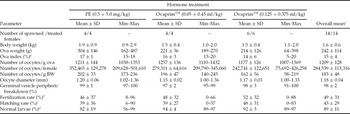
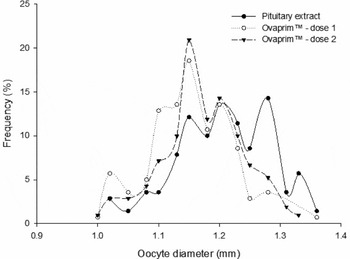
All females responded to the Ovaprim™ and PE treatments and were thus hand-stripped. Oocyte, egg and larvae quality of Ovaprim™-treated females (both doses) were not different (P > 0.05) from PE-treated females (Table 1). All together, these 14 females (pooled data) possessed a mean ova weight of 242 g, 15% of ova index, 1209 oocytes/g ova, 284 539 oocytes/female, 183 oocytes/g BW and oocyte diameter of 1.18 mm. The percentage of frequency distribution of the oocyte diameter presented unimodal tendency, with mode at 1.15 mm in Ovaprim™-treated females (both doses) and at 1.28 mm in PE-treated females (Figure 1). Oocyte maturation was advanced as 98% of the stripped oocytes possessed germinal vesicle peripheric or breakdown. Nine hours after fertilization, 49% of the eggs were fertilized and all embryos were at gastrula stage, with approximately 100% epiboly (blastopore closure). Hatching occurred 21 h after fertilization in 43% of the total eggs, and 89% of the hatched larvae were normal (Table 1).
Female body weight, oocyte, egg and embryo quality (mean ± SD) of Prochilodus lineatus after pituitary extract or Ovaprim™ treatment

Ovaprim™ = sGnRHa at 20 μg and domperidone at 10 mg per ml.
aOva index = Ova weight × 100/g body weight.
bFertilization rate = number of fertilized eggs × 100/total number of eggs.
cHatching rate = number of hatched larvae × 100/total number of eggs.
dPercentage normal larvae = number of normal larvae × 100/total number of larvae.
eThere was no effect (P > 0.05) of hormonal treatment on any of the parameters tested, thus data from all female were pooled (overall mean).
Frequency distribution of stripped oocytes diameter of P. lineatus after pituitary extract (PE) or Ovaprim™ treatment. Lines with different symbols indicate the three different treatments: (●) PE at 0.5 + 5.0 mg/kg; (°) Ovaprim™ at 0.05 + 0.45 ml/kg (dose 1) and (▼) Ovaprim™ at 0.125 + 0.375 ml/kg (dose 2).

Experiment 2. Sperm quality
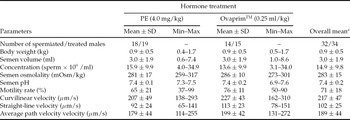
One Ovaprim™- and one PE-treated male did not release sperm after hormone treatment; the other males were stripped. Sperm quality parameters of Ovaprim™-treated males were not different (P > 0.05) from PE-treated males (Table 2). Altogether, these 32 males (pooled data) possessed a mean semen volume of 3.0 ml, concentration of 14.9 × 10⁹ sperm/ml, semen osmolality of 283 mOsm/kg and semen pH of 7.4.
Male body weight and sperm quality (mean ± SD) of Prochilodus lineatus after pituitary extract (PE) or Ovaprim™ treatment. All males received an initial dose of PE at 0.4 mg/kg, 12 h before pituitary extract or Ovaprim™ treatment

Ovaprim™ = sGnRHa at 20 μg and domperidone at 10 mg per ml.
aThere was no effect (P > 0.05) of hormonal treatment on any of the parameters tested, thus data from all males were pooled (overall mean).
When possible, osmolality and pH values were compared between semen and seminal plasma of the same males. Osmolality was always higher in semen (286 mOsm/kg in Ovaprim™-treated and 281 mOsm/kg in PE-treated males) compared with seminal plasma (278 mOsm/kg in Ovaprim™-treated and 257 mOsm/kg in PE-treated males). In comparison, the pH was always lower in semen (pH 7.4 in both Ovaprim™-treated and PE-treated males) compared with seminal plasma (pH 7.9 in Ovaprim™-treated and 8.0 in PE-treated males).
Under CASA evaluation, sperm from Ovaprim™-treated males were not different (P > 0.05) from that of PE-treated males and yielded a mean motility rate of 71%, VCL of 217 μm/s, VSL of 102 μm/s and VAP of 189 μm/s (Table 2).
Discussion
Treatment with PE is the most widely used method, globally, to induce fish reproduction. The gonadotropins present in the PE act directly at gonad level and induce successful spawning in a great variety of fish species, including the Characiformes P. lineatus. However, concerns over the use of PE (Zohar & Mylonas, Reference Zohar and Mylonas2001) led the Ministry of Agriculture in Brazil to prohibit its use in some States. In the present study, the use of Ovaprim™ on the induction of spawning and spermiation of P. lineatus as a replacement for PE therapy was evaluated.
Ova quality
Ovaprim™ treatment (both doses) did not affect the number of spawned P. lineatus females, oocyte quality, fertilization rate, hatching rate or the percentage of normal larvae when compared with PE-treated females. All the observed values were within the range described in the literature for species of the genus Prochilodus (Cordero et al., Reference Cordero, Pertuz and Solano2003; Viveiros et al., Reference Viveiros, Orfão, Maria and Allaman2009, Reference Viveiros, Nascimento, Orfão and Isaú2010; among others).
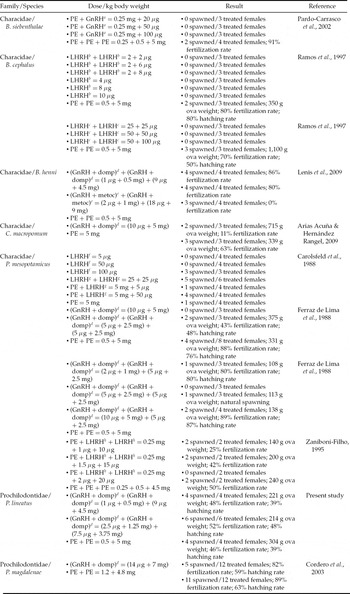
According to the literature (Table 3), Characiformes females treated with a single or double dose of GnRH do not spawn (B. cephalus; Ramos et al., Reference Ramos, Ramos and Mendonça1997) or spawn only after very high doses of GnRH (P. mesopotamicus; Carolsfeld et al., Reference Carolsfeld, Ramos, Ormanezi, Gomes, Barbosa and Harvey1988). When GnRH was injected after PE treatment, none out of nine Brycon siebenthalae (Pardo-Carrasco et al., Reference Pardo-Carrasco, Suarez-Mahecha, Munõz-Lara, Arias-Castellanos and Gil2002), five out of eight P. mesopotamicus (Carolsfeld et al., Reference Carolsfeld, Ramos, Ormanezi, Gomes, Barbosa and Harvey1988) and four out of six P. mesopotamicus (Zaniboni-Filho, Reference Zaniboni-Filho1995) females were reported to have spawned. However, the number of females per treatment was too small to draw any conclusion from these studies. When both GnRH and a dopamine antagonist were administered in a single dose, two out of three C. macropomum (Arias Acuña & Hernández Rangel, Reference Arias Acuña and Hernández Rangel2009), no P. mesopotamicus (Ferraz de Lima et al., Reference Ferraz de Lima, Carolsfeld, Ramos, Alcântara and Ramos1988) and five out of 12 P. magdalenae (Cordero et al., Reference Cordero, Pertuz and Solano2003) females spawned. However, when this combination was administered in two injections, all B. henni (Lenis et al., Reference Lenis, Restrepo and Cruz-Casallas2009), four out of 12 P. mesopotamicus (Ferraz de Lima et al., Reference Ferraz de Lima, Carolsfeld, Ramos, Alcântara and Ramos1988) and all P. lineatus (present study) females were found to have spawned.
Ova quality of Characiformes fish species after induction with GnRH or LHRH analogue combined or not with a dopamine antagonist (domperidone or metoclopramide), and compared with pituitary extract (PE)

aMammalian GnRHa (Argent Laboratories). bBuserelin acetate (Hoechst). cGonadorelin acetate (Serono Ltd). dSalmon GnRHa and domperidone (Ovaprim™; Syndel Laboratories Ltd). eMammalian GnRHa and metoclopramide (Ovopel™; Sigma Co.). fLHRHa (Ningbo Sansheng Pharmaceutical Co. Ltd).gLHRHa (Syndel Laboratories Ltd.). hLHRHa (Sigma Co.).
Based on these results, it is possible that Characiformes females are sensitive to the dopaminergic inhibition of gonadotropin release to a certain degree, and that this sensitivity is species dependent. Furthermore, to be effective, GnRH plus dopamine antagonist therapy should be administered in two different injections, similarly to the regime for PE therapy.
Sperm quality
In the present study, only one male in each hormone treatment group did not respond; all other Ovaprim™-treated and PE-treated males released sperm after hormone injection.
Sperm quality was similar between Ovaprim™-treated and PE-treated males and was within the range reported previously for this fish species (Viveiros & Godinho, Reference Viveiros and Godinho2009; Godinho & Viveiros, Reference Godinho, Viveiros, Tiersch and Green2011; among others). Similarly, the Characiformes C. macropomum (Arias Acuña & Hernández Rangel, Reference Arias Acuña and Hernández Rangel2009) and the Osmeriformes Osmerus eperlanus (Król et al., Reference Król, Kowalski, Hliwa, Dietrich, Stabiński and Ciereszko2009) males produced similar sperm quality after Ovaprim™ and PE therapy. In contrast, the Cypriniformes Leuciscus leuciscus males produced better sperm quality after Ovaprim™ therapy compared with PE, Ovopel™ and LHRHa treatments (Cejko et al., Reference Cejko, Targońska, Kowalski, Żarski, Sarosiek, Kucharczyk and Glogowski2012).
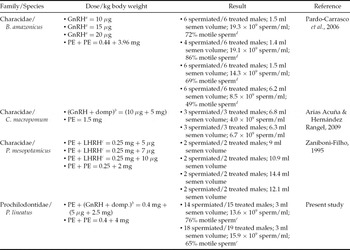
Hormone therapy in males exerts a mild effect compared with females. In males, hormones are injected to increase testicular hydration that, in turn, increases seminal plasma release, decreases sperm viscosity, and thus facilitates sperm flow (Viveiros et al., Reference Viveiros, Fessehaye, Ter Veld, Schulz and Komen2002). According to the current results and the literature (Table 4), the type of hormone therapy that is effective in Characiformes males is less specific than that for females; males were found to release sperm after a single dose of GnRH (Pardo-Carrasco et al., Reference Pardo-Carrasco, Zaniboni-Filho, Arias-Castellanos, Suárez-Mahecha, Atencio-García and Cruz-Casallas2006), a single dose of GnRH plus a dopamine antagonist (Arias Acuña & Hernández Rangel, Reference Arias Acuña and Hernández Rangel2009), a single or double dose of PE (Zaniboni-Filho, Reference Zaniboni-Filho1995; Pardo-Carrasco et al., Reference Pardo-Carrasco, Zaniboni-Filho, Arias-Castellanos, Suárez-Mahecha, Atencio-García and Cruz-Casallas2006; Arias Acuña & Hernández Rangel, Reference Arias Acuña and Hernández Rangel2009; the present study), or after the combination of PE and GnRH plus a dopamine antagonist therapy (the present study).
Sperm quality of Characiformes fish species induced with a GnRH or LHRH analogue combined or not with a dopamine antagonist (domperidone), and compared to pituitary extract (PE)

aMammalian GnRHa (Sigma Co.). bSalmon GnRHa and domperidone (Ovaprim™; Syndel Laboratories Ltd.). cLHRHa (Sigma Co.). dMotility rate evaluated subjectively under a light microscope. eMotility rate evaluated under a Computer-Assisted Sperm Analyzer (CASA).
We conclude, therefore, that Ovaprim™ treatment can successfully replace PE treatment for the induction of spawning and spermiation in P. lineatus without any loss of gamete quality. This method is a useful tool for commercial hatcheries of Characiformes fish to ensure spawning success.
Acknowledgements
This study received funding from the Brazilian fostering agencies CNPq (A.T.M.V., grant no. PQ 302434/2011-9; A.C.S.G., PhD grant no. 554950/2009-0; project 471393/2011-8), ANEEL P&D Furnas (project 017965) and FAPEMIG (project 00129-11; M.C.L., grant no. BPD 00216-11). The authors thank the undergraduate students L.F.R. Pereira and M.A.G. Lemes (UFLA), the MSc students T.R. Taffarel (UFLA) and D. Rossetto (UNIOESTE), the biologists D.M. Ribeiro and M.B. Goulart (Furnas), and the staff F.H. Siqueira, G.A. Azarias and J.M. Silva (CEMIG) for assistance during the experiments.