Behavioral and psychological symptoms are one of the defining clinical features of dementia. Symptoms such as agitation, anxiety, aggression, or restlessness, occur across all etiologies and disease stages, are almost universal and negatively affect both persons with dementia and family caregivers (Lyketsos et al., Reference Lyketsos2011; Alzheimer's Association, 2012; Callahan et al., Reference Callahan2012). Consequently helping families prevent and manage behavioral symptoms has become an important focus of research. Non-pharmacological interventions such as caregiver education, skills training, environmental modifications, and cognitive reframing are considered front-line treatments given that pharmacological treatments may pose more risk than benefit and do not address behaviors that are the most distressful to caregivers such as rejection of care, shadowing, or repetitive vocalizations (Gitlin et al., Reference Gitlin, Kales and Lyketsos2012; Kales et al., Reference Kales, Gitlin and Lyketsos2014; Maust et al., Reference Maust2014; Kales et al., Reference Kales, Gitlin and Lyketsos2015).
Although there are a wide range of non-pharmacological strategies, their use typically depends upon family caregivers for their implementation (Brodaty and Arasaratnam, Reference Brodaty and Arasaratnam2012). For example, simplifying the physical environment, removing dangerous items, introducing activities that match a person's abilities or communicating effectively, rely on families to apply these strategies (Gitlin et al., Reference Gitlin2009). Thus, the effectiveness of these strategies to prevent and/or reduce the frequency of occurrences of behavioral symptoms may vary based upon a caregiver's readiness or willingness to learn about and enact strategies.
To understand the readiness levels of caregivers to use non-pharmacological strategies, we previously applied the Transtheoretical Model of Change framework (TTM: Prochaska et al., Reference Prochaska, DiClemente and Norcross1992) to classify caregivers as either in a pre-action stage of readiness reflecting pre-contemplation, contemplation, or preparation levels in the TTM framework or action stage reflecting those adopting the new strategies (Gitlin and Rose, Reference Gitlin and Rose2014, Reference Gitlin and Rose2016). In addition to dementia-related research, the TTM model has been applied to the management of other age-related chronic conditions including heart failure (McKibbin et al., Reference McKibbin2007), respiratory illness (Carruth et al., Reference Carruth, Duthu, Levin and Lavigne2008), arthritis (Arthur et al., Reference Arthur2009), and functional disability (Rose et al., Reference Rose, Gitlin and Dennis2010).
Using these classifications, we showed that in a trial testing, a non-pharmacological approach to behavioral management (Advancing Caregiver Training (ACT); Gitlin et al., Reference Gitlin, Winter, Dennis, Hodgson and Hauck2010), caregivers differed in their readiness levels to learn about and enact strategies at the start of the intervention. Of 110 caregivers in the sample, 33.6% (n=37) were described in an action stage of readiness (high readiness) at the start of the intervention as they understood behaviors to be a consequence of the disease process and expressed willingness to use new strategies such as changing their communication style or simplifying their home environment. This is in contrast to the remaining 66.4% (n=73) of the sample who were identified at a pre-action stage of readiness (low readiness) either because they viewed behaviors as intentional, had a poor understanding of dementia, or were not actively seeking to use strategies to manage behavioral symptoms.
We also found that high readiness at the start of the intervention was associated with better caregiver mood, less financial difficulties, and lower cognition and more behavioral symptoms in persons with dementia. Compared to those who remained in pre-action, caregivers at the action stage by the conclusion of the intervention reported better treatment outcomes including being more therapeutically engaged, greater reductions in the frequency of behavioral occurrences and less upset and more confidence managing targeted behaviors (Gitlin and Rose, Reference Gitlin and Rose2014, Reference Gitlin and Rose2016). Collectively, these studies have shown that readiness has important descriptive and predictive properties that can inform intervention design for caregivers at different levels of willingness to use non-pharmacological strategies.
In the ACT trial which is the focus of this current study, although most caregivers remained at (n=35, 31.8%) or moved to action (n=44, 40%) by treatment conclusion, others did not (n=31, 28.2%) (Gitlin and Rose, Reference Gitlin and Rose2014). This latter group can be conceived of as treatment failures as they were not actively using strategies introduced in the intervention to manage behavioral symptoms. The present study seeks to understand factors that may differentiate caregivers at pre-action and action stages of readiness by the conclusion of a non-pharmacological intervention by examining dyadic characteristics and treatment-related mechanisms. Specifically, we sought to answer two questions. First, we wanted to identify background characteristics of caregivers and persons with dementia that were associated with readiness level at the conclusion of an intervention. Understanding factors associated with treatment failure can inform future intervention development. Second, we sought to determine if treatment-related mechanisms differentiated caregiver readiness levels. Specifically, we examined whether those at action and pre-action levels by the conclusion of the intervention differed with regard to intervention participation (defined as number of sessions received), the number of non-pharmacological strategies introduced by interventionists and the extent to which these strategies were used by caregivers. Here the goal was to further validate our classification schema for readiness and also examine how readiness informs the unfolding of the intervention. We reasoned that while intervention participation and the number of strategies introduced by interventionists would not differ by readiness stage, the extent to which strategies were integrated would differentiate those at action and pre-action by the conclusion of the intervention.
Methods
Sample and procedures
As reported elsewhere (Gitlin et al., Reference Gitlin, Winter, Dennis, Hodgson and Hauck2010), recruitment for trial participation occurred between December 2003 and March 2007 and involved media announcements and mailings by social agencies. Caregivers were eligible who lived with patients having a physician diagnosis of dementia or Mini-Mental State Examination (MMSE) score <24 (Folstein et al., Reference Folstein, Folstein and McHugh1975), were >21 years, English speaking, planning to live in the area for six months, not actively seeking nursing home placement, managing behavioral symptoms, and reporting upset (>5 on 10-point scale). Dyads were excluded if either had terminal illness with life expectancy <6 months; active treatments for cancer; >3 acute hospitalizations in past year to assure the sample was physically stable. Also excluded were those involved in another behavioral management trial and persons with dementia with a history of schizophrenia or bi-polar disorder, dementia secondary to probable head trauma, or MMSE=0 and bed-bound.
Written informed caregiver consent was obtained at baseline using an institutional approved form. Following baseline, caregivers were randomized to treatment or a no contact control group.
Of 272 dyads, 137 were randomized to intervention of whom110 (80.2%) were included in this study; five (3.6%) did not complete any sessions, and 22 (15%) had incomplete data on variables of interest. No large or statistically significant differences in baseline characteristics were found for the 110 included and 27 excluded in this study.
Data from two sources were used. First, trained interviewers (not interventionists) masked to group allocation gathered information regarding characteristics of caregivers and persons with dementia at a baseline interview prior to randomization and the start of the intervention, and at 16 and 24 weeks from randomization. Second, interventionists, occupational therapists (OT), recorded readiness levels at the start, and conclusion of the intervention based on their observations of caregivers (see discussion of reliability and validity below under Readiness Measure). Also, during or immediately following the conclusion of each treatment session, interventionists recorded which strategies were introduced and integrated as either observed by them or reported by caregivers as being actively used in daily care routines.
Intervention
The intervention (ACT; Gitlin et al., Reference Gitlin, Winter, Dennis, Hodgson and Hauck2010) involved a 16-week active phase with up to ten OT contacts and two advanced practice nurse visits, and a maintenance phase (16–24 weeks) of three OT telephone contacts to reinforce and validate problem-solving and strategy use for a total of 15 contacts of which 13 were with OTs.
Occupational therapy sessions helped caregivers identify potential modifying precipitating factors for those behaviors that were targeted as most problematic (up to four target behaviors). In session 1, the OT interventionists introduced the intervention, conducted a needs assessment to identify behavioral challenges and the behaviors caregivers sought to work on or target (up to 4). Also, there was an assessment of the home environment, caregiver communication strategies, and level of stress. In session 2, OT interventionists provided education about dementia and behaviors, discussed self-care for the caregiver including use of stress reduction techniques, and began to problem solve and brainstorm modifiable contributors to the first targeted behavior. In session 3, a range of strategies to manage the first targeted behavior were introduced and practiced. Sessions 4 through 10 involved continuous support of use of strategies, problem solving, and brainstorming for each targeted behavior and practicing recommended strategies. Strategies were introduced, demonstrated, practiced, reviewed, and/or refined at each session per targeted behavior. Strategies were categorized as communication techniques (e.g. present no more than two choices, speak in a calm voice), environmental modifications (e.g. remove unnecessary objects and tripping hazards, provide task lighting), task simplification (e.g. present one article of clothing at a time, precut vegetables for arranging in a salad bowl), or use of meaningful activities (e.g. set up and help person initiate an activity of interest). In sessions 11–13 (maintenance), OT interventionists provided telephone support to troubleshoot with caregivers and encouraged them to continue to use strategies; no new strategies were introduced during the maintenance phase.
During nursing sessions, an advanced practice nurse provided and reviewed with caregivers educational materials on dementia, the importance of self-care for the caregiver, and potential medication issues and medical conditions that could exacerbate behavioral symptoms. Also included was a visual inspection of skin integrity, a brown bag medication review, and the drawing of blood and urine of the person with dementia to rule out underlying medical contributors to dementia-related behaviors. Results of the nurse component of the intervention have been reported elsewhere and are not included here (Gitlin et al., Reference Gitlin, Winter, Dennis, Hodgson and Hauck2010; Hodgson et al., Reference Hodgson, Gitlin, Winter and Czekanski2011).
Caregiver characteristics
Caregiver demographic characteristics captured at the baseline interview were examined: age, sex, race [white/non-white], relationship to person with dementia [spouse/non-spouse], education [<high school, high school, >high school], years of caregiving, and financial strain. For the latter, caregivers rated difficulty paying for basics (food, housing, medical care, heating) as 1=“not difficult at all,” 2=“not very difficult,” 3=“somewhat difficult,” and 4=“very difficult” (Gitlin and Rose, Reference Gitlin and Rose2014, Reference Gitlin and Rose2016).
Characteristics of persons with dementia
For baseline characteristics related to persons with dementia, we considered their cognitive status at study entry as captured by the 30-item MMSE (Folstein et al., Reference Folstein, Folstein and McHugh1975). Correct responses are summed with higher scores indicating higher cognitive functioning.
For behaviors, several standardized scales were used including the 16-item Agitated Behaviors in Dementia Scale (ABID; Logsdon et al., Reference Logsdon1999), two items (i.e. repetitive questioning, hiding, or hoarding) from the Revised Memory and Behavior Problem Checklist (Teri et al., Reference Teri, Truax, Logsdon, Uomoto, Zarit and Vitaliano1992), three items (i.e. incontinence, shadowing, boredom) from previous research identifying these behaviors as common and distressing (Gitlin et al., Reference Gitlin, Winter, Corcoran, Dennis, Schinfeld and Hauck2003), and two “other” items identified by caregivers that could not be coded elsewhere.
For each of the 23 behaviors occurring, caregivers indicated frequency (range: 0–360 across behaviors). Two scores were calculated: total number of behaviors occurring in past month, and mean estimated frequency of the behaviors that occurred.
Treatment-related factors
For each session, OT recorded session number and contact start and finish time. From these, three participation characteristics were computed: number of treatment sessions, length of each session (h:min), and total contact time across sessions (h:min) for each caregiver.
OT also reported (yes/no) whether they had introduced communication techniques, environmental modifications, task simplification techniques, and/or meaningful activities, and then for each, what specific strategies were introduced (e.g. role play, demonstration) for the targeted behavior that was being addressed in the session. We computed the number of strategies introduced/reviewed for each session and over the course of the intervention (total number). Also, for each strategy type (e.g. communication, environmental modification, task simplification, or use of activities), the number of “Yes” responses was summed to create a measure that reflected the number of sessions each strategy type was introduced/reviewed (range: 0–13).
At each treatment session, caregivers were also asked whether they had practiced/tried strategies (yes/no) to manage targeted behaviors discussed in the previous session. A measure of strategy integration for each caregiver was computed by summing the number of “Yes” responses across sessions for each strategy type (range: 0 to 12). We computed a ratio of strategy integration by dividing the number of sessions caregivers reported using strategies by the number of sessions OT reported introducing each strategy × 100.
Readiness measure
Consistent with prior work, we used a rating approach modeled on TTM (Prochaska et al., Reference Prochaska, DiClemente and Norcross1992) that involved a two-dimensional measure reflecting caregiver understanding of behaviors as dementia-related, and willingness to try strategies to manage them. We developed behavioral anchors for four readiness levels adapted from behavioral change studies with older adults (Burbank et al., Reference Burbank, Padula and Nigg2000; McNulty et al., Reference McNulty, Johnson, Poole and Winkle2004): 1=pre-contemplation indicating lack of knowledge of dementia and behavioral symptoms, a belief that nothing will help or unwillingness to change; 2=contemplation indicating caregivers acknowledged behavioral symptoms were dementia-related, understood behaviors were not intentional manipulations, were thinking about change but not ready to take action; 3=preparation reflecting awareness that behaviors could be better managed, and intent to try new strategies; 4=action reflecting awareness and active efforts to use new behavioral management strategies. We were not able to evaluate maintenance of behavior change. As relatively few caregivers were found to be at pre-contemplation, contemplation, and preparation stages of readiness at 16-weeks after baseline, we collapsed these stages into pre-action (n=31) and compared them to those in action (n=79) for the purposes of this study.
As previously described, OT interventionists rated caregiver readiness at the start of the intervention and at the final treatment session; ratings were significantly correlated across time periods (r s=0.462, p < 0.001). Although readiness ratings were dependent upon interventionists, we previously demonstrated construct validity of readiness, consistent with its application to other health behaviors (Prochaska et al., Reference Prochaska, Velicer, DiClemente and Fava1988; Prochaska et al., Reference Prochaska, DiClemente and Norcross1992; Armitage, Reference Armitage2006; Rose et al., Reference Rose, Gitlin and Dennis2010; Gitlin and Rose, Reference Gitlin and Rose2014) and a positive relationship to treatment outcomes (Gitlin and Rose, Reference Gitlin and Rose2016). Note, ratings for the final treatment session (16-weeks) were used in this study.
Data analysis
Univariate analyses (χ 2 and t) were used to describe characteristics of caregivers and persons with dementia for those high and low in readiness at the conclusion of the intervention.
To examine differences in number of strategies introduced, a One-Way Repeated Measures Multiple Analysis of Covariance (MANCOVA) was computed. Readiness (pre-action/action) was entered as the between factor, number of strategies introduced/reviewed at each session was entered as the repeated measure, and readiness at baseline as the covariate. To examine differences between readiness groups on types of strategies introduced, a One-Way MANCOVA was computed with readiness (pre-action/action) as the between factor, number of sessions for each strategy type introduced as the multivariate measure (communication, environmental modifications, task simplification, and meaningful activities) and baseline readiness as a covariate factor.
A series of Analyses of Covariance (ANCOVAs) were computed to examine differences between readiness levels on participation characteristics and strategies integrated. For participation characteristics, readiness at 16-weeks (pre-action/action) was included as the between factor, participation characteristic (number of sessions, length of session, total contact) as the dependent measure, and readiness at baseline as the covariate. Similarly, for strategies integrated, readiness at 16-weeks (pre-action/action) was included as the between factor, percentage of strategies integrated by type of strategy (communication, environmental, task simplification, and meaningful activities) as the dependent measure, and readiness at baseline as the covariate. SPSS version 22.0 was used for all analyses.
Results
Sample characteristics
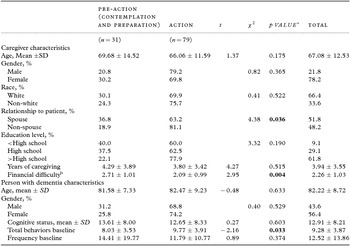
For this study, caregivers had a mean age of 67.08 (SD=12.53), were mostly female (78.2%), white (66.4%), and reported > high school (61.8%) education. Percentage of spousal and non-spousal relationships in the sample was similar (51.8% and 48.2%, respectively). As a whole, caregivers reported a mean of 3.94 (SD=3.44) years as caregivers and little to some financial difficulty (M=2.26, SD ± 1.03) (Table 1). In addition, of the 110 caregivers who completed the study, 80.1% completed 11 or more sessions of the intervention: M=11.72 (SD=1.63). Mean length of each session was 55 min (SD=13 min) and mean total contact time was 10 h: 41 min (SD=2 h: 52 min).
Characteristics of caregivers and persons with dementia by caregiver level of readiness at 16-weeksFootnote a (n=110)

*Items in bold indicate significance.
a Refers to caregiver level of readiness rated by interventionists at the conclusion (16-weeks) of intervention.
b Rated from 1=not difficult at all to 4=very difficult.
Persons with dementia were mostly female (56.4%), with an average age of 82.22 (SD ± 8.72) and MMSE score of 12.91 (SD ± 8.21). Families were actively managing a mean of 8.12 (SD ± 4.08) behaviors that occurred with a mean frequency of 12.11 (SD ± 13.37) times in the past month (or approximately three times a week).
Readiness measures showed improvement over the course of intervention. As was reported in our previous study (Gitlin and Rose, Reference Gitlin and Rose2014), at baseline, 66.4% (n=73) were rated at pre-action whereas only 33.6% (n=37) were rated at action. By treatment conclusion, 28.2% (n=31) and 71.8% (n=79) of caregivers were rated at pre-action (treatment failure) and action (treatment success), respectively.
Characteristics of caregivers and persons with dementia associated with readiness level at 16-weeks
Univariate analyses revealed that by the conclusion of the intervention, caregivers at pre-action levels of readiness were more likely to be a spouse (χ 2 (1)=4.38, p=0.036), report greater financial difficulties (t (109)=2.95, p=0.004) and be managing fewer number of problem behaviors (t (108)=−2.16, p=0.033) than those at the action level (Table 1).
Treatment-related factors associated with readiness level at 16-weeks
Readiness at baseline was not a significant covariate in any of the analyses computed on treatment-related factors. Therefore, findings reported focus solely on the impact of readiness levels at 16-weeks.
Participation Characteristics. Consistent with expectations, there were no significant differences between pre-action and action levels on number of treatment sessions (F (1, 107)=0.85, p=0.358, η 2=0.008), length of treatment sessions (F (1, 107)=1.43, p=0.143, η 2=0.234), or total contact time (F (1, 107)=3.18, p=0.077, η 2=0.029) received. Caregivers at pre-action level participated in M=11.29 (SD=2.34) treatment sessions, for M=52 minutes (SD=12 min) per session, with an accumulated total of M=9 hours: 48 minutes (SD=2 h : 27 min) of interventionist contact. Similarly, those at action level participated in M=11.76 (SD=1.58) treatment sessions, for M=56 minutes (SD=13 min) per session, with an accumulated total of M=11 h : 02 min (SD=2h: 57 min) of interventionist contact.
Strategies Introduced. As expected, overall number of strategies introduced/reviewed by OT was similar for pre-action and action groups (F (1,107)=3.61, p=0.060, η 2 = 0.033). Mean number of strategies introduced/reviewed was 49.35 (SD=23.97) and 55.86 (SD=21.43) for pre-action and action levels respectively reflecting about five strategies introduced at each session.
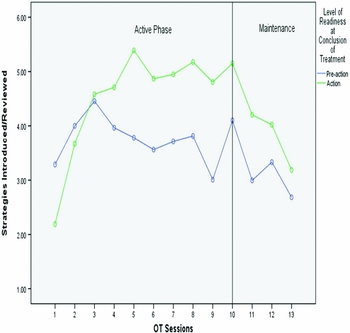
Although overall number of strategies introduced/reviewed did not differ, the MANOVA analysis revealed that the pattern for strategy introduction was moderated by level of readiness (Wilks’ λ=0.79, F(12, 96)=2.66, p=0.004, η 2=0.209). As shown in Figure 1, number of strategies introduced/reviewed does not appear to differ for sessions 1–3 or for sessions 11–13 (maintenance). However, for sessions 4–10 which involved introducing and practicing non-pharmacological strategies, there was a small (on average 1–2 strategies), but consistently greater number of strategies introduced at each session for those at action level of readiness in comparison to those at pre-action level.
Mean strategies introduced or reviewed across OT sessions by readiness level.

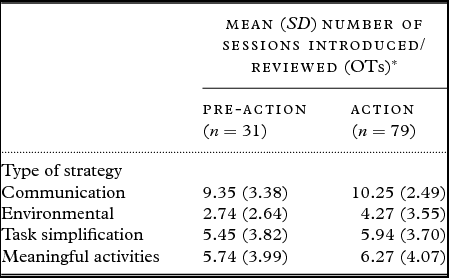
As to the types of strategies introduced, the mean number of sessions each strategy type was introduced/reviewed over the course of the intervention is presented in Table 2. Communication strategies were most often presented, followed by meaningful activities, task simplification strategies, and environmental modifications. We found no significant differences between pre-action and action readiness levels in the number of sessions for which different strategy types were introduced (Wilks’ λ=0.92, F (4, 104)=2.15, p=0.079, η 2 partial=0.08).
Mean (SD) number of sessions in which strategies were introduced or reviewed by interventionists by type of strategy (n=110)

*If strategy was not introduced, a value of “0” was assigned in the calculation.
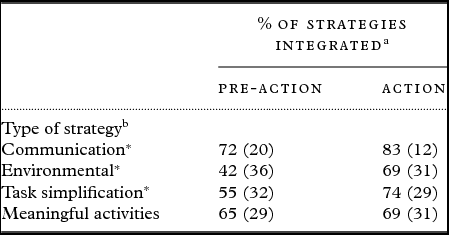
Strategy Integration. There were consistent and significant differences in the number of strategies that were integrated or used by caregivers (Table 3). Across sessions, caregivers at the action level of readiness were more likely to report using communication (F(1, 107)=10.34, p=0.002, η 2 partial=0.088), environmental modification (F(1, 88)=7.21, p=0.009, η 2 partial=0.076) and task simplification (F (1, 102)=4.78, p=0.031, η 2 partial=0.045) strategies in between treatment sessions more so than those in pre-action stages. No differences were found between groups on using meaningful activities (F(1, 96)=0.31, p=0.582, η 2 partial=0.003); use of activities as a treatment strategy were similarly used between the two readiness groups.
Percentage of strategies integrated (SD) by strategy type

*Significant differences between pre-action and action groups (ps < 0.03).
a Percentage Strategies Integrated=(# Sessions Integrated/# Sessions Strategies Introduced) × 100.
b n s differed by type of strategy since targeted behaviors differed and caregivers were not introduced to all strategies. Numbers in pre-action and action were 31/79, 23/68, 29/76, and 28/71 for communication, environmental, task simplification, and meaningful activities analyses, respectively. A multivariate analysis substituting mean values for missing values yielded the same solution.
Discussion
The findings of this study extend our understanding of caregiver readiness and highlight the utility of the TTM framework in understanding the factors associated with intervention success and failure at treatment conclusion. Although RCT trials are critical in demonstrating the efficacy of an intervention, the treatment mechanisms linked to positive outcomes are typically not examined and remain unclear. By assessing caregiver readiness at the conclusion of the intervention, we were able to identify a group actively using intervention strategies (action) and those who were not (pre-action), and then to systematically examine how they differed. As we show elsewhere, those who are not actively using intervention strategies may reflect treatment failures and in turn may not benefit from the intervention or demonstrate improvements in outcomes measures (Gitlin and Rose, Reference Gitlin and Rose2016). Overall, the findings from this study suggest that caregiver readiness to actively make use of non-pharmacological strategies introduced in an intervention is not a given, and is associated with characteristics of caregivers and which also shapes treatment processes.
By the conclusion of the intervention, those caregivers who were actively making use of strategies introduced in the intervention reflecting treatment success, were more likely to be in a non-spousal relationship, to report fewer financial difficulties and to be managing more psychological and behavioral symptoms than those at pre-action level (reflecting treatment failure). The association of readiness to both financial difficulties and number of behavioral symptoms replicates what we previously found for baseline levels of readiness (Gitlin and Rose, Reference Gitlin and Rose2014). Specifically, we found previously that having financial difficulties was associated with being in a pre-action level of readiness at the start of the intervention. The present study extends this finding to show that financial strain has an enduring impact; it is associated with a low level of readiness at the start of the intervention and with treatment failure at the end of the intervention. However, although caregivers with financial strain have the motivation to enroll in the study, it is unclear why financial difficulties appear to interfere with a caregiver's ability to engage in a non-pharmacological intervention in which the strategies do not pose a financial cost. It may be that financial concerns serve as an added stressor that distracts caregivers from focusing on making behavioral adjustments such as adapting new communication patterns. Addressing financial concerns through care management, referrals and linkages, and/or assistance with financial planning may be an important first step for those financially strained which should be provided prior to or simultaneously with offering non-pharmacological behavioral management strategies. Although financial strain has been identified as a predictor of nursing home placement (Spillman and Long, Reference Spillman and Long2009), no caregiver interventions to our knowledge directly address this stressor.
Alternatively, the relationship between financial strain and readiness may be related to level of education as SES and education are correlated. However, in this sample, the correlation between education level and financial strain was not significant (r = 0.013, p = 0.890) and education level was unrelated to level of readiness (p=0.190) making this explanation unlikely. Still, the relationship between education level and readiness may be fruitful to explore as those at the highest education level were more likely to be at action levels than pre-action levels of readiness in comparison to those at lower education levels (see Table 1). Perhaps, financial strain and education may each uniquely contribute to readiness; education may contribute to the understanding of the disease (the basic start in TTM model); and not having financial strain may provide the added resources needed (e.g. time) to manage behaviors.
As to behaviors, it may be that caregivers managing a greater number of behaviors become more motivated to try new approaches compared to their counterparts who are managing fewer behaviors. Those managing many behaviors may have exhausted or run out of effective strategies and thus may be more willing or ready to learn and try new approaches. We do not know how long caregivers were managing each of the targeted behaviors they reported occurring; nor do we know how many and types of strategies they deployed prior to receiving the intervention. However, these factors may be contributing to readiness level.
Treatment-related measures allowed us to examine the link between readiness and strategy provision and their integration. We found that over sessions, the pattern with which strategies were introduced differed as a function of readiness level. Although there were few differences in strategy provision between pre-action and action levels at the start and finish of the intervention, differences emerged in the middle of the intervention with slightly fewer strategies introduced for those in pre-action as compared to those at action. This suggests that OT were responsive to the changing readiness levels of caregivers and adjusted the number of strategies they introduced downwards so as not to overwhelm those in pre-action, per protocol. This may account for why those in pre-action were able to complete the intervention and for the overall high retention rate for the intervention group overall (84%). While those in pre-action stayed with the intervention, this group may require more treatment sessions than those in action to be able to effectively strategies, particularly those requiring behavioral change (e.g. communicating differently, rearranging the environment). Readiness may serve as an important tailoring characteristic for pacing the intervention and determining the number of sessions that may be needed.
However, despite fewer strategies introduced in a number of individual sessions, we found no significant differences on overall number of strategies introduced or on treatment participation (session number, length, and intervention contact) as a function of readiness level, suggesting that treatment provision was equivalent for caregivers at pre-action and action levels. Therefore, it is unlikely that differences in outcomes reported for readiness groups (Gitlin and Rose, Reference Gitlin and Rose2016) were the result of fewer strategies introduced.
Moreover, in the present study, we found that readiness level was linked to the actual use and integration of non-pharmacological strategies. Caregivers actively making use of strategies at 16-weeks (action) reported enacting those strategies outside of treatment sessions more than those at pre-action for three of the four strategy types. It may be that greater compliance throughout the intervention resulted in meaningful changes in behavioral symptoms that reinforced strategy use. In turn, greater strategy use resulted in fewer occurrences of behavioral symptoms and less upset with those symptoms at 16-weeks (Gitlin and Rose, Reference Gitlin and Rose2016). As readiness was associated with enactment, it also provides additional evidence for the validity of the readiness construct.
By comparing those in pre-action to those in action at the conclusion of the intervention, we were able to identify the integration of strategies as an important component of caregiver readiness. On the basis of this, it may be useful to develop a component of the intervention that is designed to increase the enactment of strategies between treatment sessions or which provides those at risk for treatment failure to receive additional support or assistance to use strategies. Other treatment-related factors may also differentiate these two readiness groups and be important to consider in future research. These might include for example examining the strength of the therapeutic alliance and level of rapport established and whether and how these differ for those in action and pre-action. Also of interest is to determine whether there is a point in the treatment process in which pre-action and action groups diverge or at what point individuals become activated and move to an action level. Again, intervention approaches could be developed on the basis of such findings to better tailor treatment processes.
Several study limitations should be noted. The study relied on interventionists to record the number and type of strategies they introduced each session. We did not examine reliability of coding although interventionists brought clarifying questions and coding issues to bi-weekly supervisory sessions. It is possible that their documentation did not accurately reflect treatment sessions and include omissions and/or commissions. Nevertheless, there were clear differences among the number of strategies introduced for each strategy type suggesting that interventionists did differentiate among the types of strategies they introduced. Also, we relied on interventionists to rate the level of readiness of caregivers at initial and final intervention sessions. Interventionists may inadvertently perceive low readiness at the start of the intervention with the knowledge that a goal of the intervention is to increase knowledge, use of strategies, and hence readiness by the end of the intervention. However, this potential bias in ratings seems highly unlikely. As we report, there was a small but substantial group who did not change in their level of readiness and remained in pre-action, reflecting a treatment failure. Furthermore, bias seems unlikely as background characteristics of caregivers differentiated readiness levels and this data were collected by independent raters masked to group allocation.
Although content validity was achieved with participating OTs prior to study initiation, development of a reliable and valid measure, and obtaining independent ratings is a goal for future research in this area. We have shown previously preliminary construct validity: readiness was associated with treatment process variables (in the current study and in Gitlin and Rose, Reference Gitlin and Rose2014) and we have used the same measurement approach with other study populations (Rose et al., Reference Rose, Gitlin and Dennis2010). Finally, generalizability may be limited as caregivers were volunteers and readiness levels may be different for this sample than the caregiver population-at-large. Nevertheless, only 34% were rated at the highest readiness level initially suggesting that participants may be ready to volunteer for a trial but not necessarily to use non-pharmacological strategies. Finally, as readiness level was collected on intervention participants only, comparable control group data are unavailable.
Despite limitations, this study extends an understanding of caregiver readiness by illustrating characteristics and treatment mechanisms associated with a caregiver's readiness to integrate strategies introduced in an intervention. Further, it also provides additional validation of our classification schema for readiness and illustrates a useful framework with which to understand treatment mechanisms linked to why non-pharmacological interventions may be successful for some, but not for others.
Conflict of interest
None
Description of authors’ roles
Both authors contributed to the design of this study and to manuscript development. Karen Rose conducted the analyses, and was responsible for initial manuscript drafts. Laura N. Gitlin was the principal investigator of the original trial, provided conceptual guidance and wrote portions of the paper.
Acknowledgments
Research for the original trial reported here was supported by funds from the National Institute on Aging (NIA) and the National Institute on Nursing Research Grant (# RO1 AG22254). Clinical Trial Registration: #NCT00259480.