1 Introduction
It has long been known that coordination can only target constituents, and, therefore, is considered to be a reliable constituency test. This assumption has been the center of much debate since the earliest days of syntactic theorizing. This article enters this debate by reconsidering a constraint on left-sharing in coordination, which has recently been introduced by Osborne & Gross (Reference Osborne and Gross2017) (O&G hereafter), as exemplified in (1).
(1)
(a) * The man [who built the rocket has] and [who studied robots designed] a dog. (Phillips Reference Phillips2003: 49 (22a))
(b) * Before [school I study] and [work I sleep]. (Osborne & Gross Reference Osborne and Gross2017: 654 (15c))
(c) * Susan repairs old [bicycles in the winter] and [cars in the summer]. (Osborne Reference Osborne2008: 1140)
The examples in (1) show that certain cases of left-sharing in coordination are barred by the grammar. O&G dub this phenomenon left node blocking (LNB), and to account for it, they propose the Principle of Full Clusivity (PFC), which states that left-sharing is blocked if coordination cuts into a constituent (constituents underlined, following O&G). O&G further claim that the PFC makes the right predictions if coordination operates on non-constituent strings, and if syntactic structures are less layered (i.e. flat).
However, many of the native speakers consulted informally disagree with the judgments reported about the LNB data. For instance, many speakers find examples like (1b) and (1c) perfectly acceptable. This indicates that the empirical ground on which LNB is based is not firm, especially as many of the examples used by O&G to argue for LNB are ungrammatical sentences cited from previous work (which were obviously not directly related to sharing in coordination). Given this, I seek to experimentally investigate left-sharing in coordination by conducting a systematic study on native speakers of American English. The results reveal that many of the cases of left-sharing that are claimed to be ungrammatical are in fact perfectly acceptable. I thus conclude that LNB is wrong and left-sharing in coordination is as permissive as right-sharing. In addition, I will present evidence that coordination must operate on constituents, indicating that the theoretical basis of LNB and the PFC is also shaky. Therefore, the claim that syntactic structures should be construed as flat becomes unjustified. I spell out an analysis couched in left-to-right syntax that explains major cases of left-sharing in coordination. The results of the investigation show the significance of experimental data in syntactic theorizing, in addition to introspective and corpus data.
The rest of the article is organized as follows. I begin by presenting the claims made by O&G about left-sharing in coordination in section 2. In section 3, I report on an empirical investigation of left-sharing in English. In section 4, I address a major assumption in O&G's analysis, namely that coordination does not have to operate on constituents. I show that coordination targets constituents, even in the cases where it appears that non-constituents are conjoined, such as gapping and non-constituent coordination (NCC). Section 5 discusses cases of left-sharing in coordination and presents an analysis of them. Section 6 is a conclusion.
2 Left-node blocking and the Principle of Full Clusivity
As stated in the introduction, O&G claim that although coordination is so permissive in allowing various combinatorial options, there are cases of left-sharing in coordination that are strictly banned by the grammar. As mentioned, O&G refer to this phenomenon as left node blocking (LNB). Although the previous literature has not used the term LNB, examples of this phenomenon have been reported by several researchers (e.g. Baker Reference Baker1978; Neijt Reference Neijt1980; Hudson Reference Hudson1988; Wilder Reference Wilder, Alexiadou and Hall1997; Phillips Reference Phillips2003; Osborne Reference Osborne2008; Sailor & Thoms Reference Sailor and Thoms2013; Sportiche et al. Reference Sportiche, Koopman and Stabler2014):
(2)
(a) * Photographs [of movie stars cost a dollar] and [of baseball players cost a penny]. (Baker Reference Baker1978: 275)
(b) * The University's [students are intelligent] and [faculty is committed to freedom]. (Neijt Reference Neijt1980: 52)
(c) * In [Paris we danced] and [Rome we sang]. (Hudson Reference Hudson1988: 338 (76))
(d) * Three [blue cars arrived] and [red cars departed]. (Wilder Reference Wilder, Alexiadou and Hall1997: 76)
(e) * The man [who built the rocket has] and [who studied robots designed] a dog. (=1a)
(f) * the King [of England's crown] and [of Spain's scepter] (Osborne Reference Osborne2008: 1139 (65))
(g) * I taught the guy that knows [Icelandic how to dance] and [Faroese how to sing]. (Sailor & Thoms Reference Sailor and Thoms2013: 363 (15b))
(h) * This girl in the red [coat will] and [dress must] put a picture of Bill on your desk. (Sportiche et al. Reference Sportiche, Koopman and Stabler2014: 65)
To explain LNB, O&G devise the Principle of Full Clusivity (PFC), which dictates that ‘a constituent preceding the/a root in the initial conjunct of a coordinate structure must be included in or excluded from that coordinate structure entirely’ (Osborne & Gross Reference Osborne and Gross2017: 654). Thus, sharing of the in (3) is blocked because the initial conjunct cuts into the constituent the man:
(3) * The [man arrived] and [woman left]. (Osborne & Gross Reference Osborne and Gross2017: 674 (15a))
O&G base their analysis on two assumptions. First, coordination may conjoin non-constituent strings, which O&G refer to as string coordination. Thus not all cases of apparent coordination of non-constituents should be derived from larger categories. For instance, O&G assume that the coordination in sentences like (4) does not have to be derived from larger constituents (i.e. Tom saw you first and (Tom) saw me second).
(4) Tom saw [you first] and [me second]. (Osborne & Gross Reference Osborne and Gross2017: 664 (33a))
As is clear in the LNB cases presented above, this assumption is crucial for the application of the PFC; the PFC would be irrelevant if these examples were derived from larger categories because there would not be left-sharing in the first place.
Second, structures are constructed from left to right in terms of constituencies and dependencies in a Dependency Grammar framework (cf. Bruening & Al Khalaf Reference Bruening and Al Khalaf2018, Reference Bruening and Khalaf2020). These structures lack a TP/IP projection, and root nodes are replaced by lexical items:
(5) (Osborne & Gross Reference Osborne and Gross2017: 649 (8b))


As can be seen in (5), the conjuncts are linked by a dependency line, and only the initial conjunct is linked to the preceding element.Footnote 1 Note that assuming that structures are constructed from left to right is crucial because, as O&G claim, this reflects how the PFC works: a string cannot be shared in coordination if it has not been admitted as a constituent online, assuming that left-to-right derivations reflect how linguistic strings are processed. O&G further contend that the PFC makes the right predictions if it operates on flat structures. For example, while the PFC makes the right predictions about the acceptability of left-sharing in (6) with flat structures, it gives a wrong result in (7) with more layered structures, predicting that the sentence should be ungrammatical.
(6) (Osborne & Gross Reference Osborne and Gross2017: 675 (64a,b))
(7) (Osborne & Gross Reference Osborne and Gross2017: 675 (64c))


Consequently, O&G claim that although coordination fails to be a reliable constituency test, the restrictions on left-sharing in coordination provide insights on the nature of syntactic structures: syntactic structures should be flat.
3 An experimental investigation of sharing in coordination
As mentioned earlier, many of the speakers I informally consulted disagree with the judgments reported about many of the examples exhibiting LNB. I believe that this is due to the fact that the examples O&G used to motivate LNB were not derived from a systematic investigation of left-sharing in coordination and were cited from previous literature (which is mostly introspective in nature). In this section, I report on a large-scale experiment on native speakers of American English. The experiment tested the effects of constituency and the locus of sharing in coordination on acceptability.
3.1 Items
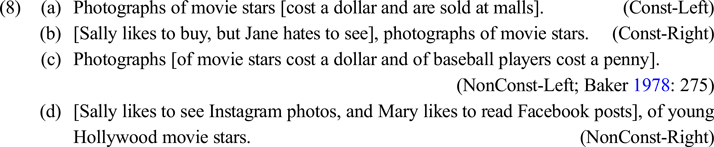
The experiment had a 2×2 factorial design, in which Constituency (Const & NonConst) and Locus (i.e. the location of sharing; Left & Right) are independent variables; and Rating (1–7 Likert scale) is a dependent variable. A sample set of test items appears in (8). The complete set of test items is listed in the Appendix. Note that the items presented to the participants did not contain bracketing, so that bracketing would not bias the participants to a particular parse. However, the items used in the experiment do not crucially hinge on bracketing to represent the parse intended for each of these items.

Eight sets like the one in (8) were mixed with 36 fillers. The fillers were sentences that involved no coordination. A third of the fillers were ungrammatical sentences, while the remaining were grammatical. The task of the participant was to rate sentences on a seven-point Likert scale. The experiment had a between-subjects design; thus the items were distributed to four lists, each of which contained 17 items. The order of the items was randomized for each participant within each of the lists to guard against any bias that might be caused by the order of presentation of items. Each participant completed only one list.
3.2 Participants
A total of 80 native speakers of American English were recruited to participate in the study via Amazon Mechanical Turk (AMT), a crowdsourcing website. The files uploaded to AMT to conduct the experiment were prepared using Turktools (Erlewine & Kotek Reference Erlewine and Kotek2016). Participation was restricted to IP addresses within the USA and speakers were asked whether their native language is English. Those who indicated that it is not were excluded from the analysis; four participants were excluded for this reason. Eight participants were also exluded for answering more than 25 percent of the fillers incorrectly. This left 68 participants in the analysis.
3.3 Results
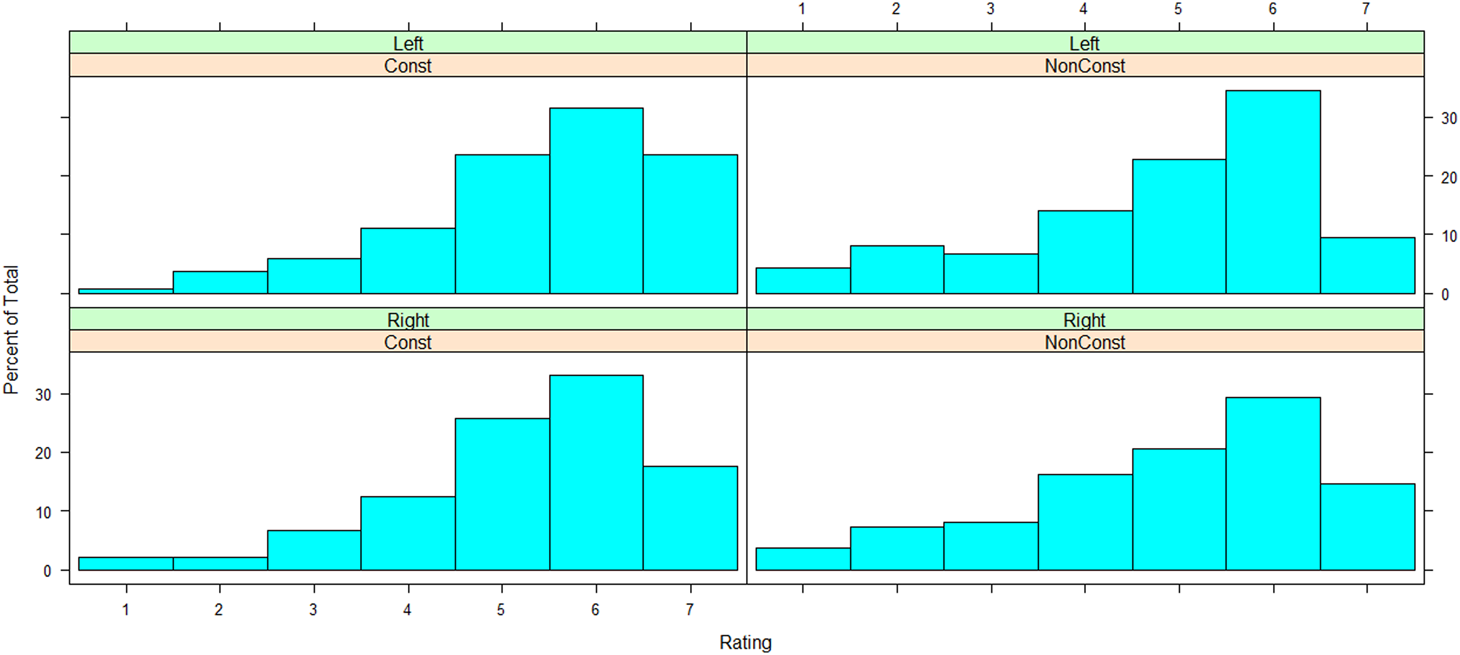
The results were analyzed using R (R Core Team 2019). Figure 1 shows the percentages of Rating for all the four experimental conditions. As can be seen, the results reveal that there is no difference in acceptability between left-sharing and right-sharing for the two Constituency conditions.
Percentages of Rating values for Constituency*Locus

To test for the effects of Constituency on the acceptability of the locus of sharing, a cumulative link model (CLM) was fit to the data (Christensen Reference Christensen2015), using Ordinal package (Christensen Reference Christensen2018) – which is used for Likert data specifically. The results of running that model appear in table 1.
The results of CLM of Rating Constituency*Locus

As shown in the table, there is no significant effect of Constituency, Locus, or the interaction thereof on Rating. Of particular concern for us is the fact that there is no significant effect of the interaction between NonCont and Left conditions on Rating ((χ 2 = −0.844, p = .39)).
3.4 Interim conclusion
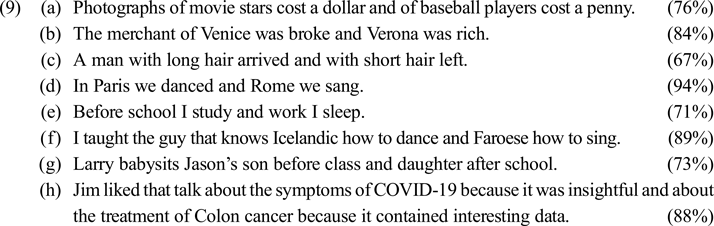
The empirical investigation reveals that there is no difference in acceptability between left-sharing and right-sharing of a non-constituent; contrary to what Osborne & Gross claim, an (apparent) non-constituent can be shared in coordination. Surprisingly, many of the NonConst-left items used in the study are the same ones used by O&G to motivate LNB. Below are some of these items along with the percentage of acceptability of each one of them.Footnote 2

Thus, the larger population of native speakers of English accept sentences in which it appears that a non-constituent is left-shared in coordination. Thus, in fact, there is no LNB in the grammar and as a result there is no need for the PFC.
4 Against string coordination
In the previous section, I have shown that LNB and the PFC are wrong on empirical grounds. In this section, I show that the theoretical grounds on which they are based is problematic. As mentioned in the section 2, O&G claim that for their analysis to go through, it is crucial to assume that coordination may operate on non-constituent strings, making this assumption specifically for cases of gapping and NCC, being the ones that are relevant to LNB. To clarify, what is conjoined in examples like (10) is non-constituent strings, meaning that what you see is what you get. Note that, by this claim, O&G reject analyses that posit an abstract level of representation in which coordination combines full-fledged constituents.Footnote 3

In this section, I argue against a string coordination analysis of gapping and NCC, citing evidence that these constructions are derived from full constituents. I will also show that the differences between conjunct-external sharing and conjunct-internal sharing presented by O&G support this conclusion.
4.1 Gapping
Gapping, a term first coined by Ross (Reference Ross1967), occurs when verbal material goes missing from a non-initial conjunct:
(11) Some had ordered mussels, and others swordfish. (Toosarvandani Reference Toosarvandani2016: 381 (1); adapted)
As a background, gapping received (at least) two types of analysis, which I will refer to as reductionist and non-reductionist analyses. The reductionist analyses derive gapping from larger categories via ellipsis/movement, and they come in two forms. In the first form, gapping is derived from a clause-sized constituent (e.g. Jackendoff Reference Jackendoff1971; Ross Reference Ross1967; Sag Reference Sag1976; Pesetsky Reference Pesetsky1982; Williams Reference Williams1977; Jayaseelan Reference Jayaseelan1990), whereas in the second form it is derived from a vP-sized constituent (e.g. Coppock Reference Coppock and Adronis2001; Yatabe Reference Yatabe, Flickinger and Kathol2001; Lin Reference Lin2002; Crysmann Reference Crysmann, Jäger, Monachesi, Penn and Wintner2003; López & Winkler Reference López and Susanne2003; Beavers & Sag Reference Beavers, Sag and Müller2004; Chaves Reference Chaves2007; Johnson Reference Johnson2009; Toosarvandani Reference Toosarvandani2016). As for the non-reductionist analyses, they derive gapping from mechanisms that do without ellipsis/movement.Footnote 4 A major type of argument against the reductionist analyses of gapping comes from scope ambiguity (e.g. Siegel Reference Siegel1984, Reference Siegel1987; Oehrle Reference Oehrle, Huck and Ojeda1987; McCawley Reference McCawley and Peterson1993; Johnson Reference Johnson2004; Kubota & Levine Reference Kubota and Levine2016; Potter et al. Reference Potter, Frazier and Yoshida2017), as exemplified in (12), where the modal and negation can have a wide-scope reading in which they outscope the coordinate structure or a distributive-scope reading in which they scope locally within each conjunct.
(12) Mrs. J can't live in Boston and Mr. J ø in L.A. (Kubota & Levine Reference Kubota and Levine2016: 109 (5a))
As noted by Kubota & Levine (Reference Kubota and Levine2016), Potter et al. (Reference Potter, Frazier and Yoshida2017), and the others, analyses that assume that gapping is derived from clause-sized constituents do not capture the wide-scope reading in examples like (12); they only capture the distributive-scope reading (I strikethrough elided material with no bias to any analysis).
(13) Mrs. J can't live in Boston and Mr. J can't live in L.A.
On the other hand, the analyses that assume that gapping is derived from vP-sized constituents do not account for the distributive-scope reading, and can only account for the wide-scope reading. For instance, Johnson (Reference Johnson, Kusumoto and Villalta2000, Reference Johnson2009) proposes that gapping is derived from a vP-sized source where verbs are ATB-moved to a higher position and where scope-taking elements are higher than the coordinate structure, as illustrated in (14) for (13) (I differ from Johnson in using binary branching structures). As can be seen, this analysis can only capture the wide-scope reading.
(14)

In a recent study, however, Potter et al. (Reference Potter, Frazier and Yoshida2017) propose a solution to this problem by arguing that gapping is derived from two sources: a clause-sized source and a vP-sized source. Hence, the ambiguity in gapping is reduced to a case of structural ambiguity. Potter et al. argue that evidence for this two-source analysis is the fact that gapping interacts with independent factors, to the effect that only one of the readings is available in certain syntactic contexts. To clarify, consider the examples in (15):
(15) (Potter et al. Reference Potter, Frazier and Yoshida2017: (39))
(a) To Mary, James didn't give a cupcake or Bill chocolates.
(b) With only ten dollars between them, James could get a sandwich, and Mary a bowl of soup.
(c) Often, James orders mussels, and Mary shrimp.
(d) Never does Kim play bingo or Sandy chess.
As pointed out by Potter et al., a constituent appears in a left-peripheral Topic Phrase in examples like (15a,b) (Rizzi Reference Rizzi1990), and in a peripheral Focus Phrase in examples like (15c,d) (Rizzi Reference Rizzi1990; Haegeman Reference Haegeman2000). Hence, necessarily, the gapping here should be derived from a CP-sized source because it is impossible for the topicalized/focused phrase to scope over the coordinate structure unless the coordination is clausal. Given this, the fact that only a distributive-scope reading is available in these examples suggests that the ambiguity is structural. Therefore, scope ambiguity in gapping does not argue against reduction; on the contrary, it provides support for analyses that derive gapping from a conjunction of constituents. Thus, O&G's claim that certain cases of gapping should receive a string coordination analysis – which is implicitly based on a general rejection of the analyses in which gapping is derived from larger constituents – is untenable.
4.2 Non-constituent coordination
NCC has received much interest since the 1970s and continues to be a topic of heated debate in more recent work (e.g. Hudson Reference Hudson1976; Sag Reference Sag1976; Hudson Reference Hudson1982; Sag et al. Reference Sag, Gazdar, Wasow and Weisler1985; Dowty Reference Dowty, Oehrle, Bach and Wheeler1988; Wilder Reference Wilder, Alexiadou and Hall1997; Beavers & Sag Reference Beavers, Sag and Müller2004; Osborne Reference Osborne2008; Hofmeister Reference Hofmeister2010; Sailor & Thoms Reference Sailor and Thoms2013; Bruening Reference Bruening2015; Kubota & Levine Reference Kubota and Levine2015). Like gapping NCC recieved two types of analysis: a reductionist analysis that derives the coordination from larger categories (e.g. Wilder Reference Wilder, Alexiadou and Hall1997; Crysmann Reference Crysmann, Jäger, Monachesi, Penn and Wintner2003; Beavers & Sag Reference Beavers, Sag and Müller2004; Hofmeister Reference Hofmeister2010; Sailor & Thoms Reference Sailor and Thoms2013; Bruening Reference Bruening2015) and a non-reductionist analysis that derives the coordination via mechanisms that do without ellipsis/movement (e.g. Dowty Reference Dowty, Oehrle, Bach and Wheeler1988; Steedman Reference Steedman, Baltin and Kroch1989; Kubota & Levine Reference Kubota and Levine2015).
A major argument leveled against the reductionist analyses is also derived from scope ambiguity – which O&G capitalize on to support their string coordination analysis. Sailor & Thoms (Reference Sailor and Thoms2013), Kubota & Levine (Reference Kubota and Levine2015), Osborne & Gross (Reference Osborne and Gross2017), and others note that NCC exhibits the same type of scope ambiguity observed in gapping. In (16a), the negative operator introduced by no girl can have a wide-scope reading in which the sentence means: it is not the case that Sam sent a girl chocolates today and flowers yesterday, a reading that is unavailable in the non-elliptical counterpart in (16b), where the negative operator scopes locally in each conjunct. This fact is problematic to analyses that take NCC to be derived from larger categories.
(16) (adapted from Osborne & Gross Reference Osborne and Gross2017: 669 (50))
(a) Sam sent no girl chocolates today and flowers yesterday.
(b) Sam sent no girl chocolates today and sent no girl flowers yesterday.
Sailor & Thoms (Reference Sailor and Thoms2013), however, propose an analysis that solves this paradox – an analysis that is similar to Potter et al.'s analysis of gapping in spirit. In this analysis, NCC is derived from two sources: a CP source and a vP source. To illustrate, the distributive reading in examples like (16a) arises when NCC is derived from conjoined CPs as in (16b). The phrases that survive the ellipsis (which Sailor & Thoms refer to as chunks) move leftward to the edge of the non-initial conjunct. I illustrate the derivation of the distributive reading in (17) for (16a):Footnote 5
(17)

The wide-scope reading in (16a), on the other hand, arises from low coordination of vPs, where the sentential negation is higher than the coordinate structure.Footnote 6 Thus, scope ambiguity in NCC is then a case of structural ambiguity and, consequently, makes a strong argument against a string coordination analysis such as the one proposed by O&G.
Additional facts suggest that NCC is derived via reduction. One fact comes from plural agreement (Beavers & Sag Reference Beavers, Sag and Müller2004; Bruening Reference Bruening2015) and licensing of items sensitive to plurality, like plural floating quantifiers (Bruening Reference Bruening2015), as illustrated in (18). The fact that verbs show plural agreement with subjects involving NCC and that NCC may associate with floating quantifiers that are sensitive to plurality proves that NCC conjoins constituents.
(18) (Bruening Reference Bruening2015: 2 (6a,b))
(a) Bill catching a fish on Monday with a fly rod and on Tuesday with a spear were both surprising.
(b) Micah claiming he was an astronaut to impress Bill and a spy to impress Bob were different events.
Another fact comes from examples in which NCC occurs in a medial conjunct, where a following conjunct involves no reduction. As shown by Beavers & Sag (Reference Beavers, Sag and Müller2004), examples like (19) suggest that NCC is derived from larger constituents; otherwise it would be hard to explain the structure of the final conjunct:
(19) Jan [[travels to Rome tomorrow], [[to Paris on Friday], and [will fly to Tokyo on Sunday]]]. (adapted from Beavers & Sag Reference Beavers, Sag and Müller2004: 54 (10))
In conclusion, O&G's string coordination analysis of NCC is untenable. NCC is a coordination of full constituents that have undergone reduction.
4.3 On conjunct-external sharing and string coordination
O&G argue that not all cases of gapping involve coordination of non-constituent strings. To distinguish the cases of gapping that should be subsumed under string coordination from those that should not, they claim that the former show properties of conjunct-external sharing, while the latter show properties of conjunct-internal sharing, highlighting a number of differences between the two. In what follows, I go through these differences and show that they in fact provide evidence that with conjunct-external sharing (i.e. so-called string coordination), it is constituents that are conjoined.
First, O&G show that subject–verb agreement is strict with conjunct-external sharing, but not with conjunct-internal sharing:
(20) (Osborne & Gross Reference Osborne and Gross2017: 662 (22), (24))
(a) ?? Have [you started] and [she stopped]?
(b) Have [you started] and [they stopped]?
(21) [You have started to read], and [she/her has started to write].
However, this observation actually suggests that a string coordination analysis of conjunct-external sharing is inaccurate. More specifically, the strict agreement requirement with conjunct-external sharing receives a plausible explanation if the sharing results from ATB movement of the shared constituent/element, which is only possible if the coordination involves full-fledged constituents. In this case, sharing would only be possible if the lower copies of the ATB-moved element match in form because ATB movement is restricted by semantic (e.g. Munn Reference Munn1993; Fox Reference Fox2000) and syntactic/morphological (e.g. Franks Reference Franks1995; Citko Reference Citko2005; Al Khalaf Reference Al Khalaf2015) parallelism:
(22)

On the other hand, conjunct-internal sharing as in (21) allows agreement mismatches because the gapping here is not derived via ATB movement (e.g. Potter et al. Reference Potter, Frazier and Yoshida2017). I assume that only the cases of gapping that are derived from a vP source can involve ATB movement (e.g. (14)), which is not what we see here. The gapping here is rather derived via ellipsis, and ellipsis is less strict with agreement mismatches.
In addition, O&G show that, unlike conjunct-internal sharing, conjunct-external sharing is strict concerning pronoun forms:
(23) (Osborne & Gross Reference Osborne and Gross2017: 663 (26))
(a) Has [he started] and [she finished]?
(b) ?? Has [he started] and [her finished]?
(24) [He started this evening], and [her started yesterday morning]. (Osborne & Gross Reference Osborne and Gross2017: 663 (28))
Again, this difference can be explained if what derives conjunct-external sharing is ATB movement. It is the parallelism constraint on ATB movement that forces the pronouns to match in form across the conjuncts. This constraint is not operative in conjunct-internal sharing which is not derived via ATB movement. Thus, once again, this indicates that so-called string coordination is just a coordination of constituents.
Another difference is that redundancy is possible with conjunct-external sharing (25a), but not with conjunct-internal sharing (25b). That is, in conjunct-external sharing, repetition of material in the non-initial conjunct is possible, but is impossible with conjunct-internal sharing.
(25) (Osborne & Gross Reference Osborne and Gross2017: 663 (30))
(a) There is [watermelon at home] and [watermelon at work].
(b) ?? [At home there is watermelon], and [at work there is watermelon].
However, that gapping disallows redundancy in the gapped conjunct follows from the fact that gapping involves contrastively focused remnants (e.g. Oehrle Reference Oehrle, Huck and Ojeda1987; Gengel Reference Gengel2013). For remnants to be contrastive, they must be distinct from the elements they contrast with; thus, it is not surprising that gapping does not allow redundancy.
The possibility of redundancy with conjunct-external sharing, on the other hand, would be accounted for if sharing resulted from ATB movement, which does not give rise to contrastively focused constituents in the non-initial conjunct (it is the shared element that moves; no other movements apply). If this reasoning is correct, then the facts from redundancy suggest that conjunct-external sharing involves coordination of constituents.
Furthermore, O&G note that conjunct-external sharing and conjunct-internal sharing give rise to different interpretations. For instance, a Yes-No question with conjunct-external sharing is understood as a normal Yes-No question – which can be answered with yes or no, whereas a Yes-No question with conjunct-internal sharing gives the meaning of a forced-choice question:
(26) (Osborne & Gross Reference Osborne and Gross2017: 664 (32))
(a) A: Did you drink [coffee today] or [tea yesterday]?
B: Yes.
(b) A: [Did you drink coffee today], or [did you drink tea yesterday]?
B: Tea yesterday.
Again, this observation is not remarkable given that gapping is derived via focus movement of the constituents that survive the gapping operation (whether that operation is movement or ellipsis/deletion): a Yes-No question with contrastive focus gives a forced-choice reading. In contrast, a Yes-No question with conjunct-external sharing – which I argue is derived via ATB movement – has no contrastively focused constituents; thus it is understood as a Yes-No question, not a forced-choice question.
The conclusion reached, then, is that the differences between conjunct-external sharing and conjunct-internal sharing are predicted if conjunct-external sharing involves coordination of full-fledged constituents, and if sharing is a result of ATB movement.
4.4 Interim conclusion
In this section, I presented evidence that gapping and NCC – two cases of coordination relevant to LNB – involve coordination of full-fledged constituents. I also showed that the distinctions between conjunct-external sharing and conjunct-internal sharing can be understood if what is conjoined in conjunct-external sharing is constituents. Thus, LNB and the PFC are also wrong on theoretical grounds; so-called string coordination does not exist.
5 Analysis of left-sharing in coordination
In section 3 I have shown that left-sharing of a non-constituent is actually acceptable for the large population of native speakers of American English. In section 4, I have also shown that coordination can only target constituents. An immediate question that might be asked, then, is: how are apparent non-constituents left-shared?
It is intuitive to say that left-sharing in coordination occurs via one of three mechanisms (or a combination thereof). The first and most straightforward mechanism is leftward movement (i.e. ATB movement) of the shared constituent out of the coordinate structure, as seen in ATB wh-movement (27a), ATB topicalization (27b) and ATB VP fronting (27c). Also, cases of subject sharing can be seen as involving ATB movement (27d, ignoring RNR); the subject moves across-the-board from a coordinate vP (cf. Johnson Reference Johnson2009).
(27)
(a) Where did [Mary vacation and Bill decide to live]? (Munn Reference Munn1999: 421 (1a))
(b) The same man [Mary helped and Jane ruined]. (Zhang Reference Zhang2010: 223 (9.2a))
(c) Criticize himself, [John will but Mary won't]. (Al Khalaf Reference Al Khalaf2015: 174 (383))
(d) Bo [has now started drafting and will soon finish] his play. (adapted from Osborne & Gross Reference Osborne and Gross2017: 661 (21))
Note that in this case, sharing is allowed only if the shared element/string is movable and the constraints on moving that element/string are all respected.
The second mechanism is ellipsis in a/the non-initial conjunct, which is what we see in NCC:
(28)
(a) John persuaded [Bill to write a book and Max to write a play]. (Dowty Reference Dowty, Oehrle, Bach and Wheeler1988: 169 (20e))
(b) I told stories about [my family for a few minutes and my pets for a few hours]. (Sailor & Thoms Reference Sailor and Thoms2013, adapted from 362(6))
(c) They put the knives yesterday [in intricately worked leather sheathes to protect them and carved wooden boxes to protect us]. (Bruening Reference Bruening2015: 5 (25b))
Note, however, that it is not clear that NCC involves syntactic sharing because the shared string does not syntactically fall outside the coordinate structure. Rather, the non-initial conjunct involves ellipsis, while constituents within the initial conjunct remain within the conjunct.
The third mechanism is selection, where a head selects for a coordinate dependent (29). Intuitively, sharing via selection is licit only if the shared element and the coordinate structure can enter in a selection relation. Note that sharing is impossible if the shared head does not select for all of the conjuncts, as illustrated in (29c).
(29)
(a) His novels combine [wit and irony] which merge in a unique and recognizable voice.Footnote 7
(b) You can mix [paint and varnish] to achieve a variety of painting techniques.Footnote 8
(c) * She dined [strawberries and on parched corn] for three days in a row. (cf. She dined on [strawberries and parched corn] for three days in a row)
Below I present an analysis of left-sharing in coordination, focusing on the first two cases. A number of assumptions should be spelled out. First, I adopt a complementation structure of coordination (e.g. Johannessen Reference Johannessen1998; Al Khalaf Reference Al Khalaf2018; cf. Al Khalaf Reference Al Khalaf2021), where & is a head that takes the non-initial conjunct as a complement and the initial one as a specifier:
(30)

I assume that syntactic structures are built from left to right (e.g. Phillips Reference Phillips2003; Bruening & Al Khalaf Reference Al Khalaf2018; Osborne & Gross Reference Osborne and Gross2017). Thus, displaced elements are merged first. Then, lower copies of those elements are merged later in the derivation as the structure is being built. Note that left-to-right derivation does not differ much from top-down derivation, which is adopted in much work. I adopt left-to-right derivation for concreteness, but top-down derivation is also compatible with the analysis. By this assumption, I adopt a concept of free merge, where (internal) merge applies without the need for triggering features (e.g. Chomsky Reference Chomsky and Belletti2004; Ott Reference Ott2015; Al Khalaf Reference Al Khalaf2019; cf. Al Khalaf Reference Al Khalaf2017). With these assumptions in place, I now turn to the cases of left-sharing discussed above. I will discuss left-sharing in ATB constructions and in NCC, being two obvious cases where it appears that an element or a string of words is left-shared.
Beginning with the case of left-sharing in ATB constructions, as assumed above, I propose that ATB movement is derived in a left-to-right fashion by merging the filler first and then merging lower copies as the derivation proceeds. To illustrate, consider example (31) repeated from above:
(31) The same man [Mary helped and Jane ruined].
The derivation proceeds from left to right by first merging the filler the same man and then building the first conjunct Mary helped. A lower copy of the displaced constituent is merged at the left edge of the vP phase within the initial conjunct (because following minimalist assumptions, movement occurs successive-cyclically via phase edges). Another copy of the displaced constituent is merged in the base position within the initial conjunct (which is the object position of the verb helped):
(32)

The derivation proceeds by merging & and then its complement, which is the non-initial conjunct. Copies of the displaced constituent are merged in the same manner described for the initial conjunct:
(33)

Thus, left-sharing in ATB constructions simply results from movement of the shared constituent out of all the conjuncts.
Turning now to left-sharing in NCC. As indicated earlier, sharing here is just apparent in that there is no ATB movement of a constituent of any sort. Rather, it appears that sharing results from syntactic operations that apply to non-initial conjuncts, giving the illusion that a string is being shared between two conjuncts. To account for NCC, I will adopt a slightly modified version of the analysis advanced by Sailor & Thoms (Reference Sailor and Thoms2013) which I summarized in section 4.2. In particular, NCC arises as a result of movement of constituents to the left edge of a non-initial conjunct, followed by ellipsis of the remnant of that movement. I add to the assumptions I made above about ATB movement the assumption that ellipsis occurs as a result of an ellipsis feature ([e] feature; Merchant Reference Merchant2001) on a phasal head, which instructs the PF to unpronounce the complement of that phasal head.
To illustrate, consider example (34) repeated from above:
(34) I told stories about [my family for a few minutes and my pets for a few hours].
I suggest that here two CPs are being conjoined:
(35) [CP I told stories about my family for a few minutes] and [CP I told stories about my pets for a few hours].
As proposed above, the NCC in (34) is derived via movement of the constituents that survive ellipsis, followed by ellipsis of the remnant of the movement. The derivation proceeds from left to right by building the initial conjunct, and then the non-initial one. At the point where the non-initial conjunct begins to be constructed, the elements that survive the ellipsis in the non-initial are merged at the left edge of the conjunct. The derivation then proceeds by merging C which has an ellipsis feature, and then the rest of the structure. The [e] feature instructs the PF to unpronounce the material in the c-command domain of the phasal head that carries the feature, namely C, resulting in the ellipsis of the remnant of the movement, as illustrated in (36).
(36)

Note that with left-to-right derivation, we no longer run into the issue of explaining how displaced constituents that move out of the non-initial conjunct are linearized. In particular, left-to-right derivation merges the constituents where they appear on the surface structure; thus, linearization is part of the derivation, and no further assumptions should be made to account for it.
To wrap up, left-sharing arises either as a result of ATB movement or ellipsis in the non-initial conjuncts (which also involves movement) – in addition to sharing via selection. I have explained left-sharing in a left-to-right syntax, where displaced constituents are merged first, and lower copies are merged later as the structure is being built.
6 Conclusion
In this article, I investigated the LNB phenomenon, a constraint on left-sharing in coordination that has recently been introduced by Osborne & Gross (Reference Osborne and Gross2017). The results of a large-scale acceptability judgment task reveal that native speakers of American English allow left-sharing of non-constituents, which means that the empirical facts on which LNB is based were inaccurate. I have also argued that LNB is based on a problematic theoretical assumption as well, namely that coordination may target non-constituent strings. I presented an analysis of left-sharing in left-to-right syntax. The direct consequence of the results of the investigation is that the claim that syntactic structures should be construed as flat is not justified because it is based on wrong assumptions. There is no good reason to believe that binarity does not restrict syntactic structures. The results also reveal the significance of large-scale experiments on naive subjects in syntactic theorizing, in addition to introspective and corpus data.
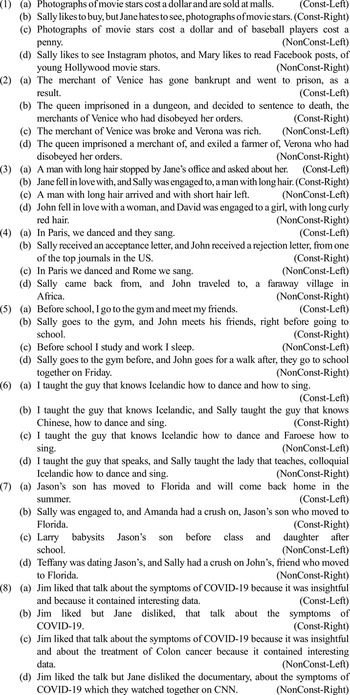
Appendix: Test items