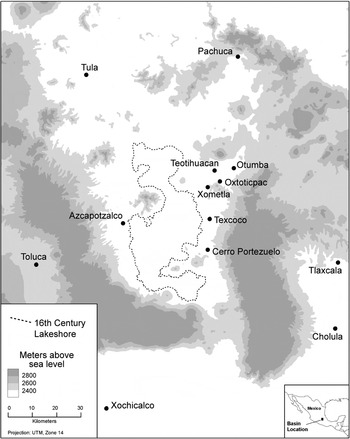
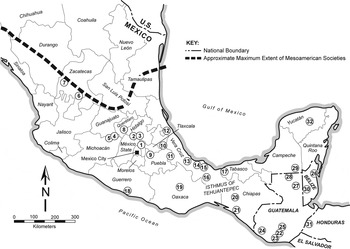
In the 1950s and 1960s, preliminary reports on the excavations directed by George Brainerd at Cerro Portezuelo in the southeastern Basin of Mexico (Figure 1), about 30 km south of Teotihuacan, suggested that ceramics there exhibited a relatively gradual transition to new forms, following the collapse of the Teotihuacan state (Hicks and Nicholson Reference Hicks and Nicholson1964). More intensive study of Brainerd's materials (as reported in other papers in this special section of Ancient Mesoamerica [Volume 24, Issue 1]), when viewed in the light of a much better understanding of Teotihuacan-period ceramics (Rattray Reference Rattray2001), show much less continuity, which is also the case at Teotihuacan itself following the collapse. Also, far more is now known about ceramics from various regions in western and northwestern Mesoamerica. Those from the vicinity of Ucareo, located in the eastern Bajío, in the state of Guanajuato near the Cuitzeo Basin (Figure 2:5), show an especially close resemblance to the new forms seen at Cerro Portezuelo, Teotihuacan, and elsewhere in the Basin of Mexico (Hernandez and Healan Reference Hernandez and Healan2012). There was clearly strong influence from western Mesoamerica in the Epiclassic period (approximately a.d. 600/650––800/850) following the collapse of the Teotihuacan state. Whether this influence took the form of a large in-migration of people is debated, but diverse lines of evidence strongly suggest a sizable migration. Further migrations occurred in Mesoamerica in the Postclassic period (after a.d. 800/850), but they are beyond the scope of this paper and will not be addressed here.
Selected archaeological sites in and near the Basin of Mexico.

For several decades North American archaeologists gave little weight to migrations in their proposed explanations for sociocultural changes. This was largely in reaction to earlier uses of migration as an excessively simplistic explanation for change. The fact that things were different was explained by the arrival of different people, and it was thought that that was all there was to it. New (or processual) archaeologists were rightly concerned with understanding actual processes of change, and they looked for these processes mainly within societies, tending to neglect or downplay the possible significance of migrations. But there is ample evidence that sizable migrations sometimes really did happen in the past, as well as in the present, and migration has recently been revived as one plausible explanatory factor for some sociocultural changes. This is not to say that it can be considered a simple process or that local events were not also important. Furthermore, migrants are not unaffected by movement: the very process of migration and exposure to new social and environmental situations is one cause of change. Previous occupants of a region are rarely wholly exterminated or driven away, and there are often complex interactions between newcomers and locals—interactions that leave all of them different than before.
The study of migration by purely archaeological methods is difficult. Styles of material culture—ceramics, lithics, architecture, even settlement patterns—can spread without any significant migration of people. It is best if archaeology can be combined with written documents, but, even when no written documents are available it is possible to add more lines of evidence, especially biological and linguistic ones. One excellent example is Ortman's (Reference Ortman2009) study of migration in the southwestern United States from the Mesa Verde area to the Rio Grande area. Another good example is Heather's (Reference Heather2009) insightful analysis of numerous migrations, many of them invasions, in Europe during the first millennium a.d., both before and after the collapse of the Roman empire. Others include Anthony's (Reference Anthony1990, Reference Anthony2007) work on earlier Eurasian migrations and the volume on migrations and invasions edited by Chapman and Hamerow (Reference Chapman and Hamerow1997).
For central Mexico during the Epiclassic period, the paper by Beekman and Christensen (Reference Beekman and Christensen2003) is an especially important earlier contribution, as are volumes edited by Manzanilla (Reference Manzanilla2005) and Solar Valverde (Reference Solar Valverde2006). Other important publications include those by Healan (Reference Healan2012), Cobean (Reference Cobean1990), Mastache and Cobean (Reference Mastache, Cobean, Diehl and Berlo1989), Cobean and Mastache (Reference Cobean, Mastache and Healan1989), Mastache et al. (Reference Mastache, Cobean and Healan2002), García Chávez (Reference García Chávez1991, Reference García Chávez1995), Moragas Segura (Reference Moragas Segura2005, Reference Moragas Segura2009), Sugiura Yamamoto (Reference Sugiura Yamamoto and Valverde2006), and Hernandez and Healan (Reference Hernandez and Healan2012), as well as an unpublished manuscript by James Bennyhoff and René Millon (Reference Bennyhoff and Millon1966–1969). I also take account of studies of ceramics at Cerro Portezuelo and elsewhere by Crider (Reference Crider2002, Reference Crider2011, Reference Crider2013; Crider et al. Reference Crider, Nichols, Neff and Glascock2007) and Clayton (Reference Clayton2013). Last but not least, I use my decades of study of Teotihuacan ceramics and more recent examination of materials from Cerro Portezuelo.
My views are between the extremes of the late William Sanders (Reference Sanders and Valverde2006) (that Epiclassic society derived overwhelmingly from Teotihuacan, and the influence of migrants was minimal) and Evelyn Rattray (Reference Rattray1966, Reference Rattray, Mastache, Parsons, Santley and Puche1996, Reference Rattray and Valverde2006) (that newcomers effected a complete break from Teotihuacan antecedents), though I lean toward significant migration. Most likely, there was a sizable migration (or migrations) from west Mexican sources shortly before, during, and/or after the collapse of the Teotihuacan state. Their complex interactions with Teotihuacan and its survivors are poorly understood. Their elucidation is an ongoing task.
TRANSITION, DERIVATION, LOCAL DISCONTINUITY, INHERITANCE, EMULATION, AND INVENTION
I set the stage by discussing several concepts. ‘Transition’ (or ‘transitional’) is a slippery and unsatisfactory concept that is best abandoned, at least for purposes of understanding sociocultural change. It tends to presuppose some prior relatively stable state, followed by a less stable and brief period of rapid change leading up to another relatively stable condition. In doing so, the concept is Janus-like, looking both backward and forward in time. But the people who lived through such periods could only see the past and the present, and had only hopes, fears, and guesses about their future. I argue that derivation and local discontinuity (and its opposite, continuity) are far more useful concepts.
By study of derivation, I mean the search for the most likely antecedents of a particular cultural form. Derivation occurs mainly through inheritance and emulation. I define inheritance as where a novice learns how to make the form by learning directly from a more skilled practitioner. Often the learning is from a parent or other close relative, but it can also be through apprenticeship to someone else. The learning includes unconscious as well as conscious practices and is at least partly what Bourdieu (Reference Bourdieu1977) called habitus. Inheritance can occur in any material category, including mundane objects of little significance, and usually involves both technological and decorative styles, as described by Hegmon (Reference Hegmon and Stark1998). Emulation is where the form is created by an already competent artisan who consciously copies an object that is not part of his or her inheritance. I think emulation is more apt to occur in categories with salient cultural meaning, such as decorated ceramic serving wares or wares used in rituals. Emulation may not closely copy technological style. A similar outward appearance may be obtained by different means.
By local discontinuity I mean the occurrence of objects that have no convincing local antecedents, and hence local derivation is unlikely. Such objects may be the result of inheritance from nonlocal sources (especially from newcomers), emulation of nonlocal forms, or invention. Invention refers to objects that have no apparent derivation at all—novel objects created by innovators.
DECLINE AND COLLAPSE OF THE TEOTIHUACAN STATE
The area directly administered by the Teotihuacan state may not have extended much beyond the Basin of Mexico, but Teotihuacan influences were widespread in Mesoamerica, reaching westward at least to the Cuitzeo Basin in northeastern Michoacan (Figure 2) and eastward to the Maya region. There were Teotihuacan outposts at places such as Matacapan in southern Veracruz (Figure 2:15) (Ortiz and Santley Reference Ortiz, Santley, Paz and Castro1998), Cerro Bernal in Chiapas (Figure 2:21) (García-Des Lauriers Reference García-Des Lauriers and Harrison-Buck2012), Balberta and Montana in Pacific Guatemala (Figure 2:22 and 2:23) (Bove and Medrano Busto Reference Bove, Busto and Braswell2003), and Kaminaljuyu in highland Guatemala (Figure 2:25) (Kidder et al. Reference Kidder, Jennings and Shook1946). Teotihuacan-related people intervened in the politics of Tikal, Copan, and other Classic Maya sites (Figure 2:27 and 2:31) (Gómez Chávez and Spence Reference Gómez Chávez, Spence, Nichols and Pool2012). For several centuries Teotihuacan was powerful enough to discourage the growth of significant rival centers within a radius of a few hundred kilometers. (In the state of Puebla, Cholula [Figure 1] is a special case: sizable but far smaller than the city of Teotihuacan, it may have enjoyed a degree of independence.)
Selected archaeological sites in Mesoamerica. Nations labeled in all upper-case letters, states in upper- and lower-case: (1) Teotihuacan, (2) Tula, (3) Sierra de las Navajas, (4) Chupicuaro, (5) Ucareo, (6) La Quemada, (7) Alta Vista, (8) San Juan del Río, (9) Cholula, (10) Cantona, (11) Maltrata Valley, (12) El Tajin, (13) Cerro de las Mesas, (14) Tres Zapotes, (15) Matacapan, (16) San Lorenzo, (17) La Venta, (18) Acatempa, (19) Monte Albán, (20) Mirador, (21) Cerro Bernal/los Horcones, (22) Balberta, (23) Montana, (24) Takalik Abaj, (25) Kaminaljuyu, (26) Altun Ha, (27) Tikal, (28) Nakbe, (29) Calakmul, (30) Caracol, (31) Copan, (32) Chichen Itza.

During the Xolalpan ceramic phase (approximately a.d. 350–550), the Teotihuacan state was at its peak. Then, in the following Metepec phase (approximately a.d. 550–600/650) the city of Teotihuacan was apparently in decline. My analysis of unpublished data from the Teotihuacan Mapping Project (TMP) suggests that the city's population may have shrunk by more than half. In the original ceramic analysis of all the TMP surface collections, Metepec sherds were about 46% of Xolalpan sherds. In the subsequent reanalysis, Metepec was only about 36% of Xolalpan, mainly because of the number of sherds switched from the preceding Tlamimilolpa phase to Xolalpan. Of course, if the Metepec phase lasted only about half as long as Xolalpan, the Metepec sherds, per year, were about 72% to 92% those of Xolalpan. Some may object that this is an overly mechanical way of estimating populations, but in the absence of data from many excavations, what better way is there, except to also consider the spatial extent of settlement?
Figures 3 and 4 are maps of the spatial distributions of Xolalpan and Metepec sherds collected by the TMP. The letters and numbers around the edges of these figures identify the arbitrary 500 × 500 m “sectors” imposed by the TMP. For example, the intersection of N1 and W2 is sector N1W2. Figure 4 shows Metepec contraction, especially in the outer parts of the city. It is important to recognize this because it contradicts claims that in Metepec times the center was sparsely occupied and that most of the remaining population lived in the outskirts.
Spatial pattern of Xolalpan phase ceramics collected by the surface survey of the Teotihuacan Mapping Project. Drawn by Shearon Vaughn after a map prepared by Whitney Powell and George Cowgill.

Spatial pattern of Metepec phase ceramics collected by the surface survey of the Teotihuacan Mapping Project. Drawn by Shearon Vaughn after a map prepared by Whitney Powell and George Cowgill.

Analysis of grave offerings by Sempowski (Reference Sempowski, Tapia and Rattray1987, Reference Sempowski, Sempowski and Spence1994) and spatial analyses of TMP data by Robertson (Reference Robertson, Gallut and Peralta2005) suggest that wealth disparities were increasing. Manzanilla (Reference Manzanilla2006) argues that intermediate elites within the city were gaining increasing independent power and wealth, appropriating revenues that formerly reached the state. Excavations just outside the Yayahuala apartment compound in sector N2W2 (Séjourné Reference Séjourné1966:21) revealed deep layers of refuse accumulating in streets, as did Cabrera Castro and Gómez Chávez (Reference Cabrera Castro, Gómez Chávez, Mastache, Cobean, Cook and Hirth2008:69, 71) in the La Ventilla district, in sectors S1W2 and N1W2. In this district, some streets were blocked by gates. Collectively, this evidence suggests a variety of internal problems for the state, perhaps exacerbated by administrative and ideological rigidity (Millon Reference Millon, Yoffee and Cowgill1988).
There were probably no serious environmental problems within the Basin of Mexico (McClung de Tapia Reference McClung de Tapia2009), but there may have been trouble from growing regional centers not far outside the basin, notably Xochicalco in Morelos and Cacaxtla-Xochitecatl in Tlaxcala (Figure 2). Unfortunately chronologies are still too imprecise to tell for sure whether these centers began to rise before Teotihuacan's demise, and hence may have contributed to it, or only after Teotihuacan's collapse removed an obstacle to their development. McCafferty (Reference McCafferty, Kowalski and Kristan-Graham2007:457) states that Cholula (Figure 1) weathered the turbulence of Teotihuacan's collapse to gain dramatically in size and prestige. However, Uruñuela Ladrón de Guevara and Plunket Nagoda (Reference Uruñuela Ladrón de Guevara, Nagoda and Manzanilla2005) more convincingly argue that Cholula was in sharp decline during the Epiclassic period and was not revitalized until Early Postclassic times.
Around a.d. 600/650, dramatic events occurred at Teotihuacan. Temple pyramids, the Ciudadela, and other civic-ceremonial structures along the Avenue of the Dead and elsewhere were burned, and idols were demolished and their fragments scattered (López Luján et al. Reference López Luján, Nadal, Fash, Fash and Hernández2006; Martínez Vargas and Jarquín Pacheco Reference Martínez V., Jarquín P., Castro, García and García1982; Millon Reference Millon, Yoffee and Cowgill1988). Linda Manzanilla (in Beramendi-Orosco et al. [Reference Beramendi-Orosco, González-Hernández, Urrutia-Fucugauchi, Manzanilla, Soler-Arechalde, Goguitchaishvili and Jarboe2009] and Soler-Arechalde et al. [Reference Soler-Arechalde, Sánchez, Rodríguez, Caballero-Miranda, Goguitchaishvili, Urrutia-Fucugauchi, Manzanilla and Tarling2006]) argues that the Metepec phase ended around a.d. 600 and that the catastrophic burning in the civic-ceremonial center of the city took place earlier, at the end of the Xolalpan phase. However, TMP excavations in the 1960s revealed numerous cases of Metepec concrete floors prior to the burning in structures along the Avenue of the Dead, including the palaces, south transverse platform, and eastern outer platform of the Ciudadela (Millon Reference Millon and Berlo1992:370, Figure 7; Rattray Reference Rattray2001:445, Figure 9, and 447, Figure 11), the Palace of the Sun (Rattray Reference Rattray2001:617, Table 1), the North Platform of the Great Compound (Millon Reference Millon and Berlo1992:379, Figure 8b; Rattray Reference Rattray2001:951, Figure 13), and elsewhere. This is in addition to Metepec concrete floors in residential compounds some distance from the Avenue of the Dead, such as Tetitla, in sector N2W2, and in an enclave of Oaxaca-related persons in sector N1W6.
Manzanilla's (Beramendi-Orosco et al. Reference Beramendi-Orosco, González-Hernández, Urrutia-Fucugauchi, Manzanilla, Soler-Arechalde, Goguitchaishvili and Jarboe2009) date for the great burning is based largely on a few archaeomagnetic specimens. However, the chronology of shifts in the virtual geomagnetic pole (VGP) is itself based largely on calibrated radiocarbon dates (Wolfman Reference Wolfman, Eighmy and Steinberg1990) and continues to have some problems (Hagstrum and Blinman Reference Hagstrum and Blinman2010; Lengyel Reference Lengyel2010)—in addition to issues about individual specimens. I have more confidence in Bayesian analysis of calibrated radiocarbon dates constrained by stratigraphic evidence, as used by Beramendi-Orosco et al. (Reference Beramendi-Orosco, González-Hernández, Urrutia-Fucugauchi, Manzanilla, Soler-Arechalde, Goguitchaishvili and Jarboe2009). This is a powerful method that should be used far more widely in Mesoamerica. Zeidler et al. (Reference Zeidler, Buck and Litton1998) provide a lucid example of how it works. It mathematically combines multiple radiocarbon measurements with stratigraphy and other evidence. Manzanilla uses it to support a date of around a.d. 550 for the end of the Xolalpan phase. I agree that this is a good estimate for the end of Xolalpan, in the light of current data. Our disagreement is over the timing of the great conflagration. Ample stratigraphic evidence shows that it happened at the end of the Metepec phase, rather than at the end of the Xolalpan phase.
CENTRAL MEXICAN CERAMIC CATEGORIES
Ceramic complexes often can be subdivided into three major categories. Some kinds of vessels, though they can be highly meaningful, are generally not highly decorated and are intended primarily for mundane purposes such as storage, transport, and cooking. It is reasonable to call them “utilitarian.” This is a better term than “plainware,” although, in fact, most are relatively plain. Other kinds of vessels, usually more carefully finished and more highly decorated, are intended mainly for serving food and drink, as well as for display, and can be called “serving” vessels. Still other kinds, intended mainly for use in religious ceremonies, especially for burning incense and other offerings, can be called “ritual” objects. These categories can intergrade (for example, serving vessels can be used for grinding condiments or in rituals), but, in practice, and for the complexes in question, the distinctions are usually pretty clear. Serving ware forms in Classic and Epiclassic central Mexico include various shapes of bowls, vases, plates, and small jars. Utilitarian forms include ollas, cazuelas, amphoras, “craters,” and braziers that held fires used for space heating or cooking. Ritual forms include various kinds of elaborate and simple censers, and “Storm God” jars. The category of figurines lumps objects that may have been used for diverse purposes—some in rituals but others probably as toys.
In considering Epiclassic derivations in central Mexico, it is important to compare changes in all these broad categories. Changes in utilitarian ceramics are most likely to be due to inheritance from newcomers. Changes in serving wares could be due to inheritance but might be due to adoption of new symbols and the meanings behind them, or simply emulation of foreign styles considered prestigious by locals. Changes in ritual ceramics are likely due to new religious practices and beliefs.
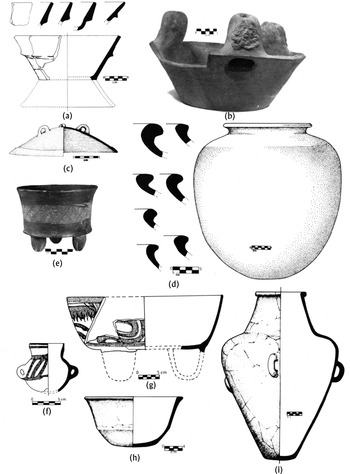
Figure 5 shows examples of major ceramic categories of the Metepec phase at Teotihuacan. Rattray (Reference Rattray2001) provides much more detail.
Major ceramic categories of the Metepec phase of Teotihuacan: (a) Coarse Matte censer bases, (b) Coarse Matte three-prong burner, (c) Fine Matte tapaplato (“handled cover”), (d) ollas, (e) direct-rim tripod cylinder vase, (f) Red-on-Natural jar, (g) Red-on-Natural basin, (h) San Martín Orange crater; (i) San Martín Orange amphora (after Rattray Reference Rattray2001).

ADVOCATES OF EPICLASSIC LOCAL CONTINUITY
In 1966, when much less was known about west Mexican cultures than is the case today, Bennyhoff (Reference Bennyhoff1967), who intensively studied Basin of Mexico ceramics of all periods, favored Epiclassic inheritance from Teotihuacan. He recognized that, following the destruction of major civic-ceremonial buildings in the city, there was a pronounced change in ceramics marked by a new phase that he called Oxtoticpac (using the original Nahuatl place name rather than the modern spelling used by Sanders). He (Bennyhoff Reference Bennyhoff1967:20–21) saw it as “an impoverished Teotihuacan derivative, strongly influenced by Xochicalco, while the [ensuing] Xometla phase, as found in the Teotihuacan Valley, represents a hybrid and fusion of the altered and exhausted Teotihuacan tradition and the enigmatic Coyotlatelco culture.” He felt certain that after the Late Preclassic period there were no massive intrusions of people until the appearance of the Early Postclassic Mazapan culture, a foreign tradition that he thought probably developed somewhere to the northwest. Bennyhoff (Reference Bennyhoff1967:21–22) believed that a few migrants probably arrived earlier, but never in sufficient strength to alter the basic continuity of the Cuicuilco-Teotihuacan tradition. Millon (see, for example, 1988:111) agreed, distinguishing an earlier Oxtoticpac phase from later Xometla (with Coyotlatelco style serving wares) in his chronological charts. In the Teotihuacan Valley, this later Epiclassic subphase is well represented at the site of Xometla (Nichols and McCullough Reference Nichols, McCullough and Sanders1986).
An unpublished typescript by Bennyhoff and Millon (Reference Bennyhoff and Millon1966–1969) provided more details about what they saw as likely derived or not derived from Metepec-phase ceramics in Oxtoticpac. They saw Oxtoticpac as characterized by many significant changes in wares, decoration, and vessel forms. Matte Ware and Thin Orange disappeared. Two completely new forms were trough ladles and ladle censers (sahumadores). Influence from Xochicalco was indicated by the appearance of basal-overlap bowls. “But the majority of features seem derivable from the Metepec phase” (Bennyhoff and Millon Reference Bennyhoff and Millon1966–1969:126). However, they described many ceramic differences. Coarse Ware hourglass censers with crenelated rims, modeled ornamentation, and indented fillets were new. Unslipped Ware was thinner and darker than the older Matte Ware and had a finer paste. Another marker was the three-pronged “brazier” with three solid prongs projecting inward from the rim. The form was probably derived from Teotihuacan three-prong burners (Figure 5b), but the shapes were quite different. The neckless olla with a roll rim was the most common Burnished Ware form, derived from the Metepec olla (Figure 5d) but much smaller and always unpainted. At first, high-neck ollas with a thick rim were much less common, but by the late Epiclassic Xometla phase, high-neck ollas far outnumbered roll-rim ollas. A common new marker was the flaring dish, a large, thick-walled utility vessel with burnished interior and carelessly finished exterior. Another common new form was the upcurved cazuela, a large, deep, flat-based vessel that typically has a thick simple rim. Simple bowls and slant-rim bowls occurred. Comals were rare and occurred in two forms: one was a diagnostic shallow dish with flaring walls, direct rim, and roughened, flattish base with a slight basal-overlap ridge. More common was a thick, shallow dish with a gently upcurving rim and rounded lip. It resembles the Metepec comal in shape but was larger and much thicker.
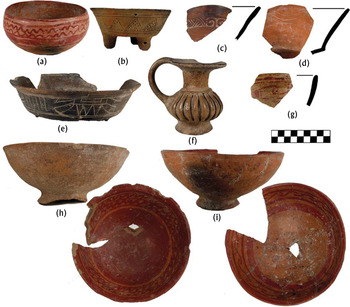
Polished Ware vessels were usually more carefully finished. The obtuse-angled bowl continued as one of the most common forms, with outcurving walls and a flat base, often with supports. A new form was the tubular support, a tall, hollow cylinder with an open base, derived from Metepec. Other support forms were smaller and solid, including conical or truncated nubbins, rectangular tabs (a marker form), and bulbous and conoidal supports. Flaring bowls and dishes also were common. A very characteristic new form (virtually a marker) was the basal-overlap bowl with a Z-angle shoulder, upright to flaring rim, and a rounded to flattish base (Figure 6c and 6d). It probably reflected influence from Xochicalco.
Major ceramic categories of the Early and Late Epiclassic periods in the Basin of Mexico. a–f are Early Epiclassic. (a) “Proto-Coyotlatelco” bowl, (b) Incised and Punctate heavy line, (c and d) basal-overlap bowls, (e) Incised and Punctate light line, (f) handled squat florero, (g–i) Late Epiclassic Coyotlatelco bowls. (Courtesy of Destiny Crider.)

Epiclassic decorative treatment was varied, with emphasis on abstract and geometric designs within panels. The step and scroll was much more frequent than before, while life-figure representation was virtually absent. One characteristic technique was incision with punctate fill (Figure 6b and 6e). The ring-base florero may also have this decoration. Stamping was commonly used on simple, incurved, and deep upright bowls, normally in a single unbordered panel around the exterior a little below the rim. Mold-made carved ware continued in simple and deep upright bowls. The frequency of painted wares increased, and three new wares featuring white paint were added. Use of specular hematite red declined sharply but occurred occasionally. Metepec ridged dishes continued, but designs were usually limited to a single panel, most frequently encircling the interior just below the rim, but sometimes on the exterior of jars and rounded or flaring bowls. Designs often featured fine-line brush strokes, finer than the narrow lines of Metepec. Resist-on-Natural continued in low frequencies on hemispherical bowls. Mold-made figurines were rare, small, and flat. They displayed less detail than those of the Metepec phase, but the eyes were shown clearly, and the nose was not prominent. “Throned” figures continued, but all details were blurred.
Bennyhoff and Millon's mindset in the 1960s encouraged them to privilege inheritance from Metepec-phase Teotihuacan wherever that was not too implausible. They never referred to west Mexico or any other possible alternative sources, and I believe they thought of west Mexican cultures as far less developed than they are now known to have been. Nevertheless, there is still a case for some degree of inheritance from Teotihuacan antecedents, though a much lesser degree than they believed.
Persons who argue for strong ethnic continuity at Teotihuacan tend to downplay differences between ceramics before and after the city's collapse—or sometimes ignore the issue altogether. Parsons and Sugiura Yamamoto (Reference Parsons, Yamamoto, Nichols and Pool2012) claim more continuities than did Millon and Bennyhoff, without specifying their sources. Sugiura Yamamoto (Reference Sugiura Yamamoto and Valverde2006) is dismissive of peoples from west Mexico, describing them as marginal to Mesoamerica and on a relatively low level of sociopolitical development. Northernmost Mesoamericans in the state of Durango, north of Zacatecas, may have been marginal, but this characterization hardly squares with what is now known of the variety, sophistication, and complexity of western societies further south and closer to central Mexico, including those of the Bajío (Beekman Reference Beekman2010). Fournier and Bolaños (Reference Fournier, Bolaños, Kowalski and Kristan-Graham2007) also argue against any significant migration of people from west Mexico into central Mexico during the Epiclassic period, stating that current radiocarbon dates of west Mexican ceramic styles, from which Coyotlatelco styles are supposedly derived, are no earlier in west Mexico than in central Mexico and that the ceramic resemblances are not really that close. But they do not include any illustrations from which one could judge the degree of ceramic resemblances, and the quality of relevant dates in west Mexico is still not good enough to be decisive one way or the other. Most importantly, they do not mention the difficulties in deriving the Coyotlatelco style from Teotihuacan styles.
It has been suggested that there may be more continuity from Teotihuacan into the Epiclassic in utility wares than in serving and ritual wares (see, for example, Gaxiola González Reference Gaxiola González and Valverde2006). Perhaps the best candidates for such continuity are low-necked, “roll-rim” ollas. Some of these seem hard to tell from Metepec-phase ollas (Rattray Reference Rattray2001:571) (Figure 5d). But other Epiclassic ollas and other utility vessels, such as high-neck ollas (often with vertical loop handles attached to the rim) and neckless jars are quite different. I have seen little data on utility forms outside the Basin of Mexico, so I cannot say if there are equally plausible antecedents elsewhere. However, the proportion of Epiclassic utility ware types not easily derivable from Teotihuacan antecedents has sometimes been overlooked, as well as the number of Teotihuacan utility forms and even whole wares that ceased to be made after the collapse of the Teotihuacan state. One excellent example is the distinctive utility ware called San Martín Orange (Figures 5h and 5i), recently discussed by Sullivan (Reference Sullivan2006), made in one or, at most, two districts within the city. That ware does not seem to have been widely exported even within the Basin of Mexico, and its manufacture appears to have ceased abruptly when the Teotihuacan state collapsed. Most likely there was no longer a scale of demand for it that could support specialization in a single ware that consisted of only two major forms: craters and amphoras. But it is far from clear that in Teotihuacan times there was much specialization in other utilitarian wares, probably produced in a number of neighborhoods by part-time potters.
The great majority of Epiclassic serving wares in the Basin of Mexico do not have good Teotihuacan antecedents, although stamped decoration in some Metepec phase serving vessels might be a source for the stamped decoration that is more prevalent in the Epiclassic (Crider Reference Crider2013). In addition to major differences in shapes between Teotihuacan and Epiclassic Red-on-Natural vessels, in Teotihuacan times the red lines are usually broad (up to 8–10 mm or more) and often bordered by narrow incised lines, while in the Epiclassic incised outlining is nearly absent, and the red lines are much narrower.
Some scholars, notably Sanders, make much of alleged cultural continuity in the Basin of Mexico to argue for strong continuity in population. Assuredly, many features of sixteenth-century thought and religion, such as the “Storm God” and the “Feathered Serpent,” have very deep historical roots in central Mexico (Carrasco et al. Reference Carrasco, Jones and Sessions2000). But many other features did not outlive the Teotihuacan state, such as whatever beliefs and practices were associated with the small censers called candeleros. Many of the standardized Teotihuacan signs cataloged by Langley (Reference Langley1986) remain mysterious precisely because they do not have later derivatives.
LOCAL CERAMIC DISCONTINUITIES IN THE EPICLASSIC BASIN OF MEXICO
There are growing indications that the Epiclassic period in the Basin of Mexico (approximately a.d. 600/650 to 800/850) can be subdivided into two ceramic phases with the earlier phase being prior to the appearance of the well-developed Coyotlatelco style (Crider Reference Crider2013). Figure 6 shows major Epiclassic ceramic categories in the Basin of Mexico. This subdivision is also seen in the Valley of Toluca (Sugiura Yamamoto Reference Sugiura Yamamoto and Valverde2006). It is natural to think that the pre-Coyotlatelco phase might have ceramic complexes derived in large part from those of the Metepec phase of Teotihuacan. This is the way the Oxtoticpac assemblage, found in a cave at Oxtotipac in the Teotihuacan Valley, was interpreted by Sanders (Reference Sanders and Sanders1986, Reference Sanders, Diehl and Berlo1989, Reference Sanders and Valverde2006).
In the region around Tula, about 60 km north-northwest of Teotihuacan (Figure 1), there had been a number of Teotihuacan settlements, notably Chingu (Díaz Reference Díaz and Luz1980). Probably as early as the a.d. 500s new kinds of ceramics appear in the Tula area, believed to have been carried by influential newcomers from in or near the Bajío (Healan Reference Healan2012). The site of Tula Chico has been thought to have been still too small to have had much influence in the Basin of Mexico. However, recent work suggests that Tula Chico may have been larger than was thought (Suárez Cortés et al. Reference Suárez Cortés, Healan and Cobean2007). In any case, an important point is that newcomers from western Mexico were probably settling in the Tula area while Teotihuacan was in decline but had not yet collapsed.
Rattray (Reference Rattray1966:129), in her major study of Coyotlatelco ceramics—based mainly on a large sample from Cerro Tenayo in the western Basin of Mexico, a few kilometers north of Azcapotzalco—was aware of the Oxtoticpac phase proposed by Sanders, Bennyhoff, and Millon but was skeptical of it. In her subsequent study of TMP ceramics, she was unable to identify any distinct phase between Metepec and Coyotlatelco, although she had earlier published a few examples of types now suspected to be early Epiclassic (Rattray Reference Rattray1966:121, Figures 3f and 3i) (see Figures 6b and 6e).
It is now clear that Rattray was wrong when she insisted on a single Epiclassic ceramic phase. Crider (Reference Crider2013) has made important steps in defining subphases and identifying their spatial and temporal variants, but much more needs to be done. Among other things, it is urgent that ceramics from selected TMP collections with large Epiclassic sherd counts be re-examined. This is but one of many instances of the immense value of keeping these collections intact, in spite of the expense and problems involved. There can never be a ‘final’ analysis of actual archaeological objects. Stratigraphic excavations at Teotihuacan and elsewhere will also be vital—if any undisturbed Epiclassic layers can be found.
Critical here is the degree of continuity or discontinuity in technological style, especially in things that can be detected by a keen and knowing eye but that have little effect on the general appearance of objects, as discussed by Clayton (Reference Clayton2013). If the changes are in outward appearances but not in technological style, it suggests they were emulations of foreign styles made by Teotihuacan descendants. If these hard-to-see technological styles change also, it suggests inheritances made by newcomers. The extent to which discontinuities between late Teotihuacan and Epiclassic ceramics involve new technological styles, in utilitarian wares as well as serving wares, suggests inheritances from newcomers.
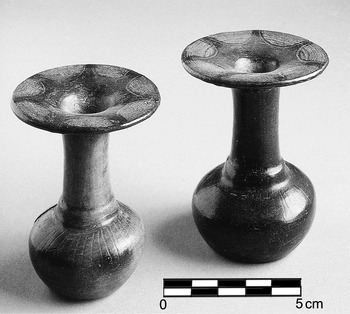
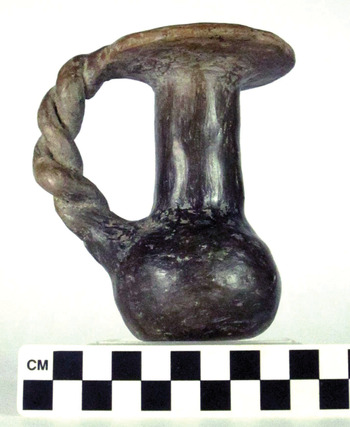
Among decorated forms, so-called floreros may be derived from Teotihuacan antecedents but with major changes. Typical Teotihuacan forms are gracile, with a long, narrow, cylindrical neck, very widely-flaring rim, no handles, and no supports (Figure 8). Several somewhat similar vessels were found in Cerro Portezuelo burials, but they are squat and rather heavy with a short neck, a loop handle, annular supports, and sometimes attached vertical fillets on the body (Figure 5f). Floreros very similar to those from Cerro Portezuelo are found in the Valley of Toluca (Sugiura Yamamoto Reference Sugiura Yamamoto and Valverde2006). To my eye, the contrast with the Teotihuacan form is pronounced, and the apparent lack of intermediate forms does not suggest local continuity, although Bennyhoff and Millon (Reference Bennyhoff and Millon1966–1969) do show a gracile florero, assigned to the Metepec phase, in most respects typical of Teotihuacan examples, but with a low ring base. Another partial exception is an unprovenanced vessel in the collections of the School of Human Evolution and Social Change at Arizona State University, called to my attention by Destiny Crider (Figure 9). In form and all outward appearances this vessel resembles typical Teotihuacan floreros, although the shaping and surface burnishing are cruder than on most Teotihuacan examples. The vertical lip-to-body handle, however, is a feature of Epiclassic floreros. The twisted strands of this handle appear also on a few of the (otherwise very different) Epiclassic examples, though not on all. There is a good case that this vessel form was largely derived from Teotihuacan.
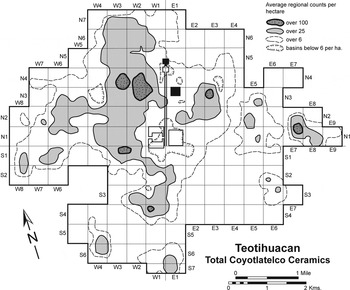
Spatial pattern of Epiclassic ceramics collected by the surface survey of the Teotihuacan Mapping Project. Drawn by Shearon Vaughn after a map prepared by Whitney Powell and George Cowgill.

Typical Teotihuacan floreros.

An unprovenanced florero, with twisted strap handle. Anthropology collections of the School of Human Evolution and Social Change, Arizona State University.

The discussion by Gaxiola González (Reference Gaxiola González and Valverde2006) makes excellent points about the regional diversity of Epiclassic ceramics—and likely multiple inheritances and innovations—but sees Teotihuacan influences in many examples that do not look much like anything I know of at Teotihuacan. One among many cases is the tripod vessel with basal overlap and outslanting hollow supports, described as a “hybrid” of Teotihuacan and other traditions by Gaxiola González (Reference Gaxiola González and Valverde2006:45) (Figure 10). I can detect no Teotihuacan resemblance here: it looks wholly unrelated to Teotihuacan.
Vessel incorrectly called a Teotihuacan hybrid by Margarita Gaxiola (Reference Gaxiola González and Valverde2006).

Vessels with basal overlap (sometimes called basal Z-angle) are well represented at Cerro Portezuelo (Figures 6c and 6d). However, I know of no good Teotihuacan antecedent for this form. Basal overlap vessels are found at Xochicalco and other sites in Morelos (Cyphers Reference Cyphers and Hirth2000; Cyphers and Hirth Reference Cyphers, Hirth and Hirth2000:119–120) in the Early Gobernador subphase, estimated to date a.d. 650–800. These are probably what Bennyhoff (Reference Bennyhoff1967) and Bennyhoff and Millon (Reference Bennyhoff and Millon1966–1969) had in mind in referring to possible influences from Morelos.
Several vessels and sherds at Cerro Portezuelo have a very distinctive style of angular narrow-line incising in still-plastic clay, enclosing areas filled with numerous punctate dots, with both finer (Figure 6e) and coarser variants (Figure 6b). These probably began in Early Epiclassic times, before Coyotlatelco. There is no Teotihuacan antecedent for this vessel form or decorative style. However, it is also present at Cerro Tenayo in the western Basin of Mexico (Rattray Reference Rattray1966) and elsewhere. Its source is, to me, mysterious. Nichols et al. (Reference Nichols, Neff and Cowgill2013) report that instrumental neutron activation analysis (INAA) of four sherds of this kind assigned them to their Tenochtitlan/western basin source group. They were the only early Epiclassic specimens from Cerro Portezuelo that were not assigned to the southeastern basin/Chalco source group.
Another hybrid vessel found at Cerro Portezuelo is well-polished and has the overall shape of a typical slender Teotihuacan-period florero, but typical features of the Teotihuacan “Storm God” were modeled onto the long neck of the vessel. A somewhat similar vessel was found at Kaminaljuyu (Kidder et al. Reference Kidder, Jennings and Shook1946:203, Figure 199-l). There is nothing Epiclassic about these vessels. Because they are a combination apparently unknown at Teotihuacan, it is a suggestion of regional divergence at Cerro Portezuelo, as discussed by Clayton (Reference Clayton2013), and a hint that some of the Teotihuacan-related people at Kaminaljuyu may have stemmed from elsewhere in central Mexico.
If it is really true that Teotihuacan-descended potters had little incentive to change plainwares but good reasons to change styles of serving and ritual wares, the notion proposed by Sanders (Reference Sanders and Valverde2006) that their incentive was to “gain market share” anachronistically projects modern commercial practices and attitudes into the past. Moreover, it is difficult to see how commercial considerations could apply to ritual ceramics at the same time that they led to adoption of new styles of serving wares. However, we should consider the possibility that there could have been an ideological, political, and even moral repudiation of things associated with the Teotihuacan state, if not the city itself. If indeed that state collapsed largely as a result of internal tensions, it is plausible that many Epiclassic groups made a point of distancing themselves from the symbolism of that state, even groups dwelling in the ruins of the city. Identifications with the past are more likely to occur among people safely removed in time, such as the archaistic Teotihuacan revivals created by the Aztecs (López Luján Reference López Luján1989; Umberger Reference Umberger1987); or distant in both space and time, as done by Late Classic Maya (Stone Reference Stone, Diehl and Berlo1989).
To what extent are the new styles most plausibly derived from antecedents outside Teotihuacan? Ceramic traditions in western and northwestern Mexico are varied, their complex interrelations are not well understood, and their chronological uncertainties remain troubling (Beekman Reference Beekman2010). Nevertheless, in view of the difficulties in deriving central Mexican Epiclassic ceramics from local antecedents, ceramic traditions in parts of western Mexico, especially the Bajío, look like strong candidates as sources for many features of Epiclassic ceramics in the Basin of Mexico. Regions further west or north, in Jalisco or Zacatecas, are not likely sources.
Archaeologists who see strong resemblances to some western ceramics include Cobean and Mastache (Reference Cobean, Mastache and Healan1989), Healan (Reference Healan2012), and Mastache et al. (Reference Mastache, Cobean and Healan2002). Hernandez and Healan (Reference Hernandez and Healan2012) describe ceramics from near Ucareo (Figure 2:5) in the eastern Bajío, which they regard as especially good sources for Epiclassic ceramic styles in central Mexico.
DISCONTINUITIES IN OCCUPATION PATTERNS WITHIN TEOTIHUACAN AND ELSEWHERE
Sanders et al. (Reference Sanders, Parsons and Santley1979) and Parsons (Reference Parsons2008) report Epiclassic settlement patterns in the Basin of Mexico that are drastically different from those of the Teotihuacan period, but drastic regional settlement changes might be expected to occur after collapse of political unification—with or without the arrival of many newcomers. Nevertheless, discontinuities in occupation at Teotihuacan itself suggest newcomers. Too often, excavation techniques at Teotihuacan have left the possibility of hiatuses in occupation unclear. However, near the eastern edge of the city, in sector N1E7, a multi-apartment residential compound was briefly abandoned after the Metepec phase, then reoccupied by producers of Epiclassic-style pottery and lithics (Rattray Reference Rattray, Tapia and Rattray1987, Reference Rattray and Valverde2006). In the Rancho La Ventilla district, not far from the city center, Cabrera Castro and Gómez Chávez (Reference Cabrera Castro, Gómez Chávez, Mastache, Cobean, Cook and Hirth2008:69, 71) report unfinished craft items and other objects left in place atop the latest Teotihuacan floor in a compound of artisans, giving them the impression that it was rapidly abandoned. At Xalla, a large civic-ceremonial complex somewhat east of the Avenue of the Dead in sector N4E1, a 20 cm layer of fine sediments introduced by wind and rain overlies evidence of burning and violent destruction of images (Leonardo López Luján, personal communication 2011). Burning and destruction of images is also seen at the Ciudadela and elsewhere along the Avenue of the Dead (López Luján et al. Reference López Luján, Nadal, Fash, Fash and Hernández2006). At Azcapotzalco, on the west side of Lake Texcoco, a layer originally interpreted as building fill by Tozzer (Reference Tozzer1921) has been reinterpreted as a destruction layer by García Chávez (Reference García Chávez1991). There is also evidence at Cerro Portezuelo of a significant interval of abandonment followed by reoccupation, as described by Hicks (Reference Hicks2013). There are other cases where no such abandonment is reported. For example, López Pérez et al. (Reference López Pérez, Nicolás Careta, Naim and Valverde2006) report continuous occupation in underground chambers dug in Teotihuacan times to obtain building materials, a short distance east of the Sun Pyramid in sector N3E2. They suggest that Epiclassic newcomers were living in marginal locations within the city before its collapse, and coexisting with the previous occupants. However, I am unclear about the stratigraphy, and much of their evidence for coexistence is based on overlaps in obsidian hydration and radiocarbon date ranges. I do not think they have fully taken into account the problematic character of hydration dating (Braswell Reference Braswell1992). Also, in any sizable batch of radiocarbon or obsidian dates, a few will have calibrated intercepts and even “two sigma” ranges that are well outside the true date. That is to say, the date ranges of ceramic complexes estimated by these methods may overlap even when the actual dates of the complexes do not. This is yet another example of the need for more firmly-based chronologies.
Diehl's (Reference Diehl, Diehl and Berlo1989) belief that there was little change in areas of heavy sherd cover at Teotihuacan between the Metepec phase and the Epiclassic period is a regrettable error not based on any first-hand knowledge of the data. It is, instead, a misunderstanding of information that I derived in the early 1970s by plotting sherd densities obtained through the intensive surface survey carried out by the TMP in the 1960s. In fact, although Teotihuacan soon regained its status as a populous community, there was a very drastic shift in the districts within the former city with highest sherd densities—far more drastic than any that had occurred since the city first reached its maximum extent in the Tzacualli phase, around a.d. 100. Compare the TMP sherd density map for the Epiclassic (Figure 7) with that for Metepec (Figure 4). The TMP map clarifies some of the questions raised by Parsons and Sugiura Yamamoto (Reference Parsons, Yamamoto, Nichols and Pool2012). The spatial extent of Epiclassic settlement at Teotihuacan was around 17–18 km2, not much smaller than the approximate 20 km2 of Teotihuacan at its height in the Xolalpan phase. Further, the Epiclassic sherd count was about 58,000, as compared to 107,000–145,000 for Xolalpan and approximately 49,000 for Metepec.
TMP tract 1:N1E7 is an isolated pyramid near the eastern margin of Teotihuacan. As Figures 4 and 7 show, the pyramid and surrounding structures share a localized concentration of Metepec ceramics, followed by a more extensive, but still localized, spread of Epiclassic ceramics, including some that are Early Epiclassic according to Bennyhoff's unpublished analyses. This is an exception to the overall disjunction between occupation peaks in the two phases, and it suggests some kind of power center marginal to the Classic city, a center that seems to have begun before total collapse of the entire city and which then continued into the Epiclassic period. It is the strongest suggestion of some degree of sociopolitical continuity between the two periods, and it calls for more extensive study. Rattray (Reference Rattray, Tapia and Rattray1987) excavated in tract 9:N1E7, which was a Teotihuacan apartment compound just east of the pyramid, occupied as early as the Tzacualli phase. It had abundant Metepec ceramics under a plastered concrete floor, followed by burning and collapse of the roof, then a brief period of abandonment, and then adobe structures with Epiclassic ceramics and production of Epiclassic style obsidian artifacts. Nelson (Reference Nelson2009) discusses the Epiclassic lithics and includes a stratigraphic profile. I do not believe the pyramid itself has ever been excavated.
To be sure, many Metepec structures within the city are overlain by significant quantities of Coyotlatelco ceramics. There is too much spatial overlap to suggest coexistence of people making Metepec ceramics and those making Coyotlatelco ceramics. However, the overall Coyotlatelco occupation pattern is very different, and there was perhaps no longer a single urban center (Crider Reference Crider2002; Crider et al. Reference Crider, Nichols, Neff and Glascock2007).
If Teotihuacan was resettled by newcomers, why did so many of them settle in the ruins of the city, especially since they seem to have built much less in the way of civic-ceremonial structures there than elsewhere in the Basin of Mexico? It may have been partly an ambivalent attitude toward the former city, which may have maintained an aura of sacred importance at the same time that Teotihuacan state symbolism was rejected and Teotihuacan burials and caches were energetically looted. It may also have been, in part, a simple matter of taking advantage of surviving residential structures.
A UNIQUE “STORM GOD” JAR
A vessel from Cache 2, Trench 93 at Cerro Portezuelo is so unusual that it calls for separate discussion (Figure 11). It is clearly a variant of the “Storm God” jars that have a long history of evolving forms at Teotihuacan. At first glance, it is easy to dismiss this vessel as simply one more regional or temporal variant, and derived from the Teotihuacan tradition. Closer consideration, however, shows that it is very strange. Specifics, such as the small mouth and small pointed nose, are, to my knowledge, unique and wildly different from all known Teotihuacan examples, which have large mouths with a broad and curled upper lip and prominent fangs, a bulbous snub nose, and arching eyebrows. Most significantly, within the Teotihuacan tradition, the right hand either holds nothing or holds an undulating rod that clearly represents the lightning bolt of the “Storm God,” seen both in jars and in mural paintings (Figures 12 and 13). But in the Cache 93-2 vessel, the tall straight rod simply connects to the vessel itself, and there is no sign of any arm or hand; nor are there any undulations in the rod. The workmanship is unusually crude and far from the Teotihuacan technological style. The vessel is an emulation rather than an inheritance or an established regional variant, and it was made by an unskilled artisan who did not fully understand the symbolism of Teotihuacan “Storm God” representations. It looks like the work of an artisan who had never seen one before and was told to make a copy of a Teotihuacan “Storm God” vessel but was unable to get a close look at the real thing. Whatever the real story behind it is, this vessel is exceedingly strange and, at least for the present, enigmatic.
The anomalous “Storm God” jar from Cache 93-2 at Cerro Portezuelo. See Clayton (Reference Clayton2013) for another view of this vessel.

A well-made Teotihuacan “Storm God” jar with lightning bolt.

The “Storm God” with lightning bolt in a Techinantitla mural (courtesy of Saburo Sugiyama).

Clayton (Reference Clayton2013) discusses Cache 93-2. Its stratigraphic context puts it in Teotihuacan times, before the Early Epiclassic period. Of the 24 ceramic objects in the cache, eight were subjected to INAA. The sources of most are uncertain, and none are clearly from the Teotihuacan Valley. Except for two mold-made funerary masks, none of the 24 objects are close to the Teotihuacan technological style. (The mask molds have not been found and, therefore, cannot be sourced). Cache 93-2 may be an example of regional variation before the collapse of the Teotihuacan state.
BIOARCHAEOLOGY
The most decisive evidence about migrations will probably eventually come through bioarchaeological methods, such as DNA determinations, highly heritable and easily measured phenotypic features of bones and teeth (Aubry Reference Aubry2009), and analyses of strontium and oxygen stable isotopes in teeth and bones. However, at present I am cautious about interpretations based on stable isotopes of oxygen because I feel more work needs to be done concerning possible postdeposition alterations (diagenesis), establishment of a much larger database of accepted local ‘profiles’ from Teotihuacan, much more data from a wider range of other regions, possible effects of climatic changes, and the effects of water in local streams derived from distant sources. The situation seems somewhat better for stable isotopes of strontium, especially because it is based on unchanging local geology, and, at least in the Andes, it appears to give better results than oxygen (Knudson Reference Knudson2009). So far there have been few studies based on strontium isotopes in central Mexico (Price et al. Reference Price, Manzanilla and Middleton2000; White et al. Reference White, Price and Longstaffe2007). More are needed.
OTHER LINES OF EVIDENCE
Ceramic figurines show some continuity from Teotihuacan antecedents. Barbour (Reference Barbour and Sanders1987, Reference Barbour, Paz and Castro1998) reports that certain late Teotihuacan forms, particularly “half-conicals” and “thrones” (Figure 14), continue into the Epiclassic period, though they are generally of inferior technical quality. Disappearance of other figurine types, such as “portraits,” seems understandable, since “portraits” probably represent Teotihuacan soldiers. But the elaborate mold-made half-conicals and thrones are heavily laden with meaning. Headrick (Reference Headrick2007) proposes that they represent deceased Teotihuacan elites. If so, their continuation may mark strong identification with the collapsed Teotihuacan state, or at least its elite ritual. But, they generally have blurred features. I wonder if they were made from worn Metepec molds by artisans who did not understand their original meanings. I know of no systematic searches for non-Teotihuacan sources from which aspects of Epiclassic figurines in the Basin of Mexico might have been derived.
Teotihuacan figurines: (a) “half-conical” and (b) “throne.”

Nelson's (Reference Nelson2009) discussion of the Epiclassic lithic workshop in 9:N1E7, just east of the Metepec Pyramid, illustrates large corner-notched projectile points that are very different from the stemmed points typical of earlier periods at Teotihuacan. Carballo (Reference Carballo2011) notes that corner-notched points are characteristic of the Epiclassic period elsewhere in central Mexico. It seems highly unlikely that a drastic change in lithic style would occur simply by emulation at the same time that drastic changes occur in ceramic styles, and I think it is further evidence in support of a significant migration.
Linguistic evidence also plays a role, as discussed especially by Beekman and Christensen (Reference Beekman and Christensen2003). Speakers of many languages probably lived in Teotihuacan, but it is generally thought that, because Teotihuacan was so widely influential in Mesoamerica, words borrowed from the language of its elite would likely show up in many languages elsewhere. Dakin and Wichmann (Reference Dakin and Wichmann2000) argue that kakawa, a Mayan word for cacao, was derived from Nahuatl, and hence an early form of Nahuatl was the elite language of Teotihuacan. However, Kaufman and Justeson (Reference Kaufman and Justeson2007) argue that no Uto-Aztecan language can have been the source for kakawa and that there is no good evidence for any borrowings at all from Nahuatl before about a.d. 900. They suggest that the dominant language of Teotihuacan was probably not Nahuatl. This would weaken the case for an influential presence of Nahua speakers in the Basin of Mexico in Teotihuacan times and strengthen the case that Nahua speakers arrived in large numbers only after the Teotihuacan state was in decline or had collapsed. However, not all knowledgeable linguists are convinced by Kaufman and Justeson, and the dominant language of Teotihuacan remains highly controversial.
MIGRANTS AND MOTIVATIONS
If migrants from in or near the Bajío were important, what were the likely push and pull factors? Evidence is mixed for drought at this time in west or central Mexico. Elliott (Reference Elliott2007) finds no evidence for drought or desertification in the Malpaso Valley in the state of Zacatecas before the 1500s, but that is far to the north. McClung de Tapia (Reference McClung de Tapia2009) finds no sign of significant Epiclassic climate change in the Teotihuacan Valley. But one cannot extrapolate from one region to others hundreds of kilometers away, and things were possibly very different in the Bajío, where pollen cores point to drought (Christopher Beekman, personal communication 2010). Yet, a worsening of environmental conditions in the Bajío cannot be taken for granted. In any case, abrupt droughts are more apt to produce refugees than conquerors, as in the United States dust bowl of the 1930s or the West African Sahel in the 1970s. Gradual declines in rainfall may be another matter.
Heather (Reference Heather2009) argues that in the first century a.d. Romans did not extend their empire east of the Rhine because the region had so little to offer them, rather than because of effective resistance. (The Germanic annihilation of three Roman legions in a.d. 7 was a ‘fluke,’ never to be repeated.) By the a.d. 400s, peoples east of the Rhine had developed very much stronger polities, largely because of wealth acquired through interactions with the Roman state, and this, rather than any marked weakening of Rome itself, was what made possible devastating conquests of key Imperial provinces—notably western north Africa—by ‘barbarians.’ Did the Teotihuacan state have any comparable effect in west Mexico, helping to bring about the rise of stronger polities that eventually played a large role in Teotihuacan's destruction? At present, the evidence does not suggest this, but I do not think the possibility has yet been considered in sufficient depth, and it is worth investigation. Or could it be that Teotihuacan's impacts closer to home led to the rise of polities like Xochicalco, weakening the Teotihuacan state and leaving it vulnerable to west Mexican invaders? This is another topic for further research, including better chronologies for these sites, by methods such as Bayesian analysis of multiple calibrated radiocarbon dates constrained by stratigraphic evidence, along the lines pioneered for Mesoamerica by Beramendi-Orosco et al. (Reference Beramendi-Orosco, González-Hernández, Urrutia-Fucugauchi, Manzanilla, Soler-Arechalde, Goguitchaishvili and Jarboe2009).
If there were large migrations, did migrants arrive as conquerors, playing a major role in the collapse of the Teotihuacan state (possibly in collusion with elements within that state) or only as fillers of a vacuum left by self-destruction of the Teotihuacan state? At the moment, neither possibility can be ruled out, but I lean toward the former. Violent conquests are well-documented around the world in cases where written evidence exists. Teotihuacan certainly appears to have been in a weakened condition in its last century. Smaller west Mexican polities may have formed an alliance to topple their large neighbor to the east. Here, again, is a topic for research. Evidence of central Mexican inheritances from two or more west Mexican sources would suggest such an alliance.
WHAT BECAME OF TEOTIHUACAN SURVIVORS?
In some discussions of the Epiclassic period there seems to be an unstated assumption that descendants of the city of Teotihuacan couldn't have just become archaeologically invisible. It is assumed that whether they mostly stayed in place or mostly emigrated, they must have left their traces somewhere. This has been referred to as a “billiard ball” model, in which ethnic groups are discrete, tightly bound, and durable. This assumption is unwarranted. In terms of sheer biological survival, besides the likelihood that the city's population dwindled considerably in its final century, it is conceivable that a high proportion of the remainder lost their lives through outright slaughter and possibly from other factors such as famine. Parsons and Sugiura Yamamoto (Reference Parsons, Yamamoto, Nichols and Pool2012) and others apparently overlook the mathematical fact (as pointed out in any elementary demographic textbook) that a rate of natural increase (births minus deaths) of 1% per year can double a population in 70 years, while a negative annual rate of 1% can cut a population in half in 70 years. A positive rate of 1% is somewhat high but not impossible for a premodern population, but a 1% negative rate is all too plausible.
However, even if there was a high rate of physical survival during Teotihuacan's decline and fall, many survivors may have changed their cultural identity within a generation or two and ceased to produce objects related to the Teotihuacan tradition, thus becoming untraceable on the basis of material culture. A major theme of the recent volume on ethnic identity by Berdan et al. (Reference Berdan, Chance, Sandstrom, Stark, Taggart and Umberger2008) is its complexity and volatility in both the Postclassic period and present-day Mexico. They suggest that it may have been more fixed in strong states, such as Teotihuacan, but less so in times of political instability. The Epiclassic period assuredly counts as a time of instability. Teotihuacan dissidents may have made a point of distancing themselves from the collapsed state while its supporters may have seen little to gain by drawing attention to their connection. We cannot assume that Teotihuacan survivors are necessarily to be identified by their ceramics, somewhere among the various Epiclassic complexes, either within or outside the Basin of Mexico.
SUMMARY
Epiclassic materials at Teotihuacan, Cerro Portezuelo, and elsewhere in central Mexico provide less evidence of Teotihuacan inheritance than is often claimed or assumed. Particular elements of some Epiclassic ceramic complexes may derive from Teotihuacan antecedents, but the proportion of new elements is large. This does not, by itself, demonstrate beyond all reasonable doubt the arrival of substantial numbers of newcomers, but it lends additional support to that scenario, which is also suggested by biological, lithic, and linguistic evidence, as well as by hiatuses in occupation in at least some Teotihuacan structures reoccupied in the Epiclassic period. These newcomers apparently interacted in complex ways with Teotihuacan survivors, leading to ceramic complexes that included both emulation and inheritance from multiple antecedents. Ethnic identities probably shifted and may have been rapidly redefined.
Several questions provide a framework for continued research:
1. What features of Epiclassic material culture are most likely derived by inheritance from Teotihuacan society?
2. What features of Epiclassic material culture in central Mexico are most likely derived by inheritance from migrants who arrived from elsewhere?
3. What features are most likely local emulations of foreign practices?
4. What features are most likely inventions; novelties not due to inheritance or emulation?
5. If migrants were important, where did they come from? Was it mainly from in or near the Bajío? What other regions are possible sources?
6. If migrants were important, what were likely push and pull factors motivating them to leave their homeland(s) and choose central Mexico as their destination?
7. By what means were the migrations effected?
8. What were the impacts of migrants on the pre-existing societies of central Mexico?
RESUMEN
Las cerámicas de la Cuenca de México después del colapso del estado teotihuacano son más difíciles de derivar de antecedentes teotihuacanos de lo que se piensa. Las cerámicas de la Cuenca después del colapso parecen ser menos disimilares a las cerámicas provenientes de partes del occidente de Mesoamérica, especialmente alrededor del estado de Guanajuato. Los estilos cerámicos pueden difundirse sin un movimiento poblacional significativo. Sin embargo, junto con la evidencia lingüística y de otros tipos, es probable que haya existido una migración de escala considerable.
Durante décadas, los arqueólogos norteamericanos dieron poco peso a la migración en sus explicaciones de cambios socioculturales. Sin embargo, existe una amplia evidencia que indica que las migraciones en efecto existieron, lo que ha revivido a la migración como parte de la explicación de estos cambios. Pero el estudio de la migración exclusivamente mediante la arqueología es difícil. Es más favorable si la arqueología se integra con evidencias lingüísticas y biológicas.
Mi punto de vista actual se encuentra entre los extremos del fallecido William Sanders (la influencia de los migrantes fue mínima) y de Evelyn Rattray (los nuevos habitantes rompieron completamente con los antecedentes teotihuacanos). Lo más probable es que haya existido una migración significativa desde el occidente de México, y que los nuevos habitantes hayan interactuado de forma compleja con los sobrevivientes teotihuacanos.
Con el estudio de la “derivación,” me refiero a la búsqueda de los antecedentes de un elemento cultural en particular. La derivación ocurre mayormente a través de la herencia y la emulación. La herencia es cuando un aprendiz tiene instrucción directa de un artesano más hábil. La emulación es cuando un objeto es creado por un artesano ya competente, quien conscientemente copia un objeto que no forma parte de su herencia.
Durante la fase Metepec, cerca del 500/550–600/650 d.C., Teotihuacan se encontraba en declive. La población de la ciudad pudo verse reducida a menos de la mitad. Las desigualdades de riqueza probablemente crecieron, y las elites intermedias dentro de la ciudad pudieron haber obtenido más poder. Los nuevos habitantes provenientes del occidente de México probablemente se asentaron en el área alrededor de Tula. Algunos dudan esta posibilidad, sin embargo, subestiman las dificultades implicadas en considerar a los nuevos estilos cerámicos como herencias teotihuacanas.
Alrededor de los años 600–650 d.C., las estructuras cívico-ceremoniales a lo largo de la Calzada de los Muertos fueron quemadas, y sus imágenes de piedra destruidas. La fecha más temprana propuesta del 550 d.C. se basa sólo en estudios arqueomagnéticos, los cuales, como técnica, requieren verificación. En muchos lugares, existe evidencia de abandonamiento antes de la reocupación por gente con un estilo cerámico distinto.
Los complejos cerámicos pueden ser comúnmente subdivididos en tres categorías. Algunos están destinados al almacenamiento, transporte y preparación de alimentos, y les podemos llamar “utilitarios.” Otros están destinados principalmente a servir alimentos y bebidas, y les podemos llamar “para servir.” Otros fueron utilizados durante ceremonias religiosas, y les podemos llamar “de ritual.” Es útil considerar estas categorías de forma individual al discutir las diferencias entre cerámicas teotihuacanas y epiclásicas.
Las cerámicas epiclásicas de la Cuenca de México pueden ser subdivididas en subfases temprana y tardía. En Cerro Portezuelo, la subfase temprana es parecida a la Oxtotipac de Sanders, con algunas herencias teotihuacanas, pero con muchos tipos de derivación desconocida, algunos quizá de Morelos. La subfase tardía es el complejo Coyotlatelco, derivado probablemente del occidente de México. Existen también cambios en la lítica. Por ejemplo, las puntas de dardos con pedúnculas de tiempos teotihuacanos son remplazadas por puntas con muescas esquineras.
La evidencia linguística sugiere que el nahua no fue la lengua más importante en Teotihuacan y que pudo haber sido introducida desde el occidente de México durante el epiclásico. La lengua dominante de Teotihuacan fue tal vez un miembro de la familia otomangue.
No debemos asumir que los sobrevivientes teotihuacanos puedan ser trazados en el registro arqueológico. Una vez que Teotihuacan perdiera su prestigio, éstos pudieron haber adoptado otras identidades étnicas.
ACKNOWLEDGMENTS
I am grateful to Ben A. Nelson, Barbara L. Stark, René Millon, Michael E. Smith, Leonardo López Luján, David Carballo, Brenda Baker, Kelly Knudson, Linda Manzanilla, Natalia Moragas, two anonymous reviewers, and especially Christopher S. Beekman for comments on earlier versions of this paper. Robert Sternberg offered useful advice about archaeomagnetic dating. Dan M. Healan graciously shared his unpublished review of the archaeology of Tula (editor's note: This piece is now published, see Healan [Reference Healan2012]). I thank all the participants in the Cerro Portezuelo Project, especially Deborah Nichols, Sarah Clayton, Destiny Crider, Hector Neff, and Frederic Hicks. I have profited from discussions with members of the Arizona State University transdisciplinary group researching ancient and modern migrations and disruptions: Takeyuki Tsuda, Brenda Baker, Rachel Scott, Kelly Knudson, James Eder, Jonathan Maupin, Lisa Meierotto, and Jane Buikstra. I also gratefully acknowledge the assistance of Wendy Teeter and the Fowler Museum (University of California, Los Angeles), and I thank Casandra Hernández for translating the extended Spanish résumé. Shearon Vaughn produced Figures 1, 2, 3, 4, and 7. Destiny Crider and Hannah Reitzel Rivera helped greatly with electronic aspects of the figures. Our research on Cerro Portezuelo has been supported by National Science Foundation grants to Arizona State University (No. 0513979), Dartmouth College (No. 0514187), and the Missouri University Research Reactor (No. 0504015). Additional support has been provided by the Clair Garber Goodman Fund (Dartmouth College), a Rockefeller Center Urban Studies grant (Dartmouth College), the School of Human Evolution and Social Change (Arizona State University), and the Archaeological Research Institute (ASU).