On 21 December 1872, HMS Challenger set sail from Portsmouth, southern England, on a 4-year voyage around the world's oceans covering nearly 70,000 nautical miles. The vessel, previously owned by the Royal Navy, had its guns removed and space created for laboratories, 21 officers and a crew of 216 (Buchan Reference Buchan1891). Its task was to survey and explore as many areas of ocean as possible, to take depth soundings, measure seawater temperatures, its saltness (salinity) and to take dredge samples of sediment and fauna on the sea floor. It returned to Spithead, Hampshire on 24 May 1876. The findings were published in 1896 as the ‘Report of the Scientific Results of the Voyage of HMS Challenger during the Years 1873–76’ by a long list of scientists led by Charles Wyville Thomson (1830–82), John Murray (1841–1914) and George Nares (1831–1915). It constituted what many regarded as the greatest advance in scientific knowledge of the planet since the 15th Century and 16th Century. The samples collected from the expedition were stored at the Challenger offices in Edinburgh under the supervision of Thomson who became director of the Challenger Expedition Commission and was tasked to superintend the arrangement of the collections and the publication of the results at the public expense (Bonney Reference Bonney1885–1900). After Thomson's death in 1882, John Murray, regarded by most as the father of modern oceanography, took over as director and supervised the writing and publication of the 50 volumes of reports.
1. Early days
When Thomson returned from the Challenger expedition, it was to Edinburgh University, where he was Professor of Natural History. James Croll was already in Edinburgh at this time. Having published in Reference Croll1864 his first papers in the Philosophical Magazine on the relationships between ice ages and variations in the Earth's orbit, he was given a job in 1867 at the Geological Survey of Scotland by Archibald Geikie (1835–1924) (Irons Reference Irons1896). His duties there included keeper of maps and correspondence. We will never know the conversations that took place between Geikie and Thomson and the teams of scientists under their direction, but Croll can certainly be added to the list of scientists in the vicinity. With the many discoveries that HMS Challenger had uncovered and the presence in Edinburgh of so many outstanding scientific intellects in the same place at the same time, it is no surprise perhaps that James Croll developed into one of the world's leading scientists in the study of what he, himself, described as ‘secular changes of the Earth's climate’.
One of the key interests of Croll was trying to understand how changes in the orbit of the Earth around the Sun may have affected past changes in climate. In 1867 he published a remarkable paper in the Transactions of the Geological Society of Glasgow that discussed several key issues that were to be discussed further by him between then and 1875 (Croll Reference Croll1867, Reference Croll1875a). The first focused on the role of the Gulf Stream on the Earth's heat balance and on processes of climate change. The second concerned the influence that long-term changes in the nature of the Earth's orbit around the Sun may have had on past changes in global climate. Lastly, he described several ways in which changes in global ice cover may have affected patterns of Quaternary sea-level change. During this time of his life he became embroiled in a series of well-known public arguments with Dr William B Carpenter (1813–85) concerning the processes governing the flow of global ocean currents.
So who was Carpenter? William Benjamin Carpenter was born in Exeter the eldest son of a Unitarian preacher (Smith Reference Smith2004). As a student he trained as a physician at University College, London, and later at the University of Edinburgh. He was a specialist in invertebrates and comparative neurology and an excellent public speaker. He later specialised in marine zoology and his studies of foraminifera and crinoids were well known. This, in turn, led him into marine exploration and to two oceanographic surveys. The first of these was in HMS Lightning in 1868 and the second was with HMS Challenger. In HMS Lightning, a 40-year-old converted paddle steamer, both he and Thomson undertook one of the first oceanographic surveys of the North Atlantic. It was Carpenter's background in marine zoology and oceanographic surveys that brought him into contact with James Croll. The scene was thus set for heated discussion on issues that had arisen as a result of these early oceanographic expeditions and the scientific data that had been gathered.
Add to the equation John Murray, the son of Scots emigrants to Canada who had returned to Scotland in 1858 to complete his education at Stirling High School (Ashworth Reference Ashworth2004). Ten years later after some time at Edinburgh University studying medicine, Murray secured passage on a whaling ship, the Jan Mayen, as a surgeon. His 7 months at sea took him to Spitsbergen and Jan Mayen. During the voyage, as well as providing medical help to the whalers, he collected marine samples, measured the movement of ocean currents and sea ice as well as collecting weather data. Murray eventually returned to Edinburgh and embarked on geological research under the supervision of Archibald Geikie. Shortly afterwards, Thomson recruited him as a crew member on the Challenger, where he was to undertake oceanographic measurements using methods very similar to those he had used on the Jan Mayen. So, by the time that HMS Challenger set sail on her 4-year voyage in 1872, Thomson, Murray and Carpenter were well known to each other as established scientists in their respective fields.
One can only speculate on Croll's involvement with them at a personal level. Although Croll was then employed by Geikie at the Geological Survey of Scotland in Edinburgh as a keeper of documents and maps, he never mentions John Murray in his writings. Croll had communicated with Thomson and we know that he had sent him a copy of his book, Climate and time (Croll Reference Croll1875a; Irons Reference Irons1896, p. 308). Thomson wrote a letter of thanks for the book to Croll from Ascension Island where Challenger was anchored during April 1876. After HMS Challenger returned that year, the task of the reporting of the results of the expedition and of collating the tens of thousands of samples was directed by Thomson. Murray worked under Thomson during this period and helped him publish in 1880 The voyage of the challenger in the Atlantic that represented a preliminary report on the findings from the voyage (Thomson Reference Thomson1878). After Thomson died in 1882 following a prolonged period of poor health, John Murray took over the immense task of publishing the complete results of the Challenger project.
By the late 1860s Croll had appreciated that the processes responsible for global ocean currents were central to many of his ideas on climate change. The problem that he faced was a lack of data since, apart from the early oceanographic measurements of Thomson, Carpenter and Murray from the North Atlantic Ocean and the Greenland Sea, the nature of the world's oceans was essentially unknown. The many maps of the world showed in plenty of detail the geography of the major oceans and seas. Yet beyond the realms of exploration and navigation not much was known. This all changed when HMS Challenger set sail in 1872 on its 4-year voyage and Croll saw an opportunity.
2. Croll's Gulf Stream hypothesis
While the vital role of global ocean currents in navigation had been known since the days of Vasco da Gama, hardly any consideration had ever been made of the processes driving these currents. During the 19th Century scientists started to consider these matters in detail and develop ideas of how heat in the low latitudes (often described as the torrid zone) was transferred to higher latitudes. Croll was one of the first to use physics and mathematics to explore these issues in detail. In a series of calculations, he argued that if the average annual temperatures at various latitudes across the Earth was proportionate to the amounts of direct heat received from the Sun, equatorial areas would be much warmer than they are at present while polar areas would be much colder (Croll Reference Croll1875a). From this he concluded that heat must continually be transferred by ocean currents from low to high latitudes, and from the poles to the equator by a return flow. He argued that much of the heat from the Sun, rather than raising the temperature of the equatorial zone, goes indirectly to heat the polar regions. Croll recognised that atmospheric heat transport was an important process, but he emphasised that heat transfer by ocean currents was, by far, the dominant mode of heat transfer.
He used the example of the Gulf Stream to try and quantify the scale of heat transfer that takes place. His calculations equated to a Gulf Stream flow of 43,900,000 m3 per second – referred in oceanography as equivalent to 43.9 Sverdrup (Sv). Given the limited amount of oceanographic data prior to the Challenger expedition and that modern estimates of the Gulf Stream flow are ~30 Sv through the Florida Straits and near 150 Sv south of Newfoundland, Croll's estimate was quite realistic. Indeed, had he known that the Gulf Stream is between 800 and 1200 m deep he may well have derived an estimate closer to present values (Rossby et al. Reference Rossby, Flagg, Donohue, Sanchez-Franks and Lillibridge2013; Gula et al. Reference Gula, Molemaker and McWilliams2015).
Croll calculated from first principles the amount of heat that the Gulf Stream could transfer per day from the equatorial zone to the Arctic Ocean. He then estimated how much heat was received from the Sun on a unit area across the equator (making an adjustment for heat absorption by the atmosphere) and demonstrated that this value was a tiny proportion compared with the amount of heat transported by the Gulf Stream. In his own words he reasoned that, ‘the quantity of heat conveyed into the Arctic by the Gulf Stream equals about, three times all that falls within the Arctic Circle’ (Croll Reference Croll1867, p. 187).
He maintained that these processes have the effect of reducing the difference between the temperature of equatorial and polar regions and that, without these processes, the average difference in air temperature would be closer to 200 °F (93 °C) than the actual difference of ~80°F (27 °C). He further observed that nearly one-fifth of the entire heat of the Atlantic is derived from the Gulf Stream and, hence, if the Gulf Stream were withdrawn, the temperature of the Atlantic would be proportionally lowered. Even at this stage in his research Croll was contemplating possible links between ocean circulation changes, the Gulf Stream and ice ages (Irons Reference Irons1896, p. 228).
3. A remarkable sea level change observation
But Croll was thinking more widely. Through his knowledge of astronomy and physics he was actively considering how long-term changes in the nature of the Earth's orbit around the Sun would have modified the distribution of heat and the magnitude of Gulf Stream flow. He even went so far as to speculate on how such changes may have affected global sea levels as a result of ice sheet melting. In a paragraph of brilliant reasoning, a century ahead of its time, where he considered how the melting of ice across the southern hemisphere (in effect he meant Antarctica, although the continent had not yet been explored or mapped) might have influenced sea level, he made the following statement:
Let us now consider the effect that this condition of things would have upon the level of the sea. It would evidently tend to produce an elevation of the sea-level on the northern hemisphere in two ways. 1st. The addition to the sea occasioned by the melting of the ice from off the Antarctic land would tend to raise the general level of the sea. 2ndly. The removal of the ice would also tend to shift the earth's centre of gravity to the north of its present position and as the sea must shift along with the centre, a rise of the sea on the northern hemisphere, would necessarily take place. (Croll Reference Croll1867, p. 190)
As an example, he made the case that if 470 feet (~143 m) of ice was melted from across the surface of the Antarctic continent, sea level would rise by 18 feet 5 inches (5.6 m) and that the removal of this amount of ice would shift the earth's centre of gravity about 7 feet (2.1 m) to the north of its present position causing the sea to sink on the southern hemisphere and rise on the northern. (Croll Reference Croll1867, p. 194).
This observation by Croll of the gravitational effects of ice sheets on regional sea level is astonishing. Indeed, it was not appreciated fully until almost a century later when geophysicists started to calculate gravitational changes in sea level caused by the partial melting of Late Quaternary ice sheets (e.g., Farrell & Clark Reference Farrell and Clark1976). The relevance of this idea today is also central to our understanding of how regional sea levels respond to changes in the melting histories of the Antarctic and Greenland ice sheets in response to global warming. For example, the descriptions of Croll resonate in recent modelling research that has shown how accelerated melting of the Greenland ice sheet due to climate warming will result, through gravitational changes, in a lowering of sea level across the northern North Atlantic (Mitrovica et al. Reference Mitrovica, Tamisiea, Davis and Milne2001).
4. The Croll versus carpenter controversy
The essence of the disagreement between Croll and Carpenter centred on Carpenter's belief that the movement of ocean currents is due to the influence of gravity resulting from regional variations in the density of seawater. Carpenter maintained that differences of what he referred to as specific gravity would produce currents, creating a general movement of the ocean from the equator to the poles (Irons Reference Irons1896, p. 228). In terms of Croll's thinking, the issue was central to the ideas that he was advocating in relation to the causes of ice ages.
Carpenter, from experience of dredging expeditions in the North Atlantic, had found the presence of great masses of warm water across the North Atlantic that formed part of a global movement of ocean water polewards. Croll disagreed with this view and maintained that the surface slope of the ocean between the tropics and the Arctic was so small that it would be insufficient to produce any appreciable movement of ocean currents, and pointing out that the cause of this flow must be due to something more than the mere force of gravity. In support of these arguments he cited the example of the Gibraltar current that could not be explained as a result of a difference of altitude of seawater between the Atlantic Ocean and Mediterranean Sea of no more than ca.0.5 m (Irons Reference Irons1896, pp. 229–23).
The debate between Croll and Carpenter continued throughout 1874. During this year, Croll addressed the topic in three papers in the Philosophical Magazine plus another in Nature. The most detailed paper was his first in the Philosophical Magazine that represented the third part of a trilogy of papers on the ‘cause of ocean currents’ (Croll Reference Croll1874a). He emphasised the vital role that ocean currents play in transferring heat from equatorial ocean areas to the poles. But he was developing his ideas on ocean currents to a large extent from first principles supported whenever possible by data returned to the Admiralty from ports where HMS Challenger had made landfall. By the start of 1874, HMS Challenger had already traversed the Gulf Stream twice taking depth soundings, water temperature measurements and seafloor samples. At the time that Croll was publishing his Reference Croll1874a, Reference Crollb, Reference Crollc papers, HMS Challenger had reached 60°S and was sailing across the Antarctic circumpolar current reaching Melbourne, Australia, in March of that year. Croll had by this time gained access to data from the Admiralty, in particular several sets of water temperature depth profiles from the central Atlantic. Results from these measurements first appear in his 1875 papers but, a year earlier, Croll was setting out his own theories of the importance of global atmospheric circulation in driving ocean currents.
In 1875 there were five exchanges published in the Philosophical Magazine by Croll and Carpenter, three of them from Croll (Reference Croll1875b, Reference Crollc, Reference Crolld). The pivotal paper was the first of these where he outlined his ‘Wind Theory of Oceanic Circulation’. With the Challenger expedition having returned to port most of the data had not been analysed in any detail. Nowhere was this more true than in the field of physical oceanography where thousands of depth soundings and ocean temperature measurements has been taken from across the world's oceans. Croll contacted the Chief Hydrographer of the Admiralty to ask him to provide him with the Challenger temperature soundings for three locations in the Atlantic located respectively at 23°N, 7°S and 38°S. His knowledge of global atmospheric circulation patterns led him to think that this data might be a way to test Carpenter's theory of ocean circulation driven by gravitation. Furnished with the seawater temperature soundings that were made available to him, and published tables listing the values for seawater expansion at different temperatures, Croll showed that seawater at 23°N was warmer than it was at the equator, and hence had experienced greater thermal expansion. He thus calculated that seawater at 23°N was 3 feet and 3 inches higher at this location than it was at the equator. He used this information to argue that since water cannot flow uphill, Carpenter's hypothesis that oceanic circulation from low to high latitudes was driven by gravity was nonsensical.
Carpenter's reply (Reference Carpenter1875) repeated the well-trodden arguments but introduced something new – ocean salinity (described at this time as ‘saltness’). He made the case that Croll had not considered the role that regional differences in ocean salinity may have on ocean circulation. He argued that ocean water at 23°N was much saltier than at the equator and therefore that the specific gravity (relative density) was much greater further north. This would have the effect of reducing, or possibly eliminating, the height difference of the ocean surface elevation between 23°N and the equator. Croll had already referred to the issue of salinity affecting density and had discussed the issue in detail in his book published that same year (Croll Reference Croll1875a). As far as relative density variations in ocean water was concerned, he, not surprisingly, wrote to the Hydrographer at the Admiralty again asking for the relevant Challenger data on specific gravity. He found that the adjustment to be made was tiny, in the order of 3 inches between the two locations. He then published this information (Croll Reference Croll1875d) making the case that ocean elevation differences due to salinity differences were negligible and did not change the nature of the rising ocean surface slope between the equator and the warmer water further north. One must not forget that the scientific disputes between Croll and Carpenter were being played out to the entire scientific community. It was particularly painful for Carpenter, a Fellow of the Royal Society for many years, to be the focal point of Croll's relentless scientific onslaught. The most turbulent years came in 1874 and 1875.
5. Acrimony
During 1874 and 1875 the disagreements on the nature and causes of ocean circulation, particularly in respect of the Atlantic Ocean, had degenerated into claims and counter claims. We witness this most vividly in some of the material published by both authors during 1874 in the journal Nature. Perhaps the most incendiary material appears in a short note by Carpenter (Reference Carpenter1874, p. 62) reproduced here in full:
MR. CROLL will doubtless be of opinion that as my ‘theories’ show such an utter ignorance of ‘even the elements of physics and mechanics’, I can employ my time much better in acquiring some knowledge of those sciences, than in continuing to discuss the subject with him. I shall be glad to be allowed to state to the readers of Nature, as I have to those of the Philosophical Magazine (May), other grounds on which I must decline to prolong this discussion.
(1) Mr Croll has charged me (Phil. Mag. for March, p. 177, note) with a serious misstatement in regard to the mean annual rate of the Gulf Stream, which be affirms to be nearly double what I have represented it. Now my statement was avowedly based on the average of the whole year's observed rates whilst Mr. Croll has taken as the basis of his, the arithmetic mean between the maximum and the minimum. It has been said in disparagement of statistics that ‘anything can be proved by figures’ and Mr. Croll, who is nothing if not a statistician seems to me to justify the imputation, for the adoption of his method would make the average number of children of a marriage to be at least ten!
(2) Mr. Croll, in asserting that I have left out of consideration ‘the fact that the sea is salter in intertropical than in polar regions, and that this circumstance, so far as it goes, must tend to neutralise the difference of temperature,’ has only exhibited his own ignorance of a very important fact of Ocean Physics – the low salinity of equatorial surface-water which was ascertained in Kotzebue's voyage fifty years ago, has been confirmed by many later series of observations, has been repeatedly cited in text-books, and has been adduced by myself as an indication that polar water is continually ascending from the bottom to the surface under the equator. But farther, not only has this fact been confirmed by the Challenger observations, but so remarkable an accordance has been shown by them to exist between the low specific gravity of equatorial surface-water and that of equatorial bottom-water, as strongly to indicate that, as the latter is certainly polar, the former is so also. It suited Mr. Croll's purpose, however, with these observations before him, completely to ignore them, and to state as fact what is the precise contrary of facts.
(3) According to Mr. Croll and his anonymous authority, the Astronomer Royal must be unfamiliar with even ‘the elements of physics and mechanics;’ for, speaking from the Chair of the Royal Society in 1872, he explicitly expressed his acceptance of the doctrine I advocate, as ‘certain in theory and supported by observation.’ The eminent meteorologist, Prof Mohn, of Christiania, also, who expressed to me in writing last year his acceptance of it, must be equally ill-informed; as, too, must be Dr Meyer of Kiel, who has been engaged for four or five years past in the investigation of the physics of the Baltic, the North Sea and their connecting channels, and who has satisfied himself so completely of the power of small differences of specific gravity to put large bodies of water in motion. I have nowhere said that no eminent physicist shares Mr. Croll's objections; though I have not myself met with such a one.
(4) I regret to have been forced, by the personal attacks in which Mr. Croll has latterly thought fit to indulge, thus to retort upon him. Henceforth I shall not consider myself called upon to take any notice of assertions and arguments which I do not find to exert the least influence on the opinions of the eminent scientific men with whom it is my privilege to associate.
The above letter to Nature prompted an immediate response from an anonymous scientist also published in the same eminent journal (F.R.S. 1874, pp. 83–84) to:
protest very earnestly against the manner in which Dr Carpenter has thought fit to reply in your columns to the defence which Mr Croll made against the representation of his views… what, in common with every sincere well-wisher of Science I desire to see, is its thorough, honest and courteous discussion. Dr Carpenter's high position gives a weight to what he says and does, which adds much to the regret with which his letter will be perused. That this protest may be received on its own merits and without reference to the pen which holds it, I withhold my name.
6. Global ocean circulation and Climate and time
As the acrimony between Carpenter and Croll rumbled on, the year 1875 marked the publication of Croll's famous book, Climate and time. It contained a staggering 31 chapters and 577 pages of text. The majority of the first 14 chapters, comprising nearly 240 pages, are concerned with various aspects of ocean circulation. In these pages Croll draws on much of the material that he had previously published in his academic papers but with the addition of new material. The chapters on ocean circulation represent a synthesis of his views in which he summarises the key aspects of the ocean circulation debate as advocated by himself, Carpenter and others. The key issues are documented in Chapter VI where he describes the central themes of his and Carpenter's arguments. It had been known by mariners from centuries of global navigation that there is a clear relationship between trade winds and ocean currents across the Atlantic. Indeed, Maury (Reference Maury1855) published his treatise on The physical geography of the sea and showed in detail the roles of wind circulation in driving ocean currents.
Although Maury's concept indeed proved to be correct, Croll (Reference Croll1875a, Reference Crollb, Reference Crollc, Reference Crolld, p. 104) had realised that both decreasing ocean temperatures and decreasing salinity with increasing latitude ought to cancel each other. He reasoned that according to one theory, ocean currents exist because the waters of equatorial regions, in consequence of their higher temperature, are less dense that the waters of polar regions (Fig. 1). Yet, according to the other theory, ocean currents exist because the waters of equatorial regions as a result of their greater saltiness, are denser than the waters of polar regions. Croll's simple point that these two processes counteract each other meant that ocean currents should not exist as the density of ocean water would be similar across all ocean areas.
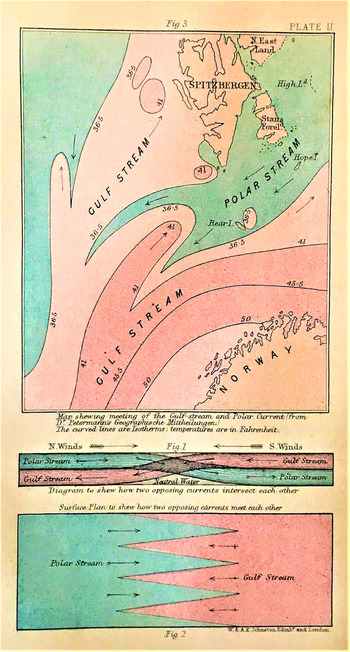
Interactions of Gulf Stream and Polar Currents as depicted by Croll in Climate and time (Reference Croll1875a; Chapter XIII). The Svalbard example shown here is analogous to the Davis Strait example cited in Croll's Chapter XIII.

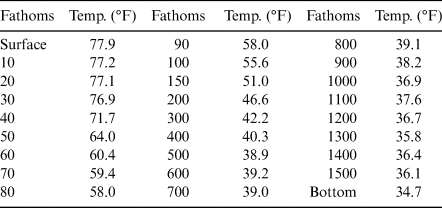
Croll wondered how it could be that the difference in salinity between equator and pole, instead of producing ocean currents, tends to prevent current flow by acting in opposition to the differences in ocean temperature between equator and pole? True to his scientific principles, he attempted to quantify the surface slope of the ocean from equator to pole that would arise from the differential thermal expansion of ocean water. His immediate port of call was Staff-Captain Evans, Hydrographer of the Admiralty, for a set of ocean temperature measurements made by Captain Nares from the Challenger expedition. He acquired data that had been sampled close to the equator between 14°49′ N and 32°16′W (Table 1).
HMS Challenger ocean temperature and depth data from the central Atlantic (14°49′N; 32°16′W) cited by Croll (Reference Croll1875a) in support of his ocean current theory.

Using the well-established table (Maury Reference Maury1855) showing how much seawater expands at different temperatures, it became clear that the surface of the ocean at the equator could stand no more than 4 feet 6 inches (1.37 m) higher than at the pole. Croll then calculated that the force acting on such a slope equates to a miniscule fraction of that of gravity and therefore was incapable of generating ocean currents.
Croll always maintained that the primary global ocean currents were principally driven by patterns of global atmospheric circulation and that this was incompatible with Carpenter's views that ocean current ought only to flow from low to high latitudes. He argued that the function of the Atlantic and Pacific Oceans is, by means of currents, to render both habitable by transferring the excess of equatorial heat to temperate and polar regions. This work they accomplish not directly, by radiation, but indirectly, by heating the aerial currents which blow as warm breezes over the land (Irons Reference Irons1896, p. 227). He cited the example of ocean currents in the Davis Strait west of Greenland where there is a strong undercurrent flowing northward beneath a surface current flowing southward. The lower current is sufficiently strong to transport large icebergs northwards counter to the surface current and the prevailing northerly winds. Croll pointed out that, according to Carpenter's theory, the surface current was flowing in the wrong direction (Croll Reference Croll1875a, p. 133) (Table 1).
The Davis Strait example highlighted several themes that extended well beyond the Croll–Carpenter debate. The first of these concerned the northern North Atlantic and Greenland Sea and what exactly the process was that triggered the descent of surface water to enable return flow at depth. Croll had gone part of the way in explaining this through his realisation that cold surface currents could flow on top of warmer, more saline, undercurrents. But he had not yet appreciated that the processes of sea ice formation across the Greenland Sea and Arctic Ocean led to the expulsion of brine and the descent of high salinity water, via shelf areas, into the interior of the ocean. The simple explanation for this is that, except for the pioneering research of John Murray, oceanographic research in the high latitudes at this time had not yet commenced. It was to be another 18 years before Fridtjof Nansen (1861–1930) set off on the first Fram expedition in which he was to measure the behaviour of surface currents across the Arctic. Further years were to pass before Otto Sverdrup's Fram expedition and it was not until the end of the century when a young Nansen met Walfrid Ekman (1874–1954) and learned of his theories of what was later to become known as the ‘Ekman Spiral’ (Ekman Reference Ekman1905).
Remarkably, although Croll had no reason to imagine that ocean currents experience differential lateral deflection with changing ocean depth (Ekman Spiral) he had started to describe parts of this process by 1875. Most notably in Climate and time (Reference Croll1875a, p. 136) he discussed the influence of wind on surface currents and the shearing of successive layers of ocean water over each other. Nansen was of a younger generation than Croll but very aware of his contribution to oceanography. Indeed, just over a year before his death and 14 years after the publication of Climate and time, Nansen, having returned to Norway following his first crossing of Greenland's interior, had received a copy of the book and had written to Croll thanking him for it (Irons Reference Irons1896, p. 476).
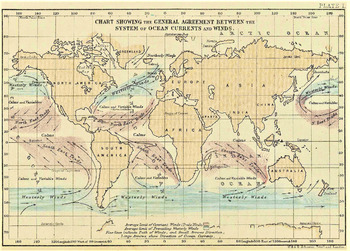
Within the pages of Climate and time Croll brings together much of his earlier writings on ocean circulation. After spending multiple pages dismantling Carpenter's theory of gravitation, he sets out in Chapter XIII to describe his own, ‘Wind Theory of Ocean Circulation’. His explanations are concise and elegant. He describes how the direction of the main surface ocean currents across the world's oceans correspond exactly with the direction of the prevailing winds, with one caused by the other (Fig. 2). Looking back almost 150 years later, his discourse could easily constitute a first-year university lecture on the relationships between global oceanic and atmospheric circulation. Yet what he was describing then was brand new and daring in the sense that he had very little oceanographic data to work with except the material that he had managed to obtain from the Admiralty following the return of HMS Challenger to its home port.
Distribution of global ocean currents as envisaged by Croll in Climate and time in support of his wind theory of ocean circulation (Croll Reference Croll1875a; Chapter XIII).

Many of the ideas of Croll we find repeated a century later in the writings of Wally Broecker (Reference Broecker1995), the latter emphasising the Atlantic Ocean conveyor as a means by which heat and salt are transferred to the high latitudes. We now know from Broecker and others that the Gulf Stream is a much larger feature than described by Croll, but the physical oceanography of this remarkable phenomenon remains the same. One of the main things that has changed since Croll's time is our understanding of how North Atlantic Deep Water is created in the Greenland Sea thus enabling the development of the southward-moving return limb of the oceanic thermohaline conveyor (Broecker Reference Broecker1995). Croll was not to know the mechanisms by which salt is expelled from freezing brine across the Arctic Ocean and Greenland Sea. After all, apart from John Murray, no oceanographic measurements had ever been made in the high latitudes, nor had a young Nansen ever dreamed that years later he would embark on the Fram expeditions and discover how surface ocean currents flow obliquely to the prevailing winds.
7. Concluding remarks
It is well known in science that important advances in knowledge often arise from interdisciplinary initiatives. When one reads the various works of James Croll one cannot help but be struck by the way that he moves effortlessly between one discipline and another. With hindsight one can see how his attempts to understand processes of global oceanic circulation were based both on his knowledge of global atmospheric circulation patterns and processes, and on his knowledge of physics and astronomy. We repeatedly witness in his writings on ocean circulation, detailed calculations of global heat and energy budgets as well as discussions on how heat and salt are transferred from low to high latitudes. But his discussions on ocean circulation do not end there. Following his concluding Chapter XIII on ocean circulation in Climate and time, he then proceeds in a remarkable manner to consider how patterns of ocean circulation may have changed during ice ages and how these changes may have been influenced by orbital changes, most notably by the eccentricity cycle.
As a student of past changes in sea level, this author was astonished to realise that during the 19th Century Croll had already calculated, from the HMS Challenger expedition data, regional variations in the thermal expansion of seawater as well as changes in water temperature with depth. Croll would not have known that, ca.150 years later, scientists would be discussing the effects of thermal ocean water expansion within the context of modern processes of sea level rise (Dawson Reference Dawson2019; IPCC 2019). To this author, it was also incredible that Croll had also discussed at a preliminary level the effect on regional sea level of the gravitational attraction of ocean water to ice sheets and how ocean levels might change if an ice sheet increased or reduced in size. These are ideas that are only now reaching the forefront of scientific knowledge and are beginning to be described in reports of the Intergovernmental Panel on Climate Change (IPCC 2019).
One cannot fail also to recognise Croll's meticulous attention to detail and his appreciation of the value of scientific measurement. This is vividly illustrated in the way he attempted to gather empirical data on ocean temperature from the HMS Challenger expedition. Rather than wait until after the expedition had returned in 1876, Croll had at an early stage approached the Chief Hydrographer of the Navy and requested the Atlantic data. This information proved to be paradigm changing. He presented it in several academic papers as well as in Climate and Time (Croll Reference Croll1875a, pp. 222–223). It proved to represent a defining moment that signalled the end of Carpenter's gravitational theory and the general acceptance of his wind theory of ocean circulation. For these and all his many other scientific discoveries, we owe James Croll, in hindsight, an immense debt.