

After Aristotle's death, and as a result of the various alternations of the logical corpus, many interpretations were written about it.Footnote 1 As for the Categories, it acquired a special focus since the first century,Footnote 2 but, unfortunately, most of the interpretations that were written about it did not survive,Footnote 3 and the lucky extant interpretations were those written by Porphyry (d. 309),Footnote 4 Dexippus (after 330),Footnote 5 Ammonius (around 440–520),Footnote 6 Simplicius (after 529),Footnote 7 Olympiodorus (around 495–570),Footnote 8 and Philoponus (around 490–570).Footnote 9
Many discussions were held among the ancient commentators about the subject matter of the Categories,Footnote 10 including the question of the book's authenticity and purpose. In general, the ancient commentators tended toward a logical interpretation, which became the dominant one in the late antiquity. This interpretation placed the Categories at the head of Aristotle's logical corpus and viewed it as a book that deals with utterances as indicators of concepts. This interpretation was established by Porphyry, who found it fitting to compose an introduction to logic (Isagoge) which was later read as an introduction to the Categories.Footnote 11 This approach became part of the Peripatetic tradition, and it continued to be dominant even after Simplicius' time. It is not my aim here to claim that this was the only available interpretation of the nature of the Categories at that time, but rather that it was the most dominant one.
In the Islamic world, the Categories was translated into Arabic first by the younger Ibn al-Muqaffaʿ (d. 815)Footnote 12 and then by Isḥāq ibn Ḥunayn (d. 910),Footnote 13 and during that time it received considerable attention from the Arabic philosophers and logicians, who commentated upon it extensively. In many cases the scholars did not deviate from the Aristotelian tradition, which understood the Categories as a book on logic and placed it within the Organon; however, there were also other approaches with regards to the work's subject matter and orientation.Footnote 14 The present article discusses al-Kindī's unique approach to the theory of the categories, focusing on two elements of his intellectual persona that are reflected in it: the logical element and the mathematical element. In what follows I outline al-Kindī's interpretation of the Categories, showing how these two elements are reflected in it.
AL-KINDĪ AS A LOGICIAN
Although al-Kindī's significant contribution to the editing and translating of several logical works from Greek and Syriac was recognized by the Arab biographers,Footnote 15 his abilities as a logician per se were granted a rather ambiguous reception. Ṣāʿid al-Andalusī, for instance, maintains al-Kindī's logical writings are of little scientific value (qallamā yuntafaʿu bihā fī al-ʿulūm).Footnote 16 He further maintains that al-Kindī's logical works have no reference to the “art of analytics” (ṣināʿat al-taḥlīl), whose function is to distinguish between truth and falsity.Footnote 17 Whether the reason for this is ignorance of this art's value or the need to hide it from the public, in both cases Ṣāʿid ascribes it to a deficiency in al-Kindī's learning.Footnote 18 Al-Qifṭī too is skeptical about al-Kindī's logical abilities, as he subscribes to Ṣāʿid's view.Footnote 19 (In addition to these two historians, it seems as if al-Fārābī had reservations towards al-Kindī's workings, since he completely ignores him in his survey of the scholars who took part in the transmission of Greek logic to the Arabic world.Footnote 20) Ibn Abī Uṣaybiʿa tries to rectify this unfortunate state of affairs and accuses Ṣāʿid of acting unjustly (taḥāmala) toward al-Kindī. He adds that Ṣāʿid's remarks will not undermine al-Kindī's proficiency in the sciences and will not discourage people from reading his works and benefit from them.Footnote 21
Notwithstanding Ṣāʿid and al-Qifṭī's hostility, an examination of al-Kindī's list of works reveals a profound interest in logic, manifested in the many works he had written on the various fields of logic – including the Analytics (al-Taḥlīlāt).Footnote 22 Unfortunately, none of al-Kindī's logical writings have come down to us,Footnote 23 so it is very difficult to establish a clear position about his contribution to the history of logic in general, and more specifically to the reception of the Categories. However, the Arab bibliographers mention several works on the Categories composed by al-Kindī. Ibn al-Nadīm mentions His Epistle on the Ten Categories (Kitāb Risālatihi fī al-Maqūlāt al-ʿashr).Footnote 24 Al-Qifṭī lists a certain Book of the Ten Categories (Kitāb al-Maqūlāt al-ʿashr).Footnote 25 Ibn Abī Uṣaybiʿa records a number of works on the subject: Book on Aristotle's Aim in the Categories (Kitāb fī Qaṣd Arisṭūṭālīs fī al-Maqūlāt),Footnote 26Epistle on the Ten Categories (Risāla fī al-Maqūlāt al-ʿashr), and other works that probably treated specific aspects of the theory of categories: Epistle on the Five Names that Accompany all of the Categories (Risāla fī al-Asmāʾ al-khamsa al-lāḥiqa li-kull al-Maqūlāt) and Epistle on the Relative Quantity (Risāla fī al-Kammiyya al-muḍāfa).Footnote 27
Luckily, we do possess al-Kindī's epistle On the Number of Aristotle's Books (Fī Kammiyyat Kutub Arisṭū; hereafter: Kammiyya),Footnote 28 which is quite indicative of his logical skills. In this epistle al-Kindī classifies Aristotle's works as he understood them:Footnote 29
Aristotle's ordered writings,Footnote 30 which the student needs to go through successively, in their order and composition, so that he can be a philosopher through them – after the science of mathematics – are four kinds of books: the first of the four is the logical [works] (al-manṭiqiyyāt); the second kind is the physical [works] (al-ṭabīʿiyyāt); the third kind [discusses] that which can do without physics and exists by itself, having no need for bodies (fīmā kāna mustaghniyān ʿan al-ṭabīʿa, qāʾimān bi-dhātihi ghayr muḥtāj ilā al-ajsām), [although] it exists with bodies, connected to them through a certain connection; the forth kind [discusses] that which has no need for bodies and is not connected to them at all (fīmā lā yaḥtāj ilā al-ajsām wa-lā yuwāṣiluhā al-batta).Footnote 31
According to al-Kindī, after the student of philosophy acquires the mathematical science he must study four kinds of Aristotelian writings: logical,Footnote 32 physical,Footnote 33 writings on things that do no need bodies for their existence (although they are able to exist attached to bodies),Footnote 34 and metaphysical writings.Footnote 35 Al-Kindī also mentions Aristotle's writings on ethicsFootnote 36 and other topics, but does not elaborate.Footnote 37 In the Aristotelian tradition, the four kinds of writings that al-Kindī enumerated belong to the theoretical sciences, while ethics is among the practical sciences.Footnote 38 Al-Kindī views his classification as pedagogical; its aim is to make it easier for the student of philosophy to acquire them. Although metaphysics is mentioned last, it is the most important science.Footnote 39
The first thing that stands out when examining the Kammiyya is that al-Kindī's position regarding logic seems unclear. It is unclear whether or not he accepted the traditional Peripatetic view of logic as a tool for truth and certainty.Footnote 40 The same occurs in al-Kindī's Epistle on the Definitions and Descriptions of the Things (Risālat al-Kindī fī Ḥudūd al-ashyāʾ wa-rusūmihā; hereafter: Ḥudūd);Footnote 41 although he refers to a few logical concepts,Footnote 42 al-Kindī does not define the term manṭiq (logic).
This ambiguity is also reflected when examining al-Kindī's position concerning mathematics: as we have seen, he places mathematics before the study of the Aristotelian corpus. If one wishes to be a philosopher, one must be taught in the four kinds of sciences found in Aristotle's books. But before that, one must know mathematics. Does al-Kindī substitute mathematics for logic as a preliminary science? The Arab biographers mention many mathematical works written by al-Kindī.Footnote 43 Among others, he composed an epistle entitled That Philosophy cannot be Attained without the Mathematical Science (Risāla fī annahu lā tunāl al-falsafa illā bi-ʿilm al-riyāḍiyyāt).Footnote 44 From this title it is clear that al-Kindī held mathematics to be the preliminary science one should learn. The position that al-Kindī adopts seems closer to the Platonic tradition.Footnote 45 After classifying the sciences, he writes:
These are the enumerations of his [i.e., Aristotle's] writings that we have mentioned earlier; the complete philosopher needs to acquire their knowledge after the science of mathematics. […] For if one lacks the knowledge of the mathematical sciences – which consists of arithmetic (ʿilm al-ʿadād), geometry (al-handasa), astronomy (al-tanjīm), and [musical] composition (al-taʾlīf) – and then studies (lit. uses) those [i.e., Aristotelian books] all his life, he shall not complete the knowledge of any of them, and his effort will earn him nothing but [the ability] to recite them verbally, [and that] if he is of good memory; but acquiring their profound knowledge is not at all possible (lit. does not exist) if one lacks the knowledge of mathematics.Footnote 46
Al-Kindī adopts the traditional Pythagorean fourfold classification of mathematics into arithmetic, geometry, astronomy, and musical composition.Footnote 47 His remarks on mathematics are similar to what the Peripatetics before and after him have to say about logic:Footnote 48 acquiring mathematics is a preliminary condition for understanding the rest of the sciences; the starting point for all of the sciences – including logic – must be mathematical, otherwise there is no guarantee that these sciences will be studied correctly.Footnote 49 Indeed, a quick survey of al-Kindī's writings exhibits his interest in mathematics.Footnote 50
II. SUBJECT AND PREDICATE: LOGIC OR ONTOLOGY?
Among the various books of Aristotle's Organon, al-Kindī took special interest in the Categories. In the Kammiyya a modest discussion is devoted to the eight books of Aristotle's Organon. It opens with the Categories:
The first among them [i.e., the logical works] is called Qāṭīghūriyās and it is about the categories, namely, the subject (al-ḥāmil) and the predicate (al-maḥmūl). The subject is what is called “substance” (jawhar), and the predicate is what is called “accident” (ʿaraḍ), which is predicated of the substance without giving it its name or its definition (ghayr muʿṭin lahu ismahu wa-lā ḥaddahu).Footnote 51
According to al-Kindī, there are eight books in Aristotle's logic. He does not mention Porphyry's Isagoge,Footnote 52 which traditionally opened the Organon, but rather approaches the Categories immediately. While the other books are surveyed briefly, the discussion of the Categories is broader, exhibiting al-Kindī's personal interest in it.Footnote 53 Near the end of the discussion he introduces the threefold division of the Categories in a manner indicative of his familiarity with the work.Footnote 54 The view that al-Kindī had a special interest in the Categories is reinforced by the fact that the translator Ibn Bihrīz (d. c. 860) wrote a summary of the book especially for him.Footnote 55
Al-Kindī treats the Categories as a logical book, and he views the ten categories as the basic elements from which propositions can be made, thus he connects between the Categories and On Interpretation (ʿAlā al-tafsīr) by saying that the former is entitled On Interpretation since it aims at “interpreting what is said in the Categories and connecting them [i.e., the categories] in order to make propositions [which consist of] subject and what can be said about it, namely from subject and predicate.”Footnote 56
Al-Kindī adopts the traditional Aristotelian division of substance and accident,Footnote 57 and clarifies the nature of their relationship: the accident is said of the substance “without giving it its name or its definition.”Footnote 58 He later explains himself:
The predicate “said-of” [is divided] to two species: one of them gives its subject its name and its definition, like the “living” that is said-of the man, for the man is called “living” and is [also] defined by the definition of the living, that is “a sensing substance that moves toward a different thing exterior to it” (jawhar ḥassās mutaḥarrik li-ghayr shayʾ khārij ʿanhu).
[…] [The second species of the predicate] is what is said of its subject as a similar name (ishtibāh al-ism)Footnote 59 and not as an agreed upon (tawāṭuʾ) [name],Footnote 60 without giving its definition and its name, like “the whiteness” that is predicated of “the white”, namely “the white body.”Footnote 61
Al-Kindī's distinction between two kinds of relations between the subject (al-ḥāmil) and the predicate (al-maḥmūl) is significant, and is subsequently developed in philosophers as al-Fārābī, Ibn Sīnā and Fakhr al-Dīn al-Rāzī. According to al-Kindī, the relation between the subject and the predicate is such that the predicate is said of the subject when the latter can be called by its predicate, and when both of them share a definition. He exemplifies this by the relation between “man” and “animal”: the species “man” is included in the genus “animal”, and hence “man” can be named “animal” as well as be defined it, for the definition of “animal” (“a substance with a sensory faculty that moves towards a different thing exterior to it”Footnote 62) also applies to “man”. In this sense, “animal” can function both as a name for “man” and as his definition. Al-Kindī calls this relation between subject and predicate a “synonym” (ʿalāqat tawāṭuʾ).
Another possible relation that can exist between the subject and the predicate is a homonym (ishtibāh). In this kind of relation, the predicate expresses neither the subject's name nor its definition. As an example, al-Kindī gives the whiteness that is predicated of the white [body]. Though the terms “white” and “whiteness” are similar, “whiteness” cannot function as a name or a definition for the “white” (or, to be precise, “the white body”) and the relation between them is of paronymity (ishtiqāq): the term “white” is derived from the term “whiteness”. The “white body” is not identical to the “whiteness”, and when one says “whiteness” one does not mean “white body”. Therefore, in this case the predicate does not function as a name for the subject. Accordingly, the definition of “whiteness”, namely “a color [that] obstructs the vision” (lawn yuʿīq al-baṣar),Footnote 63 is not said of the “white body”. Hence the relation between the “white” and the “whiteness” is neither of name nor of definition, but rather of a linguistic derivation: the term “white” is derived linguistically from the term “whiteness”.Footnote 64
Al-Kindī finds the second type of relation between subject and predicate to be the one that fits into the theory of categories. In the Kammiyya he enumerates the ten categories:
The categories [i.e.,] the accidental predicates (al-maḥmūlāt al-ʿaraḍiyya) of the “said-of” subject (al-maqūl al-ḥāmil), <which is>Footnote 65 the Substance (al-jawhar),Footnote 66 are nine: Quantity (kammiyya),Footnote 67 Quality (kayfiyya),Footnote 68 Relation (iḍāfa),Footnote 69 Where (ayn), When (matā), Acting (fāʿil), Being Acted Upon (munfaʿil), Having [=Property] (lahu), Position (waḍʿ).Footnote 70
The categories are said of the substance in the manner of linguistic derivation. For instance, “whiteness” is included in the category of Quality, but one does not say “the table is whiteness”, but rather “the table is white”. The term “white” is derived from the term “whiteness”, and the rest of the categories that are said of the substance undergo the same process of linguistic derivation.
Al-Kindī's distinction between two kinds of relation is important and has far reaching ontological implications. In the case of “man is an animal”, the relation between the subject and the predicate is that of identification, so far as that the subject can be defined by the predicate as well as be named by it. On the other hand, one says “the table is white” and not “the table is whiteness”. In this case, the relationship between the subject and the predicate is ontological, in the sense that the “white” is really present in the table. To sum up, in the first example the relation is logical, while in the second example the relation is ontological.
III. THE MATHEMATIZATION OF THE CATEGORIES
As we have seen, al-Kindī's surviving fragments on logic imply that he doesn't see logic in its traditional Aristotelian role as a tool for certainty. This role is taken by mathematics insofar as it provides the aspiring student of philosophy the necessary skill of correct thought. Logic is to be studied only afterwards. In this section I will try to explain how al-Kindī understands the transfer from mathematics to logic and the relation between the two.
Al-Kindī sees the “science of the substance (ʿilm al-jawhar) and its predicates (al-maḥmūlāt)” as the most important science.Footnote 71 He divides the predicates into simple (mufrad) and composite (murakkab), and the latter are divided on the basis of whether or not they have matter.Footnote 72 Accordingly, the categories are divided in the following manner:
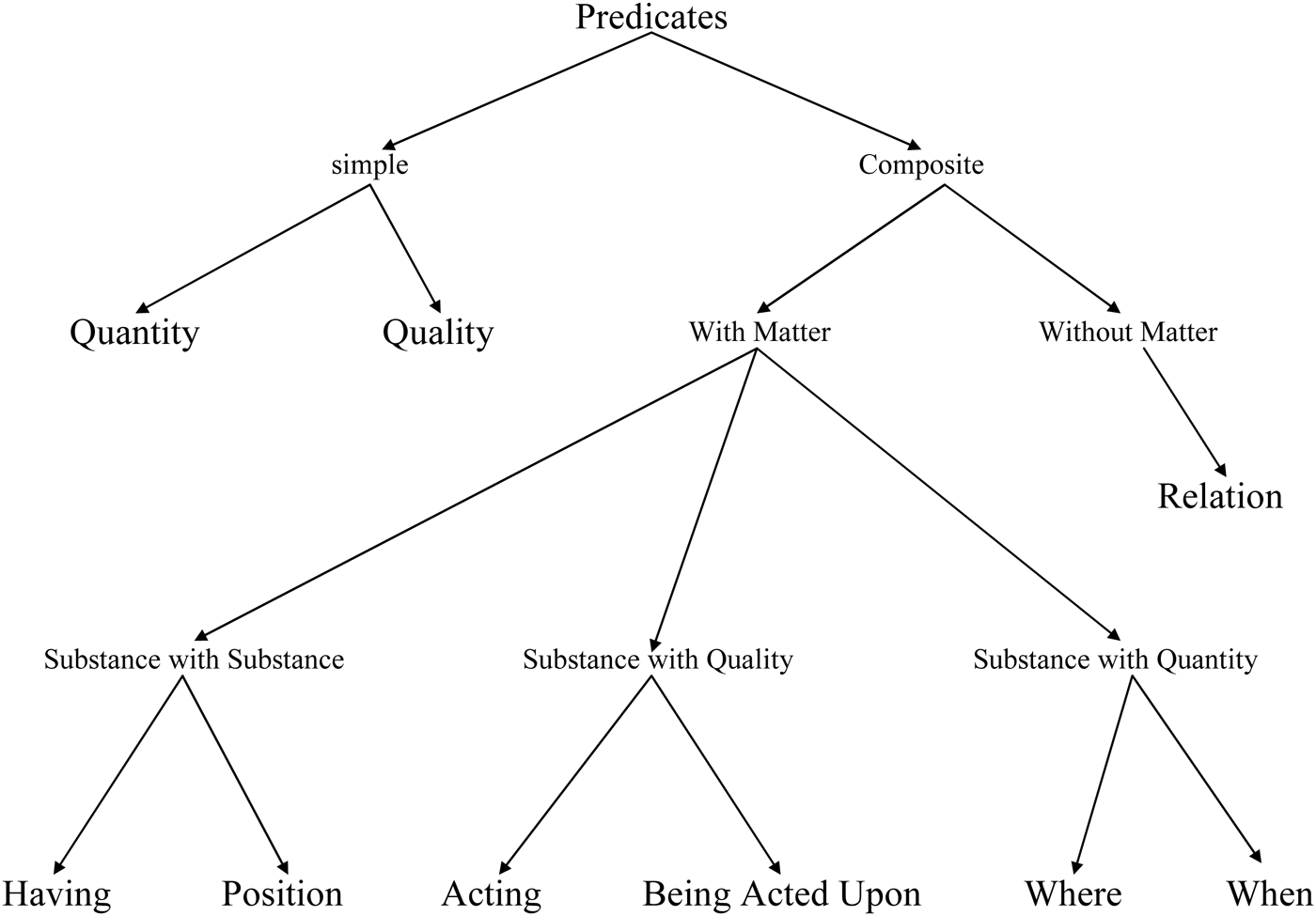
1. The categories Quantity and Quality differ from the rest as they are not composite. Each of the two is characterized by its special essential property: Quantity alone characterizes the substance as “equal” (mithl) or “non-equal” (lā mithl),Footnote 73 while Quality alone characterizes it as “similar” (shabīh) or “non-similar” (lā shabīh).Footnote 74
2. Composite categories are divided into two:
2.1 Composite without matter (ṭīna):Footnote 75 this is the category of Relation, for the relations between the father and the son, or the whole and the part – to take al-Kindī's examples – do not involve matter.
2.2 Categories which are composite with matter:
2.2.1 The composition of Quantity and Substance: if the substance exists (kāʾin) in a certain placeFootnote 76 – place is a quantity – this is the category of Where (ayn); if the substance exists in a certain time (zamān) – time is a quantity as well – this is the category of When (matā).
2.2.2 The composition of Quality and Substance: if the substance is in action – actionFootnote 77 being a quality – this is the category of Acting (fāʿil); if the substance is being acted upon – the latter being a quality too – this is the category of Being Acted Upon (munfaʿil).Footnote 78
2.2.3 The composition of Substance and Substance: if a certain substance is “with” (maʿa) another substance, this is the category of Having (mulk),Footnote 79 in which one of the substances has the other; if a certain substance is situated “on” another substance, this is the category of Position (waḍʿ).Footnote 80
It seems that al-Kindī ascribes a special place to the categories of Quantity and Quality, while the rest of the categories are the result of the different combinations between the two and the category of Substance.Footnote 81 He then adds another element to his understanding of the categories:
The primary knowledge that encompasses every philosophical science is [the knowledge of] the substance, and [then that of] the quantity and the quality. The primary substance, namely the sensible, is also included in the knowledge of its primary predicates (maḥmūlāt). For the sense does not approach [substance] directly, but approaches it through the mediation of the quantity and the quality, and he who lacks the science of quantity [and] quality lacks the science of the substance. Within the science of philosophy, the science of the substance is the most unchangeable, true, and perfect. The secondary substances are those whose knowledge does not perish, because it is stationary and they are far from change and flowing. One approaches them through the science of the primary substance.Footnote 82
Not only are Quantity, Quality, and Substance the basis of the rest of the categories,Footnote 83 the first two are epistemologically prior to Substance, the knowledge of which is dependent upon them.Footnote 84 On the other hand, the knowledge of the unchanging secondary substances (al-jawāhir al-thawānī) is dependent upon the knowledge of the changing primary substances (al-jawāhir al-awwalī).Footnote 85 In other words, although the knowledge of the secondary substance is superior given that it is the knowledge of the universal, it is dependent upon the knowledge of the primary substance, which, in turn, is dependent upon the knowledge of the categories of Quantity and Quality. Therefore, al-Kindī asserts: “if someone lacks […] the science of quantity and the science of quality, he lacks the science of the primary and secondary substances.”Footnote 86
Elsewhere in the Kammiyya al-Kindī enumerates the arts and sciences that belong to these two categories:
Two arts study the quantity:
The first is the art of number (ṣināʿat al-aʿdād), which studies the separate quantity, namely the counted quantity (kammiyyat al-ḥisāb). […]
The other art is the science of [musical] composition, which is finding the relation between a [certain] number and [another] number.
Two arts also study the quality:
The first is the science of the unmoving quality (ʿilm al-kayfiyya al-thābita), which is the science of the area called “geometry” (ʿilm al-misāḥa al-musammā handasa).
The other is the science of the moveable quality (ʿilm al-kayfiyya al-mutaḥārrika), and it is the science of the appearance of the all (ʿilm hayʾat al-kull) [i.e., the world and the heavens surrounding it], its shape, and its movements. […] This is called the science of “astronomy”.Footnote 87
Finally, al-Kindī connects mathematics with the rest of the sciences and stresses that mathematics must be philosophy's starting point, and a preliminary condition for studying it correctly:
He who lacks the four sciences that are called mathematics and taʿālīm Footnote 88 – which are the [sciences of] the number, the area, astronomy, and [musical] composition – lacks the science of the quantity and the quality, and lacks the science of the substance, that cannot persist without their mediation (lā yazūlu illā bi-tawassuṭihimā). He who lacks the science of quantity, quality, and substance lacks the science of philosophy.
Indeed, he who wants the science of philosophy should precede [it] with the use of the mathematical writings according to their order which we have defined; and the logical [writings] according to their order that we have already defined; then the writings about the natural things in the manner we have already defined; and then the metaphysical [books]; and then the books on ethics and the governance of the soul according to the virtues; and then what is left of the sciences, that we have not defined, [which is] composed of what we have defined.Footnote 89
Al-Kindī broadens the boundaries of the discussion and connects mathematics with all of the sciences that belong to philosophy. Through the mediation of the categories of Quantity and Quality, mathematics leads the student of philosophy to a proper instruction of the latter. In al-Kindī's thought, the passage from mathematics to logic is not a sudden one; he knows how to connect the two without alienating logic from mathematics, and the passage doesn't seem like a leap. The overlapping of these sciences occurs thanks to the categories of Quantity and Quality: on the one hand, they belong to logic, being part of the discussion of the Categories; on the other, they possess the mathematical aspect, for the four mathematical sciences (arithmetic, geometry, musical composition, and astronomy) fall under them. Quantity and Quality do not act merely as mediators, but rather penetrate the rest of the categories as I showed in the above scheme. Their importance in the sciences is such that al-Kindī states: “he who lacks the science of quantity, quality, and substance lacks the science of philosophy.”Footnote 90
Besides Substance, Quantity, and Quality – the latter two receiving special attention – the rest of the categories are scarcely mentioned.Footnote 91 Quantity and Quality have epistemological prevalence over Substance,Footnote 92 for according to al-Kindī the knowledge of the latter is dependent upon the other two, which also function as the epistemological gateway to the rest of the sciences.Footnote 93 In al-Kindī's model mathematics is not only the tool that opens the philosophical corpus and trains the student for the study of the rest of the sciences; it is actually present in all of them, through the categories of Quantity and Quality.
In a certain manner, one can say that al-Kindī communicates with the Pythagorean, Platonic, and Aristotelian traditions. His treatment of the categories of Quantity and Quality, which results in the presence of mathematics in all of the sciences, has affinity to the Pythagorean idea of a universe all of whose phenomena can be expressed as mathematical relations.Footnote 94 The Platonic influence is apparent in placing mathematics as a prior condition for studying the sciences and in maintaining that mathematics rather than logic is the tool for correct thought.Footnote 95 Finally, the Aristotelian influence is apparent from the adoption of the categories as the basis for the entire discussion.Footnote 96 What we arrive at is a systematic attempt for the mathematization of the categories.Footnote 97
IV. CONCLUSION
A study of al-Kindī's approach to the theory of categories reveals that it is closely connected to his pedagogical prioritization of mathematics over logic and serves as a bridge between the two disciplines. Mathematics and logic are connected through the mediation of the categories of Quantity and Quality, which belong to logic insofar as they are part of the Categories, but possess a mathematical aspect as well. Without further explanation, al-Kindī maintains that these two categories penetrate the rest of the categories and the sciences, as well. Furthermore, they have a key role in the theory of knowledge as they are an epistemological condition for the knowledge of the substance. Finally, all of the remaining categories are derived from different relations between Substance, Quantity, and Quality.
Belonging to the early ʿAbbāsid era, when the pursuit for knowledge focused more on the sciences that on philosophy, al-Kindī was more of a scientist than a philosopher. In this sense, it comes as no surprise that his understanding of the categories is directed towards a scientific use of them, though his model is still a theoretical one.Footnote *


