1. INTRODUCTION
Latin is one of the best documented and most extensively studied of any language: nearly every area has been subject to continued and intense scrutiny, with ideas from recent subfields of linguistics providing a fresh look at some old topics.Footnote 1 The Latin future (or –to) imperative, the form that conveys commands for non-immediate execution, constitutes precisely such a topic in Latin linguistics: from the Roman Imperial period on, students have demarcated the usages, syntax and context-specific features associated with this form; more recently, scholars have applied ideas from various linguistic subfields to achieve new insights.Footnote 2 Given that the –to imperative is so well understood, it might come as a surprise to find that some matters pertaining to it are still debated. This paper will address four such contested areas: first, its register (is it colloquial—that is, a feature of everyday speech—or elevated?); second, the form's politeness (is the –to imperative ‘softer’ than the present imperative?); third, the temporal scope of the –to imperative (can it ever really pertain to orders for immediate execution, and thus overlap with the present imperative?); and fourth, the sensitivity of the form to social factors, that is, to the identity of the speaker and the addressee. (Did slaves avoid using the form with superiors? Did women, held to be more polite than men, refrain from it? By contrast, was the speech of citizen males characterized by a high frequency of the –to imperative?)
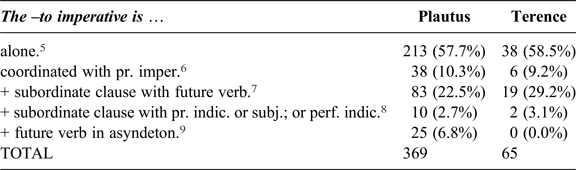
In what follows, I first survey the state of the question for each of these topics, then attempt to address each by applying ideas from linguistics and some simple statistical tests to the analysis of a relatively large corpus of linguistic data.Footnote 3 For us, this corpus consists of all tokens of the future (or –to) imperative.Footnote 4 Table 1 summarizes this data by categorizing all the tokens in Roman comedy, according to the constructions in which they appear.
Syntactical forms featuring –to imperative, distribution in Plautus and Terence.

With this complete data, and the application of simple statistical tests, to be explained when relevant, we will be in a position to address the problems posed above.
First, however, a brief review of some well-known features of the –to imperative will set the stage. According to the common view, this form originates from verb-stem plus archaic ablative of a demonstrative, *tod (hence *age tod, meaning ‘from that point on, drive’), and the –to imperative conveys commands intended for non-immediate realization. That is, such commands look to execution at some future time, or at any time appropriate for fulfilment.Footnote 10 The grammarian Diomedes (fourth century c.e.) defines the –to imperative as follows:
1. (Diom. 339.13 K)
futurum uero tempus [sc. imperatiui modi] differt a ceteris futuris, quia non ut confestim fiat imperamus, sed in futurum fieri, ut perpetuum fiat, quasi ‘facito’, ‘legito’, id est ‘semper fac’, ‘semper lege’. iure ergo diceretur quasi futuri.
The future time [of the imperative mood] differs from the other futures, because we are commanding not in order that it is done immediately, but command it to be done in the future, in order that it be done as an abiding command, for instance, facito, legito: that is, ‘always do’, ‘always read’. Rightly then would [the latter] be assigned to the future time.Footnote 11
But by the time Diomedes was writing, the –to imperative, used to convey commands for non-immediate realization, had fallen out of use in the spoken language.Footnote 12 This is why Diomedes focusses on the type he was no doubt frequently exposed to: the kind of –to imperative that conveys a command or a piece of advice to be followed whenever circumstances require. Such a form was still used in laws, technical treatises and manuals.Footnote 13 Indeed, as recent work has shown, for writers of manuals and technical treatises after Cato, the –to imperative became a ‘generic marker’ that situated the relevant work within the didactic tradition.Footnote 14
With this context, we may first note the average frequency of use in both Plautus and Terence. Table 2 shows the raw number of occurrences of the imperative in –to in Plautus and Terence, separately. Only second-person forms are considered.Footnote 15 The second row shows the average frequency: that is, the number of occurrences per 1,000 words.Footnote 16
Imperative in –to: frequency and average frequency in Plautus and Terence.

Plautus uses the imperative in –to at a rate of 2.3/1,000 words; in Terence, it appears with an average incidence of 1.3/1,000 words. It is interesting to compare the average frequencies in the two contemporaries, Plautus (all extant comedies) and Cato (Agr.). The –to imperative appears in the former at an average incidence of 2.3/1,000 words; in the latter, 78.4/1,000 words; thus, it appears an astounding 34 times more often in Cato's treatise.Footnote 17 Even allowing that the latter figure contains all –to imperatives, both second and third persons, the divergence is still striking. The genre in which Cato writes must be determining the higher frequency of the –to imperative in his De agricultura. To explain this difference, it may be noted that the –to imperative has a special affinity for instructions, when compared to the present imperative.Footnote 18 Since giving instruction is a treatise's defining function, the –to imperative, eminently suited to conveying instruction, appears most frequently in that genre.
To return to its use in Roman comedy, does the diminution in the average frequency of the –to imperative from Plautus' to Terence's plays indicate an actual diminution in the use of the form? Adams, in an important article on female speech in Roman comedy, introduced the idea that diminution in use of a form from Plautus to Terence could correspondingly imply a diminished frequency in the spoken language from the late third century b.c.e. down to the mid second century b.c.e.Footnote 19
In order to test the assumption, namely that Latin speakers were less and less inclined to use the –to imperative during the above-stated time frame, we may use the z-test. This test allows us to determine whether the difference between two proportions, collected from independent samples, is significant.Footnote 20 As it turns out, the z-test does so indicate, at a confidence interval greater than 99.99%. This result strongly suggests that there was a regression in the use of the –to imperative from the time of Plautus down to Terence's floruit. Thus, a form little-used in Cicero's time was probably already in decline during the early to mid second century b.c.e.Footnote 21
2. REGISTER
We turn now to the first of the four debated areas identified above, register. Some scholars argue that the form was stylistically elevated, while others maintain that the –to form is stylistically neutral. Thus, for instance, in a recent commentary on Terence's Hecyra, we read on dicito (ad Hec. 76), in the line senex si quaeret me, modo isse dicito: ‘The fut[ure] imp[erative], with its echo of legal texts and precepts … may be another mark of Parmeno's self importance.’Footnote 22 On the other hand, Gratwick, in a comment on the future imperative writes: ‘there was nothing fancy in the fut[ure] imperative as such’; and de Melo, in a review of a recent book on Terence's language, agrees: ‘I do not believe that the “future” imperative qua future imperative has an elevated tone that makes it well suited for official documents like laws. Rather, it seems to me that future imperatives are used in commands in legal language because they are not restricted to the near future like the ‘present’ imperative.’Footnote 23
It may be possible, if not to settle this debate, then at least to present a strong case for understanding the –to imperative, at least in the time in which Plautus was active, as not elevated. To show this, we need to consider a heuristic device first discovered by Haffter and then elaborated by Happ.Footnote 24 According to these scholars, in Plautus, the ratio of cantica (accompanied stichic or polymetric verses) to unaccompanied, or spoken, verses, deuerbia, is 3C:1D, that is, three accompanied verses (marked ‘C’, for canticum) for every single spoken verse (marked ‘D’, for deuerbium).Footnote 25 Stylistically marked elements are at home in the former, accompanied verses; low-register elements are attracted to the latter setting, unaccompanied, or spoken, verses. If, however, an item is stylistically unmarked, it should be distributed throughout Plautus' plays more or less according to the stated ratio.
Although Haffter applied the ratio to his analysis of padded expressions like uox mi ad aures aduolauit for uocem audiui, Happ used it to suggest that certain features of verb morphology, for instance, forms such as amasso and faxo, sigmatic-stem futures, belong to the colloquial register.Footnote 26 Recent work on Roman music suggests that grouping recitative and sung metre together as stylistically ‘higher’ than spoken verse (iambic senarii) is correct. In his monograph on the subject, Moore argues that we should not distinguish too nicely between cantica or polymetric song, on the one hand, and stichic accompanied, ‘recitative’ verse (in trochaic septenarii, iambic septenarii, trochaic octonarii and iambic octonarii), on the other: ‘polymetric passages often contain meters identical to those found in the stichic passages, and stichic and polymetric passages blend easily with each other’; he concludes the discussion by saying that ‘Roman comedy's deuerbia (all in iambic senarii) were spoken, its cantica, both stichic and polymetric, sung’.Footnote 27 If, as now seems likely, stichic verse (tr7 and ia7; tr8 and ia8) and polymetric verse were sung, both metrical settings would more likely attract higher-register items than spoken verse.
Yet, Moore provides us with a slightly different ratio than does Haffter. The former scholar has 37% of all metres in Plautus as iambic senarii, that is, unaccompanied verses, while the remaining—63%—are accompanied.Footnote 28 The resulting ratio we get from Moore's percentages is 2C:1D, that is, two accompanied for every one unaccompanied verse. But the percentages, while helpful, are based on the number of verses, and do not take into account that the lines of stichic accompanied verse are longer than those of iambic senarii. Thus, the Moore ratio of 2:1 should perhaps be revised upward. It seems better to keep the Haffter/Happ ratio of 3:1.
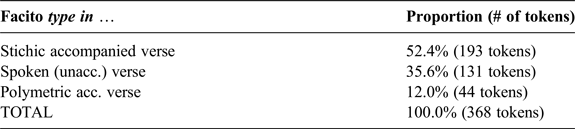
Let us turn now to the distribution of –to imperatives in Plautus (there are 368 countable tokens).Footnote 29
Distribution of –to imperatives in Plautus by verse-type.

The table distinguishes tokens appearing in stichic accompanied verse from those appearing in polymetric accompanied verse. Following Haffter, Happ and Moore, however, we shall treat both types together when computing the ratio: namely 237 tokens appear in both stichic and polymetric accompanied verse (C), while 131 occur in unaccompanied verse (D). Thus, the ratio 237C:131D reduces down to about 9C:5D. Spoken verse seems to contain more tokens than we were led to expect, considering that the expected ratio was 9C:3D. The chi-square calculation indicates that this difference is statistically significant.Footnote 30 Thus, we may tentatively conclude that the form belonged to a colloquial register in the time Plautus was alive. Yet, it must here be admitted that the metrical test is not on its own conclusive; in tandem with this test, inspection of the contexts themselves is necessary, as de Melo has convincingly shown.Footnote 31 When we inspect individual passages, we find we must modify the quantitative analysis. For the form is found in high-register and low-register contexts indifferently, a result suggesting that the –to imperative is stylistically neutral.Footnote 32 Although these findings are certainly not conclusive, the burden is now on those who would wish to argue that the –to imperative is elevated.
Unfortunately, the distribution of the –to imperative over cantica and deuerbia in Terence can tell us nothing about the register the form occupied in the mid second century b.c.e., for, as Bagordo has demonstrated, Terence does not distinguish cantica from deuerbia passages on the stylistic level like Plautus does.Footnote 33 However, as in Plautus, so too in Terence: the form appears in high-register and low-register contexts indifferently, suggesting that it was at home in both contexts, and was perhaps stylistically unmarked in the later author, too.Footnote 34
3. IS THE –TO IMPERATIVE THE SOFTER FORM COMPARED TO THE PRESENT IMPERATIVE?
It has long been remarked that the –to imperative, like the present imperative, can convey a wide variety of speech acts, from commands and requests, to permissions and advice.Footnote 35 Thus, it would appear that both forms are alike in being neutral forms of expression. Yet, scholars from the Roman Imperial period did not appear to think so. For instance, the Latin grammarian Consentius, citing Arruntius Celsus (third century b.c.e.), suggests that the –to imperative was considered the softer form:
2. In the passage, the need for the verb of the imperative to be non-past is discussed. (Keil 5.374.35–5.375.2)
nam qui dicit ‘fac’, ante imperat, quam id fiat; sed hic tamen qui dicit ‘fac’ properat, ut ait Celsus; ille etiam morari sinit, qui dicit ‘facito’.
For one who says ‘fac’ commands before the object of the command should be carried out; but he hurries [the addressee] on, as Celsus says; the one who says ‘facito’ permits there to be a delay.
‘He permits there to be a delay’ (ille etiam morari sinit) suggests that, with facito, the person presenting a task for completion to the addressee was being less peremptory about it. In fact, Diomedes reports the scholarly view that the label imperatiuus not be assigned to the –to imperative at all:
3. (339.13 K)
quem sermonem nonnulli censuerunt mandatiuum potius quam imperatiuum dici, quoniam praesenti tempore imperare solemus ut fiat, in futurum uero magis mandare.
And this expression some have seen fit that it be called mandatiuus—the mood of entrusting someone with something, rather than imperatiuus—the mood of command, since we are used to commanding something to be done in the present, but rather entrust things to be done for the future.
Although arguments had been made that the –to imperative was in fact the stronger form, these were refuted by Loch,Footnote 36 and, indeed, according to the present communis opinio, the –to imperative is, like the present imperative, neutral.Footnote 37
Now, while it is true that both the present imperative and the future imperative similarly convey a wide range of directive forces, from commands to advice, a closer comparison of the two forms reveals that the present imperative appears to have a greater affinity for commands, while the –to imperative has a greater affinity for permissions and instructions.
If we take into account a pool of 384 present imperatives, gathered from three Roman comedies, we find that 177 (or 46.1%) of these convey commands.Footnote 38 By contrast, 131 (or 30.3%) of –to imperatives convey commands. The z-test calculation indicates that the difference between these two proportions is significant.Footnote 39 While we cannot state on this basis that the present imperative is the more peremptory of the two forms, we could tentatively conclude that it has a greater affinity to commands than does its relative, the –to imperative.
To turn now to permissions, it has long been noted that the future imperative tends to convey such a speech act.Footnote 40 When issuing a permission, the speaker allows the addressee to do something the latter presumably already wants to do. For instance, the second turn in the following constructed example features a permission:
4.
A. I want an ice cream.
B. Have an ice cream, then.
An example of a ‘permission’ speech-act from Roman comedy is the following:
5. The young man Philocrates laments that his friend, a free man, was mistakenly sent to the quarry. The old man Hegio addresses Philocrates. (Plaut. Capt. 948–9)
Hegio, the old man, allows Philocrates to take the unfortunate young man with ducito. In this case, and in others, the –to imperative permits the hearer to do something whenever the latter desires.Footnote 41 We should distinguish from such permissions ‘conditioned’ permissions, such as the following:
6. A slave boldly promises that he will steal money from his old master. The old man's friend chimes in, expressing amazement at the slave's audacity. (Plaut. Pseud. 511–13)
In this case, whatever the type of speech act, the –to imperative is triggered here in the first place by a (temporal) condition, namely [si non apstulero,] uirgis caedito.Footnote 42 And we should also note the constructed example, 4 above. In that case, the position in the discourse of ‘have an ice cream, then’, as the second turn in a two-part sequence, similarly triggers the use of a permissive speech-act.
Of the 95 –to imperatives functioning as permissions, 49 are triggered either by the conditional clause or by the position in the discourse. This leaves us with 46 tokens to work with. When we similarly exclude from our 384 present imperatives all those permissions triggered by a conditional clause or the position in the discourse, we arrive at 21 tokens. That is, there are 21 present imperatives motivated not by the conditional clause, or the position in the discourse, but by the communicative intention (that is, to permit something to the addressee).
Once we exclude the tokens on the criteria described above, we find that 10.6% of the –to imperatives in Roman comedy convey permissions. This proportion differs significantly from the proportion of present imperatives, 5.5%, that communicate permissions. Thus, we can tentatively conclude that the –to imperative has a greater affinity to conveying permissions than does the present imperative.Footnote 43
As stated in the introduction to this paper, facito conveys instructions, and is frequently found in treatises, technical manuals and laws.Footnote 44 Instructions in these genres are timeless. That is, they are not necessarily meant for immediate realization. The reader may choose to heed the instruction whenever it is relevant for him or her to do so.Footnote 45 A couple of mock doctor's instructions can be found towards the beginning of Plautus' Mercator:
7. A master and a slave converse. (Plaut. Merc. 137–40)
There are a total 54 instructions in Roman comedy with the –to imperative. We can subtract from this figure 18 passages like the following, ubi hoc egeris | transito ad uxorem meam (Ter. Ph. 718–19), or where the context requires a future imperative, as we had done for permissions above. Thus, we are left with 36 instructions, representing a proportion of 8.3% of the total –to imperatives. By contrast, 1.8% of present imperatives surveyed convey instructions. The z-test shows that the difference between these proportions is significant. In other words, it is not due to chance that there is a higher proportion of instructions in the pool of –to imperatives. Rather, the semantic value of this form must be determining that higher figure. While it is probably not accurate to say that the –to imperative is specialized for instructions, we could say that the –to imperative has a greater affinity for that type of speech act, and that, if faced with the option, speakers would more likely choose the –to imperative to convey instructions.Footnote 46
In sum, we have found that, compared to the present imperative, facito has a greater affinity for permissions and instructions. The present imperative, however, has a greater affinity for commands than does the –to imperative. Given these facts, it makes sense that grammarians wanted to avoid giving the present imperative and the –to imperative the same label, imperatiuus. While it is true that both forms convey a similar range of directive forces, we may not from this overlap conclude that the forms are essentially the same in terms of speech-acts conveyed.
We may now be in a position to better understand a long-noted fact, which has, however, never been underpinned with statistics: the –to imperative does not attract mitigators as frequently as the present imperative.Footnote 47 3.8% of all –to imperatives in Plautus are softened. Of the present imperatives in the same author, 7.9% receive mitigators. This variation is probably not due to chance.Footnote 48 Rather, I suggest that the –to form at the time Plautus was writing did not prefer softeners, compared to the present imperative, because the former was felt to be a milder expression anyway.Footnote 49
4. IMPERATIVE IN –TO AS A PRESENT-IMPERATIVE SUBSTITUTE
4.1 Status quaestionis
Scholars have long discussed the use in EL of the –to imperative to express a command for immediate execution, but they have not agreed on how prevalent this use is. Christian Neue had listed passages in which the imperative in –to refers to the present. Charles Thurot later analysed these passages and concluded that, with the exception of a small minority, all of these may be taken as referring to the future time. As Thurot says, the imperative in –to ‘ne s'emploie d'un avenir immediat que dans un trop petit nombre de passages’.Footnote 50 Riemann, however, later disagreed:
[t]outefois on recontre chez Plaute un assez grand nombre de passages où l'impératif en –to désigne une action dont on demande l'accomplissement immédiat; mais chez Térence ces exceptions sont moins nombreuses [emphasis Riemann's].Footnote 51
The pendulum then swung the other way. Hofmann and Szantyr say that such instances of the –to imperative requesting that an action be carried out immediately are ‘spärlich und nicht eindeutig’, and Vairel-Carron agreed.Footnote 52
As the above overview of scholarly opinion suggests, researchers do not agree whether the –to imperative can convey an order intended for immediate execution. Nor is it always clear how to distinguish between immediate future (that is, directly after the command is conveyed) and non-immediate future. As Vairel-Carron suggests, there are no right answers to these questions.Footnote 53 A Latin speaker probably chose to use a –to imperative based on his or her own subjective view of what counted as ‘non-immediate future’. Similarly, scholars rely on their own subjective view of what counts as a non-immediate future to determine whether or not a –to imperative belongs to the category futurum pro praesente.
To take just one example, Riemann claims that the following –to imperative is intended for immediate execution:Footnote 54
8. A leno demands a letter from a slave. (Plaut. Persa 500)
When he tells the pimp at clare recitato, does the slave Toxilus intend that his command be executed immediately? In the event, the pimp does not begin reciting until after two more exchanges transpire. That is, the pimp does not immediately obey the command recitato, but he does immediately comply with recita.
The point of this discussion is to show that, when assessing the relevant temporal sphere of cases like these, interpretations will be subjective. Nevertheless, it must be stated that, unlike Plaut. Persa 500, passage 8 above, relatively few of the 434 –to imperatives in Roman comedy are difficult to interpret.
Let us take a closer look at these difficult passages. In Plautus, there are 341 relevant tokens for our consideration, after we subtract suppletive forms (esto, scito and memento), and two other tokens.Footnote 55 After subtracting such forms in Terence, we are left with 58 total tokens. Thus, the total number of relevant cases is 399. Of these, 69 are of doubtful interpretation, so, 17.3% of the countable total (399). This 17.3% falls into the following groups: the –to imperative relevant to ‘time now and in the future’, formulas like lege agito, and those instances that genuinely refer to the immediate present. Let us take each group in the order presented.
4.2 The –to imperative meaning ‘now and in the future’
Facito can mean ‘do this now and in the foreseeable future’.Footnote 56 A sub-genre of this type of command is the ‘timeless instruction’—one that is relevant for now and all time. This is the instruction of laws and pieces of wisdom conveyed as advice. For instance, the slave of Plautus' Curculio, assuming the role of magister amoris, says:
9. (Plaut. Curc. 28–30)
The adverb, semper ‘always’, indicates that Palinurus' instructions are relevant both now and in the future.Footnote 57
This time-scope of the –to imperative is often apparent even without the presence of the adverb, as in the following passage:
10. A young man to a woman unknown to him. (Plaut. Men. 725–8)
Obviously the command uiuito is relevant to the immediate future—Matrona can begin her solitary life right now as soon as she hears it—but it is also relevant to the more distant future as well: she may continue being spouseless ‘so long as Jupiter holds sway’.Footnote 58
The semantic property of certain verbs makes the –to imperative a suitable candidate to express that verb as a request or command. In particular, these verbs display atelic aspect, that is, these verbs do not imply a limit or end: thus, for instance, ‘be well’, or ‘consider, reflect’ against verbs with telic aspect, like ‘give’ and ‘recover’.Footnote 59 For example, the greeting salueto ‘be well’ is valid not just for the immediate present but also for the time following; the same goes for ualeto.Footnote 60 On the same grounds, curses with uiuere attract the –to form: Iuppiter te, miles, perdat; intestatus uiuito (Curc. 622), or passage 10 above. And again on the same grounds, the phrase gratiam habere, ‘feel grateful’, when conveyed as a command or request, selects exclusively the –to imperative:Footnote 61
11. A young man begs a senex to let a slave off punishment. (Plaut. Trin. 1180)
We find no such examples with the present imperative, but two with the –to imperative.Footnote 62 Since this is such a small number, however, the conclusion must remain tentative, that speakers cast gratitude expressed with gratiam habere only by way of the –to imperative.
A considerable number of –to imperatives frame what Risselada calls a ‘metadirective’.Footnote 63 Metadirectives make explicit the intended reaction to an utterance. Thus, the intended reaction to a question is an answer; a metadirective would be ‘answer me’ in the utterance ‘where are you going? Answer me’, quo te confers? dic mihi . The intended reaction to an assertion is belief or agreement. A metadirective would be ‘believe me’ in the assertion ‘I'm going to Rome, believe me’, Romam eo, crede mihi .
In Roman comedy, then, we find metadirectives cast in the –to imperative, such as the following:
12. A courtesan tries to convince a young man to continue visiting her. (Plaut. Truc. 867–9)
In the terminology of speech-act theory, the ‘illocutionary point’, or intent, of Phronesium's words is to assert something, simply that ‘the mouse does not stay long in one place’.Footnote 64 Her words' ‘perlocutionary effect’, that is, the intended reaction, is that the addressee consider them. Now, this consideration is to take place after the full story is recounted, and continue for some time after that. The metadirective cogitato, ‘consider’, ‘turn it over [in your mind]’, conveys precisely that sense here.Footnote 65
4.3 Formulas
Here I deal with two special utterances, lege agito and inquito. Lege agito is cast with a –to imperative because of the temporal situation, as arranging a session in court takes time and the lawsuit will always be held in the future. A suitable translation is ‘go ahead, then, bring a suit against me [whenever you like]’.Footnote 66
As for inque/inquito, Hofmann and Szantyr suggest that inquito, looking to immediate fulfilment may replace inque in certain passages owing to the latter's homonymy with inque = et in.Footnote 67 I suggest, rather, that there is a distinction in register.
Inque always means ‘[give an] answer [to a third person]’ in Roman comedy, for instance:
11. (Plaut. Pseud. 535–8)
12. Two senes, Chremes and Demipho, attempt to get the parasite Phormio to give up his (Phormio's) fiancée and return to a woman he had rejected for the fiancée. Phormio refuses. Chremes supplies a possible argument to Demipho. (Ter. Phorm. 917–19)
Twice inque appears within a stipulatio, a quite formal context, like passage 11 above.Footnote 68 But twice it appears in an unmarked context, where character A coaches character B on what to say to character C.Footnote 69
Inquito, by contrast, appears confined to formal contexts, when the speaker attempts to elicit from the addressee a context-appropriate formula.
13. The son-in-law attempts to secure a blessing on the marriage from his future father-in-law. (Plaut. Aul. 787–9)
14. A slave tries to bind a leno to an oath. (Plaut. Rud. 1338–43)
The third passage may be, like the first two, formal. In it, a slave assumes the role of accountant to review his master's recent business transactions.
15. (Plaut. Trin. 425–7)
ST. (in informal, business-like tone) Has the banker Olympicus been paid the one thousand drachmas that you owed him according to the account?
LE. Yes, the ones I promised as a pledge.
ST. No, say rather ‘the ones I was forced to pay’.Footnote 70
Three hapax legomena in Roman comedy appear in this passage, a fact that supports viewing its context as an elevated one: pronuper, the reduplicated perfect of spondeo, and the uncontracted form of debeo, dehibeo.
Thus, while inque can be used in formal contexts (stipulationes) and in informal ones, inquito appears to be confined to formal passages. But given the small numbers of the relevant tokens, the conclusion should be taken as tentative.
4.4 Futurum pro praesente: –to imperative for commands requiring immediate fulfilment
Once we exclude from our total the tokens falling into one of the two previous categories, we are left with only 16 of the total 399 instances of –to imperative that are genuinely problematic for us, that is, they convey a command to be satisfied immediately. All appear in Plautus; none in Terence, with perhaps one exception. Are there any characteristics common to these exceptional instances in which the –to imperative appears to overlap with the present imperative's function?
Riemann, surveying his tokens of futurum pro praesente, had supposed that ‘l'emploi de l'impératif en –to au lieu de l'impératif ordinaire était peu correct et appartenait plutôt au langage familier’.Footnote 71 If Riemann is correct that the futurum pro praesente was less correct and belonged to an informal idiom, we might expect it to appear in the language of slaves or low-status characters, whose language more closely approximates a colloquial idiom.Footnote 72 We know, moreover, from comments in Donatus, that Terence may have assigned incorrect expressions to his slave characters as a characterizing means.Footnote 73 For instance, in a comment on a passage from Phormio:
16.
ad Phorm. 249 HABENDAE COMPEDES uitiosam locutionem seruili personae dedit Terentius; nam integrum esset, si diceret ‘habendas compedes’.
on Phorm. 249 SHACKLES ARE TO BE HAD Terence assigned an incorrect manner of speaking to a slave character: for were he to say it in the accusative ‘habendas compedes’, it would be irreproachable.
If we keep in mind that the total share of speech in Roman comedy assigned to slaves is 35.5%, the proportion of –to-for-present imperative assigned to them appears very high indeed: 9/16 examples, or 56.3% of the relevant tokens. I offer an example.
17. A slave, assuming an air of superiority, to his friend. (Plaut. Persa 310–11)
There is perhaps a single example of futurum pro praesente in Terence, but even this should probably be excluded.
18. A slave to an adulescens. (Ter. Phorm. 229–30)
Although Geta at first glance appears to be telling the young man to ‘attack now (nunc)’, the following points should be considered. First, nunc here marks the next step in a progression (‘given the foregoing, then’).Footnote 74 Prior to these lines, the young man has agreed to carrying out one step of the plan; given his compliance, the slave can therefore ‘now (nunc) tell him to attack (adito, Phorm. 229). Second, the verb describing what Geta will do is future tense (ero), and parallel with his instruction to the young man (adito). Finally, Barsby, the most recent translator and himself an expert on the sermo Terentianus, interprets the whole passage along these lines, that is, ‘accordingly, you attack first [not necessarily now, but later], and I'll be in hiding as a substitute’.Footnote 75
Geta's utterance, therefore, does not constitute futurum pro praesente. Two results follow from this. First, with Geta's nunc prior adito tu (passage 18) excluded, there are no examples of the futurum pro praesente in Terence. That means all –to imperatives in the African poet are ‘properly’ future imperatives. This fact then constitutes yet another example of Terence as puri sermonis amator, according to the praise of C. Julius Caesar, himself an author recognized for clarity, simplicity and correctness.Footnote 76 Second, the chi-square calculation shows that there is a tendency for slaves to use the futurum pro praesente in Roman comedy, that is, the connection between slave speech and futurum pro praesente as a characterizing feature is somewhat strong.Footnote 77 Yet, given the small number of tokens (sixteen in total, of which slaves speak nine), we must treat this result cautiously. We may wonder whether in fact the –to imperative is constrained by any sociolinguistic factors. To this question we now turn.
5. THE SOCIO-PRAGMATICS OF THE –TO IMPERATIVE
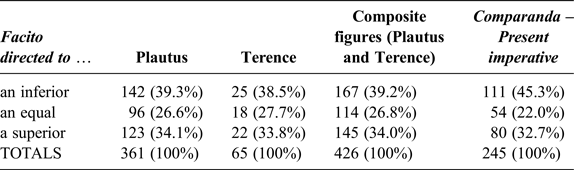
Do the characters of Roman comedy avoid using the –to imperative with their superiors? Is it, by contrast, more prevalent in the speech directed to subordinates? We can answer this question, again, by considering the distribution of the –to imperative over three different types of relationship.
–to imperative distributed across three speaker-addressee relationships in Roman comedy.Footnote 78

We can treat the figures for Plautus and Terence together as is done in the column marked ‘Composite figures’, because there is no difference between the two authors with respect to the distribution of the –to imperative over the three relationship-types.Footnote 79
In the right-most column, labelled ‘Comparanda – Present imperative’, we see that 245 present imperatives have been analysed according to the same relationship-types. These present imperatives have been selected at random from three plays, Bacchides, Rudens and Adelphoe. As the z-test indicates, when it comes to distribution over the dyad-types (address to an inferior, address to an equal, address to a superior), there is no distinction between present imperative and –to imperative.
This result should not come as a surprise given what we saw above, in section (3): both present imperative and future imperative convey a wide range of directives, some of which (permissions, advice and suggestions, addressee-beneficial requests like ‘have a piece of cake’) are not at all authoritative. Although women, as Adams has shown, are more polite than are men, the –to imperative, being a non-authoritative form in general, is randomly distributed over the speech of men and women.Footnote 80 That is, it is characteristic of neither gender.Footnote 81 But perhaps we can make some observations relevant to the characterization of role-types.
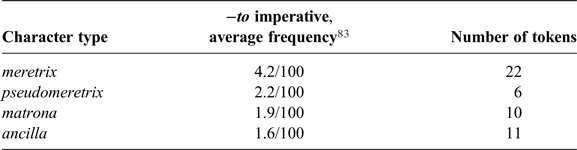
First, among female roles in Plautus, the –to imperative perhaps typifies most the meretrix and the lena.Footnote 82
Let it be said, first of all, that there are relatively few tokens to work with. And there are even fewer to work with when we come to analyse the speech of women in Terence. Only seven tokens total are assigned to women in the later author: three appear in maidservants' (ancillae) speech, resulting in an average frequency of 1.4 instances per 100 lines. Three occur in the speech of the courtesan (meretrix), resulting in an average frequency of 1.3 instances per 100 lines. A single instance is found in the speech of the matron (matrona), resulting in an average frequency of less than one (.5) instance per 100 lines.
These figures from Terence are useless, as they are based on such small numbers, but it is worth noting that they do corroborate three points represented in Table 5. First, maidservants are among the least frequent users of facito in both Plautus and Terence, especially when we keep in mind that, in Terence, two of the three instances assigned to a maidservant are actually put in the mouth of a male speaker, who is conveying a woman's words to his listener!Footnote 84 Keeping that in mind, then, we arrive at the second similarity between earlier and later comic poet: courtesans turn out to be the most frequent users of this imperative. Third, matrons appear to use the form in both authors the least frequently, and it should be noted that the ‘giftige Frau’ character type, best exemplified in the figure of Cleostrata from Casina, speaks the –to imperative as frequently as does the good matron, instanced in the figure of Alcumena from Amphitruo.Footnote 85 The latter two character types—the matron (in general) and the maidservant—are supposed to be exemplars of wifely and servile obedience respectively, and this must account for their overall avoidance of the –to imperative, compared to the courtesan, whose generic trait is procacitas ‘forwardness’.Footnote 86
The –to imperative in female character-types: Plautus.

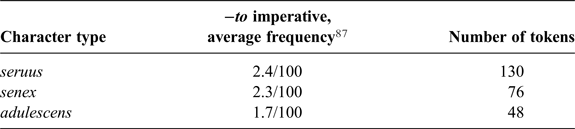
All the foregoing conclusions can only have value as suggestions. With the corresponding figures for male speakers, we are on safer ground, as the following table shows.
The –to imperative in male character-types: Plautus.

As Adams observed, the adulescentes in Roman comedy, ‘in their role as hopeful lovers … often seek to curry favour with masterful slaves and others. Old men and slaves are rarely coaxing or polite’.Footnote 88 This observation, made with reference to the distribution of the polite imperative softener obsecro, holds also for the distribution of the –to imperative over these character types—adulescentes, senes, serui. Young men, the most polite of the three, predictably employ the direct form of command, the –to imperative, least frequently, while ‘masterful slaves’ and old men, the most authoritative males in the world of the palliata, speak them at about equal incidence. Still, it is unlikely that the differences in the rate of use were so sharp as to make the slaves and the senes stand out compared to the adulescens.
The figures for Terence parallel those of Plautus. In the later playwright's work, young men speak eight instances, representing less than one (.75) instance per 100 lines. 25 tokens are to be found in the speech of old men, with a resulting frequency of 1.5 per 100 lines. Finally, slaves use the form 21 times, which results in an average frequency of 1.9 per 100 lines. The reason why slaves use the form most frequently is not far to seek: it is a feature of the genre that slaves give instructions, advise and command the young lover. Unsurprisingly, then, most of the forms of the –to imperative in Terence are given to the adviser and instructor par excellence, the slave as callidus or wise adviser.
Indeed, we find that both of the Roman comic poets prefer to have tricky slaves employ the –to imperative. In Plautus, tricky slaves speak most (81) of the total 131 tokens (62%) assigned to serui. Of the total speech assigned to male slaves in Plautus, tricky slaves utter 46.1%. The chi-square test shows us that Plautus deliberately assigns more tokens of the –to imperative to his callidus than to the other types of slave, because the callidus seruus assumes a special role of adviser and planner in Plautine comedy. We find the same result in Terence. In the latter author, callidi serui utter 15 of the 21 (71.0%) total –to forms assigned to slaves, and, of all the speech assigned to male slaves, tricky slaves in Terence claim a 48.1% share. The chi-square test indicates that Terence deliberately assigns more tokens of the –to imperative to his tricky slaves.
One final statistic merits attention: a politeness ‘index’; that is, the number of mitigators per 100 –to imperatives spoken by each character type surveyed above. For women, any statistics would be unreliable since they are based on very few tokens indeed. In Plautus, we find only one –to imperative softener in matrons' speech; courtesans employ mitigators only twice each and maidservants three times. Women never soften –to imperatives in Terence.
We have more data for the male speakers in Plautus. Among men, adulescentes soften these forms at a rate of 8.3 per 100 –to imperatives (4 instances); serui at a rate of 3.1 per 100 (4 instances). Senes soften –to imperatives least frequently, at a rate of 1.3 softeners per 100 such forms (1 instance).Footnote 89
Unfortunately, again, we do not have a lot of data to work with when considering the politeness index of male characters in Terence. Young men speak one mitigator, and it will be recalled that 8 forms of the –to imperative appear in the speech of adulescentes. Thus, the latter group modify about 12 times per 100 forms (12.5 times, to be precise). Old men soften the form 8 times per 100 forms (2 softeners over 25 –to imperatives), and slaves never soften the –to imperative. Although these findings are not reliable, it may be noted that the same general pattern obtains in both Plautus and Terence, with young men the most polite in both authors.
6. CONCLUSIONS
It is time to summarize the findings of this contribution. First, the use of the –to imperative was probably declining in usage from the late third century and down to the middle of the second century b.c.e. Second, the second-person form probably does not belong to an elevated register. Third, the –to imperative shows a greater affinity for instructions and permissions compared to the present imperative. Fac, however, shows a greater affinity for commands than does facito. Fourth, there are few instances of the –to imperative which look for immediate fulfilment of the request: 16 out of 399 total countable instances of the –to imperative in Roman comedy, or 4.0%. There is some evidence to suggest that futurum pro praesente, that is, facito referring to fulfilment in the immediate future, was characteristic of servile characters in Roman comedy. Such an ‘improper usage’, a uitiosa locutio, accorded with the prevailing notion which held that slaves were inferior to free men, and their speech, correspondingly, was less correct. Fourth, although the tokens were few in number, it was suggested that the courtesan employed the –to imperative most often of the female character-types in both Plautus and Terence. By contrast, in both authors, maidservants and young men employ the –to imperative least often, on average. But the differences in the average frequency with which male characters utter the form were probably not so great that the original audience members could distinguish slave, young man and old man in that way. Finally, the callidus seruus, typically the starring role and executor of the ruse, uses the –to imperative most often in Plautus and in Terence. In this regard, he is clearly distinguished from his peer, the ‘good slave’. The prevalence of the –to imperative, typical of instructions, is indeed well suited to the callidus, who often advises and instructs other, often more powerful, characters.