The cognitive deficit in the aging process has been well documented in the literature (Li et al., Reference Li, Zhu, Hou, Chen, Wang and Li2016). Some authors have reported that some cognitive skills as vocabulary, general knowledge or semantic memory are showing late life decline (Grady, Reference Grady2012), yet others like conceptual reasoning, ability to learn, episodic and working memory processing speed, as well as executive functions decline gradually over time (Fabricio & Yassuda, Reference Fabricio and Yassuda2011; Grady, Reference Grady2012; Harada, Love, & Triebel, Reference Harada, Love and Triebel2013). How the decline of these cognitive process interact to each other is still a matter of debate. Therefore, it is of interest to evaluate the potential relationships between these cognitive processes that are not directly addressed by majority of traditional models of cognition. One example could be the relationship between executive functions and memory. Memory strategies could require the reorganization of the material and even its transformation in a new concept, idea, or spatial shape. To do this it is clearly necessary to generate different options to solve the problem, to inhibit those that are expected to be unsuccessful, to execute an appropriate action and to control for the environmental feedback to regulate behavior in subsequent occasions. These strategies are a key factor for memory test performance (Yubero et al., Reference Yubero, Gil, Paul and Maestú2011) and could be even a more important aspect than memory function itself. Therefore, the execution of an appropriate cognitive strategy could radically modify performance on a memory test indicating that executive processes play a fundamental role. This relationship between these cognitive functions is directly evaluated by TMS as will be shown later.
Executive functions are control processes of general domains that oversee and regulate other cognitive processes to guide the achievement of future goals (Luszcz & Lane, Reference Luszcz, Lane, Hofer and Alwin2008, pp. 193–206). According to these authors, if we rely on the executive hypothesis, early age-related cognitive changes are associated with poor executive control processes. Harada et al., (Reference Harada, Love and Triebel2013) claim that mental flexibility and inhibition decreases with age especially after the age of 70. Furthermore, several studies proved that both the episodic memory and executive functions are particularly vulnerable to aging (Beaudoin & Desrichard, Reference Beaudoin and Desrichard2017; Fortin & Caza, Reference Fortin and Caza2014; Grady, Reference Grady2012). The question that seems to be unresolved yet, is whether, performance on episodic memory test is mainly influenced by a poor ability to mobilize cognitive strategies or to a primary memory deficit in the older population.
Lemaire and Reder (Reference Lemaire and Reder1999) defined strategy as “a procedure or a set of procedures for achieving a higher level goal or task”. Burger, Uittenhove, Lemaire, and Taconnat (Reference Burger, Uittenhove, Lemaire and Taconnat2017) argue that efficient execution of strategies is crucial to memory performance and to observing age-related differences. Some studies have stated that young people use more strategies, more spontaneously and more often than older people (Cheke, Reference Cheke2016; Fabricio & Yassuda, Reference Fabricio and Yassuda2011).
It has been discussed largely in the literature whether performance on memory test in the older age is due to the elaboration of memory strategies (cognitive dimension) or rely more on a progressive decline of the brain structural and functional networks (neurobiological dimension). Some authors have conducted studies comparing the cognitive strategies between young participants and older adults (Fabricio & Yassuda, Reference Fabricio and Yassuda2011; Fox, Baldock, Freeman, & Berry, Reference Fox, Baldock, Freeman and Berry2016). They have observed that even if both groups used similar strategies at encoding, the younger ones showed better performance at recall if the contextual information have changed (i.e. recombining pairs at test), concluding that the strategies used by older adults are relying more on contextual aspects than the items itself. They also claim that age differences in memory performance may be due more to neurobiological changes associated with age and not so much to the use of strategies. The problem-solving literature indicates that both episodic memory and executive control processes contribute to the production of solution options to open-ended problems (Kaiser et al., Reference Kaiser, Simon, Kalis, Schweizer, Tobler and Mojzisch2013). This may suggest that older adults will be impaired at accessing multiple specific solutions. However, there is also evidence that older adults utilize different strategies than younger adults when generating solutions to personal problems (Mata, Schooler, & Rieskamp, Reference Mata, Schooler and Rieskamp2007) These memory compensations refers to strategies or processes through which individuals may adapt to, or overcome, decrements or impairments in memory skills (de Frias, Dixon, & Bäckman, 2003). Other authors have indicated that age-related differences also depend on the type, number, frequency, and manner in which memory strategies are used, improving performance in the older age (Burger et al., Reference Burger, Uittenhove, Lemaire and Taconnat2017). Therefore, accurate strategies might compensate for age-related cognitive declines (Frankenmolen et al., Reference Frankenmolen, Overdorp, Fasotti, Claassen, Kessels and Oosterman2017; Gross & Rebok, Reference Gross and Rebok2011). In addition, it is also important to know that mood has a widespread effect on cognition (perception, attention, memory and executive functions), which can influence cognitive test performance in older adults (Chepenik, Cornew & Farah, Reference Chepenik, Cornew and Farah2007).
To evaluate the influence of memory strategies in memory test performance the Test of Memory Strategies (TMS) was developed (Fernandes et al., Reference Fernandes, Araújo, Vázquez-Justo, Pereira, Silva, Paul and Maestú2018; Yubero et al., Reference Yubero, Gil, Paul and Maestú2011). The TMS is formed by five word-list conditions in which a progressive reduction of memory strategies is implemented. In the first condition words do not have any semantic or phonological association between them and in the last condition words are organized in two semantic categories. Thus, it starts from a condition with a high need for memory strategies, to an external organization of the material where no high need of cognitive strategies is needed.
Previous studies using the TMS, showed that it is a useful tool to observe the differences that appear in the use of memory strategies comparing older participants with patients with different neurodegenerative disorders, as well as depression. This study, revealed a sensitivity and specificity of 90% to differentiate between groups in its five conditions (Yubero et al., Reference Yubero, Gil, Paul and Maestú2011). Fernandes et al., (2018) tested in a Portuguese version of the TMS, the differences between young and older participants (average age higher than 65 years old). However, the differences across life (young-middle age-older) with the TMS have not been investigated yet. The current work is trying to study the role of memory strategies, in three groups (young adults, middle-age and older adults) of participants without cognitive decline, on episodic memory test performance. Because the TMS is parametrically reducing the needs of memory strategies across conditions, we expect that adults and older participants will show a greater benefit of the external organization of the material improving performance across conditions. These effects would be noticed as well in young controls but in a slighter manner.
The aim of the present study was to study how executive functions influence on episodic memory test performance in three age groups (from young to old adults) without cognitive decline. Two additional factors were tested, how the contextual organization of the material affects the serial position effect as well as the influence of cognitive reserve on performance of the different condition of the TMS.
Based on the literature revised above and our current design we hypothesize that the more organization of the material would induce a better performance in all three groups, but with some differences between them. It is expected that the younger group will achieve better results in the first experimental conditions (without organization of the material) of TMS than the middle age and older adults groups. However, as the material is organized in the later conditions of the TMS those differences in performance would be diminished between groups. As for the effects of serial position, it is expected that this effect remains in the initial conditions of the TMS but would it be progressively diminished when the contextual organization would facilitate the recall. Finally, the TMS–3, 4, and 5 categories will be more related to episodic memory tests while TMS–1 and 2 categories will be more related to cognitive tasks involving executive functions.
Method
Sample and Participant Selection
The present study is of crossed type and is formed by a total sample of 180 participants of which 101 are women and 79 are men. Specifically, there were 26 young men, 27 adults men and 26 men were in the older group. As for women, the mentioned age groups presented the following sizes: 34, 33 and 34 women respectively. Each age group was formed by 60 members, and their average ages were 34.07; 55.60 and 72.32 respectively. Participants younger than 25 years of age were not included since, according to the literature, the cerebral maturity has its limit approximately at this age, after which begins a point of divergence for the cognitive performance (Tanner & Arnett, Reference Tanner, Arnett and Furlong2009). In the same way, ages exceeding 85 years of age were also not included because of the possibility of presenting cognitive or sensorial deficits that impede the optimal development of the tests. The Mini-Mental-State-Examination (MMSE; Lobo, Ezquerra, Burgada, Sala, & Seva, 1979) was applied to all participants as a screening method to exclude those not surpassing the cutting point (≥ 25). So, the sample was formed with people aged between 25 and 85 years, with a score in the MMSE of ≥ 25. Participants did not present history of dementia, psychiatric disorder, acquired brain damage, neurological disorders or other visual, auditive or psychomotor deficits. All participants signed an informed consent.
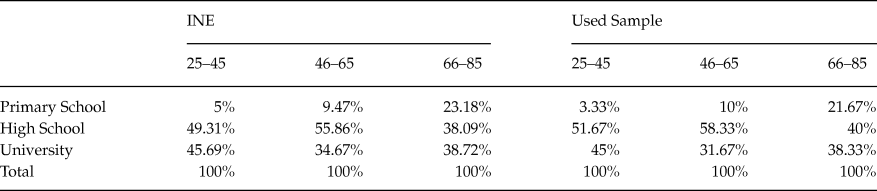
The proportion of participants with studies in each age segment bracket mirrors the corresponding real proportion in Spanish population according to the National Statistics Institute official data as is shown in Table 1 (Instituto Nacional de Estadística, INE; 2017).
Comparison between Data Obtained from INE and the Used Sample Adjusted to them

Note: Proportions (in %) corresponding with different age and education groups.
Materials and Procedure
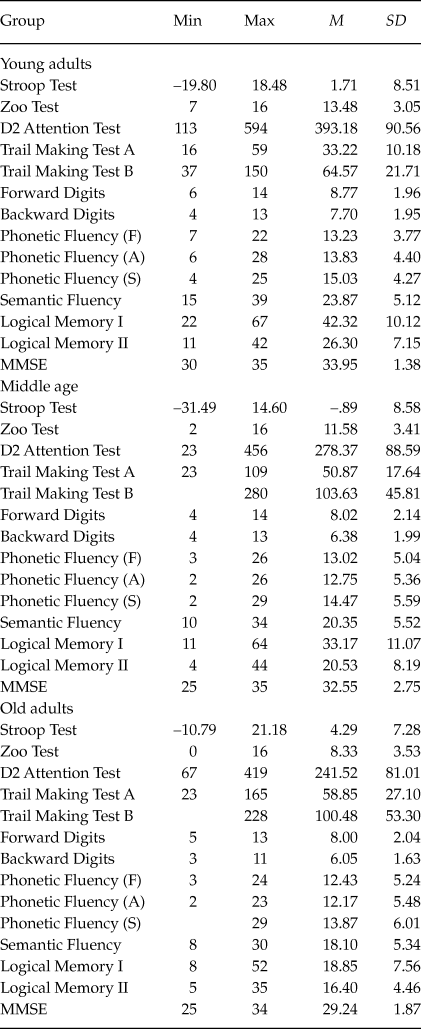
The experiment had an approximate length of 50 minutes and consisted in the application of a neuropsychological battery including memory tasks, executive functions, language and attention. MMSE (Lobo et al., Reference Lobo, Ezquerra, Burgada, Sala and Seva1979), Cognitive Reserve Questionnaire (Rami et al., Reference Rami, Valls-Pedret, Bartrés-Faz, Caprile, Solé-Padullés, Castellví and Molinuevo2011), Stroop Color and Word Test (Golden & Freshwater, Reference Golden and Freshwater2002), Logical Memory I y II of the IV edition of Weschler Memory Scale (Wechsler, Reference Wechsler2013), Trail Making Test A/B (Reitan, Reference Reitan1958), Zoo test of Behavioural Assessment of the Dysexecutive Syndrome (Wilson, Alderman, Burgess, Emslie, & Evans, Reference Wilson, Alderman, Burgess, Emslie and Evans1996), Digit Span of Edition IV of the Wechsler Adults Intelligence Scale (Wechsler, Reference Wechsler2012), FAS Word Fluency (Strauss, Sherman, & Spreen, Reference Strauss, Sherman and Spreen2006) and the D2 Test of Attention (Brickenkamp & Zillmer, Reference Brickenkamp and Zillmer1998) were applied to observe performance in memory and executive functions and to be able to correlate their results with the TMS, which was included to check the hypothesis that with age, the ability to generate memory strategies decreases. As explained at the beginning of the article, there is evidence showing this deterioration in old adults with pathology (Yubero et al., Reference Yubero, Gil, Paul and Maestú2011) but so far it had not been studied with a wide sample of young and old adults without health problems. Descriptive statistics of the neuropsychological battery can be seen in Table 2.
Descriptive Values for Group Comparison on Classical Neuropsychological Test

Note: Scores. Stroop = Interference; Zoo = Direct Score; D2 = Total Score; TMT = Time; Forward Digits = Total Score; Backward Digits = Total Score; Phonetic Fluency = Total Score; Semantic Fluency = Total Score; Logical Memory I = Total Score; Logical Memory II = Total Score; MMSE = Total Score.
The TMS is a test of memory strategies that begins with an incidental learning test and progressively offers an external organization of the material (word-list) so that the need of memory strategies decreases.
The TMS consists of five word lists:
(1) First list (TMS–1): Incidental learning is prevalent in this list. This is a list made up of 10 words without semantic or phonetic relationship between them. The participant begins without knowing that she/he is performing a memory test. The instruction we offer was the following: “I’ll read a list of words, you must listen carefully because then I’m going to ask you about some semantic characteristics of those words.” As in all conditions of TMS, right after reading the words the participant was asked to remember as many words as he/she could form the previous list.
(2) Second list (TMS–2): In this condition of the test the participant already knows she/he is performing a memory test. The 10 words that make up this list are also not semantically related. The instruction provided is the following: “Now I’m going to read a list of words, you must l carefully because when I’m done, you’ll have to remember them”.
(3) Third list (TMS–3): Formed by 10 words belonging to two disordered semantic categories. These categories are types of trees and furniture. Here we can see if the participant were able to develop memory strategies without using the potential semantic organization of words. The instruction provided were the same as in list two: “Now I’m going to read a list of words, listen carefully because when I’m done, you’ll have to remember them”.
(4) Fourth list (TMS–4): This list is made up of 10 words belonging to two sorted semantic categories: Means of transport and tools. As in list three, the investigator will not tell the participant the existence of these two categories, and nothing about their organization. Therefore, the instruction will be the same as in lists two and three.
(5) Fifth list (TMS–5): Here we find 10 words also ordered in two different semantic categories, in this case sports and vegetables. The difference with the two previous lists is that in this case the participant is informed of the existence of these two categories and their consecutive order, so the investigator will provide the following statement: “Now I’m going to read a list of words sorted into two different categories. You must listen carefully because when I’m done you will have to remember them”.
Data analysis
The data were analyzed with an analysis of variance for groups (three age groups) and related measures (5 TMS conditions). In each contrast of the analysis the size of the effect (η2) and the power (1 – β) are provided. The verification of the assumptions of multivariate normality was conducted with the contrasts of Mardia, Henze-Zirkler and Royston. Univariate normality was checked with visual inspection of qqplot graphics and the Shapiro-Wilk test. The homogeneity of variances was verified with the Levene test. In case of not compliance to the sphericity assumption, we opted for the Greenhouse Geisser correction, indicating the value of Epsilon as “GG-ε”. In those effects that were significant were carried out posthoc tests of Bonferroni. In order to analyze the influence of the cognitive reserve four levels were established (high, medium-high, medium-low, low) according to the normative data of the Cognitive Reserve Questionnaire, in which a score ≤ 6 corresponds to a cognitive reserve in the low level, a score between 7 and 9 points is considered medium-low range, a score between 10–14 would belong to the medium- high range and ≥ 15 points would correspond to a high level. Its effect on TMS was checked with an ANOVA analysis with repeated measures. As for the assumptions needed for this ANOVA to be reliable, we applied the same procedures and corrections as in the previous analysis. For the exploratory factor analysis, the method of ordinary least squares estimation (OLS) with oblique rotation (oblimin type) was used. Determination of the number of factors to retain was made through the parallel and MAP algorithms and the analysis of the theoretical coherence of rotated weights matrix. As goodness of fit the percentage of explained variance and Tucker-Lewis, RMSR and RMSEA indices are provided.
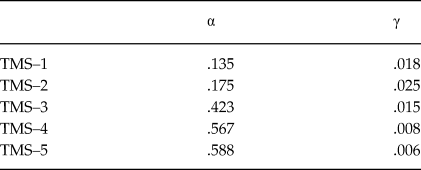
In order to describe the effects of primacy and recency in the 5 TMS scales, it has been decided to use the coefficients of the quadratic function α + βx + γx2. As the coefficient β is related to the displacement of the function, it has been fixed as a constant that coincides with the center of the series, estimating the other two coefficients by the least squares method. Simplifying the interpretation, the coefficient γ is related to the depth of the function and the parameter γ with its width, so that greater effects of primacy and recency would be transferred to lower values of α and greater values of γ (See Table 3).
Coefficients for the TMS Serial Position Curves

Note: Cronbach’s alpha (α) and γ coefficients of the quadratic function (α + βx + γx2)
Results
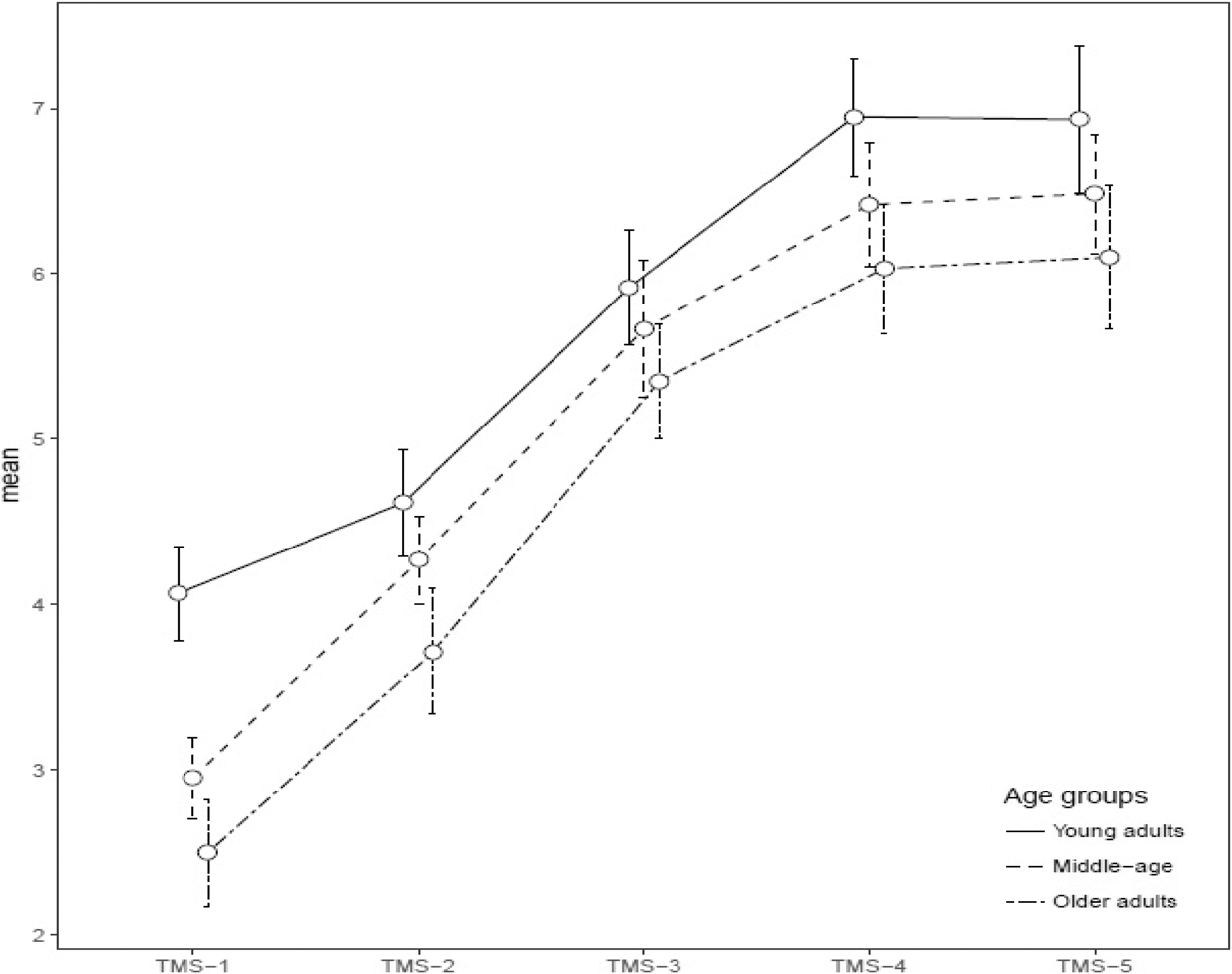
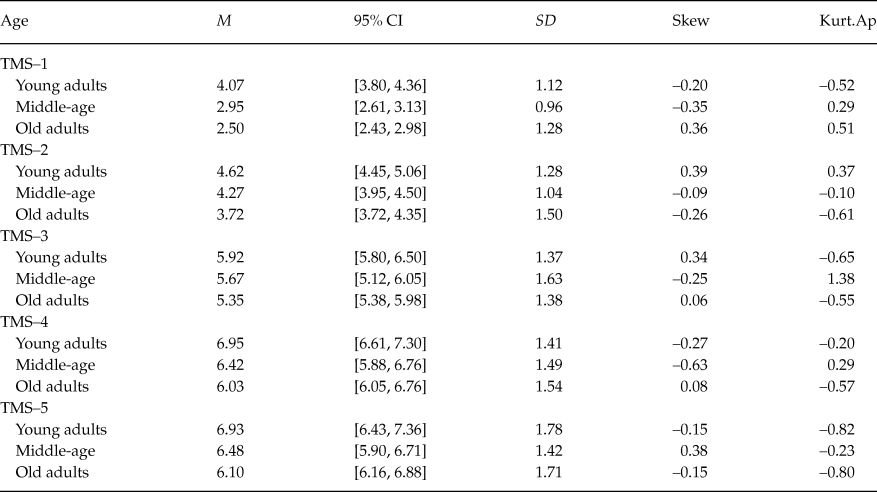
TMS showed similar behavior to that found in other studies: A significant improvement, proportional and linear, of the participants in each of the conditions that are part of it (see Figure 1), although showing differences in the ordinates of each age group. In Table 4 descriptive statistics (mean, confidence interval, standard deviation and skewness and kurtosis coefficients) can be seen for each group in each part of the test.
Means and their Confidence Intervals 95% for the TMS for Each Age Group Test

Descriptive Statistics in the TMS for the Age Variable

Note: 95% CI = confidence interval for the average to 95%; SD = Standard Deviation; ACE = Skewness and Kurtosis index.
The tests of multivariate normality of Mardia and Henze-Zirkler reflected that the data are normally distributed (p = .051 and p = .184 respectively) but the Royston test didn’t (p < .001). Shapiro-Wilk’s univariate normality tests had significant results (all of them with p < .01), although after visually revising the qqplot graphics and the asymmetry and kurtosis coefficients, and being this an ANOVA test, it was decided not to make any correction in the scores. Levene tests resulted all of them non-significant, with values higher than .05. The results of the ANOVA showed an effect of the group, F (2, 177) = 14.79, p < .001, η2 = .14, 1 – β = .999. Also effect of the TMS was found, GG-ε = .95, F (3.88, 674.04) = 292.48, p < .001, η2 = .62, 1 – β = .999 but not effect was found from the interaction between both: GG-ε = .95, F (7.61, 674.04) = 1.95, p = .053, η2 = .02, 1 – β = .798. Bonferroni tests showed significant effects for all comparisons of the TMS tasks (p < .001) except for the comparison between tasks 4 and 5 (p = 1). Bonferroni comparisons for age groups showed differences of the younger group with the other two groups, (in both cases p < .001) but not for the comparison between the adult and the older group (p = .058).
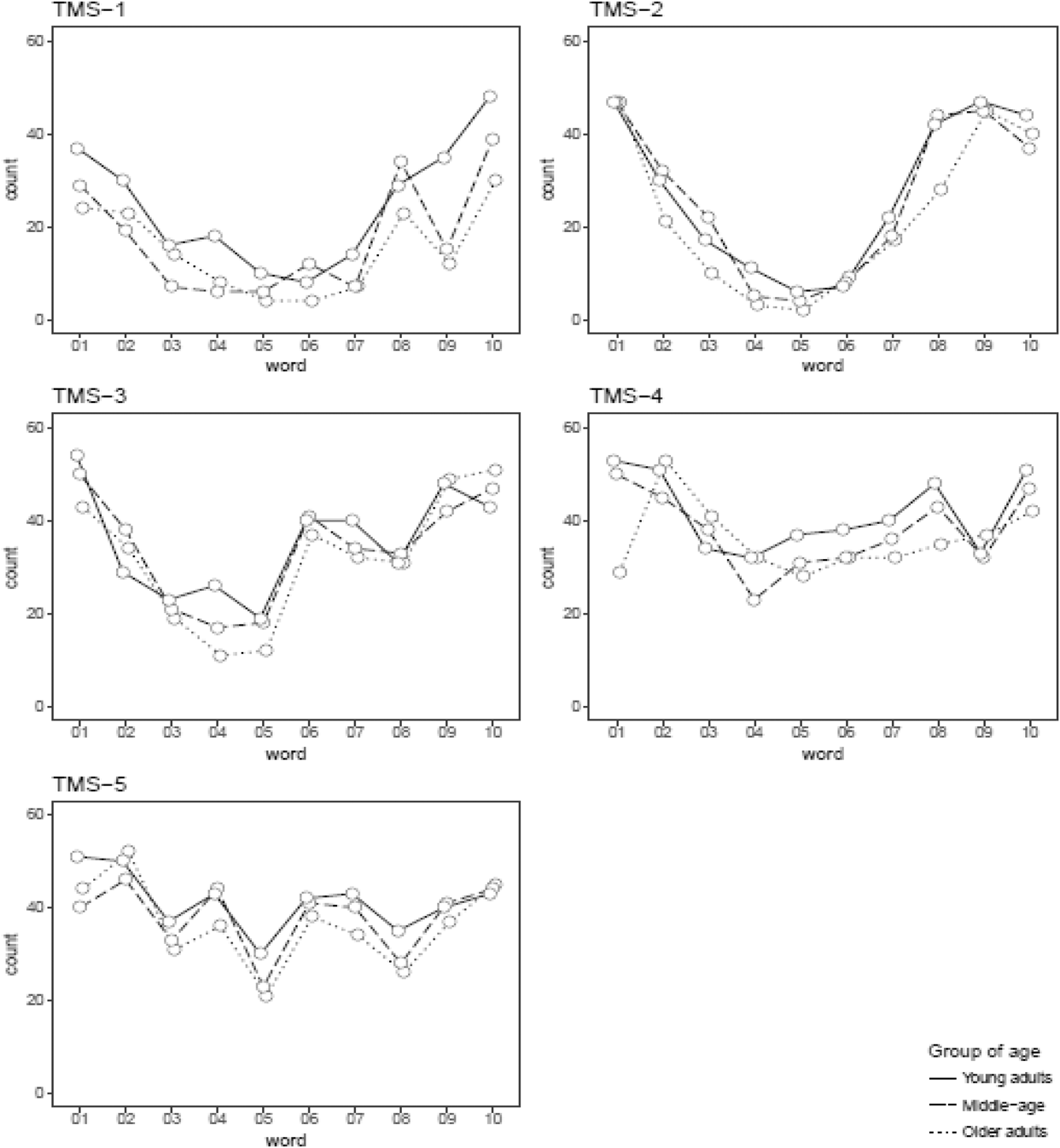
The process of change in the hit rate for each condition of the TMS depending on the external organization of the material can be seen in Figure 2: Bonferroni comparisons for age groups showed differences of the younger group, with the other two groups (in both cases p < .001) but not for the comparison between the adult and the older group (p = .058). This is represented by a loss of the serial position effect where the ability to recall words in the intermediate position of the list is progressively increased across conditions, leading to the breakdown of the primacy and recency effects.
Serial Position of Age Groups in the 5 categories of TMS Curves

The estimation of the α and γ parameters of a quadratic model for each TMS scale can be seen in Table 1. It shows a correct description of the effects of primacy and recency in the curves of position serial for the test. TMS–1 is the one with the lowest Cronbach’s alpha coefficient (0.135) and, together with TMS–2, a greatest γ (0.018), indicating that it is the one with the most pronounced curve. In the rest of the TMS tests there is a decrease in this serial effect, with greater α coefficients and lower γ.
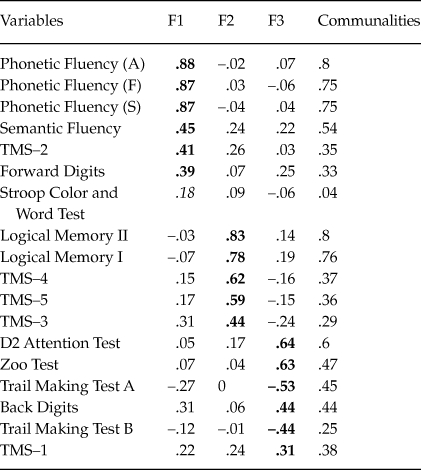
The exploratory factor analysis with the 5 elements of the test showed a clear structure of a single factor, which can explain the 38% of the variance with the following adjustment indices, RMSR: .04; RMSEA: .068 and Tucker-Lewis = .955. The total consistency of the scale, estimated through the alpha coefficient of Cronbach, gave a value of .75. A second exploratory factor analysis that included the five measurements of TMS along with the other neuropsychological measures showed a structure of three factors (see Table 5).
Table of Ordered Loadings of the Factor Analysis with the Neurological Measures and Communalities

Note: Bold = highest loading for each variable; Italics = if the value is not reasonably high in any factor.
A first factor that groups the FAS Word Fluency variables, the TMS–2 and the measurement of direct digits; a second factor related to encoding and retrieval (2 and 1) and TMS–3 to 5. Finally, a third factor composed by D2 Test of Attention, the Zoo Test, the Trail Making Test (A and B), Inverse Digits and the TMS–1. There is one measure, the Stroop Color and Word Test, which seems not to relate adequately with the rest of the factors, presenting communalities values of .043. This factorial structure explains 47% of the variance, with reasonable adjustment values: RMSR: .05, RMSEA: .082 and Tucker Lewis: 0.871. The correlation between the first and second factor was .46, between the first and the third of .47 and between the second and the third of .40. The interpretation of these three factors, which will be discussed in the next paragraph, could be summarized as Table 5.
The cognitive reserve results showed an effect of groups: F (1, 178) = 65.65, p < .001; and TMS: F (1, 178) = 19.55, p < .001; but not of the interaction between the reserve and the TMS: F (4, 712) = 0.67, p = .61.
Discussion
This study assessed the influence of the progressive reduction in the need for executive functions (external organization of the material) when performing memory tests in three stages of life; youth, adult life and ageing. To do this, the TMS was used (Yubero et al., Reference Yubero, Gil, Paul and Maestú2011). As expected, the young group showed better results in all conditions than the older groups, where executive functions needs are maximized as reported in prior studies (Bailey, Dunlosky, & Hertzog, Reference Bailey, Dunlosky and Hertzog2014) in TMS–2 and 3. However, in those conditions where executive functions are minimized TMS–4 and 5 no differences between groups were found. This may be because the external organization of the material benefits performance on memory test.
It is important to highlight that while there were differences in TMS–1 to 3 between the younger group and the two other groups, there were no differences between the middle-age and the older group in any of the TMS conditions. This could indicate that these two groups have more difficulties in establishing cognitive strategies than the younger one which can be reflecting the progressive decline of the executive functions in the aging process previously described in the literature (Bouazzaoui et al., Reference Bouazzaoui, Angel, Fay, Taconnat, Charlotte and Isingrini2014; Votruba, Persad, & Giordani, Reference Votruba, Persad and Giordani2016). The ANOVA shows that both the age group and the TMS category influence performance, however these influences seem to be independent, although were close to achieve an interaction. In the factorial analysis it was observed that TMS–3, TMS–4 and TMS–5 appear to be associated with episodic memory tests (Logical Memory I and II). However, TMS–1 and TMS 2 are more related to cognitive task that involves executive functioning such as selective attention, flexibility, working memory, inhibition as well as planification (D2 Test of Attention, Zoo Test, Trail Making Test A, Digit Span Backward, Trail Making Test B, FAS Word Fluency). This indicates that in the first conditions there is a high dependence on the executive functions (TMS–1 and TMS–2) and as a progressive organization of the material is being made, the process of episodic memory becomes more important. It is of interest to see how in the factorial analysis the conditions TMS–3 to 5 are associated with episodic memory test, even if they have an intrinsic semantic demand. Traditional neuropsychological test such as logical memory from the Wechsler memory scale have a huge semantic demand as the history need a deep semantic demand to understand the context and their potential consequences. Therefore, traditional episodic memory test is highly influenced by semantic demands as it happens as well in our TMS–3 to 5 conditions. Thus, it is not surprising that these three experimental conditions were associated with traditional episodic memory tests. In fact, this is an interesting finding as it is reflecting the principal memory compound of these three experimental conditions. Even if TMS–3 to 5 were grouped together in the factorial analysis and associated with traditional episodic memory tests, they showed differences in performance. This is highlighting the importance not just of the existence of semantic categories but most importantly of the serial presentation of the two categories. Thus, the most organized the material the better the performance on a memory test. Finally it is interesting to say that in the implicit memory condition the lack of the organization of the material seems to trigger internal implicit strategies, evidenced in the better performance of the younger participants. Therefore, the factorial analysis supports the assumption that the increased benefit in performance in the older population from TMS–3 to 5 is due to the reduction of the needs of executive functions.
All these leads to the idea that worse performance on memory tests in the older population could be mainly influenced by a decline of the executive functioning rather that to a pure memory deficit. An analysis was also carried out to observe the effects of primacy and recency. According to the literature (Griffin et al., Reference Griffin, John, Adams, Bussell, Saurman and Gavett2017) the serial position effect reveals that the memory of a word list follows a predictable pattern, according to which the first words in the list will be recovered more easily than the ones in the middle. This fact was confirmed in our study, especially in TMS–1 and TMS–2 where there is no semantic relationship between words or organization of the material. As the material is being organized (TMS–3, TMS–4 and TMS–5), the need to use memory strategies decreases and the effect of primacy and recency decreases as well. This can indicate the dependency of the executive function on these classic effects in memory tasks.
In this work we are not using clues to trigger recall in our participants. This is a completely free recall experiment. In previous experiments of word pairs olders tend to perform better when there is a semantic relationship between them, clues facilitating recall. However, there is an important difference between those previous studies and our work. We did not provide the semantic category nor give an example of the category. We just make the subject aware about the semantic organization of the material in condition 5. In fact, in the TMS–4 we do not even provide such an information, so no external semantic cues are provided at all. Therefore, our results cannot be justified under this framework of specific semantic clues.
This study may involve some limitations. Could be that the cognitive reserve is influencing performance on TMS. The average of the education in this sample mirrors the distribution of the general population of Spain in each segment of age included in the study. So it is unlikely that that this factor is having higher influence than age. However, if cognitive reserve should be affecting the TMS performance, this can be the case just in the TMS–1 to 3, where group differences were found. However, this effect disappears in TMS–4 and 5 where no group differences were found. Not finding an interaction between the cognitive reserve and the TMS results allows us to have some assurance that the results found with respect to age are not distorted by the cognitive reserve effect. In this work it was observed that the low performance in the episodic memory tests can be due to the progressive decline of the executive function and not actually to a primary deterioration of the episodic memory abilities.
This may help in determining who has primary memory or executive function deficit. Finally, it supports the idea of conducting cognitive training over the executive functions or to the skills of mobilizing memory strategies, rather than pure memory training as it is frequently established in the older population.