International election monitoring has existed in various forms for decades,1
The first instance was in 1857 when a European Commission established by the Treaty of Paris observed elections in Moldovia and Wallachia. United Nations (UN) supervision of elections in “Trust and Non-Self-Governing Territories” (UN 1991b) was an important precursor to modern election monitoring. The Organization of American States (OAS) also started observing elections on a small scale in sovereign states in 1962, and starting in 1964, the Commonwealth Secretariat (CS) undertook several missions in territories controlled by Britain. The United States has also long been highly active in Central America, the Caribbean, and Europe (Wright 1964) and—spearheaded by the Carter Center—myriad U.S.-funded NGOs began observing elections in the 1980s; see Garber 1984. For historical overviews, see Beigbeder 1994; Jason 1991–92; and Hyde 2006a, chap. 2; and Wright 1964.
Carothers 1997.
Some authors refer to observers as short-term missions and monitors as long-term missions. In practice, organizations have different definitions for these terms. I use the terms interchangeably.
Figure 1 shows the number and percentage of legislative or presidential elections monitored between 1975 and 2004 in nonestablished democracies. Monitoring increases from an average below 10 percent of elections from 1975 to 1987, to a high of 81.5 percent of elections in 2004. The most drastic increase occurs between 1988 and 1990.

Number and percentage of monitoring missions in nonestablished democracies
Note: Nonestablished democracies are defined as countries with a Polity II score equal to or less than seven in the year before the election.
Sources: Data taken from the following eighteen organizations: the Organization for Security and Cooperation in Europe, Council of Europe, European Union, the Carter Center, the Commonwealth Secretariat, the Organization of American States, National Democratic Institute, International Republican Institute, IFES (Formerly the International Foundation for Election System), the Norwegian Helsinki Center, the European Parliament, the International Human Rights Law Group, the Asian Network for Free Elections, the Elections Institute of South Africa, the South African Development Community, the Economic Community of West African States, the African Union, and the United Nations.
This rapid rise of election monitoring was unanticipated in the 1980s. Whereas Huntington foreshadowed it,4
Huntington 1991, 8.
Franck 1992, 85, 87.
Ibid., 87.
So why did international election monitoring spread so quickly? Why did the surge in election monitoring not accompany the wave of democratization in the mid-1970s? Why did states that traditionally viewed elections as falling purely within domestic jurisdiction allow international organizations and nongovernmental organizations (NGOs) to interfere? After all, elections are arguably the most sensitive domestic area of all. Furthermore, why did the United Nations (UN) and many regional organizations institutionalize election monitoring? Perhaps most puzzling, why do countries invite monitors but nevertheless cheat?
These questions go to the heart of efforts to explain the spread of norms and behaviors among governments.7
See Nadelmann 1990; Finnemore and Sikkink 1998; Checkel 2001; Cortell and Davis 1996; Johnston 2001; and Simmons and Elkins 2004.
Katzenstein 1996, 5.
March and Olsen 1998, 948.
There are several possible explanations for this phenomenon. Perhaps the rise of election monitoring was purely a mechanical function related to increasing democratic transitions. However, this does not explain why the current form of election monitoring should have been a response to democratization. Furthermore, the pace of democratic transitions between the mid-1970s and 1980s compares favorably with that of the 1990s.10
Huntington 1991.
Alternatively, a diffusion model may shed some light on the pattern of the spread of monitoring.11
Simmons and Elkins 2004.
Some scholars have focused on election monitoring in the Americas, suggesting that it emanated from there. Santa-Cruz argues that the constitutional structure of the Americas alone can account for the emergence of international monitoring.12
However, NGOs operated outside the Americas without major difficulty. Cases include the elections in Guyana in 1980,13Carter Center 1992, 16.
Santa-Cruz 2005a, 665.
Another possibility is that the rise of monitoring resulted purely from a change in the global normative environment about elections and human rights. However, the consolidation of these norms themselves cannot be properly understood without reference to how the Cold War changed the international system. Furthermore, norms alone cannot explain why governments invited monitors, because by the early 1990s electoral rights, although increasingly adopted into international law, were in practice still quite weak.16
Franck 1992, 81–82.
The end of the Cold War alone also cannot explain the attention to elections, the framing of election monitoring as a human rights issue, or the specific choice of election monitoring as a favored tool of democracy promoters. Furthermore, neither the end of the Cold War nor the instrumental calculations of some governments made the rapid spread of election monitoring inevitable. Why did election monitoring reach a threshold at which it became rational even for cheating governments to invite monitors? Instrumental logic itself does not explain the precipitating context that so rapidly increased the overall willingness of governments to invite monitors.
Argument
With the exception of Santa-Cruz's detailed study,17
the rise of election monitoring has received little systematic attention.18Bjornlund 2004 discusses factors such as opposition demands for monitoring and government desire for legitimacy; McCoy 1995 highlights changing concepts of security, the growth of global communication, technology, and international institutions; and Hyde 2006a and 2006b offers a rational model.
Finnemore and Sikkink 1998, 895.
As I show in the following sections, election monitoring initially emerged due to an evolving set of norms related to democracy, elections, and human rights. These norms interacted with post–Cold War changes in the international environment to create both a demand for and a supply of monitoring. This is why timing of the “tipping point” occurred around the end of the Cold War. As more and more transitioning countries sought legitimacy through monitoring, the cost of refusing monitors rose so that even many cheating governments found it rational to invite monitors. This led to the rapid spread, or cascade, of monitoring. Thus, although international election monitoring may not have become internalized, it has become the norm for nonestablished democracies and transition states.
The causal explanation is more complex, however. My aim is therefore to develop and present a rigorous method for investigating and demonstrating the causal mechanisms underlying the rise of election monitoring, and “norm cascades” more generally. The evolution and spread of norms, as with many other social processes, result from complex combinations of normative, instrumental, and other constraints and causes of action. As noted, the rise of election monitoring has been driven by an interaction of instrumentalism, emergent norms, and fundamental shifts in the international system. By dissecting this larger theoretical complexity into specific subclaims that can be empirically investigated, I examine the specific role of each of these causal factors, their mutual tensions, and their interactive contribution to the evolution of election monitoring. The following sections articulate the argument in greater detail.
Emergence
Scholars argue that new norms can enable actors and create interests or categories of actions that otherwise would be impossible.20
See ibid., 891; and Flynn and Farrell 1999.
Franck 1992.
Multiple actors, such as NGOs, courts, international and regional organizations, and state leaders and representatives heavily supplemented any domestic pressures for monitoring. International NGOs began to offer election monitoring and state leaders pressured incumbents to invite monitors. Along with institutional actors such as the UN Secretary General, state leaders also encouraged capacity building within the international and regional organizations. The high profile involvement of former U.S. president Jimmy Carter significantly increased attention to the issue. The normative enabling environment for election monitoring was thus laid by many different norm entrepreneurs.23
Proponents of election monitoring had a difficult fight, however. As Flynn and Farrell argue, new behaviors that violate existing collectively legitimated norms are likely to produce counteraction that will make the new behaviors costly or ineffective.24
Flynn and Farrell 1999, 511.
Franck 1992.
Powers and Goertz 2006.
Finnemore 1996, 160.
Timing
Figure 1 shows a notable change in the use of election monitoring between 1989 and 1992. Some might call this a tipping point. The original concept of a tipping point is a level of activity that triggers explosively convergent expectations and behaviors.28
In the evolution of norms, tipping is rarely so drastic. Nevertheless, there are noticeable behavioral threshold effects. Finnemore and Sikkink report that tipping points seem to occur when a third of the relevant actors have adopted the norms.29Finnemore and Sikkink 1998, 901.
If one looks at the trends for all countries, not just nonestablished democracies, there is a similar increase around the early 1990s with 34 percent of all countries holding elections inviting monitors by 1993.
There was also significant institutionalization around this time as international organizations created new capacity for monitoring election norms and embedded the concept in organizational agreements. In 1989, at the first meeting of the Conference on the Human Dimension of the Commission on Security and Cooperation in Europe (CSCE), member states began to discuss elections and monitors.31
CSCE 1989.
CS 1990.
OAS 1990.
CSCE 1990a.
OAS 1990.
CSCE 1990b.
Although the normative environment and the ensuing debate had spurred the emergence of election monitoring, the timing of the rise of election monitoring remains puzzling. Normative consolidation occurred only toward the end of the 1990s and remains incomplete. The tension between external democracy promotion and sovereignty concerns had also not been resolved by the time election monitoring reached this tipping point, so why did it occur then? Furthermore, the pace of democratic transitions had accelerated in the mid-1970s, so why was the tipping point not reached earlier?
Election monitoring reached a tipping point around 1989–91 because the normative environment interacted with important shifts in the international system of power. First, systemic changes accompanying the end of the Cold War bolstered the emerging norms. Just as ideas associated with the losing side of war or with economic failure often get discredited37
and just as winning coalitions get to construct a new order after political upheavals,38Barkin and Cronin 1994, 114.
Causality also ran in the other direction, however: the emerging norms may have expedited the end of the Cold War. Thomas argues that the human rights ideas disseminated by transnational activists and dissidents persuaded key actors to reject Soviet repression and that the international normative environment “had made it almost impossible for the Soviet Union to improve its relations with the West without first improving its human rights record.”40
Thomas 2001, 127.
The timing of the rise of monitoring was connected with the international power shift in another important way. Whereas the Cold War had forced Western countries to place a higher priority on their allies' stability than on their democratic credentials,41
Rich 2001, 22–23.
Finally, because norms are more likely to spread during periods of domestic turmoil and transition, “we should expect states to endorse international norms during periods of domestic turmoil in which the legitimacy of elites is threatened.”44
Finnemore and Sikkink 1998, 906.
Kingdon 1984.
However, although institutionalization of an emergent norm promotes its spread,46
it does not guarantee it. Nor can the fact that Western countries wanted to promote democracy explain why so many incumbents cooperated instead of simply refusing monitors who might criticize them.Cascade
A norms cascade is defined as the wider and faster spread of the norm after the tipping point.47
Finnemore and Sikkink 1998, 902.
Theory on norm cascades stresses that the search for legitimacy is a driving factor in the spread of norms.48
Ibid., 895.
Dahl and Lindblom 1992, 115.
Incumbents' motivations for inviting monitors were thus both normative and instrumental. Some incumbents may personally have adopted the new election norms and some politicians were truly eager to transform their countries into democracies. If so, then their search for legitimacy was in line with belief-based definitions such as that of Hurd who defines legitimacy as “the normative belief by an actor that a rule or institution ought to be obeyed.”50
Hurd 1999, 381.
Franck 1992, 46.
Herrmann and Shannon 2001, 264.
Finnemore and Sikkink 1998, 895.
This dual motivation for seeking legitimacy was important, however, because the actions of governments with different motivations influenced each other and contributed to the spread of monitoring. Because some governments were honestly seeking to transition to democracy, they willingly succumbed to international scrutiny. Indeed, because refusing monitors forfeited possible benefits of international endorsement including an increased domestic confidence in the democratic process, such honest governments always had an incentive to invite monitors. The international community could therefore infer that incumbents who refused monitors must have intended to cheat.
The wave of invitations extended by honest governments thus made monitoring sufficiently prevalent to impose reputational costs on governments that refused to invite monitors. That is, contrary to Franck's assertion that governments would not invite monitors because it was tantamount to an admission of lack of domestic credibility,55
Franck 1992, 87.
Kelley 2006.
For a cheating incumbent, the decision to invite monitors thus came to depend on whether the expected benefit of a possible endorsement by the monitors would warrant the risk of documented and overt criticism. As the expected benefit naturally varies with the possible rewards while the risk of criticism varies with the probability of detection, cheating governments therefore became quite willing to invite monitors in the early 1990s when there was a rise in democratic conditionality and when election monitors were few and inexperienced. If this is correct, then in the early 1990s one should thus expect to see a wave of invitations from honest governments, followed by more cheating and authoritarian governments inviting monitors. However, if the probability of detection increases as monitors improve with experience, there may again be some decrease in the willingness among cheating governments to invite monitors. Finally, strong pariah governments for whom condemnation is near certain have nothing to gain by inviting monitors. Similarly, governments whose geopolitical importance makes them immune to international criticism have nothing to lose by refusing monitors. These governments will therefore refuse monitors.
Internalization
Election monitoring has certainly become widespread. Only a few countries, such as Egypt, Jordan, Kuwait, Cuba, Syria, and Uzbekistan, still outright reject observers. As noted, the ideal is to make monitoring obsolete because properly conducted elections have become sufficiently institutionalized. Internalization of monitoring is, therefore, a suboptimal stage that, if present, may at best be defined as the commonly held belief that nonestablished democracies should invite monitors. Defined as such, it is possible, based on the prevalence of monitoring, to say that significant internalization has occurred. This is rather superficial, however, and it is questionable whether governmental elites have truly internalized the fundamental democratic norms that underlie the practice of election monitoring.
This deeper level of internationalization is difficult to assess, because the concept and mechanisms of internalization are unclear in the literature. For example, Finnemore and Sikkink argue that internalization may occur through “iterated behavior and habit” or legal institutionalization, yet these are also measures of internalization.58
Finnemore and Sikkink 1998.
Methods and Observable Implications
To systematically examine the many subparts of the extensive argument about the emergence, timing, cascade, and internalization of international election monitoring, in the remaining sections I carefully derive a set of observable implications for each of these stages and then examine empirically the presence of these observable implications. The observable implications are drawn directly from the main arguments. To pay careful attention to the rules of evidence and falsification, for each of the observable implications I assess their certainty and distinctiveness. The implications are not all certain, meaning that they are not bound to follow if the theory is correct. However, for those with a high degree of certainty, their absence would falsify at least some part of the argument.59
Van Evera 1997.
Observable Implications
Emergence
The first set of observable implications relate to the argument about the emergence of election monitoring and the notion of enabling norms, norm contestation, and the direct link between human rights, democracy, and election monitoring.
Observation E1 (Enabling norms): If the evolution of a prior set of norms enabled the development of election monitoring, then one should be able trace the historical evolution of these norms and identify their growing linkages to elections and sovereignty more broadly.
Because these norms could exist without really being related to monitoring, this implication is not very distinctive, but it is quite certain. Therefore, if one cannot identify links between prior norms and election monitoring this undermines the logic of enabling norms. The next two observable implications are more specific formulations of the first.
Observation E2 (Norm contestation): If extensive disagreement occurred between proponents of election monitoring and proponents of the traditional norms of sovereignty and noninterference, then such a debate should be evidenced in primary documents of organizations and states.
This implication is not very certain because debate may not have been recorded, but it is rather distinctive. Furthermore,
Observation E3 (Human rights and democracy): If electoral norms developed specifically out of the human rights and democratic entitlement norms, then proponents should reference these during the creation of new institutions for election monitoring.
This implication is only somewhat distinctive; such references could have other causes. However, the implication is quite certain. Therefore, if no such references exist, this undermines the argument that the election monitoring norms derived from the human rights norms.
Timing
The second set of observable implications relate to the timing of the rise of election monitoring and the extent to which this can be attributed to the end of the Cold War.
Observation T1 (Geopolitical references): If the end of the Cold War helped consolidate democratic norms, then proponents should relate the end of the Cold War to democracy norms and then to election monitoring.
This observable implication is not entirely certain, because this rhetoric may not be traceable. However, it is quite distinctive; there are not many other plausible reasons actors would explicitly link the end of the Cold War to elections and monitoring. Therefore such links would strongly support the importance of the structural role in the timing of the emergence of monitoring. Secondly,
Observation T2 (Western leadership): If it was important that the end of the Cold War altered the power balance and freed Western countries to push for democratic changes, then strong proponents of election monitoring—in terms of advocacy, practice, and funding—should be Western.
This observable implication is not highly distinctive. Western actors could end up promoting election monitoring for other reasons than a larger power-balance shift. However, the observable implication is quite certain. Because the new power balance favored Western actors, if the shift was important to the rise of election monitoring, Western actors should have taken the initiative. Thus, if Western actors play little role or non-Western actors lead, this considerably weakens the structural power-balance argument. Lastly,
Observation T3 (Domestic turmoil and pressures): If the timing of the rise of monitoring was partly enabled by the domestic turmoil created by the end of the Cold War in some countries, then one should observe an increase in domestic groups who seek to monitor elections and who call for international monitoring.
Although increased domestic pressure is neither certain nor something that follows distinctively from a structural or normative connection with the end of the Cold War, the timing of such demands would support the argument that these contributed to the rise of monitoring.
Cascade
The third set of observable implications relate to the cascade, or the rapid spread of election monitoring. The first observable implication concerns the change in the incentive structure facing governments.
Observation C1 (Increased conditionality and sanctions): If discontinued patronage funding patterns from the Cold War influenced monitoring, then international actors should increasingly make rewards conditional on elections and democracy.
If there is no shift toward democratic conditionality, then the argument for an instrumental motivation for legitimacy is considerably weakened. The next observable implication involves rhetoric:
Observation C2 (Legitimacy rhetoric): If the need for legitimacy drives invitations, then governments might state the need for legitimacy when inviting monitors.
This prediction is fairly weak, however. Lack of such rhetoric would not disprove that legitimacy was a driving factor, nor would its presence prove the importance of legitimacy. The next two observable implications pertain to the types of governments that should invite monitors, and when. First,
Observation C3 (Honest governments): If the practice of inviting monitors was initially boosted by a series of newly honest governments seeking legitimacy, then the countries that invited monitors in the early 1990s should have run fairly clean elections (otherwise they would not have been honest).
If they indeed ran clean elections as a break from the past, then these countries should demonstrate larger than average democratic gains. Over time, invitations from autocratic governments should increase while democratic gains decline. This prediction is not distinctive; the gains could be unrelated to election monitoring. However, it is fairly certain, so without a demonstration of gains, the logic of the argument fails. Furthermore, if the quest for legitimacy is instrumental and if the probability of detection grows as monitors gain experience, then some authoritarian governments should resume their rejection of monitors over time. That is
Observation C4 (Authoritarian governments): The rate at which undemocratic governments invite monitors should first rise as they come under pressure, then decrease as monitors gain competence and raise the likelihood of criticism.
This observable implication is neither certain or distinctive, however. There may be other factors that prevent or alter this pattern. The last observable implication related to the spread of monitoring concerns cheating.
Observation C5 (Continued cheating): If inviting monitors is instrumental for some governments, then some governments should still cheat while inviting monitors.
This is not certain, however. If there is no cheating, the instrumental logic could still hold (that is, governments might not cheat for instrumental reasons). However, this observable implication is highly distinctive: If governments are in control of the running of the election and if there nevertheless is cheating, this strongly bolsters the instrumental logic because governments that invite monitors due to their belief in election norms should, by definition, run clean elections.
Internalization
The final set of observable implications is a modest attempt to assess any deeper internalization of the norms underpinning international election monitoring. The first relates to the expectation about contestation.
Observation I1 (Decreased contestation): If election monitoring has become internalized, contestation should decrease and governments should rarely object to the presence of monitors.
If there is really internalization, one would expect decreased contestation to follow with certainty. However, this is not an entirely distinctive expectation. It is possible that the disagreement is expressed in other ways or simply repressed. Thus, decreased contestation would not prove internalization, but continued raucous debate would make internalization questionable. The other way to assess internalization is through behavior. It is essentially the inverse of the implication related to continued cheating as in observation (C5):
Observation I2 (Decreased cheating): If election monitoring has become widely internalized in the sense that most governments believe in the related norms of conduct of elections, then governments that invite monitors should not cheat.
This observable implication is not distinctive because governments may avoid cheating for strategic reasons. Thus, honest elections cannot prove internalization. The implication is quite certain, however; if governments are in control of the running of the election, then continued cheating can refute internalization of the underlying set of norms related to elections and democracy.
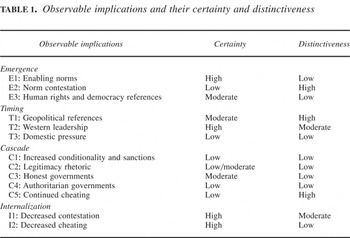
Table 1 lists the observable implications and the assessment of their certainty and distinctiveness.
Observable implications and their certainty and distinctiveness

Data and Sources
Examining the observable implications requires various methods such as content analysis of documents, historical analysis of legal standards, research on voting patterns, and longitudinal data. The analysis is also based on sequencing of events such as the emergence of norms and institutionalization predicted by the arguments. Lastly, the analysis examines public justifications of actions. Although actors may strategically use rhetoric, in an analysis of norms and concepts such as legitimacy, public justifications speak directly to the normative context.60
Finnemore 1996, 159.
Data collection and presentation is guided by the sets of observable implications. Historical analysis is based on a chronological examination of global developments, hundreds of primary documents from the UN and regional organizations, as well as numerous secondary accounts. The data include 177 countries since 1975 and all missions by the eighteen major agencies listed under Figure 1. Including only these organizations slightly underreports monitoring but has the advantage of being accurate within these agencies. The election monitoring data was gathered in cooperation with the election monitoring agencies and includes 514 reports spanning twenty years. Elections in the database have been checked against several official election archives online, in academic journals, and in encyclopedias. Both elections and the presence of monitors were checked against Lexis Nexis news accounts. Data on UN votes and statements were derived from primary documents.
The data presented are focused on nonestablished democracies, which are defined as countries with a score on the Polity II democracy scale of seven or below in the year before the election. Nonestablished democracies were chosen because organizations rarely consider monitoring well established democracies. The following section examines the evidence.
The Empirical Evidence
Emergence
The argument about the emergence of international election monitoring emphasizes that proponents of election monitoring were able to build on a set of prior entitlement norms and frame election monitoring in the context of human rights and democratic rights. Furthermore, because international election monitoring clearly violated existing collectively legitimated norms of sovereignty and noninterference in internal affairs, this led to strong debate, which in turn helped to foster the new election monitoring norms.
This section examines whether the observable implications support this argument. It first traces the historical evolution of these norms and identifies their growing linkages to elections and the sovereignty debate more broadly (E1: Enabling norms). It then takes a more in-depth look at a central debate occurring within the UN regime between sovereignty and elections norms (E2: Norm contestation), and finally analyzes whether proponents directly linked existing human rights and democracy norms to election monitoring (E3: Human rights and democracy references).
Historically, one of the core enabling norms for election monitoring was self-determination, which became associated with elections in the process of gaining independence.61
Franck 1992, 52.
Ebersole 1992–93, 94–95.
A second set of enabling norms were the principles of the freedom of expression and participatory rights that developed election-related standards to which governments could be held accountable. In 1948 the American Declaration of the Rights and Duties of Man referred to voting rights and periodic popular elections held in a free and fair manner, and the Universal Declaration of Human Rights recognized the universal right to freedom of opinion and expression and to peaceful assembly and association. In 1966 the Covenant on Civil and Political Rights specified the forms of expressions required to support freedom of expression (Article 19(2)) and provided that all citizens should have the right to participate in public affairs either directly or through freely chosen representatives, and to vote and be elected in genuine, periodic, and secret elections (Article 25). Regional developments such as the 1950 European Convention for the Protection of Human Rights and Fundamental Freedoms and the 1969 American Convention on Human Rights, as well as their respective courts, also bolstered the expectations of political rights and electoral competition. These were further supported in the Commonwealth Secretariat's 1971 Declaration of Commonwealth Principles63
Beigbeder 1994, 238.
These norms, however, did not present a fait accompli for the spread of election monitoring. External engagement in elections was still hampered by the long-standing norms of sovereignty and nonintervention.64
See Lyons and Mastanduno 1993; and Barkin and Cronin 1994. Even during the earliest UN monitoring in colonial territories, France, Britain, and Portugal had claimed that the activity constituted interference in their internal affairs; see Asante 1994, 273.
Asante 1994, 262–63.
Luard, 1988, 49.
Kegley, Gregory, and Herrman 1998, 89.
Finally, as more states signed international human rights treaties, the notions of domestic jurisdiction and nonintervention became subject to such commitments.68
In 1986, for example, the International Court of Justice also ruled that a state is “sovereign for the purpose of accepting a limitation of its sovereignty in this field [of elections].”69Military and Paramilitary Activities in and Against Nicaragua (Nicaragua v. U.S.) 1986 ICJ Rep. 14, 131 (judgment of 27 June).
Mexican Election Decisions, Cases 9768, 9780, 9828; Inter-Am. C.H.R. 98, OEA/ser.L/V/II.77, doc.7, rev. 1 (1989–90), 119–20, cited in Asante 1994, 278.
CSCE 1991, preamble.
It is thus possible to trace how the permissive norms of self-determination, freedom of expression, and participatory rights clearly evolved while the prohibitive norms of sovereignty and noninterference were restricted. This combination of changes created a normative enabling environment for the emergence of election monitoring (E1: Enabling norms).
There is also considerable evidence of the debate about election monitoring that arose within the UN regime (E2: Norm contestation). Although the entitlement norms and the increasing tolerance toward external actors discussed above had helped create an environment in which election monitoring might be permissible, the notion of “competitive” elections was still not part of international law and opposition to monitoring was still fierce. Because election monitoring threatened the legitimacy of entrenched regimes,72
Fox 1995.
McFaul 2004–2005, 153.
Several elections fueled the debate about election monitoring. Although the UN observation of Nicaragua's elections was embedded in a 1987 peace agreement,74
UN 1989.
UN 1991b, 14.
The debate manifested itself in various venues, but it became most visible in the series of twin resolutions in the UN General Assembly. These resolutions, which recurred almost annually for fifteen years, began with the 1988 resolution on “The Principle of Periodic and Genuine Elections” (henceforth the “elections resolution”) that was countered by a series of resolutions on “Sovereignty and Non-interference” (henceforth the “sovereignty resolution”). The UN Secretary General commented: “[T]his series of General Assembly resolutions, together with the respondent reports submitted by myself and other relevant UN entities, illustrates the ongoing process of dialogue, assessment, debate, and reform in the area of electoral assistance that has emerged in response to the rising tide of interest in democratization and requests for UN support.”76
Boutros-Ghali 1996, 15–16.
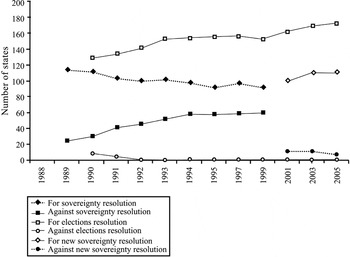
The votes on these resolutions indeed displayed the battle of ideas. The first and second elections resolutions in 1988 and 1989 were adopted without a vote. The first counter-resolution on sovereignty was adopted in 1989. Figure 2 shows the number and percentage voting for and against each of the resolutions over time. There is a steady gain for the elections resolution and a steady decline for the sovereignty resolution, until, as discussed below, the latter seriously softens its language. There was thus ample evidence of a real debate of core norms within the context of the emergence of new norms on election monitoring (E2: Norm contestation).

Absolute numbers voting for and against the twin resolutions
Note: The 1988 and 1989 resolutions for elections were adopted without a vote and are therfore not recorded. There was no sovereignty resolution in 1988.
Source: UNBISnet.
Proponents of election monitoring specifically used the language of human rights and democracy norms when creating new institutions for election monitoring (E3: Human rights and democracy references). The evolving language in the twin resolutions reveals these references and the gradual weakening of the sovereignty and noninterference position. Language in the elections resolutions strongly connected competitive elections to human rights norms. They typically mentioned human rights in the first paragraph and then noted the provisions on elections in the Universal Declaration for Human Rights and similar provisions in the International Covenant on Civil and Political Rights. Once again linking apartheid to human rights and then elections more broadly, the next paragraph condemned the system of apartheid and stated that “the right of everyone to take part in the government of his or her country is a crucial factor in the effective enjoyment by all of a wide range of other human rights and fundamental freedoms.”77
UN 1988, point 2.
The language in the sovereignty resolution was equally revealing. The early resolutions were entitled “Respect for the Principles of National Sovereignty and Non-Interference in the Internal Affairs of States in Their Electoral Processes” and stressed Article 2, paragraph 7 of the UN Charter,78
“Nothing contained in the Charter shall authorize the United Nations to intervene in matters which are essentially within the domestic jurisdiction of any State.”
UN 2001, point 2.
UN 2003.
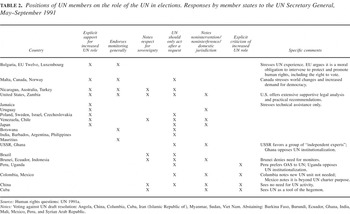
In February 1991, UN Secretary General Perez de Cuellar requested comments from all member states on the matters raised in the twin resolutions, specifically asking for comments on the apparent conflict of the principles. Table 2 shows a content analysis of the replies. As seen from the different concerns identified in the letters, many countries highlighted sovereignty, nonintervention, and noninterference. However, for many countries these were portrayed as compatible with external elections assistance. Thus, in his 1992 Agenda for Peace the new UN Secretary General Boutrus Boutrus Ghali declared: “The time of absolute and exclusive sovereignty … has passed.”81
Boutros-Ghali 1992.
Positions of UN members on the role of the UN in elections. Responses by member states to the UN Secretary General, May–September 1991

The emergence of election monitoring was thus enabled by a set of norms rooted in self-determination, and by the principles of freedom of expression and participatory rights. Moreover, election monitoring emerged out of an intensive debate that specifically pitted democracy and human norms against traditional sovereignty norms.
Timing
As the above account shows, consolidation of the enabling normative environment was ongoing throughout the 1990s. Indeed, in 1993 the World Conference on Human Rights called on external actors to promote democracy and the 1994 Second International Conference of New or Restored Democracies called on the UN Secretary General to study how the UN could support new or restored democracies. Following these leads, new series of General Assembly resolutions began calling on the UN to strengthen its role in enhancing elections and the promotion of democratization. This strengthening of norms on elections likely continued to exert pressure on incumbents to invite monitors.
However, the fact that the enabling normative environment and the debate between opponents of external intervention and proponents of democracy promotion had not been resolved by the time election monitoring reached a tipping point raises the question of why it occurred when it did. This section examines the evidence for the argument that election monitoring reached a tipping point at the end of the Cold War because the Cold War helped consolidate the normative debate, freed the victors of the war to set a new agenda and push for democratic transitions, and increased domestic pressures on incumbents to hold democratic elections.
That the Cold War contributed to a consolidation of democratic norms is supported by the fact that proponents of election monitoring did relate changes in the political environment to democracy norms and then to advocacy of election monitoring (T1: Geopolitical references). Indeed, U.S. leaders especially linked world events to their interest in election monitoring. At the 1990 CSCE conference, U.S. Secretary of State James Baker noted that, “We are present at the creation of a new age of Europe” and that “the free-elections proposal … has gathered strength from the dramatic events of last fall and the new elections of this spring.”82
Baker 1990.
Bush 1990.
There is also extensive evidence that Western actors led the advocacy, practice, and funding of election monitoring (T2: Western leadership). The historical record shows that the main actors were the political leaders of the West and mostly U.S. NGOs. First of all, the countries voting against the aforementioned “sovereignty resolution” were various European countries, the United States, Canada, New Zealand, Australia, and Israel. Western countries clearly spearheaded the movement to engage the UN in election monitoring and other election-related activities, to press for a set of international obligations establishing norms about elections and citizens' rights, and to normalize external engagement in elections more generally.
Furthermore, at the CSCE conference in 1989, it was the United Kingdom and the United States that called for free elections in all CSCE member states and for observation by outside governments, institutions, or organizations.85
“U.S. Proposes Free Elections Throughout Europe,” Associated Press newswire, 19 June 1989.
Bush 1990.
Halperin 1993, 105.
Other Western states also joined the efforts. For example, during the March 1991 legislative elections in Albania, at least eleven North American and European countries sent legislative delegations in addition to the ones sent by European organizations and American NGOs.88
NDI 1991.
Garber 1984, ii.
Jason 1991–92, 1830–36.
Finally, invitations for monitors came specifically from states in transition and from states where domestic groups pressured their governments to invite international monitors (T3: Domestic pressure). Although there had clearly been instances in the late 1980s where incumbents had only invited international monitors under severe international pressure, what brought election monitoring to its tipping point was the rapid succession of invitations to the postcommunist elections in Europe and from other transition countries eager to demonstrate their democratic standards. Hungary was the first to invite observers after significantly changing the legal framework for elections.91
CE 1990, 20–21.
Ibid., 5.
UN 1991b, add.2.
The timing of the breakthrough of election monitoring therefore depended both on the preexisting normative environment and on the shift in norms, power, and priorities brought by the end of the Cold War. It is because both of these factors were important that international election monitoring did not emerge in the mid-1970s although a wave of democratic transitions began occurring then.
Cascade
This section examines the evidence for the argument about why election monitoring spread rapidly. The first part of the argument is that running an illegitimate government became increasingly costly as international actors moved toward more democratic conditionality and exerted greater pressure on governments to be seen as legitimate. The second part of the argument is that the need for legitimacy drove a set of honest governments to invite monitors in the early 1990s and led to a situation where even many cheating governments had an incentive to invite monitors to avoid a definite stamp of illegitimacy.
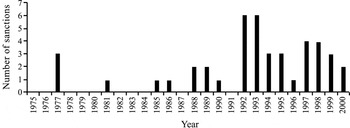
There is ample evidence that international actors indeed made rewards conditional on elections and democracy (C1: Increased conditionality and sanctions). This was most notably manifested in an increased use of various sanctions to promote democracy. As Figure 3 shows, the move coincides well with the rise in monitoring as the years 1991–92 represented a clear spike in the number of sanctions initiated to promote democracy. At the same time the international donor community increasingly linked benefits to democracy.96
See European Bank for Reconstruction and Development 1990; World Bank 1989, 60–61; Geisler 1993, 614; Kaiser 1999; and Nelson and Eglinton 1992.

Number of democracy-related sanctions initiated in a given year
Source: Data compiled from Marinov 2005.
Many governments also stated that they invited monitors because they wanted to be seen as legitimate (C2: Legitimacy rhetoric). In the pivotal 1988 plebiscite in Chile, the government would have preferred not to invite outside observers,99
Santa-Cruz 2005b, 82.
Alfred Stepan, “The Last Days of Pinochet?” New York Review of Books, 2 June 1988, 2.
CE 1990, 59.
Ibid.
McCoy 1993, 133.
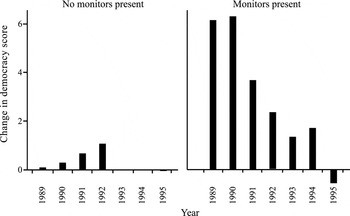
There is also evidence that the practice of inviting monitors was fueled by a series of honest governments seeking legitimacy (C3: Honest governments). As expected, because countries that invited monitors in the early 1990s were honest, they ran clean elections and therefore demonstrated larger than average democratic gains, and over time, these democratic gains decrease. As Figure 4 shows, in 1989 monitored elections averaged a gain of 6.1 on the Polity II democracy scale, as led by Chile and Panama. In 1990, monitored elections averaged a 6.3 gain led by mostly East European countries; in 1991, monitored elections averaged a 3.8 gain; and in 1992, a 2.2 gain. After this, net gains decreased as more dishonest governments invited monitors. The wave of governments that pushed monitoring past a trivial threshold in the early 1990s was thus led by honest governments.

Mean change in democracy scores for nonmonitored versus monitored elections, 1989–95
Further, there is evidence that as refusing monitors became equivalent to a self-declaration of cheating, autocratic governments also began to invite monitors more often (C4: Authoritarian governments). Although there had been some cases of monitoring in authoritarian states earlier, between 1987 and 1995 the percentage of autocratic governments inviting the major monitoring organizations rose steadily from 0 to 60 percent. However, the data are less clear on whether, as expected, authoritarian governments resume the rejection of monitors as monitors gain experience, the probability of detection grows, and criticism becomes more likely. There is a slump in monitoring of authoritarian governments after 1995, but some years still have high percentages. This may reflect two things: (1) the ability to detect cheating may not have increased that much, and (2) as there are more monitoring organizations, the likelihood increases that even autocrats will find someone to their liking. Overall, however, the evidence supports the observation that authoritarian governments quickly jumped on the bandwagon and invited monitors.
Lastly, there is support for the argument that some governments invited monitors for purely instrumental reasons, because a significant number of governments still cheated while inviting monitors (C5: Continued cheating). Whether measured by the reports of monitors themselves, by general democracy scores, or by other methods, many governments continued to cheat to various degrees although they invited monitors. One estimate considers that serious cheating occurred in as many as 25 percent of monitored elections.105
Bjornlund 2004, tab. 3.2.
Thus, election monitoring spread rapidly because the desire for legitimacy drove a set of honest governments to invite monitors in the early 1990s. Combined with increased use of democratic conditionality by external actors, this led to a situation where even many cheating governments had an incentive to invite monitors to avoid a definite stamp of illegitimacy.
Internalization
Although international election monitoring has become prevalent, there is mixed evidence about the extent to which governments and global elites have internalized election monitoring in their belief systems. As would be expected if election monitoring had become broadly accepted, debate about the validity of monitoring has largely decreased (I1: Decreased contestation). As discussed earlier, the language of the opposing UN “sovereignty resolutions” has softened drastically and there is convergence on the votes. As the National Democratic Institute (NDI) president noted in 2000 when criticizing Zimbabwe's rejection of NDI: “The refusal to accredit certain observers violates international standards for democratic elections and is counter to the practice of Zimbabwe's neighbors and virtually all democratic countries.”106
NDI 2000, 1.
The problem, however, is that if election monitoring had become widely internalized—in the sense that most governments truly believed in the related norms of election conduct—then one should no longer observe extensive cheating in elections (I2: Decreased cheating). As discussed above, however, widespread cheating persists. Thus, a growing supply of different organizations practicing monitoring to varying standards has allowed international monitoring to become broadly practiced, but evidence that governments are truly adopting the set of standards and norms that motivated the emergence of monitoring is mixed at best.
Conclusion
I began this article by asking a set of diverse questions about why international election monitoring spread and became institutionalized so quickly: Why did the surge in election monitoring not come with the wave of democratization in the mid-1970s? Why did states that traditionally viewed elections as falling purely within domestic jurisdiction allow international organizations and NGOs to interfere? Finally, and perhaps most puzzling, why did countries that intended to cheat nevertheless invite monitors?
Although these questions may appear unconnected, they are in fact intricately linked. To understand the rise of monitoring, it is not enough to answer one of these questions in isolation. First of all, each only addresses one of the stages of the evolution of norms. A focus on the normative environment and institutionalization may, for example, be able to explain quite well why and how monitoring emerged. As evidenced in the debates in the UN and regional organizations, the norms of free expression and self-determination, and the principle of periodic and genuine elections emphasized democracy as a human right and challenged the existing norms of sovereignty and nonintervention. A focus on this normative environment alone, however, would not explain the timing or pace of the spread.
It might be feasible to explain why monitoring reached a tipping point in the early 1990s rather than the mid-1970s by focusing on the systemic shifts following the end of the Cold War. As shown, the end of the Cold War clearly freed Western countries to push more vigorously for democracy and increased the use democratic conditionality. World leaders and official documents explicitly linked their calls for monitoring with world events and conditioned international recognition on clean elections. Answering this question about timing alone, however, does not explain why such a relatively strong intrusion into domestic affairs became acceptable, nor why monitoring spread so rapidly. It might also be possible to explain why monitoring spread so rapidly by focusing on the incentive structure facing governments, which can also help explain why even cheating governments began to invite monitors. As discussed, once many honest governments had invited monitors, not doing so became a self-declaration of cheating. Thus, the costs of refusing monitors rose. This created a feedback loop, increasing domestic and international pressure. But a focus on the incentive structure alone cannot explain the rising importance of legitimacy, and alone it falls short in explaining the initial emergence of monitoring and the timing of its rise.
In addition to failing to account for all the different stages of the evolution of election monitoring, a narrow focus on any one of these questions and a related narrow focus on singular causes might also miss the interactions among the causal factors in contributing to each individual stage. Although a purely incentive-based analysis might be able to account for the pattern of the spread of election monitoring, for example, it misses the normative bases behind the incentives and perhaps how the shift in the international system shaped both the norms and the incentive system that led to this pattern. A focus only on norms and the normative debate might do well in explaining the emergence of monitoring, but it doesn't capture how the end of the Cold War contributed to the consolidation of the norms, how the shift in the power balance changed demands by donors and freed Western countries to push for democracy, and, therefore, how these factors contributed to the need for legitimacy. Lastly, a focus on the power shift following the end of the Cold War might explain the timing of monitoring, but it might miss the importance of the preexisting normative context, or the subtleties of how the new incentive structure was driven by the need for democratic legitimacy.
The case of election monitoring thus amply demonstrates how, as with other complex social processes, the evolution and spread of norms results from the interaction of multiple factors through an intricate interplay of causal mechanisms.107
Finnemore and Sikkink 1998.
Finally, by presenting a strong empirical example of a case study of the evolution of a norm, this study challenges scholars to continue to explore other changes in government behavior over time, and to investigate commonalities and differences across cases. Together with other studies,108
this will help scholars to continue to refine theories about the evolution of norms and behaviors.