1. Introduction
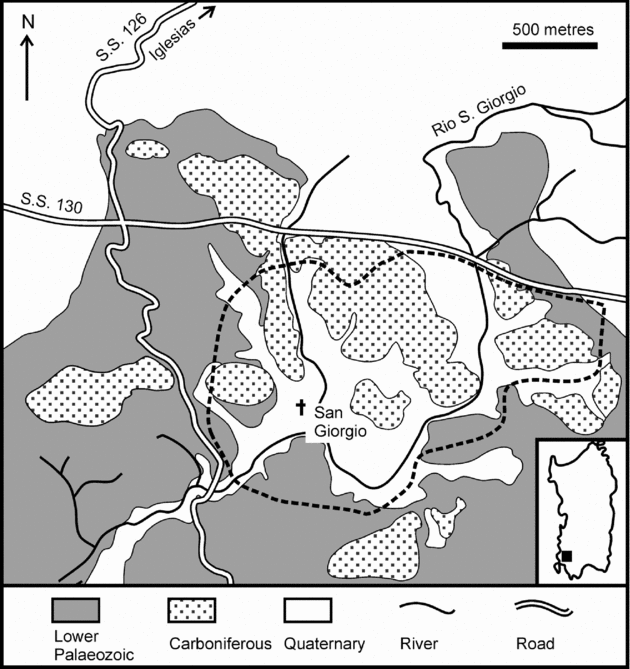
The best documented Pennsylvanian (upper Carboniferous) succession in Sardinia is in the small, intramontane San Giorgio Basin near Iglesias, in the southwest of the island (Fig. 1), in an area where the landscape has been extensively modified by extensive mining activity since the 19th century (Scanu et al. Reference Scanu, Corriga, Pillola, Corradini, Suttner, Kido, Königshof, Waters, Davis and Messner2016). Although of restricted lateral extent and vertical thickness, these deposits have yielded abundant plant macrofossils and palynofloras, as well as occasional arachnoid, insect and tetrapod remains (Fondi, Reference Fondi1979; Del Rio, Pillola & Muntoni, Reference Del Rio, Pillola and Muntoni2002; Pillola et al. Reference Pillola, Petti, Sacchi, Piras, Zoboli and Nicosia2004; Selden & Pillola, Reference Selden and Pillola2009). Plant macrofossils were first recorded by Gambera (Reference Gambera1897), Testa (Reference Testa1914), Novarese (Reference Novarese1917) and Novarese & Taricco (Reference Novarese and Taricco1923), and the earliest attempt at a taxonomic treatment was by Cocozza (Reference Cocozza1967). Despite large parts of the basin having become obscured by spoil tipped from the nearby Campo Pisano lead and zinc mine, there has been continued interest in the geology (e.g. Barca & Costamagna, Reference Barca and Costamagna2003), and palaeobotany (Pittau & Del Rio, Reference Pittau, Del Rio, Cherchi, Corradini and Putzu2002; Del Rio, Pillola & Muntoni, Reference Del Rio, Pillola and Muntoni2002; Del Rio & Pittau in Barca et al. Reference Barca, Carannante, Cassinis, Cherchi, Corrandini, Cortesogno, Del Rio, Durand, Ferretti, Fontana, Funedda, Gaggero, Garau, Leone, Macciotta, Marchi, Matteucci, Murru, Neri, Loi, Pillola, Pittau, Ronchi, Salvadori, Sarria, Schroeder, Serpagli, Simone and Stefani2004, p. 16; Ronchi et al. Reference Ronchi, Kustatscher, Pittau and Santi2012), including the relationship between floral changes, basin evolution and Variscan chain elevation (Pittau, Del Rio & Funedda, Reference Pittau, Del Rio and Funedda2008).
Simplified geological map of the Pennsylvanian-age San Giorgio Basin, SE Sardinia. The dashed line delineates the area now covered by spoil from the nearby Campo Pisano lead and zinc mine. Adapted from Del Rio & Pittau (Reference Del Rio, Pittau, Cassinis, Cortesogno, Gaggero, Pittau, Ronchi and Sarria1999, fig. 7) and Barca & Costamagna (Reference Barca and Costamagna2003, fig. 1).

There have been disagreements about the age of these deposits. Novarese (Reference Novarese1917) and Novarese & Taricco (Reference Novarese and Taricco1923) argued for an Autunian age based partly on the reported presence of walchian conifer remains. Merlo (Reference Merlo1911) and Testa (Reference Testa1914) proposed a general Carboniferous age, while Cocozza (Reference Cocozza1967) suggested a late Stephanian age (‘Stephanian D’ sensu Doubinger, Reference Doubinger1956), based on the presence of species such as Neuropteris planchardii and Callipteridium pteridium, as well as rare walchian conifers. A slightly older, Stephanian B age was suggested by Del Rio (Reference Del Rio1973), Del Rio & Pittau (Reference Del Rio, Pittau, Cassinis, Cortesogno, Gaggero, Pittau, Ronchi and Sarria1999) and Pittau & Del Rio (Reference Pittau, Del Rio, Cherchi, Corradini and Putzu2002) based mainly on palynology. Most recently, Fondi (Reference Fondi1979) used evidence of tetrapod footprints to argue for a late Westphalian age.
With the aim of resolving this issue, this paper gives a revised taxonomic synopsis of the San Giorgio Basin macroflora and will attempt to place it in the most recent biostratigraphical scheme developed by Wagner (Reference Wagner1984, Reference Wagner1998), Cleal (Reference Cleal1991) and Cleal & Thomas (Reference Cleal and Thomas1994). An attempt will also be made to provide a palaeoenvironmental interpretation of the basin during Pennsylvanian times.
2. Geological background
As in the rest of southern Europe, the upper Palaeozoic deposits of Sardinia represent two major tectono-sedimentary megacycles (Cassinis & Ronchi, Reference Cassinis and Ronchi1997, Reference Cassinis and Ronchi2002; Cassinis, Perotti & Ronchi, Reference Cassinis, Perotti, Ronchi, Lucas, Krainer and Schneider2013): (1) upper Carboniferous to early Guadalupian volcanic to fluvio-lacustrine deposits formed in relatively small extensional basins, and (2) arid upper Guadalupian and Lopingian deposits. The small fault-bounded intramontane San Giorgio Basin is the stratigraphically oldest of the basins in Sardinia representing the earlier megacycle (Pittau, Del Rio & Funedda, Reference Pittau, Del Rio and Funedda2008).
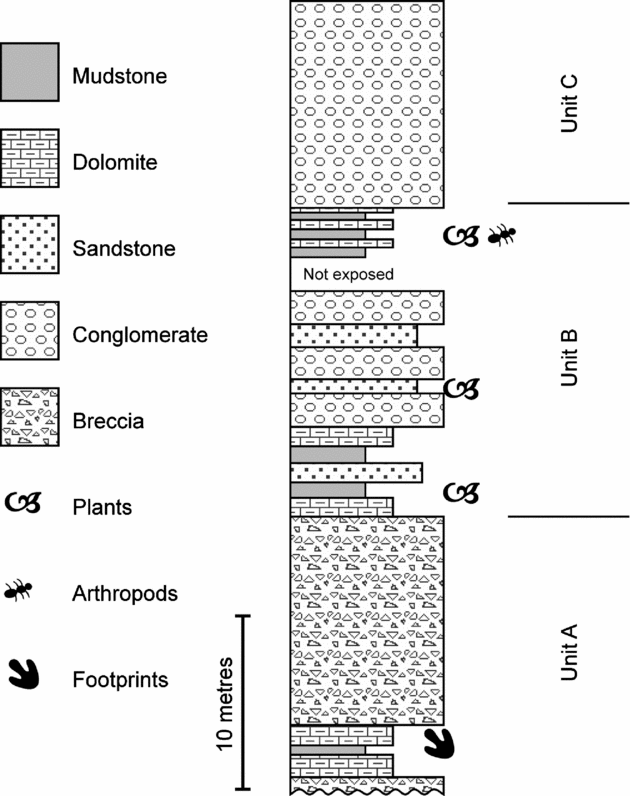
The basin, which is of only about 3 km2 aerial extent (Del Rio & Pittau in Barca et al. Reference Barca, Carannante, Cassinis, Cherchi, Corrandini, Cortesogno, Del Rio, Durand, Ferretti, Fontana, Funedda, Gaggero, Garau, Leone, Macciotta, Marchi, Matteucci, Murru, Neri, Loi, Pillola, Pittau, Ronchi, Salvadori, Sarria, Schroeder, Serpagli, Simone and Stefani2004, p. 16), was the result of extensional tectonics (Barca & Costamagna, Reference Barca and Costamagna2003; Cassinis, Perotti & Ronchi, Reference Cassinis, Perotti, Ronchi, Lucas, Krainer and Schneider2013). It contains c. 45 m of mainly coarse clastic deposits with subsidiary finer-grained deposits (together referred to the San Giorgio Formation) lying unconformably on the upper Cambrian – lower Ordovician Cabitza Shales Formation (Barca & Costamagna, Reference Barca and Costamagna2003; Barca in Barca et al. Reference Barca, Carannante, Cassinis, Cherchi, Corrandini, Cortesogno, Del Rio, Durand, Ferretti, Fontana, Funedda, Gaggero, Garau, Leone, Macciotta, Marchi, Matteucci, Murru, Neri, Loi, Pillola, Pittau, Ronchi, Salvadori, Sarria, Schroeder, Serpagli, Simone and Stefani2004, p. 15). Three lithostratigraphical units are now recognized (Del Rio, Pillola & Muntoni, Reference Del Rio, Pillola and Muntoni2002; Del Rio & Pittau in Barca et al. Reference Barca, Carannante, Cassinis, Cherchi, Corrandini, Cortesogno, Del Rio, Durand, Ferretti, Fontana, Funedda, Gaggero, Garau, Leone, Macciotta, Marchi, Matteucci, Murru, Neri, Loi, Pillola, Pittau, Ronchi, Salvadori, Sarria, Schroeder, Serpagli, Simone and Stefani2004, p. 16), in the following ascending stratigraphical order (Fig. 2).
Simplified geological section through the Carboniferous sequence of the San Giorgio Basin, showing main fossiliferous horizons. Re-drawn from Barca & Costamagna (Reference Barca and Costamagna2003, fig. 7).

Unit A: 0–13 m of mainly breccias with dolomitic cement, with subsidiary dolomite and dolomitic siltstone in the lower part.
Unit B: 6–15 m of mainly yellow-grey dolomites with subsidiary well-bedded breccias, siltstones and mudstones, and capped by massive sandstone.
Unit C: 6–11 m of mainly conglomerates, with subsidiary sandstones.
The sequence has been interpreted as a series of debris and mass flow deposits resulting from rapid erosion of the immediately adjacent lower Palaeozoic basement, separated by lacustrine siltstones and mudstones representing intervals of reduced subsidence (Barca & Costamagna, Reference Barca and Costamagna2003). The fossils mostly occur in the lacustrine deposits.
3. Materials and methods
The fossil plants of the Pittau – Del Rio Collection stored in the Geological and Palaeontological Museum of Cagliari University (MGPDL) were collected over the last 20 years during several field trips to the San Giorgio Basin. The matrix of the specimens was cleaned with a small, rigid-bristled brush, and the plant remains were cleaned with a paintbrush with soft bristles. Fractured specimens were consolidated using Paraloid B72.
In situ spores were isolated by taking a small quantity of organic material from the cones with a pointed needle. The organic material was dissolved using HCl (30 %) and HF (37 %), washed with water and cleaned up with ultrasound to separate the spores from the cone tissue. Any resulting spores were mounted with synthetic resin in permanent slides for study.
4. Palaeobotany
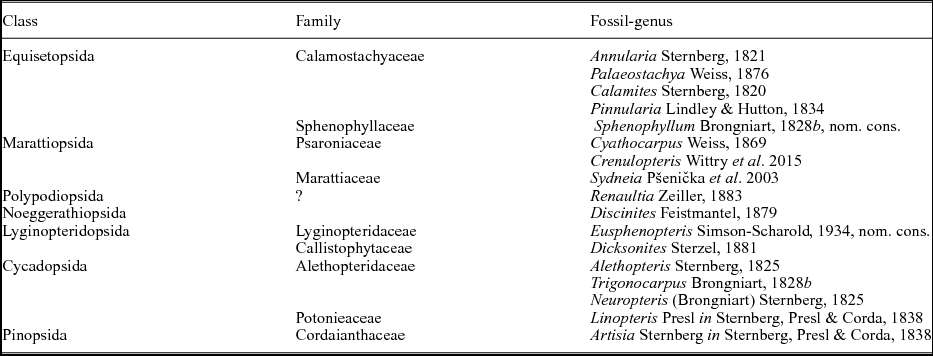
In the following analysis, the plant fossils have been named using fossil-taxa as defined by McNeill et al. (Reference McNeill, Barrie, Buck, Demoulin, Greuter, Hawksworth, Herendeen, Knapp, Marhold, Prado and Prud'homme Van Reine2012), with each taxon referring to a particular plant part, life history stage and preservation state as defined in its diagnosis. More detailed descriptions of the fossils are provided in the online Supplementary Material (available at http://journals.cambridge.org/geo). The systematic positions of the species discussed are shown in Table 1.
Summary of systematic position of the fossil-genera reported in this paper from the San Giorgio Basin.

Annularia sardiniana sp. nov.
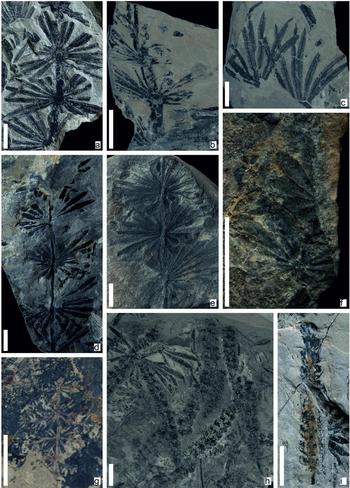
Figures 3
a–c, 6i
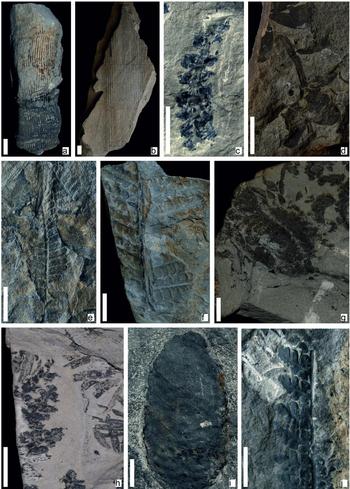
Diagnosis. Leafy shoots with circular leaf whorls of typically 36 mm (sometimes up to 70 mm) diameter; each whorl with 11–30 (typically 20) linear-lanceolate, 2.0–2.5 mm wide, rather lax leaves with acute to bluntly acute apex, basally fused to 1.0–1.5 m wide collar.
Holotype. MGPDL 17397 (Fig. 3a), San Giorgio, near Iglesias (Sardinia, Italy), San Giorgio Fm, Carboniferous (Middle Pennsylvanian).
Pennsylvanian plant fossils from the San Giorgio Basin, Sardinia. (a–c) Annularia sardiniana sp. nov. (a: MGPDL 17397, holotype; b: MGPDL 17155; c: MGPDL 17111); (d, e) Annularia spinulosa Sternberg, Reference von Sternberg1821 (d: MGPDL 17406; e: MGPDL 17223); (f) Annularia sphenophylloides (Zenker) Gutbier, Reference Gutbier1837 (MGPDL 17193); (g) Annularia galioides (Lindley & Hutton) Kidston, Reference Kidston1891 (MGPDL 17201); (h, i) Palaeostachya sp. (h: MGPDL 17399; i: MGPDL 17134).

Etymology. Named for Sardinia, the region where this species has been described for the first time.
Remarks. This is by far the most abundant fossil-species in the San Giorgio flora and was evidently the foliage of the plant that dominated the vegetation within the main, wetland part of the basin. It is readily distinguished from all other previously described Annularia species in the size of the leaf whorls, and the wide basal collar to which the leaves of each whorl are fused. Annularia spinulosa Sternberg, Reference von Sternberg1821 has similar sized leaf whorls, but in the latter the whorls often have an oval outline, the leaves tend to have a more rigid appearance and are often terminated by a mucronate tip, and the basal collar of the whorls is far narrower. Annularia pseudostellata Potonié, Reference Potonié1899 also has similar sized leaves which can also have a rather lax appearance, but differ from A. sardiniana in the leaves being much more slender and lacking a basal collar. The only other species reported from a Pennsylvanian flora of Euramerica with a well-developed basal collar to each leaf whorl is Annularia rallii (Zeiller) Jongmans, Reference Jongmans1955 (= Phyllotheca rallii Zeiller, Reference Zeiller1899) from northern Turkey. However, the leaf whorls are much smaller.
Annularia spinulosa Sternberg, Reference von Sternberg1821
Figure 3d, e
Remarks. This is the species that has traditionally been referred to as Annularia stellata (Schlotheim) Wood, Reference Wood1869, but which Barthel (Reference Barthel2000) showed to be more correctly named Annularia spinulosa. It is a very distinctive species with large whorls of leaves that has been widely reported from upper Westphalian, Stephanian and Autunian floras of Europe and North America (e.g. Abbott, Reference Abbott1958; Crookall, Reference Crookall1969; Laveine, Reference Laveine1989). It differs from Annularia sardiniana sp. nov. in that the leaf whorls often have a distinctly oval outline, and the individual leaves tend to have a more rigid outline, be widest in the distal part, and often terminated in a small, mucronate tip. Although the two species occur at the same locality in Sardinia, they are found in distinctly different rock layers. A specimen from San Giorgio was figured by Del Rio, Pillola & Muntoni (Reference Del Rio, Pillola and Muntoni2002, Fig. 3) as Annularia stellata.
Annularia sphenophylloides (Zenker) Gutbier, Reference Gutbier1837 (= Galium sphenophylloides Zenker, Reference Zenker1833)
Figure 3f
Remarks. This distinctive species was represented by a single fossil preserving two leafy shoots. The small, spathulate leaves are quite different from the other species found in this flora. Like A. spinulosa, this species has been widely reported from upper Westphalian, Stephanian and Autunian floras of Europe and North America (e.g. Abbott, Reference Abbott1958; Crookall, Reference Crookall1969; Laveine, Reference Laveine1989).
Annularia galioides (Lindley & Hutton) Kidston, Reference Kidston1891 (= Asterophyllites galioides Lindley & Hutton, Reference Lindley and Hutton1832)
Figure 3g
Remarks. Details are difficult to see because the specimen is preserved among mineral growth. Nevertheless, the small, lanceolate leaves resemble closely this species. There is also some comparison with Annularia spicata Gutbier (as figured by Barthel, Reference Barthel2012) but the latter tends to have smaller and more slender leaves, and more leaves per whorl.
Palaeostachya sp.
Figures 3h, i, 4a, 5c
Remarks. These cones were found in close association with the Annularia sardiniana sp. nov. foliage and they probably belonged to the same plants. They occur at different stages of maturity, in some cases with the bracts strongly curved (e.g. Fig. 3i) so their distal ends are parallel to the cone axis (assumed to be immature) and in others with the bracts extending directly out from the cone (assumed to be mature). They are also in different stages of decay such that in some cases the cones are starting to fall apart and thereby reveal aspects of their internal structure. Some such cones, for instance, clearly show the sporangiophores being attached to the axil of the bract and cone axis, indicating they belong to the fossil-genus Palaeostachya (Cleal & Thomas, Reference Cleal and Thomas1994).
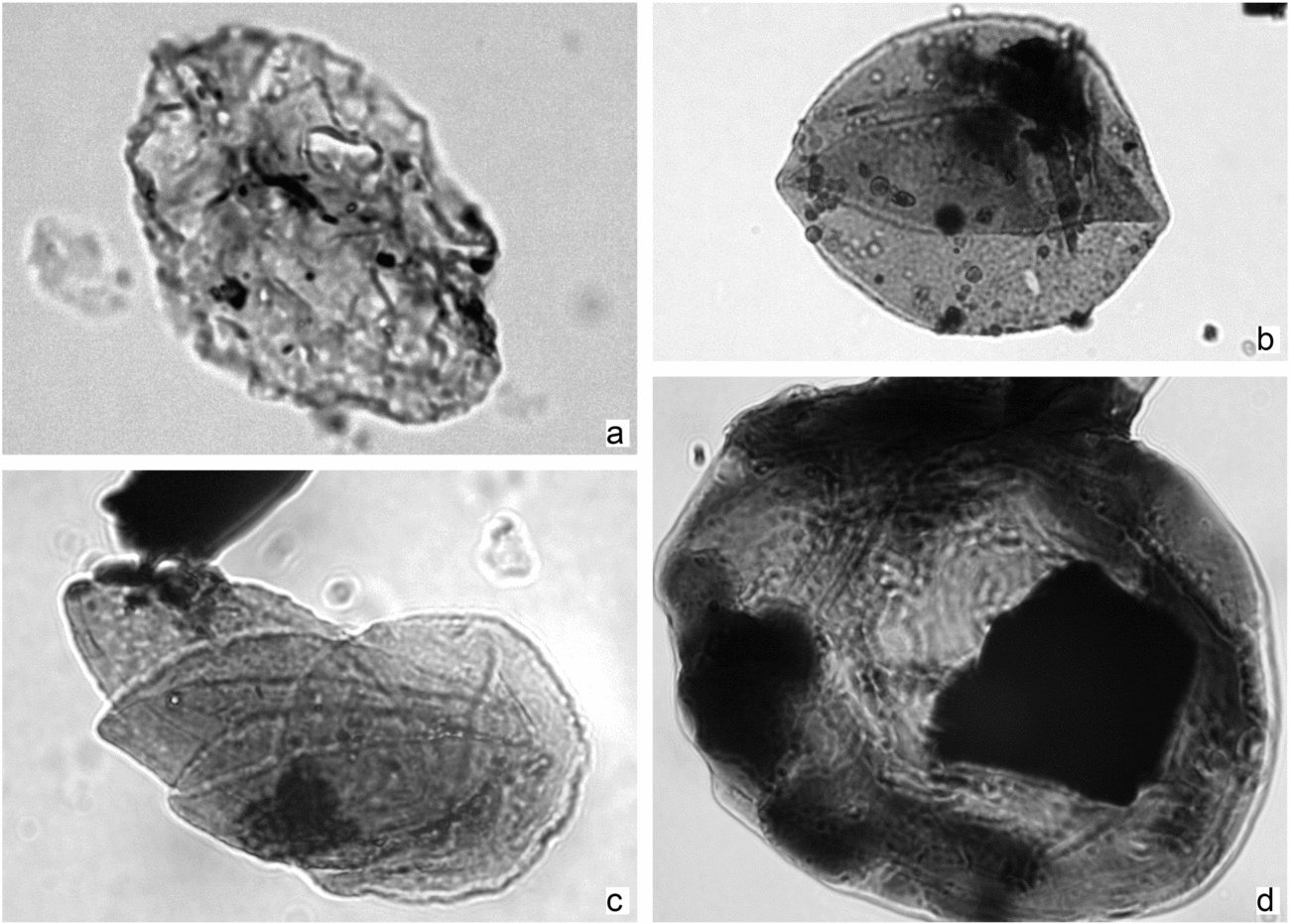
As with other Pennsylvanian-age Palaeostachya cones (Balme, Reference Balme1995) those from the San Giorgio Basin yielded Calamospora in situ spores (Fig. 4a); Calamospora microrugosa (Ibrahim) Schopf, Wilson & Bentall, Reference Schopf, Wilson and Bentall1944 is well represented in the dispersed palynological assemblages from the basin (Pittau, Del Rio & Funedda, Reference Pittau, Del Rio and Funedda2008). However, spores are not important taxonomic characters in calamostachyacean cones (Bek & Opluštil, Reference Bek and Opluštil1998). A more important obstacle to providing a species identification for the cones is that they are all more or less fragmentary and their mode of attachment to the rest of the plant is not preserved. For this reason, we have opted to record these cones merely as Palaeostachya sp. (contrast with a newly described species based on more complete material: Cleal & Shute, Reference Cleal and Shute2016).
Pennsylvanian in situ spores from the San Giorgio Basin, Sardinia. (a) Calamospora sp. from Palaeostachya sp. cone (MGPDL 17135); (b) Cyclogranisporites aureus (Loose) Potonié & Kremp, Reference Potonié and Kremp1955 from Sydneia sp. (MGPDL 17200); (c) Cyclogranisporites multigranus Smith & Butterworth, Reference Smith and Butterworth1967 from Renaultia sp. cf. Renaultia villosa (Crépin) Danzé, Reference Danzé1956 (MGPDL 17218); (d) ?Latosporites sp. from ?Discinites sp. (MGPDL 17172).

Pennsylvanian plant fossils from the San Giorgio Basin, Sardinia. (a, b) Calamites sp. (a: MGPDL 17162; b: MGPDL 17400); (c) Palaeostachya sp. (MGPDL 17135); (d) Sphenophyllum sp. cf. Sphenophyllum emarginatum (Brongniart) Brongniart, Reference Brongniart1828b (MGPDL 17408); (e) Cyathocarpus sp. (MGPDL 17390); (f) ?Crenulopteris sp. (MGPDL 17212); (g) ?Sydneia sp. (MGPDL 17200); (h) Renaultia sp. cf. Renaultia villosa (Crépin) Danzé, Reference Danzé1956 (MGPDL 17187); (i) ? Discinites sp. (MGPDL 17172); (j) Eusphenopteris nummularia (Gutbier) van Amerom, Reference van Amerom1975 (MGPDL 17400).

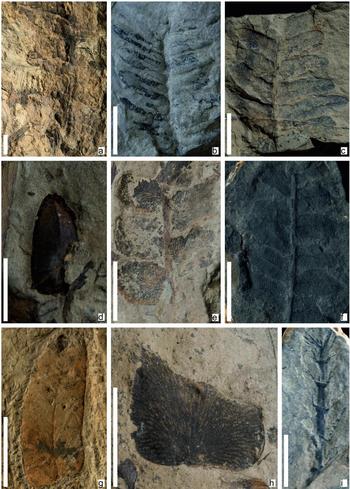
Pennsylvanian plant fossils from the San Giorgio Basin, Sardinia. (a) Dicksonites plukenetii (Schlotheim ex Sternberg) Sterzel, Reference Sterzel1881 (MGPD 2764); (b) Alethopteris ambigua Lesquereux, Reference Lesquereux1880 (MGPDL 17117); (c) Alethopteris sp. (MGPDL 17409); (d) Trigonocarpus sp. (MGPDL 17409); (e) Neuropteris ovata Hoffmann, Reference Hoffmann1826 (MGPDL 17409); (f) Neuropteris sp. (MGPDL 17221); (g) (?)Neuropteris sp. (MGPDL 17170); (h) Linopteris sp. cf. Linopteris obliqua (Bunbury) Zeiller emend. Zodrow, Tenchov & Cleal, Reference Zodrow, Tenchov and Cleal2007 (MGPDL 17409); (i) Annularia sardiniana sp. nov. (MGPDL 17133).

Calamites sp.
Figure 5a, b
Remarks. From the prominence of the longitudinal ribs and the absence of branch scars, these appear to be pith casts rather than stem compressions. The distinctive feature was the very long internode distances, much larger than is typical in the most common fossil-species such as Calamites cistii Brongniart, Reference Brongniart1828a . However, the preservation especially of the node ends and their tubercles makes it impossible to assign them meaningfully to any fossil-species.
Cocozza (Reference Cocozza1967, figs 17, 18) figured similar Calamites specimens from San Giorgio as Calamites suckowii Brongniart, Reference Brongniart1828a , Calamites sp. cf. Calamites suckowii, Calamites gigas Brongniart, Reference Brongniart1828a and Calamites cf. leioderma Gutbier.
?Pinnularia sp.
Remarks. This fragment can be compared with the specimen figured by Crookall (Reference Crookall1969, pl. 109, fig. 8) as Pinnularia capillaceae Lindley & Hutton, Reference Lindley and Hutton1834. However, it is so small that the identification must be regarded as tentative.
Sphenophyllum cf. emarginatum (Brongniart) Brongniart, Reference Brongniart1828b
Figure 5d
Remarks. Although this tiny fragment is undoubtedly a Sphenophyllum and the leaf shape appears to indicate S. emarginatum, it is far too incomplete for definite identification at species level.
Cyathocarpus sp.
Figure 5e
Remarks. These small fragments of fern frond with small, linguaeform, somewhat elongate pinnules clearly resemble Cyathocarpus but are too fragmentary for a species identification.
?Crenulopteris sp.
Figure 5f
Remarks. We are using this fossil-genus in the sense of Wittry et al. (Reference Wittry, Glasspool, Béthoux, Koll and Cleal2015) for the species that had previously been incorrectly assigned to Lobatopteris Wagner, Reference Wagner1959. This type of marattialean fern is represented here by just two frond fragments. Neither is well enough preserved to allow a species identification, or even to be certain that they belong to the same species. The specimen with pinnatifid pinnae bears some resemblance to ‘Pecopteris’ camertonensis (Kidston) Wagner, Reference Wagner1959 as figured by Kidston (Reference Kidston1924, pl. 122, fig. 1), but is too small to confirm the identity.
?Sydneia sp.
Figures 4b, 5g
Remarks. The affinities of this specimen are uncertain. The shape and arrangement of the sporangia has some resemblance to the putative marattiacean fern Sydneia Pšenička et al. Reference Pšenička, Bek, Zodrow, Cleal and Hemsley2003, but yielded trilete spores (resembling the dispersed species Cyclogranisporites aureus (Loose) Potonié & Kremp, Reference Potonié and Kremp1955) rather than monolete spores (Fig. 4b).
Renaultia cf. villosa (Crépin) Danzé, Reference Danzé1956
Figures 4c, 5h
Remarks. When fertile, these small, lobed pinnules are covered by small, globular sporangia, clearly resembling Renaultia as documented by Brousmiche (Reference Brousmiche1983). The small, oblique, somewhat pecopteroid pinnules resemble Renaultia villosa as figured by Brousmiche (Reference Brousmiche1983, pl. 47; see also Danzé, Reference Danzé1956, pl. 27). However, the San Giorgio specimens are too fragmentary for a definite species identification.
The spores obtained from the San Giorgio specimens (Fig. 4c) have a cingulum similar to Lycospora, but they do not always develop an equatorial crassitude. They compare with the dispersed species Cyclogranisporites multigranus Smith & Butterworth, Reference Smith and Butterworth1967 and are rather larger than those reported by Brousmiche (Reference Brousmiche1983) from Renaultia villosa, which have a diameter of c. 25 µm).
?Discinites sp.
Figures 4d, 5i
Remarks. There is little structure visible on the surface of this cone, other than lozenge-shaped markings, which may be at least partly taphonomic in origin. The miospores found in the cone (Fig. 4d) were similar to Latosporites Potonié & Kremp, Reference Potonié and Kremp1954 and Punctatosporites (Ibrahim) Potoné & Kremp, Reference Potonié and Kremp1954, and are similar to the dispersed Latosporites found in the microflora assemblages of the same section (Pittau, Del Rio & Funedda, Reference Pittau, Del Rio and Funedda2008). It is likely that the in situ spores were at different stages of ontogenetic development, with the glossy specimens being immature, and those with intra-structured exine being more mature or even possibly somewhat degraded; in dispersed palynomorph assemblages, these stages would be attributed to different pollen species and genera. Spores of Latosporites–Laevigatosporites have been reported from glossopteridalean cones (Surange & Chandra, Reference Surange and Chandra1974) and Sphenophyllalean strobili (Libertin, Bek & Dràbkovà, Reference Libertin, Bek and Dràbkovà2014).
Eusphenopteris nummularia (Gutbier) van Amerom, Reference van Amerom1975 (= Sphenopteris nummularia Gutbier, Reference Gutbier1835)
Figure 5j
Remarks. Although only small specimens, they show the distinctive subtriangular pinnules with a vaulted limb that is a very characteristic feature of this species. Van Amerom (Reference van Amerom1975) has given the best photographic documentation and a detailed account of the taxonomy of this species. A previous record of this species from Sardinia (Del Rio, Reference Del Rio, Pillola and Muntoni2002, fig. 4) has been under the name Sphenopteris rotundiloba Němejc, Reference Němejc1937, which is very similar to E. nummularia except that the pinnules and pinnae are significantly larger.
Dicksonites plukenetii (Schlotheim ex Sternberg) Sterzel, Reference Sterzel1881 (= Pecopteris plukenetii Schlotheim ex Sternberg, Reference von Sternberg1825
Figure 6a
Remarks. The short, squat, parallel-sided pinnules with a vaulted limb and angular lobes are highly characteristic for this species, and compare closely with the specimens figured by Galtier & Béthoux (Reference Galtier and Béthoux2002). The figures of specimens from San Giorgio in Cocozza (Reference Cocozza1967) are not very clear but appear to be of a Dicksonites and so are assumed to be probably of the same species. Cocozza assigned the specimens to forma sterzelii, presumably based on Dicksonites sterzelii (Zeiller) Danzé, Reference Danzé1956, but the latter species tends to have significantly smaller and more subtriangular pinnules than D. plukenetii.
Alethopteris ambigua Lesquereux, Reference Lesquereux1880
Figure 6b
Remarks. We are interpreting this species in the same sense as Zodrow & Cleal (Reference Zodrow and Cleal1998), in particular in including the type of Alethopteris lesquereuxii Wagner, Reference Wagner1968 within the circumscription of A. ambigua. The slender, linguaeform pinnules, strong midvein and once-forked lateral veins clearly indicate this species. It can be distinguished from Alethopteris pennsylvanica Wagner, Reference Wagner1968 in that the latter has more widely spaced pinnules that tend to be basally fused, and the veins lie at nearer to right-angles to the pinnule margin. Also similar is Alethopteris leonensis Wagner, Reference Wagner1964, but this has more tapered, decurrent pinnules with a less rounded apex, a less prominent midvein and less dense lateral veins (Wagner & Álvarez-Vázquez, Reference Wagner and Álvarez-Vázquez2010a ).
Alethopteris sp.
Figure 6c
Remarks. Although clearly alethopterid and having a rather denser venation than the A. ambigua specimens, these pinnules are too small to identify to species.
Trigonocarpus sp.
Figure 6d
Remarks. The species taxonomy of these ovules when preserved as casts or adpressions remains highly confused (e.g. see comments by Gastaldo & Matten, Reference Gastaldo and Matten1978), with few published species being adequately circumscribed.
Neuropteris ovata Hoffmann, Reference Hoffmann1826
Figure 6e
Remarks. Although small, this specimen appears to have the characteristic venation of N. ovata. The density of veining and squat form of pinnules make it close to the characteristically Stephanian N. ovata var. grandeuryi Wagner, Reference Wagner1963.
Neuropteris sp.
Figure 6f
Remarks. This specimen differs from that assigned to N. ovata in the pinnules being less squat, the midvein being longer and the veining generally being more thickly marked.
(?)Neuropteris sp.
Figure 6g
Remarks. These isolated pinnules are impossible to identify to species or even definitely to genus. Cocozza (Reference Cocozza1967) identified one specimen as Neuropteris planchardii Zeiller, Reference Zeiller1888 (= Neurocallipteris planchardii (Zeiller) Cleal, Shute & Zodrow, Reference Cleal, Shute and Zodrow1990) but that species does not have the subfalcate pinnules with a markedly cordate base as seen in the San Giorgio specimens. There is a superficial similarity with some Paripteris species, but they also do not have a cordate base and the midvein is generally not as thick. Some comparison can also be made with the larger pinnule forms of Laveineopteris such as Laveineopteris jongmansii (Crookall) Cleal & Shute, Reference Cleal and Shute1995 but the veins in the San Giorgio specimens are much denser and finer.
Linopteris cf. obliqua (Bunbury) Zeiller emend. Zodrow, Tenchov & Cleal, Reference Zodrow, Tenchov and Cleal2007
Figure 6h
Remarks. This small basal fragment of a pinnule undoubtedly belongs to Linopteris and bears some similarities to the larger pinnules of Linopteris obliqua, notably in the shape and number of vein meshes. However, it is impossible to identify these species without evidence of the overall pinnule shape, which we cannot determine.
Artisia approximata (Brongniart ex Lindley & Hutton) Corda in Sternberg, Presl & Corda, Reference von Sternberg, Presl and Corda1838 (= Sternbergia approximata Brongniart ex Lindley & Hutton, Reference Lindley and Hutton1837).
Remarks. This pith cast was the only cordaitanthalean remains in our collection. Cocozza (Reference Cocozza1967, fig. 20) illustrated specimens that were interpreted as Cordaites cf. lingulatus Grand'Eury, Reference Grand'Eury1877. However, the vein density appears to be only about ten per centimetre across the leaf, which is rather low for Cordaites (compare with vein density values given in Šimůnek, Reference Šimůnek2007); these specimens could perhaps represent fine-ribbed Calamites similar to the specimen figured by Cocozza (Reference Cocozza1967, fig. 18a).
5. Discussion
5.a. Palaeoecology
Six lithologies were recognized among the specimens examined during this study (Fig. 7).
-
(I) Very pale, grey flaggy but non-laminated mudstone. This was the most commonly found lithology. In the field rocks of this facies appear medium to medium-dark grey in colour but became noticeably lighter on drying. We interpret these deposits as lacustrine.
-
(II) Flaggy, laminated mudstone with bands of dark mudstone within an otherwise mainly pale mudstone. This was clearly similar to Lithology I.
-
(III) Laminated, dark grey, hard mudstone. We also interpret these as lacustrine, possibly deposited under lower energy conditions.
-
(IV) Medium to coarse-grained yellow to cream coloured sandstones. These are likely to represent small-scale channel deposits.
-
(V) Blocky, grey mudstone with a distinctive conchoidal fracture. We interpret these as lacustrine deposits.
-
(VI) Medium grey mudstone with distinctive yellow to orange iron staining. In the field this was found towards the top of the fossiliferous interval, just before appearance of the overlying conglomeratic unit. We interpret these deposits as the last phases of the lacustrine fill, as the basin became better drained.
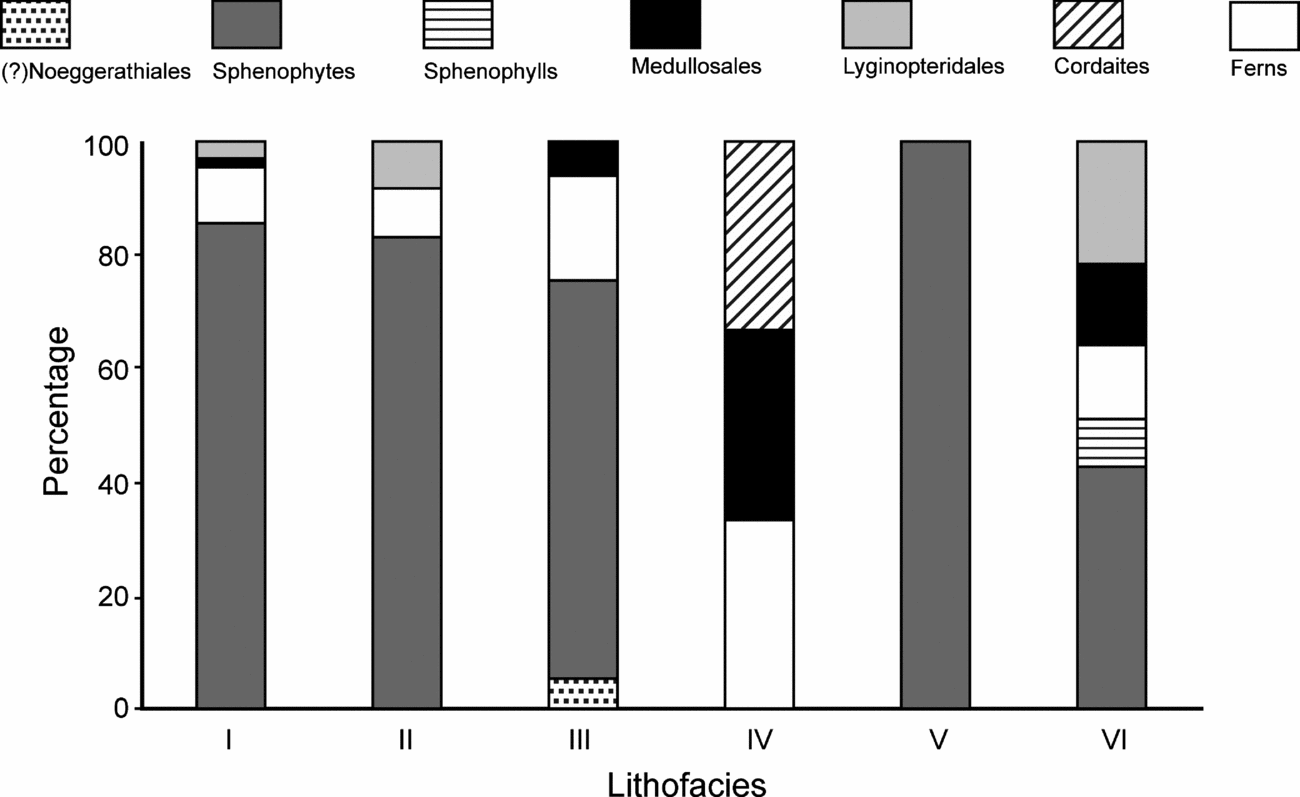
Distribution of the major plant groups in the six lithologies recognized in this study (see text for details).

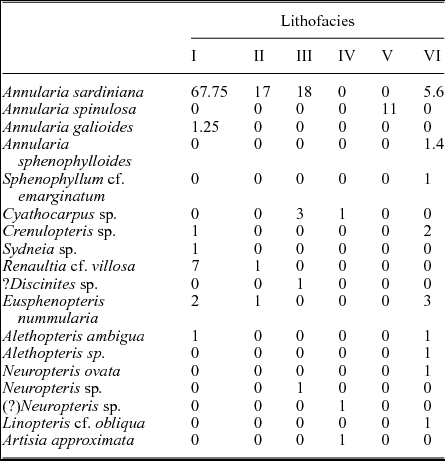
The relative abundance of the different species in these lithologies is shown in Table 2 and the general balance of major plant groups in Figure 7. We also explored the data using the Shannon t-test (Table 3) described by Magurran (Reference Magurran1988), which compares both the species richness and species evenness of pairs of assemblages (analysis using the PAST statistical package; Hammer, Harper & Ryan, Reference Hammer, Harper and Ryan2001). In order to get more meaningful results from the latter test, the fossil-species were rationalized into biologically more meaningful units. The sphenophyte cone records were combined with Annularia sardiniana sp. nov. as they were all of consistent morphology and were consistently in close association with that fossil-species of foliage. The Calamites stems, in contrast, were allocated pro-rata to the Annularia species present in that facies as there was less certainty as to their affinities. The Trigonocarpus records were omitted from the analysis because of the uncertainty as to which medullosalean they should be assigned and, as the number of specimens was very small, the effect on the results would be expected to be negligible.
Distribution of taxa in the six lithologies identified in the fossiliferous sequence of the San Giorgio Basin. The numbers of specimens for each species have been adjusted using an approach summarized in the text.

Comparison of fossil floras derived from the six lithologies defined in the text, using the Shannon t-test.

Values that have a p(same) > 0.05 are shown in bold. d.f. = degrees of freedom.
All of the results confirm the essential homogeneity of the fossil floras found in lithologies I, II and III, both in terms of overall representation of plant groups and of fossil-species. They are dominated by the sphenophyte species Annularia sardiniana sp. nov. with minor contributions (usually < 20 %) of ferns, medullosaleans and lyginopteridaleans. We conclude that these facies were all sampling the dominant vegetation in the basin, which consisted largely of sphenophytes that produced the Annularia sardiniana foliage. It is generally acknowledged that this group of plants usually favoured muddy substrates on the margins of areas of standing water or possibly fluvial channels (Gastaldo, Reference Gastaldo1992; Bashforth et al. Reference Bashforth, Drábková, Opluštil, Gibling and Falcon-Lang2011; Thomas, Reference Thomas2014).
With the exception of Renaultia and Eusphenopteris, nearly all of the other fossil-species in lithologies I, II and II were represented by isolated and usually poorly preserved fragments. It is possible that these are the remains of plants that were rare in the vegetation growing here. However, since the small fragments are generally poorly preserved compared with the sphenophyte remains, we suggest they were probably allochthonous remains of vegetation that had drifted into the basin from surrounding areas.
Lithology V compares lithologically with Lithology I except in colour and the tendency to develop conchoidal fracture. Although also probably lacustrine, the presence of a different species of calamostachyalean sphenophyte suggests that the adjacent shore had different substrate conditions.
The channel sandstone (Lithology IV) contained very few plant remains, other than a single piece of cordaitanthalean pith cast and a pteridosperm fragment. In contrast, Lithology VI yielded a high diversity of plant remains, including a significantly higher proportion of ferns, medullosaleans and lyginopteridaleans, as well as rare sphenophylls not seen in the other facies. Lithology VI is located at the top of the fossiliferous part of the basin fill and it seems likely that the plant remains represent vegetation that occupied the basin as it started to fill in with sediment and the water table fell. Some of the species that occur in this facies also occur as rare drifted fragments in lithologies I, II and III.
Our palaeoecological interpretation of the San Giorgio Basin is, therefore, that it was a small pull-apart basin that was partly filled with a lake whose muddy waterlogged shores supported mainly calamostachyalean sphenophytes. On the margins of the basin, rather better drained substrates supported vegetation with predominantly ferns and pteridosperms, whose remains occasionally drifted into the lake, transported either by water or wind. Even more distal vegetation away from the centre of the basin supported pteridosperms and cordaitanthaleans, and occasional fragments of these plants also found their way into the basin sediments transported along with coarser grained arenaceous deposits, perhaps representing flooding events. As the basin eventually drained and water tables fell, the fern and pteridosperm-dominated vegetation from the better drained substrates spread over the basin, replacing the calamostachyalean sphenophyte vegetation (a similar succession was noted in the Middle Pennsylvanian Nýřany Member in the Czech Republic; Bashforth et al. Reference Bashforth, Drábková, Opluštil, Gibling and Falcon-Lang2011).
These results are largely compatible with the palynological spectra obtained from the San Giorgio Basin by Del Rio, Pillola & Muntoni, (Reference Del Rio, Pillola and Muntoni2002), Pittau & Del Rio (Reference Pittau, Del Rio, Cherchi, Corradini and Putzu2002) and Pittau, Del Rio & Funedda (Reference Pittau, Del Rio and Funedda2008). These were essentially equally divided between sphenophytes, ferns and gymnosperms (mainly cordaites and conifers), reflecting the more regional vegetation.
5.b. Biostratigraphy
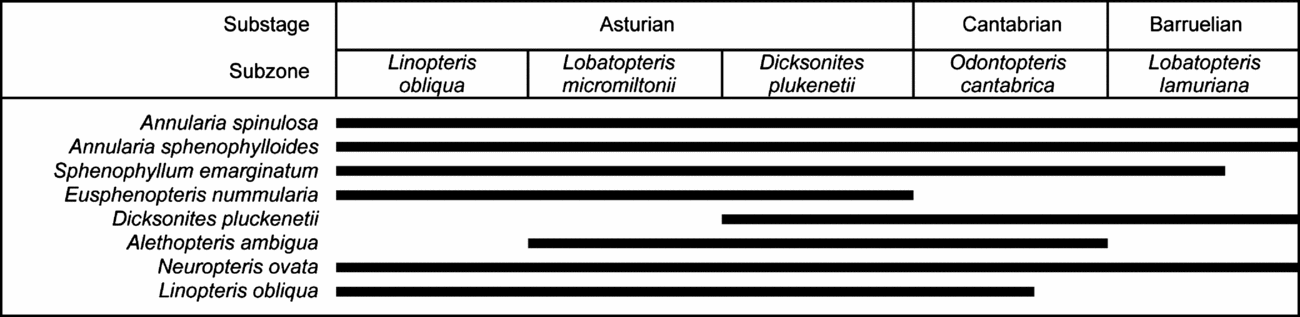
Although the dominant taxa in the San Giorgio macroflora are not biostratigraphically informative, the rarer, allochthonous taxa are. The presence of Eusphenopteris nummularia, Dicksonites plukenetii, Alethopteris ambigua, Neuropteris ovata and Linopteris obliqua together indicate either the upper Crenulopteris acadica Zone (Dicksonites plukenetii Subzone) or the Odontopteris cantabrica Zone in the scheme of Wagner (Reference Wagner1984, Reference Wagner1998), Cleal (Reference Cleal1991) and Cleal & Thomas (Reference Cleal and Thomas1994). The absence of evidence specifically indicating the O. cantabrica Zone (e.g. Odontopteris minor Brongniart, Nemejcopteris feminaeformis (Schlotheim ex Sterzel) Barthel) tends to swing the argument in favour of the D. plukenetii Subzone, albeit on negative criteria (Fig. 8). This in turn indicates a late Asturian (or possibly Cantabrian) age for the San Giorgio macroflora, which is compatible with the age determination based on tetrapod footprint evidence (Fondi, Reference Fondi1979).
Stratigraphical ranges of key taxa in the San Giorgio Basin, based on data from Wagner (Reference Wagner1984, Reference Wagner1998), Cleal (Reference Cleal1991) and Cleal & Thomas (Reference Cleal and Thomas1994).

Previous authors (e.g. Cocozza, Reference Cocozza1967) have placed emphasis on the presence of conifer remains to support the idea of a younger age. We have seen no macrofloral evidence of conifers from this basin, either in our collection or in the published literature. Even if we had, however, this would not have been of any significance for the age of these deposits. It is well documented that conifers were growing in extra-basinal habitats at least as early as middle Westphalian (early Moscovian) times and occasionally find their way into the macrofossil record (e.g. Lyons & Darrah, Reference Lyons and Darrah1989; Galtier et al. Reference Galtier, Scott, Powell, Glover and Waters1992); and there is palynological evidence of even earlier occurrences (Zhou, Reference Zhou1994). Given that the San Giorgio Basin was so small it would not be surprising to find the occasional conifer fragment from extra-basinal vegetation that had found its way into the depositional system here; this would have neither stratigraphical nor palaeoclimatic significance.
5.c. Comparisons with other floras
The only other deposits in Sardinia of comparable age are at Tuppa Niedda, c. 20 km northwest of San Giorgio. Like the San Giorgio sequence, that at Tuppa Niedda is dominated by conglomerates and sandstones (Costamagna & Barca, Reference Costamagna and Barca2008; Costamagna, Cruciani & Franceschelli, Reference Costamagna, Cruciani and Franceschelli2012) probably representing alluvial conditions (Pittau, Del Rio & Funedda, Reference Pittau, Del Rio and Funedda2008). Although no macrofloras have been reported, Pittau, Del Rio & Funedda (Reference Pittau, Del Rio and Funedda2008) have listed a palynoflora from Tuppa Niedda indicating a similar age to the San Giorgio sequence.
A late Asturian age for the San Giorgio Basin suggests that the extensional tectonics responsible for its formation were related to the Leonian Phase of the Variscan Orogeny, whose effects were widespread across Europe (Dvořak et al. Reference Dvořak, Mirouse, Paproth, Pelhate, Ramsbottom and Wagner1977; Opluštil & Cleal, Reference Opluštil and Cleal2007; Cleal et al. Reference Cleal, Opluštil, Thomas and Tenchov2010). Post-Leonian depositional basins are best documented in northern Spain, notably in the Cantabrian Mountains of Palencia and León (Wagner, Reference Wagner1966; Wagner, Fernandez-Garcia & Eagar, Reference Wagner, Fernandez-Garcia and Eagar1983; Wagner & Álvarez-Vázquez, Reference Wagner and Álvarez-Vázquez2010 b) the main difference being that deposition there was mostly paralic and continued through into Barruelian times. It also coincided with changes in depositional patterns in the Central and Western Bohemia (Opluštil & Pešek, Reference Opluštil and Pešek1998), Intra Sudetic (Opluštil & Kędzior in Cleal et al. Reference Cleal, Opluštil, Thomas and Tenchov2010) and Upper Silesia basins (Kędzior et al. Reference Kędzior, Gradziński, Doktor and Gmur2007), in southwestern Britain (Cleal, Reference Cleal1997), northeastern Bulgaria (Tenchov, Reference Tenchov2007) and northern Turkey (Cleal & van Waveren, Reference Cleal and van Waveren2012). The onset of late Carboniferous basin formation in Sardinia was therefore part of a continent-wide late Variscan tectonic event.
The Leonian Phase also coincided with a significant change in coal swamp vegetation north of the Variscan Mountains, notably with an increase in the abundance and diversity of marattialean ferns and medullosalean pteridosperms, recognizable in both the macrofloral and palynological record (Cleal et al. Reference Cleal, Tenchov, Dimitrova, Thomas, Zodrow and Wong2007, Reference Cleal, Opluštil, Thomas and Tenchov2010). The San Giorgio macroflora is overwhelmingly dominated by parautochthonous sphenophytes, reflecting the local lacustrine conditions. However, the macroflora probably derived from the late phases of the basin fill (preserved in Lithology VI) consists of marattialean and medullosalean remains and is broadly compatible in the broad balance of the major plant groups with that seen in similar age strata in South Wales (Davies, Reference Davies1929). However, in Sardinia this wetland vegetation was short-lived, and based on palynological data there was a progressive change to drier conditions during Stephanian and early Permian times, linked with changing landscapes and climate resulting from late Variscan tectonic uplift (Pittau, Del Rio & Funedda, Reference Pittau, Del Rio and Funedda2008).
6. Conclusions
The macrofloras from the San Giorgio Basin in southwestern Sardinia are overwhelmingly dominated by parautochthonous sphenophyte remains representing the vegetation growing around the margins of a freshwater lake. However, there are also allochthonous remains of a more diverse fern–pteridosperm-dominated vegetation, broadly similar in both species composition and relative representation of major plant groups to late Asturian (late Moscovian) wetland vegetation preserved north of the Variscan Mountains (e.g. South Wales). The basin was relatively short-lived and after a time started to drain, so that the sphenophyte vegetation became replaced by the fern–pteridosperm-dominated vegetation.
The palynological assemblages of the San Giorgio Basin and the nearby Tuppa Niedda area reflect a continental environment with a lake surrounded by a widespread alluvial plain vegetation in a tropical zone.
A late Asturian age for the San Giorgio Basin suggests that the extensional tectonics responsible for its formation were related to the Leonian Phase of Variscan tectonics, whose effects can be seen across Europe. The basin should therefore be regarded as late Variscan rather than post-Variscan.
Acknowledgements
The first author (CJC) would like to thank the authorities of Università di Cagliari for funding a Visiting Professorship that allowed the study of this flora. EK acknowledges also a Visiting Professorship funded by the Università di Cagliari and financial support from the Alexander von Humboldt-Foundation (3.3-ITA/1141759STP). GGS and CB acknowledge the Sardinia Regional Government for financial support (P.O.R. Sardegna F.S.E. Operational Programme of the Autonomous Region of Sardinia, European Social Fund 2007–2013 – Axis IV Human Resources, Objective l.3, Line of Activity l.3.1). This is a contribution to IGCP 575 Pennsylvanian terrestrial habitats and biotas of southeastern Euramerica.
Supplementary material
To view supplementary material for this article, please visit http://dx.doi.org/10.1017/S0016756816000765.