In their introductory article to this debate series, Andrew Street and Alan Maynard (Reference Street and Maynard2007 – henceforth SM) appropriately argue that in England it is faulty to base hospital payments solely on the weighted average of hospital inpatient and outpatient costs. They also highlight some of the many challenges in revising and updating the current hospital payment formulas. We agree with much of their discussion, but there are also further issues to consider. From an outsider’s view of the UK system, we agree that the English reforms to hospital payment are a step in the right direction; they improve incentives and are likely to reduce waiting times and expand access to care. In this invited comment, we draw upon the experience of the US, Australia, and Spain, and elaborate on a few further concerns that deserve more attention: centering on incentives across different settings, capturing patient severity, and rewarding quality of care.
The key objective of the English hospital payment reform is to create incentives for high quality, maintaining cost control and encouraging appropriate allocation of patients among different types of facilities. The challenge is how to do this. Based on Ellis and McGuire (Reference Ellis and McGuire1986), Laffont and Tirole (Reference Laffont and Tirole1993), and others, economists typically assert that payments are a price that can be used to adjust incentives and achieve a desired balance between multiple competing objectives. Price signals about the cost and value of different activities were missing in England until 2004 when the NHS made an important transition in hospital payments from a system based largely on block grants to a system based on activity-based payments. In this new scheme, hospital payments are based on relatively coarsely defined payment clusters called Healthcare Resource Groups – HRGs – which are similar conceptually to the Diagnosis Related Groups (DRGs) used around much of the rest of the world. While the existing HRG system is attractive for its relative simplicity, it may be too simple to pay effectively for the full diversity of facility-based services and patient types.
We believe that a dimension in which the system will need reform is in its sensitivity to place of service. Street and Maynard highlight that the current HRG payments reflect a blend between the average costs of treatment at two different levels of facilities – inpatient and day treatment. The characterization of HRGs as a fully prospective payment system is an oversimplification because the HRG system also has adjustments for length of stay as well as for elective and non-elective procedures, and exclusions for certain high-cost chronic conditions. But the fact remains that the same HRG payment rate is intended to apply to patients treated in both outpatients and inpatient departments of hospitals. Because costs in these two settings are so different, paying only one price will inevitably overpay for one setting and underpay for the other. While average cost pricing does encourage provision in lower-cost settings, the incentives to do so are too strong. Moreover, these two settings will be competing against other settings, such as ambulatory surgery centres and doctors offices. Do HRGs create appropriate incentives for hospitals relative to these other settings?
Part of the challenge of implementing activity-based payments is that English hospitals are coming to this system from the opposite direction from the US. Prior to the implementation of DRGs in the US, hospitals were paid with very little bundling of services, using either fees or per diem (per day) payments. Moving to DRGs from a finely divided payment system allowed a transition period in which the fine, fee-based system continued until refinements in bundles and pricing could be made. In contrast, the English system is coming from a budgeted system to DRGs (HRGs). England will need to get the rest of its fee and payment structure in place much more quickly to facilitate the transition as well as to avoid perverse incentives across types of service during the transition period. The US experience suggests that an appropriate transition will take not only time, but require resources to correct mistakes learned along the way.
Lessons (or not) from the USA
It is easy to be critical of the US for its high costs, non-universal health insurance, and uneven performance. But the US remains an important innovator in payment systems and alternative provider settings. While the US could undoubtedly learn more from the rest of the world, there are lessons for England and elsewhere from the US.
The history of US payments for hospitals, hospital outpatient departments (HOPDs), and other inpatient and outpatient providers highlights the effects of payment system reforms on health care delivery. Contrary to many expectations, when DRG payments to hospitals were first implemented by the Medicare program in 1983, they did more than just reduce hospital lengths of stay; the larger immediate effect was a shift in treatment settings from inpatient treatment (paid through DRGs) into outpatient settings. Coding creep (‘gaming’) of the payment system by upcoding was also present, but relatively modest compared to changes in the site of service. This ‘DRG creep’ was easily accommodated through payment updates, and future payment changes by Medicare have built-in assumptions about such creep. The resulting increase in outpatient treatment was initially concentrated in HOPDs, but also encouraged the growth of free-standing ‘Ambulatory Surgical Centers’ (ASCs), which parallel the Independent Treatment Centres (ITCs) in England. These ASCs specialize in relatively few elective surgical procedures, are more convenient, and are lower cost than HOPDs. ASCs grew dramatically in the US over the subsequent 20 years, so that in 2004 there were over 4,000 such facilities, representing about 14% of the volume of HOPD payments (MEDPAC, 2006). Because ASCs compete closely with HOPDs, up until 2004 their Medicare fees were simplified but similar in level to the HOPD payments. A US General Accounting Office (GAO) study in 1990 initially revealed that ASCs were being overpaid. However, policy makers remained unconvinced that ASCs were overpaid until a subsequent GAO publication in 2004. Between 2004 and 2007, ASC payment levels were cut dramatically, in many cases by 50–75% relative to HOPD levels. An interesting question for England is whether its payment system will be flexible enough to allow for such dramatic adjustments, or whether payments will be wedded to the average cost of bundles of diverse services across different settings.
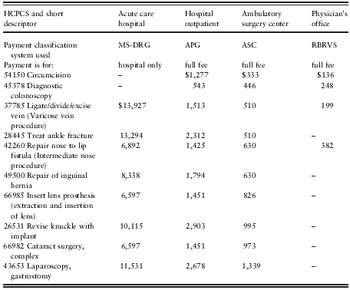
The US has acknowledged and accommodated heterogeneity in costs across practice settings rather than trying to eliminate it. Table 1 illustrates the heterogeneity in payments as reflected in current 2008 Medicare payments for ten procedures across four provider settings in the US: inpatient, HOPD, ASC, and office-based care. These payments include the patient cost-sharing contributions. Because the US Medicare program covers only the elderly and disabled population, the payment levels are not directly comparable to those in the English HRG universal system. Nonetheless, the patterns are revealing anyway. Many procedures have an enormous range of costs, with payments that vary by more than a factor of ten across settings. Simply setting payments equal to a weighted average of inpatient and hospital outpatient department costs does not solve the problem of how to price services that can alternatively be provided in an office, a HOPD, or a low-cost intermediate site such as an ASC/ITC. There is more than one substitution possibility that needs to be considered. For instance, what about procedures that are not done on an inpatient basis but are done in both office and HOPD settings? How will payments encourage efficient choices between these settings?
US medicare payments for ten procedures in four settings, for 2008 in US$

Sources: DRG payments are calculated from DRG weights as reported in US Federal Register, June 7, 2007, multiplied by the proposed FY 2008 DRG payment per case of $9299, and do not reflect all of the Medicare program’s payment adjustments. HOPD and ASC payments are from CMS (2007) 1506P[1]. Physician fees are based on the 2008 RVUs multiplied by an approximation of the 2008 average value per RVU.
A closely related issue is how to reflect heterogeneity in patient severity in facility payments. Even within an HRG, there will remain considerable heterogeneity – this is partly what is captured by place of service. Treatments for varicose veins and intermediate nose procedures (e.g., cleft palate corrections) are examples in which treatments can range from minor to extensive. Varicose veins can be treated in an office with minor skin punctures, or they can be treated with more intensive laser therapy, or with serious inpatient surgical removal of entire veins. Similarly, nose corrections have a wide range of severity and treatment options. This is part of the reason why US Medicare fees paid vary between office-based treatment and inpatient treatment by a factor of 70 for varicose veins and 18 for nose procedures. In the absence of very careful and intrusive scrutiny of doctors’ treatment practices, paying a single fee for such heterogeneous patients will lead to substantial overpayment of some and underpayment of other patients and facilities for different treatment choices.
In response to heterogeneity in patient severity, the US continually refines the DRG payment system. After decades of gradual, incremental changes to the Medicare DRG system, in 2007 the Medicare program increased the number of DRGs from 538 to 745 ‘Medicare Severity DRGs’ (MS-DRGs), catching the Medicare program up with versions of DRGs that are used in the commercial (non-Medicare) sector. The primary focus of the DRG revisions was to better capture treatment cost variation within the existing CMS-DRGs. While the NHS need not add such complexity early on in its own HRG refinements, it will face similar incentives to add complexity. Our own criticism of the Medicare DRG refinements is that they focus on adding procedure complexity, more so than adding diversity of diagnostic severity. Similar to the NHS’ HRGs, payments largely reflect ‘what was done’ rather than ‘what was wrong with the patient’. Ideally, more attention should be paid to the latter objective than the former, although we must admit that the US healthcare system has only poorly adopted the objective of paying for health not process.
Lessons from Australia
With its universal public health insurance mix of public and private provision, and leadership in health payment systems, Australia’s health care system has been an inspiration for health reformers in many other countries and provides useful insights for England’s NHS. Unlike the UK, but as in Spain, the Australian system is decentralized and individual states choose payment policies and organizational structure for hospitals (fees for doctors and drugs are determined at the Federal level). Ever since Victoria led the way in 1993, in an effort to constrain costs, many Australian states pay acute care hospitals using Australian Refined DRGs (AR-DRGs). Increases in demand-side measures such as co-payments have also played a significant role in cost containment. The hospital payment system in Victoria has repeatedly modified the AR-DRG system to create its own VIC-DRG, which incorporates payment adjustments for same-day and one-night stays to pay hospitals less than the full AR-DRG amount for less seriously treated care. Diagnostic coding creep (DRG creep) has occurred, although it has only gradually appeared over ten years (Nichol et al., Reference Nichol, Mould and Wall2003) and does not loom large in recent discussions for DRG refinements. As in most countries, cost containment remains a concern in Australia. In particular, Victoria continues to explore refinements to its DRG payment system, including hospital capitation for inpatient services and revised casemix systems (Antioch and Walsh, Reference Antioch and Walsh2002; Duckett, Reference Duckett and Agius2002; Antioch et al., Reference Antioch, Ellis, Gillett, Borovnicar and Marshall2007). Australian hospitals continue to receive block grants for some of the services (e.g. teaching) that they provide. Financial pressures remain to change payments for chronic conditions treated at tertiary and teaching hospitals.
Some claim that in Australia, as a result of DRG payments, hospitals avoid certain high-cost patients (Duckett, Reference Duckett and Agius2002). Individual hospitals have incentives under DRGs to try to avoid treating the most severely ill patients in order to reduce costs. Although the model of Frank, Glazer, and McGuire (Reference Frank, Glazer and McGuire2000) applies most directly to capitated competing health plans rather than hospitals, their model is instructive in suggesting how hospitals may alter the mix and quality of services they offer to try to attract the more profitable, low-cost patients within a DRG or HRG category. Improved severity adjustment can potentially help mitigate this problem.
As noted previously, in systems where fees or incurred costs are used as the basis of payment, providers do not have appropriate incentives to control costs. The failure to control costs is even worse when fees or cost-based payments exceed marginal costs, since services will tend to be overprovided, which may only be viewed as desirable if there are public health or other motives for wanting to increase services.
Both elements work to increase total healthcare budgets. Despite its weakness in cost containment, the main argument in favour of cost-reimbursement is its capacity to prevent providers from avoiding high-cost patients. Given that their health system budgets have skyrocketed, many countries including Australia, Spain, Austria, and now England, have emulated the US DRG approach to paying hospitals and have transitioned to a prospective payment system, each with their own refinements. The experience of Catalonia, an autonomous community of Spain, provides another useful example of a DRG implementation.
Lessons from Catalonia, Spain
Decentralization of the Spanish Universal Health System began to take place in the 1980s, and the Catalan Health Authority was the first community in Spain to adopt DRGs for management and payment (HOPE, 2006). Catalonia moved from a cost reimbursement system towards a DRG-based formula and increased the drug co-payments with the intention of containing cost growth. DRGs started being used for financial payments in 1996. From 1993 to 2000, hospital activity increased by an average of 4.1%, while the average cost only increased by 1.8%, a significant slowing down in the rate of increase (Cots, Reference Reguant2004; Lopez, Reference López1998). We are not aware of any studies indicating whether the introduction of DRGs has helped eliminate the poor patient satisfaction with the Spanish system (Mossialos, Reference Mossialos1998; CatSalut, 2002). This low satisfaction is said to be due to the fact that patients have historically not been allowed to choose between providers and there are often long waiting lists for elective procedures, complaints that have also been heard about the English NHS. Catalonia introduced free choice of primary care providers in 2000. This increased provider choice indirectly allows consumers greater flexibility in choice of specialists and hospitals and promotes quality competition between hospitals (Ma, Reference Ma1994). This greater choice, together with other government reforms targeting elective procedures have contributed to a 27% reduction in waiting lists in Catalonia from 2001 to 2006 (CatSalut, 2002–2007).
Transition problems, total costs, and rewarding facility quality
SM spend considerable time discussing transition problems related to the fact that costs and frequencies of certain procedures may change in response to the payment system. We agree that transitional corrections in prices are an issue, but we are less worried about transition problems than about ensuring that the structure of payments is fundamentally sound. Updating and recalibrating prices is a necessity of any payment system. We believe that policy reformers in England may find that any effort to pay providers a simple average payment will result in too much opportunity for hospitals to increase activity at overpaid HOPDs, and potentially reduce or undersupply appropriate services for less well-paid inpatient care.
We agree with SM in worrying about the PbR system increasing total costs of facility-based care. Any payment system can be adjusted by reducing prices downward to control costs, but the key issue is whether doing so with the existing PbR system will create worse outcomes than fiscal constraints under the old system. An important objective of switching to activity-based payments was to try to shorten waiting lists and improve incentives for facilities to treat more patients. Both efforts will tend to increase resources used in facility-based care and hence increase costs. The key challenge is deciding on how much costs should increase along with recent reforms.
SM also fear that the introduction of Payment by Results will not foster high quality at hospitals. We agree that there seems to be no direct payment incentives for quality of care in the current system. But SM do not mention the other key area of the English hospital payment reforms: Dramatic increases in consumer choice between providers. In the US, it is provider choice as much as anything which motivates facilities to strive for high quality. A DRG-based system not only promotes cost reduction, but also promotes facility competition to attract patients (Ma, Reference Ma1994). In the US, competition has helped motivate hospitals to specialize greatly, which is viewed as increasing quality and efficiency gains. Indeed, the ASC example discussed above is largely a reflection of patient choice of convenience and quality combined with facility quality competition.
Office-based physicians in the UK are now being rewarded for attaining various quality and performance standards, with rewards that are mostly driven by process measures (patients vaccinated, diabetics screened) rather than true health outcomes (infections avoided or cured, diabetics not worsening). Rewarding health outcomes is the true promise of ‘Payment by Results’ which we would argue is named inappropriately in the current system. True payments for performance, as it is called in the US, are the fundamental objective of many experiments and efforts in the US, but have not as yet been achieved. Hospital payments in England would ideally also reward hospitals for quality, but quality is very difficult to measure and reward and we offer no specific suggestions. Nevertheless, the hypothetical implementation should first learn from the office-based physicians’ experience. While there is some evidence of large quality improvements at the beginning of the rewarding system implementation, to a great extent much of the apparent improvement reflects improved coding of services that were already being provided before the change. Consequently, some physicians saw their salaries increased without necessarily achieving large quality improvement (Doran et al., Reference Doran, Fullwood, Gravelle, Reeves, Kontopantells, Hiroeh and Roland2006). Since maintaining high quality and containing costs is the Holy Grail of every healthcare delivery system, perhaps it is fitting if we end this article with emphasizing that it deserves stronger reflection in the PbR system.