Introduction
The macromolecular organic matter in meteorites occupies a key position in organic cosmochemistry because it is the most quantitatively important constituent. This fraction is not a homogeneous material, however, but rather comprises a range of structural units, each class of which will represent a specific chemical process and environment that went to form the organic agglomeration. Organic material in Murchison has undergone aqueous alteration on the parent body but there is no evidence for significant thermal alteration of the material meaning that this primitive material is relatively unprocessed since the formation of our solar system and is a record of prebiotic molecular evolution. Anders & Kerridge (Reference Anders, Kerridge, Kerridge and Matthews1988) considered establishing the origins of the insoluble organic matter (IOM) in carbonaceous chondrites to be a daunting task because its intractable nature presents specific analytical challenges. Hence, new techniques and approaches are needed to progressively reveal more of the information contained within this potentially enlightening material.
The elemental composition of macromolecular material in the Murchison (CM2) chondrite has been determined as C100H71N3O12S2 based on elemental analysis (Hayatsu et al. Reference Hayatsu, Matsuoka, Scott, Studier and Anders1977) and revised to C100H48N1.8O12S2 based on pyrolytic release studies (Zinner Reference Zinner, Kerridge and Matthews1988). Two principal analytical approaches have been adopted for its study: (i) non-destructive methods such as nuclear magnetic resonance spectroscopy (Cronin et al. Reference Cronin, Pizzarello and Fyre1987; Gardinier et al. Reference Gardinier, Derenne, Robert, Behar, Largeau and Maquet2000; Cody et al. Reference Cody, Alexander and Tera2002) and (ii) a destructive approach using pyrolysis or chemical degradation techniques to break the structure down into fragments more amenable to inspection (e.g. Hayatsu et al. Reference Hayatsu, Matsuoka, Scott, Studier and Anders1977; Murae Reference Murae1995; Komiya & Shimoyama Reference Komiya and Shimoyama1996; Remusat et al. Reference Remusat, Derenne and Robert2005a,Reference Remusat, Derenne, Robert and Knickerb; Sephton et al. Reference Sephton, Pillinger and Gilmour1998, Reference Sephton, Pillinger and Gilmour2000, Reference Sephton, Love, Watson, Verchovsky, Wright, Snape and Gilmour2004). More recently, these approaches have been augmented by surface analysis techniques such as Raman spectroscopy (e.g. Busemann et al. Reference Busemann, Alexander and Nittler2007) and secondary ionization mass spectrometry (e.g. Remusat et al. Reference Remusat, Guan, Wang and Eiler2010).
Cronin et al. (Reference Cronin, Pizzarello and Fyre1987) first employed 13C nuclear magnetic resonance (NMR) spectroscopy to detect aromatic carbon within the Murchison (CM2) IOM. These studies indicated a degree of aromaticity of 40% although it was believed that the contribution of non-protonated aromatic carbon was being underestimated, which was used to infer the presence of extensive polycyclic aromatic sheets. More recent NMR studies by Cody et al. (Reference Cody, Alexander and Tera2002) revised the levels of aromatic carbon in Murchison to between 61 and 66% and provided further evidence that the Murchison IOM was a complex organic solid composed of a wide range of organic (aromatic and aliphatic) functional groups, including numerous oxygen-containing functional groups. The range of oxygen-containing organic functionality in Murchison is substantial with a wide range in O/C ratio possible depending on whether various oxygen-containing organic functional groups exist as free acids and hydroxyls or are linked as esters (Gardinier et al. Reference Gardinier, Derenne, Robert, Behar, Largeau and Maquet2000; Cody et al. Reference Cody, Alexander and Tera2002). Low O/C values are consistent with elemental analyses, requiring that oxygen-containing functional groups in the Murchison IOM are highly linked.
Thermal fragmentation of Murchison IOM material produces benzene, toluene, alkylbenzenes, naphthalene, alkylnaphthalenes and polycyclic aromatic hydrocarbons (PAHs) with molecular weights up to around 200–300 amu indicating that the majority of the carbon is present within aromatic ring systems (Simmonds et al. Reference Simmonds, Shulman and Stembridge1969; Studier et al. Reference Studier, Hayatsu and Anders1972; Levy et al. Reference Levy, Grayson and Wolf1973; Bandurski & Nagy Reference Bandurski and Nagy1976; Holzer & Oró, Reference Holzer and Oró1977; Murae Reference Murae1995; Kitajima et al. Reference Kitajima, Nakamura, Takaoka and Murae2002; Sephton et al. Reference Sephton, Pillinger and Gilmour1998, Reference Sephton, Pillinger and Gilmour2000, Reference Sephton, Love, Watson, Verchovsky, Wright, Snape and Gilmour2004). However, pyrolysis and chemical degradation studies indicate that aliphatic hydrocarbon moieties exist within or around the aromatic network as hydroaromatic rings and short alkyl substitutions or bridging groups (e.g. Levy et al. Reference Levy, Grayson and Wolf1973; Hayatsu et al. Reference Hayatsu, Matsuoka, Scott, Studier and Anders1977; Holzer & Oró, Reference Holzer and Oró1977; Sephton & Gilmour Reference Sephton, Gilmour, Gilmour and Koberl2000). The more polar moieties in IOM have proven difficult to study. Pyrolysis experiments have released oxygen-containing compounds such as phenols, phenyl carboxylic acids, propanone and methylfuran (Studier et al. Reference Studier, Hayatsu and Anders1972; Levy et al. Reference Levy, Grayson and Wolf1973; Biemann Reference Biemann1974; Hayatsu et al. Reference Hayatsu, Matsuoka, Scott, Studier and Anders1977; Holzer & Oró Reference Holzer and Oró1977; Sephton et al. Reference Sephton, Pillinger and Gilmour1998). Pyrolysis has also led to the tentative identifications of some nitrogen heterocyclic species, e.g. cyanuric acid and alkylpyridines, while substituted pyridine, quinoline and carbazole were observed in sodium dichromate oxidation of the macromolecular material (Studier et al. Reference Studier, Hayatsu and Anders1972; Hayatsu et al. Reference Hayatsu, Matsuoka, Scott, Studier and Anders1977). Sephton et al. (Reference Sephton, Love, Watson, Verchovsky, Wright, Snape and Gilmour2004) detected carbazole in the products of catalytic hydrogenation of the macromolecule. The polar moieties of IOM, however, remain relatively poorly characterized.
In this study we have characterized the polar moieties associated with Murchison IOM. However, as conventional pyrolysis-gas chromatography-mass spectrometry (Py-GC-MS) is unable to detect a large number of polar O- and N-containing compounds because these species are either not GC-amenable or defunctionalization occurs during pyrolysis, we have utilized a technique able to target specific linkages within the IOM: thermally assisted hydrolysis and methylation (thermochemolysis). This uses tetramethylammonium hydroxide (TMAH) to break ether and ester bonds and results in methylation of the released products (Challinor Reference Challinor2001). The temperatures commonly employed (280°C) are below these required for pyrolytic cracking of organic material (Challinor Reference Challinor2001). Thermochemolysis therefore has excellent potential as a means of determining oxygen-bound moieties within organic macromolecules and, as such, lends itself to a study of the IOM of the Murchison meteorite. On-line thermochemolysis, as employed here, requires significantly less material than off-line procedures, which is an important consideration when analysing precious extraterrestrial material. In this paper we present thermochemolysis data for Murchison IOM. The data indicate how organic units are connected or occluded and reveal unprecedented information on the chemical progression of macromolecule synthesis.
Experimental
Thermochemolysis
A hydrofluoric/hydrochloric acid (HF/HCl) residue from a sample of the Murchison meteorite was ultrasonically extracted with dichloromethane (DCM) and methanol (9:1). Approximately 1 mg of the HF/HCl residue from Murchison was placed in a quartz pyrolysis tube, which was plugged with quartz wool at each end. Then 10 μl of 25% TMAH in methanol was added to the loaded sample and the methanol allowed to evaporate for 12 h. Using a CDS Pyroprobe 1000 (CDS Analytical, Oxford, PA), samples were heated in a flow of helium at a rate of 20°C ms−1 to 280°C where the sample was held at this temperature for 15 s. As a control, a sample was thermally desorbed under identical heating conditions but with no TMAH added. For comparison, a further sample was heated to the higher (carbon–carbon bond breaking) temperature of 610°C at a rate of 20°C ms−1 both with and without TMAH. Procedural blanks were determined by heating a clean pyrolysis tube with quartz wool and TMAH under the conditions described above.
Gas chromatography-mass spectrometry
GC-MS analysis was carried out using an Agilent Technology 6890 gas chromatogram coupled to a 5973 mass spectrometer fitted with a CDS 1500 valve interface held at 250°C. Separation was performed on a SGE (UK) BPX5 column (30 m length, 0.25 mm internal diameter and 25 μm film thickness). Helium at a column flow rate of 1.1 ml min−1 (constant flow rate) was used as the carrier gas. Injection was splitless and the injector temperature was 250°C. The GC oven temperature was held for 15 min at 30°C and then programmed at 4°C min−1 to 300°C; the final temperature was held for 9 min. Identification of alkylbenzoic acids (as methyl esters) was based on retention times, mass spectra and comparison with authentic standards (Acros Organics, UK).
Two-dimensional gas chromatography time-of-flight mass spectrometry
To further characterize the products released upon thermochemolysis comprehensive two-dimensional gas chromatography time-of-flight mass spectrometry (GC×GC-ToFMS) was utilized. Thermochemolysis was performed at 280°C under conditions as described above. GC×GC-ToFMS analysis was performed using an Agilent 6890 GC with a GC×GC modulator (LECO Corporation) coupled to a Pegasus IV time-of-flight mass spectrometer (LECO Corporation). The GC injector was operated in split mode (20:1) with a column flow rate of 1 ml min−1 and held at 250°C. GC×GC separation utilized a non-polar column and a polar column: a BPX5 column (30 m×0.25 mm×0.25 μm; SGE) and a BPX50 column (1.8 m×0.1 mm×0.1 μm; SGE) respectively. The GC oven temperature was held for 10 min at 35°C and ramped to 300°C at a rate of 5°C min−1 and then held for 5 min; the second column was ramped at +15°C relative to the first column with a modulation time of 4 s. Mass spectra were acquired in electron ionization mode from 33 to 500 amu with an acquisition rate of 135 spectra per second.
Results and discussion
Carboxylic acids
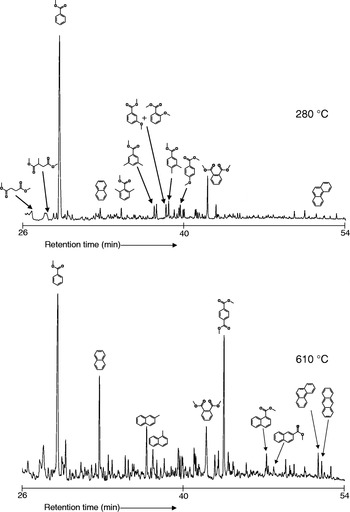
The results of the thermochemolysis of Murchison IOM at 280°C and 610°C are shown as total ion current chromatograms of the products in Fig. 1. The principal compound released in both cases was benzoic acid with other abundant compounds including methyl and dimethyl benzoic acids as well as methoxy benzoic acids. Short-chain α,ω-dicarboxylic acids (C4–8) were also released from the IOM, as were the compounds fluoranone, methoxymethylsulfanylbenezenes and dimethylsulfone.
Total ion chromatogram of products released upon thermochemolysis of HF/HCl residue from Murchison at 280°C and 610°C.

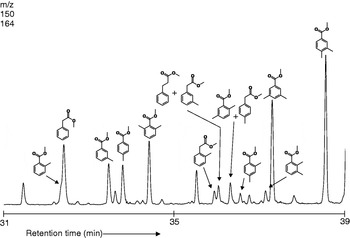
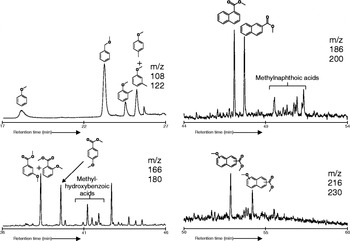
Within the distribution of the C1 and C2 benzoic acids (BA) all possible structural isomers (except the ethyl-BA; see Fig. 2) are present. This is a significant observation and implies an abiotic source because biologically derived acids tend to display a limited number of structures. The isomeric diversity of the BA is in accord with previously published observations of free carboxylic acids which are also structurally diverse (Sephton Reference Sephton2002). Within the thermochemolysis products, the most abundant isomers include 3,4-dimethylbenzoic acid (DMBA), 3,5-DMBA, 2,5-DMBA, 2,6-DMBA and phenylacetic acid. The 3,4-, 3,5- and 2,5-dimethylbenzoic acid isomers are generally considered to be the most stable isomers on geological time scales (Adams et al. Reference Adams, Moore, Fabry and Ahn1992). The presence of 2,6-DMBA is notable because it is not often encountered in material from a biological source. Hydroxybenzoic acids and naphthoic acids are also present (Fig. 3) with the latter representing the largest ring size of the aromatic acids detected. The presence of abundant benzene-dicarboxylic acids is not unexpected as they have recently been identified as quantitatively important constituents in the free carboxylic fraction from Murchison (Martins et al. Reference Martins, Watson, Sephton, Botta, Ehrenfreund and Gilmour2006).
Partially reconstructed mass chromatogram (m/z 150+164) displaying the C1 and C2 benzoic acids released upon thermochemolysis of HF/HCl residue from Murchison at 280°C.

Partially reconstructed mass chromatograms displaying phenols (m/z 108+122), hydroxybenzoic acids (m/z 166+180), naphthoic acids (m/z 186+200) and hydroxynaphthoic acids (m/z 216+230) released upon thermochemolysis of HF/HCl residue from Murchison at 280°C.

Remusat et al. (Reference Remusat, Derenne and Robert2005b) analysed the insoluble organic matter from Murchison and Orguiel by thermochemolysis and pyrolysis and the results from this present study are comparable. However, the main difference is that Remusat et al. (Reference Remusat, Derenne and Robert2005b) conducted thermochemolysis at pyrolysis temperatures of 610°C, which would have resulted in the cleavage of C–C bonds (see Fig. 1 for a comparison between the thermochemolysis temperatures), whereas we have chosen to selectively target oxygen-containing bonds by utilizing a lower temperature.
The detection of benzoic acids in the thermochemolysis products from Murchison is in harmony with previously published chemical degradation work. Hayatsu et al. (Reference Hayatsu, Matsuoka, Scott, Studier and Anders1977) oxidized a HF/HCl residue from Murchison with nitric acid and the main products released were benzoic acids. Hayatsu et al. (Reference Hayatsu, Winans, Scott, McBeth, Moore and Studier1980) oxidized a sample of Murchison meteorite with alkaline CuO to release phenolic esters from the organic macromolecule. The main products that were released included m-hydroxybenzoic acid, 3-hydroxy-1,5-benzenecarboxylic acid (5-hydroxy-isophthalic acid), 1,2-benzenedicarboxylic acid (phthalic acid) and 1,2,4-benzenetricarboxylic acid (benzene-1,2,4-tricarboxylic). However, the two above-mentioned methods may have resulted in the oxidation of hydrocarbons in the macromolecule producing oxygenated products (for example, toluene would yield benzoic acid) and therefore cannot be considered exclusively due to bound acidic species. The results are comparable with those reported in this paper in that the majority of the products are single-ring structures with some naphthoic acids.
There are also numerous reports of free volatile aliphatic and, occasionally, aromatic acids in Murchison and other meteorites. Water is commonly used as the solvent in these studies and higher molecular weight carboxylic acids are not generally observed, most likely due to increased hydrophobic behaviour with increasing molecule size. Generally, the abundance of the aliphatic acids decreases with increasing chain length with all structural isomers present (Yuen & Kvenvolden Reference Yuen and Kvenvolden1973; Sephton Reference Sephton2002). Reports of free aromatic acids are limited. Naraoka et al. (Reference Naraoka, Shimoyama and Harada1999) reported the presence of both aliphatic and aromatic acids in three CM2 Asuka carbonaceous chondrites from Antarctica. For the free aromatic acids, they only reported the presence of benzoic acid, methylbenzoic acids (all three isomers) and phenylacetic acid. However, the aromatic acids reported in Naraoka et al. (Reference Naraoka, Shimoyama and Harada1999) may not be ‘free’ acids because the sample was refluxed with 0.18 M KOH and therefore saponification of bound acids cannot be ruled out. They made no mention of higher molecular weight aromatic acids such as dimethylbenzoic acids or naphthoic acids. Free benzoic, phthalic and naphthoic acids have been reported in water extracts from Murchison (Martins et al. Reference Martins, Watson, Sephton, Botta, Ehrenfreund and Gilmour2006). The major difference between free and bound fraction in meteorites is that bound acids appear to be dominated more by aromatic structures.
Hydrocarbons
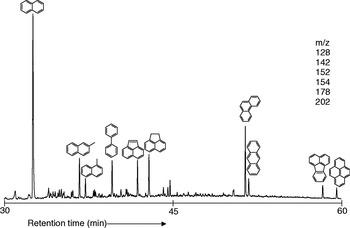
Hydrocarbons that were not present in the thermally desorbed (280°C) sample with no TMAH were also detected. Compounds identified included naphthalene, methylnaphthalenes, biphenyl, methylbiphenyls, acenaphthylene, acenaphthene, phenanthrene, anthracene, fluoranthene and pyrene (see Fig. 4). This discrepancy between thermally desorbed and thermochemolysis products suggests that hydrocarbons are released when the HF/HCl residue is treated with TMAH and are in some way occluded in the organic framework but not covalently bound.
Partially reconstructed mass chromatogram (m/z 128+142+152+154+178+202) displaying aromatic hydrocarbons released upon thermochemolysis of HF/HCl residue from Murchison at 280°C.

Such an interpretation is supported by the predominance of parent molecules compared to their alkylated counterparts, highlighting the fact that these compounds contain no evidence of residual bonds that may have connected them to the macromolecule. It is not possible to detect benzene or toluene due to the long solvent delay required when using TMAH on a GC-MS system. Although not unexpected, this is the first time that occluded hydrocarbons have been suggested to be present within the macromolecular material.
As with the carboxylic acids, our hydrocarbon data is in accord with Remusat et al. (2005b) but their use of pyrolysis temperatures (610°C) could not allow discrimination between occluded and bound PAH units. Our data also has a bearing on questions raised by other studies in which parental PAH were released from the Murchison macromolecular material. Hydropyrolysis of Murchison successfully produced substantial amounts of parental PAH including phenanthrene, carbazole, fluoranthene, pyrene, chrysene, perylene, benzoperylene and coronene (Sephton et al. Reference Sephton, Love, Watson, Verchovsky, Wright, Snape and Gilmour2004). For these units to represent bound entities they must have been joined to the macromolecule with a single heteroatomic bond (Sephton et al. Reference Sephton, Love, Watson, Verchovsky, Wright, Snape and Gilmour2004). Thermochemolysis, however, would have revealed the presence of any such bond and confirms the presence of occluded PAH in meteorite macromolecules.
Isomeric diversity of products
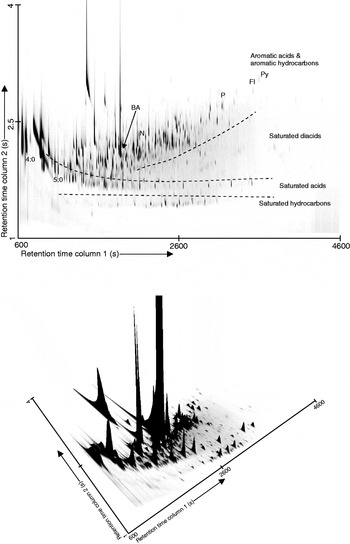
The complexity of the products released by thermochemolysis can clearly be seen in the GC-MS chromatograms (Fig. 1). A technique is required that allows the separation of these complex and co-eluting mixtures. Isolation by using a GC×GC-ToFMS system employing a non-polar followed by a moderately polar column enables chromatographic separation based on volatility and polarity, respectively, which can result in the resolution of previously co-eluting compounds. This two-dimensional separation also enables visualization of different compound classes. Signal-to-noise ratios are greatly increased by separation of compounds from column bleed, and solvent tail and peaks are much narrower than by traditional GC.
Figure 5 displays the results of GC×GC-ToFMS analysis. The axis representing column 1 reveals the effect of increasing the molecular weight of non-polar compounds such as the PAH homologues. The axis representing column 2 displays a progressive discrimination based on the polarity of compounds such as the benzoic acids and napthoic acids.
Total ion GC×GC-ToFMS chromatograms (contour and surface plots) of products released upon thermochemolysis of HF/HCl residue from Murchison at 280°C. 4:0=butanoic acid, 5:0=pentanoic acid, BA=benzoic acid, N=naphthalene, P=phenanthrene, Fl=fluoranthene, Py=pyrene.

Although complete structural diversity appears to exist within the thermochemolysis products, some dominant units are revealed. The most obvious are the benzoic acids which, because of their limited molecular weight and partly polar character, display intermediate retention times on both columns. Their relative response implies that single aromatic rings are highly important within oxygen-bound entities in the macromolecular material. Importantly, a range of saturated and unsaturated compounds are also present suggesting that hydrogen supply was important during the synthesis or subsequent alteration of these macromolecular entities. Parent body aqueous alteration is one mechanism by which this variation in saturation may have come about.
Origin of thermochemolysis products
There are primarily two processes that could result in the formation of organic acids in extraterrestrial environments. Firstly, acids could be formed by irradiation of cosmic ices within the interstellar medium (Bernstein et al. Reference Bernstein, Elsila, Dworkkin, Sandford, Allamandola and Zare2002). Wootten et al. (Reference Wootten, Wlodarczak, Mangum, Combes, Encrenaz and Gerin1992) and Mehringer et al. (Reference Mehringer, Snyder and Mioa1997) have detected acetic acid in the interstellar medium; these small free acids could then be trans-esterfied into an organic macromolecule. The free carboxylic acids in carbonaceous chondrites have been shown to be enriched in deuterium suggesting a possible interstellar origin (Krishnamurthy et al. Reference Krishnamurthy, Epstein, Cronin, Pizzarello and Yuen1992; Huang et al. Reference Huang, Wang, Alexandre, Lee, Rose–Petruck, Fuller and Pizzarello2005). It must be noted, however, that although free carboxylic acids have been detected in the interstellar medium it is thought they are rapidly destroyed by ultraviolet radiation (Bernstein et al. Reference Bernstein, Ashbourn, Sandford and Allamandola2004). A related but alternative mechanism is suggested by data from sedimentary bitumens which imply that concomitant polymerization and oxidation of pre-existing organic materials can occur in response to irradiation (Court et al. Reference Court, Sephton, Parnell and Gilmour2006). It is possible that similar processes may occur in cosmic settings.
Another potential process would be formation during an aqueous alteration event upon the parent body, this would involve cleavage and oxidation of hydrocarbons from the macromolecule. Oxidation of aromatic units is a well-known process that is accelerated in the presence of water and is commonly observed for PAHs in coals (Martinez & Escobar Reference Martinez and Escobar1995). Such an interpretation would be consistent with the varying degrees of saturation observed in the thermochemolysis products as water can act as an exogenous source of hydrogen (Sephton et al. Reference Sephton, Pillinger and Gilmour1998, Reference Sephton, Pillinger and Gilmour2000).
Irrespective of the mechanism of acid formation, the role of these units as a macromolecular enclosure for PAHs implies a clear order of formation. The PAHs (free and macromolecular) must have been synthesized before the acids, relegating the latter to the products of a late-stage interstellar process, a solar nebular mechanism or a parent body alteration depending on from where the PAHs are eventually discovered to have originated.
Conclusions
Thermochemolysis is an effective method to liberate oxygen bound entities form extraterrestrial macromolecular materials. GC-MS of the products indicates that one- and two-ring aromatic acids and short-chain α,ω-diacids dominate, and all structural isomers of C1 and C2 benzoic acids are present reflecting an undirected abiotic formation mechanism for these compounds. GC×GC-ToFMS data display the presence of substantial isomeric diversity and a range of saturation levels for the thermochemolysis products. Parental PAHs are also released and their lack of substitution reveals that they must be occluded within the organic network and this therefore reflects a formation mechanism and environment that predates their organic-acid-rich host. Processes that may have produced the acid-rich macromolecular material include the irradiation of cosmic ices and aqueous alteration on the meteorite parent body.
Acknowledgement
This work was supported by the Science and Technology Facilities Council.