Introduction
The chimaerism technique has proven useful to obtain offspring in which a part of the gametes comes from embryonic cells or embryo stem cells (Ma et al., Reference Ma, Fan, Ganassin, Bols and Collodi2001; Fan et al., Reference Fan, Alestrom and Collodi2004).
The colonization of transplanted cells in the presumptive chimaera, both at somatic and germ-line levels, depends on the preponderance of transplanted cells over the recipient cells. To facilitate colonization, different treatments can be applied with the aim of penalising the recipient embryo or some specific structures, as occurs with PGCs precursors (Carscience et al., Reference Carsience, Mary, Ann, Verrinder and Robert1993). To this end, chemical products (Swartz, Reference Swartz1980) or ionising radiations (Joly et al., Reference Joly, Kress, Vandeputte, Bourrat and Chourrout1999; Li et al., Reference Li, Deng, Liu, Song, Sha, Wang and Wei2002) have commonly been used. The use of ultraviolet (UV) radiation is of interest because it is cheaper, easier and less dangerous than other kinds of radiation, and no special installations are required for its use. In our laboratory, a UV radiation dose to penalise recipient embryos was defined specifically for wild and gold zebrafish strains (Francisco-Simão et al., Reference Francisco-Simão, Cardona-Costa, Pérez-Camps and García-Ximénez2009). On the other hand, in another work, Cardona-Costa & Francisco-Simão et al., (Reference Cardona-Costa, Francisco-Simão, Pérez-Camps and García-Ximénez2009) observed that the micromanipulation medium osmolarity (30 vs 300 mOsm/kg) could affect recipient embryo survival, possibly due to the rupture of the osmolarity barrier when the microinjection pipette punctured the outer embryonic layer.
In this context, the aim of the present work was to test the effect of the previously defined radiation dose (0.529 mW/cm2 for 30 s) together with the micromanipulation medium osmolarity (300 or 30 mOsm/kg) on the germ-line chimaerism efficiency in zebrafish.
Materials and Methods
Embryos at the early blastula stage from two different strains (wild: donors; gold: recipients) were used. All chemical products and culture media were from Sigma-Aldrich (Madrid, Spain)
UV irradiation of gold (recipient) embryos
According to previous results obtained in our laboratory (Francisco-Simão et al., Reference Francisco-Simão, Cardona-Costa, Pérez-Camps and García-Ximénez2009), gold-type embryos were treated with UV radiation to improve the colonization of transplanted cells during chimaeric embryo development. Briefly, embryo irradiation was carried out almost to mid blastula transition (MBT) stage without dechorionation. They were held in 35 mm-Petri dishes (corning) as containers with system water. A vortex (MS1-IKA) at 200 rpm was used with the aim of homogenising the radiation area during UV exposure. A UV germicide lamp (General Electric, 30 W) was used. Irradiation was carried out at 62 cm of focus-object distance. The radiation dose applied was 0.529 mW/cm2 and was measured by a USB 4000 (Miniature Fiber Optic Spectrometer; Ocean Optics Inc. First in Photonics). After irradiation, embryos were kept at room temperature for 30 min and then dechorionated.
Chimaerism technique
Donor MBT blastomeres (non-radiated cells) from wild specimens were obtained by blastoderm disaggregation, in modified Hanks-buffered salt solution (HBSS) medium free of Ca2+ and Mg2+ (Cardona-Costa & García-Ximénez, Reference Cardona-Costa and García-Ximénez2007).
The chimaerism was performed using a Nikon inverted microscope (Nikon Europe B.V.) equipped with two Leitz micromanipulators (Leica). Two separated media drops were placed in a Petri-dish (90 mm) and covered by mineral oil. One of them was composed of HBSS (300 mOsm/kg) medium free of Ca2+ and Mg2+ contained the isolated blastomeres and the other one was the handling medium in which the chimaerism was performed, composed of HBSS (300 mOsm/kg) or HBSS-10% (30 mOsm/kg) medium (Pérez-Camps & García-Ximénez, Reference Pérez-Camps and García-Ximénez2008) depending on the experimental group carried out. During the manipulation process, the cells were picked with a microinjection pipette of 50 μm inner diameter and injected into the embryos held with a 260 μm outer diameter holding pipette. The number of injected cells per recipient embryo ranged from 50 to 100 cells and they were deposited into the animal pole as described by Lin et al. (Reference Lin, Long, Chen and Hokins1992); specifically, into the lower part of the blastoderm (Nakagawa & Ueno, Reference Nakagawa and Ueno2003). Manipulated embryos were placed in 35 mm cell culture dishes at 28.5°C for 5 days in HBSS-10% (30 mOsm/kg).
Surviving embryos at 30–60 min were considered as the initial number. The further survival rates were assessed at 24 h, 48 h, 72 h and 5 days post-chimaerism. Then, surviving embryos were raised to adulthood where skin pigmentation from adult chimaera and their F1 progeny was registered.
Experimental design
Four experimental groups were established by combining embryo recipient UV radiation (30 s UV vs non-radiated) and the micromanipulation medium osmolarity (30 vs 300 mOsm/kg). Differences among groups in survival rates of different stages were tested. Somatic and germ-line chimaerism were evaluated in adults.
Overall germ-line chimaerism rate estimation
In this work, the parameter used to compare the osmolarity media and UV effect on germ-line chimaerism rates assumed that all the adult specimens obtained (male and female) in each experimental group provided a single ‘hermaphrodite and simultaneous’ gonad. In this way, depending on the treatment applied, the relative frequency of gametes produced (whether sperm or eggs) from donor cells (wild) or from recipient (gold) could be estimated by melanocyte presence in the larval skin, because the marker from wild specimens (pigmentation) is dominant over gold specimens, so only offspring from gold–gold gametes pairing will be non-pigmented. To this end, embryos from the four experimental groups were collected for 8 weeks and their skin pigmentation (wild or gold) was evaluated at 48 h developmental stage (Lin et al., Reference Lin, Long, Chen and Hokins1992).
At least three replicates were done in all experimental groups. Results were analysed using the chi-squared test. When a single degree of freedom was involved, Yates correction for continuity was performed.
Results and Discussion
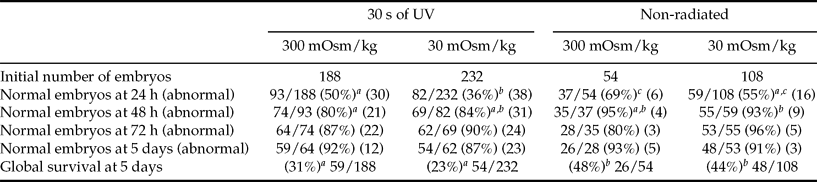
Results from Experiment I are shown in Table 1. In the irradiated groups, significant differences were observed in the survival rate at 24 h between the two handling media osmolarity (300 mOsm/kg: 50% and 30 mOsm/kg: 36%; p < 0.05). However, this difference gradually disappeared from the 48 h to 5 days stage, and even in the global survival (cumulative survival). Moreover, in the non-radiated groups, micromanipulation medium osmolarity did not affect embryo survival rates at any developmental stage. These results could indicate that the osmotic shock produced when chimaerism is performed in 30mOsm/kg micromanipulation medium osmolarity does not apparently affect long term survival in a relevant manner (Cardona-Costa & Francisco-Simão et al., Reference Cardona-Costa, Francisco-Simão, Pérez-Camps and García-Ximénez2009). As was expected, global survival (cumulative survival) rates in the irradiated groups were significantly lower than in non-irradiated (Francisco-Simão et al., Reference Francisco-Simão, Cardona-Costa, Pérez-Camps and García-Ximénez2009).
Survival rates of transplanted embryos. Embryos were irradiated or not (controls) and manipulated in different osmolarity media (30 and 300 mOsm/kg).
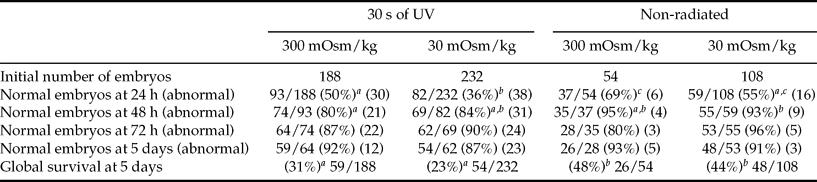
a–cColumns with different superscripts are statistically different (p < 0.05).
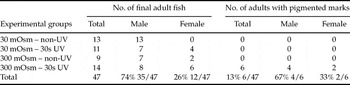
It may be noted that the number of males was higher than females in all experimental groups. No interpretation of this observation could be made because the system and factors of phenotypic sex determination are unknown in zebrafish (Saito et al., Reference Saito, Goto-Kazeto, Arai and Yamaha2007).
Only six (four males and two females) from the 47 total adults showed wild skin pigmentation and all of them belonged to the 300 mOsm-30s UV experimental group (Table 2). Moreover, it should be emphasised that high rates of wild offspring (50%) were also only observed in the 300 mOsm–30 s UV group (Table 3). This fact confirms that the presence of pigmentation acts as an excellent sign of germ-line chimaerism in zebrafish (Lin et al., Reference Lin, Long, Chen and Hokins1992). In medaka fish, the gamma irradiation of recipient embryos also favoured the appearance of large pigmentation signals from donor cells and, in parallel, a significant increase in germ-line chimaerism (Joly et al., Reference Joly, Kress, Vandeputte, Bourrat and Chourrout1999).
Sex distribution and pigmented marks in adult presumptive chimaeras.

Wild skin pigmentation rates in F1 larvae assessed at 48 h.

a,b Data in rows with different superscripts are statistically different (p < 0.05).
*As all were males, gold females were introduced to make the germ-line chimaerism assessment feasible.
According to the results obtained, the penalization of recipient embryo with a radiation dose of 0.529 mW/cm2 for 30 s together with the manipulation in 300 mOsm/kg handling medium osmolarity was the combination that obtained the best somatic and germ-line chimaerism rates.
Acknowledgements
We would like to thank Mr Javier Rubio Rubio for technical support regarding colony maintenance, microinstrument making and embryo micromanipulation. The authors also thank Mr Neil Macowan for revising the English of this manuscript.
Manuel Francisco-Simão received a grant from the AECI (Spanish Agency for International Cooperation) and the Universidade Agostinho Neto (Angola).
This work is part of the project AGL2008-03275. Financial support for this project was denied by the CICYT of the Spanish Government Ministry of Science and Innovation.