

1. Introduction
The rapid economic growth in China has transformed the lives of hundreds of millions of people, but it has also created rampant inequalities between the fast growing urban sector and the lagging rural areas, as well as a demand for resources with global repercussions. Following the successful agricultural sector reform, much attention has been given to the potential for increasing productivity in the forest sector. We use plot-level data of 3,180 households in eight provinces of China to analyze the relationships among property rights, tenure security and investment in forests. We find that the forest tenure reform that began in 2003 significantly strengthened owners’ perceptions of tenure security and increased forestry investment. Contracted property rights have significant and positive effects on tenure security and investment, but the perception of security does not stimulate investment in a statistically significant way.
A number of studies have reviewed the factors driving the emerging increase of forest coverage in China and the growth of forest farmers’ income (Jacoby et al., Reference Jacoby, Li and Rozelle2002; Li and Wang, Reference Li and Wang2009; Xu and Jiang, Reference Xu and Jiang2009; Xu et al., Reference Xu, White and Lele2010). Well-defined property rights have been identified as a key element for the stimulation of investment in the forestry sector. Awareness has increased among policy makers regarding the importance of land tenure systems and the fact that uncertainty with regard to future returns weakens farmers’ incentives to invest in their land (Wen, Reference Wen1995; Yao, Reference Yao1995).
Most studies of land rights, uncertainty and investment focus on rural sector and agricultural land, because the majority of the poor live in rural areas, and because rural land is seen as a critical production factor for farmers. Rural land policy thus points to some important issues with regard to poverty alleviation and food security. Tenure reforms have been more common for agricultural land than for forestland. In China, since the Household Responsibility System (HRS) reform was implemented in the early 1980s, agricultural land has been completely under household management in the forms of private plots, responsibility land, ration land and contract land. However, forestland reform lagged behind until the recent forest tenure reform in China beginning in the early 2000s, in terms of people and area affected (Xu et al., Reference Xu, White and Lele2010).
There is, thus, an obvious interest among policy makers in understanding the incentives for forest investment. Past research shows some interesting results of tenure reform. Using country-level data and an OLS approach, Bohn and Deacon (Reference Bohn and Deacon2000) estimated the effect of ownership risk on the overall capital investment ratio of a country and the change of its forested acreage, which is found to be highly significant and quantitatively important. Similarly, studies in Latin America confirmed a significant effect of land titling on investment, as in Honduras (Alston et al., Reference Alston, Libecap and Schneider1995), Nicaragua (Lopez, Reference Lopez1997), Paraguay (Carter and Olinto, Reference Carter and Olinto2003) and the Amazon frontier (Deininger and Chamorro, Reference Deininger and Chamorro2004). The findings from Ethiopia remind us that the impacts of reforms, in some cases, need to be analyzed at a more disaggregated level. Holden and Yohannes (Reference Holden and Yohannes2002) found no evidence that tenure insecurity has a negative effect on investment in trees in southern Ethiopia, whereas Deininger and Jin (Reference Deininger and Jin2006) worked in the highlands of Ethiopia and found that investment was enhanced by the transfer of rights to land associated with tenure security.
There are even fewer studies that specifically look at the relationship between property rights, tenure security and investment incentives in the forest sector, especially in China – a gap that this study intends to fill. The performance of China's recent collective forest tenure reform has, however, been assessed by a number of studies (see, for example, Kong et al., Reference Kong, Guo and Li2006; Zhao, Reference Zhao2009; Xu et al., Reference Xu, White and Lele2010). However, there is still a need to analyze how property rights reform contributes to forestland-related investment. This could have long-term impacts on both rural economic growth and environmental conservation (i.e., through tree planting, forest resource protection and forest management.
The empirical literature is not conclusive with regard to the impact that increased tenure security can have on investments in forestry. There are basically three reasons for the lack of robust findings. First, there is the case when investments are conducted in order to enhance tenure security. An endogenous bias then exists when estimating the effect of tenure security on agricultural or forestry investment. For example, in the data collected by the World Bank in Ghana, Migot-Adholla et al. (Reference Migot-Adholla, Benneh, Place, Atsu, Bruce and Migot-Adholla1994) found that tenure security clearly and positively affects investment. Besley (Reference Besley1995), however, working with the same data, successfully modeled and empirically tested the endogeneity of investment in tenure security using land rights as instruments. Similarly, Baland et al. (Reference Baland, Gaspart, Place and Platteau1999), in their study of 36 villages in central Uganda, present evidence that investment enhances tenure security, yet the reverse relationship is not true. Furthermore, the study by Brasselle et al. (Reference Brasselle, Gaspart and Platteau2002) in Burkina Faso demonstrated the lack of influence of tenure security on investment, and they also concluded that land-related investment appears to be undertaken primarily to increase tenure security rather than as a consequence of more secure rights.
Second, most of the existing studies rely on evidence from small samples in limited geographical domains.Footnote 1 For instance, Besley's (Reference Besley1995) influential study in Ghana looked at 1,074 fields (of 217 households in total) in Wassa and 494 fields (of 117 households) in Anloga. The study by Brasselle et al. (Reference Brasselle, Gaspart and Platteau2002) was based on 205 households from nine villages located in two neighboring departments. Holden and Yohannes (Reference Holden and Yohannes2002) studied 505 households in 15 sites in southern Ethiopia. Small sample size may bias the estimated coefficient toward zero (Deaton, Reference Deaton1997) because the variation in land rights is quite limited. Therefore, small sample size can be a possible explanation for the inconclusive results in the existing studies in African countries (Deininger and Jin, Reference Deininger and Jin2006).
Third, the proxies used for tenure security are not always well justified. Besley (Reference Besley1995) used land rights as instruments (transfer rights) to measure tenure security. Bohn and Deacon (Reference Bohn and Deacon2000) indexed the ownership risk by measurements of the country's political instability and type of government regime in power. Jacoby et al. (Reference Jacoby, Li and Rozelle2002) used length of time a plot had been used, and Brasselle et al. (Reference Brasselle, Gaspart and Platteau2002) used possession of documents certifying land rights.
This study aims to add to the empirical evidence of the causal link between property rights, tenure security and forestland-related investment in China. It is of great general interest to understand how well the most recent property rights reform in China's collective forest sector contributes to forestland-related investment, because this is one of the most important policy objectives of the reform. Stimulating forest investment is also key to rural economic growth, in terms of increasing farmers’ income from forest and agricultural land, as well as environmental conservation.
Using plot-level data of 3,180 households in eight provinces of China, we have information on the three key factors of interest:
-
(1) forest investment – the monetized summation of all forms of forestry-related inputs, including labor and capital, as a consolidated index of the quantity of resources that the household allocates to its forestland – this index represents the farmers’ investment in and attention to forestland;
-
(2) tenure security – respondents’ expectations as to whether they will still own the plot after five years;
-
(3) property (tenure) rightsFootnote 2 in two forms – (i) nine specific rights that the household perceives that it holds for a plotFootnote 3 ; (ii) the property rights index generated by summing up the scores of all the nine rights.
The empirical strategy involves a sequence of estimation stages. First, ordered probit models are employed to examine correlated factors on forestland owners’ expectation of still owning their plots after five years. Second, because the perceived tenure security lacks variation in the sample, as over 91 per cent of respondents perceived high security in owning their plots, we also need to take into account selection bias when estimating forestry investment. We therefore use the Heckman two-stage selection models to estimate determinants of forestry investment, and random effects models using the panel data as a comparison.
Our major findings are as follows. (1) The new forest tenure reform after 2003 is found to significantly strengthen owners’ perceptions of tenure security and to increase forestry investment. (2) Contracted property rights have significant and positive effects on tenure security and investment, but the perception of security does not stimulate investment in a statistically significant way. (3) Previous investment in forestland (in the year 2000 in this case) does not significantly affect tenure security the same way as in Ethiopia, implying no distinct evidence of the common endogenous relation between tenure security and investment in the China case; however, previous investment does increase future investment – possibly due to investment inertia. In addition, a household's income structure, credit ability and political influence matter for both forestland tenure perception and related investment, as expected.
2. Data and descriptive statistics
The data come from the Environmental Economics Program in China (EEPC) of Peking University.Footnote 4 The survey was conducted in 2006–2007, collecting both household and village levels of information from eight provinces (Fujian, Jiangxi, Zhejiang, Anhui, Hunan, Liaoning, Shandong and Yunnan). At that time, more than 10 provinces had announced their plans for the most recent tenure reform in collective forest areas. A brief review of China's forest tenure reforms can be accessed in the online Appendix available at http://journals.cambridge.org/EDE.
In each province, the surveyed counties were randomly chosen, and interviews were conducted in 10–20 randomly selected households in each of five or six villages that were randomly selected in each county. Figure A1 (see online Appendix) depicts the surveyed provinces on the map of China; table A1 (online Appendix) lists the sample statistics of the survey. The information collected at the household level includes their social, economic and demographic characteristics, production and consumption, land use practices and land rights, forest management activities and use rights, asset changes, social capital and relationships, as well as information on participation in the reform. The time span in the questionnaires covered 2000 (before the reform) and 2005 or 2006 (after the reform).Footnote 5 Below is a brief introduction and descriptive statistics.
2.1. Property rights regime under the reform
In China, forestlands are declared as collective property. Individual households can receive contracts for use rights to forestland and the ownership of trees planted on forest plots. This management form (i.e., individual household management) consists of private/family plots and responsibility plots/hills. The latter is different from the former in that decision making needs to be shared by both the collective and households, although the collective owns both the land and the trees in both cases. Table A2 (online Appendix) provides statistics about the shares of different tenure types in each province, presenting the absolute dominance of individual management, ranging from 50 per cent in Fujian to 92 per cent in Hunan. Given its dominance as a management form and the goal of the recent collective forest tenure reform, it is of great importance to study how the contracted rights that farmers enjoy affect their tenure security perceptions and investment incentives.
The data for contracted property rights provide information on: (1) forestland use rights, which are the rights to: convert to agricultural land, convert to other forest types, select tree species to plant, manage non-timber forest products, and abandon forestland; and (2) gains-from-trade rights, which are the rights to: mortgage plots or forestland certificates as collateral and transfer plots within or outside their own village. Following Holden et al. (Reference Holden, Xu and Jiang2009), we also create a property rights index representing the strength of the bundle of rights farmers enjoy, by summing up the scores of each perceived right. A score of 0 means that respondents did not feel they had any specific right, 0.5 means they were uncertain because approval by the village leadership was required, and 1 means they were sure about this right. Table A3 (online Appendix) shows the summary statistics of each disaggregated right and the rights index.
On average, farmers’ perceptions of forestland use rights are stronger than gains-from-trade rights in all eight provinces (indicated by the greater mean values of the first five rights compared to the remaining four). Forestland owners enjoy significantly stronger rights than others in Fujian (4.99), Jiangxi (5.45), Zhejiang (5.23) and Shandong (6.13), as seen by their mean values of the property rights index compared with those of the full sample (4.53). Forestland transfer and mortgage rights are perceived to be weaker than the basic land-use rights in each province. Owners in Hunan perceive the weakest rights (0.14), with the right to mortgage forestland certificates as collateral allowed only on 0.7 per cent of plots (the lowest in the whole sample), and more than 2 per cent of plots with no perceived land-use rights.
In addition to whether perceived land rights increase owners’ inclination to invest, this study also investigates whether holding a forestland certificate (or contract) or not and the length of certificate (or contract) affect investment, especially because the reform extended the allowable contract period to 30–70 years. In the survey data, the average contract length is 69 years, but only 23 per cent of plots have forestland certificates (online Appendix, table A4).
2.2. Farmers’ perception on tenure security
To measure tenure security, existing literature has used various proxies: possession of formal title, length of time a plot has been used (Jacoby et al., Reference Jacoby, Li and Rozelle2002), possession of documents certifying land rights (Brasselle et al., Reference Brasselle, Gaspart and Platteau2002) and transfer rights (Besley, Reference Besley1995), for example. Deininger and Jin (Reference Deininger and Jin2006) introduced a new subjective indicator for tenure security – whether a household perceives a risk of land redistribution in the future, e.g., the next five years; Holden et al. (Reference Holden, Xu and Jiang2009) found a more precise subjective indicator that expresses households’ perceptions of tenure security, i.e., whether a household still owns the specific land after five years. Both Deininger and Jin (Reference Deininger and Jin2006) and Holden et al. (Reference Holden, Xu and Jiang2009) used households’ perceived ability to transfer, mortgage or sell land to indicate the transferability of land in their studies.
Holden et al. (Reference Holden, Xu and Jiang2009) used as their dependent variable whether a household expected to hold a plot after five years in their analysis of plot-level tenure security in three provinces of China (Fujian, Jiangxi and Yunnan). Hence this study also adopts this variable. This is a satisfactory proxy for perceived tenure security, mainly because tenure security is a subjective variable, which means that there hardly exists an objective measurement for it. We also follow Holden et al. (Reference Holden, Xu and Jiang2009) as to how to score the answer to the question of whether the respondent expects to hold the plot after five years. A score of 2 is given to the tenure security variable if the respondents answered yes, 1 if they were uncertain, and 0 if they were sure that they would not hold this plot after five years. Table A5 (online Appendix) gives the summary statistics of farmers’ perceived tenure security.
In each province, a majority of the owners felt secure that they would still hold their plots after five years, as all the mean values are close to 2. In the full sample, almost 89 per cent of respondents reported that they were sure to own the plot after five years, while only 1.9 per cent were sure they would not, and the rest were uncertain. This implies a lack of variation in tenure security which would be necessary to take into account when empirically estimating its impact on investment.
2.3. Forest investment
The investment variable is an aggregation from the survey data of all forest-related labor and financial expenditures. There are two main reasons for totaling all capital investment (or expenditure) and money-equivalent labor inputs to measure the interests among households for forestry-related investments. First, stimulating investment/attention in forestland by forest farmers is seen as one of the most important policy objectives of the reform, as much of the forestland has received suboptimal investment levels in the past. Second, the great majority of people will sustain themselves on agricultural incomes or off-farm earnings. They will only expect the return of their inputs on forestland in a longer term. This means that all productive inputs, such as labor, trees, seedlings, fertilizer, pesticide, irrigation, machinery cost related to transportation of seedlings, etc., can be seen as investments.
The monetized investment variable is an improvement over the existing literature. The aggregated investment reflects the effort that farmers put into forestland. It also measures the attention and care that farmers put into forest management. In contrast, previous studies either use a binary investment variable or only consider tree planting behaviors or land-related improvements to measure land-related investment.
Table A6 (online Appendix) shows the total expenditure on existing forestland in the eight provinces before and after the reform, by summing up the following two elements: (1) physical investment in fertilizer, pesticide, irrigation, machinery cost in transporting seedlings and timber or fruits, etc., plus farmer households’ afforestation-related investments consisting of trees, areas and seedlings; and (2) labor input related to forest management, such as time spent on planting trees, nurturing or taking care of forest, etc., multiplied by their daily wages.
Except for Hunan and Zhejiang, both the average investment and the maximum invested amounts in 2005 are significantly higher than the levels in 2000. One likely reason is that Zhejiang has a more advanced industrial economy and a well-functioning off-farm job market. In Hunan, we have no forestland plot samples controlled by individual households. However, looking at the investments in other tenure types, Hunan showed a mean of CNY 230 and a maximum of CNY 15,400 in 2005, as compared to no investment in 2000. One possible reason could be the strikingly poor perception of property rights (an average property rights index score of 0.14), compared to the other provinces’ scores, which were greater than 4 (see online Appendix, table A3). Although tenure security overall is quite high in all eight provinces, Hunan has the lowest with an average of 1.7.
2.4. Explanatory variables
Table A4 (online Appendix) gives the sample means and standard deviations of the household and forest plot characteristics, as well as other control variables. The choice of explanatory variables has been precipitated by our hypotheses, economic theory and related empirical papers (e.g., Besley, Reference Besley1995; Deininger and Jin, Reference Deininger and Jin2006; Holden et al., Reference Holden, Xu and Jiang2009). The household characteristics include household size, household head's age, sex and education, total household income and forestry income share, liquidity constraints (i.e., house value, borrowed money or not), political power proxies (i.e., party membership, village leadership, once having a job in the forestry sector), and a proxy for social capital (i.e., whether they can successfully borrow CNY 500 within one week). The plot characteristics include plot size, total number of plots in 2005, irrigation condition, distance to home and road, slope, forest type, year when contracted, length of a rotation period, certificate received or not and length of contract.
There is yet another factor that affects forest investment, which is enforcement cost and the expected future costs of management.Footnote 6 Even though rights are perceived as secure, the enforcement can be costly due to, for example, high demand for land, harmful social norms, inconvenience of access to forest, etc. Because these factors differ between the counties and villages, they will also affect the investment decisions. Unfortunately, because we lack good data on these categories of enforcement costs, their effects on investment cannot be fully captured, which is a limitation of this paper. The distance-to-home variable, however, is one variable that we expect to explain at least a small part of enforcement cost, together with the regional dummies.
Income level is higher in Zhejiang, Anhui and Yunnan, while forestry income share is the highest in Fujian (6 per cent). In Jiangxi and Zhejiang, forestry contributes 4 per cent to total household income, compared to 2 per cent in Anhui and Yunnan. Plot size is largest in Fujian and smallest in Shandong. More of the forests are on steeper land in Zhejiang, Liaoning and Yunnan. Distances to home and road are more than 1 km on average, except for Shandong, where distances are shorter.
The length of a rotation period is the longest in Liaoning (35 years) and Hunan (30 years), but is only 12 years in Jiangxi.Footnote 7 This is primarily due to agro-ecological circumstances. Liaoning is the only province located in northeastern China – where the dominant tree species are black pine, larch and robur – and forests were previously managed by state-owned forest enterprises. The overall forest age was younger in Anhui, Shandong and Yunnan when individual owners began managing their forestland. Households hold forestland certificates for an average of 23 per cent of the plots under individual control, with the lowest in Shandong (only 1 per cent) and the highest in Zhejiang (41 per cent) and Liaoning (47 per cent).
We also include: households’ total cropland area; total working days in off-farm jobs (due to their substitutive or complementary relationship with forest management); number of times the village has made small land adjustments so far; and expectations about future small land adjustments, as tenure security is expected to be affected by historical adjustments. Households in Jiangxi and Zhejiang have the greatest number of working days in off-farm jobs. Apart from its contribution to household total income, off-farm income is also seen as an opportunity cost for forestry activities. Meanwhile, total cropland area is larger in Hunan and Yunnan, close to 20 mu (1/15 ha) per household. The number of small land adjustments in the village is perceived to be relatively higher in Hunan and Liaoning than in the rest.
To see how the recent round of forest tenure reform has affected farmers’ investments, a dummy variable representing whether the village has implemented the reform or not after 2003 is included (1 = yes and 0 = no ). It is not easy to separate the effect between this round of reform and historical influence, which could also affect people's future investment behavior. So, in order to control for the inertia from previous investment behavior, the investment in 2000 is included in the investment estimation.
3. Empirical strategy
3.1. Hypotheses
This study intends to test the four hypotheses below. The first addresses the factors determining the expectation of forestland owners related to tenure security, while the remaining three focus on the determinants of forest investment.
-
(H1) Perceived tenure security is related to farmers’ wealth, political influence and experience with local institutional evolution;
-
(H2) Stronger property rights directly increase forest investment;
-
(H3) Higher perceived tenure security increases forest investment;
-
(H4) Stronger property rights increase investment because they increase perceived tenure security.
Hypothesis (H1) tests how perceived tenure security is linked to several factors. Wealthier people may feel that they have greater tenure because, for example, they have higher social status in the community or more bargaining power due to their economic influence. More powerful people may have a perception of greater tenure security due to their political advantage since they are more likely to obtain political assistance. In contrast, higher frequency of past local land redistributions may negatively affect farmers’ perception of tenure security.
With hypotheses (H2) and (H3), we will test whether forest investment is increased directly due to existing property rights reform in China, or whether it is the perceived tenure security that affects forest investment. Finally, in hypothesis (H4), we try to unravel the causality of these two effects on forest investments.
3.2. Empirical strategy
The empirical strategy involves a sequence of stages and is based on Besley's (Reference Besley1995) seminal work regarding the impact of property rights on investment incentives. In order to estimate the impact of perceived property rights on tenure security and forest investment, we need to define as follows.
I ijt (investment of household i on plot j in period t) is a continuous variable, which sums up both physical investment and the money-equivalent of labor input. We generate a consolidated investment index from our data, including the amount of resources that a household puts into its forest.
T ijt denotes perceived tenure security, i.e., how secure household i is regarding its user rights in plot j in period t.
R ij represents property rights, which is also a latent variable (how household i perceives its specific rights to plot j, or the whole bundle of rights that it enjoys).
Both T ijt and R ij are based on ordinal rankings made by the respondents. T ijt takes values 0, 1 or 2, with 0 meaning ‘insecure’, 1 meaning ‘uncertain’ and 2 meaning ‘secure’; R ij takes values 0, 0.5 or 1, meaning ‘no’, ‘uncertain because approval by village leadership is required’ and ‘yes’, respectively.
Let X and Z be two vectors of exogenous variables representing household and plot characteristics, respectively; let u, v, ε be uncorrelated error terms in each equation.
First stage: Estimation of perceived tenure security
 $$T_{ijt} = \alpha + \gamma R_{ij} + \tau I_{ijt - 1} + \delta_{1} X + \theta_{1}Z + u\comma \;$$
where tenure security T ijt is thought to be determined by previous investment I ijt−1, and rights R ij , controlling for household and plot characteristics, X and Z, respectively. The parameter γ, of contracted property rights R ij , is expected to be significant as per the belief that stronger rights secure owners’ perception of tenure. A positive and significant τ in equation (1) implies that investment enhances tenure security, hence inducing endogeneity between investment and tenure security as observed in some African countries. This will lead to endogenous bias between I ijt and T ijt when estimating investment if using conventional Ordinary Least Squares (OLS) regressions.
We use ordered probit (and logit) with maximum likelihood estimation on the estimation of tenure security, which takes a value of 0, 1 or 2, with 0 meaning ‘insecure’, 1 meaning ‘uncertain’ and 2 meaning ‘secure’. This approach allows us to capture the difference between the three categories based on the ordering. Hence, we do not ignore the effect of the second category of tenure security; the respondent who specifies his/her expectation of losing the forestland is in between a ‘no’ and a ‘yes’.
Second stage: Estimation of investment
If there is no endogenous relationship between investment and tenure security (i.e., a non-significant τ), equations (2) and (3) can be specified as:
 $${I_{ijt}}^{1} = \beta + \theta T_{ijt} + \lambda_{1} I_{ijt - 1} + \delta_{2}X + \theta_{2}Z + \nu\comma \;$$
 $${I_{ijt}}^{2} = \eta + \mu R_{ij} + \lambda_{2} I_{ijt - 1} + \delta_{3}X + \theta_{3}Z + \varepsilon.$$
In equation (2), if T ijt is affected by I ijt−1 to some degree, this may lead to a biased and inconsistent estimation with OLS regression. However, this can be managed with a number of econometric techniques, such as two-stage least squares regressions by means of instrumental variable (dealing with endogenous causality), Heckman selection specification test (for self-selection or selection bias), tobit models, fixed-effects or random-effects regressions (excluding historical and/or geographical influences in panel data).
If T ijt is not an outcome because of I ijt−1, implied by an insignificant τ in equation (1), θ in (2) and μ in (3) identify whether property rights directly affect investment (referring to hypothesis (2)), or whether it is the tenure security that affects investment (hypothesis (3)). Previous investment can safely be included here, as both rights and the investment prior to the reform are exogenous. Hypothesis (4) is identified by a significant γ in equation (1) and a two-step estimation on equation (2) to explain whether it is true that stronger property rights increase investment because they increase perceived tenure security.
4. Econometric results and discussions
Following our hypotheses and the econometric specifications in section 3, our empirical discussion in this section focuses first on determinants of perceived tenure security and whether previous investment on forestland affects tenure security. We then turn to the factors affecting forest investments, in particular whether greater tenure security or stronger contracted rights, or stronger contracted rights through enhanced tenure security, have impacts on forest-related investment.
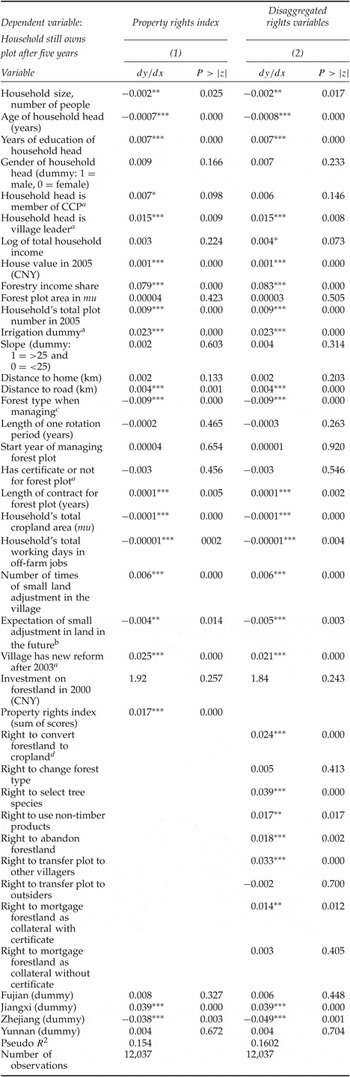
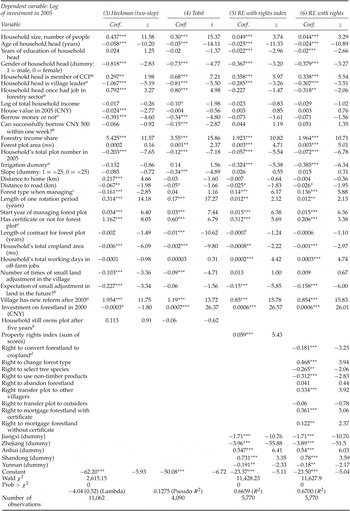
Table 1 presents the results from ordered probit models for tenure security perception, using the contracted rights index versus the nine rights.Footnote 8 Table 2 reports the estimated results for determinants of forest investment, where model 3 presents the Heckman selection results and model 4 the tobit regression using the cross-sectional data for 2005, while models 5 and 6 report the results of random effects models of rights index (5) or disaggregated rights (6) using the re-call panel with years 2000 and 2005/2006.
Factors correlated with forestland tenure security: results from ordered probit models

Notes: Anhui, Liaoning and Shandong provinces predicted tenure security perception perfectly. Their dummies were dropped from the estimation due to colinearity.
a Dummy variables (1 = yes, 0 = no).
b Ordinal variables (0 = no, 1 = unsure, 2 = yes).
c Forest type, based on availability of forest harvesting (0 = no forest, 1 = land with few woods, 2 = timber forests, 3 = bamboo and economic forests).
d Rights variables (0 = no, 0.5 = approval required, 1 = yes).
*Significant at 10%; **significant at 5%; ***significant at 1%.
Determinants of forestry investment

Notes: Fujian and Liaoning provinces predicted investment perfectly. The provincial dummies of them were dropped from the estimation due to colinearity.
a Dummy variables (1 = yes, 0 = no).
b Ordinal variables (0 = no, 1 = unsure, 2 = yes).
c Forest type, based on availability of forest harvesting (0 = no forest, 1 = land with few woods, 2 = timber forests, 3 = bamboo and economic forests).
d Rights variables (0 = no, 0.5 = approval required, 1 = yes ).
*Significant at 10%; **significant at 5%; ***significant at 1%.
4.1. Perceived tenure security
Because the ordinal dependent variable has more than two outcomes to the question of whether the household expects to still own the plot after five years (0 = no, 1 = unsure and 2 = yes ), maximum likelihood ordered probit regressions are applied to assess the factors correlated with perceived tenure security. The maximum likelihood method adopts a non-linear formulation and uses standard normal cumulative probability functions to assume distributions of error terms, so non-linear effects in estimating probabilities are corrected. This method is believed to be better designed for models with ordinal outcomes than least squares regressions, especially in large samples.
With respect to household heterogeneity, robust White/Sandwich estimation is used to correct heteroskedastic standard errors through the Taylor-series linearization method. Provincial dummies are included to control for geographical fixed effects or unobserved location-specific factors. As the coefficients of the ordered probit regressions reported by STATA are merely interpretable by their signs and z-statistics, marginal effects of the estimators are computed and presented in table 1.
The hypothesis (H1), perceived tenure security is related to farmer's economic wealth, political influence and experience of local institutional evolution, is supported in both models 1 and 2. A key finding for all individually controlled forestlands is the significant difference of perceived tenure security between villages involved in the new reform (after 2003) versus those without any new reform. The marginal effect suggests that households in reformed villages perceive a higher probability (2.5 per cent) of owning their plots five years later. Both the contracted property rights and the aggregated index of contracted property rights are positive and highly significant (at 1 per cent), demonstrating a strong enhancing correlation between the number and strength of contracted rights and the feeling of tenure security.
This finding is consistent with the study by Holden et al. (Reference Holden, Xu and Jiang2009) on Fujian, Jiangxi and Yunnan. The right to change forest type, transfer rights to outsiders and mortgage forestland without certificates are insignificant, and the right to transfer to outsiders even has a negative sign. However, the right to transfer plots to other villagers and the right to mortgage plots with certificates are positive and significant. This may imply expectations of an emerging market for land transfers in rural China. Comparing these findings to the literature, perceptions of transferability rights or even a bundle of rights can be a good indicator of tenure security, but do not provide the whole story if used as a proxy for tenure security.
The extent of land tenure security can be influenced by the social status or bargaining power of the household (Brasselle et al., Reference Brasselle, Gaspart and Platteau2002). However, their study did not include these variables in their estimation because they did not have the directly measured data. In this study, we use whether household head is member of the Communist Party and whether household head is a village leader to measure their political influence. The former has a positive sign in each model (significant at 10 per cent in model 1), and the latter is highly significant in both models. This result is interesting because, in rural China, village leaders are usually considered to be the people who implemented the reform and continue to make decisions.
The experience of local institutional evolution is measured by number of times of small land adjustment with regard to cropland and owner's expectation of such adjustment in the near future. The former is positively correlated and the latter is negative, both highly significant (at the 1 per cent level). This may be because, in rural China, cropland adjustment usually occurs every three to five years in response to new births and deaths. However, the rural population growth implies that owners perceive such cropland adjustments as gains. Interestingly, the negative relationship between the expectation of future small adjustments and tenure security perception suggests some future risk and uncertainty that farmers do not like regarding forestland as an extra asset for individual households.
It is noteworthy that the coefficient of previous investment (in the year 2000) is not statistically significant in any of the four models: perceived forestland tenure security seems not to be enhanced by investment operations in the same way as in some African countries (e.g., Ethiopia). It turns out that the estimation of the parameter τ in equation (1) is insignificant and hence the investment equation (2) or (3) can be estimated without any reason to suspect any endogeneity as hypothesized by Besley (Reference Besley1995). These results are presented in table 2 and discussed in subsection 4.2.
Several other interesting findings emerged from our results. First, the log of household total income (significant at the 10 per cent level) plus the 2005 house value (indicator of wealth level in rural China, and significant at 1 per cent) are positively associated with a more secure feeling on tenure, but with a very small magnitude of marginal effects. Second, the importance of forestry in household income, household's total number of plots, plot's irrigation condition and distance to road are all highly significant and positively correlated with tenure security perception. For example, the farther a plot sits from a main road, the smaller the probability of land acquisition by the government or companies to build a highway. Third, more years of education implies a greater possibility of working in off-farm jobs, which is also consistent with the coefficient of household's total working days in off-farm jobs. Although a larger family size indicates a higher gain of plots allocated by the government, it also means more population for intra-household reallocation of forestland (inheritance), which is a tradition in rural China. Both these factors undermine tenure security perception in a statistically significant way (at the 1 per cent level), but the magnitude of marginal effects is rather small (0.2 per cent and −0.07 per cent). In addition, Jiangxi significantly enjoys higher tenure security than other provinces, while Zhejiang is the opposite.
4.2. Determinants of forestland-related investment
There are several econometric issues to consider in estimating investment. Although the EEPC survey was designed based on the random sampling rule, potential selection bias is still a concern because: (1) there are a significant number of plots without any investment or input; (2) the tenure security perception variable has a limited variation (the mean is 1.87 with 2 as max, and standard deviation is 0.39). Selection bias or rationing may be caused by other factors, such as perceived rights or household socio-economic characteristics (Heckman, Reference Heckman1990). So selection bias was checked first by a Heckman selection specification test. Because the test result rejects the hypothesis of no selection bias in the model, a two-step approach suggested by Heckman (Reference Heckman1990) and Deaton (Reference Deaton1997) was applied to correct for the model and obtain unbiased estimates. The results of the second stage are reported in the column for model 3 in table 2.Footnote 9 It also reports the results of a tobit regression under model 4 due to a large number of ‘0’ investment in 2005.
Another concern is the possible endogeneity in households’ expectation/perception of tenure security when estimating investment incentives, which is a common case in Ethiopia, and one of the findings of Brasselle et al. (Reference Brasselle, Gaspart and Platteau2002). It is not certain whether farmers in China also invest in their plots to enhance tenure security, but this can be checked by econometric methods. The third concern refers to hypotheses (H2), (H3) and (H4), i.e., whether stronger contracted property rights stimulate investment directly or through enhanced tenure security.
Models 5 and 6 use the property rights index and each specific right in random effects models, using the panel data (for year 2000 and 2005/2006) to estimate their direct effect on investment propensity. The most significant result is that both the property rights index (model 5) and each of the contracted rights (except the right to abandon or transfer plot to outsiders in model 6) appear to have a significant impact on investment behavior.
This result provides strong evidence for hypothesis (H2) that stronger property rights directly increase forest investment. The coefficient of property rights index in model 5 implies that a higher score is estimated to increase investment by 5.9 per cent. In model 6, the marginal effects induced by gains-from-trade rights are relatively greater than use rights. For example, stronger perceived rights of the ability to transfer a plot to other villagers and to mortgage a plot as collateral significantly increase investment, by more than 30 per cent (33 per cent and 36 per cent, respectively).
Other than the right to change forest type, use rights actually reduce the propensity to invest. The use rights that have this effect include the rights to convert forestland to cropland, to select tree species and to use non-timber products. The coefficients for these negative relationships are significant at the 1 per cent and 5 per cent levels. Such negative relationships could be seen as counterintuitive because fewer restrictions should increase the potential return and subsequently the incentive to invest. However, for many plots, there is an opportunity cost in terms of even more profitable agricultural uses. The impact of these rights on forestry-related investments could therefore be seen as a reflection of the greater value of the land in alternative uses.
Model 3 suggests that, when selection bias is well controlled, enhanced tenure security does not have any significant effect on investment incentive (given the coefficient of the variable Household still owns plot after five years is 0.113 and its z-statistic only 0.91, not significant even at the 10 per cent level). This insignificance could also be due to the lack of variation in the tenure security perception variable, as the effect of village has new reform after 2003 is positive and significant (at 1 per cent). In other words, although contracted property rights enhance tenure security perception (from models 1 and 2 in table 1), they do not necessarily affect investment through tenure security. Hence, hypotheses (H3) and (H4) are rejected due to lack of evidence supporting the impact of perception on investment.
Rather, households with larger plot size and fewer plots, plots without irrigation, and plots situated closer to roads are more likely to invest in forestland, implied by the significance in models 4, 5 and 6. The coefficients of forest type in all four models demonstrate the belief that individual management stimulates harvesting and reforestation; hence more investment and input are undertaken in forestland with easier availability to harvest. This finding complements the study by Xie et al. (Reference Xie, Berck and Xu2011) on the reform's effect on plantation at the village level. (Note that our study uses household- and plot-level data.)
Models 5 and 6 focus on testing hypotheses (H2) and (H3), using random effects regressions with the panel data of 2000 and 2005/2006. A satisfactory estimating power is achieved, with roughly 67 per cent of the variation of investment being explained in such a large sample. Again, the new forest tenure reform is significant in encouraging forest investments, when 85 per cent higher investment is found in villages embracing the reform, compared with those without reform. The effect of the reform is distinctive and consistent in models 5 and 6, first with that of a forestland certificate: people with a certificate have a 31.2 per cent (or 21 per cent) higher incentive to invest than those who do not, which is significant at the 1 per cent level. Second, the more recently owners began to manage their plots, the higher the estimated incentive, by 1.5 per cent (at 1 per cent significance). Respondents’ expectations of future land adjustments discourage forest investment by 15 per cent (significant at 1 per cent) due to potential risk of land acquisition.
Household demographic and socio-economic characteristics affect investment propensity. Larger household size implies more labor available for forestry activities and its coefficient (0.049 or 0.044) is significant at the 1 per cent level. Age, gender and education of household head are negatively correlated with investment. We believe this is because older people may have less to gain from such long-term investments, and because males or more highly educated people may be engaged more in off-farm jobs. This is consistent with the negative coefficient of household's total cropland area, implying farming as a substitute for forestry activities.
A household's total number of working days in off-farm jobs has a small positive effect on investment. This is not as expected by the opportunity cost theory, which is that off-farm working time can be seen as an opportunity cost for forest investment. However, it implies that forestry activities, rather than being seen as a substitute for farming, are complementary to off-farm jobs. This effect may be a result of increased household income, as off-farm employment on average contributes 45 per cent of total household income in China.Footnote 10 Intuitively, higher income should provide more incentive for investment, but the evidence is not strong, since the sign of household total income is negative.
Being a Communist Party member or village leader implies strong bargaining power and access to more information, and is estimated to significantly increase investment by one-third over those who are not (models 3, 4, 5 and 6). The negative coefficient of household head as a village leader may be explained by less time available for forestry activities (substitution effect). The income effect on forest investment from a government salary as a village leader is ambiguous, given the insignificant coefficient of total household income (in log form) and the significantly small positive effect of household's total working days in off-farm jobs. Nevertheless, labor distribution is found to significantly affect forest investment.
Household's income structure is represented by household's total income and forestry income share. It is worth noting that a potential endogeneity might be imposed by this variable because the share value is computed by the 2005 forestry income as a share of total household income. Still, we choose to use it because: (1) sufficient data for forestry income is not available from recall for the year 2000; and (2) forestry income is a small part of income, and household income structure in rural China does not vary much across years, e.g., the forestry income shares are no more than 5 per cent, in most cases much less. Therefore, we choose to measure the importance of forestry in a rural family. The result is that a 1 per cent increase in the share of forestry income is estimated to encourage investment by 1.92 per cent.
Credit and liquidity indicators, however, such as house value in 2005, whether the family borrowed money or not in 2005/2006, or whether they can successfully borrow CNY 500 within one week, are not statistically significant in models 5 and 6. Due to the lack of well-designed and well-functioning credit markets in rural China at that moment, the insignificance of such variables lacks a precise explanation. As stronger mortgage rights strengthen the incentive to invest, more work needs to be conducted in analyzing the effect of building infrastructure and implementing enforceable mechanisms for credit markets.
During the survey in Jiangxi, formal credit and forestland transfer markets existed only in Chongyi County, out of five visited counties. Moreover, the limited magnitude of land transfer transactions suggests that the shadow price of demand for forestland is below the owners’ reserve price. More research is needed to study the land transfer market and owners’ willingness to accept by estimating a supply and demand curve for such market. Also, taking into account the government's concern for the poorest people and poverty reduction, welfare loss and market/seller/buyer characteristics would be interesting research issues to pursue.Footnote 11
The robustness of the results in models 5 and 6 were tested by adding provincial dummy variables to control for geographical or other unobservable factors. Our estimations do not vary. Because of collinearity, the Liaoning, Shandong and Anhui dummies were dropped from the tenure security estimations, and the Fujian and Liaoning dummies were dropped from the investment estimations. When estimating investment, the rest show distinctive and significant effects: Anhui and Shandong have higher investment in forestry (at 1 per cent), while Jiangxi, Zhejiang and Yunnan have less.
5. Conclusions
Institutional change can alter natural resource and environmental outcomes as well as people's welfare (Bohn and Deacon, Reference Bohn and Deacon2000). This paper assesses how tenure reform in China's collective forest sector affects Chinese farmer households’ perception of tenure security and propensity to invest in their forestland. A large database obtained from comprehensive surveys in eight provinces is used to quantitatively explore factors correlated with stronger perceived tenure security and determinants of forest-related investment.
The evidence from this study adds to the literature in four aspects. First, in China, there is limited research testing whether there is endogenous causality between investment and tenure security, as has been seen in some African countries where investment has been undertaken to enhance tenure security.
Second, the data allow an explicit differentiation between perceived tenure security and contracted use and transferability rights, which are two concepts largely treated as proxies and deemed interchangeable in the literature (Deininger and Jin, Reference Deininger and Jin2006). Overall, stronger contracted rights were found to provide important and direct investment incentives, but this does not necessarily come about through enhanced perceived tenure security. We should caution, though, that this finding may be due to the lack of variation in the tenure security variable. When looking at each contracted right, use rights enhance tenure security more significantly than transferability-related rights. Rights to change forest type, to transfer forestland to other villagers and to mortgage significantly stimulate investment, while other use rights undermine the incentive to invest in forestry. This suggests that households attach little importance to forestry in rural China – maybe due to its small contribution to household income. It also suggests that a well-defined market and enforceable rules would work well for forestland transfer.
Third, the direct impact of property rights on the incentive to invest is good news for policy makers. Given this finding that transferability and gains-from-trade rights significantly increase investment propensity, the next step of reform should focus on building infrastructure and devising mechanisms that create and support formal credit and land transfer markets in rural China.
Last but not least, the changes from China's forest tenure reform – where individual households can manage forestland, empowered by legal certification and stronger contract rights – enhance tenure security and encourage forest investment. These results show good prospects for the reform of state-owned forest areas, which have long struggled to overcome poor efficiency, heavy social burdens and forest resource degradation. Policy makers have made progress in reducing the effects of land insecurity on investment, but they need to be careful, as the vulnerability of tenure security perception is also correlated with many factors. Meanwhile, the emerging increase in investment and growth in the rural and forestry sector, coupled with the importance of forestry for global markets – given China's large share of global demand for timber and forest products – will provide China with opportunities as well as challenges.
Supplementary materials and methods
The supplementary material referred to in this paper can be found online at journals.cambridge.org/EDE/.