Introduction
In 1960, George EngelReference Engel1 criticized the reductionistic concept of disease in medicine: “the traditional attitude toward disease tends in practice to restrict what it categorizes as disease to what can be understood or recognized by the physician and/or what he notes can be helped by this intervention. This attitude has plagued medicine throughout its history and still stands in the way physicians’ fully appreciating disease as a natural phenomenon.” As an alternative, he proposed the biopsychosocial model, Reference Engel2 which uses a multifactorial frame of reference and allows illness to be viewed as a result of interacting mechanisms at the cellular, tissue, organismic, interpersonal, and environmental level, as essential components of the whole system.Reference Engel3
Although Engel thought that the transition from the narrow biomedical model to the biopsychosocial model was the major challenge to medicine at the turn of the 20th century, Reference Engel4 medicine seems still biomedically orientedReference Fava and Sonino5 and seems to neglect the relevance of psychosomatic phenomena in the medically ill.Reference Fava and Sonino6
Psychiatry and clinical psychology still embrace the reductionistic biomedical model basing their assessment on psychometric instruments, questioned already in the 1980s in favor of clinimetric principles.Reference Fava, Carrozzino, Lindberg and Tomba7 Among others, the Diagnostic and Statistical Manual of Mental Disorders (DSM) has shown a limited clinical utility in psychosomatics.Reference Cosci and Fava8 Its fifth edition9 (DSM-5) did not give room to relevant clinical phenomena such as demoralization, allostatic overload, and hypochondriasis, which exist in the clinical realm.Reference Cosci and Fava8 In addition, the DSM-5 diagnosis of somatic symptom disorder has the limit to deemphasizing the role of medically unexplained symptoms, Reference Cosci and Fava8 while the diagnosis of conversion disorder emphasizes the outdated role of medically unexplained symptoms.Reference Cosci and Fava8 Moreover, the DSM-5 diagnosis of illness anxiety does not include hypervigilance to bodily symptoms and is characterized by overlapping criteria of somatic symptom disorder and illness anxiety disorder, Reference Cosci and Fava8 while the DSM-5 diagnosis of psychological factors affecting other medical conditions poorly specifies the psychological or behavioral factors that adversely affect a medical condition.Reference Cosci and Fava8 In brief, the DSM-5 seems to capture only a narrow part of the information necessary for the clinical process and neglects important features concerning psychological factors affecting medical conditions and abnormal illness behavior. The DSM-5 classification of somatic symptoms and related disorders, although it has introduced substantial modification in diagnostic criteria, does not seem to meet the basic requirements of clinical utility in the field of psychosomatic medicine and the identification of the psychological factors influencing the course of medical disorders.Reference Cosci and Fava8
In 1995, an international group of researchers developed a set of Diagnostic Criteria for Psychosomatic Research (DCPR)Reference Fava, Freyberger and Bech10 to help clinicians in translating psychosocial variables at the interplay of biological, psychological, and social factors into operational tools. The DCPR had been applied in several medical settings: cardiology, Reference Mangelli, Semprini and Sirri11–Reference Rafanelli, Roncuzzi and Milaneschi13 oncology, Reference Grassi, Sabato and Rossi14 dermatology, Reference Picardi, Porcelli and Pasquini15 endocrinology, Reference Sonino, Ruini and Navarrini16 psychiatry, Reference Venditti, Cosci and Bernini17 consultation liaison psychiatry, Reference Battaglia, Martino and Piazza18 and primary care.Reference Piolanti, Gostoli and Gervasi19 A semi-structured interview for DCPR was proposed.Reference Porcelli, Sonino, Porcelli and Sonino20 The DCPR and the semi-structured interview for DCPR showed clinical utility regarding the following clinical issues: subtyping medical patients, identifying subthreshold or undetected syndromes, evaluating the burden of somatic syndromes, predicting treatment outcomes, and identifying risk factors.Reference Porcelli and Guidi21
In 2017, a revised version of the DCPR (DCPR-R)Reference Fava, Cosci and Sonino22 was published under the light of the revision of the DSM nosography. According to the DCPR-R, the psychosomatic syndromes are clustered into four clinical domainsReference Fava, Cosci and Sonino22: stress (ie, allostatic overload), personality (ie, type A behavior and alexithymia), illness behavior (ie, hypochondriasis, disease phobia, thanatophobia, health anxiety, persistent somatization, conversion symptoms, anniversary reaction, and illness denial), and psychological manifestations (ie, demoralization, irritable mood, secondary somatic symptoms).Reference Fava, Cosci and Sonino22 The diagnosis of hypochondriasis was introduced since it was omitted in the DSM-5 classification, leading to subsuming of the diagnosis of hypochondria under the rubric of somatic symptom disorder and illness anxiety disorderReference Cosci and Fava8; the diagnosis of allostatic overload was added since it reflects the cumulative effects of stressful experiences in daily life.Reference Fava, Cosci and Sonino22, Reference Fava, McEwen and Guidi23 The semi-structured interview for DCPR was also revised; we have now the DCPR-R Semi-Structured Interview (DCPR-R-SSI).
The present study was run to test the criterion-related validity of the DCPR-R. Subjects with a diagnosis of migraine were studied since migraine is a disabling disorder impairing well-being and health-related quality of life, Reference Terwindt, Ferrari and Tijhuis24, Reference Lipton, Liberman and Kolodner25 and being associated with stress, Reference Kokonyei, Szabo and Kocsel26 irritability, Reference Lebedeva, Kobzeva and Gilev27, Reference Peres, Mercante and Tobo28 alexithymia, Reference Wise, Mann and Jani29, Reference Neyal Muftuoglu, Herken and Demirci30 and somatic symptoms.Reference Huber and Henrich31–Reference Demjen and Bakal33
A good criterion-related validity might be confirmed by: (1) a higher rate of DCPR-R diagnoses than DSM-5 diagnoses, (2) an incremental validity of the DCPR system over the DSM systemReference Bech34 using psychological functioning as criterion variable, (3) an association between the presence of at least one DCPR-R diagnosis and low psychosocial functioning (ie, low quality of life and well-being, high stress, psychological distress, and abnormal illness behavior).Reference Piolanti, Offidani and Guidi35
Methods
Participants
The data were collected in a subsample of subjects enrolled in the frame of the PAINMIG study, a study aimed at assessing psychiatric and psychosomatic characteristics of migraine patients enrolled at the Headache and Clinical Pharmacology Center of the University Hospital Careggi, Florence, Italy. The sample here analyzed includes the first 200 migraine outpatients consecutively recruited from September 2016 to May 2018 at the Center. Subjects had to meet the following inclusion criteria to be included: (1) a diagnosis of episodic or chronic migraine according to the International Classification of Headache Disorders, 3rd edition (beta version)36 and (2) age between 18 and 64 years. The exclusion criteria were (1) cognitive deficits or other intelligence problems affecting the ability of reading and understanding and (2) mother tongue other than Italian.
The study was approved by the Institutional Review Board of the University Hospital Careggi. Chronic migraine and episodic migraine subjects were assigned to two different groups, matched for sex and age (ratio 1:1).
Procedure
Participants were evaluated by a physician of the Centre and diagnosed with chronic migraine (≥15 days of migraine/month) or episodic migraine (<15 days of migraine/month) according to the International Classification of Headache Disorders, 3rd edition (beta version).36 Thereafter, they were evaluated by trained clinical psychologists who run a structured interview investigating sociodemographic and anamnestic information, Reference Guidi, Gambineri and Zanotti37 the DCPR-R, the structured clinical interview for DSM-5 disorders, and the psychosocial index.
Instruments
The DCPR-R SSIReference Fava, Cosci and Sonino22 is a semi-structured interview based on the DCPR-R. It has four diagnostic modules (ie, stress, illness behavior, psychological manifestation, personality) to formulate the diagnoses of allostatic overload, health anxiety, disease phobia, hypochondriasis, thanatophobia, illness denial, persistent somatization, alexithymia, conversion symptoms, anniversary reaction, somatic symptoms secondary to a psychiatric disorder, demoralization, demoralization with hopelessness, irritable mood, type A behavior, and alexithymia.Reference Fava, Cosci and Sonino22 The interview focuses on the last 6–12 months and has 79 yes/no items. The semi-structured interview for DCPR showed excellent psychometric properties in terms of construct validity, predictive validity, Reference Porcelli, Sonino, Porcelli and Sonino20, Reference Galeazzi, Ferrari and Mackinnon38, Reference Tomba and Offidani39 and inter-rater agreement.Reference Galeazzi, Ferrari and Mackinnon38 The psychometric or clinimetric characteristics of the semi-structured interview for DCPR-R have not been investigated yet.
The Structured Clinical Interview for DSM-5, Clinician Version (SCID-5-CV)Reference First, Williams and Karg40 is a semi-structured interview assessing DSM-5 disorders. It has five diagnostic modulesReference Glasofer, Brown, Riegel and Wade41 and five tree-structure modules, which allow evaluating diagnostic hypotheses.Reference Spitzer, Williams and Gibbon42 The SCID represents the gold standard for assessing mental disorders, and shows high reliability scores (kappa values 0.60–1.00) and good test–retest validity.Reference Glasofer, Brown, Riegel and Wade41 The Italian version is consistent with the English one.Reference First, Williams and Karg40
The Psychosocial IndexReference Sonino and Fava43 is a questionnaire assessing the well-being, stress, distress, quality of life, and abnormal illness behavior of the subjects. The self-rated part, which was used for the present study, includes 55 items derived from previously validated instruments: Screening List for Psychosocial Problems, Reference Kellner44 Stress Profile, Reference Wheatley45 Psychological Well-being Scales, Reference Ryff46 and a simple direct question on Quality of Life following Gill and Feinstein’sReference Gill47 recommendations. Most of the items are rated on a yes/no answer, while some are rated on a 4-point Likert scale (from “not at all” to “a great deal”), whereas the item on quality of life has five possible choices (from “awful” to “excellent”).Reference Piolanti, Offidani and Guidi35 The Italian version of the PSI has shown similar characteristics to the English one (ie, intraclass correlation coefficients ranging from 0.94 to 0.80, excellent inter-rater concordance).Reference Sonino and Fava43
Statistical analysis
Frequencies of DCPR-R and SCID-5 diagnoses were calculated. Comparisons of rates were run via the chi-square test.
Incremental validity of the DCPR-R was tested via hierarchical linear regression analysesReference Hunsley and Meyer48 to test the extent to which the number of DCPR-R diagnoses contributed over and above the number of SCID-5 diagnoses to a significant increase in the prediction of psychosocial impairment. The criterion variable (ie, dependent variable) in the hierarchical regression models was each of the five PSI subscales. The entry order of predictor variables was the following: the number of SCID-5 diagnoses served as independent variable at Step 1, the number of DCPR-R diagnoses served as independent variable at Step 2. The increase of the explained variance from Step 1 to Step 2 was used as a measure of incremental validity. Two adjustment variables were selected based on the literature: sexReference Piccinelli and Simon49, Reference Kroenke and Spitzer50 and daily use of pharmacological treatments.Reference Fallon51, Reference Sirri, Grandi and Fava52 The lifetime history for psychiatric disorders and age were also used as adjusting variables since they showed a statistically significant difference among subjects with one DCPR-R diagnosis, subjects with two DCPR-R diagnoses, and subjects with three or more DCPR-R diagnoses.
Skewness and kurtosis for each hierarchical regression variable were considered adequate for a linear model of analysis (ie, ordinary least square; OLS) in a range of ± 2.Reference Gravetter and Wallnau53 A critical p-value of ≤.01, equivalent to a Bonferroni correction of p ≤ .05 for five tests, was set. The Statistical Package for Social Science (SPSS; 21.0) was used.
Differences between subjects with at least one DCPR-R diagnosis and subject without DCPR-R diagnoses were tested via the one-way analyses of covariance (ANCOVA). The aim was to test whether the presence of at least one DCPR-R diagnosis discriminates between subjects with higher and lower psychosocial functioning. In the ANCOVA models, each PSI subscale was used as a dependent variable and the presence/absence of at least one DCPR-R diagnosis was used as grouping variable. Four adjustment variables were selected: sex, Reference Piccinelli and Simon49, Reference Kroenke and Spitzer50 daily use of pharmacological treatmentsReference Fallon51, Reference Sirri, Grandi and Fava52 according to the literature, lifetime history for psychiatric disorders, and age. A critical p-value of ≤.01, equivalent to a Bonferroni correction of p ≤.05 for five tests, was set. The statistical software MedCalc 14.8.1 was used.
Three tests were run for fine-scale ANCOVA analyses:Reference Rutherford54 (1) a test of collinearity between variables via the generalized variance inflation factor (GVIF), where a GVIF of <2 indicates no evidence of problems due to multicollinearityReference Fox and Monette55; (2) a test for absence of heteroscedasticity (ie, homoscedasticity of data) via the studentized Breusch-Pagan test, evaluated for each ANCOVA model, where nonsignificant (p > .05) studentized Breusch-Pagan coefficient (BP) indicates no evidence of problems due to heteroscedasticityReference Breusch and Pagan56; and (3) an inspection of skewness and kurtosis for each ANCOVA variable, values ≤ ±2 were considered adequate for a linear model of analysis.Reference Gravetter and Wallnau53 The statistical software R 3.3.2 was used.
Results
Two hundred subjects were analyzed. The mean age ± SD was 45.36 ± 11.77 years; 80% (n = 160) were females. The majority (78.5%; n = 157) had at least a high-school education, were employed or full-time students (83.5%; n = 188), and were married or cohabiting (64.5%; n = 129). About 19.5% (n = 39) smoked a mean ± SD of 7.14 ± 5.44 cigarettes daily and 80% (n = 160) drunk 2.57 ± 1.39 cups of coffee daily. About 30% (n = 61) had a lifetime history of psychiatric disorders, and 29.5% (n = 59) underwent at least one psychotherapy session.
Differences between chronic and episodic migraine subjects were found for lifetime history of psychiatric disorders (episodic migraine: n = 22; chronic migraine: n = 39; χ2= 6.817; df = 1; p = .009) and for frequency of current psychotherapeutic treatment (episodic migraine: n = 3; chronic migraine: n = 12; χ2 = 5.655; df = 1; p = .018).
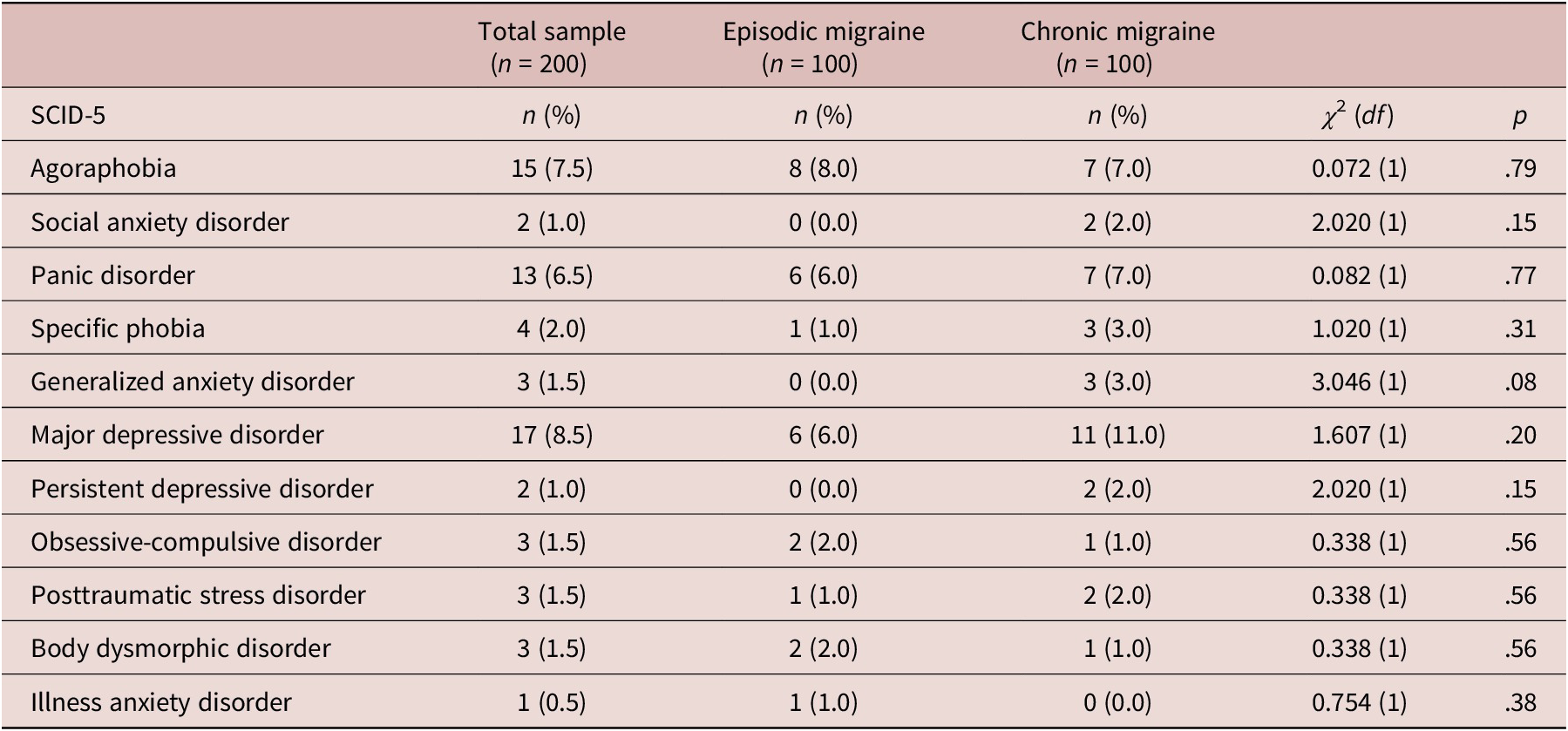
Forty-seven subjects (23.5%) reported at least one diagnosis of mental disorder according to the DSM-5 (ie, SCID-5). The most frequent diagnoses were major depressive disorder (8.5%; n = 17), agoraphobia (7.5%; n = 15), and panic disorder (6.5%; n = 13) ( Table 1). No differences were found between chronic and episodic migraine subjects related to this variable ( Table 1).
Frequencies of DSM-5 diagnoses. Difference between episodic migraine and chronic migraine outpatients (chi-square test).

Abbreviation: SCID 5, Structured Clinical Interview for DSM-5 disorders.
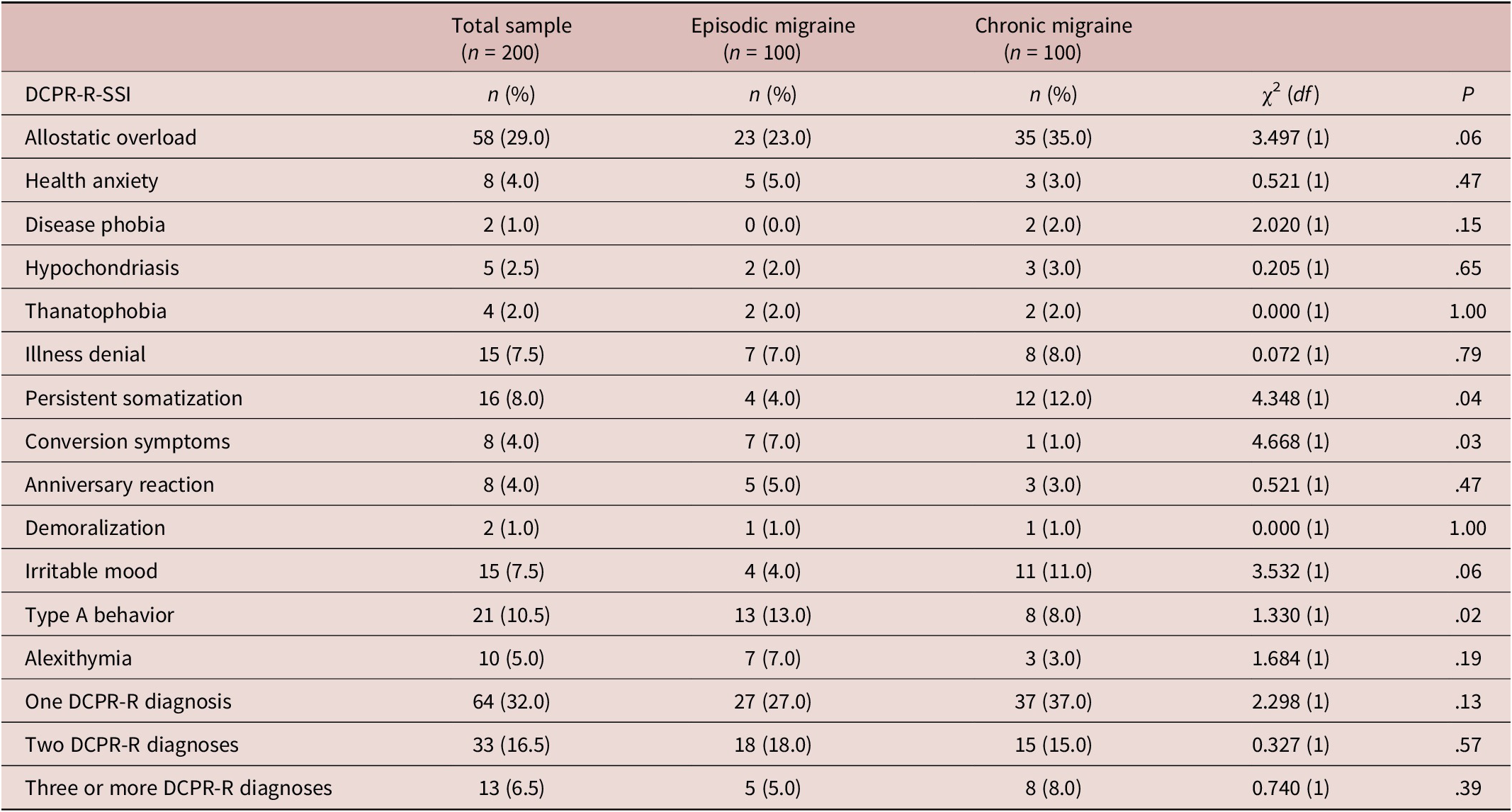
One hundred and ten subjects (55.0%) reported at last one diagnosis of psychosomatic syndrome according to the DCPR-R (ie, DCPR-R-SSI). The most frequent diagnoses were allostatic overload (29%; n = 58), type A behavior (10.5%; n = 21), persistent somatization (8%; n = 16), irritable mood (7.5%; n = 15), illness denial (7.5%; n = 15), and alexithymia (5% n = 10) ( Table 2). Episodic migraine outpatients showed statistically significant higher rates of type A behavior and conversion symptoms, while chronic migraine outpatients had higher rates of persistent somatization ( Table 2).
Frequencies of DCPR-R diagnoses. Difference between episodic and chronic migraine outpatients (chi-square test).

Abbreviation: DCPR-R-SSI, Diagnostic Criteria for Psychosomatic Research-revised semi-structured interview.
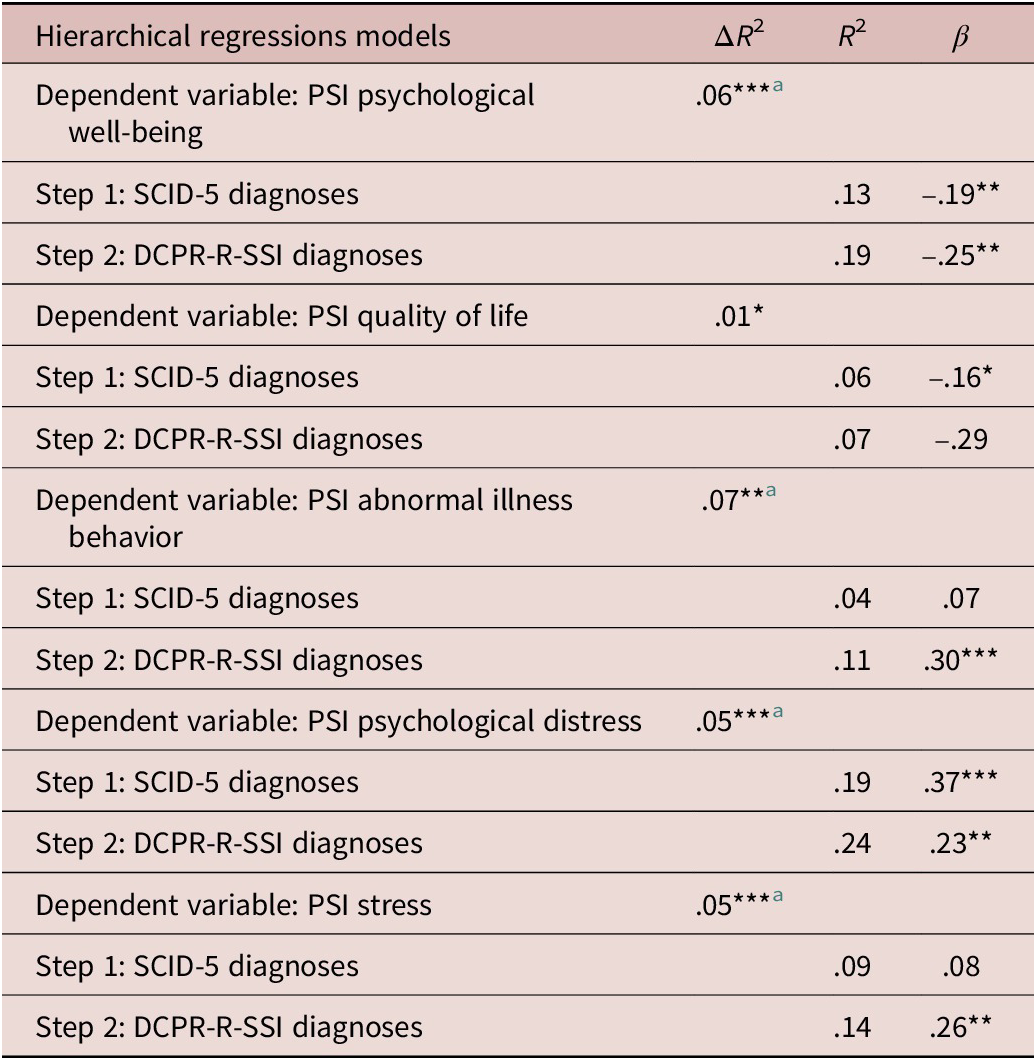
Table 3 shows the hierarchical regression models. All variables showed skewness and kurtosis in the range of acceptability (skewness ranging from –1.06 to 1.66; kurtosis ranging from –1.91 to 1.91) (data not shown). Thus, a linear model of analysis was applied. Using the PSI Psychological Well Being as the criterion variable, the DCPR-R increased up to 0.19 the amount of explained variance at Step 2, showing a statistically significant increase of variance (ΔR2 = .06; p < .001) ( Table 3). Using the PSI Quality of Life as criterion variable, the DCPR-R increased up to 0.07 the amount of explained variance at Step 2 showing an increase of variance (ΔR2 = .01; p < .05), which did not survive to Bonferroni correction ( Table 3). Using the PSI Abnormal Illness Behavior as the criterion variable, the DCPR-R increased up to 0.11 the amount of explained variance at Step 2, showing a statistically significant increase of variance (ΔR2 = .07; p < .001) ( Table 3). When the PSI Psychological Distress was used as the criterion variable, the DCPR-R increased up to 0.24 the amount of explained variance at Step 2, showing a statistically significant increase of variance (ΔR2 = .05; p <.001) ( Table 3). Finally, using the PSI Stress subscale as the criterion variable, the DCPR-R significantly increased up to 0.14 the amount of explained variance at Step 2 (ΔR2 = .05; p < .001) ( Table 3).
Hierarchical regressions examining the incremental validity of the DCPR system over the DSM system adjusted for sex, age, daily use of pharmacological treatments, and lifetime history of psychiatric disorders.

n = 200.
Abbreviations: PSI, Psychosocial index; SCID-5 diagnoses, number of diagnoses obtained via the Structured Clinical Interview for DSM-5 disorders; DCPR-R-SSI diagnoses, number of diagnoses obtained via the Diagnostic Criteria for Psychosomatic Research-Revised Semi-Structured Interview.
*p < .05; **p < .01; ***p < .001.
a Survived to Bonferroni correction (p ≤ .01).
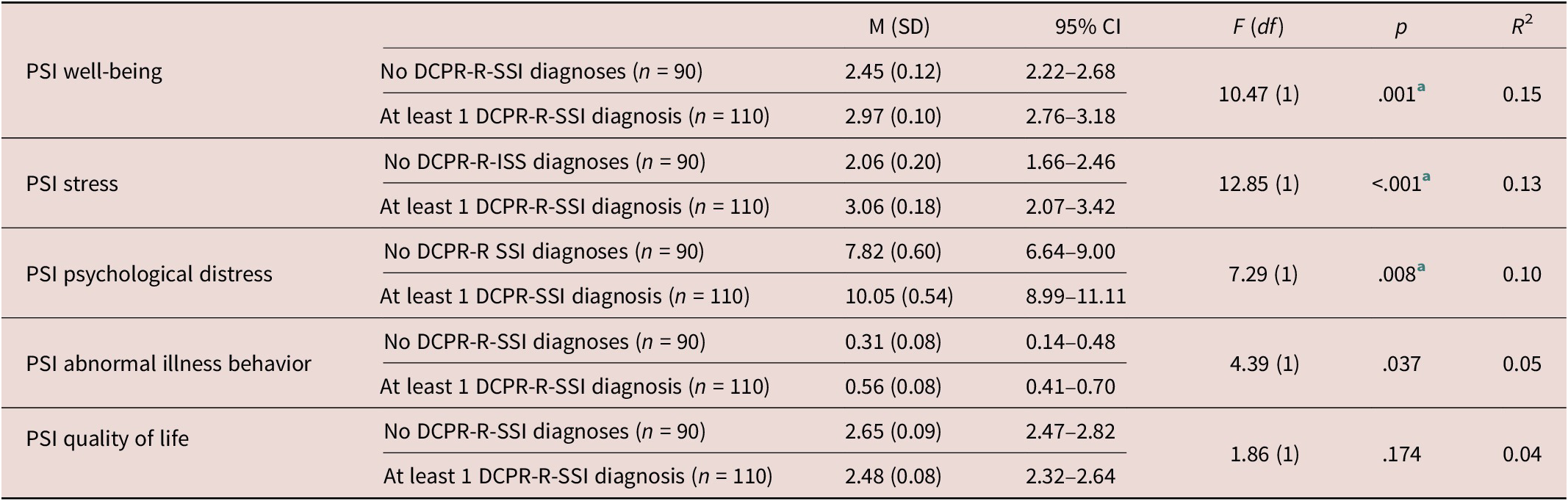
Table 4 shows the ANCOVA models. All variables showed skewness and kurtosis in the range of acceptability (skewness ranging from –1.06 to 1.99; kurtosis ranging from –1.91 to 1.66) (data not shown) as well as optimal values of GVIF ranging from 1.03 to 1.16 (data not shown). The models showed statistically nonsignificant studentized BP coefficient (PSI Psychological Well-Being model: BP = 4.89; df = 5.00; p = .420; PSI Quality of Life model: BP = 4.90; df = 5.00; p = .42; PSI Abnormal Illness Behavior model: BP = 5.28; df = 5.00; p = .38; PSI psychological distress model: BP = 5.14; df = 5.00; p = .40; PSI Stress model: BP = 7.15; df = 5.00; p = .21). Thus, there was no evidence of outliers of skewness and kurtosis, of multicollinearity, as well as of heteroscedasticity.
Psychosocial index dimensions. Subjects with no DCPR-R diagnoses vs subjects with at least one DCPR diagnosis. Comparisons of means (DS) via the ANCOVA, adjusted for sex, age, daily use of pharmacological treatments, and lifetime history of psychiatric disorders.

n = 200.
Abbreviations: PSI: Psychosocial Index; No DCPR-R-SSI diagnoses: no diagnoses according to the Diagnostic Criteria for Psychosomatic Research-Revised Semi-Structured Interview; At least 1 DCPR-R-SSI: at least one diagnosis according to the Diagnostic Criteria for Psychosomatic Research-Revised Semi-Structured Interview.
a Survived to Bonferroni correction (p ≤ .01).
Table 4 also shows statistically significant differences between subjects with at least one DCPR-R diagnosis and those without DCPR-R diagnoses. Subjects with at least one DCPR-R diagnosis showed statistically significant lower PSI Psychological Well-Being (p = .001), higher PSI Stress (p < .001), and higher PSI psychological distress (p = .008) than subjects without DCPR-R diagnoses.
Discussion
Chronic and episodic migraine subjects differed for lifetime history of psychiatric disorders and frequencies of current psychotherapy treatments, which is consistent with the literature.Reference McLean and Mercer57
The most frequent DSM-5 diagnoses were agoraphobia, panic disorder, and major depression, which is in line with previous studies.Reference Minen, Begasse De Dhaem and Kroon Van Diest58, Reference Hamelsky and Lipton59 No differences were found for DSM-5 diagnoses between chronic and episodic migraine subjects although the literature suggests higher rates of mental disorders in chronic migraine patientsReference McLean and Mercer57–Reference Hamelsky and Lipton59 than in episodic migraine subjects. In the present research, the rate of DMS diagnoses was relatively low in both chronic and episodic migraine subjects and this may explain the failure to achieve the statistical significance. However, although not statistically significant, the rate of major depression in chronic migraine patients was twice that in episodic migraine subjects. The enrolment of a larger sample might probably solve such an inconsistency with the literature. The low rate of DSM-5 diagnoses is a negative result, which deserves to be discussed also under a different light: we had a lower rate of DSM diagnoses than DCPR-R diagnoses (see also below), thus apparently DSM-5 catches less diagnoses than DCPR-R at least in migraine outpatients. Particularly striking is the lack of DSM diagnoses under the rubric of somatic symptom and related disorders. Apparently, once again, we have the evidence of the clinical inadequacy of the DSM-5 classification in the psychosomatic realmReference Cosci and Fava8 that is the inadequacy of current psychiatric criteria to identify patients who present with psychological distress and abnormal illness behavior, and the evidence that DSM categories other than mood or anxiety disorders are of little help in the setting of migraine.
The most frequent DCPR-R diagnoses were (1) allostatic overload, consistently with the literatureReference Kokonyei, Szabo and Kocsel26, Reference Vo, Fang and Bilitou60; (2) type A personality—Huber and HenrichReference Huber and Henrich31 found that migraine outpatients tend to present internal tension more often than controls at work and in achievement situations; (3) alexithymia, in line with Wise et al.Reference Wise, Mann and Jani29 and Neyal et al.Reference Neyal Muftuoglu, Herken and Demirci30; (4) persistent somatization and illness denial, consistent with Huber and HenrichReference Huber and Henrich31 as well as with Williams et al.Reference Williams, Raczynski and Domino32 and Demjen and BakalReference Demjen and Bakal33; and (5) irritable mood—Lebedeva et al.Reference Lebedeva, Kobzeva and Gilev27 found irritability as one of the most relevant psychosocial factors associated with migraine, and Peres et al.Reference Peres, Mercante and Tobo28 found that sporadic and daily irritability increases the risk of migraine. Episodic migraine outpatients showed statistically significant higher rates of type A behavior and conversion symptoms than chronic migraine subjects while chronic migraine outpatients showed higher rates of persistent somatization than episodic migraine patients. Since this is the first time that DCPR or DCPR-R were used in migraine patients, we can only infer that chronic migraine patients might tend to manifest persistent symptoms, both in the frame of migraine and in the frame of illness behaviors.
When PSI Psychological Well Being, Abnormal Illness Behavior, Psychological Distress, and Stress were used as criterion variables, the DCPR-R system showed incremental validity over the DSM system. This was not true when PSI Quality of Life was used as the criterion variable, although the result was statistically significant and did not survive to Bonferroni correction. The above results support the hypothesis that DSM categories are not enough to assess patients in the setting of migraine. Further confirmation is the evidence that subjects with at least one DCPR-R diagnosis had lower PSI Psychological Well-Being, higher PSI Stress, and higher PSI Psychological Distress than subjects without DCPR-R diagnoses.
This study has limitations and strengths. The first limitation is the monocentricity of the research and the use of a third-level facility for enrolment; thus the results cannot be generalized to migraine subjects of the general population. An additional shortcoming that might limit the generalization of results is the relatively small sample size, although adequate to run the analyses presented. However, third-level facilities are commonly used in research of this kind since the large majority of migraine patients address to these centers.Reference McLean and Mercer57 The main strengths are that DCPR-R were applied for the first time to assess migraine outpatients and that DCPR-R validity was tested for the first time.
Conclusion
In brief, DCPR-R allowed to formulate a higher rate of diagnoses than DSM-5 and showed a good criterion-related validity, thus highlighting their adequacy in this clinical environment. An assessment of migraine subjects that aims at being comprehensive should include instruments based on DCPR-R. This kind of assessment might provide information also for psychotherapeutic and pharmacological interventions.
The need to include consideration of psychosocial factors has emerged as a crucial part of investigation and patient care.Reference Fava and Sonino61 These aspects have become particularly important in chronic diseases, where cure cannot take place.Reference Fava and Sonino61 It can thus be postulated a role of well-being therapy, Reference Fava62 a short-term psychotherapeutic strategy that emphasizes self-observation with the use of a structured diary, interaction between patients and therapists, and homework, to counteract the limitations and challenges induced by illness experience. Promising results in this regard have been shown in a study addressing depressive symptoms and demoralization after myocardial infarction.Reference Tomba, Tecuta and Guidi63
The evidence that DCPR-R allowed to formulate a higher rate of diagnoses than DSM-5 also suggest that psychiatric disorders are less represented in migraine patients than psychosomatic syndromes, thus pharmacological interventions having an indication for psychiatric disorders but not having indications for psychosomatic syndromes should be used with caution in migraine patients. Antidepressants, which are largely prescribed in this population, should be used only based on clear indications. Indeed, it is known that they have a delayed and moderate efficacyReference Gaynes, Warden, Trivedi, Wisniewski, Fava and Rush64; their efficacy decreases in the long termReference Gaynes, Warden, Trivedi, Wisniewski, Fava and Rush64; they may induce withdrawal symptoms at reduction or discontinuationReference Chouinard and Chouinard65; and unfavorable long-term outcomes and paradoxical effects, such as depression inducing and symptomatic worsening, have been reportedReference Fava66 and explained based on the oppositional model of tolerance.Reference Fava and Offidani67 Finally, antidepressants may provoke disturbingReference Carvalho, Sharma and Brunoni68 or persistent side-effects (eg, persistent sexual side effects)Reference Csoka and Shipko69 and may increase the risk of the occurrence of a medical disease (eg, breast cancer, cardiovascular event).Reference Maslej, Bolker and Russell70, Reference Bahl, Cotterchio and Kreiger71
Disclosures.
Conflict of interest declaration: Fiammetta Cosci, Andrea Svicher, Sara Romanazzo, Lucia Maggini Francesco De Cesaris Maggini, Silvia Benemei, and Pierangelo Geppetti have nothing to disclose.