

Well-performing health systems are critical for pursuing universal health coverage (UHC) and for achieving health and health-related Sustainable Development Goals (SDGs). It is important to understand key concepts such as systems approach, analysis, and thinking before taking a deeper dive into health systems.
Health systems can be described in broad or restricted terms. The most widely accepted definition of a health system includes all the institutions, actors, and activities whose primary purpose is to promote, restore, or maintain health.
The WHO’s health system framework comprising six building blocks and the “Control Knobs” framework with five knobs are the more widely used. Both frameworks have three main goals: improved health status, financial risk protection, and user satisfaction or responsiveness.
Kielmann’s and Roemer’s health system models primarily assess health services, although the former defines health systems in broad terms by elaborating the interrelationship between the community, health care delivery, and the external environment.
No single framework addresses all the aspects of a health system. It is more useful to know the strengths, limitations, purpose, and usefulness of each framework to help achieve a specific objective, such as for analysis, design of reforms, or evaluation of the health system.
1.1 Health Systems from Unfamiliarity to Inevitability
During the 1970s and 1980s, debates within countries and in many international forums indicated a growing dissatisfaction with the state of health and health services. This was accompanied by a broad recognition that the solution needed to include the development of comprehensive national health systems [Reference Kleczkowiski, Roemer and Van der Werff1], a perspective further supported by the Alma-Ata Declaration on Primary Health Care as the leading strategy for Health for All [2]. While scholarship on strengthening health systems has continued since, questions of what is a health system, what are its boundaries and components, how it should be analyzed, and how to best improve health system performance remain contested and evolving matters. Early work on health systems was influenced by Milton Roemer’s descriptive analysis of national health systems [Reference Roemer3], while the subsequent reports by WHO in 2000 and 2007 [4, 5] helped solidify a shared understanding of health system functions, goals, and objectives. Given the social and dynamic nature of health systems, new perspectives keep emerging that question the necessity to delineate fixed boundaries of a health system, as every country has a national health system that reflects its history, economic development, and social and political ideologies and decisions [Reference Roemer6, Reference Elling7].
Development partners – international organizations that provide financial, material, or technical assistance to other countries (often labeled “donors”; see Chapter 35) – have often imposed their agendas on low- and middle-income countries (L&MICs) by directing their assistance to prioritized government-run health programs that target specific diseases responsible for major burden in the country. When these efforts are organized, financed, delivered, and monitored around specific types of health conditions (e.g., HIV/AIDS, tuberculosis, malaria, family planning, reproductive health, childhood immunizations, neglected tropical diseases), they are frequently called “vertical” programs. They have typically focused on individual-level interventions, occasionally supplemented by health promotion activities delivered at the population level. Such programs often function in parallel with other programs that can duplicate or fragment efforts if they are not well integrated and coordinated in a health system. While some of these programs have been organized as time-limited campaigns (e.g., smallpox eradication), many are intended as long-term programs, and rely on centralized management and resources to meet their discrete objectives or continued implementation.
Whereas many L&MICs policymakers and development partners are increasingly giving importance to health system strengthening, the success of broader approaches has been mixed. Many governments have not fully appreciated the importance of well-performing health systems as a necessary platform for the successful implementation of public health programs, or to provide a basis for structural reforms. Nonetheless, the crucial importance of health systems has been underscored by recent commitments from most countries to pursue the ambitious target of UHC and for achieving the SDG of Health and Wellbeing (SDG 3) and other health-related SDGs. Yet, societies are increasingly confronted with health, social, and economic crises from disasters due to natural hazards, environmental degradation, pandemics and epidemics, or are constrained by limited access to critical health products that have large social externalitiesFootnote 1 beyond individual use (e.g., COVID-19 vaccines and diagnostics). It is thus apparent that national health systems and international organizations need to be strengthened and reorganized to tackle these neglected common goods for health that address population needs [Reference Soucat8].
This chapter aims to clarify health system concepts and components, and models and frameworks that are frequently debated in high-level forums and can puzzle public health professionals and organizations working in L&MICs. The purpose is to help develop a systems thinking and approach among these professionals that leads to better-performing health systems and the attainment of UHC and health-related SDGs.
1.2 Health through a Systems Lens
Before taking a deeper dive, it is important to clarify a few fundamental concepts about health systems, recognizing that the terms may take on different meanings in different settings.
A system is a set of interconnected parts or components that come together for a given purpose – the word is derived from the Greek term sunistánai, meaning “to cause to stand together.” A simple system will have few parts and stable relationships between the parts, like a rope-and-pulley system to lift heavy objects. A complicated system is one that has many parts that interact with each other, may involve subsystems, and typically produces predictable results. Examples include the workings of a mechanical clock or cooking with a recipe. A complex system is one with many elements that interact with each other in different and changing ways, typically in a nonlinear fashion, and has multiple subsystems, abilities to adapt, self-organize, or learn, and is not predictable in detail. Because of the central role of adaptation or learning, complex systems are often called complex adaptive systems. The Earth’s climate is a good example of a complex system, but there are many examples of complex systems in biology (e.g., the human body), ecology (e.g., a coral reef), computer sciences (e.g., artificial intelligence), and social sciences (e.g., cities) and economics (e.g., stock markets).
Since health systems are complex adaptive systems, it is helpful to understand how these systems behave, and their implications for enhancing performance (Figure 1.1). Feedback loops are common in health systems and occur when an outcome of a process is fed back into the same system. This can happen in a reinforcing way, such as the vicious cycle between malnutrition and infection, or in a balancing way, such as when there is an equilibrium in a resource-constrained health care system that continues to provide services for a better-off population while failing to reach the poor. Path dependence is another characteristic of health systems, where earlier decisions lead to irreversible pathways and different outcomes based on those initial decisions and choices made along the way. We see this commonly in the different types of technology standards found in different settings, such as why vehicles travel on different sides of the road in different countries. In a health system, it helps explain why complex programs such as health insurance schemes or decentralization of government health services cannot be expected to be simply copied from one place to another and achieve the same results. Phase transitions are also a common phenomenon and refer to events that suddenly hit a critical point at which radical changes occur, such as seen in the exponential growth of an epidemic, or in a sudden change in demand for health services. Adaptation, or emergent behavior, occurs in a health system with the creation of a new set of behaviors or organization that affects the whole system. This may occur suddenly, such as when community groups organize themselves to respond to a health crisis or when conditions lead to health workers going on strike. They can also happen more deliberately, such as when health teams decide to change how services are implemented through a quality improvement process or how services are provided, perhaps deciding to shift tasks.
Behaviors of complex adaptive systems seen in health systems.

Comprehending a system and its interconnected components, while necessary, is by no means sufficient to bring about an improvement in performance. Just as the understanding of systems, and in this context health systems, has evolved, so too have the approaches to examine, analyze, and think about health systems. While not distinctly separate, these approaches build on one another, and are briefly discussed here as systems approach, systems analysis, and systems thinking.
The systems approach takes into account the connections and interactions between the components of a system and follows a logical problem-solving method to develop a comprehensive solution to a problem that presents several dimensions. The systems approach follows three general steps: assessment of system vulnerability, implementation of countermeasures, and evaluation of effectiveness [Reference Scott, Leischow and Milstein11]. The simplest model of a systems approach is based on input, process, output, and feedback loops, and has been used to analyze systems in different disciplines by system analysts. In health, this approach has many uses, such as for assessment of the availability [Reference Navarro12] and quality of services (Figure 1.2) [Reference Donabedian13].

Systems analysis is a problem-solving technique that decomposes or deconstructs a system into its component parts for the purpose of studying how well they work and interact to accomplish their purpose. From a health perspective, systems analysis should be: (1) broad and inclusive, considering all characteristics of health system inputs, processes, and performance outcomes; (2) analytical, based on how inputs, processes, and outputs interact with each other and with environmental factors to improve performance; (3) relevant, considering how reforms to key health system determinants could improve performance; and (4) evidence-based, utilizing and sharing information on health system experiences across countries [Reference Berman and Bitran14]. It should consider politics, history, and institutional arrangements; propose causes of poor health system performance; suggest options and strategies to improve performance; and support implementation and evaluation.
Systems thinking is an analytic process intended to understand how things are connected to each other as part of a whole entity (i.e., a system) [Reference Peters15]. Whenever we talk about how one thing leads to another, or how an event will turn out, we are using a mental model to explain how things fit together. More formally, systems thinking involves using explicit rather than implicit models where assumptions are identified, data is used, and the processes can be repeated by others. Note that if the processes are followed in a methodical or orderly fashion, the approach can also be considered systematic. There are many different methods, tools, and approaches that provide different types of insights that are gaining increasing currency in analyzing health systems [Reference Peters15].
Understanding health systems through systems thinking approaches and methods is particularly useful for addressing difficult questions, such as: How does this health program work? What are good entry points to intervene in a health policy and program? How can a health policy or program be scaled up, sustained, or made more effective in reaching marginalized populations? Systems thinking approaches are used to understand the dynamics of disease transmission, or to identify root causes of variations in health behaviors and services. They can also help to address the multisectoral factors that promote the spread of innovation in health, better understand how intended and unintended consequences come about, or facilitate decision-making.
A description of the many quantitative, qualitative, and mixed methods used in systems thinking is beyond the scope of this book, though there are some key systems thinking capabilities that are especially helpful to inform decisions and actions in health systems:
1. mapping actors or stakeholders in a health system (e.g., their interests, capabilities, influence, locations);
2. identifying the types of relationships between actors in a health system (e.g., accountabilities, authorities, financial, organizational, and social connections);
3. engaging with key actors in processes to identify and make a change (e.g., those involved in governance, organization, financing, delivery, and benefit of health policy and programs, with particular attention to ensure there is a “voice” for marginalized and vulnerable groups);
4. identifying and formulating questions that address critical problems;
5. using data and analysis to inform decisions around key questions;
6. focusing on achieving key health results, but looking for unintended consequences of actions that need to be addressed; and
7. learning from and encouraging adaptations that lead to improved performance of health systems.
Ultimately, a systems thinking approach places more attention on local context, incentives, and institutions, anticipates and addresses unintended consequences, and uses approaches to develop and implement policies and programs that engage key actors through the use of data for ongoing problem-solving and adaptation.
1.3 Health System and Its Boundaries
Health systems are not only complex and changing, but are also open systems in that they interact with their external environments and other social systems (e.g., through interactions with people, information, materials, etc.). This makes it challenging to define the boundaries of a health system. Any boundary of a health system is arbitrary and may be contested. The exact boundaries may depend on how stakeholders in a health system view their limits of interaction. This is because a population’s health is not only affected by a package of promotive, preventive, curative, rehabilitative, and palliative health care services (typical parts of a health care system), but also by structural and social determinants like education and work opportunities, security, discrimination, clean water, adequate nutrition and housing, or income levels. Yet, as described below, these critical social and structural determinants of health (see Chapter 31) are often considered as outside the boundaries of the health system, even though they interact with it and impact its outcomes. One way this interaction occurs is by having components that fall within a health system, such as nutrition supplementation programs or health education programs that are primarily intended to improve people’s health.
Health systems can be described broadly to include the structural and social determinants of health as integral to the system that “produces” good health. One simple health system model illustrates the interrelationship between environmental ecology, community, and the health care delivery system interposed between the two (Figure 1.3) [Reference Kielmann, Siddiqi and Mwadime16]. The three components are highly interdependent. The environmental ecology – the sociocultural, demographic, economic, and political surroundings – largely determine the health problems and needs of the community, and exert a major influence on the nature, volume, and quality of health services. The community largely determines the sociocultural and political milieu and exerts considerable influence on the physical environment. The extent to which the community is involved with health-related matters influences health problems and needs. The range and quality of health care delivery thus are determined to a large extent by the environmental ecology and community.
Broadly defined health system model.

Health systems can be defined more restrictively as a combination of resources, organization, financing, and management that culminate in the delivery of health services to the population [Reference Roemer17]. This definition is framed around service delivery, which itself may be defined differently in different settings. Such systems frequently focus on individual clinical care and neglect population services (like health regulation, health promotion, or disease surveillance). This definition of a health system does not include all the factors that influence health outside health services, with the argument that if it did, the scope of health systems would be hopelessly broad since virtually all aspects of nature, society, and human relations influence health.
The World Health Report 2000 defines a health system to include all the institutions, actors, and activities whose primary purpose is to promote, restore, or maintain health [4]. A health activity is defined as any effort, whether in personal health care, public health services, or through intersectoral initiatives, whose primary purpose is to improve health. The emphasis on the word primary is important as it helps define the boundaries of the health system. While no one can question the influence of clean water on health, the primary purpose of water supply systems is not to improve health, hence using this definition would not include water supply as part of the health system. On the other hand, the primary purpose of monitoring water quality is better health, and so falls within the boundaries of the health system. Similarly, the primary purpose of women’s education is not to improve health, but the primary purpose of health education of women is to improve health. By the same logic, the former would not be considered part of the health system, while the latter would. This distinction is not just theoretical, it has implications for organizing and financing health systems. For example, estimating health expenditures or developing budgets for health organizations depend on what is included in a health system.
This book has chosen to follow the World Health Report 2000 definition of the health system, while recognizing that health systems are open systems, where structural and social factors interact with the health system and have undeniable importance in affecting people’s health.
Whereas health system and health care system are terms that have been used interchangeably in the literature, a health care system refers to the more limited and specific part of the health system that is concerned with health services and their delivery, financing, organization, and governance. A health care system is a formal organizational structure for a defined population whose finance, management, scope, and content are defined by laws and regulations [19]. It may be organized around a set of health facilities providing services to specific populations in a given catchment area, or around an organized network of health care providers or funders of health care. A health care system provides services to people to contribute to their health in defined settings such as homes, educational institutions, workplaces, public places, communities, hospitals, and clinics.
Health system and health sector are two related terms that have frequently been used interchangeably. As stated above, the term health system is well defined and widely accepted globally [4]; there is, however, no universally accepted definition of the term health sector. According to one definition, health sector refers to the policies, laws, resources, organizations, programs, and services that fall under the jurisdiction of health ministries [20]. The term health sector gained prominence during the 1990s as many countries implemented various health sector reforms technically and financially supported principally by the World Bank. Health sector reform was defined as sustained, purposeful change to improve the efficiency, equity, and effectiveness of the health sector [Reference Berman21]. The term health system gained common usage following the World Health Report 2000 that defined and presented a health system conceptual framework. Nevertheless, and given its past usage, the term health sector continues to be used in specific situations, such as while discussing inter- or multisectoral coordination in health, private health sector, and health sector reforms. This book shall preferentially use the term health system but will accept the term health sector when used for specific situations. It recognizes that health systems are organized at local, national, and international levels, and include public, private, and nonprofit organizations and civil society including communities as part of the health system.
1.4 Health System Models and Frameworks
Before plunging into a discussion on health systems, it is important to recognize the theoretical underpinnings of different models and frameworks and the purpose they serve. Theories, models, and frameworks in implementation science have three overarching aims – describing and/or guiding the process of translating research into practice (process models); understanding and/or explaining what influences outcomes (determinant frameworks, classic theories, implementation theories); and evaluating implementation (evaluation frameworks) [Reference Nilsen22].
A plethora of health system models and frameworks have been proposed that attempt to define, describe, and explain different aspects of health systems [Reference Shakarishvili, Atun and Berman23]. These are arguably helpful in identifying different approaches to health system strengthening, while also creating confusion as to which conceptual model to refer to for designing health system reform interventions. Hence it is important to select models and frameworks according to their proposed aim.
This chapter will discuss four health system frameworks and models: (1) WHO’s health system framework; (2) the Control Knobs framework; (3) Kielmann’s health system model; and (4) Roemer’s health system model. The first two were developed at the beginning of this century, while the last two are from the 1980s and 1990s. Each model or framework was developed for a specific purpose and has its strengths and limitations. Although not discussed here, the Lancet Health Commission on High-Quality Health Systems has also proposed a framework, which is briefly discussed in Chapter 16 [Reference Kruk, Gage and Arsenault24]. It is more important to be able to comprehend and critique each model than trying to look for the idyllic framework.
From an applied perspective, health system models and frameworks are illustrations of their various components or functions and serve several purposes. In line with Nilsen’s proposition, each framework lends itself to analysis of the individual components, elements, or subsystems which helps to better understand the extent to which each fulfills its respective function within the whole system [Reference Nilsen22]. Second, frameworks help to assess how the various components interact with one another and contribute to achieving the desired objective. Third, they help to identify the less well-performing elements and point to remedial measures needed. Finally, frameworks aid in monitoring the performance of individual components or the whole system. Indeed, this is an iterative process and the basis for the planning, implementation, monitoring, and evaluation cycle.
1.4.1 The WHO Health System Framework
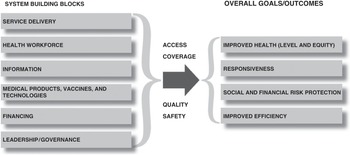
First presented in the World Health Report 2000 [4], WHO’s health system framework was subsequently modified in 2007 [5]. This framework is widely accepted and used by L&MICs and many have crafted their national health policies and strategies on what has come to be known as the “Building Blocks” framework. The WHO health systems framework has three components – the building blocks and overall goals or outcomes, with intermediary objectives related to service outcomes inserted between the two (Figure 1.4).
The WHO health system framework.
Building Blocks.
What were previously known as “functions” are now called “building blocks” of the health system. The WHO framework has six building blocks: (1) service delivery; (2) health workforce; (3) health information system; (4) medical products, vaccines, and technologies; (5) financing; and (6) leadership and governance. Box 1.1 provides a brief description of each [5].
Service delivery refers to delivering effective, safe, quality personal and nonpersonal health interventions to those who need them, when and where needed, with minimum waste of resources.
A health workforce is one that works in ways that are responsive, fair, and efficient to achieve the best health outcomes possible, and there are sufficient numbers and mix of staff, fairly distributed; they are competent and productive.
A health information system ensures the production, analysis, dissemination, and use of reliable and timely information on health determinants, health systems performance, and health status.
Access to essential medical products, vaccines, and technologies of assured quality, safety, efficacy, and cost-effectiveness, and their scientifically sound and efficient use, is crucial for a well-functioning health system.
A health financing system raises sufficient funds, in ways that these are adequately pooled, and ensures that people are protected from financial catastrophe or impoverishment while using services.
Leadership and governance involve ensuring strategic policy frameworks exist and are combined with effective oversight, appropriate regulations and incentives, attention to system design, participation, transparency, and accountability.
In this framework, physical infrastructure is implicitly considered as part of the building block of service delivery. It is an essential component, especially in low income and conflict settings, where poor physical infrastructure is a critical contributor to dysfunctional health systems. Infrastructure includes the buildings that house health facilities, utilities such as water and electricity, furniture and fixtures, equipment and supplies, transport including ambulances, and backup support for their maintenance and repair.
Overall Goals and Outcomes
of the health system as per the framework include improved health, financial risk protection, responsiveness, and efficiency. These are also considered as intrinsic goals of the health system as these are valued as an end in themselves.
Health is the defining objective of the health system and can be measured in terms of longevity (life expectancy), mortality (death), morbidity (disease and risk of disease), disability (functionality), fertility (population parameters), or as summary measures of population health, such as health expectancies or health gaps (see Chapter 13).
Financial risk protection is protection against the risk each household faces due to the cost of health care. In a fairly financed system, financial risk is distributed according to the ability to pay rather than to the risk of illness (see Chapter 5). A health system where individuals or households are forced into poverty by paying for needed health care or forced to do without it because of the cost is considered unfair.
Responsiveness refers to how the health system performs relative to nonhealth aspects and meets the population’s expectations of how it should be treated by providers of care. The World Health Report 2000 identifies seven elements of responsiveness. Three are categorized under respect for persons – (1) respect for the dignity of the person, (2) confidentiality, and (3) autonomy – while four fall under client or user orientation: (4) prompt attention (timeliness), (5) amenities, (6) access to social support networks, and (7) choice of provider [4]. Put simply, health system responsiveness measures the level of user satisfaction with health services and not the system’s response to health needs, which is included in health outcomes [Reference Robert, Hsiao and Berman25].
Efficiency refers to the value for money by doing the right things and doing them right. Interventions are said to be efficient when they obtain the maximum output from a given set of inputs or achieve the desired output from a minimum input. Efficiency has been included as an intrinsic goal, which has not been widely accepted. We consider efficiency as an instrumental goal of the health system.
In assessing health systems, it is essential to consider both the overall achievement of stated goals and their distribution across population groups. The latter raises the importance of equity as a goal, where equity refers to fairness in the use of limited resources and ensuring equal health outcomes. This particularly applies to the goals of health and responsiveness. By contrast, the goal of financial risk protection is assessed in terms of distribution only. The rationale is that while it is always desirable to achieve more health and more responsiveness, it is not intrinsically valuable to spend an ever-increasing amount of money on the health system. What matters is that available funds should be spent equitably, and the disparity in financial burden should be minimized across groups [Reference Murray and Frenk26].
Service Outcomes
such as access, coverage, quality, and safety are included in the framework as intermediate or instrumental objectives of the health system. The latter is considered as a means and not an end in themselves (Chapter 10). The concept of equity is well rooted in access and financial risk protection as it is an intrinsic as well as instrumental goal of the health system. Intrinsic, because in egalitarian societies equality is an end and is the value that underpins fair financing; instrumental because it underscores the distributional aspects of health services in terms of financial and physical access [Reference Murray and Frenk26].
Critique.
The Building Blocks framework is simple to comprehend and is useful for identifying inputs and key outcomes, and provides a good description of how health system components are functioning. The framework, however, is not strong on assessing how different components relate to one another and lacks the dynamism of informing what sort of interventions are needed to address gaps in the system. It neglects the role of key components like organizations, stakeholders, and processes. This framework also ignores the demand side of the equation or the importance of community engagement. Chapter 11 attempts to present a modified health system framework to address the latter shortcoming.
1.4.2 The “Control Knobs” Framework
Control knobs in this framework have been used metaphorically and derive their name from a system where the managers or operators adjust controls at different steps in the production process to efficiently deliver high-quality products [Reference Robert, Hsiao and Berman25]. The control knobs of a health system can be conceived and adjusted in a similar way by the government to enhance performance of the health system.
Before discussing the Control Knobs framework, it is important to understand that this framework was conceived in the 1990s to help countries think through and implement health sector reforms. Four fundamental forces were thought to drive the reform process in countries – rising costs of health care, rising expectations of the citizens who demand more from governments and health systems, limits on the capacity of the governments to pay the costs of health care, and the growing skepticism about conventional approaches to the health sector influenced by the market and diminishing trends toward social solidarity.
The health sector reform process brought together six important elements: (1) the policy cycle and its associated stages; (2) ethical theories underpinning the reform process; (3) systematic political analysis since politics matters at each step of the cycle; (4) a set of core health system performance goals and intermediate performance measures; (5) systematic approaches to health system diagnosis; and (6) a framework of five control knobs that provide options to reformers for influencing health system performance [Reference Robert, Hsiao and Berman25].
These five control knobs of the health system are thought to reflect the most important factors that determine and can be used deliberately to change health outcomes. These are financing, payment, organization, regulation, and behavior (Box 1.2, Figure 1.5). The framework also identifies three performance goals similar to the Building Blocks framework, namely health status, financial risk protection, and customer satisfaction.
The five control knobs for health sector reform.
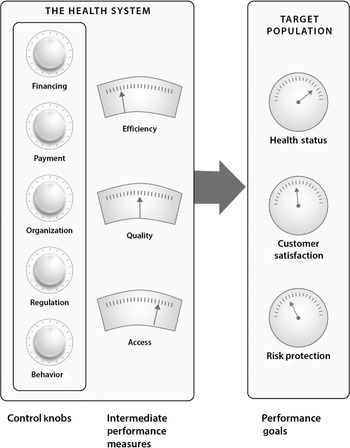
The health status of the population is the first performance goal and is considered to be politically appropriate, philosophically relevant, and fulfills the test of causal dependence. In deciding which health problems should be given priority, a country may wish to pay special attention to the diseases that are causing the greatest harm.
Financial risk protection is about preventing impoverishment and its associated loss of opportunity as a result of seeking health care. Providing financial risk protection, however, does not allow the population to avoid all costs of health care.
Customer satisfaction is the degree to which citizens are satisfied with services provided by the health sector. This goal allows capturing various features of the health system, apart from its impact on health status.
The framework also proposes three intermediate performance measures. These measures are critical links in the chains that connect root causes to the ultimate performance goals. They include efficiency, access, and quality of health services (Chapter 10).
Financing refers to all mechanisms for raising money that pays for activities in the health sector. These mechanisms include taxes, insurance premiums, and direct payment by patients. The design of the institutions that collect money (e.g., social insurance funds) is also part of this control knob, along with allocation of resources to different priorities.
Payment refers to the methods for transferring money to health care providers, such as fees, capitation, and budgets. These methods create incentives, which influence how providers behave. Money paid directly by patients is also part of this control knob.
Organization refers to the mechanism to influence the mix of providers in health care markets, their roles and functions, and how the providers operate internally. These mechanisms include measures such as competition, decentralization, and managerial aspects related to providers.
Regulation refers to coercion by the state to alter the behavior of actors in the health systems, including providers, insurance companies, patients, and the population. To be effective, regulation requires sound legislation and enforcement capacity.
Behavior includes efforts to influence how individuals act in relation to health and health care, including both patients and providers. This includes, for example, mass media campaigns on smoking or influencing medical associations to improve physician practices.
Critique.
The Control Knobs framework is robust in helping to think through health system reforms from a policymaker’s perspective. The control knobs offer intervention options for reforming the health system, and in this regard the model is dynamic. It does not highlight how different control knobs interact with one another, is primarily supply-driven, and does not emphasize the importance of community engagement. It also assumes that policy interventions have a linear effect while impacting services.
1.4.3 Kielmann’s Health System Model
Kielmann’s health system model was developed in the 1990s primarily to assess the district health system in low-resource settings [Reference Kielmann, Neuvians, Kipp and Hoda27]. Its premise is the systems approach that relies on the input, process, output, and feedback loop that lends itself to doing a systems analysis, followed by planning for strengthening the district health system [Reference Kielmann, Siddiqi and Mwadime16]. The model defines health systems in broad terms by elaborating the interrelationship and interdependence between the community, health care delivery system, and external environment (Figure 1.6).
Kielmann’s health system model.

Community participation is at the heart of the model, without which health services will not achieve their full potential. Participation is reflected in the extent that the community: (1) organizes itself to address its health problems; (2) expresses or verbalizes its health needs and demand for services by prioritizing health problems; (3) contributes physical, financial, and human resources to support health services; and (4) utilizes the health care delivery system it contributes to [Reference Kielmann, Siddiqi and Mwadime16].
The health care delivery system is based on a systems approach. It proposes that health problems and needs should be the basis for defining the service inputs (human, physical, financial, time, and information). The inputs should translate into the desired service outputs, which refer to the number, frequency, and quality of activities necessary to implement a given program. This requires sound management and organization that ensures integrity and functionality of the entire system complex. The support systems include elements such as referral, transport, information, supply chain, and other subsystems. Input distribution ensures access to all population groups. Service outcomes, which include both the intermediate (or instrumental) and ultimate (or intrinsic) goals, are directly influenced by the service outputs.
The external environment, the social and environmental determinants, influences the health system through cultural, climatic, economic, geographic, political, and social settings the community lives in. These factors determine the nature of health problems and needs, as well as the ways the community deals with them. The external environment includes the influence of other sectors – such as education, agriculture, and industry – on health and health services. Such interactions may be mutually beneficial or occasionally detrimental when sectoral activities exert opposing effects.
Critique.
Kielmann’s model is analytically sound and has an assessment tool that goes with it [Reference Kielmann, Janovsky and Annett18]. The model is comprehensive in that it has three main components – the ecosystem, health care delivery, and the community – and the interactions among these are difficult to miss. The model is robust for assessing the delivery of health services especially at the district and subdistrict levels. The model, however, is not suitable for policy analysis or reforms and is rather deficient on issues of governance and financing of the health system.
1.4.4 Roemer’s Health System Model
Roemer’s health system model, one of the first to be presented, identifies five interconnected activities in a health system [Reference Roemer3]. These are: (1) production of resources; (2) organization of programs; (3) economic support mechanisms; (4) management methods; and (5) delivery of services. The health problems and needs feed into the system on one side, and on the other side the health results are produced from the operations of the system. The principal interrelations of these components are shown in Figure 1.7.
Roemer’s health system model.

The model recognizes that complete mapping of the relation among the five components would require a complex interplay of additional connections. Each component of the health system has numerous subcomponents, many of which can be regarded as subsystems. For example, the component of resources has a subcomponent on human resources, which can be further disaggregated into education of nurses, and the latter can in turn be narrowed down to nursing curriculum and so on. A detailed description of the model can be found elsewhere [Reference Roemer3].
Critique.
Roemer’s model was the first health system model proposed and has historical significance. It follows a systems approach and is fairly descriptive of how health needs get translated into results through five interconnected elements. The model defines the health system rather narrowly without including the external environment and community engagement as essential components.
1.5 Comparative Analysis of the Health System Models and Frameworks
A comparison of characteristics of the health system models and frameworks is presented in Table 1.1. A composite and consensus-based model that includes all the aspects of a system has not yet been developed. It is more useful to know the strengths and limitations of each and to use these to achieve a specific objective. For instance, Kielmann’s model would serve well if a district-level analysis were desired. Roemer’s model would be useful for analyzing a hospital or network of health care institutions. The Control Knobs framework has its strength in health sector reform and for choosing the right mix of structural reform interventions. The WHO Building Blocks framework is best for a comprehensive analysis and for acquiring an overall understanding of the country’s health system.
| Health system characteristics | WHO health system Building Blocks framework | Control Knobs framework | Kielmann’s health system model | Roemer’s health system model | |
|---|---|---|---|---|---|
| Overarching aim [Reference Berman21] | Process models | Yes | No | Yes | Yes |
| Determinants frameworks | No | No | Yes | No | |
| Evaluation framework | Yes | Yes | Yes | Yes | |
| Defining feature | Includes all components whose primary purpose is to improve health | Reform of the health sector or health policy reform | Improvement of health services leading to improved outcomes/results | ||
| Community involvement | No | No | Integral to the model | No | |
| External environmental factors | Not explicitly included | Integral to the model | Not included | ||
| Health system goals | Improved health | Yes (aggregate, distributional) | Yes | Yes | Yes |
| Financial risk protection | Yes | Yes | No | No | |
| User satisfaction | Yes (responsiveness) | Yes (customer satisfaction) | Yes (partial through community participation) | No | |
| Follows a systems approach | Partial | Partial | Yes | Yes | |
| Follows a function-based approach | Six building blocks | Five control knobs | Management and organization and support systems | Five interconnected functions | |
| Amenable to policy or systems analysis | Policy and systems analysis | Systems analysis with a focus on services | |||
| Focus of reform | Policy and systems reform, noninterventional | Health policy reforms, with a framework for interventions | Strengthening district health systems | Strengthening health systems | |
1.6 Conclusion: Thinking Systems, Programs, and Determinants Together
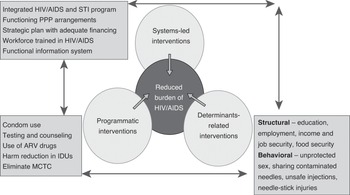
Most health workers in L&MICs are predominantly involved in the implementation of promotive, preventive, curative, rehabilitative, and palliative programs to reduce the burden of problems associated with reproductive health, communicable diseases, noncommunicable diseases, or injuries. Addressing the underlying determinants, especially proximal, is often an integral component of such programs. Many health professionals see health from an illness or program perspective. This chapter has approached health from a systems perspective, which is the aim of this book. Interventions, whether system-led, programmatic, or those targeted at tackling health determinants, are all part of the wider health system and offer the best opportunity for improving health outcomes when addressed together. This is well illustrated through reducing the burden of HIV/AIDS in a population (Figure 1.8). Such an approach advocates for more integrated and universally accessible health systems, building on the principles and a solid foundation of primary health care, which is the subject of the next chapter.
Broader systems thinking approach for reducing the burden of HIV/AIDS in a population. ARV, antiretroviral; IDU, intravenous drug users; MCTC, mother-to-child transmission; PPP, public–private partnership; STI, sexually transmitted infections.