Introduction
Using semiconductor photocatalysts to degrade organic pollutants [Reference Qi, Xie, Wang, Liu and Zhao1, Reference Shahrezaei, Habibzadeh, Babaluo, Hosseinkhani, Haghighi, Hasanzadeh and Tahmasebpour2] and produce H2 from water splitting [Reference Leung, Warnan, Nam, Zhang, Willkomm and Reisner3] under solar irradiation has drawn more and more attention due to its distinctive advantages in terms of low cost, nontoxicity, clean, lack of secondary pollution, and environmentally friendly [Reference Qi, Liu and Qiu4, Reference Ramírez-Ortega, Acevedo-Peña, Tzompantzi, Arroyo, González and González5, Reference Qi, Liu, Chen, Xia and Li6]. Therefore, photocatalytic technology has become an important key to solve the problems of environmental remediation in the future. It is essential to synthesize high-efficiency semiconductor photocatalysts for promoting the practical applications of photocatalytic technology. Over the past four decades, TiO2, as one of the most important semiconductor photocatalysts, has become an international research focus in the green chemistry field since the discovery of its photocatalytic activity discovery in 1972 [Reference Fujishima and Honda7]. However, intrinsic drawbacks belonging to TiO2 are its wide band gap of 3.0 or 3.2 eV for the crystalline phase of rutile or anatase [Reference Bhanvase, Shende and Sonawane8, Reference Qi, Cheng, Yu and Ho9, Reference Neppolian, Bruno, Bianchi and Ashokkumar10] and low absorption performance of visible light [Reference Subramanian, Wolf and Kamat11, Reference Yu, Wu, Yu and Luo12, Reference Zhang, Wang, Liu and Li13, Reference Riaz, Qi, Fang, Xu, Zhou, Jin, Hong, Zhi and Liu14], which significantly limit its practical applications as a solar-driven photocatalyst. To overcome these drawbacks and develop the TiO2 photocatalysts, extensive works from different ways have been done to prepare the high-efficiency TiO2 catalyst with efficient photodegradation ability during the past decades [Reference Wang, Ruan, Li, Li, Hu, Chen, Shao and Zheng15, Reference Simsek16, Reference Yoo17, Reference Powella, Quesada-Cabreraa, Taylorb, Teixeiraa, Papakonstantinoub, Palgravea, Sankara and Parkin18, Reference Zheng, Li, Wan, Yu and Xing19]. Recently, reduced TiO2 (r-TiO2) [Reference Zhan, Tan, Yu, Jia and Huang20, Reference Chen, Xia, Li, Li and Zhang21, Reference Bai, Li, Zhang, Zhang, Wang, Xu and Zhu22, Reference Di Valentin, Pacchioni and Selloni23, Reference Zhao, Tan, Zhao, Lv, Zhou, Song and Sun24] with visible light–driven photocatalytic property has been regarded as a promising photocatalyst in terms of the Ti3+ and oxygen vacancies (Ov), which significantly extend the photoresponse and facilitate the photodegradation ability. Chen et al. [Reference Chen, Xia, Li, Li and Zhang21] synthesized the reduced TiO2 nanotubes using hydrogenation and electrochemical deposition method. They found that the presence of Ti3+/Ov in TiO2 could enhance the charge transfer in the process of photocatalysis. Although numerous works have been done about r-TiO2 catalysts, the issue of high rate recombination of photoinduced carriers is still not solved. Therefore, the current extensive efforts are focused on fabricating the high-efficiency r-TiO2–based catalysts with high separation efficiency of photoinduced carriers. To get TiO2-based catalysts with remarkably enhanced performance, an effective strategy is to couple the other novel semiconductor materials with TiO2 due to the controllable morphology and the development of heterojunction between two semiconductor materials [Reference Zhao, Tan, Zhao, Lv, Zhou, Song and Sun24, Reference Lu, Shao, Wang, Lu, Zhang, Zhang, Zhang, Li and Liu25, Reference Wang, Cai, Jin, Zhang, Fang, Qu, Zhang and Zhang26, Reference Liu, Luo, Xiong, Yang, Zhang, Cai and Gu27, Reference Obregón and Colón28]. The presence of heterojunction in the catalyst system could restrain the recombination of photoinduced carriers [Reference Qi, Cheng, Yu and Ho29, Reference Qi, Qi, Yang, Wang, Selvaraj and Zheng30, Reference Liu and Zhang31, Reference Wen, Xie, Chen and Li32]. Yang et al. [Reference Qi, Qi, Yang, Wang, Selvaraj and Zheng30] reported a 3D ZnIn2S4/TiO2 Z-scheme system catalyst with enhanced photocatalytic activity. They found that the electrons could recombine with the holes in the TiO2 nanobelts and ZnIn2S4 nanosheets, respectively, in the Z-scheme type system.
Moreover, the construction of multisystem heterostructures is deemed to an effective way to facilitate the photocatalytic performance of TiO2. Graphitic carbon nitride (g-C3N4) [Reference He, Xie, Luo, Wen, Ma, Li, Fang and Zhang33, Reference Wang, Zhu, Liu, Zhang, Yu and Zhou34, Reference Low, Dai, Tong, Jiang and Yu35] is attracting significantly attention and has emerged as one of the most prominent candidates in photocatalytic application. It has typical two-dimensional structure with large surface areas and narrow band gap, which is widely used as semiconductor materials to combine the other semiconductors. It is highly noteworthy that the combination of TiO2 and g-C3N4 can make the composites remarkably enhanced performance. Li et al. [Reference Li, Nie, Jiang, An, Wong, Zhang, Zhao and Yamashita36] successfully prepared g-C3N4/TiO2 composite catalyst by a hydrothermal calcination process. The narrow band gap (2.48 eV) of the as-prepared hybrid and effective separation of photoinduced carriers could be ascribed to the synergetic effect. Ma et al. [Reference Ma, Tan, Yu and Li37] reported g-C3N4/TiO2 hybrid that has high percentage of (001) facets. The results showed that the g-C3N4/TiO2 has highly efficient photodegradation ability due to the heterojunction in g-C3N4/TiO2 hybrid and large surface area of layered structure for g-C3N4.
More recently, ternary photocatalytic system has become a hot topic in photocatalysis; however, there are few studies to architect the dual Z-scheme photocatalytic system. Ag-based catalysts such as Ag3VO4 [Reference Li, Duan, Qin, Fan and Zheng38], Ag3PO4 [Reference Chen, Bing, Liu, Zhang and Fang39], Ag3WO4 [Reference Zhang, Cui, Yang, Tang, Liu and Li40], and Ag2O [Reference Jiang, Jiang, Shi, Wang, Li, Zhu and Zhang41] have drawn more and more attention from public as efficient photocatalysts to degrade pollutants. Among these Ag-based photocatalysts, Ag3VO4 has aroused great interests in terms of its highly efficient photodegradation ability, suitable band gap (2.2 eV), and high chemical consistency [Reference Zhao, Xu, Li and Xu42, Reference Wangkawong, Suntalelat, Tantraviwat and Inceesungvorn43, Reference Sun, Xu, Li, Shu, Liu and Zhang44]. Up to now, numerous hybrid photocatalysts consisting of Ag3VO4 and other materials (such as TiO2 [Reference Wang, Wang, Cao, Che, Li, Shao, Zheng and Li45], Bi2WO6 [Reference Li, Hu, Jiang, Liu, Liu and Wang46], and g-C3N4 [Reference Wang, Li, Sun, Yang, Guan and He47]) have been already synthesized. Wang et al. [Reference Wang, Wang, Cao, Che, Li, Shao, Zheng and Li45] prepared Ag3VO4/TiO2/graphene nanocomposites as wide spectrum responsive photocatalysts, exhibiting significantly high-efficiency photocatalytic capacity in degradation for RhB. Compared with single component, ternary system can effectively improve the photocatalytic activity. Li et al. [Reference Li, Liu, Liu and Qin48] successfully synthesized a dual Z-scheme photocatalytic system composited of Ag2O-modified Ti3+ self-doped TiO2 nanocrystals. This dual Z-scheme system exhibited significantly elevated photocatalytic capacity for RhB. Based on the previous reports, the newfangled strategy coupling r-TiO2 with Ag3VO4 and g-C3N4 was designed. Through the construction of heterojunctions, Ag3VO4 with suitable band gap and high conductivity could make the dual Z-scheme charge transfer pathway completed with improved separation efficiency and stronger redox ability of photogenerated electrons and holes.
Our group has been reported Z-scheme g-C3N4/r-TiO2 composites for photocatalytic ability in previous study [Reference Zhou, Ye, Yan, Wang, Pan, Wang, Wang, Zu and Cheng49]. The sample of 15% g-C3N4/r-TiO2 was denoted as S1. In this current work, a strategy of Ag3VO4/g-C3N4/r-TiO2 hybrid was developed for stable photocatalytic application. We prepared this novel ternary composite by hydrothermal and deposition method. The obtained materials were used as photocatalysts to degrade MB solution under visible light irradiation to evaluate its photocatalytic performance, which showed extremely higher photocatalytic activity in comparison with the reported g-C3N4/r-TiO2 or Ag3VO4/g-C3N4 catalysts. Different contents influence of Ag3VO4 on absorption performance of visible light in terms of the hybrid was also done systematically. Besides, the dual Z-scheme photocatalytic mechanism and the stability for the ternary Ag3VO4/g-C3N4/r-TiO2 composite were investigated.
Results and discussions
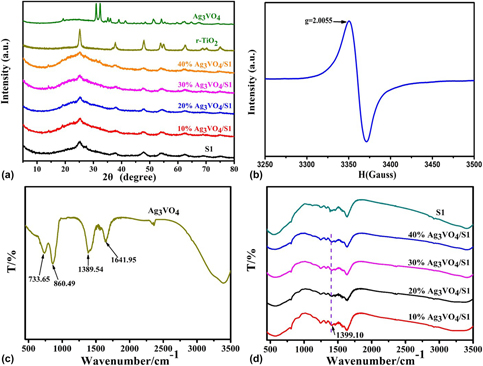
The X-ray diffraction (XRD) patterns were analyzed to characterize the crystal structure and phase information of Ag3VO4, r-TiO2, and Ag3VO4/S1 (C3N4/reduced TiO2) composites and the result was shown in Fig. 1(a). Conspicuously, a range of diffraction peaks that appeared at 25.2°, 37.8°, 48.0°, 53.9°, 55.0°, and 62.7° in the obtained TiO2 are corresponded to the crystal face of (101), (004), (200), (105), (211), and (204), respectively. The results above can be well indexed to typical phase of TiO2 [Reference Sha, Wang, Ye, Dai, Ren, Chen, Wu, Wang, Tang and Yan50] (JCPDS No. 21-1272). For pure Ag3VO4, diffraction peaks at 30.97°  $\left( {\bar{1}21} \right)$ and 32.33° (121) correspond to the monoclinic phase of Ag3VO4 [Reference Wang, Ruan, Li, Li, Hu, Chen, Shao and Zheng15] (JCPDS No. 43-0542). Furthermore, for S1, the diffraction peak at 27.7° [Reference Ma, Tan, Yu and Li37] corresponds to (002) diffraction of tri-s-triazine units, which demonstrates the existence of g-C3N4 [Reference Lee and Cui51]. Obviously, all the peaks of the ternary composites can be attributed to r-TiO2, g-C3N4, or Ag3VO4, which proved the successful preparation of Ag3VO4/S1 composites. Particularly, the intensity of characteristic diffraction peaks for Ag3VO4 gradually increased with the increased contents of Ag3VO4 in Ag3VO4/S1 composites.
XRD patterns of Ag3VO4, r-TiO2, and Ag3VO4/S1 composites (a), EPR spectrum of Ag3VO4/S1 (b), FTIR spectrum of Ag3VO4 (c), and FTIR spectra of Ag3VO4/S1 composites (d).

To identify the element information, the electron paramagnetic resonance (EPR) measurement result was shown in Fig. 1(b). It is well known that the g-values of Ti3+ and oxygen vacancy are 1.94–1.99 and 2.004, respectively [Reference Sha, Wang, Ye, Dai, Ren, Chen, Wu, Wang, Tang and Yan50]. Conspicuously, the result (g = 2.0055) can confirm the products possess the steady oxygen vacancy.
To further characterize the Ag3VO4/S1 products, FT-IR spectra of the samples are shown in Figs. 1(c) and 1(d). For ternary composites, the relatively broad band in 500–700 cm−1 can be ascribed to the Ti–O vibration modes of r-TiO2 [Reference Liu, Luo, Xiong, Yang, Zhang, Cai and Gu27]. Obviously, a strong band at 1200–1700 cm−1, with a series of bands (1252, 1322.3, and 1637.9 cm−1) are corresponded to the mode of C=N and C–N in g-C3N4 [Reference Ren, Wu, Zou, Dai, Sha, Chen, Wang, Pan and Yan52]. The characteristic peak at 1399.10 cm−1 is ascribed to the mode of VO3 group in Ag3VO4 [Reference Murugesan, Wijayasinghe and Bergman53]. The results of FTIR also prove the Ag3VO4/S1 is composed of Ag3VO4, r-TiO2, and g-C3N4, which are consistent with the XRD analysis.
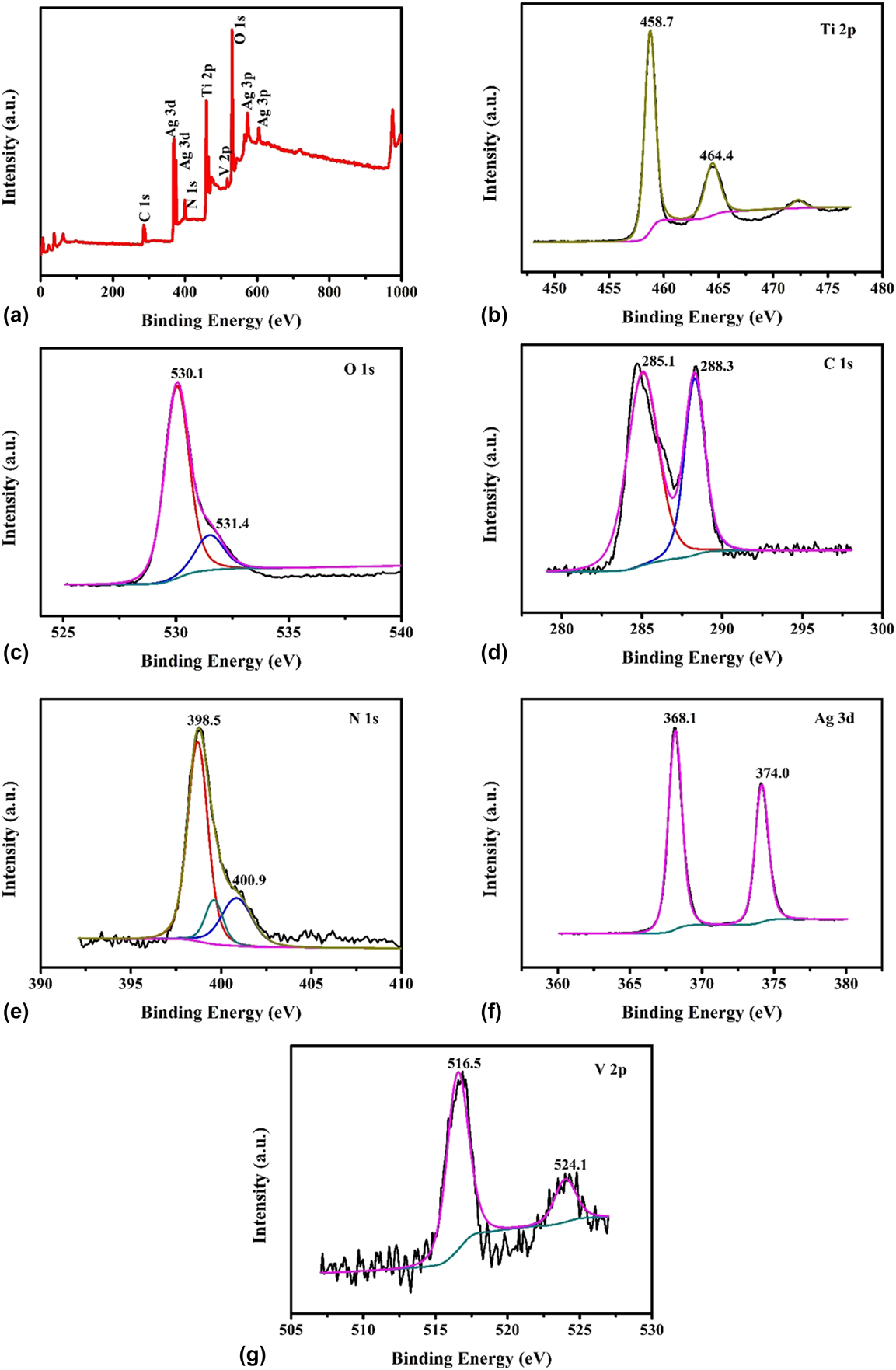
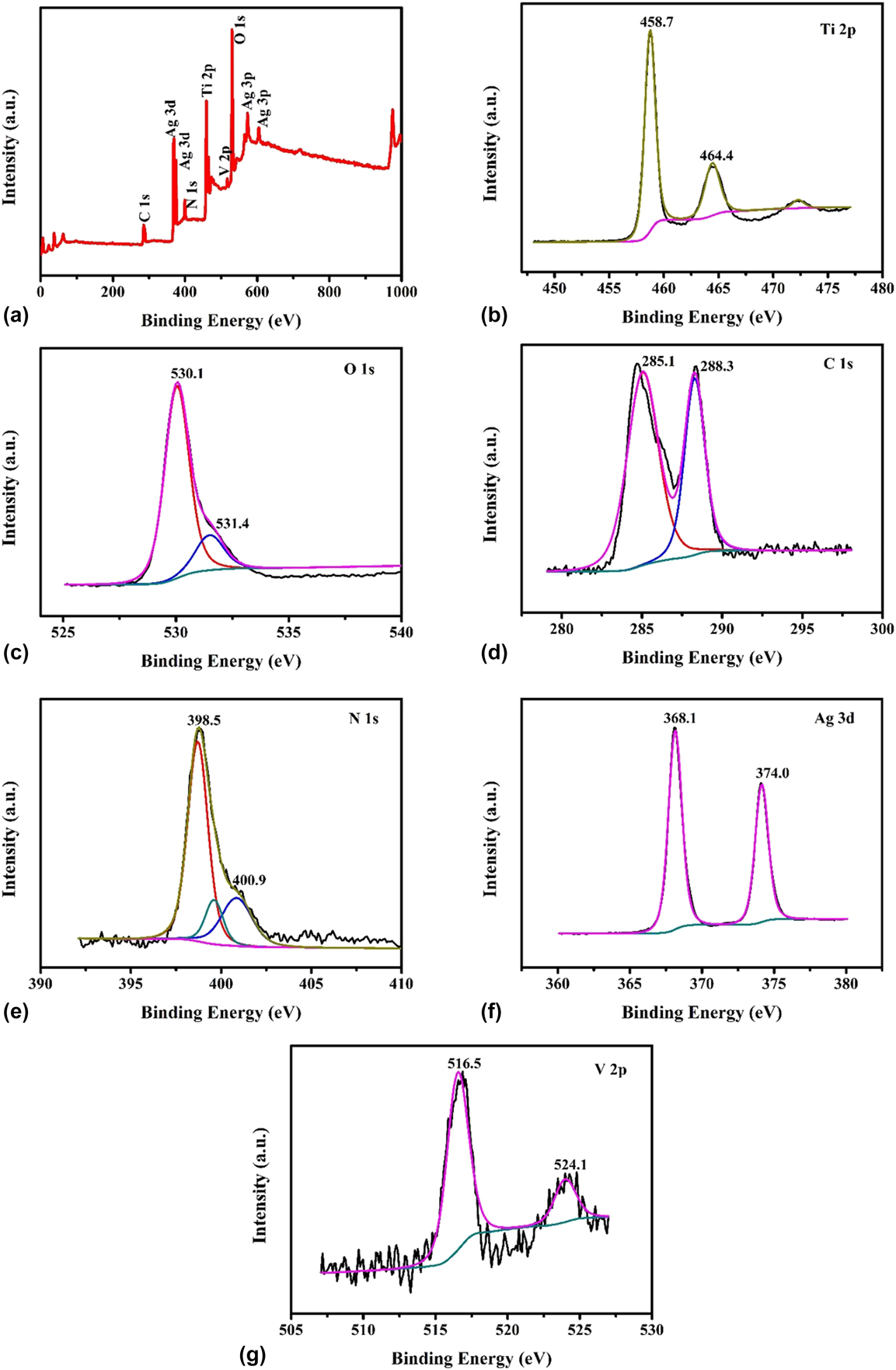
To identify the chemical states of O, Ti, N, C, Ag, and V elements in 30% Ag3VO4/S1 sample, X-ray photoelectron spectroscopy (XPS) analysis was conducted as shown in Fig. 2. It could be found that the peaks of O, Ti, N, C, Ag, and V [Fig. 2(a)] were measured in the survey spectra of Ag3VO4/S1 composites. As shown in Fig. 2(b), in the Ti 2p region, two binding energy values located at 458.7 and 464.4 eV are assigned to 2p 3/2 and 2p 1/2 for Ti4+ in TiO2, respectively [Reference Sha, Wang, Ye, Dai, Ren, Chen, Wu, Wang, Tang and Yan50]. Particularly, there is a weak shift for the bind located at 458.7 eV of Ti 2p 3/2, and it is attributed to the oxygen vacancies in the samples [Reference Lee and Cui51]. The spectrum of O 1s was shown in Fig. 2(c). The peak centered at 530.1 and 531.4 eV is attributed to Ti=O and O–H, respectively. As shown in Fig. 2(d), there are two peaks (258.1 eV, 288.3 eV) in g-C3N4. They are corresponded to the C–C and N–C=N2, respectively. Noticeably, the intensity of the peak (288.3 eV) is much higher than that of single g-C3N4, which proves the presence of strong interfacial interaction between TiO2 crystals and g-C3N4 sheets [Reference Yu, Wang, Low and Xiao54]. It could be found in Fig. 2(e), the peaks (398.5 eV and 400.9 eV) in N 1s XPS spectrum can be well corresponded to C=N–C and N–C3, respectively. Figure 2(f) exhibits the Ag 3d spectrum. Two intense bands located at 368.3 and 374.0 eV were assigned to the binding energies of Ag 3d 5/2 and Ag 3d 3/2 [Reference Ren, Wu, Dai, Sha, Pan, Chen, Wang, Wang, Ye and Yan55]. Obviously, the spectrum of V 2p [Fig. 2(g)] that located at 516.5 and 524.1 eV are corresponded to the V 2p 3/2 and V 2p 1/2, respectively [Reference Wang, Ruan, Li, Li, Hu, Chen, Shao and Zheng15]. The strong interaction among Ag3VO4, g-C3N4, and r-TiO2 also can be found because the binding energies of V 2p and Ag 3d in sample are higher than those of V 2p and Ag 3d in pure Ag3VO4. The results indicate the excellent interface bonding among these components, which could improve the transfer of photoinduced carriers in the sample.
XPS spectra of 30% Ag3VO4/S1. (a) Survey spectrum, (b) Ti 2p, (c) O 1s, (d) C 1s, (e) N 1s, (f) Ag 3d, and (g) V 2p.
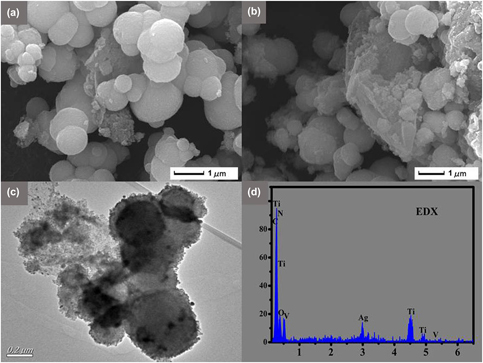
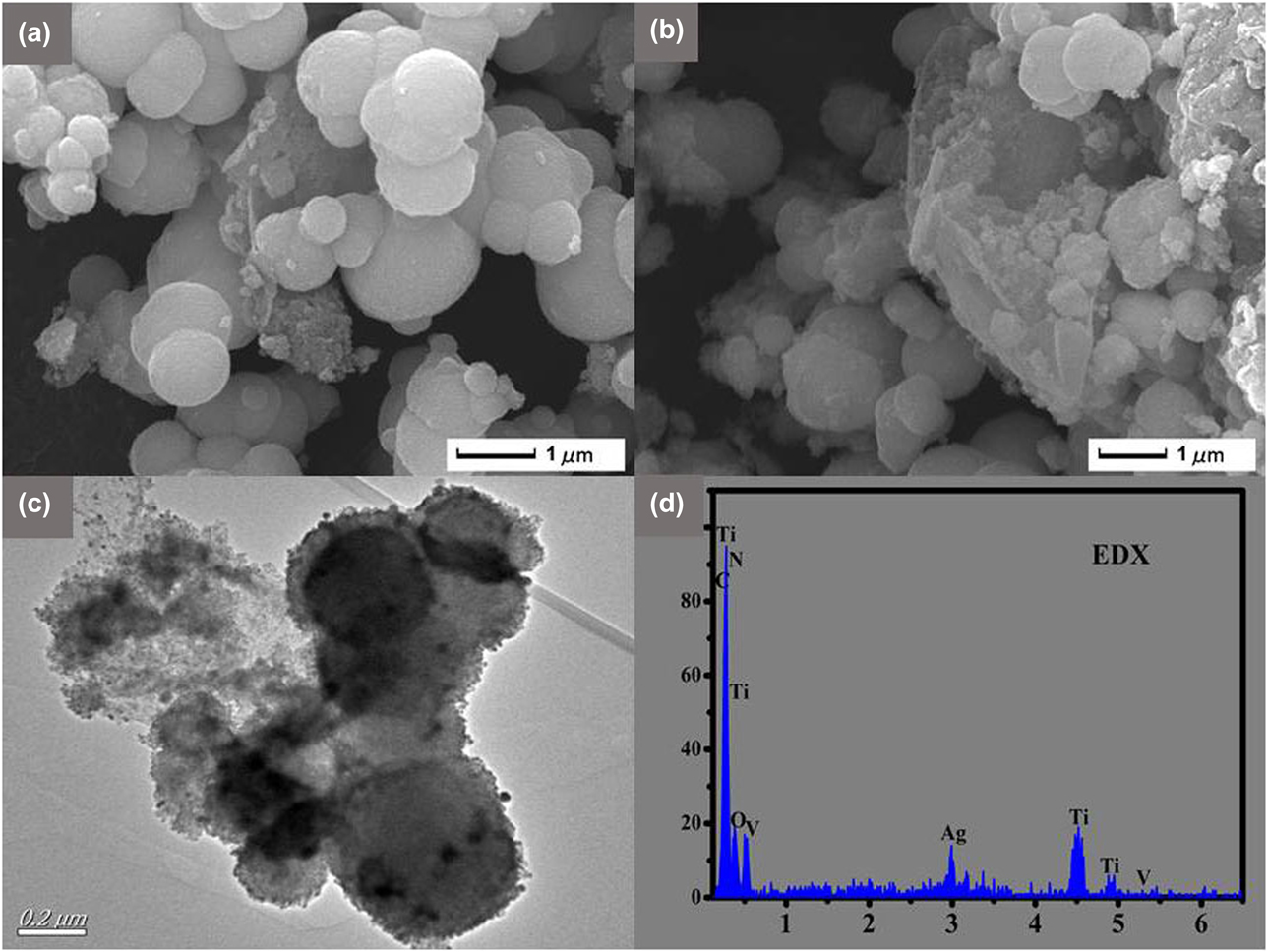
To evaluate the morphology and microstructures of different as-prepared samples including g-C3N4/TiO2 (S1) and Ag3VO4/S1 composites, scanning electron microscopy (SEM) and transmission electron microscopy (TEM) analyses were conducted (Fig. 3). Figure 3(a) shows that r-TiO2 sample had regular sphere-like shapes with diameter sizes ranging from 500 nm to 2 µm. The g-C3N4 had a typically two-dimensional lamellar structure with large surface area, and sphere-like r-TiO2 is spreading over the surface of lamellar g-C3N4. It can be clearly seen that Ag3VO4 nanoparticles with diameter sizes in the range of 100 nm were tightly adhered to the surface of the S1 [Fig. 3(b)], which means that the heterojunction was formed. The g-C3N4/TiO2 (S1) could be used as a basis material for the crystallization growth of Ag3VO4 and prevented the occurrence of nanoparticle agglomeration, which obtained the composites with an excellent morphology and microstructures. Energy dispersive X-ray spectroscopy (EDS) was used to observe the composition of as-prepared materials; it also can be seen that the composite consists of Ti, O, C, N, Ag, and V elements [Fig. 3(d)]. This result further confirms that the Ag3VO4/S1 hybrids had been successfully prepared.
SEM images of S1 (a), Ag3VO4/S1 (b), and TEM image of Ag3VO4/S1 (c) and EDS pattern of Ag3VO4/S1 (d).
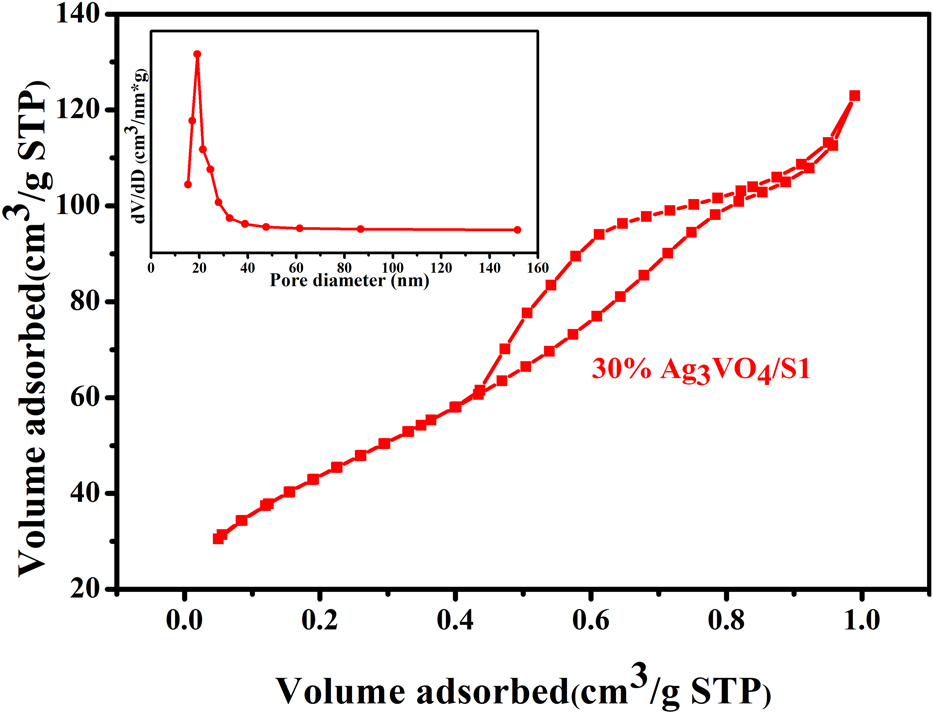
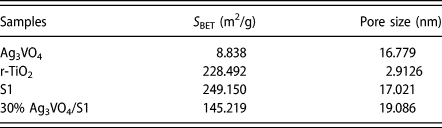
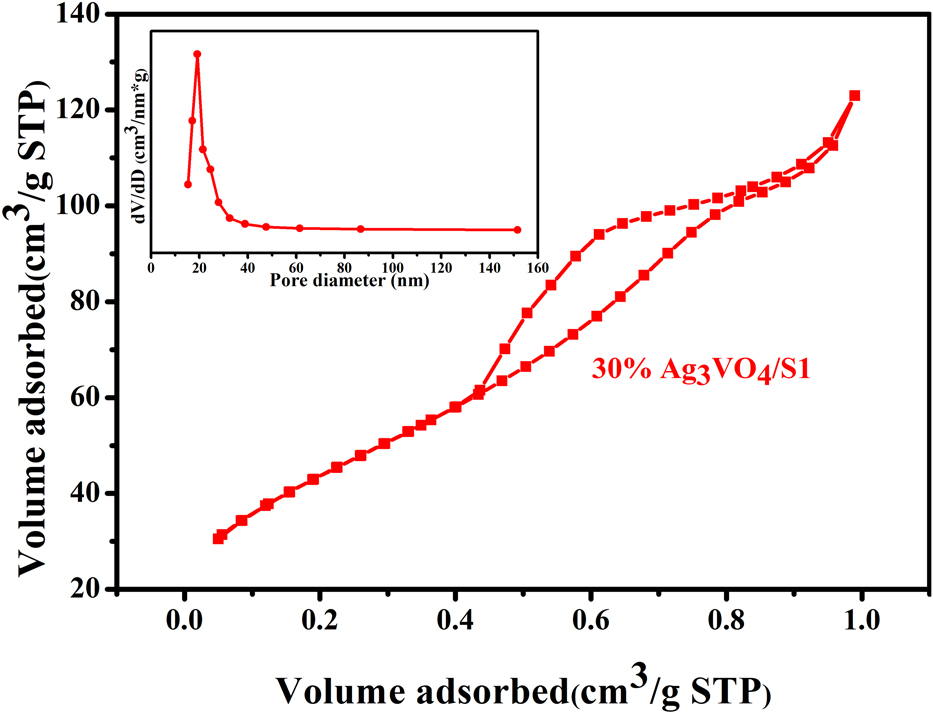
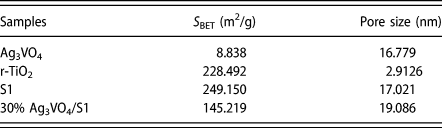
Nitrogen adsorption–desorption isotherms measurements were used to determine the surface area of the obtained products and the pore size distribution curve (insert) of 30% Ag3VO4/S1, as shown in Fig. 4. It can be detected that the as-prepared 30% Ag3VO4/S1 has the typical type IV isotherms, indicating the mesoporosity structure in g-C3N4/TiO2 (S1) has not been broke and the Ag3VO4/S1 composite belongs to the mesoporous material [Reference Wang, Wang, Cao, Che, Li, Shao, Zheng and Li45]. It can be clearly seen that the specific surface areas and pore sizes summarized data of Ag3VO4, S1, and 30% Ag3VO4/S1 in Table I. The 30% Ag3VO4/S1 composite has large BET surface area (145.219 m2/g), which is beneficial for enhancement of photocatalytic performance. BET surface area of S1 (249.150 m2/g) drop down to the 145.219 m2/g in 30% Ag3VO4/S1 composite, which may be the Ag3VO4 nanoparticles adhered onto the surface of the S1. It is believed that the large surface area and porous feature of the catalyst could have more surface active sites for adsorption of reactants and the rapid transportation of reactant and the products in the photocatalytic process.
Nitrogen adsorption–desorption of 30% Ag3VO4/S1 and pore size distribution curves (inset).
The specific surface areas and pore sizes data of the as-synthesized samples.
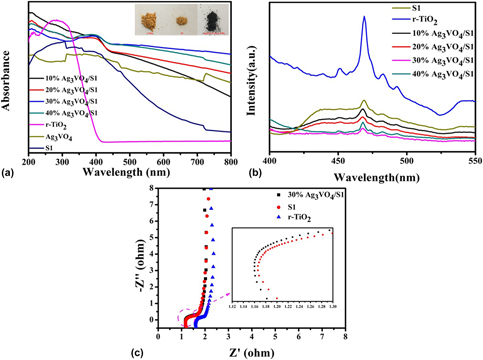
A UV-vis diffuse reflectance spectroscopy (UV-vis DRS) test was constructed to inspect the optical properties for r-TiO2, Ag3VO4, S1 and the different mass ratio of Ag3VO4 in composites. As can be seen in Fig. 5(a), bare r-TiO2 presents a visible light photoresponse performance [Reference Sha, Wang, Ye, Dai, Ren, Chen, Wu, Wang, Tang and Yan50]. S1 shows higher light absorption property than the bare r-TiO2 in visible light region. Particularly, all Ag3VO4/S1 samples show strong light absorption properties and the absorption edges are significantly shifted toward longer wavelengths, which indicates not only the changes of band gaps in terms of the effect of Ag3VO4 with excellent optical property [Reference Sun, Xu, Li, Shu, Liu and Zhang44] but also the synergetic effect among Ag3VO4 and S1. Moreover, among these samples, the mass ratio of Ag3VO4 in composites was remarkably affected on the visible light absorption property of the composites. The 30% Ag3VO4/S1 shows optimal visible light absorption property.
UV-vis DRS spectra of the samples (a), the photoluminescence spectra of as-prepared materials (b), and EIS for r-TiO2, S1, and 30% Ag3VO4/S1 (c).
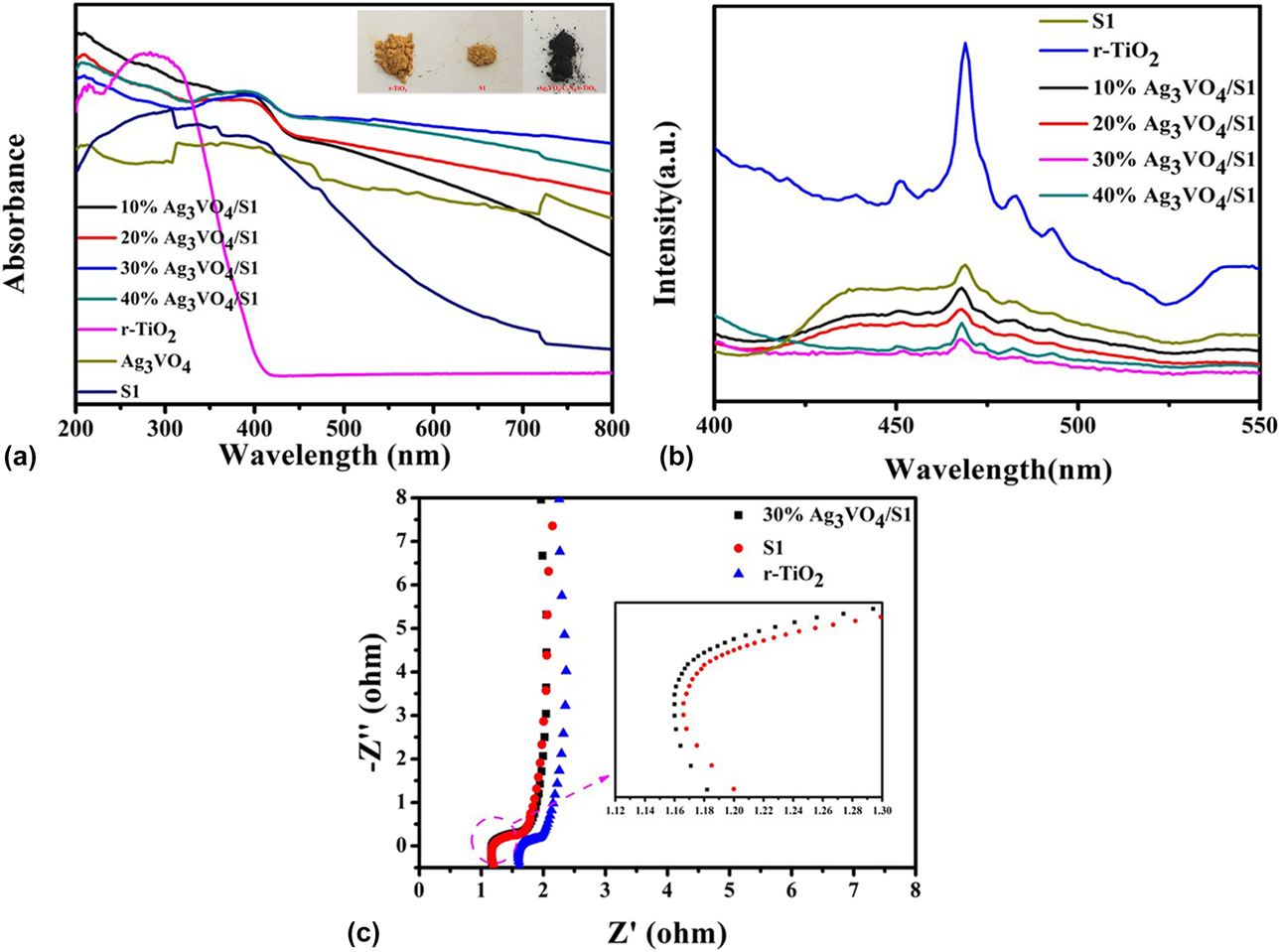
To detect the effectiveness of Ag3VO4 nanoparticle on recombination of photoinduced electron–hole pairs, the photoluminescence spectra of the obtained sample were recorded as shown in Fig. 5(b). Conspicuously, the Ag3VO4/S1 has lower fluorescence intensity contrast to r-TiO2 and S1. Different mass ratio of Ag3VO4 in products was significantly affected on fluorescence intensity. The 30% Ag3VO4/S1 composite possesses the minimal fluorescence intensity, indicating the high efficiency on suppressing the recombination.
Figure 5(c) exhibits electrochemical impedance spectroscopy (EIS) for 30% Ag3VO4/S1, S1, and r-TiO2. According to the Nyquist plots, the internal resistance (R s) of 30% Ag3VO4/S1, r-TiO2, and S1 is 1.19 Ω, 1.61 Ω, and 1.21 Ω, respectively. Furthermore, the charge transfer resistance (R ct) of 30% Ag3VO4/S1, r-TiO2, and S1 is 0.36 Ω, 0.83 Ω, and 0.37 Ω, respectively. Ag3VO4/S1 sample shows the lower R ct, implying the rapid transfer of photoinduced charges in the ternary composites.
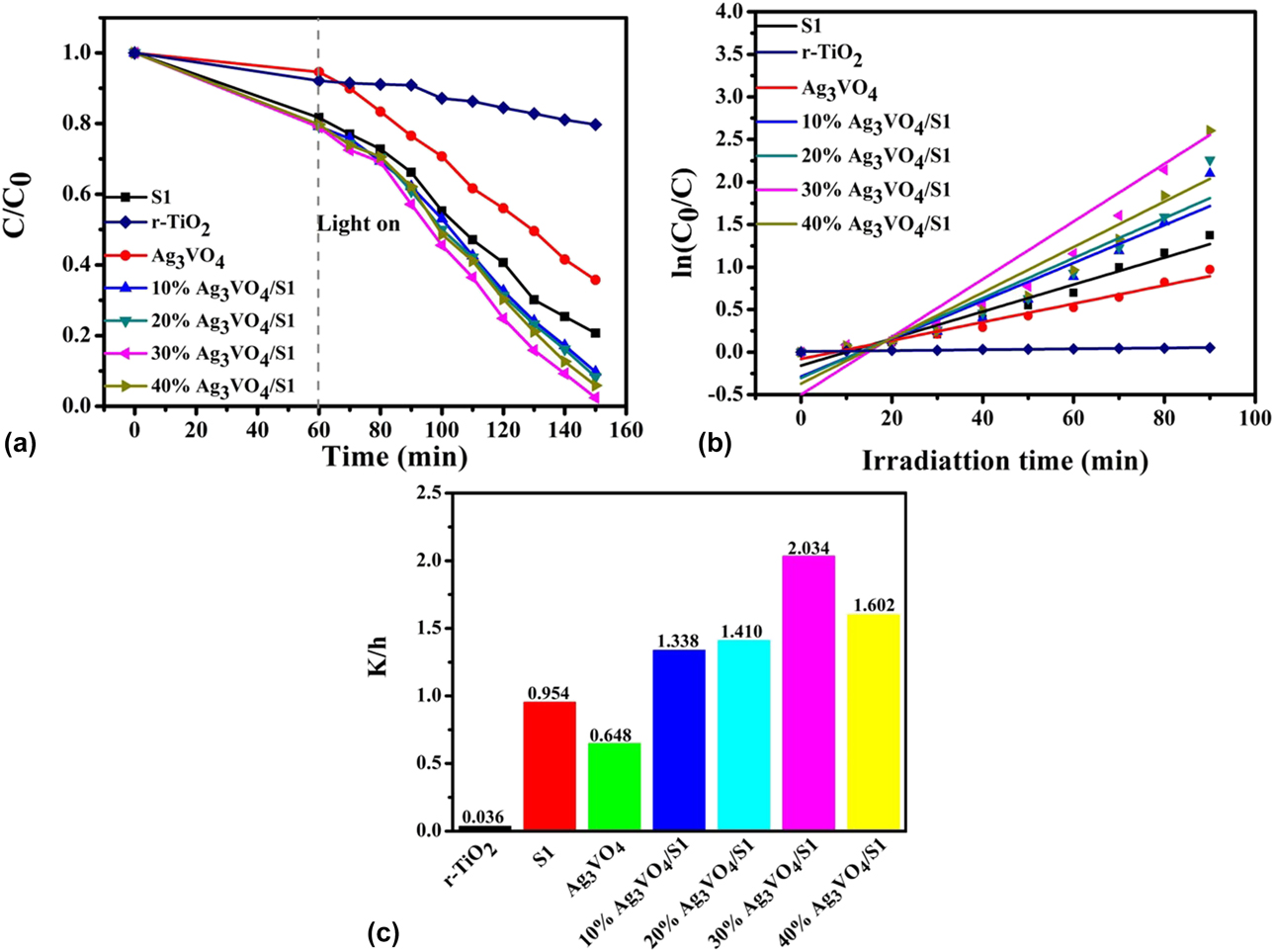
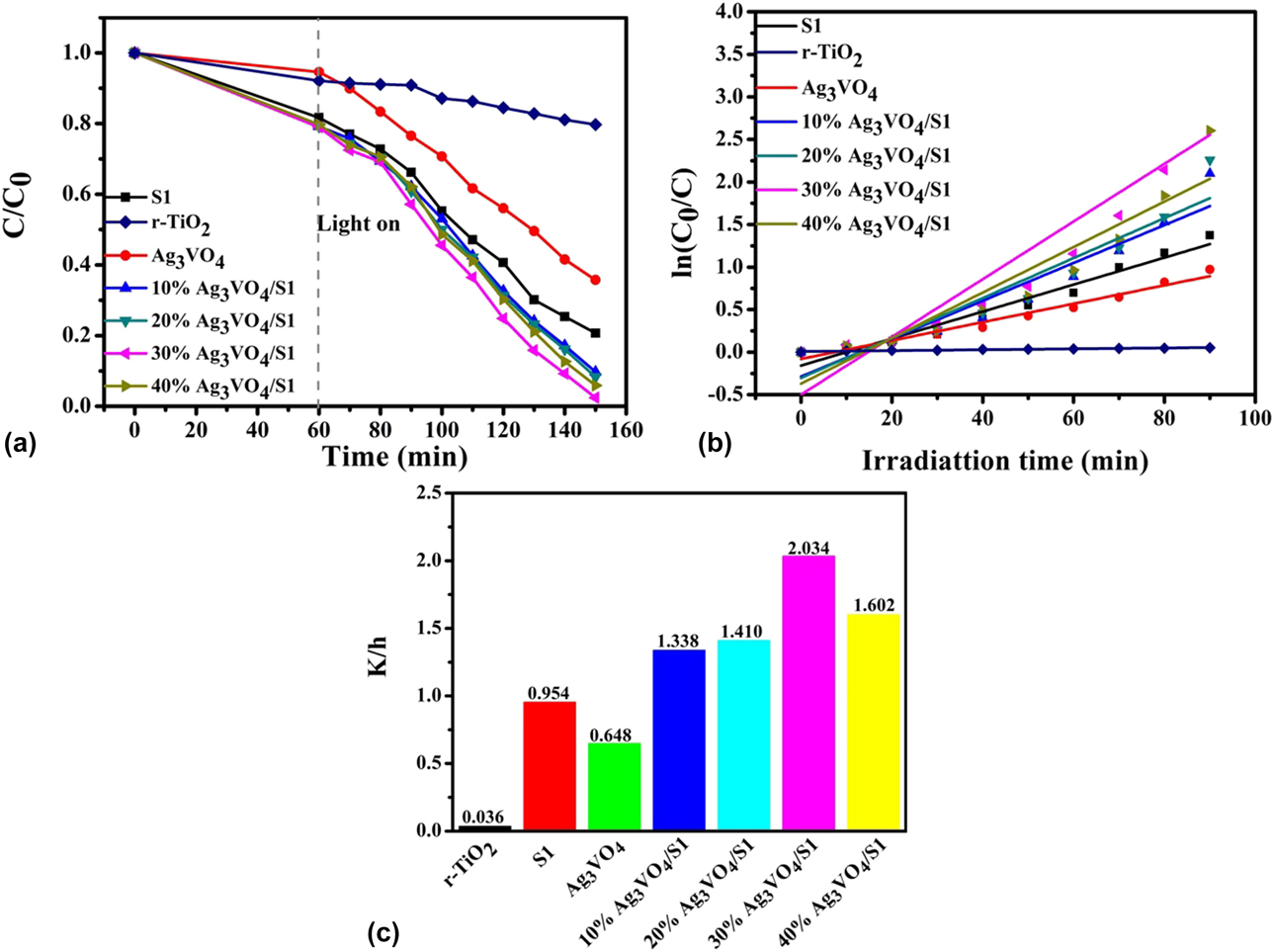
The photocatalytic activities of as-prepared photocatalysts were investigated through photodegrading the representative MB pollutants under visible light irradiation [Fig. 6(a)]. Obviously, the degradation capacity of Ag3VO4/S1 was higher compared with those of bare S1 and r-TiO2. Especially the mass ratios of Ag3VO4 to composite were significantly affected on the photocatalytic activity. The degradation speed increased with increasing mass ratio for Ag3VO4 from 0 to 30%, and then decreased when the mass ratio for Ag3VO4 was over 30%. It is noted that 30% Ag3VO4/S1 exhibits the optimal degradation capability from which 97.6% of the MB molecules could be degraded after irradiated in 90 min. The degradation efficiency of r-TiO2, S1, Ag3VO4, 10% Ag3VO4/S1, 20% Ag3VO4/S1, and 40% Ag3VO4/S1 is 19.8%, 79.3%, 64.3% 90.3%, 91.7%, and 94.1%, respectively. Figure 6(b) shows the corresponding first-order kinetics plot with linear relation. The kinetic constant of S1 and Ag3VO4 and diverse mass ratios of Ag3VO4 to composite are shown in Fig. 6(c). The kinetic constant of 30% Ag3VO4/S1 came up to the 2.043 h−1, which was much higher than that of any other composite. Such a prominent photocatalytic capacity could further confirm the synergetic effect of Ag3VO4 and S1.
Photocatalytic degradation of MB over different samples under visible light irradiation (a), the corresponding first-order kinetics plot (b), and rate constant k of MB degradation for the as-prepared photocatalysts (c).
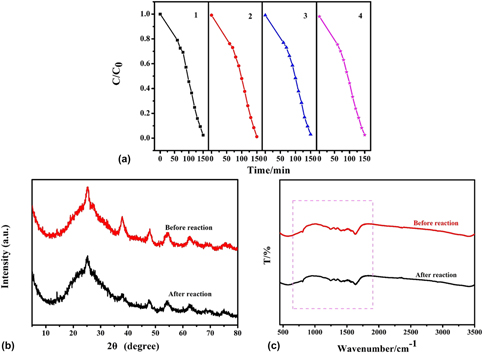
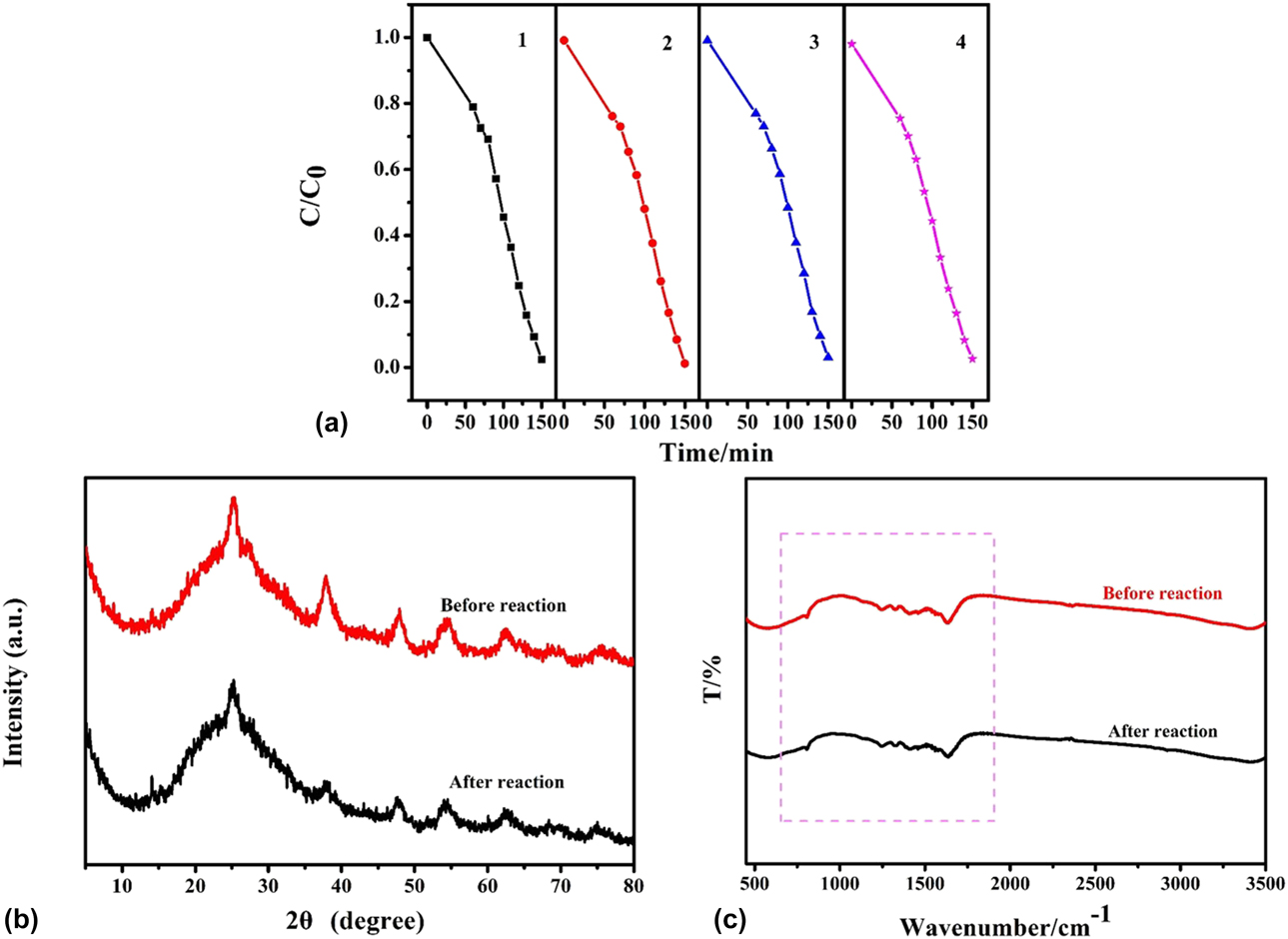
To further investigate the stability of as-prepared Ag3VO4/S1 sample, the same sample (30% Ag3VO4/S1) was reused continuously four times, and the result was exhibited in Fig. 7. As it could be found that the high photocatalytic ability of Ag3VO4/S1 sample still be maintained after four recycling runs [Fig. 7(a)], it is suggesting that the as-prepared Ag3VO4/S1 sample has the excellent reusability. Furthermore, the 30% Ag3VO4/S1 sample was examined through XRD and FTIR before and after four circulating runs [Figs. 7(b) and 7(c)]. It could be found that no fresh peaks came out before and after reaction, implying that the ingredient of 30% Ag3VO4/S1 was not changed. Hence, the stability of Ag3VO4/S1 catalyst is confirmed.
Recycling runs in the photocatalytic degradation of MB under visible light irradiation (a), XRD patterns before and after photocatalytic degradation of the 30% Ag3VO4/S1 (b), and the FTIR spectra before and after photocatalytic degradation of the 30% Ag3VO4/S1 (c).
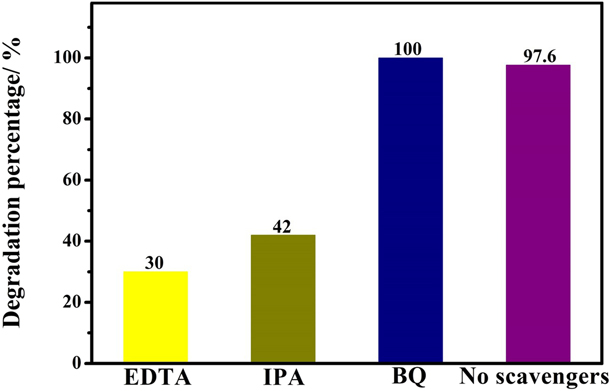
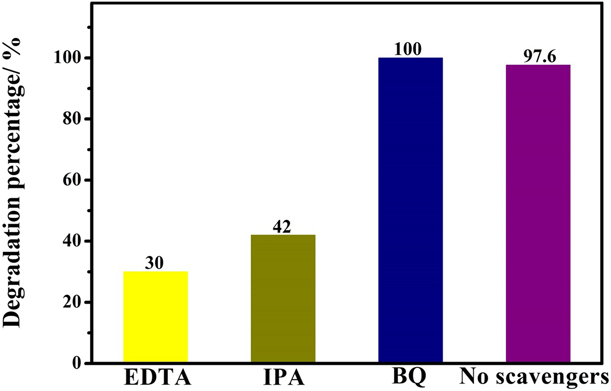
On the photocatalytic process, some active species covering hydroxyl radicals (•OH), hole (h+), and superoxide anion radicals (•O2−) were formed. The trapping experiments have been done to detect the effects of these active species. In this study, isopropanol (IPA), benzoquinone (BQ), and ethylenediaminetetraacetic acid (EDTA) were used as scavengers for •OH, •O2−, and h+, respectively. The degradation efficiency of MB for 30% Ag3VO4/S1 sample was 97.6% when no scavengers play a part. The degradation efficiency was increased to 100% when adding BQ into the reaction system. Conspicuously, the addition of IPA or EDTA could give rise to the remarkably decreased for the degradation efficiency, 42% and 30%, respectively. This result implied that •OH and h+ were the main active species on improved reaction system (Fig. 8).
The effect of different scavengers on photocatalytic degradation of MB under visible light irradiation.
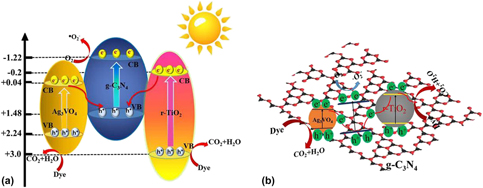
Based on these foregoing analyses and energy band structures for r-TiO2, Ag3VO4, and g-C3N4, a dual Z-scheme photocatalytic mechanism in Ag3VO4/S1 composite was discussed in detail (Fig. 9). Ag3VO4, g-C3N4, and r-TiO2 can be excited under visible light region, and the photoinduced electrons and holes were stored on their conduction band (CB) and valence band (VB), respectively. At the initial stage, the electrons on the CB of Ag3VO4 and r-TiO2 could effortlessly migrate to VB of g-C3N4 to recombine with holes or into the CB of g-C3N4 by means of the heterojunction because the CB in r-TiO2 and Ag3VO4 are more negative than the VB of g-C3N4. The holes are still gathered on the VB of r-TiO2 and Ag3VO4. The introduction of Ag3VO4 makes the dual Z-scheme charge transfer pathway completed with higher separation efficiency and stronger redox ability of photogenerated electrons and holes. It is noting that the formation of the charge transfer pathway is resembled with double “Z” shapes [Reference Wu, Li and Zhang56, Reference Xu, Zhang, Yu, Wageh, Ghamdi and Jaroniec57, Reference Le, Li, Borjigin, Li and Wang58, Reference Feng, Zeng, Chen, Ma, Zhao, Jin, Lu, Wu and He59]. The process above finally could provide tunnels for the rapid transfer of photoinduced electron–hole pairs. The surface of r-TiO2 and Ag3VO4 could immediately contact with the molecules in the pollutant and respond to the water molecules to form •OH because of the holes stored in VB. The formation of •O2− could ascribe to the electrons that deposit in the CB of g-C3N4. The MB has been degraded to the carbon dioxide and water due to the oxidation of active species h+ and •OH, ultimately [Reference Tang, Chang, Tang and Li60, Reference Tang, Fu, Chang, Xie and Tang61].
The structure of band gap (a), mechanism scheme of photoexcited electron–hole pairs’ separation process (b).

Conclusion
The dual Z-scheme Ag3VO4/S1 was achieved through the hydrothermal and deposition process. Ag3VO4 nanoparticles with diameter sizes in the range of 100 nm were tightly adhered to the surface of the S1 on the as-prepared Ag3VO4/S1 products by the r-TiO2 microspheres and the g-C3N4 sheets. According to the UV-vis DRS and PL, the obtained Ag3VO4/S1 composite samples demonstrated optimal photocatalytic behavior such as prominent photodegradation capability, excellent reusability, and stability. •OH and h+ were the dominating active species in improved reaction system based on trapping experiments. The Ag3VO4/S1 composites belong to Z-scheme photocatalyst according to the experiments and the energy band structures for g-C3N4, Ag3VO4, and r-TiO2. Particularly, the introduction of Ag3VO4 makes the dual Z-scheme charge transfer pathway completed with improved separation efficiency and stronger redox ability of photogenerated electrons and holes. It is predicted that Ag3VO4/S1 with efficient visible-light–driven photocatalytic capability will greatly promote the practical applications of catalysts to remove environmental pollutant.
Experimental
Preparation of g-C3N4
Pure g-C3N4 powder was synthesized by an efficient calcination method. The first step is that 2 g dicyandiamide (DCDA) was added into a corundum crucible. Then, the powder was transferred into a tube furnace with a holding time of 4 h at 550 °C. Finally, the yellowish white powder of g-C3N4 was obtained when cooling it at room temperature.
Synthesis of S1 (g-C3N4/r-TiO2) composites
First of all, 0.08 g of g-C3N4 and 60 mL of alcohol were added into 100 mL beaker and vigorously stirred at room temperature with the time of 30 min. Then, 0.3 g of ascorbic acid was added into the aforementioned solution. Next, 2 mL of TiCl3 was added into this mixed solution and under stirring. Afterward, the resulting solution was transferred into stainless steel autoclave for a heating process (180 °C, 8 h). Finally, the obtained g-C3N4/r-TiO2 (denoted as S1) composites were collected after washing and drying (60 °C, 12 h).
Synthesis of Ag3VO4/g-C3N4/r-TiO2 composites
The Ag3VO4/g-C3N4/r-TiO2 composites were obtained by a deposition method with the raw materials of silver nitrate and sodium orthovanadate (V) dodecahydrate, which denoted as X% Ag/S1 (X%: a series of mass ratios for Ag3VO4 in composite). In the first step, 0.05 g S1 was added into 30 mL deionized water. Next, 0.006 g AgNO3 and 0.005 g of sodium orthovanadate (V) dodecahydrate were added into the solution mentioned above with stirring for 6 h under dark condition. Finally, the suspension was obtained after washing and drying (60 °C, 12 h). To change the contents of both AgNO3 and sodium orthovanadate (V) dodecahydrate, different mass ratios of Ag3VO4 (10%, 20%, 30%, and 40%) in the composite were obtained using the same procedure. Herein, all ternary composites compared with r-TiO2 and S1 were used for different measurements to demonstrate their superiority.
Characterizations
X-ray diffraction (XRD) analyses were conducted using a diffractometer (D8 Advance, Bruker-AXS, Leipzip, Germany) with a Cu Kα radiation source (λ = 0.1546 nm) in the range of 5–80° to detect the phase of the products. A Fourier transform infrared (FT-IR; Nicolet Model Nexus 470, Madison, Wisconsin) equipment was used to obtain the FT-IR spectra of the samples. The morphologies of these samples were observed through the scanning electron microscopy (SEM; JEOL-JSM-7100F, Tokyo, Japan) and transmission electron microscopy (TEM; JEOL JEM2010, Tokyo, Japan). The X-ray photoelectron spectroscopy (XPS) messages were conducted in Thermo ESCALAB 250XL electron spectrometer (Thermo Fisher Scientific, Waltham, Massachusetts), which used an Al Kα radiation source. The Brunauer–Emmett–Teller (BET) messages of the samples were studied on NOVA 2000e instrument (Quantachrome, Boynton Beach, Florida) by N2 adsorption at 77 K. The CHI660D electrochemical analyzer (Shanghai Chenhua Instrument, Shanghai, China) was used to test the electrochemical properties with 1 M Na2SO4 solution. The reference electrode and working electrode were saturated calomel electrode (SCE) and samples-based electrode, respectively.
Photocatalytic performance of samples
As the first step, the solution (composed of 50 mg sample and 50 mL, 20 mg/L MB) was stirred for 60 min in a dark environment to establish the condition of absorption–desorption equilibrium between catalyst and MB dyes. After separated, the residual concentration of MB in the solution was analyzed by a spectrophotometer (UV mini-1240). The stability of samples was demonstrated by recycling experiments. The catalyst was centrifuged, washed, and dried when each cycle test was finished.
Acknowledgments
This work is supported by Six Talents Peak Project in Jiangsu Province (2011-ZBZZ045) and Jiangsu Province Ordinary University Graduate Student Innovation Project (KYCX18_2231).