


1. INTRODUCTION
X-ray and extreme ultraviolet (EUV) photons carry enough energy to ionize any atom or molecule. Interaction of this kind of photons with matter results in releasing of photoelectrons usually having energies sufficient for further ionization or excitation. In case of solids the radiationless recombination may cause defects and chemical changes in irradiated material. If the radiation power density is high enough, ablation of the material can occur. Such phenomenon was demonstrated in various experiments using synchrotrons (Zhang et al., Reference Zhang, Katoh, Washio, Yamada and Hamada1995), free electron lasers (FEL) (Juha et al., Reference Juha, Krasa, Cejnarova, Chvostova, Vorlicek, Krzywinski, Sobierajski, Andrejczuk, Jurek, Klinger, Fiedorowicz, Bartnik, Pfeifer, Kubat, Pina, Kravarik, Kubes, Bakshaev, Korolev, Chernenko, Ivanov, Scholz, Ryc, Feldhaus, Ullschmied and Boody2003), or laser-produced-plasma (LPP) sources (Bartnik et al., Reference Bartnik, Fiedorowicz, Jarocki, Juha, Kostecki, Rakowski and Szczurek2005; Makimura et al., Reference Makimura, Kenmotsu, Miyamoto, Niino and Murakami2005;). In case of FEL the power density and energy fluence is usually sufficiently high for multiple ionization of the ablated material and formation of non-equilibrium plasma. Plasma formation by X-ray irradiation of solids is also possible using the so-called high-energy-density (HED) facilities (Perry et al., Reference Perry, Springer, Fields, Bach, Serduke, Iglesias, Rogers, Nash, Chen, Wilson, Goldstein, Rozsynai, Ward, Kilkenny, Doyas, Da Silva, Back, Cauble, Davidson, Foster, Smith, Bar-Shalom and Lee1996). Extremely high-energy X-ray pulses, produced in these installations, are used for example for fusion experiments (Hurricane et al., Reference Hurricane, Callahan, Casey, Celliers, Cerjan, Dewald, Dittrich, Doppner, Hinkel, Berzak Hopkins, Kline, Le Pape, Ma, MacPhee, Milovich, Pak, Park, Patel, Remington, Salmonson, Springer and Tommasini2014).
High-power X-ray sources can be used also for plasma production in gaseous media. In this case photoionization results in direct conversion of gaseous media into photoionized plasmas. In contrary to interaction with solids no energy is lost for material ablation, thus plasma can be formed with much lower radiation intensity. Experiments on photoionized plasmas produced by irradiation of gases using high-power X-ray sources concern the so-called laboratory astrophysics. The term refers to experimental simulation of some processes or forms of matter present in the Space. Most of the matter in the Universe is ionized due to heating by gravitational compression or exposure to intense EUV or X-ray radiation. Photoionization of gases is a key process in the formation of different kinds of astrophysical plasmas, especially located close to strongly radiating compact objects. Photoionized plasmas of corresponding parameters were investigated in series of experiments using high-power X-ray pulses, produced in high-power laser facilities GEKKO XII (Fujioka et al., Reference Fujioka, Takabe, Yamamoto, Salzmann, Wang, Nishimura, Li, Dong, Wang, Zhang, Rhee, Lee, Han, Tanabe, Fujiwara, Nakabayashi, Zhao, Zhang and Mima2009) and Shenguang II (Wei et al., Reference Wei, Shi, Zhao, Zhang, Dong, Li, Wang, Zhang, Liang, Zhang, Wen, Zhang, Hu, Liu, Ding, Zhang, Tang, Zhang, Zheng, Nishimura, Fujioka, Wang and Takabe2008) or the Z-pulsed-power facility (Bailey et al., Reference Bailey, Cohen, Chandler, Cuneo, Foord, Heeter, Jobe, Lake, Liedahl, MacFarlane, Nash, Nielson, Smelser and Stygar2001; Cohen et al., Reference Cohen, MacFarlane, Bailey and Liedahl2003). In these experiments, the irradiated media were placed close to the X-ray radiating plasmas. X-ray power densities in the extreme cases exceeded 1011 W/cm2 and were sufficient for the formation of photoionized plasmas with high ionization degree. A brief review of interpretation of astrophysical observations, supported by the laboratory astrophysics experiments, was presented in (Mancini et al., Reference Mancini, Bailey, Hawley, Kallman, Witthoeft, Rose and Takabe2009).
Photoionized plasmas are also formed by X-ray or EUV irradiation of interstellar media or outer regions of planetary atmospheres. In the latter case, the EUV radiation is especially important because of strong interaction with valence and core electrons and significant contribution of the EUV in Solar electromagnetic radiation. The EUV radiation ionizes upper planetary atmospheres (Lammer et al., Reference Lammer, Eybl, Kislyakova, Weingrill, Holmström, Khodachenko, Kulikov, Reiners, Leitzinger, Odert, Xiang Grüß, Dorner, Güdel and Hanslmeier2011) forming low-density plasmas. Laboratory simulation of this kind of photoionized plasmas does not require extremely high radiation field because of relatively high values of cross-sections for processes induced by EUV photons comparing with X-rays (Watson, Reference Watson1972; Gallagher et al., Reference Gallagher, Brion, Samson and Langhoff1988; Itikawa et al., Reference Itikawa, Ichimura, Onda, Sakimoto, Takayanagi, Hatano, Hayashi, Nishimura and Tsurubuchi1989; Samson & Stolte, Reference Samson and Stolte2002). In this case, photoionized plasmas can be created using EUV radiation pulses of moderate intensity, available from small-scale laboratory sources, at radiation intensity of the order of 107-109 W/cm2 (Bartnik et al., Reference Bartnik, Fedosejevs, Wachulak, Fiedorowicz, Serbanescu, Saiz, Riley, Toleikis and Neely2013a; Reference Bartnik, Wachulak, Fiedorowicz, Fok, Jarocki and Szczurek2013b; Reference Bartnik, Wachulak, Fiedorowicz, Jarocki, Kostecki and Szczurek2013c).
Of course it is not possible to reproduce astrophysical plasmas in laboratory conditions because of different size, density, and temporal evolution. Other parameters, however, like temperature or ionic composition can be achieved. Also, some parameters of radiation field forming the photoionized plasmas in space can be simulated in the laboratory. Investigations of the laboratory plasmas can support accuracy of physical models, constructed for analysis of observed spectra from astrophysical plasmas.
In this work, spectral investigations of Ne photoionized plasmas induced using three different radiation sources, were performed. The sources are based on nanosecond Nd:YAG lasers of different parameters and double-stream gas puff targets. The radiation is focused by EUV or soft X-ray (SXR) collectors. Low-temperature Ne plasmas, composed of mainly neutral atoms and singly charged ions, were produced. Significant influence of radiation intensity and spectral distribution of the driving radiation pulses on ionic composition was demonstrated. For the most intense radiation, Ne III and even Ne IV species were detected. Differences in relative intensities of the most characteristic spectral lines were discussed.
2. EXPERIMENT
2.1. EUV Sources
In our experiments, three LPP, EUV, and SXR sources were used. They were based on Nd:YAG lasers of different parameters and equipped with appropriate focusing collectors. The first one (Source No. 1) was a 10-Hz LPP EUV source, based on a double-stream gas-puff target, irradiated with the 4 ns/0.8 J Nd:YAG laser pulse. The target was created by pulsed injection of a krypton – xenon (90/10%) gas mixture into a hollow stream of helium by employing an electromagnetic valve system, equipped with a double-nozzle setup. The focusing conditions and plasma parameters were adjusted to obtain the maximum intensity in the EUV spectral region. The radiation was focused using a gold-plated grazing incidence ellipsoidal collector, manufactured by Rigaku Innovative Technologies Europe s.r.o., Czech Republic. The collector is a part of an ellipsoid having a collection angle of 0.8 sr. Roughness of its reflective surface is smaller than 1 nm. The collector has a rotational symmetry and plasma is located in one of its focal points. An incidence angle for the focused radiation is approximately 15°. The collector allowed for effective focusing of radiation emitted from Kr/Xe plasma in the wavelength range λ = 9–70 nm. The most intense emission was in the relatively narrow spectral region, centerd at λ = 11±1 nm. The spectral intensity at longer wavelength range was much smaller; however, spectrally integrated intensities in both ranges were comparable. The EUV fluence in a focal plane of the collector reached 0.1 J/cm2 at the center of a focal spot. A full width half maximum diameter of the intensity distribution in the focal spot was 1.4 mm. Schematic view of the source together with the spectrum of the focused EUV radiation is presented in Figure 1a and 1b. It should be pointed out that short wavelength radiation with the wavelengths below 8 nm is not reflected from the collector surface. Detailed description of the source and parameters of the focused EUV radiation can be found elsewhere (Bartnik et al., Reference Bartnik, Fiedorowicz, Jarocki, Kostecki, Szczurek and Wachulak2011).
Schematic view of the EUV Sources No. 1 and 2 indicating location of an auxiliary valve for gas injection into the interaction region, together with the EUV/VUV spectrograph (a) the EUV spectra of the focused radiation: Source No. 1 (b), Source No. 2 (c).
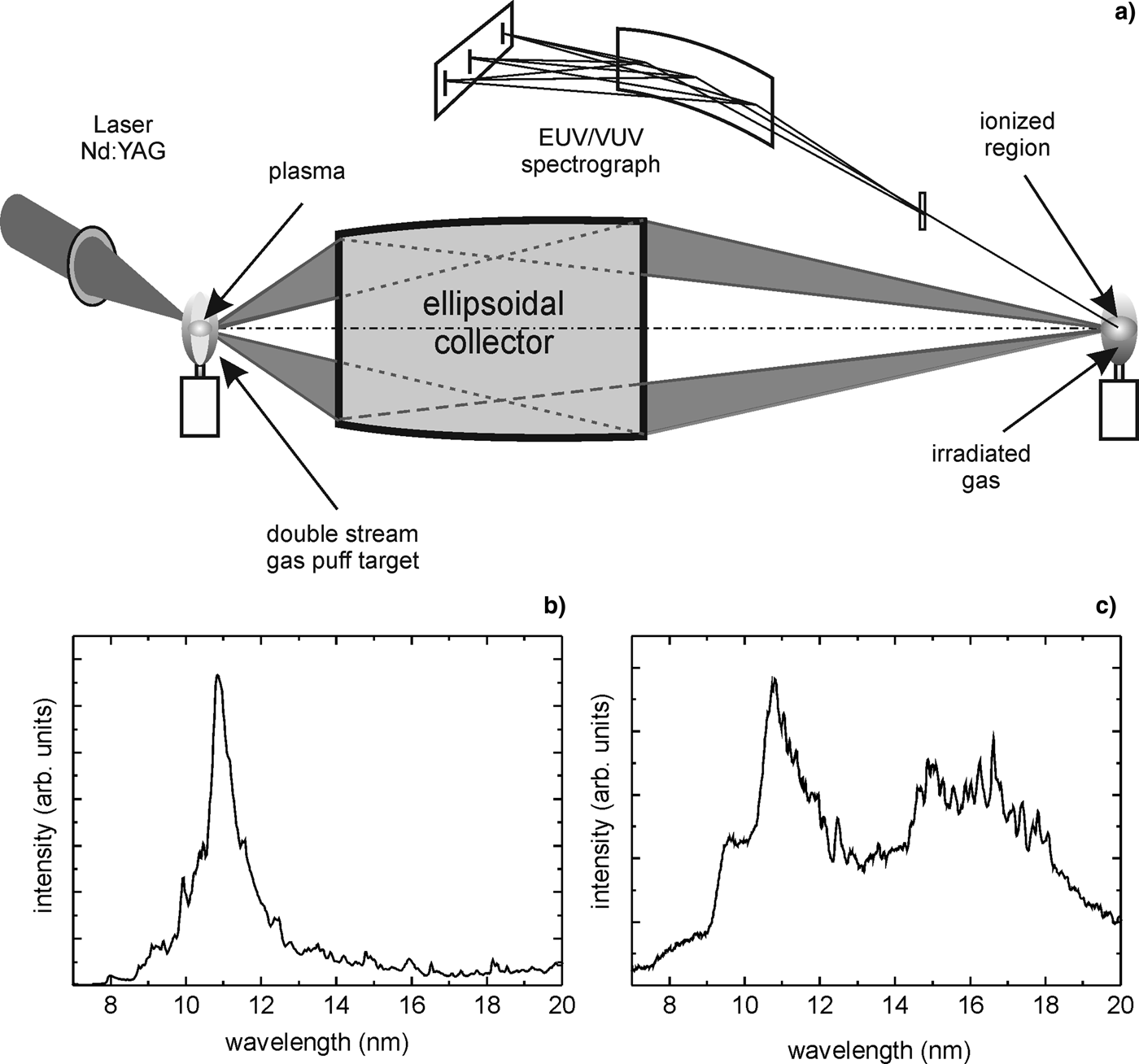
The second EUV source (Source No .2) was based on a 10 J/10 Hz Nd:YAG laser system with the pulse duration of 10 ns. In this case, also a double-stream gas-puff target was employed for plasma creation. The only difference was that the Kr/Xe mixture was replaced by pure Xe gas. Laser pulse energy in this case could be changed from 1 to 10 J. Increase of the pulse energy resulted in spectral shift of the emitted radiation toward the SXR region. In all cases, however, plasma emission is dominated by the EUV radiation. This part of radiation was collected and focused with good efficiency using a Mo-coated ellipsoidal mirror having the same geometry as the EUV collector used for the Source No. 1. Spectral distribution of the focused EUV radiation, obtained in this case, is presented in Figure 1c. The most intense emission was again in the spectral region close to λ = 11 nm; however, the spectrum contains the second wide maximum around λ = 16 nm. Maximum value of the EUV fluence in a focal plane of the collector exceeded 0.4 J/cm2. Experimental arrangement of the source is similar to the Source No. 1 as shown in Figure 1a.
The third source (Source No. 3) was based on the same laser system as in case of the Source No. 2. In this case, however, the laser pulse was shortened to approximately 1 ns using an Stimulated Brillouin Scattering (SBS) mirror. Also in this case the plasma is being created by a laser irradiation of the double-stream gas-puff target that used Xe gas as the working medium. Plasma radiation spectrum in this case spans the wide wavelength range with strong maximum at λ≈1.4 nm. The radiation was focused using a paraboloidal collector consisting of a set of two identical axisymmetrical paraboloidal mirrors mounted coaxially, as shown in Figure 2a. Plasma is located in a focal point of one of the mirrors which allows to form a parallel SXR/EUV beam that is focused by the second mirror. Spectrum of the focused radiation (Fig. 2c) is similar to the direct plasma emission spectrum (Fig. 2b); however, the relative intensity of the radiation close to 1 nm wavelength in comparison with the longer wavelengths is approximately two times lower. Maximum value of the SXR/EUV fluence in a focal plane of the collector reached 0.25 J/cm2. Experimental arrangement of the source is shown in Figure 2a.
Schematic view of the Source No. 3, indicating location of an auxiliary valve for gas injection into the interaction region, together with the EUV/VUV spectrograph (a) the SXR/EUV spectrum of direct plasma emission (b) and the SXR/EUV spectrum of the focused radiation (c).

2.2. Gas Injection and Measurement Systems
EUV propagates only in vacuum, thus interaction of the EUV radiation with gases requires pulse injection of a gas stream into the vacuum chamber, synchronously with an SXR/EUV pulse. In our experiments, different gases were injected into the interaction region, perpendicularly to an optical axis of the irradiation system, using an auxiliary gas puff valve. The valve was equipped with a circular nozzle, having diameter of Φ = 0.7 mm in case of the Source No. 1 and Φ = 2 mm in case of the other sources. An outlet of the nozzle was always located approximately 2.5 mm from the optical axis of the irradiating system. Larger nozzle diameter was allowed to increase the size of the interaction region and photoionized plasma. The larger plasma – the larger number of EUV photons emitted from the plasma. It enabled to minimize a number of laser pulses required for spectral measurements. The gas density in the interaction region was controlled by adjusting a gas backing pressure or the opening time of the valve. The density value was of the order of 1–10% of the atmospheric density.
Irradiation of gases injected into the interaction region, results in ionization and excitation of atoms and ions. The EUV spectra were measured using a grazing incidence, flat-field spectrometer (McPherson, Model 251), equipped with a 450 lines/mm toroidal grating. The spectral range of the spectrometer was λ = 10–95 nm. An optical axis of the spectrometer is perpendicular to the optical axis of the EUV or SXR irradiating system, thus the emission spectra are well separated from the spectra of the laser-plasma radiation. It is very important because the laser-plasma emission is approximately 105 times higher comparing with the photoionized plasma emission. The spectra, integrated over 10–500 pulses, were recorded using a charge-coupled device detector, cooled down to a temperature of −40°C. A location of the auxiliary gas puff valve and the spectrograph in respect to the sources is depicted in Figures 1a and 2a.
3. EXPERIMENTAL RESULTS
Emission spectra, acquired for Ne photoionized plasmas using the irradiation systems, described in Section 2.1, are presented in Figures 3–5. The spectrum, depicted in Figure 3, was obtained by irradiation of Ne gas by the EUV pulses with relatively low fluence not exceeding 0.1 J/cm2, using the Source No. 1. In this case, the spectra could be acquired for large number of pulses hence, despite low intensity of the emitted radiation, good quality spectra were obtained. The spectrum, shown in Figure 3, was obtained with 100 EUV pulses. It consists of multiple lines, originating from transitions in Ne atoms and singly charged Ne ions. The most intense line is a doublet corresponding to 2s 22p 5–2s2p 6 transitions of Ne II ions. The spectrum was obtained for the gas density of the order of 1017 atoms/cm3. Relative intensities of Ne II lines in case of higher densities remained practically unaltered. No lines corresponding to Ne III or higher ionization degrees were detected.
A typical spectrum obtained for Ne photoionized plasmas using the irradiation system based on the Source No. 1.

A typical spectrum obtained for Ne photoionized plasmas using the irradiation system with the Source No. 2: (a) A long-wavelength range. (b) a short-wavelength range.

A typical spectrum obtained for Ne photoionized plasmas using the irradiation system based on Source No. 3.

Significantly different are Ne spectra, depicted in Figure 4, obtained for the experimental arrangement employing the Source No. 2. Photoionized plasmas in this case were created by the EUV irradiation of Ne gas with much higher fluence of approximately 0.4 J/cm2. A single EUV exposure was limited to 10 pulses to avoid strong degradation of the gas puff nozzle exposed to hot plasmas. Despite a small number of EUV pulses, spectral intensities are comparable with the intensities obtained with hundreds of EUV pulses with the low fluence. It could be explained by higher EUV fluence and larger region of emission due to a larger nozzle outlet. As in the first case, the spectrum shown in Figure 3a consists of multiple lines, originating mainly from transitions in Ne atoms and singly charged Ne ions; however, it contains also well-pronounced spectral lines corresponding to 2s 22p 4–2s2p 5 transition in Ne III ions at wavelengths of λ = 37.9 and λ = 48.9 nm. In this case, the 2s 22p 5–2s2p 6 doublet of Ne II is not the most intense line. In fact, its intensity is almost two times lower comparing with the 2s 22p 5–2s 22p 4(3P)3s line. Additional measurements performed in the shorter wavelength range revealed some weak spectral lines, shown in Figure 3b. The spectrum contains mainly lines corresponding to radiative transitions in NeIII ions; however, two of the lines originate from transitions in NeIV ions. These lines were not detected in case of using the Source No. 1.
The emission spectrum, presented in Figure 5, originates from photoionized plasmas, produced by the irradiation of Ne gas using the Source No. 3. Plasmas in this case were created by the SXR/EUV irradiation of the Ne gas with the fluence having intermediate value, between the values obtained from Sources No. 1 and 2. A single SXR/EUV exposure was limited to 25 pulses, again, to avoid strong degradation of the gas puff nozzle. The Ne spectrum is similar to that obtained in case of using the Source No. 1; however, there are two significant differences. First and the most important one is the presence of a clearly visible line corresponding to the 2s 22p 4–2s2p 5 transition in Ne III ions, at the wavelength of λ = 37.9 nm. Its intensity is comparable with NeII lines, except the most intense 2s 22p 5–2s2p 6 doublet. The second difference concerns two adjacent lines, corresponding to 2s 22p 6–2s 22p 53s transitions in neutral Ne atoms. Unlike the photoionized plasmas, produced using Sources No. 1 and 2, where relative intensities of these lines are almost the same, in case of employing the Source No. 3 their relative intensities differ approximately three times. No other lines, corresponding to Ne III or higher ionization degrees, were detected.
4. DISCUSSION
Ionization and excitation processes in Ne gas, driven by the EUV or SXR radiation, are significantly different comparing with plasma formation driven by IR lasers. In the latter case, assuming nanosecond Nd:YAG laser pulses for plasma creation, energy of a single irradiating photon is about 20 times lower than the ionization potential of Ne atoms. In this case, plasma is being heated due to inverse bremsstrahlung mechanism, reaching a high temperature, of the order of tens or even hundreds of eV, depending on the power density of the laser beam. Energies of thermalized electrons are sufficiently high for ionization of atoms or even multicharged ions. In this case, collisional processes govern the ionization and excitation of atoms and ions. In such conditions, relative intensities of spectral lines are mainly associated with the ionization degree and electron temperature.
In case of irradiation of Ne gas with the EUV or SXR photons, direct photoionization of atoms or even ions by a single photon is possible. Apart from that, energies of the resulting photoelectrons are sufficiently high for further ionization or excitation. Additionally, due to quasi-continuous spectrum of the irradiating EUV/SXR photons, direct photoexcitation of different states is also possible. Radiative decay of the excited states results in a linear emission in a wide wavelength range, including the EUV range. In contrast to LPP, energy range of emitted photons is not strictly related to electron temperature. For the same reasons, there is no power density threshold to be exceeded for gas ionization or excitation. There is also no limitation for gas density; photoionized plasmas can be created in gases with very low densities, few orders of magnitude below atmospheric density.
Differences in spectral distributions, for Ne ions, indicated in Section 3, are associated with different irradiation conditions, in particular, with variety in radiation fluences and energies of the irradiating photons. In case of experimental arrangements utilizing Sources No. 1 and 2, energy range of the irradiating photons and maxima of the spectral distributions are similar. The significant difference concerns radiation fluences, over four times higher in case of using Source No. 2.
Taking into account relatively low intensity of irradiating photons and results of spectral measurements, indicating that mainly Ne+ ions are produced, ion (or electron) density, created in all cases during the irradiation time, can be estimated from the equation:
 $$\displaystyle{{dn_{{\rm Ne}^{\rm +}}} \over {dt}} = (n_{{\rm Ne}} - n_{{\rm Ne}^{\rm +}} )\,{\rm \sigma} _{{\rm ph,Ne}^{\rm +}} F $$
where n Ne+ is the density of singly charged Ne ions, n Ne is the initial atomic density, (n Ne−n Ne+) is the current atomic density, σph,Ne+ is the cross-section for photoionization of atoms, and F is the photon flux
Taking into account the experimental data for Source No. 1: n Ne = 1017/cm3, F = 1.5 × 1024/cm2/s and the photoionization cross-section (Samson & Stolte, Reference Samson and Stolte2002) σph,Ne+ = 4 × 10⁻¹⁸ cm2, electron and singly charged ion density n e,n Ne+ = 2 × 10¹⁵/cm3 can be obtained. In equation (1), recombination of Ne+ ions was omitted because its rate, estimated based on the work by Pequignot et al. (Reference Pequignot, Petitjean and Boisson1991), is over two orders of magnitude lower according to the photoionization rate. Average energies of the photoelectrons are sufficient for further ionization or excitations. Taking into account ionization potential of neutral atoms and average photon energy (approximately 100 eV), a single photoelectron, at best, can create three additional Ne+ ions. Electron and ion densities in this case are still far below the initial atomic density, thus the estimation is reasonable. In case of the higher irradiation intensity, when using Source No. 2, it can be easily calculated that the electron (or n Ne+ ion) density is approximately four times higher.
Intensities of emission lines are determined by a time integration of the density of the excited ions multiplied by the spontaneous radiative decay rate. A significant difference in the emission spectra of photoionized plasmas concerns mainly relative intensities between 2s 22p 5–2s2p 6 and 2s 22p 5–2s 22p 43l lines. To explain this difference we can consider the 2s 22p 5–2s 22p 4(3P)3s transition. Density of the 2s 22p 4(3P)3s state can be obtained from the equation:
 $$\displaystyle{{dn_{\rm 2}} \over {dt}} = n_{\rm 1} \,n_{\rm e} \langle \,{\rm \sigma} _{{\rm e,12}} \,v\rangle - n_2 \,A_{21} $$
where:n 1is the density of singly charged Ne ions in the ground state, n 2 is the density of Ne ions in the 2s 22p 43s excited state, σe,12 is the cross-section for the electron impact excitation to the 2s 22p 43s state, ν is the electron speed, A 12 is the rate of spontaneous emission for the 2s 22p 43s – 2s 22p 5 transition.
An equation for density of the 2s2p 6 state should contain additionally a contributing factor concerning photoionization from the 2s shell. In this case, the equation can be expressed as:
 $$\displaystyle{{dn_{\rm 3}} \over {dt}} = (n_{Ne} - n_{Ne^{\rm +}} )\,{\rm \sigma} _{\,ph,3} \,F + n_{\rm 1} \,n_{\rm e} \langle \,{\rm \sigma} _{{\rm e,13}} \,v\rangle - n_3 \,A_{31} $$
where n 3 is the density of Ne ions in the 2s2p 6 excited state, σph,3 is the cross-section for photoionization of atoms to the 2s2p 6 excited state, σe,13 is the cross-section for electron impact excitation to the 2s2p 6 excited state, and A 31 is the rate of spontaneous emission for the 2s2p 6–2s 22p 5 transition.
In both the cases, the electron impact deexcitation can be neglected due to low electron and ion densities. It should be also pointed out that the electron impact excitation cross-sections (Griffin et al., Reference Griffin, Mitnik and Badnell2001) and spontaneous radiative decay rates (Verner et al., Reference Verner, Verner and Ferland1996) for both the states have similar values. In this case, relative intensities of the 2s 22p 5–2s2p 6 and 2s 22p 5–2s22p 43s lines will be strongly influenced by the term (n Ne−n Ne+) σph,3F. Its value decreases with time due to decrease of neutral atoms density. Simultaneously the term n 1n e〈σe,13v〉 increases as  $n_{\rm e}^2 $. Taking into account the corresponding cross-section for the inner-shell photoionization (Samson & Stolte, Reference Samson and Stolte2002), its value, in case of using the Source No. 1, can be estimated to be 6 × 10²²/cm3/s. For obvious reasons this term is dominating at the beginning of the irradiation process, however, during the irradiation electron and Ne+ ion densities increase and finally the collisional term reaches a comparable value to the photoionization term. In case of using the Source No. 2 for the creation of the photoionized plasma, the photoionization term reaches the value approximately four times higher comparing with the Source No. 1. Simultaneously, however, the collisional term reaches even ten times higher value, which means that this term becomes dominating. It can be thus concluded that relative decrease of the emission line, corresponding to the 2s 22p 5–2s2p 6 transition, is associated with a significant increase of the collisional excitation over inner-shell ionization.
Higher fluence of the EUV radiation pulses, in case of using the Source No. 2, results also in presence of Ne III and even Ne IV ions. The corresponding lines emitted in the shorter wavelength range are presented in Figure 4b. Their intensities are over 20 times smaller comparing with the most intense lines from Figure 4a. There are, however, also more intense Ne III lines corresponding to 2s 22p 4–2s2p 5 transitions, clearly visible in the long wavelength range. Their relatively high intensity is again associated with significant contribution of the inner-shell photoionization, this time in Ne+ ions. None of these lines was detected in case of using Source No. 1 for the photoionized plasma creation.
The spectrum obtained from Ne plasma produced using Source No. 3 is similar to the spectrum obtained using Source No. 1. In both the cases emission lines originating from Ne II ions have practically the same relative intensities. On the other hand, the spectrum contains a single Ne III line corresponding to 2s 22p 4–2s2p 5 transition at the wavelength of λ = 37.9 nm; however, it does not contain any other Ne III lines. Excitation to the 2s2p 5 state can be again associated with the inner-shell photoionization; however, it can be also caused by the inner-shell ionization by electrons with high energy, up to 1 keV, not present in case of using the two other sources. Two adjacent lines at λ = 73.6 and 74.4 nm originating from neutral neon atoms, correspond to a resonance and intercombination transitions, respectively. Their intensity ratio in coronal equilibrium, which is valid for low-density plasmas, should be proportional to the ratio of the corresponding electron impact excitation rates. This ratio in the wide energy range has the value of 3–5 (Tsurubuchi et al., Reference Tsurubuchi, Arakawa, Kinokuni and Motohashi2000), which corresponds to the value obtained in the experiment. It would suggest that in case of these transitions the collisional excitation is dominating. However, in case of the two other sources this ratio is more or less equal to 1. Reasons of this difference remain unclear.
5. SUMMARY
In this paper, first results of comparative investigations, concerning photoionized Ne plasmas created using laser-plasma-produced EUV and SXR sources of different parameters, are presented. Significant differences between experimental configurations concerning the irradiation conditions are indicated. In all cases, the EUV emission spectra of the excited atoms and singly charged Ne ions were registered. The most important differences between the spectra concern relative intensities of the 2s 22p 5–2s2p 6 doublet in respect to the other Ne II lines and also relative intensities of two adjacent lines, corresponding to 2s 22p 6–2s 22p 53s transitions in neutral atoms. Apart from that, in case of the experimental configuration with the highest fluence, multiple lines corresponding to doubly and even triply charged ions were detected. Atomic processes, dominating in photoionized plasmas obtained for different irradiation conditions, were analyzed. It was concluded that significant differences in relative intensities of the spectral lines are associated with different contributions of the inner-shell photoionization and collisional excitation to population distribution of the excited states during the process of photoionized plasma formation.
ACKNOWLEDGMENTS
This work was supported by the grant UMO-2013/09/B/ST2/01625 of the National Science Centre, Poland, by the European Commission's Seventh Framework Program (LASERLAB-EUROPE) and by EU from EUROPEAN REGIONAL DEVELOPMENT FUND, project number: WND – POiG.02.01.00 – 14 – 095/09.



