INTRODUCTION
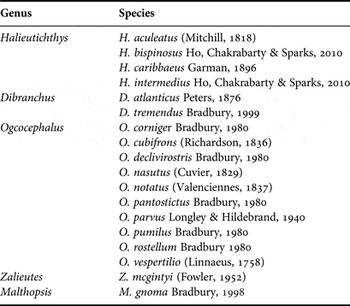
Batfish (Lophiiformes: Ogcocephalidae) are moderately to greatly flattened anglerfish, with the following morphological characteristics: head and trunk forming a subcircular to triangular-shaped disc; head with a cavity above the mouth containing a short illicium and a fleshy esca; and a short and shelf-like too long and horn-like rostrum formed by fused scales at the end of the snout (McEachran & Fechhelm, Reference McEachran and Fechhelm1998; Bradbury, Reference Bradbury and Carpenter2002). Batfish are a relatively small diverse group, with 75 species (Eschmeyer, Reference Eschmeyer2013). These benthic fish occur worldwide in tropical to subtropical seas, between the shoreline and 1000 m. Five genera and eighteen species (see Table 1 for species) occur in the western North Atlantic: Halieutichthys, Dibranchus, Ogcocephalus, Zalieutes and Malthopsis. Only four of these genera have been reported from the Gulf of Mexico. Malthopsis is a relatively small sized fish with tough and rough skin, similar to Ogcocephalus, Zalieutes and Halieutichthys. The cephalic disc is strongly triangular in shape and this is exaggerated by the subopercular spines. The cranium is elevated above the surface of the disc. The conical rostral protuberance is smaller than those of Ogcocephalus. Malthopsis gnoma does not appear to be abundant; the purpose of this paper is to report a new record of M. gnoma in the southern Gulf of Mexico.
Species of Ogcocephalidae in the western North Atlantic.

MATERIALS AND METHODS
The specimen of M. gnoma reported herein was captured on 27 July 2003, at a depth of 154 m using a 12 m long, 9 m wide, 1.5 m tall semi-balloon otter trawl with a 6.35 cm mesh in a transect conducted by the RV ‘Justo Sierra’ during the scientific expedition Sigsbee 6 over the continental slope in the Gulf of Mexico (22°13′06″N–91°47′07″W). The specimen was catalogued in the Colección Nacional de Peces of the Instituto de Biología, Universidad Nacional Autónoma de México (CNPE-IBUNAM) (Sabaj Pérez, Reference Sabaj Pérez2013). The identification of the specimen followed the key in Bradbury (Reference Bradbury and Carpenter2002) and the original description of the species (Bradbury, Reference Bradbury1998). For the map, we compiled a database of all available records in the Global Biodiversity Information Facility (GBIF, 2013) which included the records from the original description (Bradbury, Reference Bradbury1998) and new records from the Florida Museum of Natural History (UF) (accessed through GBIF data portal, UF FLMNH Ichthyology, http://data.gbif.org/datasets/resource/14301), the National Museum of Natural History, Smithsonian Institution (USNM) (accessed through GBIF data portal, NMNH Vertebrate Zoology Fishes Collections, http://data.gbif.org/datasets/resource/1836) and from Roa-Varon et al. (Reference Roa-Varon, Saavedra-Diaz, Acero and Mejia2007).
RESULTS
SYSTEMATICS
Order LOPHIIFORMES
Suborder OGCOCEPHALOIDEI
Family OGCOCEPHALIDAE Jordan, 1895
Genus Malthopsis Alcock, 1891
Malthopsis gnoma Bradbury, Reference Bradbury1998
MATERIAL EXAMINED
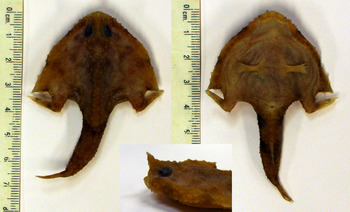
CNPE-IBUNAM 14563 (70 mm standard length), Mexico, Gulf of Mexico, Sigsbee 6, RV ‘Justo Sierra’, 154 m, July 2003 (Figure 1).
Malthopsis gnoma, CNPE-IBUNAM 14563, 70 mm: upper left, dorsal view; upper right, ventral view; below, side view of head.

SPECIES ACCOUNT
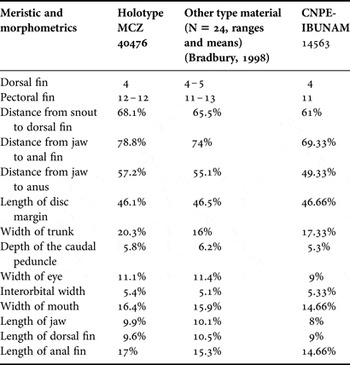
The specimen of M. gnoma (see Table 2 for meristics and morphometrics) collected in the Gulf of Mexico has a depressed body, a cephalic disc triangular in shape exaggerated by the two strongly pointed subopercular spines. The cranium is elevated above level of the disc. Dorsal surface covered with large, cone-shaped, strongly ossified scales, with apical spines and small knob-like spicules in rows from the apical spine forming buckles; between the buckles there are tubercles covered with skin. Rostrum small and horn-shaped, tilted sharply upward, with a cavity containing a small thick esca which is composed of a single dorsal median bulb. Eyes dorsolateral. Mouth small and terminal with simple teeth on jaws, ceratobranchial, palatines and vomer. Gills 2, with filaments on arches 2, 3 and 4 (reduced size in arch 4). Cheek lateral line elements 7. No membranes connecting the pectoral pedicels with trunk. Tail muscular and slender, its ventral surface covered with evenly distributed tubercles.
Meristic and morphometric comparison of Malthopsis gnoma specimens.

DISTRIBUTION
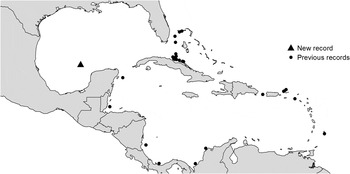
This species occurs off the north coast of Cuba, in the vicinity of Puerto Rico, the Virgin Islands, the Caribbean coast of Central America and Colombia, and the southern Gulf of México, at depths ranging between 91 and 475 m; it is most common between 275 and 475 m (Figure 2). This is the second shallowest record of M. gnoma.
Distribution of known specimens of Malthopsis gnoma. Source: this paper; Bradbury (Reference Bradbury1998); Roa-Varon et al. (Reference Roa-Varon, Saavedra-Diaz, Acero and Mejia2007) and GBIF (2013).

ACKNOWLEDGEMENTS
We thank Dr E. Escobar for the invitation to the Sigsbee 6 expedition, as well as the participants and specimen collectors on the cruise.