1. The Forgery Debate: 2012 and 2014
On 18 September 2012, Karen L. King announced at the Tenth International Congress of Coptic Studies in Rome that a private manuscript collector had recently brought a remarkable papyrus fragment to her attention.Footnote 1 King had examined the business-card sized papyrus with Roger Bagnall and AnneMarie Luijendijk, and they had collectively concluded that it could be dated on palaeographic grounds to the fourth century.Footnote 2 The Coptic fragment partially preserved a dialogue between Jesus and his disciples in which Jesus unambiguously refers to ‘my wife’. This dialogue, King argued, was probably part of a text originally composed in the latter half of the second century.Footnote 3 King made images of the papyrus fragment and her provisionally approved article on the subject for Harvard Theological Review (HTR) available online. For reference purposes, she designated the otherwise unidentifiable fragment as the Gospel of Jesus' Wife (GJW).Footnote 4
It became evident shortly after King revealed GJW that there were significant scholarly concerns about the possibility that it was a modern forgery.Footnote 5 Several Coptic specialists at the conference in Rome – including Stephen Emmel, Wolf-Peter Funk and Alin Suciu – voiced suspicions about the fragment based on peculiarities in its handwriting and grammar, just as peer reviewers of a draft of King's HTR article had done previously.Footnote 6 Then, on 21 September 2012, Francis Watson released a web article containing what would prove to be the key conceptual breakthrough in the analysis of GJW: the text appeared to be little more than a ‘collage’ or ‘patchwork’ of words and short phrases copied from the only Coptic version of the Gospel of Thomas (GTh) preserved from antiquity.Footnote 7 Simon Gathercole, Oli Homron, Mark Goodacre, Leo Depuydt and other scholars collaborating internationally via the internet quickly established that all but a word or two of the dialogue in GJW could be traced back to GTh.Footnote 8
A vigorous scholarly debate about the significance of the verbal similarities between GJW and GTh quickly ensued online. Goodacre became an early supporter of the ‘patchwork’ forgery theory and used his nearly decade-old NT Blog to disseminate his own observations (as well as those of others) in support of it.Footnote 9 Andrew Bernhard soon pointed out that GJW's most problematic line of text might well be the result of a modern forger's injudicious use of ‘Grondin's Interlinear Coptic/English Translation of the Gospel of Thomas’ (‘Grondin's Interlinear’).Footnote 10 On 11 October 2012, Bernhard released an online article calling attention to a number of features in the text that suggested GJW was probably prepared by someone relying on Grondin's edition of GTh, and Goodacre simultaneously spotlighted the most startling discovery in a blog post: GJW seems to reproduce a typographical (and grammatical) error directly from ‘Grondin's Interlinear’.Footnote 11
King withdrew from public discussion about GJW for roughly a year and a half as she coordinated a series of laboratory tests on the fragment and a Coptic fragment of the Gospel of John provided by the same manuscript collector. The testing, King asserted when her revised article on GJW was published in HTR in April 2014, ‘consistently provides positive evidence of the antiquity of the papyrus and ink … with no evidence of modern fabrication’.Footnote 12 The predominant material in each fragment was identified as ‘oxidized cellulosic material, which is consistent with old papyrus’.Footnote 13 The papyrus of GJW was determined to have been harvested during the seventh–ninth centuries ce, and the papyrus of the John fragment during the seventh or eighth century ce.Footnote 14 The chemical composition of the inks used on the two papyrus fragments were found to be similar but distinct; both were comparable to inks based on carbon black pigments (such as ‘lamp black’) from manuscripts dated between 500 bce and 1000 ce and showed no sign of modern contaminants.Footnote 15 Unpersuaded by textual arguments that GJW was a modern forgery,Footnote 16 King asserted that the completed laboratory tests supported ‘the conclusion that the papyrus and ink of GJW are ancient’.Footnote 17
However, images of the John fragment posted on Harvard Divinity School's new GJW website soon helped put the laboratory results in perspective and provided the most compelling evidence to date that GJW is a modern forgery.Footnote 18 On 24 April 2014, Christian Askeland viewed the online images of the John fragment and observed that the text on the seventh- or eighth-century papyrus fragment was written in a Coptic dialect (Lycopolitan) that had fallen into disuse centuries earlier; even more surprisingly, the text appeared to have been copied directly from a 1924 edition of the Qau codex prepared by Herbert Thompson.Footnote 19 Goodacre and Suciu swiftly illustrated the uncanny relationship between the John fragment and Thompson's edition of the Qau codex (online since 2008).Footnote 20 Emmel then pointed out that the John fragment would have had to be part of ‘the tallest (or widest) papyrus codex yet known’ if authentic.Footnote 21 In an article published in June 2014, Askeland demonstrated conclusively that the John fragment was a modern forgery with the remarkable observation that it shared all seventeen of its line-breaks exactly with the Qau codex: ‘The forger skipped every other line of Thompson's text when copying it onto his papyrus fragment … [but] failed to skip a line when he had to turn two pages of Thompson's edition’.Footnote 22
Clearly, a modern forger could prepare an ancient-looking papyrus fragment with ink not detectable as a recent fabrication in laboratory analysis.Footnote 23 In fact, the tests King had arranged actually failed to expose a pair of modern forgeries: one was the John fragment, and the second was the other fragment with essentially indistinguishable handwriting (GJW).Footnote 24 As Askeland has now explained and illustrated, ‘a distinct palaeographic pattern is shared by both fragments, confirming that the same hand has created them’.Footnote 25 Unless the similarities in handwriting are completely disregarded, both fragments must now be considered modern forgeries.
The present article will explain how the text of GJW was most likely prepared. Basically, someone rearranged words and short phrases from the only surviving Coptic version of GTh from antiquity, switched third person masculine singular affixes (ϥ: ‘he’, ‘him’) to their feminine equivalents (ⲥ: ‘she’, ‘her’), and placed two key Coptic words (ⲙⲁⲣⲓⲁⲙ: ‘Mary’; ⲧⲁϩⲓⲙⲉ: ‘my wife’) into the ‘patchwork’ text. As will become evident, the verbal similarities between GJW and GTh are overwhelming, and GJW contains at least five notable textual features – unexpected features of the text that require at least some sort of explanation – suggesting that it is not genuinely ancient. GJW can be explained best as a forgery prepared recently by someone who relied heavily on ‘Grondin's Interlinear’, a unique modern edition of the single surviving ancient manuscript that preserves GTh in Coptic.
2. Manuscripts and Editions
2.1 The Gospel of Jesus' Wife
GJW is singularly attested by the papyrus fragment King revealed in Rome in 2012. The rectangular fragment measures ca. 4 cm in height by 8 cm in width. The papyrus itself has been dated to the seventh–ninth centuries ce and a type of carbon ‘lamp black’ ink has evidently been applied to the fragment with a brush.Footnote 26 The dialect of GJW has been characterised as ‘standard Sahidic’,Footnote 27 but the obviously clumsy handwriting has proved especially difficult to date palaeographically.Footnote 28 Eight partial lines of text are visible on the recto (→); there appears to be a bit of blank space where text would be expected at the right edge of at least two of these lines (→3, 6).Footnote 29 The text on the verso (↓) is largely indecipherable; at best, three short words might be identified in the six discernible lines. The top edge of the fragment appears to have been deliberately cut. No margins are visible.
King's April 2014 HTR article contains the only edition of GJW published in a peer-reviewed journal to date. The edition provided here follows King's published edition almost in its entirety. Only a single update to the text (in →6) has been made to incorporate an observation made by experts in the study of Coptic papyri.Footnote 30
Text
Recto (along the fibres →)
1 ⲛⲁ]ⲉⲓ ⲁⲛ ⲧⲁⲙⲁⲁⲩ ⲁⲥϯ ⲛⲁⲉⲓ ⲡⲱ̣[ⲛϩ
2 ]ⲥ̣ ⲡⲉϫⲉ ⲙ̄ⲙⲁⲑⲏⲧⲏⲥ ⲛ̄ⲓ̅ⲥ̅ ϫⲉ ⲥ̣[
3 ] . ⲁⲣⲛⲁ ⲙⲁⲣⲓⲁⲙ̣ ⲙ̄ⲡϣⲁ ⲙ̄ⲙⲟⲥ ⲁ[ⲛ (?)
4 ] . . . [vac. .] / ⲡⲉϫⲉ ⲓ̅ⲥ̅ ⲛⲁⲩ ⲧⲁϩⲓⲙⲉ ⲙⲛ̣̄[
5 ] . . . ⲥⲛⲁϣⲣ̄ⲙⲁⲑⲏⲧⲏⲥ ⲛⲁⲉⲓ ⲁⲩⲱ [
6 ]ⲓ̣ ⲙⲁⲣⲉⲣⲱⲙⲉ ⲉⲑⲟⲟⲩ ϣⲁϥⲉ̣<ⲓ>ⲛⲉFootnote 31 [
7 ] ⲁⲛⲟⲕ ϯϣⲟⲟⲡ ⲛⲙⲙⲁⲥ ⲉⲧⲃⲉ ⲡ̣[
8 ] . ⲟⲩϩⲓⲕⲱⲛ̣ . . [
Verso (against the fibres ↓)
1 ]ⲧⲁⲙⲁⲁⲩ[
2 ]ⲛ̄ⲙϣⲙ̣ⲛ̣ⲧ̣[
3 ]ⲁ̣ . ⲉ̣ . . . [
4 ]ⲉⲃⲱⲗ ⲉ̣ⲧ̣ⲛ̣[
5 ]ⲟ̣ⲡ̣ . . . . [
6 ] . [.] . . ⲙⲙ̣[
Translation
1 ] ‘not [to] me. My mother gave me li[fe . . . ’
2 ] .' The disciples said to Jesus, ‘. [
3 ] deny. Mary is n[ot (?)]Footnote 32 worthy of it [
4 ] . . .’ Jesus said to them, ‘My wife . . [
5 ] . . . she will beFootnote 33 able to be my disciple and . . . [Footnote 34
6 ] . No wicked man brings (forth)Footnote 35 . . . [
7 ] . I dwell with herFootnote 36 in order to . [
8 ] . an image . . . [
1 ] my moth[er
2 ] thr[ee
3 ] . . . [
4 ] forth . . . [
5–6 ] (untranslatable) [
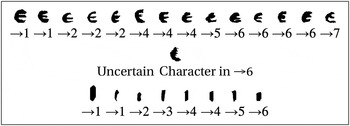
The Coptic text above differs from King's edition only at the end of →6: ϣⲁϥⲉ̣<ⲓ>ⲛⲉ rather than ϣⲁϥⲉ ⲛⲉ. As Suciu and Hugo Lundhaug first observed and Figure 1 shows, the third-from-last character in →6 differs significantly in appearance from other epsilons in GJW.Footnote 37 All fifteen certain epsilons on the recto (→) appear as a semicircle with a distinct crossbar between clearly discernible extensions of the curve; they seem ‘wide and round’.Footnote 38 Yet, the third-from-last character in →6 is barely concave and only extends significantly on the bottom. Its crossbar is almost non-existent and there is no noticeable extension of the curve at the top. The identity of this character remains uncertain, and it should at least be marked with a dot beneath it in any critical edition.Footnote 39
Tracings of epsilons, iotas and the uncertain character in →6

The third-from-last character in →6 is presented as ⲉ̣ above because it resembles epsilon more than any other Coptic letter. The character's height is about what would be expected for an epsilon on this papyrus: the undisputed epsilons measure between ca. 3.0 and 4.5 mm in height, and the uncertain character in →6 measures ca. 4.5 mm in height. Moreover, the horizontal distances from the back of the uncertain character's curve to the ends of its extensions and crossbar are surprisingly similar to those of undisputed epsilons on the fragment. The various extensions and crossbars of those epsilons stretch between ca. 2.5 and 4.5 mm horizontally, but they are always within ca. 1.0 mm of each other in any individual letter. In the uncertain character in →6, the visually non-existent top extension reaches ca. 2.9 mm horizontally from the back of the curve, the crossbar ca. 2.5 mm, and the bottom extension ca. 3.4 mm.
The third-from-last character in →6 has been emended to ⲉ̣<ⲓ> because its peculiar appearance seems to be the result of the obliteration of the expected blank space between an epsilon's upper extension and crossbar. The character can be explained as some kind of epsilon–iota hybrid.Footnote 40 Since digital, microscopic and multi-spectral images of the fragment suggest that the character in question (and the characters on either side of it) have been ‘overwritten’ or ‘patched’,Footnote 41 the suspicion that the copyist initially made a mistake in writing the end of →6 and then attempted to correct it seems fully justified.Footnote 42 At this point in time, there can be little doubt that →6 was intended to conclude with ϣⲁϥⲉⲓⲛⲉ, a word taken from GTh (like almost every other word in GJW).Footnote 43
2.2 The Gospel of Thomas
GTh is attested by one nearly perfect Coptic manuscript and three fragmentary Greek papyri. The lone extant version of GTh in Coptic is preserved in Nag Hammadi Codex ii (NHC ii), which likely dates from the late fourth or early fifth century ce.Footnote 44 The text of GTh appears on pages 32–51 of this 146-page papyrus codex in a form of Sahidic Coptic.Footnote 45 Of course, the presentation of GTh in NHC ii is unique. As a result of differences in page size, margin space, handwriting, textual modifications, scribal errors and a variety of other factors, no two manuscripts of any significant size are identical.
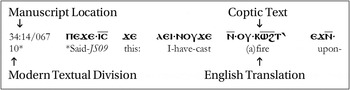
Since images of NHC ii were first published in 1956, many editions of GTh have been published.Footnote 46 The editio princeps presents each individual line of Coptic text as it appears in NHC ii,Footnote 47 but this edition has long since been superseded by others that divide GTh into a prologue (incipit) and 114 sayings (or logia).Footnote 48 Most editions (and commentaries containing the Coptic text) now divide GTh according to the modern textual divisions without printing each line of text from NHC ii separately.Footnote 49 In 1997, Michael W. Grondin posted online the first line-by-line edition of the Nag Hammadi version of GTh that had been prepared in nearly forty years. As Figure 2 shows, ‘Grondin's Interlinear’ presents each pertinent line of text from NHC ii individually with an English translation of every Coptic word or phrase beneath it.
Annotated screen capture of GTh 10 (NHC ii 34.14) in ‘Grondin's Interlinear’

Since ‘Grondin's Interlinear’ provides each line of text from NHC ii separately, it vividly reproduces certain features of the manuscript itself (e.g. line-breaks) in a way that most other editions do not. Grondin posted a single PDF version of his edition of GTh on 22 November 2002, which has remained available online ever since. He continues to hone his interlinear translation in an interactive, web-based format.Footnote 50
3. Similarities and Differences between GJW and GTh
3.1 Recto ( → ), line 1
Coptic: ⲛⲁ]ⲉⲓ ⲁⲛ ⲧⲁⲙⲁⲁⲩ ⲁⲥϯ ⲛⲁⲉⲓ ⲡⲱ̣[ⲛϩ
English: ] ‘not [to] me. My mother gave me li[fe . . . ’
The text ⲉⲓ ⲁⲛ ⲧⲁⲙⲁⲁⲩ is found in GTh 101 (NHC ii 49.36), as is ⲁⲥϯ ⲛⲁⲉⲓ ⲙ̄ⲡⲱⲛϩ (NHC ii 50.1).Footnote 51 In both →1 and its parallels in GTh, the preposition ⲛⲁ⸗ (ⲛ̄ in the prepersonal state) is completed with a first person singular suffix spelled ⲉⲓ; this is one spelling of the suffix used in Sahidic Coptic, but ‘the orthography of the first person singular suffix pronoun as object of the preposition ⲛⲁ⸗ is normally ⲓ¨’.Footnote 52 In both →1 and NHC ii 50.1, ϯⲛⲁ⸗ (‘a fusion of the infinitive ϯ “give” and the prepersonal preposition ⲛⲁ⸗ “unto” in a single unit’) is used; this double-object infinitive is ‘synonymous with the much more usual phrase ϯ ⲛ̄–/ⲙ̄ⲙⲟ⸗ ⲛ̄–/ⲛⲁ⸗ consisting of three separate groups’ (emphasis added).Footnote 53
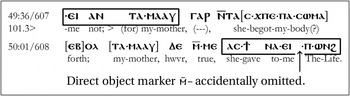
There are two notable textual features in this line of text. First, both →1 and NHC ii 49.36 split the word ⲛⲁⲉⲓ in the same place (with the letters ⲛⲁ lost in a lacuna); this apparent replication of a line-break from the only extant Coptic manuscript of GTh might be attributed to coincidence.Footnote 54 Second, the direct object marker ⲙ̄– that would ordinarily be expected before ⲡⲱⲛϩ has been omitted; this might be explained as one of the extremely rare examples of the use of the double-object infinitive ϯⲛⲁ⸗ ‘without the mediating direct object marker before the definite or possessive article + noun’.Footnote 55
Alternatively, both notable textual features can be explained by a modern forger's dependence on ‘Grondin's Interlinear’. As Figure 3 shows, someone viewing the PDF on a computer screen would have seen NHC ii 49.36 and 50.1 adjacent to each other.
Annotated screen capture of GTh 101 (NHC ii 49.36–50.1) in ‘Grondin's Interlinear’ with observations about its relationship to →1Footnote 56

Relying on Grondin's edition of GTh, a forger would have produced →1 of GJW simply by copying the pertinent text from two consecutive lines of NHC ii. The PDF omits ⲙ̄ before ⲡⲱⲛϩ as the result of a typographical error.Footnote 57
3.2 Recto ( → ), line 2
Coptic: ]ⲥ̣ ⲡⲉϫⲉ ⲙ̄ⲙⲁⲑⲏⲧⲏⲥ ⲛ̄ⲓ̅ⲥ̅ ϫⲉ ⲥ̣[
English ] .’ The disciples said to Jesus, ‘. [
The phrase ⲡⲉϫⲉ ⲙ̄ⲙⲁⲑⲏⲧⲏⲥ ⲛ̄ⲓ̅ⲥ̅ ϫⲉ is found at the beginning of GTh 12 (NHC ii 34.25).Footnote 58 A third person masculine singular suffix (ϥ) is the final letter of GTh 11 (NHC ii 34.25); what could be a third person feminine singular suffix (ⲥ) is the final letter before the parallel to GTh 12 in →2.
3.3 Recto ( → ), line 3
Coptic: ] . ⲁⲣⲛⲁ ⲙⲁⲣⲓⲁⲙ̣ ⲙ̄ⲡϣⲁ ⲙ̄ⲙⲟⲥ ⲁ[ⲛ (?)
English: ] deny. Mary is n[ot (?)] worthy of it [
The infinitive ⲁⲣⲛⲁ concludes GTh 81 (NHC ii 47.17).Footnote 59 The name ⲙⲁⲣⲓⲁⲙ does not appear as spelled in →3 anywhere in GTh. The phrase ⲙ̄ⲡϣⲁ ⲙ̄ⲙⲟϥ ⲁⲛ appears in GTh 80 (NHC ii 47.14–15).Footnote 60 The preposition ⲙ̄ⲙⲟ⸗ (ⲛ̄ in the prepersonal state) is completed by the third person masculine singular suffix (ϥ) in GTh 80; it is completed by the third person feminine singular suffix (ⲥ) in the parallel in →3.
It is somewhat puzzling why the name ‘Mary’ is spelled ⲙⲁⲣⲓⲁⲙ in GJW. This does not appear to be a standard Sahidic spelling,Footnote 61 and the name is spelled ⲙⲁⲣⲓϩⲁⲙ in GTh 21 (NHC ii 36.34) and 114 (NHC ii 51.19). The simplest explanation is that a forger accidentally omitted the Coptic letter hori (ϩ) while copying from GTh, but there are also other possibilities. Regardless, since the name ‘Mary’ is not found in close proximity to the other parallels to GTh in →3, it appears to have been specifically placed in GJW. In every other line of GJW, all the parallels to GTh can be found in close proximity to each other.
3.4 Recto ( → ), line 4
Coptic: ] . . . [vac. .] / ⲡⲉϫⲉ ⲓ̅ⲥ̅ ⲛⲁⲩ ⲧⲁϩⲓⲙⲉ ⲙⲛ̣̄[
English: ] . . .’ Jesus said to them, ‘My wife . . [
The phrase ⲡⲉϫⲉ ⲓ̅ⲥ̅ ⲛⲁⲩ ϫⲉ appears in GTh 12 (NHC ii 34.27–8).Footnote 62 The word ⲧⲁϩⲓⲙⲉ (possessive article ⲧⲁ– + noun ϩⲓⲙⲉ) does not appear in the form it takes in →4 anywhere in GTh. The final two letters (ⲙⲛ̄) appear in GTh 12 (NHC ii 34.30).Footnote 63 In →4, a phrase such as ⲡⲉϫⲁϥ ⲛⲁⲩ ⲛ̄ϭⲓ ⲓ̅ⲥ̅ might have been used to introduce Jesus' words; instead, the formula ⲡⲉϫⲉ ⲓ̅ⲥ̅, which is used more than 85 times in the 114 sayings of GTh, has been employed.
There is one notable textual feature in this line: ‘the absence of ϫⲉ following ⲡⲉϫⲉ⸗ [sic] to introduce direct discourse’; such an omission of the conjunction is ‘not standard’ Coptic grammar.Footnote 64 The verb ⲡⲉϫⲉ– is ‘almost always completed by ϫⲉ’ when introducing reported discourse, as it is in →2.Footnote 65 Nonetheless, as has been pointed out, there are authentic ancient Coptic writings that ‘vary their usage of ⲡⲉϫⲉ⸗ [sic] with and without ϫⲉ’.Footnote 66 It is not impossible that GJW is one of these select texts.
Alternatively, the absence of ϫⲉ in →4 could be the result of a forger's use of ‘Grondin's Interlinear’. As Figure 4 shows, Grondin reproduced the line-break in NHC ii between ⲡⲉϫⲉ ⲓ̅ⲥ̅ ⲛⲁⲩ and ϫⲉ in his edition of GTh.
Annotated screen capture of GTh 12 (NHC ii 34.27–8) in ‘Grondin's Interlinear’ showing that a line break separates ⲡⲉϫⲉ ⲓ̅ⲥ̅ ⲛⲁⲩ from ϫⲉ

Since Grondin correctly indicated that ⲡⲉϫⲉ ⲓ̅ⲥ̅ ⲛⲁⲩ means ‘Jesus said to them’ (a complete phrase in English), a forger may easily have overlooked ϫⲉ on the next line.
The suggestion that the absence of ϫⲉ in →4 is due to a forger's careless copying from Grondin's edition of GTh seems to be supported by the English translation that the owner gave King in 2010. In the translation, →4 is reportedly rendered: ‘Jesus said this to them: My wife …’ (emphasis added).Footnote 67 Clearly, ⲡⲉϫⲉ ⲓ̅ⲥ̅ corresponds to ‘Jesus said’, ⲛⲁⲩ to ‘to them’, and ⲧⲁϩⲓⲙⲉ to ‘My wife’. The only word that could correspond to ‘this’ seems to be ϫⲉ, and it is not only missing in GJW but would also be untranslatable in introducing a direct statement (as in →4) and would never actually be translated by the English word, ‘this’. Yet, ϫⲉ is present in the parallel to →4 in NHC ii, and Grondin has used the word ‘this’ as filler beneath the conjunction throughout his translation (see Figures 2 and 4). It appears that the ‘translation’ the owner provided King is derived directly from ‘Grondin's Interlinear’ rather than being based on GJW itself.
The appearance of the word ϩⲓⲙⲉ in →4 has been cited as evidence of the text's antiquity because it is not found in GTh and ⲥϩⲓⲙⲉ is a more commonly used word meaning ‘wife’.Footnote 68 But it seems a forger with limited knowledge of Coptic would have been more likely to use ϩⲓⲙⲉ than ⲥϩⲓⲙⲉ to ensure that Jesus unequivocally referred to his ‘wife’ in GJW. Since ‘Grondin's Interlinear’ does not indicate that ⲥϩⲓⲙⲉ can mean ‘wife’ (because the word is not used with this meaning in GTh), a forger would have needed to look up the word for ‘wife’. Any forger who looked up ‘wife’ in the English index of Crum's Coptic Dictionary would have quickly located an entry indicating that ⲥϩⲓⲙⲉ means ‘woman’, ‘wife’ or ‘female’ but ϩⲓⲙⲉ specifically means ‘wife’.Footnote 69
3.5 Recto ( → ), line 5
Coptic: ] . . . ⲥⲛⲁϣⲣ̄ⲙⲁⲑⲏⲧⲏⲥ ⲛⲁⲉⲓ ⲁⲩⲱ [
English: ] . . . she will be able to be my disciple and . . [
The phrase ϥⲛⲁϣⲣ̄ⲙ[ⲁⲑⲏⲧ]ⲏⲥ ⲛⲁⲉⲓ ⲁ(ⲛ) ⲁⲩⲱ appears in GTh 101 (NHC ii 49.33–4).Footnote 70 In this phrase, the conjugated form of ⲣ̄–ⲙⲁⲑⲏⲧⲏⲥ begins with the third person masculine singular prefix (ϥ) in GTh 101; it begins with the third person feminine singular prefix (ⲥ) in the parallel in →5. In both →5 and its parallel in GTh, the preposition ⲛⲁ⸗ (ⲛ̄ in the prepersonal state) is completed with a first person singular suffix spelled ⲉⲓ instead of ⲓ¨.
The most noticeable difference between →5 and its parallel in GTh 101 is that the negative particle ⲁⲛ (‘not’) is missing between ⲛⲁⲉⲓ and ⲁⲩⲱ in →5. The absence of ⲁⲛ might be taken as an indication that →5 was not copied from GTh, but ⲣ̄–ⲙⲁⲑⲏⲧⲏⲥ (‘be a disciple’) is never used without ⲁⲛ in GTh.Footnote 71 For a modern forger to create a positive phrase describing someone's ability to be a disciple using text from GTh, it would have been impossible to avoid deleting ⲁⲛ from a negative phrase.
3.6 Recto ( → ), line 6
Coptic: ]ⲓ̣ ⲙⲁⲣⲉⲣⲱⲙⲉ ⲉⲑⲟⲟⲩ ϣⲁϥⲉ̣<ⲓ>ⲛⲉ [
English: ] . No wicked man brings (forth) . . . [Footnote 72
Both ⲙⲁⲣⲉⲣⲱⲙⲉ and ⲉⲑⲟⲟⲩ appear once in GTh, ⲙⲁⲣⲉⲣⲱⲙⲉ in GTh 47 (NHC ii 41.17) and ⲉⲑⲟⲟⲩ in GTh 45 (NHC ii 41.3). The conjugated verb ϣⲁϥⲉⲓⲛⲉ is found in GTh 45 (NHC ii 41.2).Footnote 73
There are two notable textual features in this line. First, the non-definite noun ⲣⲱⲙⲉ is followed by the relative clause ⲉⲑⲟⲟⲩ in a simple attributive construction. The standard rule is: ‘After definite antecedents (ⲡ– etc.) the attributive role is filled by a relative clause, after non-definites (ⲟⲩ–, ∅, etc.) by the circumstantial.’Footnote 74 The presence of ⲣⲱⲙⲉ ⲉⲑⲟⲟⲩ in →6 has only been explained as ‘a rare attestation of an as yet only partially understood phenomenon’.Footnote 75 Second, two conjugation bases (ⲙⲁⲣⲉ– and ϣⲁ⸗) are used with a single infinitive (ⲉⲓⲛⲉ). The sequence of words in →6 is ungrammatical and would not be found in any authentic Coptic text.
It has been suggested that the line could be read: ⲓ̣ ⲙⲁⲣⲉⲣⲱⲙⲉ ⲉⲑⲟⲟⲩ ϣⲁϥⲉ ⲛⲉ (‘ . Let wicked people swell up . . . ’).Footnote 76 In this reading, the conjugation base ⲙⲁⲣⲉ– is understood as a standard Sahidic jussive. Since the third-from-last character is read as a certain epsilon, the conjugation base ϣⲁ⸗ may be understood as part of the infinitive ϣⲁϥⲉ. With the letters ⲛⲉ regarded as the beginning of a new word, →6 is seen as having only one conjugation base (ⲙⲁⲣⲉ–) and one infinitive (ϣⲁϥⲉ). Such a reading is at least grammatically possible.
Yet, it would be ‘seemingly odd’ for Jesus to invoke a curse in the midst of a short statement that probably ‘concerns the discipleship of women’.Footnote 77 Some have speculated that the presence of a curse might be explainable if the fragment were part of an amulet,Footnote 78 but nothing about the extant papyrus suggests that it was.Footnote 79 In addition, the proposed reading still ‘would constitute an awkward and unparalleled cursing formula’.Footnote 80 According to Crum's Coptic Dictionary, ϣⲁϥⲉ simply means ‘to swell’ and is used in describing many types of physical and non-physical swelling.Footnote 81 It is difficult to imagine that anyone intended to portray Jesus as wishing ‘swelling’ on the wicked. At least, Crum lists no instances in which this rare verb appears in the jussive, and no additional examples of its use have been provided.Footnote 82
Alternatively, →6 could be explained as a line of ungrammatical Coptic text created by someone who misunderstood ‘Grondin's Interlinear’. If a forger transformed a negative phrase in GTh to a positive phrase in GJW →5, the reverse transformation has been attempted here. The positive phrase ⲟⲩⲕⲁⲕⲟⲥ ⲣ̄ⲣⲱⲙⲉ ϣⲁϥⲉⲓⲛⲉ (‘An evil man brings (forth) . . . ’) found in GTh 45 (NHC ii 41.1–2) is part of a well-known Christian saying that makes sense in a discussion of discipleship (cf. Luke 6.40, 45),Footnote 83 and ⲙⲁⲣⲉⲣⲱⲙⲉ ⲉⲑⲟⲟⲩ ϣⲁϥⲉⲓⲛⲉ seems to be intended as a negative version of it.
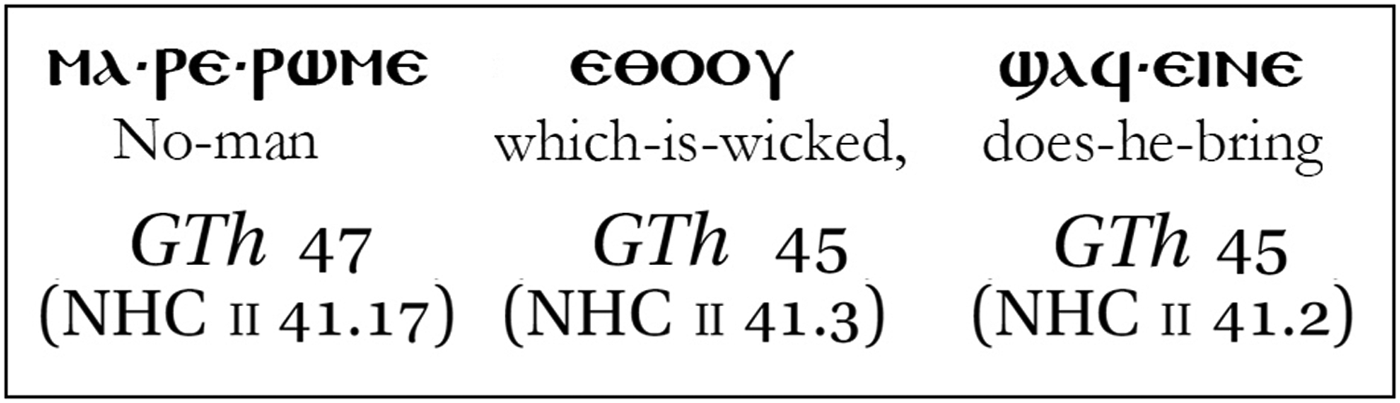
The three words in →6 are found in close proximity to each other in GTh and, when juxtaposed using ‘Grondin's Interlinear’, they appear to mean: ‘No man which is wicked does bring . . . ’ (i.e. ‘No wicked man brings (forth) . . .’) in English.
Screen capture of the three Coptic words juxtaposed in →6, as they appear (with English translations beneath) in ‘Grondin's Interlinear'
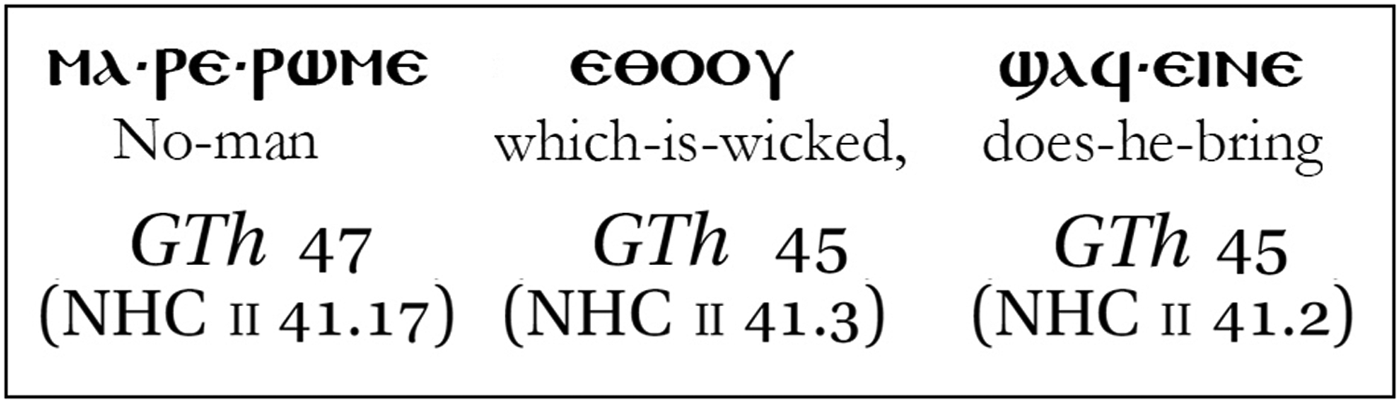
It is not difficult to see how someone dependent on the English of ‘Grondin's Interlinear’ could have believed that →6 contained a negative version of ⲟⲩⲕⲁⲕⲟⲥ ⲣ̄ⲣⲱⲙⲉ ϣⲁϥⲉⲓⲛⲉ without recognising the serious Coptic grammatical problems in the line. Grondin did not explain that a relative clause (ⲉⲑⲟⲟⲩ) should not follow a non-definite noun (ⲣⲱⲙⲉ); his work was never intended to serve as a Coptic grammar. Also, Grondin's functional equivalent translation of ⲙⲁⲣⲉⲣⲱⲙⲉ as ‘no man’ has inadvertently suggested that it could function as the subject of a sentence when it cannot; it is actually a combination of a verbal element (a negative aorist conjugation base ⲙⲁⲣⲉ–) and a noun (ⲣⲱⲙⲉ).Footnote 84
3.7 Recto ( → ), line 7
Coptic: ] ⲁⲛⲟⲕ ϯϣⲟⲟⲡ ⲛⲙⲙⲁⲥ ⲉⲧⲃⲉ ⲡ̣[
English: ] . I dwell with her in order to . [
The phrase ⲁⲛⲟⲕ ϯϣⲟⲟⲡ ⲛⲙⲙⲁϥ appears in GTh 30 (NHC ii 39.4–5),Footnote 85 and the preposition ⲉⲧⲃⲉ followed by a word beginning with ⲡ is found in GTh 29 (NHC ii 38.33).Footnote 86 In the phrase ⲁⲛⲟⲕ ϯϣⲟⲟⲡ ⲛⲙⲙⲁϥ, the preposition ⲛⲙⲙⲁ⸗ (ⲙⲛ̄ in the prepersonal state) is completed by the third person masculine singular suffix (ϥ) in GTh 30; it is completed by the third person feminine singular suffix (ⲥ) in the parallel in →7.
3.8 Recto ( → ), line 8
Coptic: ] . ⲟⲩϩⲓⲕⲱⲛ̣ . . [
English: ] . an image . . . [
The phrase ⲟⲩϩⲓⲕⲱⲛ appears in GTh 22 (NHC ii 37.34 (2x)) and 50 (42.1).
3.9 Verso ( ↓ )
With only three possibly identifiable words in six lines, the verso (↓) cannot provide any significant information about the relationship between GJW and GTh.
4. Textual Evidence of Modern Forgery in GJW
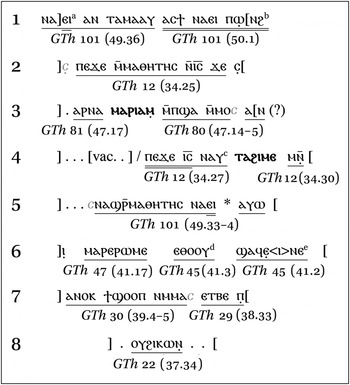
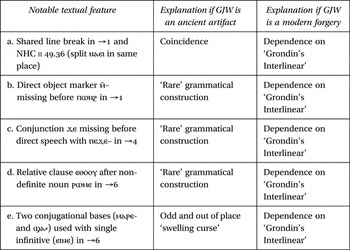
Figure 6 summarises the similarities and differences between GJW and GTh. Text in GJW that could have been copied verbatim from GTh is underlined (double underlined if it might easily have differed). Parallels in GTh (with NHC ii page and line numbers in parentheses) are noted beneath the Coptic text. Third person singular female personal affixes (ⲥ: ‘she’, ‘her’) in GJW that are masculine (ϥ: ‘he’, ‘him’) in their parallels in GTh are printed in gray italics. Words in GJW that do not appear in identical form in GTh are printed in bold. An asterisk indicates where ⲁⲛ (‘not’) appears in the parallel in GTh. Notable textual features are denoted by superscript Latin letters; these are listed in Table 1 and discussed below.
A key to the ‘patchwork’ text (GJW)

Possible explanations for the notable textual features in GJW

The verbal similarities between GJW and GTh are, at the very least, suggestive of GJW being a modern forgery. GJW does not merely share common vocabulary with GTh, nor does it consist simply of ‘parallels dispersed throughout [GTh]’.Footnote 87 Each line of GJW contains one or more snippet(s) of text found in close proximity to each other in GTh. All the words in →1 and →5 can be traced back to GTh 101. Both →2 and →4 contain phrases found in identical form in GTh 12. The text of →3 appears mostly derived from GTh 81 and 80, and the text of →7 appears derived entirely from GTh 30 and 29. Even →6, the most ‘patchwork’ line of text in GJW, consists exclusively of words from a single page of NHC ii (41).
In addition, GJW and GTh consistently use identical spellings and grammatical constructions when common alternatives could have been used instead. Both texts use the spelling ⲉⲓ rather than ⲓ¨ for the first person singular suffix (twice in →1 and once in →5), use the double-object infinitive ϯⲛⲁ⸗ instead of the more usual ϯ ⲛ̄–/ⲙ̄ⲙⲟ⸗ ⲛ̄–/ⲛⲁ⸗ in →1, and introduce Jesus’ words with ⲡⲉϫⲉ ⲓ̅ⲥ̅ (an extremely common formula in GTh) in →4. These textual similarities cannot be accounted for by ‘ancient compositional practices’.Footnote 88 It seems unlikely that any ancient text was ever created by patching together disjointed and rearranged words and short phrases from another text. Certainly, no such text has been mentioned in the discussion of GJW.Footnote 89
The apparently deliberate textual differences between GJW and GTh contribute further to the impression that GJW is a modern forgery. The text seems aimed specifically at an audience of our own era, the time in Christian history when the idea of a marriage between Jesus and Mary (Magdalene) is undeniably most popular.Footnote 90 Switching Coptic masculine pronouns in GTh to feminine, removing ⲁⲛ (‘not’) from one parallel in GTh, and placing ⲙⲁⲣⲓⲁⲙ (‘Mary’) and ⲧⲁϩⲓⲙⲉ (‘my wife’) in GJW, has created a dialogue in which the Coptic text states: ‘The disciples said to Jesus, “ . . . Mary is not worthy of it . . .” Jesus said to them, “My wife . . . she will be able to be my disciple . . . I dwell with her . . . ”’Footnote 91
The notable textual features provide decisive evidence that GJW is a modern forgery,Footnote 92 ensuring that the method used to establish that GJW is a ‘patchwork’ of snippets from GTh is not merely one that ‘assumes forgery and then produces similarities between the two works’.Footnote 93 As Table 1 shows, the notable textual features can be explained in a more satisfactory manner if GJW is regarded as a modern forgery rather than as an ancient text.
It seems implausible that GJW is an ancient text that coincidentally replicates a line break from NHC ii 49.36 (notable textual feature a), contains three different grammatical constructions that have been generously labelled as ‘rare’ (features b–d), and includes a seemingly odd and out of place ‘swelling curse’ (rather than feature e, which is ungrammatical).Footnote 94 No genuinely ancient writing would be likely to compress so many suspicious textual features into just eight short, partial lines of text. GJW is better understood as a modern forgery that contains numerous indications of its recent origin: all five notable textual features can be explained well as the result of a forger's dependence on ‘Grondin's Interlinear’.
A forger with limited knowledge of Coptic could easily have (a) copied a line break from NHC ii 49.36 because it is reproduced in Grondin's edition of GTh, (b) omitted the expected direct object marker (ⲙ–) before ⲡⲱⲛϩ because it was accidentally omitted in the pertinent passage in Grondin's 2002 PDF, (c) used ⲡⲉϫⲉ– to introduce direct speech without ϫⲉ because Grondin followed NHC ii and separated the seemingly complete phrase ⲡⲉϫⲉ ⲓ̅ⲥ̅ ⲛⲁⲩ from the conjunction ϫⲉ with a line-break, (d) violated a well-established rule of Coptic grammar by placing a relative clause (ⲉⲑⲟⲟⲩ) after a non-definite noun (ⲣⲱⲙⲉ) because Grondin did not (attempt to) explain this rule, and (e) created a wholly ungrammatical Coptic phrase with two conjugation bases and one infinitive because it seemed to make sense in the English translation in ‘Grondin's Interlinear’.
There is no reasonable way to explain the significant similarities and minor differences between GJW and GTh as the result of some kind of literary dependence in antiquity.Footnote 95GJW is not dependent on just any version of GTh: it is derived from the version found in NHC ii. This manuscript was almost certainly buried in the ground by the second half of the seventh century, the earliest time when GJW could have been copied. It also happens to contain the single Coptic version of GTh that has survived from antiquity and would be available for use in a modern forgery.
More specifically, GJW seems undeniably dependent on a specific edition of NHC ii that was posted online in 2002. Two of the notable textual features in GJW (a and c) can be attributed to line-breaks in NHC ii, which are repeated in Grondin's edition of GTh, and both of the grammatically problematic features in →6 (d and e) can be explained well by a forger's reliance on the English of the same modern edition of the text. In addition, GJW appears to contain a grammatical error in →1 (notable textual feature b) because it repeats a typographical error that Grondin accidentally made when creating the PDF version of his work. Finally, GJW can even be connected to ‘Grondin's Interlinear’ through the English translation of the fragment that the unidentified collector gave King.Footnote 96
Perhaps, in time, more light will be shed on the identity and motivation of the person(s) responsible for GJW. If not, at least we can say with certainty that GJW is a forgery that has no place in any discussion of ancient Christianity. It is a part of modern Christian history now.