Pronounced and persistent levels of externalizing symptoms characterized by overt hostility, conduct problems, and oppositional defiance pose significant problems for children in academic settings and have substantial personal and societal costs (e.g., Foster, Jones, & Conduct Problems Prevention Research Group, Reference Foster and Jones2005). In recognizing the importance of understanding the determinants of early behavior problems, a growing body of research has focused on elucidating family risk factors. In particular, family instability, characterized by the cumulative amount of transitions experienced by the family (e.g., caregiver intimate relationship transitions, caregiver changes, residential moves, or caregiver income/job loss), has been identified as a consistent precursor of externalizing symptoms in childhood (e.g., Ackerman, Kogos, Youngstrom, Schoff, & Izard, Reference Ackerman, Kogos, Youngstrom, Schoff and Izard1999; Cavanagh & Huston, Reference Cavanagh and Huston2006; Milan, Pinderhughes, & Conduct Problems Prevention Research Group, Reference Milan and Pinderhughes2006; Womack, Taraban, Shaw, Wilson, & Dishion, Reference Womack, Taraban, Shaw, Wilson and Dishion2018). Because early childhood is a time when children are actively forming expectations about the consistency of their care and relationships with significant figures in their lives (Sroufe, Reference Sroufe2000), instability experienced during this developmental period may have an especially pronounced impact on children's adjustment outcomes (Belsky, Schlomer, & Ellis, Reference Belsky, Schlomer and Ellis2012). In support of this conceptualization, some studies have shown that instability experienced early in life (i.e., during the first 5 years) is a stronger predictor of later externalizing symptoms than instability assessed during subsequent developmental periods (e.g., Cavanagh & Huston, Reference Cavanagh and Huston2008; Donahue et al., Reference Donahue, D'Onofrio, Bates, Lansford, Dodge and Pettit2010; Doom, Vanzomeren-Dohm, & Simpson, Reference Doom, Vanzomeren-Dohm and Simpson2016; Simpson, Griskevicius, Kuo, Sung, & Collins, Reference Simpson, Griskevicius, Kuo, Sung and Collins2012).
Although the salience of early instability as a risk factor for children's externalizing symptoms is well established, little is known about the family processes that underpin children's susceptibility. To address this significant gap in knowledge, the goal of the current study was to provide the first rigorous, longitudinal test of whether primary caregivers’ difficulties with serving as supportive parents for their children may mediate links between family instability and children's externalizing problems during the transition from preschool to first grade. As a critical stage-salient task for young children, the transition into formal academic settings serves as a unique opportunity for researchers to understand how early experiences within the family may be related to children's ability to successfully adjust to extrafamilial contexts. Specifically, the myriad of new and challenging experiences in early school settings are proposed to increase children's tendencies to draw on prior family experiences as roadmaps for understanding how to respond to new and unfamiliar situations (e.g., Davies, Winter, & Cicchetti, Reference Davies, Winter and Cicchetti2006). As an empirical example, prior research has demonstrated that characteristics of children's early family (e.g., parent–child) relationships serve as significant predictors of their behavioral and emotional adjustment to academic settings (e.g., Kopystynska, Spinrad, Seay, & Eisenberg, Reference Kopystynska, Spinrad, Seay and Eisenberg2016; National Institute of Child Health and Human Development Early Child Care Research Network, 2004; Stright & Yeo, Reference Stright and Yeo2014). Therefore, in the present study, we specifically focus on understanding how parenting behaviors in contexts that elicit parental support, guidance, and parent–child cooperation may underlie associations between family instability and children's externalizing symptoms during the transition to school. In addition, we test our mediational hypothesis using a full-panel analytic approach to allow the potential identification of alternative predictive pathways, such as (a) children's externalizing symptoms serving as precursors of unsupportive parenting and family instability or (b) a transactional process whereby family instability, unsupportive parenting, and children's externalizing symptoms evidence bidirectional associations over time.
Unsupportive Parenting as a Mediator of Instability
Prior theory and research have characterized supportive parents as those who are actively engaged with their child, provide their child with warmth and support, and display synchrony and appropriate sensitivity to their child's needs and developmental stage (e.g., Bornstein, Reference Bornstein1989). Conceptual models of parenting stress have proposed that the strain of experiencing family instability may manifest in subsequent difficulties serving as a supportive parent to their child in situations that involve challenge, guided learning, and cooperation (e.g., Belsky, Reference Belsky1984; Belsky et al., Reference Belsky, Schlomer and Ellis2012; Osborne & McLanahan, Reference Osborne and McLanahan2007). Consequently, the disconnect between parents and their children may account for the risks associated with instability for children. Supporting this conceptualization, prior research has shown that parents experiencing social stressors (e.g., conflict, poverty, or cumulative risk) are less likely to engage in nurturing, child-centered behaviors and are more likely to display disengaged, inconsistent, or rejecting behaviors toward their child in times when parental support and guidance are needed. These parenting difficulties, in turn, have been shown to predict children's adjustment problems (Doan, Fuller-Rowell, & Evans, Reference Doan, Fuller-Rowell and Evans2012; Evans, Li, & Whipple, Reference Evans, Li and Whipple2013; Grant et al., Reference Grant, Compas, Stuhlmacher, Thurm, McMahon and Halpert2003; Vernon-Feagans, Willoughby, Garrett-Peters, & Family Life Project Key Investigators, Reference Vernon-Feagans, Willoughby and Garrett-Peters2016).
Some prior research suggests that indices of instability (e.g., parental relationship transitions) are linked with parenting behaviors (e.g., Beck, Cooper, McLanahan, & Brooks-Gunn, Reference Beck, Cooper, McLanahan and Brooks-Gunn2010; Cooper, McLanahan, Meadows, & Brooks-Gunn, Reference Cooper, McLanahan, Meadows and Brooks-Gunn2009; Osborne, Berger, & Magnuson, Reference Osborne, Berger and Magnuson2012), and parenting difficulties have also been repeatedly associated with children's externalizing problems (see Pinquart, Reference Pinquart2017, for a meta-analysis). However, very few studies have directly tested parenting as a mediator of the risk posed by family instability. Furthermore, those who have tested mediation have yielded somewhat inconsistent results. As one example, Belsky et al. (Reference Belsky, Schlomer and Ellis2012) found that lower levels of maternal sensitivity mediated associations between early rates of family instability (i.e., number of family transitions from when children were 1 month to 5 years old) and adolescent sexual behavior (i.e., number of sexual partners at age 15). However, findings from a cross-sectional study of adolescents indicated that higher rates of family instability were associated with greater parenting difficulties, but parenting did not directly predict adolescent behavior problems (Forman & Davies, Reference Forman and Davies2003). Further still, Donahue et al. (Reference Donahue, D'Onofrio, Bates, Lansford, Dodge and Pettit2010) found that the prospective association between parental relationship instability prior to age 5 and adolescent risky sexual behavior was not mediated by parenting behaviors. Finally, as the only study to test this mediational hypothesis with child, rather than adolescent, adjustment outcomes, Osborne and McLanahan (Reference Osborne and McLanahan2007) found that the association between mothers’ previous partnership changes and child behavior problems at age 3 was mediated by maternal stress and lower quality mothering.
These few previous mediational tests have been somewhat limited in that they largely focus on adjustment outcomes in adolescence (e.g., Belsky et al., Reference Belsky, Schlomer and Ellis2012; Donahue et al., Reference Donahue, D'Onofrio, Bates, Lansford, Dodge and Pettit2010; Forman & Davies, Reference Forman and Davies2003), only examine a narrow index of instability (e.g., parental relationship transitions; Donahue et al., Reference Donahue, D'Onofrio, Bates, Lansford, Dodge and Pettit2010; Osborne & McLanahan, Reference Osborne and McLanahan2007), or both (e.g., Donahue et al., Reference Donahue, D'Onofrio, Bates, Lansford, Dodge and Pettit2010). Consequently, we know very little about how these mediational processes, particularly those involving more comprehensive assessments of instability, may unfold during the critical developmental period of early childhood, when children are thought to be particularly sensitive to disruptions in parenting behaviors and the broader home environment (e.g., Grusec & Davidov, Reference Grusec and Davidov2010; Shonkoff & Phillips, Reference Shonkoff and Phillips2000). In addition, all of these studies adopted either cross-sectional (e.g., Forman & Davies, Reference Forman and Davies2003) or static longitudinal (i.e., no repeated measures; Belsky et al., Reference Belsky, Schlomer and Ellis2012; Donahue et al., Reference Donahue, D'Onofrio, Bates, Lansford, Dodge and Pettit2010; Osborne & McLanahan, Reference Osborne and McLanahan2007) designs. Therefore, although the findings provide some mixed, preliminary support for the mediational role of parenting behaviors in process models of instability, they do not meet quantitative criteria for testing mediation (e.g., Cole & Maxwell, Reference Cole and Maxwell2003). To definitively test mediation and accurately assess the directionality of associations, it is necessary to utilize longitudinal data in which the predictor, mediator, and outcome are temporally separated with autoregressive controls specified (e.g., Cole & Maxwell, Reference Cole and Maxwell2003). Thus, to our knowledge, the present study represents the first rigorous, longitudinal test of unsupportive parenting as a putative mechanism in the pathway between family instability and children's externalizing symptoms during early childhood.
Child Externalizing Symptoms as a Precursor of Unsupportive Parenting and Family Instability
Our use of repeated measures of family instability, parenting, and child externalizing symptoms also affords an analysis of alternative hypotheses on the directionality of family processes. According to “child-driven” effects models, the directionality of associations between instability, parenting, and child externalizing symptoms may be reversed. Specifically, these models posit that caring for a child with significant behavior problems increases parental stress, undermines supportive parenting, and proliferates to disrupt the fabric and stability of the family unit (e.g., caregiver romantic relationships, caregiver stability, and caregiver job performance; Emery, Reference Emery1982; Osborne & McLanahan, Reference Osborne and McLanahan2007). In providing some preliminary support for this hypothesis, a few studies have found that child externalizing behaviors predict less supportive parenting practices (e.g., Fite, Colder, Lochman, & Wells, Reference Fite, Colder, Lochman and Wells2006; Kerr & Stattin, Reference Kerr, Stattin, Crouter and Booth2003; Marchand, Hock, & Widaman, Reference Marchand, Hock and Widaman2002; Murray, Haynie, Howard, Cheng, & Simons-Morton, Reference Murray, Haynie, Howard, Cheng and Simons-Morton2013; Reitz, Dekovic, Meijer, & Engels, Reference Reitz, Dekovic, Meijer and Engels2006) and broader family difficulties (e.g., interparental and family conflict; Cui, Donnellan, & Conger, Reference Cui, Donnellan and Conger2007; Jenkins, Simpson, Dunn, Rasbash, & O'Connor, Reference Jenkins, Simpson, Dunn, Rasbash and O'Connor2005). However, these findings have not been consistent across developmental periods (e.g., more consistent in middle childhood and adolescence than early childhood) or studies (e.g., some studies do not find child behaviors to be consistent precursors of parent and family difficulties; Eisenberg et al., Reference Eisenberg, Zhou, Spinrad, Valiente, Fabes and Liew2005; Taylor, Eisenberg, Spinrad, & Widaman, Reference Taylor, Eisenberg, Spinrad and Widaman2013). Furthermore, to our knowledge, no previous studies have specifically examined child externalizing symptoms, unsupportive parenting, and family instability within the same model to test whether child behavior problems predict parent and family-level challenges. Therefore, our study extends on previous child-driven effects models in testing whether child externalizing symptoms predict subsequent parenting behaviors and family instability over time.
Transactional Processes Involving Family Instability, Unsupportive Parenting, and Child Externalizing Symptoms
As another possible explanation for associations between instability and externalizing symptoms, transactional models propose that associations between family processes and children's behavior problems (e.g., externalizing symptoms) are bidirectional (e.g., Leve & Cicchetti, Reference Leve and Cicchetti2016; Sameroff, Reference Sameroff1975). Therefore, it is also possible that the nature of associations between family instability, unsupportive parenting, and child externalizing symptoms may reflect transactional (e.g., bidirectional), rather than unidirectional, processes. According to these frameworks, children high in behavior problems evoke less supportive parenting practices from their caregivers and potentially more instability and chaos in the household, which in turn lead to future child behavior problems. Although bidirectional models, particularly those involving child behavior problems and parenting behaviors, have gained widespread attention in developmental models of family risk (e.g., Leve & Cicchetti, Reference Leve and Cicchetti2016), empirical findings supporting bidirectional associations have been decidedly mixed. For example, some studies have found support for transactional relations between child externalizing symptoms and parenting or other family difficulties (e.g., Burke, Pardini, & Loeber, Reference Burke, Pardini and Loeber2008; Combs-Ronto, Olson, Lunkenheimer, & Sameroff, Reference Combs-Ronto, Olson, Lunkenheimer and Sameroff2009; Lansford et al., Reference Lansford, Criss, Laird, Shaw, Pettit, Bates and Dodge2011; Neece, Green, & Baker, Reference Neece, Green and Baker2012; Serbin, Kingdon, Ruttle, & Stack, Reference Serbin, Kingdon, Ruttle and Stack2015), but others testing for transactions have only found support for unidirectional effects (e.g., Fite et al., Reference Fite, Colder, Lochman and Wells2006; Kerr & Stattin, Reference Kerr, Stattin, Crouter and Booth2003; Reitz et al., Reference Reitz, Dekovic, Meijer and Engels2006). Furthermore, to our knowledge, there are very few studies utilizing stringent panel analyses, and none have tested a transactional model including externalizing symptoms, unsupportive parenting, and family instability. Therefore, our study addresses this gap by utilizing a multivariate, longitudinal design to more definitively test whether a transactional process occurs.
Present Study
To our knowledge, the present study represents the first definitive test of a more proximal family process (i.e., unsupportive parenting) as a mediating mechanism in the predictive pathway between family instability and children's externalizing symptoms during the transition into the early school years. Consistent with conceptual models of parenting stress (e.g., Belsky, Reference Belsky1984; Belsky et al., Reference Belsky, Schlomer and Ellis2012; Osborne & McLanahan, Reference Osborne and McLanahan2007), we tested the hypothesis that decreases in maternal supportive parenting behaviors during times when parental guidance and parent–child cooperation are needed would mediate longitudinal associations between family instability and children's externalizing symptoms. To achieve a more definitive understanding of the nature of associations between the primary variables in our study, we also tested the utility of complementary pathways, including (a) a “child-driven” model proposing that children's externalizing symptoms serve as precursors to subsequent unsupportive parenting and family instability and (b) potential bidirectional transactions between family instability, unsupportive parenting, and child externalizing symptoms. To overcome the limitations of previous mediational tests, we utilized a longitudinal, repeated-measures design spanning three time points to afford an analysis of change at each link in the proposed mediational chain. In addition, a multimethod (i.e., surveys and observations) and multi-informant (i.e., observer, parent, and teacher) assessment battery was used to reduce the operation of common method and informant variance.
To increase the ecological validity of our measure of parenting and get a more accurate sense of how primary caregivers parent in the context of the overall family, we assessed maternal parenting behaviors in a family interaction task that involved mothers, partners, and their child. In this study, we specifically focus on maternal, rather than paternal, parenting behaviors. Given the high rates of instability in the sample (e.g., 88% of mothers reported at least one family transition over the course of the study), the limited sample size associated with including fathers who participated in the longitudinal portion of the study (e.g., only 64% of father figures retained for all three waves) would substantially reduce power and introduce significant bias in parameter estimates (e.g., would include only those from highly stable households). Therefore, we test whether parenting behaviors of primary caregivers (i.e., mothers in our sample) rather than both parental figures mediate associations between instability and child externalizing symptoms. Finally, to reduce the potential operation of confounding factors in our analyses, we also included child sex and total household income per capita as covariates. Income was a particularly important covariate to consider given empirical documentation of the co-occurrence of poverty and family instability (e.g., Ackerman et al., Reference Ackerman, Kogos, Youngstrom, Schoff and Izard1999; Evans, Reference Evans2004; McLanahan, Reference McLanahan2009) and poverty's well-established negative impact on both parenting behaviors and child functioning (e.g., Ackerman, Brown, & Izard, Reference Ackerman, Brown and Izard2004; Conger & Donnellan, Reference Conger and Donnellan2007; Conger, Conger, & Martin, Reference Conger, Conger and Martin2010; Evans, Boxhill, & Pinkava, Reference Evans, Boxhill and Pinkava2008).
Method
Participants
Participants included 243 families (mother, intimate partner, and preschool child) residing in a moderate-sized metropolitan area in the Northeastern United States. To obtain a demographically diverse sample, participants were recruited through preschools; Head Start agencies; Women, Infants, and Children programs; internet advertisements; family-friendly locations (e.g., farmers markets and libraries); and public and private daycares serving children and families from a variety of demographic backgrounds. To be eligible for participation, families must have met the following inclusion criteria: (a) the adult primary caregiver and intimate partner had regular contact (i.e., average of 2 to 3 days per week) with each other and the child over the majority of the year (i.e., at least 10 months) prior to Wave 1; (b) at least one of the adults was the biological parent of the target child; (c) the child participant was 4 or 5 years old at Wave 1 and was enrolled in preschool, with the expectation of enrolling in kindergarten the following school year; and (d) the child did not have any significant cognitive, sensory, or motor difficulties that may compromise the validity of assessments.
The longitudinal design consisted of three annual measurement occasions, and data were collected between 2010 and 2014. Retention rates across waves of data collection were excellent (97% from Wave 1 to Wave 2, 94% from Wave 2 to Wave 3, and 91% from Wave 1 to Wave 3). The average age of child participants was 4.60 years (SD = 0.44) at Wave 1, 5.75 years (SD = 0.47) at Wave 2, and 6.81 years (SD = 0.48) at Wave 3. Around half (56%) of child participants were girls. The sample was racially diverse with almost half (48%) of families identifying as Black or African American, 43% White, 6% multiracial, and 3% another race. Approximately 16% of family members identified as Latino. The sample was also diverse with respect to socioeconomic status. Median household income of families was $36,000 per year (range = $2,000 to $121,000), with most families (69%) receiving some form of public assistance. Median education for parents consisted of a GED or high school diploma (range = no high school diploma to Master's or PhD degree). At Wave 1, primary caregivers and their intimate partners had lived together with the target child an average of 3.36 years and had, on average, daily contact with each other and the child (range = 2 or 3 days per week to daily). Of adult participants, 99% of mothers and 74% of their partners were the biological parents of the child, 47% were married, 93% lived together, and 98% were heterosexual.
Procedures and measures
Parents and children visited our research center laboratory for three waves of data collection, with each wave spaced 1 year apart. Children's classroom teachers also completed questionnaires about children's behavior at each wave. The institutional review board at the University of Rochester approved all scientific procedures prior to conducting the study, and parents gave written consent for both themselves and their child to participate. Parents and teachers were compensated monetarily for participation, and children received small toys at each visit.
Family instability
At each wave, mothers completed the Family Instability Questionnaire (Ackerman et al., Reference Ackerman, Kogos, Youngstrom, Schoff and Izard1999; Forman & Davies, Reference Forman and Davies2003) to assess family instability experienced in the previous year. The six-item measure is designed to assess the total number of unstable events experienced by the family in the last year, including caregiver changes (i.e., “Your child's primary caregiver changed [person primarily responsible for his/her care]”), primary caregiver intimate relationship transitions (i.e., “You became involved in a serious romantic relationship [regular date, live-in partner, fiancée, spouse],” “You and a serious romantic partner [spouse, dating partner, fiancée] moved in together,” or “You and a romantic partner broke up or separated”), job/income loss (i.e., “You or other adult members of your household lost a job”), and residential changes (i.e., “You moved to a new residence with your child”). The measure, which consists of the total number of unstable events, is consistent with previous assessments of instability and has good psychometric properties (e.g., Ackerman et al., Reference Ackerman, Kogos, Youngstrom, Schoff and Izard1999; Forman & Davies, Reference Forman and Davies2003). Over the course of the study, 59% of mothers reported at least one instance of an adult member of the household losing a job, 51% reported at least one instance of becoming involved in a serious romantic relationship, 40% reported at least one instance of moving in with a romantic partner, 40% reported at least one instance of breaking up or separating from a romantic partner, 58% reported at least one instance of moving to a new residence with the child, and 28% reported at least one instance in which the child's primary caregiver changed.
Maternal supportive parenting
At Waves 1, 2, and 3, families (mother, partner, and child) participated in a variation of a family interaction task (FIT) that was adapted from previous studies (e.g., McHale, Kuersten-Hogan, & Lauretti, Reference McHale, Kuersten-Hogan, Lauretti, Ke-rig and Lindahl2001; Schoppe, Mangelsdorf, & Frosch, Reference Schoppe, Mangelsdorf and Frosch2001). The tasks were comparable to one another in that they were each designed to be very difficult, if not impossible, to (a) ensure that children could not successfully complete the task on their own without assistance from their parents and (b) assess individual differences in parents’ guidance and cooperative support of their children during challenging situations. Specifically, at Wave 1, families were given 10 min to work together to build a house out of Legos after being provided with a picture version of an intricate Lego house. At Waves 2 and 3, families were asked to work together for 6 min to build a tower out of blocks that exceeded a “record” height that is very difficult to achieve. To maximize the ability to capture the natural behavior patterns displayed by parents and their children, additional instructions were limited to the request that the family work together to build the house. At each wave, families were left alone to complete the activity, and the task was video-recorded for subsequent coding of parenting behaviors.
At all three waves, trained raters assessed mothers for specific behaviors during the FIT on 9-point continuous scales ranging from 1 (not at all characteristic) to 9 (highly characteristic). Adapted from the well-established Iowa Family Interaction Rating Scales (Melby & Conger, Reference Melby, Conger, Keurig and Lindahl2001), the specific scales included sensitivity and disengagement to assess a full range of supportive parenting behaviors (e.g., from actively unsupportive to highly supportive). The sensitivity scale assesses the degree to which the mother displays an awareness of her child's needs, emotional states, interests, and abilities (i.e., mother's behaviors appear to be “in sync” with those of her child). Mothers rated highly on sensitivity were those who displayed sensitive behaviors that were strong in form, frequency, and chronicity. Specific examples include facilitating children's engagement and success in the task (e.g., “What if we tried it this way?”), responding sensitively to the child's distress, anger, or frustration (e.g., “It's ok if we don't beat the record; it's just important that we work together and try our best!”; redirecting the child's activities; or offering verbal and physical affection), and structuring the activities in autonomy supportive ways. Conversely, the disengagement scale assesses the extent to which the mother is apathetic, uninvolved, or unresponsive during the task (i.e., conveys a feeling of withdrawal and lack of investment). Specific examples of high disengagement include ignoring the child's bids for attention and support, focusing solely on the activity to the exclusion of other family members, and displaying clear disinterest in the child for most if not all of the task. Mothers received one overall rating on each of the two scales at each wave. Two trained coders independently overlapped on their ratings of over 20% of the videos at each time point to assess interrater reliability. Intraclass correlation coefficients across the waves ranged from .79 to .92 for sensitivity and .86 to .93 for disengagement. The two codes were specified as manifest indicators of a latent construct of maternal supportive parenting at each wave.
Supporting the validity of the observational measures of maternal parenting used in this study, higher ratings of sensitivity and disengagement were related to broader maternal-reported assessments of parenting at all three time points. For example, at all three waves, higher sensitivity was significantly correlated with higher scores on the responsiveness to input scale of the Parenting Dimensions Inventory (Slater & Power, Reference Slater, Power and Vincent1987) and lower scores on several subscales of the Socialization of Moral Affect for Parents of Preschoolers (Rosenberg, Tangney, Denham, Leonard, & Widmaier, Reference Rosenberg, Tangney, Denham, Leonard and Widmaier1994) including conditional approval, power assertion (e.g., harsh discipline), child-focused negative punishment, and neglect/ignoring subscales. Conversely, high ratings on disengagement were significantly correlated with lower scores on the responsiveness to input scale of the Parenting Dimensions Inventory and higher scores on Socialization of Moral Affect for Parents of Preschoolers neglect/ignoring, power assertion, child-focused negative, and conditional approval subscales across all waves.
Children's externalizing symptoms
Teacher reports on three subscales from the MacArthur Health and Behavior Questionnaire (HBQ; Ablow et al., Reference Ablow, Measelle, Kraemer, Harrington, Luby, Smider and Kupfer1999; Boyce et al., Reference Boyce, Essex, Woodward, Measelle, Ablow and Kupfer2002; Essex et al., Reference Essex, Boyce, Goldstein, Armstrong, Kraemer and Kupfer2002) were used as indicators of a latent construct of children's externalizing symptoms at Waves 1 (when children were in preschool), 2 (when children were in kindergarten), and 3 (when children were in first grade). These included oppositional defiant (9 items; e.g., “defiant, talks back to adults”), conduct problems (10 items; e.g., “lies or cheats”), and overt hostility (4 items; e.g., “kicks, bites, or hits other children”) scales. Response alternatives for each item were 0 (never or not true), 1 (sometimes or somewhat true), and 2 (often or very true). Each subscale consisted of the sum of items, and internal consistencies for the scales across the three waves ranged from .80 to .92. Prior research supports the reliability and validity of the HBQ scales for assessing young children's psychological adjustment (see Ablow et al., Reference Ablow, Measelle, Kraemer, Harrington, Luby, Smider and Kupfer1999).
Covariates
Two demographic covariates, derived from a maternal interview at Wave 1 included (a) children's sex (1 = girls; 2 = boys) and (b) total household income per capita, calculated by dividing total annual household income by the number of individuals living in the home.
Analytic strategy
Prior to conducting our analyses, we examined whether rates of missingness in our data set were associated with any of the 20 primary study variables and covariates. None of these analyses were significant, meaning that higher rates of missingness were not associated with any of the variables included in our study. Hypotheses were tested using autoregressive structural equation modeling, specified with Mplus Version 7.0 statistical software (Muthen & Muthen, Reference Muthen and Muthen1998–2012). Full-information maximum likelihood was used to estimate missing data (data were missing for 15.23% of the values) and retain the full sample for the primary analyses (Enders, Reference Enders2001). The full-information maximum likelihood method is regarded as the method of choice for estimating missing data because it yields more accurate results than other approaches by minimizing bias in regression and standard error estimates for all types of missing data when the amount of missing data do not exceed 20% (Schlomer, Bauman, & Card, Reference Schlomer, Bauman and Card2010).
Prior to conducting our primary analyses, we first examined the fit of the measurement model reflecting the patterns of relations among proposed latent variables and their manifest indicators. Therefore, a measurement model was constructed that included latent maternal supportive parenting and child externalizing symptoms at all three waves, their intercorrelations, and each of their respective manifest indicators. Correlations were also specified between error terms of comparable manifest indicators of the three latent constructs across adjacent waves to estimate their shared method variance. Model fit was assessed using standard criteria, including chi-square tests, root mean square error of approximation (RMSEA), the comparative fit index (CFI), and the standardized root mean squared residual (SRMR). Acceptable fit values include .05 or lower for RMSEA and SRMR and .90 or higher for CFI, with .95 and higher preferred (Hu & Bentler, Reference Hu and Bentler1999). To maximize measurement equivalence of the latent constructs across waves, factor loadings of corresponding indicators of each latent construct were constrained to be equal across time points. Establishing measurement invariance after adding these constraints requires that the chi-square difference is nonsignificant.
To address our primary analytic aim of examining the nature and directionality of associations between family instability, maternal supportive parenting, and child externalizing symptoms, we specified cross-lagged, autoregressive models across the three time points using structural equation modeling. All autoregressive and cross-lagged paths between contiguous measurement occasions were freely estimated. Correlations were estimated among all exogenous predictors and between error terms of comparable manifest indicators of the three latent constructs across adjacent waves. For latent constructs, the same constraints for measurement invariance previously described were used in the primary analyses. Given their potential roles as covariates, total household income per capita and child sex were included as covariates in the primary analyses. However, results indicated that child sex was unrelated to any of the other variables in the model and did not alter the pattern of significant results. Therefore, to maximize parsimony, child sex was dropped from the model, and only income was included as a covariate in the primary analyses. Correlations were specified between income and all Wave 1 predictors, and structural paths were specified between income and all endogenous variables (i.e., Wave 2 and Wave 3 variables). Finally, to test for hypothesized mediational effects, we examined the significance of indirect effects in the model by using 95% asymmetric confidence limits in RMediation (Tofighi & MacKinnon, Reference Tofighi and MacKinnon2011).
Results
Descriptive analyses
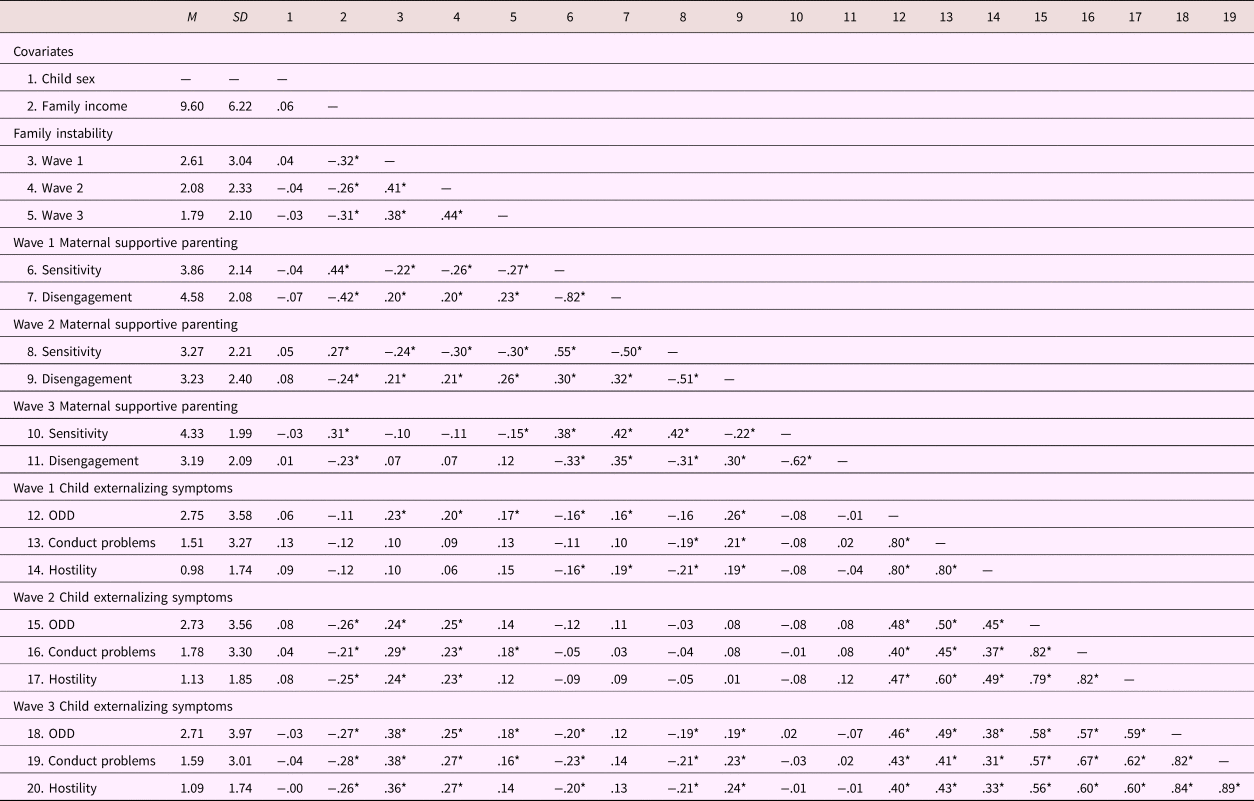
Table 1 provides the means, standard deviations, and intercorrelations for the variables used in the primary analyses. Comparisons of teacher reports of externalizing symptoms on the HBQ in the present sample with reports from a community sample of young children from two US cities (see Ablow et al., Reference Ablow, Measelle, Kraemer, Harrington, Luby, Smider and Kupfer1999) indicated that children in our sample evidenced externalizing symptoms that were, on average, 72% higher than the community samples (range = 29% higher for overt hostility to 129% higher for conduct problems). Moreover, the percentage of our sample that exceeded the mean level of externalizing behaviors in a clinic-referred sample (see Ablow et al., Reference Ablow, Measelle, Kraemer, Harrington, Luby, Smider and Kupfer1999) ranged from 17% to 21% (M = 19%) across the three scales.
Means, standard deviations, and intercorrelations of the main variables

Note: Income measured in thousands. ODD, oppositional defiant disorder. *p < .05.
Testing the measurement model
The unconstrained measurement model provided a good representation of the data, χ2 (60, N = 243) = 96.01, p = .002; RMSEA = .05; CFI = .98; SRMR = .04. Constraining the factor loadings to maximize measurement equivalence across time points did not result in a significant decrease in fit from the unconstrained model, Δ χ2 (6) = 10.43, p = .11, and the constrained model still provided a good fit to the data, χ2 (66, N = 243) = 106.43, p = .001; RMSEA = .05; CFI = .98; SRMR = .04. Therefore, we used the more conservative approach of including the constraints in the primary analyses. Factor loadings for all manifest indicators of the latent constructs were significant (p < .001), in the expected direction, and moderate to strong in magnitude (range = absolute value of .63 to .96).
Primary analyses
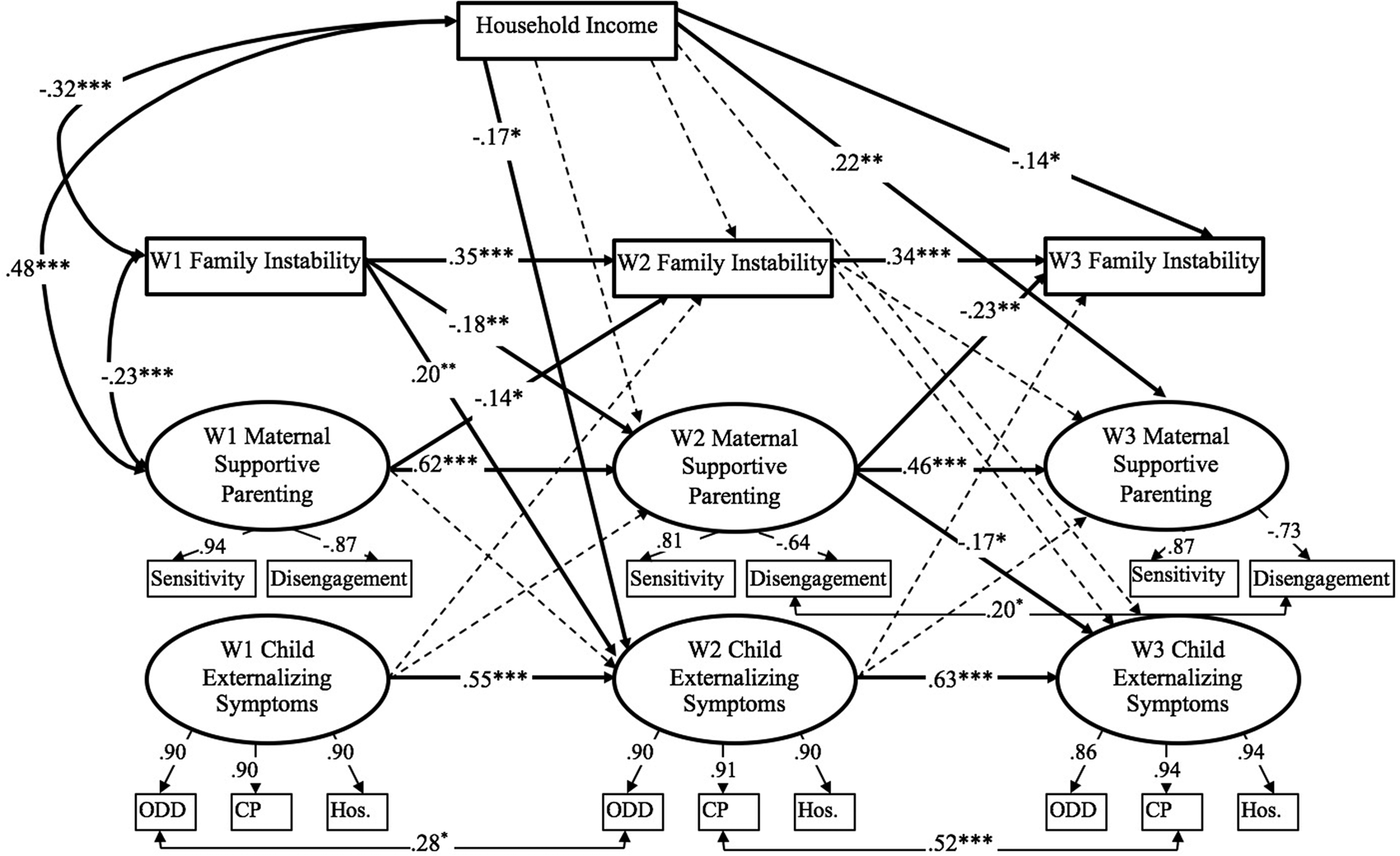
The results of the primary structural model shown in Figure 1 provided a good fit with the data: χ2 (117, N = 243) = 178.97, p = .0002; RMSEA = .05; CFI = .97; SRMR = .05. Correlations were specified among exogenous predictors and between residual errors on corresponding manifest indicators of latent constructs, but for clarity, only significant correlations are depicted in Figure 1. Autoregressive paths were significant for family instability (β = .35, p < .001 from Wave 1 to 2; β = .34, p < .001 from Wave 2 to 3), maternal supportive parenting (β = .62, p < .001 from Wave 1 to 2; β = .46, p < .001 from Wave 2 to 3), and child externalizing symptoms (β = .55, p < .001 from Wave 1 to 2; β = .63, p < .001 from Wave 2 to 3). Consistent with previous research, higher household income per capita predicted decreases in externalizing symptoms from Wave 1 to Wave 2, β = –.17, p = .02, decreases in family instability from Wave 2 to Wave 3, β = –.14, p = .04, and increases in maternal supportive parenting from Wave 2 to Wave 3, β = .22, p = .007. Family instability at Wave 1 was associated with increases in externalizing symptoms from Wave 1 to Wave 2, β = .20, p = .004.
A cross-lagged structural equation model examining transactional associations among family instability, maternal supportive parenting, and child externalizing symptoms. Parameter estimates for the structural paths are standardized path coefficients. Dashed lines indicate non-significant pathways. For clarity, only significant correlations are shown. W1 = Wave 1; W2 = Wave 2; W3 = Wave 3; ODD = Oppositional Defiant Disorder; CP = Conduct Problems; Hos. = Overt Hostility. *p < .05. **p < .01. ***p < .001.

Findings for the structural paths supported our primary hypothesis that maternal supportive parenting would mediate the prospective pathway between family instability and child externalizing symptoms. As hypothesized, higher levels of family instability at Wave 1 predicted decreases in maternal supportive parenting from Wave 1 to Wave 2, β = –.18, p = .008. Lower levels of maternal supportive parenting at Wave 2, in turn, predicted increases in externalizing symptoms from Wave 2 to Wave 3, β = –.17, p = .02. As further evidence of mediation, tests in RMediation (Tofighi & MacKinnon, Reference Tofighi and MacKinnon2011) indicated that the indirect path involving family instability, maternal supportive parenting, and child externalizing symptoms was significantly different from zero (indirect effect estimate = .032, 95% confidence interval; CI [.002, .075]).
Conversely, the mediational path proposed in the “child-driven” effects model was not significant. Specifically, children's externalizing symptoms at Waves 1 and 2 were unrelated to subsequent parenting or family instability 1 year later. However, partial support for a transactional process emerged. In addition to the significant pathway from Wave 1 family instability to Wave 2 supportive parenting, analyses also revealed that higher levels of supportive parenting at Wave 1 predicted decreases in family instability from Wave 1 to Wave 2, β = –.14, p = .047, and higher levels of supportive parenting at Wave 2 predicted decreases in family instability from Wave 2 to Wave 3, β = –.23, p = .002. Further supporting the transaction between parenting and instability, tests in RMediation (Tofighi & MacKinnon, Reference Tofighi and MacKinnon2011) also indicated that the indirect path involving Wave 1 family instability, Wave 2 supportive parenting, and Wave 3 family instability was significantly different from zero (indirect effect estimate = .028, 95% CI [.004, .061]).
Follow-up analyses
Testing child sex as a moderator
To evaluate the generalizability of the pathways in our model, we conducted an additional set of analyses to examine whether structural paths in Figure 1 varied as a function of child sex. We conducted multiple group comparisons in which the data were split according to child sex (i.e., male and female). Because splitting the data resulted in small sample sizes per group (i.e., 137 females and 106 males), it was necessary to conduct multiple group path analysis using manifest, rather than latent, composites for our measures of parenting and externalizing symptoms. To form these primary constructs, manifest variables were created by summing the respective manifest indicators of each latent construct to create composites. Disengagement ratings were reverse-scored so that they were rescaled in the same direction as sensitivity before summing the scores. We then conducted multiple group comparisons for the structural paths in Figure 1 by comparing a model in which all parameters were allowed to vary freely with a model in which all structural paths were constrained to equality across male and female child participants. Comparison of the constrained and free-to-vary models revealed no difference in fit, Δ χ2 (24) = 24.49, p = .43, thereby indicating that results did not differ as a function of child sex.
Testing the influence of different family compositions in FIT
Because of the high rate of instability in this sample, not all mothers and children participated in the family interaction task with the same father figure across all three Waves. Specifically, some mothers and children were observed together without a father figure (22 at Wave 2 and 42 at Wave 3), and others were observed with a partner who was different than the participating partner at Wave 1 (17 at Wave 2 and 10 at Wave 3). To test whether this impacted our pattern of results, we subsequently reran the model depicted in Figure 1 twice more: (a) once with a dummy variable of whether mother and child participated alone as a predictor of the respective Wave 2 and Wave 3 supportive parenting latent constructs (i.e., Wave 2 supportive parenting regressed on whether a partner was present at Wave 2 and Wave 3 supportive parenting regressed on whether a partner was present at Wave 3) and (b) once with a dummy variable of whether mother and child participated in the task with the same partner who participated at Wave 1 as a predictor of the respective Wave 2 and Wave 3 supportive parenting latent constructs (i.e., Wave 2 supportive parenting regressed on whether same partner was present at Wave 2 and Wave 3 supportive parenting regressed on whether same partner was present at Wave 3). In both models, neither covariate impacted the pattern of results.
Testing robustness of indirect effects
Because autoregressive cross-lagged models have been criticized for potentially conflating within- and between-person effects (e.g., Berry & Willoughby, Reference Berry and Willoughby2017; Hamaker, Kuiper, & Grasman, Reference Hamaker, Kuiper and Grasman2015), we followed guidelines by Hamaker et al. (Reference Hamaker, Kuiper and Grasman2015) to test an additional model that separated the within-person processes from stable between-person differences through the inclusion of random intercepts. For the random intercept cross-lagged panel model (RI-CLPM; Hamaker et al., Reference Hamaker, Kuiper and Grasman2015) to converge, it was necessary to test a path model of manifest composites using the same procedures described in our moderator analyses of child sex. To build the RI-CLPM, we constructed a model very similar to the autoregressive cross-lagged model used in the primary analyses with the addition of three individual factors representing the random intercepts for each of the primary variables (i.e., family instability, unsupportive parenting, and externalizing symptoms). Each factor's loading onto its respective variable at each time point (e.g., family instability at Waves 1, 2, and 3 were regressed onto a latent construct representing the random intercept of family instability) was fixed to 1 (e.g., identical to latent intercept constructs in latent growth modeling). In the same model, we subsequently (a) created within-person centered variables for family instability, supportive parenting, and child externalizing symptoms at all three waves; (b) specified autoregressive and cross-lagged pathways between the within-person centered variables; (c) estimated the covariances between the within-person centered variables at each time point; and (d) examined the path coefficients of the cross-lagged pathways to determine whether the indirect effects found in the primary analyses were robust when tested at a within-family level (see Hamaker, Reference Hamaker2018; Hamaker et al., Reference Hamaker, Kuiper and Grasman2015, for more information on specifying RI-CLPM models).
The model provided an adequate fit to the data, χ2 (3, N = 243) = 6.65, p = .08; RMSEA = .07; CFI = .99; SRMR = .02. Consistent with the findings of our primary analyses, family instability at Wave 1 predicted decreases in supportive parenting from Wave 1 to Wave 2, β = –.18, p = .04, which in turn predicted increases in externalizing symptoms from Wave 2 to Wave 3, β = –.25, p = .007. Supporting the robustness of the mediational finding, the indirect effect remained statistically significant (indirect effect estimate = .109, 95% CI [.001, .271]). In addition, we found that less supportive parenting at Wave 2 also significantly predicted increases in family instability from Wave 2 to Wave 3, β = –.24, p = .04. However, the indirect pathway involving Wave 1 family instability, Wave 2 supportive parenting, and Wave 3 family instability was no longer statistically significant (indirect effect estimate = .026, 95% CI [–.002, .071]).
Discussion
Although family instability has repeatedly been shown to increase children's risk for developing externalizing problems (e.g., Ackerman et al., Reference Ackerman, Kogos, Youngstrom, Schoff and Izard1999; Cavanagh & Huston, Reference Cavanagh and Huston2006; Milan et al., Reference Milan and Pinderhughes2006), little is known about the more proximal family processes that may account for this association. To address this significant gap in knowledge, our longitudinal, multimethod, multi-informant study tested whether caregivers’ difficulties serving as supportive parents during times that require parental guidance and parent–child cooperation mediated the association between family instability and children's externalizing problems during the transition to formal schooling. Findings indicated that family instability predicted decreases in maternal supportive parenting over time, which, in turn, predicted increases in children's externalizing symptoms from kindergarten to first grade.
Most empirical tests of mediational pathways involving instability, parenting, and child adjustment outcomes have predominantly utilized cross-sectional or static longitudinal designs. Therefore, in building on these previous studies, our findings provide the first rigorous, empirical test of unsupportive parenting as a key mediating mechanism accounting for longitudinal associations between family instability and children's externalizing symptoms. Results of the mediational tests indicated that less supportive parenting significantly mediated the association between family instability and child externalizing symptoms. These findings are consistent with the cascade of processes put forth by models of parenting stress (e.g., Belsky, Reference Belsky1984; Belsky et al., Reference Belsky, Schlomer and Ellis2012; Osborne & McLanahan, Reference Osborne and McLanahan2007) and family spillover (e.g., Bolger, DeLongis, Kessler, & Wethington, Reference Bolger, DeLongis, Kessler and Wethington1989; Erel & Burman, Reference Erel and Burman1995). Specifically, from a parenting stress perspective, it is possible that the stress of facing family instability may increase caregivers’ likelihood of having difficulties serving as a supportive parent for their child in times of need. These difficulties, in turn, may predict increases in their children's behavior problems. Similarly, spillover models posit that negativity (e.g., affect or behavior) directly transfers from one relationship or setting to another (e.g., Bolger et al., Reference Bolger, DeLongis, Kessler and Wethington1989; Erel & Burman, Reference Erel and Burman1995). In this way, distress in other family relationships (e.g., intimate relationship transitions) or contexts (e.g., job loss or residential moves) may “spillover” into the parent–child relationship and undermine the emotional availability of parents for their children (Bolger et al., Reference Bolger, DeLongis, Kessler and Wethington1989; Erel & Burman, Reference Erel and Burman1995). Unsupportive parenting may, in turn, lead to children having difficulties regulating their behavior (e.g., be higher in externalizing symptoms) when in other settings outside the family (e.g., school).
In addressing the unique significance of instability and the reasons why it increases caregivers’ risk for unsupportive parenting, researchers have posited that instability is particularly disruptive for primary caregivers and their children because each time there is a transition (e.g., change in residence, other adult moving in or out of the house, or income change), family members are forced to adjust to new routines, and the primary caregiver's attention is focused on the new partner or adjusting to life without the previous partner (Fomby & Cherlin, Reference Fomby and Cherlin2007). Therefore, the shift from one routine or setting to another is unsettling to the family and takes up much of the primary caregiver's attention and energy. As a result, the preoccupation, fatigue, and frustration that accompanies unstable events in the family may disrupt caregivers’ ability to effectively provide warmth, support, and guidance to their children (Forman & Davies, Reference Forman and Davies2003).
In explaining the second link in the mediational chain (i.e., unsupportive parenting as a predictor of child externalizing problems), researchers have proposed a few potential underlying mechanisms. First, it is possible that caregivers’ difficulties serving as supportive parents may predict children's adjustment problems through their influence on children's appraisals of security in their family. Specifically, lack of parental support may undermine children's confidence that their family is able to provide a supportive, safe, and cohesive environment that promotes their well-being (Forman & Davies, Reference Forman and Davies2003). In turn, feelings of insecurity may manifest in children's increased engagement in externalizing behaviors. As preliminary support for this proposition, Forman and Davies (Reference Forman and Davies2003) found that the indirect pathway involving family instability, parenting difficulties, child insecurity appraisals, and externalizing symptoms was significant in a cross-sectional study with adolescents.
Second, it is also possible that self-regulation and compliance difficulties may underlie associations between unsupportive parenting and child externalizing symptoms. Early childhood is a period during which children are developing important emotion and behavior regulation abilities, and parents are important sources of how children are taught these skills (e.g., Grolnick & Farkas, Reference Grolnick, Farkas and Bornstein2002). When parents are not actively engaged with their child, sensitive to their child's needs, and responsive to their child's reasonable requests (e.g., play or build a tower together), they are less likely to teach their children how to appropriately comply with rules and properly regulate their emotions and behavior (e.g., Doan et al., Reference Doan, Fuller-Rowell and Evans2012; Grusec & Davidov, Reference Grusec and Davidov2010). Therefore, children may become more likely to be oppositional and less likely to be able to effectively regulate their emotions and behavior, resulting in an increased risk for engaging in disruptive behavior problems (e.g., Grusec & Davidov, Reference Grusec and Davidov2010). Supporting this proposition, self-regulation difficulties have been shown to mediate associations between parenting difficulties and children's externalizing symptoms (e.g., Belsky, Pasco Fearon, & Bell, Reference Belsky, Pasco Fearon and Bell2007; Choe, Olson, & Sameroff, Reference Choe, Olson and Sameroff2013). Because our study did not explicitly test intermediary processes in the mediational pathways, it will be important for future research to further explore what underlying mechanisms account for associations between family instability, unsupportive parenting, and child externalizing symptoms.
Our use of cross-panel analysis with longitudinal data across three waves allowed us to also test the comparative value of alternative hypotheses regarding the directionality of family processes. In contrast to our primary hypothesis that unsupportive parenting would mediate associations between family instability and child externalizing symptoms, we did not find any empirical support for “child-driven” effects models, which propose that child externalizing symptoms would serve as precursors of unsupportive parenting and family instability. It is possible that our use of teachers as reporters of child externalizing symptoms may account for the null results. Researchers have posited that parents’ perceptions of their children's behavior, rather than the behavior itself, predict how they interact with their children (Webster-Stratton, Reference Webster-Stratton1990). Therefore, our null findings do not necessarily mean that there are not child-driven effects occurring in the parent–child relationship, but they might not be operating in the present study because our focus is on an informant who is not the parent (i.e., child's classroom teacher). In addition, teachers reported on children's behavior problems in the classroom, a context in which most mothers do not observe their children.
Supporting the viability of teacher reports as a potential explanation for the null findings related to child effects models, many of the previous studies finding support for child-driven effects utilized parent or child reports of child behavior (e.g., Cui et al., Reference Cui, Donnellan and Conger2007; Fite et al., Reference Fite, Colder, Lochman and Wells2006; Kerr & Stattin, Reference Kerr, Stattin, Crouter and Booth2003; Marchand et al., Reference Marchand, Hock and Widaman2002; Reitz et al., Reference Reitz, Dekovic, Meijer and Engels2006), and some studies that utilized teacher reports of child behavior and observational assessments of parenting did not find support for child-driven effects (e.g., Eisenberg et al., Reference Eisenberg, Zhou, Spinrad, Valiente, Fabes and Liew2005; Taylor et al., Reference Taylor, Eisenberg, Spinrad and Widaman2013). Furthermore, child effects might be more pronounced at different developmental periods. Specifically, most prior research finding support for child-driven effects has been with samples of older children (e.g., middle childhood and adolescence; Cui et al., Reference Cui, Donnellan and Conger2007; Fite et al., Reference Fite, Colder, Lochman and Wells2006; Jenkins et al., Reference Jenkins, Simpson, Dunn, Rasbash and O'Connor2005; Kerr & Stattin, Reference Kerr, Stattin, Crouter and Booth2003; Reitz et al., Reference Reitz, Dekovic, Meijer and Engels2006), whereas those studies that test these models with younger children have not consistently found such associations (e.g., Eisenberg et al., Reference Eisenberg, Zhou, Spinrad, Valiente, Fabes and Liew2005; Taylor et al., Reference Taylor, Eisenberg, Spinrad and Widaman2013).
Although not the primary aim of the study, we did find some modest support for a transactional association between family processes over time. Specifically, we found that, in addition to the finding that higher family instability predicted decreases in supportive parenting, higher levels of supportive parenting also predicted decreases in family instability. Further supporting a transaction, the indirect effect involving family instability, supportive parenting, and subsequent instability was statistically significant. This bidirectional association differs from our transaction hypothesis in that it occurs only between family instability and maternal parenting, with no significant role of child externalizing symptoms. One possible explanation for this bidirectional association is that unsupportive parenting may serve as a more proximal mechanism for personality characteristics of the parent (e.g., psychopathology or neuroticism). For example, prior research has shown that parents experiencing heightened psychopathological symptoms (e.g., depression, anxiety, or antisocial personality disorder) have a difficult time serving as supportive parents to their children, especially those with behavior problems, because of the sustained effort, patience, and flexibility parenting requires (Downey & Coyne, Reference Downey and Coyne1990; Johnson, Cohen, Kasen, & Brook, Reference Johnson, Cohen, Kasen and Brook2006). Parents experiencing symptoms of psychopathology are also more likely to engage in assortative mating (i.e., enter intimate relationships with others who also have psychopathology; Merikangas, Reference Merikangas1982), which not only exacerbates their psychological symptoms and parenting difficulties but also increases instances of interparental conflict, family disturbances, and relationship dissolution (Downey & Coyne, Reference Downey and Coyne1990).
As another possible explanation, our transactional findings are also consistent with family system theory's assertion that family relationships are interdependent with one another (O'Connor, Hetherington, & Clingempeel, Reference O'Connor, Hetherington and Clingempeel1997). In other words, disturbances in the parent–child relationship (e.g., unsupportive parenting) may have a negative impact on other family relationships (e.g., interparental and coparenting relationship) in such a way that undermines the stability of the family. Future research is necessary to further elucidate the potential mechanisms underlying this bidirectional association.
It is important that our findings also be interpreted in the context of study limitations. First, although we included participants from a variety of racial, ethnic, and socioeconomic backgrounds, our results may not necessarily generalize to families experiencing higher risk, high affluence, or those with children in different developmental periods (e.g., middle childhood or adolescence). Second, the modest effect sizes of the mediational pathways demonstrate variability in the experiences of children who are exposed to similar levels of instability. Therefore, it will be important for future work to examine whether other family and child factors modify the predictive pathways. Third, our examination of unsupportive parenting as a mediator was theoretically guided but not an exhaustive examination of mediating mechanisms. Therefore, future research should expand the scope of factors (e.g., triadic family functioning) that may serve as more proximal mechanisms of the risk associated with instability.
Fourth, we chose to focus exclusively on maternal parenting behaviors in our study because (a) mothers were the primary caregivers, (b) high rates of instability limited the sample size of father figures who participated in all three waves of data collection, and (c) including fathers who participated at all three time points would introduce inherent bias toward high stability. Thus, a critical next step in future research is to test how both maternal and paternal parenting practices are influenced by heightened instability.
Fifth, we also chose to examine maternal parenting in the context of a family interaction to capture an ecologically valid assessment of how mothers parent in the context of the broader family unit, but it will be informative for future research to test whether instability's influence on maternal parenting is consistent or different across parenting contexts (e.g., dyadic vs. triadic interactions). Related to this concern, we also note that not all mothers participated in the family interaction task with the same partner at all three waves (i.e., some mothers participated with children alone; others participated with a different partner than the one who participated at Wave 1). It is possible that this influenced the degree to which mothers were sensitive or disengaged in the task, but supporting the validity of our results, follow-up analyses indicated that this did not impact the pattern of associations in our analytic model.
Sixth, it is important to acknowledge that the task we used to assess maternal parenting changed between Wave 1 and Wave 2 of our study. However, the tasks were designed to activate the same processes (e.g., timed, semistructured tasks in which parents have to balance connecting with the child while attempting to achieve a goal), and the strong magnitude of the autoregressive path from Wave 1 to Wave 2 parenting behaviors (β = .62, p < .001) supports our premise that the tasks were not qualitatively different from one another.
Seventh and finally, it is also important to acknowledge the limitations of the cross-lagged autoregressive panel model approach we used to test our hypotheses. As we note when describing our follow-up analyses, critics of this approach have questioned whether these models adequately disentangle within- and between-person processes (Berry & Willoughby, Reference Berry and Willoughby2017; Hamaker et al., Reference Hamaker, Kuiper and Grasman2015). Although the RI-CLPM we examined as follow-up analyses in this study supported our main mediational finding involving family instability, unsupportive parenting, and child externalizing symptoms, it will be important for future studies to further explore these processes with samples that have a larger number of participants and additional waves of data collection to more adequately support these more parameterized models.
In summary, our multimethod, multi-informant, longitudinal study was designed to provide one of the first rigorous, longitudinal tests of a more proximal family process (i.e., supportive parenting) in explaining associations between children's early experience with family instability and their externalizing symptoms during the transition into the early school years. Findings indicated that family instability predicted decreases in supportive parenting over time, which in turn predicted increases in children's externalizing symptoms. We also found support for a bidirectional association between parenting and family instability over time wherein higher levels of instability predicted decreases in supportive parenting, which in turn predicted increases in family instability.
Although replication and extension of our findings is necessary before providing definitive clinical recommendations, our results may have important translational implications for preventing family and child difficulties. Despite the implementation of multiple policy initiatives aimed at stabilizing families, rates of instability in the United States have reached unprecedented levels (see National Center for Health Statistics, Center for Disease Control, 2015). Therefore, our findings are encouraging because they may allow for more feasible opportunities to interrupt pathogenic processes set in motion by early experiences with family instability later on in the child's life. For example, there are a number of parenting interventions aimed at helping parents cope with stress and improve the parent–child relationship (e.g., Dishion et al., Reference Dishion, Shaw, Connell, Gardner, Weaver and Wilson2008; Sanders, Markie-Dadds, Tully, & Bor, Reference Sanders, Markie-Dadds, Tully and Bor2000; Thomas, Abell, Webb, Avdagic, & Zimmer-Gembeck, Reference Thomas, Abell, Webb, Avdagic and Zimmer-Gembeck2017). Tailoring specific modules of these programs to address the challenges associated with unstable events may help parents provide sufficient support and resources to their children and, ultimately, reduce children's risk for developing externalizing symptoms. In addition, our findings are consistent with a family systems approach to interventions, which asserts that family relationships are intertwined with one another in such a way that influencing one relationship can have an impact on other relationships and broader family functioning (e.g., Cowan & Cowan, Reference Cowan, Cowan, Cicchetti and Cohen2006; Minuchin, Reference Minuchin1974). Specifically, our findings raise the possibility that interventions aimed at improving parenting and aspects of the parent–child relationship have the potential to reduce not only young children's risk for adjustment problems (e.g., externalizing symptoms) but also broader family difficulties (e.g., family instability).
Acknowledgments
The authors are grateful to the children, parents, teachers, and community agencies who participated in this project. We would also like to thank Mike Ripple, the Mt. Hope Family Center staff, and the graduate and undergraduate students at the University of Rochester who assisted on this project.
Financial support
This research was supported by the Eunice Kennedy Shriver National Institute of Child Health and Human Development (R01 HD065425) awarded to Patrick T. Davies and Melissa L. Sturge-Apple. Jesse L. Coe is funded by the National Institute of Mental Health (T32 MH019927).