INTRODUCTION
One major issue in studies of early vocabulary composition is the relative importance of nouns and verbs in early lexical learning. The debate has centered on the question of whether there is a universal, innately anchored noun bias that is conceptually driven and helps children to bootstrap into language (Gentner, Reference Gentner and Kuczaj1982; Gentner & Boroditsky, Reference Gentner, Boroditsky, Bowerman and Levinson2001; Gillette, Gleitman, Gleitman & Lederer, Reference Gillette, Gleitman, Gleitman and Lederer1999; Macnamara, Reference Macnamara1982). Cross-linguistic interest in this question started with Gentner's (Reference Gentner and Kuczaj1982) study on noun and verb distributions examining early vocabulary use in six typologically different languages (English, German, Turkish, Kaluli, Mandarin Chinese and Japanese). Based on the noun preference found in these languages, Gentner argues for a universally uniform approach to word learning. This can be interpreted as having two implications: First, nouns are learned earlier and more easily than non-nouns, and second, they are more frequent than verbs from early on. Gentner's ‘Natural Partition Hypothesis’ states that the distinction between nouns and verbs is based on a ‘preexisting perceptual-conceptual distinction between concrete concepts such as persons or things and predicative concepts of activity, change-of-state, or causal relations’ (Gentner, Reference Gentner and Kuczaj1982: 301) and nouns are conceptually more basic than other parts of speech. In a similar vein, Markman (Reference Markman1989) posited a universal, innate principle (‘Whole Object Constraint’) which is assumed to trigger early word learning in children by predetermining what to look for in word-to-object mapping. Subsequent cross-linguistic research on the distribution of nouns and verbs in early vocabulary acquisition, however, has shown that there is more variation than assumed by universalist approaches.
ARE NOUNS EARLIEST AND EASIEST?
The first implication of the Natural Partition Hypothesis is that nouns are the first words that are acquired. However, a number of studies suggest that children's early vocabularies display a large variety of parts of speech, and a large range of functions for which these parts of speech are used; in fact, even in English, nouns are not always the largest group in earliest vocabulary (Nelson, Reference Nelson1973; Gopnik, Reference Gopnik, Dale and Ingram1981; Bates, Bretherton & Snyder, Reference Bates, Bretherton and Snyder1988; Bloom, Tinker & Margulis, Reference Bloom, Tinker and Margulis1993).
Gopnik (Reference Gopnik1988) showed that some children use non-referential expressions before they used names. Furthermore, in the earliest recordings (with one-year-olds) non-nominal expressions were expressed more frequently than names, for example, that, no, whatsat, down, gone, up, more, in (Gopnik, Reference Gopnik, Dale and Ingram1981: 94). In a longitudinal study of thirty-two German children recorded from 1 ; 1 to 3 ; 0, Kauschke & Hofmeister (Reference Kauschke and Hofmeister2002) found that the earliest words are predominantly relational words (da ‘there’, weg ‘all gone’, oben ‘up’, etc.), personal social words (e.g. ja ‘yes’, nein ‘no’, hallo ‘hi’) and onomatopoetic terms (brummm ‘car sound’, tatütata ‘fire engine sound’). In a longitudinal study of forty-five mother–child dyads in English, Nelson, Hampson and Shaw (Reference Nelson, Hampson and Shaw1993) have shown that although at around age 1 ; 8 more nouns are acquired than other word classes, about 40% of these nouns are not concrete or individuated, e.g. morning, birthday, lunch, but serve a range of other functions. This suggests that from early on, children make a much more differentiated use of nouns than predicted by the Natural Partition Hypothesis.
Experimental research on whether nouns or verbs are learned more easily has shown somewhat contradictory results. Whereas Imai, Haryu and Okada (Reference Imai, Haryu and Okada2005) (on Japanese) and Imai et al. (Reference Imai, Li, Haryu, Okada, Hirsh-Pasek, Golinkoff and Shigematsu2008) (on Japanese, English and Mandarin Chinese) found that cross-linguistically children extended novel nouns more readily than verbs, Tomasello and Akhtar (Reference Tomasello and Akhtar1995) found that nouns are not intrinsically easier to learn than verbs. Instead, they show that the pragmatic context is decisive for word learning. In a word learning study of English-speaking children aged 2 ; 3, they manipulated the discourse situation leading into the naming event and tested both the naming of a new action and a new object. The children showed no difference in the learning of a new noun as opposed to a new verb, although another study found that children (age 1 ; 6 and 1 ; 11) do use newly learned nouns syntactically more flexibly than verbs (Tomasello, Akhtar, Dodson & Rekau, Reference Tomasello, Akhtar, Dodson and Rekau1997).
Given the results of all these studies, it is clear that the first implication of the Natural Partition Hypothesis cannot be taken as confirmed and instead invites further research. In the following, however, we concentrate on the second implication of the hypothesis: that nouns are more frequent in early vocabulary than verbs.
ARE NOUNS MORE FREQUENT THAN VERBS IN EARLY VOCABULARY?
Evidence from checklists
There are a number of diary or maternal questionnaire studies that have supported claims of a noun over verb preference in early vocabulary acquisition in a wide variety of languages including English (e.g. Fenson, Dale, Reznick, Bates, Thal & Pethick, Reference Fenson, Dale, Reznick, Bates, Thal and Pethick1994; Bates et al., Reference Bates, Marchman, Thal, Fenson, Dale, Reznick, Reilly and Hartung1994), Hebrew (Dromi, Reference Dromi1987), Italian (Camaioni, Castelli, Longobardi & Volterra, Reference Camaioni, Castelli, Longobardi and Volterra1991; Caselli et al., Reference Caselli, Bates, Casadio, Fenson, Fenson, Sanderl and Weir1995; Caselli, Casadio & Bates, Reference Caselli, Casadio and Bates1999), Spanish (Jackson-Maldonado, Thal, Marchman, Bates & Gutierrez-Clellen, Reference Jackson-Maldonado, Thal, Marchman, Bates and Gutierrez-Clellen1993), Korean (Au, Dapretto & Song, Reference Au, Dapretto and Song1994; Kim, McGregor & Thompson, Reference Kim, McGregor and Thompson2000), and Mandarin Chinese (Tardif, Shatz & Naigles, Reference Tardif, Shatz and Naigles1997). Most of these studies have used the MacArthur-Bates Communicative Development Inventory (CDI: see Fenson et al., Reference Fenson, Dale, Reznick, Thal, Bates, Hartung, Pethick and Reilly1993), which is a vocabulary checklist with both comprehension and production components, usually completed by the child's caretakers.
There are also two comparative cross-linguistic studies using checklists, one on early acquisition (first ten words) by Tardif, Fletcher, Liang, Zhang, Kaciroti and Marchman (Reference Tardif, Fletcher, Liang, Zhang, Kaciroti and Marchman2008) on English, Mandarin Chinese and Cantonese using the CDI, and one by Bornstein et al. (Reference Bornstein, Cote, with Maital, Painter, Park, Pascual, Pecheux, Ruel, Venuti and Vyt2004) on vocabulary development at age 1 ; 8 comparing Spanish, Dutch, French, Hebrew, Italian, Korean and English using a predecessor of the CDI.
Tardif and colleagues distinguished between nouns denoting objects (including animals) and names for people and observed that most of the first ten nouns reported referred to people, not objects. With regard to object nouns and verbs, they found significant differences between the three languages right from the beginning. English children produced more object nouns than verbs, Mandarin Chinese children more verbs than object nouns, and Cantonese-speaking children produced roughly equal numbers of object nouns and verbs in their first ten words. This study suggests that there is no universal bias towards object nouns in early acquisition, but that there might be a universal focus on people in the very first utterances of children. By contrast, the preference for nouns denoting objects and also animals varied significantly across the three languages. These results indicate that there may be cross-linguistic differences from early on in development. In addition, Bornstein and colleagues found no preference for nouns over verbs in early vocabulary development (0–50 words) of the seven languages they studied. A preference for nouns only emerged in later development. Apart from these two studies there is one further CDI study that contradicts the universal noun bias hypothesis. Childers, Vaughan and Burquest (Reference Childers, Vaughan and Burquest2007) studied the early vocabulary of Ngas children (Chadic, Afro-Asiatic, spoken in Nigeria) and found no preference for nouns in early vocabulary. A significant preference for verbs was found in comprehension, while in production no significant difference between verbs and nouns was found.
It is worth mentioning that Childers et al. (Reference Childers, Vaughan and Burquest2007) is one of the few studies (but see also Caselli et al., Reference Caselli, Bates, Casadio, Fenson, Fenson, Sanderl and Weir1995; D'Odorico & Fasolo, Reference D'Odorico and Fasolo2007, on Italian) that take the specific distribution of nouns and verbs in the CDI into account and relativize their counts of nouns and verbs to the opportunities offered by the questionnaire. The CDI – which was never intended for studies on noun vs. verb acquisition – is heavily biased towards nouns: for instance, in the English version, the noun-to-verb ratio is over 4-to-1 (249 nouns and 57 verbs). As a result, merely looking at the proportions of nouns and verbs reported by the mothers will give a heavily biased picture. Without controlling for this, CDI-based reports on a noun bias are bound to reflect the design of the questionnaire more than any real acquisitional pattern. Further, the presentation of nouns and verbs in the CDI is likely to prime mothers towards nouns. The first thirteen subgroups of words presented are nouns and each subgroup is a semantic network of words headed with a title followed by just one single, alphabetically ordered group of ‘action words’. Nouns are presented in the nominative singular and verbs in the infinitive, which have different frequency patterns in production and this might have effects on the memory of the caretakers. These facts suggest that it would be useful to look at the distribution of nouns and verbs in naturalistic data as well. As we note in the following, these studies show substantially more cross-linguistic variation than studies using maternal checklists.
Evidence from naturalistic recordings
A longitudinal study of one French child and a cross-sectional study of two age groups of French children (1 ; 8 and 2 ; 6, 12 children each) showed a higher proportion of nouns than verbs (Bassano, Maillochon & Eme, Reference Bassano, Maillochon and Eme1998; Bassano, Reference Bassano2000). However, the first French verbs in the corpus occurred as early as the first nouns. In a longitudinal study by Kauschke and Hofmeister (Reference Kauschke and Hofmeister2002) on thirty-two German-speaking children, a higher proportion of nouns than verbs was found.
By contrast, studies on a variety of non-Indo-European languages, including Mandarin Chinese (Tardif, Reference Tardif1996; Tardif et al., Reference Tardif, Shatz and Naigles1997), Korean (Choi & Gopnik, Reference Choi, Gopnik and Clark1993; Reference Choi and Gopnik1995), and the Mayan languages Tzeltal (Brown, Reference Brown1998) and Tzotzil (de Léon, Reference de Léon, Fox, Jurafsky and Michaelis1999), have shown either an equal proportion of nouns in children's vocabulary (Korean) or even a preference for verbs (Mandarin Chinese, Tzeltal, Tzotzil) in the early speech of children. This suggests that there is no universal noun bias in terms of the frequency of nouns in children's early speech.
RELATIONSHIPS BETWEEN CHILDREN'S NOUN-TO-VERB RATIOS AND THE INPUT
Some studies suggest that children's relative use of nouns and verbs directly mirrors the input. Thus if a language allows frequent ellipsis of noun phrases, children will also produce fewer noun phrases; if the input contains little ellipsis, children will produce a higher proportion of noun phrases.
Tardif et al. (Reference Tardif, Shatz and Naigles1997) compared the distribution of nouns and verbs in English, Italian and Mandarin Chinese children and their caregivers using naturalistic data (six English, six Italian and ten Mandarin Chinese children between 1 ; 10 and 2 ; 0, recordings between thirty minutes to one hour). They found that Mandarin Chinese children closely match the input of their caretakers. Both Mandarin Chinese children and adults used more verbs (types and tokens). In terms of types, English and Italian children closely match their input, i.e. they exhibit an approximately equal distribution of nouns and verbs. However, in the production of verb tokens, Italian and English children differ from their corresponding caretakers. Whereas English and Italian adults use more verb tokens, children of both languages showed an equal distribution of nouns and verbs. However, by contrast, Camaioni and Longobardi (Reference Camaioni and Longobardi2001), studying the speech of fifteen Italian mothers to their children (age 1 ; 4–1 ; 8) found a verb preference both for types and tokens. Both studies seem to suggest that in Italian input verbs are quite salient, since both found a higher proportion of verb than noun tokens and either an equal distribution of noun and verb types (Tardif et al., Reference Tardif, Shatz and Naigles1997) or, again, a higher proportion of verb types (Camaioni & Longobardi, Reference Camaioni and Longobardi2001).
However, if children adapted only to the distributions of the input, Italian children should use more verbs than they actually do in the study by Tardif et al. (Reference Tardif, Shatz and Naigles1997) . In a study of Korean and English noun–verb distribution, Choi and Gopnik (Reference Choi and Gopnik1995) found that English mothers produced an equal amount of verbs and nouns, whereas Korean mothers produced significantly more verbs. Korean children from early on, however, showed an equal distribution of nouns and verbs whereas English children produced more nouns. Thus, frequency in child-directed speech alone cannot explain the distribution of nouns and verbs in early child language. This suggests that, apart from frequency distributions in the input, additional factors are likely to affect how verbs and nouns are acquired. In what follows, we consider the following three factors: (i) degree of noun phrase ellipsis; (ii) the positioning of nouns and verbs and their relative salience; and (iii) how complex the morphology of nouns and verbs is in the language.
Effects of position and morphology
Both utterance-final and utterance-initial positions have been hypothesized to be especially salient for acquisition (Slobin, Reference Slobin, Ferguson and Slobin1973; Reference Slobin and Slobin1985). Tardif et al. (Reference Tardif, Shatz and Naigles1997) found that English, Italian and Mandarin Chinese mothers use more verbs than nouns in utterance-initial position. In utterance-final position, however, there was a significant difference across the three languages. English mothers clearly favor nouns in utterance-final position, Mandarin Chinese mothers clearly favor verbs, and for Italian mothers no significant difference was found. This suggests that position could explain the frequency distributions of nouns vs. verbs in children in the three languages noted above. However, based on a larger dataset, Camaioni and Longobardi (Reference Camaioni and Longobardi2001: 780) call the Italian findings into question, as they found more verbs than nouns in utterance-initial position and more nouns than verbs in utterance-final position in the input.
Noun and verb frequencies and saliency in the input compete with yet another factor: the grammatical complexity of the noun and verb paradigms to be learned. Complexity has several components that may be relevant for the distribution of nouns and verbs. First, the relative number of markers on nouns and verbs might be important. Second the kind of marking might play a role, i.e. whether the affixes are opaque or transparent, on the one hand, and ambiguous or unambiguous, on the other hand. Third, the number of irregular forms and number of inflectional classes might have an influence as well. It has been hypothesized by Slobin (Reference Slobin, Ferguson and Slobin1973) that systems that are fairly regular and transparent should be learned more easily than systems which are more opaque and have more irregularities.
Tardif et al. (Reference Tardif, Shatz and Naigles1997) counted the number of morphological markings on nouns and verbs in English, Italian and Mandarin Chinese. There was a major difference between nouns and verbs in all languages, whereas verbs had more markers in English and Italian, in Mandarin Chinese, nouns had more markers than verbs. Further, Italian verbs were more complex than English verbs and English verbs were more complex than Mandarin Chinese verbs. Thus, with regard to morphological complexity (as estimated from the number of inflectional markers), Italian is expected to show a high noun-to-verb ratio in children's speech because the verb morphology is more complex, compromising the number of forms. In addition, the Italian verb paradigm has several conjugation classes and is rather complex with respect to the kind of marking, i.e. transparency of affixes and number of inflectional classes. Verbs in Italian are thus supposedly more difficult to learn than nouns. However, the exact significance and the interplay of these complexity factors is as yet unknown, and the results from Italian vary. While Tardif et al. (Reference Tardif, Shatz and Naigles1997) found no statistically significant preference for nouns in the children of their cross-sectional study, Noccetti (Reference Noccetti, Bittner, Dressler and Kilani-Schoch2003) did find a strong early preference for nouns in a longitudinal study of an Italian child (age 2 ; 0–2 ; 7). In the early recordings (2 ; 0–2 ; 3) verbs were very rare in contrast to nouns. Also, later on in this study there was a strong preference for nouns over verbs.
From the above, it seems that adult frequencies, salient position and verb morphology are all plausible candidates in explaining children's noun-to-verb ratios. But overall, currently available studies are inconclusive. It is clear that explanations for the noun-to-verb ratios in children's early vocabularies can only be answered by analyzing the input in detail and the grammatical features of the languages in question. To assess the relevance of these factors, we now examine a language which exhibits strong argument ellipsis and complex verb morphology, with verbs usually in utterance-final and hence salient position. We investigate the relative influence of noun and verb frequencies on the one hand, and morphological complexity on the other, by tracking the extent to which children's noun-to-verb ratios match those of the adults over time. We examine a longitudinal corpus and the surrounding adult speech of four children learning Chintang, a Sino-Tibetan language spoken in Eastern Nepal. By simultaneously studying children's production and the input they encounter, we measure the development of their noun-to-verb ratio.
OUR STUDY: tHE DEVELOPMENT OF THE NOUN-TO-VERB RATIO IN CHINTANG
We depart from previous research in two regards: (i) we move from punctual one-age recordings to longitudinal tracking of noun-to-verb ratios in children, systematically compared to the surrounding adult speech; and (ii) we examine a language that syntactically allows noun phrase ellipsis to the same degree as Chinese and therefore leaves verbs in salient positions at clause boundaries, but which at the same time shows exceedingly complex verb morphology that we can expect to be difficult to learn.
If frequencies of nouns and verbs or of salient verb position in the input are decisive, we expect Chintang children to show the same low noun-to-verb ratio and therefore the same extent of noun phrase ellipsis as they encounter in the surrounding adult speech, similar to the findings of Tardif et al. (Reference Tardif, Shatz and Naigles1997) for Chinese. If, however, the difficulty of learning verb morphology plays a role, children's early noun-to-verb ratio should be higher. Moreover, this effect of verb morphology is expected to decrease over time: children's noun-to-verb ratio is expected to gradually adapt to that of adults as they become more and more proficient in verb morphology.
In the following we first give some background information on Chintang before testing these hypotheses.
Chintang
Chintang belongs to the Kiranti subgroup of Sino-Tibetan and is spoken in Eastern Nepal, on one of the lower foothills of the Himalayas. The language is spoken by about 6,000 speakers, and most children of the community learn Chintang as their first language. However, from early on they are surrounded by a fair amount of Nepali, the Indo-European lingua franca of Nepal. Children's Nepali improves when they go to school (where it is the only medium of instruction) and adults are all bilingual. Although the overall extent of code-switching that we observe is relatively small, it is possible that the use of nouns and verbs is affected by the extent to which Nepali is used. We present and discuss frequencies in the ‘Results’ section. Some children also learn a third language, Bantawa, which is closely related to Chintang and very similar in structure. However, the children observed in our study have very little exposure to Bantawa beyond well-established loan words, and we have only encountered a handful of Bantawa utterances in our entire corpus.
Nouns and verbs in Chintang
Chintang verb morphology is complex and qualifies as polysynthetic under all possible interpretations of that term: there is incorporation of verb roots, compounding, lexical stem extensions and a large variety of obligatory inflectional categories: tense, aspect, mood and polarity. One-argument verbs agree with their subject in person and number (singular, dual, plural and distinguishing inclusive and exclusive in the case of first person dual and plural), although the subject is normally not expressed as an NP:Footnote 1
(1) huŋgoiʔ athom=ta ti-a-c-e-hẽ. CLLDCh1R02S04b.1602 here before=emph come-past.dual.past-[1]exclusive ‘We two (exclusive) came here before.’ (Adult speaker)
Verbs with more than one argument generally agree with the most agent-like argument (‘A’) and the most patient-like argument (‘P’), again in all person and number categories.
(2) gakkaŋ yogoiʔ na-khaŋ-ce-hẽ. CLLDCh1R01S01.032 after.a.while over.there 3a.2[sg]p-see-dual[a]-nonpast‘ After a while they (dual) see you (singular) over there.’ (Adult speaker)
Agreement with the P argument can be dropped, but this presupposes a special referential context in which the speaker wishes to deflect attention from the specificity and cardinality of the P referent (semantically similar in spirit to object incorporation in other languages):
(3) ŋalɨŋ tep-ma-ʔã. CLLDCh1R03S02.0004 face wash-1sg.nonpast‘ I am washing my face.’ (or: ‘I am face-washing.’) (Adult speaker)
Unlike in English and many other languages, imperatives are not equivalent to bare stems in Chintang, but instead entail a fairly rich morphology of their own: as illustrated by the following example, imperatives carry a dedicated suffix (-a) and, if the verb is transitive, require specification of both the number of the A argument (the addressee, here dual) and the number and person of the P argument (here, third person singular).
(4) thapt-a-n-u-mh-a CLLDCh4R11S10.082 bring.across-imp-2pl.a-3sg.p-2pl.a.imp‘ (You two guys) bring it over there!’ (Adult speaker)
Chintang grammar allows for forms that are superficially equivalent to bare stems, but these represent third person singular intransitive subjunctive forms and are limited to special warning contexts and to embedding contexts:
- (5)
(a) aya tham! CLLDCh4R09S01.0356 oh [3sg]fall[SBJV] ‘Oh! he may fall down’ (i.e. ‘Watch him!’) (Adult speaker)
(b) hokhi lim=lok nam-noʔ, aŋʔ CLLDCh1R02S01.0327 how [3sg]be.tasty[sbjv]=while [3sg]smell-nonpast what ‘How tasty it smells, doesn't it?’ (Adult speaker) (literally: ‘It smells while being tasty, what?’)
Verb morphology is complicated by the fact that affixes are often doubled (as the result of prosodic conditions discussed in Bickel et al., Reference Bickel, Banjade, Gaenszle, Lieven, Paudyal, Rai, Rai, Rai and Stoll2007): for example, the past tense marker -a~-e is doubled in (1) and the imperative marker -a in (4). This complication, like all others considered so far, concerns first and foremost the way markers are piled up in any given form, i.e. the complexity is syntagmatic. From a paradigmatic point of view, Chintang is fairly regular: there are no conjugation classes, i.e. all verbs inflect alike, and there is only a handful of irregular verbs showing unpredictable alternations in stem vowels but not in the affixes (e.g. the verb tama ‘to come’ has an irregular stem variant ti- in some parts of the paradigm; cf. (1) above). As a result of this, verb morphology can be described by a single template of affixes that fits almost all lexical stems.
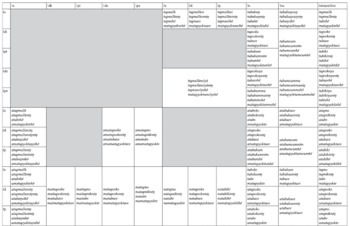
Table 1 illustrates the agreement forms of the two-argument verb tupma ‘to find, meet, agree with’. On the vertical axis, we list the person and number reference of the subject (A argument of transitives or sole argument of intransitives), on the horizontal, we list the reference of the P argument (here, ‘s’ stands for ‘singular’, ‘d’ for ‘dual’, ‘p’ for ‘plural’ and ‘ns’ for ‘non-singular’ (neutralizing the dual vs. plural distinction), ‘i’ and ‘e’ represent ‘inclusive’ and ‘exclusive’ of the addressee, respectively). The last column lists intransitively inflected forms, which are used with non-specific P arguments (as exemplified by (3) above) or verbs that have only one argument. Within each cell of the table, the forms represent (in vertical order) the non-past affirmative, the non-past negative, the past affirmative and the past negative paradigms. For example, the first form in the cell identified by ‘1pi’ and ‘3s’, i.e. tubukum means ‘we (you and us) meet him/her/it’; the third form in the cell identified by ‘2d’ and ‘intransitive’, i.e. atubace means ‘you two met (unspecific) people/things’.
Chintang agreement paradigm of the verb tupma ‘to meet’, with stem tup (identical in all forms)

The number of actual forms is even greater than is shown in Table 1 because prefixes can be freely permutated among themselves, and if the verb involves a compound of several roots or includes specific aspect and tense endings, the prefix can also occur at later positions in the morpheme string (see Bickel et al., Reference Bickel, Banjade, Gaenszle, Lieven, Paudyal, Rai, Rai, Rai and Stoll2007, for detailed discussion). Consider the data in (6):
- (6)
(a) u-ma-tup-yokt-a-ŋ-nɨ-hẽ. 3a.neg-find-neg.past-1sg.p.pl.a.exclusive
(b) ma-u-tup-yokt-a-ŋ-nɨ-hẽ neg-3a-find-neg.past-1sg.p.pl.a.exclusiveboth: ‘They didn't find me.’
(6a) and (6b) illustrate two versions of the same verb form with different prefix ordering. The stems (tup) are marked in bold. The two forms involve no known difference in meaning, dialect choice or usage. From an acquisitional point of view, however, the different options need to be learned in the same way as different forms that have different meanings: there is nothing in the input that would distinguish between meaningful and meaningless form variation.
Table 1 only includes past and non-past forms in the affirmative and negative. In addition to this, Chintang has an extensive and complex paradigm for imperatives and subjunctives, special forms for various reflexive and reciprocal constructions, and a substantial number of morphologically reduced forms (‘infinitive’, ‘converb’, ‘purposive’, plus various active and passive participles). Some of the morphologically possible forms occur less often than others, depending on the semantics of stems and affixes, but they are all part of the grammar and native speakers do know them. In our corpus of child-surrounding adult speech we found a total of 1,849 distinct verb forms (i.e. morphological combinations abstracting away from lexical stem choices), and this seems to be a realistic estimate of the average diversity of verb forms that is put to daily use by speakers.
Chitang noun morphology is also complex by English standards, but it is considerably simpler than Chintang verb morphology: nouns inflect for eleven cases and two numbers (singular vs. non-singular) (for an overview of the case system, see Bickel et al., Reference Bickel, Rai, Paudyal, Banjade, Bhatta, Gaenszle, Lieven, Rai, Rai, Stoll, Malchukov, Haspelmath and Comrie2010.) If they are possessed (which is obligatory for some stems, such as -ma ‘mother’ or -cɨk ‘side (of something)’), they also show agreement with the possessor in person and number. But this still leaves the grammatically possible number of forms one order of magnitude smaller than for verbs (viz. at 198 distinct forms: 11 cases×2 numbers×9 possessor agreement forms).
Argument positions need not be obligatorily filled and most often are empty. A sentence can, and often does, consist of a bare verb form, and, as far as we can tell, there are no constraints on the possible referential readings of such a sentence, exactly like in Mandarin Chinese: for example, a sentence like khade [3SG.go.PAST] can occur at the beginning of a discourse, meaning ‘someone went there’, or with anaphoric reference in the middle of a text, meaning ‘she went there’ or ‘he went there’. Research on a closely related language, Belhare, suggests that overt arguments are indeed rare in discourse (Bickel, Reference Bickel2003; Stoll & Bickel, Reference Stoll, Bickel, Lieven, Guo, Budwig, Ervin-Tripp, Nakamura and Özçalişkan2009). As we shall see in the ‘Results’ section, a similarly low noun-to-verb ratio to that of Belhare has been found in Chintang.
METHODS
Participants
Our study is based on a longitudinal corpus of four Chintang preschool children. The data were collected within a large-scale interdisciplinary project aiming at the audiovisual documentation of two Kiranti languages. We recorded two children (one girl and one boy) who were aged 2 ; 0 and two children (again one girl and one boy) who were aged 2 ; 11 and 3 ; 0 at their first recordings. The children live in a village with scattered houses in the hilly region of Eastern Nepal. In this region of Nepal the climate is moderate to warm and most life takes part outside of the house. All the children came from different Chintang-speaking households, though some of the children are related (cousins), and in all target households Chintang was the preferred means of daily interaction among both adults and children (cf. the ‘Results’ section for a quantitative assessment).
All the children have at least three siblings and live in individual houses together with their families. Parents live by subsistence farming. In the first months of life children stay mostly with their mother. Then in the second half of the first year, the baby either stays at home with various caretakers such as grandparents while the mother works in the house, garden and the field, or he or she is carried around by elder siblings who take care of the child. The mother, however, comes back frequently to nurse the child. Thus, from at least age 1 ; 0, children are cared for by a variety of different people of different generations. As soon as they can walk, children play outside most of the day and roam around in groups. However, there are also always many adults around who keep an eye on the children even though there is not necessarily a single caretaker who is together with the children during the whole day. Adult caretakers usually do not play with children, but engage in frequent verbal interactions.
This daily structure of the children's lives raises the issue of separating child-directed speech from child-surrounding speech. In analyzing the speech of the caretakers, most acquisition studies using naturalistic data investigate child-directed speech, since the recordings are focused on caretaker–child interactions. The situation in our recordings is very different because of the large number of interlocutors of different generations, both children and adults, who surround the child. Thus, children are not constantly in interaction with an adult as in most studies of Western urban cultures, but take part in many interactions with other children, and they also hear interactions which are not addressed to them to a much larger degree than is the case in most studies of children's language development. The main question is whether children treat all this surrounding speech as a language learning environment, or whether they rather focus more on the speech addressed to them (Lieven, Reference Lieven, Gallaway and Richards1994). One could hypothesize that children who grow up in an environment like Chintang are confronted with more different ways of talking both in content and, maybe, form, including different genres and levels of morphological complexity. However, tracking this variation would imply a different study far beyond the scope of the present paper. For current purposes we do not distinguish between child-surrounding speech (including speech to other children, which might be treated differently by the target child than utterances addressed to other adults) and child-directed speech. Both kinds of speech are always simultaneously present and for these reasons we decided to include all utterances by surrounding adults that were audible to the child.
Procedure
The four children were recorded for about four hours per month over a period of eighteen months. The recordings took place within a single week of that month, distributed over as many sessions as necessary within that week. The only criterion for recording was that the child was alert and interacting with other people (either children or adults), so that linguistic data could be obtained. The recordings were conducted with a video camera and an external microphone, which was placed close to the area where the children were playing. Most of the recordings took place outside the house on the veranda or in the nearby garden. A Nepalese research assistant recorded the children in collaboration with local assistants who were native speakers and neighbors of the children. The children were recorded in their natural environment in a variety of contexts. Since no influence was imposed on the context, there were usually a number of other children and adults present during the recording, either interacting with the child or talking to each other. Situations included mostly free play, roaming around, having a snack, teasing animals or other children. Sometimes the local assistants interacted with the child (they were part of the natural environment of the children). In a few cases, this interaction took place to induce children to talk, but mostly assistants did not actively take part in the interactions filmed but rather took care of the technical arrangements.
Four short recording sessions of Child 3 were excluded from analysis because they contained exclusively naming of objects from an English book showing objects and people.Footnote 2 A series of studies has shown that book reading is a very special context, which induces an artificially heightened noun-to-verb ratio (Ogura, Dale, Yamashita, Murase & Mahieu, Reference Ogura, Dale, Yamashita, Murase and Mahieu2006; Tardif, Gelman & Xu, Reference Tardif, Gelman and Xu1999), therefore we excluded these sessions. We also excluded from our analyses all utterances by children that were not genuine productions on their own but direct repetitions of a prompt by adults, as exemplified by the following:
(7) adult: akka=ta ca-k-ku-ŋ=mo lud-a=ʔ=na CLLDCh1R02S01.69 1sg=ptcl eat-3sg.p.nonpast-1sg.a=rep say-imp=emph=ptcl‘Say “I eat it.”’ child: akka ca-k-ku-ŋ CLLDCh1R02S01.70 1sg eat-3sg.p.nonpast-1sg.a ‘I eat it.’ (age 2 ; 2)
In situations like these, the child does not actually use the language but merely cites an utterance, and, as such, it does not give evidence of the child's actual knowledge of the language and ability to produce the same utterances on her own. The prompt by the adult may have the effect of actually teaching the language, and we briefly return to this issue in the ‘Discussion’ section. The overall percentage of children's utterances that are citations like in (7) and were removed from the analysis is 2·4% of their total utterances in our corpus (N=27,659).
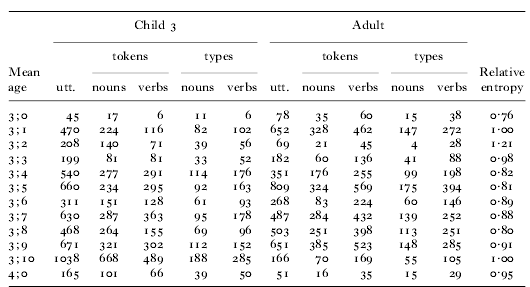
Usually some adults were present for some parts of the recording; some of them just walked by, some stayed for longer parts. A main characteristic of these recordings is that usually a large amount of people are around. This mirrors the typical daily life of the target children. The amount of interaction with adults varied from recording to recording. We include the relevant figures in the ‘Appendix’: the number of utterances per adults and per target children for each recording cycle, and the raw counts of nouns and verbs used.
For the current study we analyzed on average about one and a half hours per target child per recording cycle (mean=01:29:41 h, sd=00:55:51 h, corpus total=81:17:28 h), each containing roughly 500 child and 700 adult utterances (children's mean=513, sd=338, adults' mean=674, sd=568, corpus total=62,911; see the ‘Appendix’ for detailed frequency counts). The rest of the recordings are currently in the process of being transcribed but not ready for analysis yet. The sessions that were transcribed first were those in which the child was most alert. The recordings were transcribed, translated into Nepali and English and then morphologically coded, including part-of-speech annotations. This was done both for the speech of children and the surrounding adults. The transcriptions and translations into Nepali and some English translations were done by trained native speakers of Chintang, and the first few transcriptions and translations were double-checked by a second native speaker and the linguists in our project team. The glossing of the data was conducted by trained research assistants (linguistics majors) in Leipzig. The first glossings of the research assistants were also double-checked by a second assistant and one of us. Each child was compared to the adults who took part in his or her recording. The mothers of the children were not present during all sessions, and in the analysis of the adults, the mothers were not separated from the other adults.
Measuring the noun-to-verb ratio
In a first step we extracted all the nouns and the verbsFootnote 3 that occurred during one individual recording cycle. In our count we included all nouns, including proper names and nouns used in cursing. Excluding any of these classes of nouns would presuppose a detailed analysis of noun usage because there is no one-to-one mapping between, say, proper names and address functions. Address functions are also carried out by kin terms or even by more descriptive (or abusive) nouns. Moreover, in terms of the morphological and syntactic competence that a child needs to acquire, there is no difference between proper names and common nouns in Chintang.
We measured the noun-to-verb ratio by computing the proportion of nouns over the total of nouns and verbs. This leads to a bounded scale between 0 (verbs only) and 1 (nouns only) and avoids division by zero when no verbs occur:
(8)


The noun-to-verb ratio was measured for both types and tokens. When measuring type ratios, a form like khade ‘(he or she) went’ was counted as one, irrespective of how often the form actually occurred. Each verb form of a paradigm was counted as an individual type (so that khade ‘(he or she) went’ was counted as a different type than akhade ‘(you) went’). When measuring tokens, we counted the actual number of occurrence of each specific form, including also incorrect forms, i.e. forms in which, for instance, one morpheme was lacking. The only criteria for inclusion in the analysis was that the forms were clearly recognizable as verbs.
The noun-to-verb ratio was measured separately for each target child, at each age of recording. We also measured the noun-to-verb ratio of the adults present during each recording of each child at each age. However, we pooled adults within each such recording. This was necessary since in most recordings a large number of adults took part and some of them produced only very few utterances while others produced more. The aggregation is justified because we are interested in the adult distributions that a child hears in general and not what an individual adult does at a specific time and context.
Estimating morphological proficiency
So far there is no commonly accepted measure of children's morphological development and productivity, competence or proficiency, although several proposals have been made (see, for instance, Brown, Reference Brown1973; Aguado-Orea, Reference Aguado-Orea2004; Stoll & Gries, Reference Stoll and Gries2009; Krajewski, Lieven & Theakston, Reference Krajewski, Lieven and Theakston2010). Following the lead of Moscoso del Prado Martín, Kostic and Baayen (Reference Moscoso del Prado Martín, Kostic and Baayen2004), we adopt here the concept of the Shannon entropy for estimating the degree to which children master verb morphology, because it is well-suited for corpora and has well-understood mathematical properties.Footnote 4
Entropy is a measurement of uncertainty in a system. The more variation there is in a system, the higher the entropy. Computing the entropy of a morphological paradigm in this way captures the intuition that language proficiency correlates negatively with the predictability of using any specific form: the better a speaker masters a paradigm, the more difficult it becomes to predict the actual forms he or she chooses in a given utterance. The predictability of a specific form choice decreases with the size of the paradigm and also with the degree to which the probability distribution of all forms together becomes more uniform. The predictability becomes lowest, and therefore the entropy highest, when the paradigm is largest (i.e. a speaker uses all grammatically possible forms), and all these forms have the same probability of being chosen. If that is the case, a speaker can be said to have mastered the underlying grammatical system to its fullest extent. Conversely, if a speaker only uses few forms, or if he or she uses many forms, but a few of them clearly predominate, the entropy is lower. In such cases it is likely that the speaker does not know all forms equally well, or – most importantly from an acquisitional point of view – that many forms are tied to very specific lexical contexts, i.e. that the speaker has not yet sufficiently generalized the forms across contexts.
The following formula defines the entropy H for a paradigm  with forms {f 1 … f k}∊:
(9)
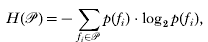
where p(f i) is the probability of using a specific form f i. The probability of a specific form f i∊ is approximated by Maximum Likelihood Estimation, i.e. via the proportion of the specific forms among all forms in the sample (again following Moscoso del Prado Martín et al., Reference Slobin, Ferguson and Slobin2004):
(10)
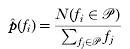
This yields entropy estimates that are directly based on the range of forms and the associated frequency distributions that a specific speaker produces at a specific time of recording. It also ensures that our estimate is relative to the total frequencies of using the paradigm to begin with and thereby for the total amount of speech recorded: morphological entropies are the same if one speaker speaks a lot and uses two forms 200 times each, while another speaker speaks much less and uses the same two forms twice each. The estimate therefore does not depend on the number of utterances recorded (which varies greatly).
As a measure of competence, the development of morphological entropy needs to be examined relative to the entropies of the surrounding adults. In order to capture this, we compute the extent to which the entropy of a child at a given age matches that of the surrounding adults:
(11)
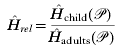
A natural way to implement morphological entropy estimation would be to compute it for each verb stem separately, since stems are likely to differ in the range and probability distributions of their forms (e.g. luma ‘to tell’ is much more likely to have first person object agreement than pui?ma ‘to pick’). However, it is nearly impossible to reliably estimate probabilities per stem, let alone compare these probabilities across speakers or recordings, because our corpus is far from being large enough so that stem frequencies become sufficiently independent of the current conversational topic (cf. Tomasello & Stahl, Reference Tomasello and Stahl2004, for general discussion of this problem in other corpora). In response to this problem, we chose a different approach. As noted earlier, Chintang has no lexical conjugation classes, and the structure of affix strings is therefore independent of the stem chosen: for example, the shape of inflectional forms of luma ‘to tell’ are identical to those of pui?ma ‘to pick’ or any other verb for that matter. This justifies postulating a single macro-paradigm for the entire language that is constant across stems. We estimated morphological entropy on this abstract macro-paradigm. Thus, instead of estimating one entropy for the paradigm of the concrete stem putt- ‘to pick’, with forms like putt-u-ku-ŋ (pick-3[sg]p.nonpast-1[sg]a) ‘I'll pick it’ and a-putt-e (2[SG]A-pick-PAST[3SG.P]) ‘you picked it’, etc., we estimate the entropy of the abstract macro-paradigm with forms like #-u-ku-ŋ and a-#-e, where ‘#’ ranges over all possible stems.Footnote 5 As a result, all reports on morphological entropy below refer to the extent to which speakers produce verbal affix strings from the entire macro-paradigm, i.e. Ĥ rel(#). Note that this also ensures that our measure of entropy is independent of the number of verb stems that are used and that enter the measurement of the noun-to-verb ratio: entropy could be high if a speaker uses only a single verb stem (thus having high noun-to-verb ratio), but with many different forms, and it could be low if a speaker uses many different verb stems (thus having a low noun-to-verb ratio), but always in the same forms (e.g. imperatives only).
Moscoso del Prado Martín et al. (Reference Moscoso del Prado Martín, Kostic and Baayen2004) compute entropies separately for derivational and inflectional morphology. For our purposes, we treat derivation and inflection as part of the same macro-paradigm because we do not wish to assume that children have acquired the distinction between the two morphological processes. In line with this, we speak of ‘morphological’, not ‘inflectional entropy’. Therefore, we estimate the probability of picking a form consisting of both derivational and inflectional affixes, e.g. putt-a-ŋ-bid-a-hã (pick-imp-1sg.p.BEN.IMP-1sg.p) ‘pick it for me!’ (with a benefactive derivational morpheme bid ‘ben’ interspersed among inflectional morphemes) in exactly the same way as a form consisting only of inflectional affixes, such as putt-a (pick-imp[sg]) ‘pick it!’. In each case, we assume that the form is chosen from all available morphological forms of the abstract stem, represented in this example as #-a-ŋ-bid-a-hã and #-a, respectively.
In the same spirit of generalizing across the inflection vs. derivation distinction, we counted the choice between simplex and compound stems as a choice among forms when estimating probabilities. Since we reduced stems to an abstract stem symbol (#), it does not matter for estimations which concrete lexical stems are chosen. This means that we do not estimate the entropy of lexical choices but rather the kind of compounding found in the abstract, i.e. whether a speaker chooses a form with two stems (#-#) or three stems (#-#-#), or no compounding at all (a single stem, (#), etc.). We take these estimates as indicative of mastering the morphological potential of the language, as opposed to learning the lexicon.
As noted in (6) above, Chintang allows free permutation of prefixes, with forms like a-ma-im-yokt-e (2[sg]-neg-sleep-neg.past) and ma-a-im-yokt-e (neg-2[sg]-sleep-neg.past) having exactly the same semantic representation, translating as ‘you didn't sleep’. However, we do not wish to make an assumption whether children know this or instead differentiate meanings on an ad-hoc basis. Therefore, we treat permutation variants as distinct forms (here, as instances of the abstract forms a-ma-#-yokt-e and ma-a-#-yokt-e, respectively).
As in the case of the noun-to-verb ratio, we estimated the morphological entropy for each target child in each recording cycle and also for all adults speaking with and/or around the target child during the same cycle.
To make this all more concrete, here is an example of how entropies are estimated: For example, the adults surrounding Target Child 1 in recording cycle 1 produce a total of 28 distinct forms of the macro-paradigm: 13 tokens of the form #-a, where -a signals imperative mood (as in kuŋs-a ‘come down!’), 10 tokens of transitive form na-#-e with na- indexing a third person agent and a second person patient and -e signaling past tense (as in napide ‘she gave it to you’); another 26 forms occur at varying frequencies. The total token frequency of these macro-paradigm forms is 83. Based on these token frequencies, we can estimate the probability of each form (cf. 10), e.g. for the imperative #-a, we estimate a probability of  , for the form na-#-e, we estimate
 , etc. Then we apply the entropy formula (9), summing over the probabilities of each of the 28 forms attested times the logarithm of these, resulting in Ĥ=4·21. Performing the same analysis for the target child in the same recording cycle reveals only three distinct verb forms: the transitive form u-#-e-hẽ denoting a third person singular acting on a first person singular in the past (as in utenehẽ ‘s/he beat me’); the third person past tense form #-e (as in khatte ‘s/he took it’); and the dual subjunctive form #-ce (as in khace ‘let's go!’). These forms happen to be used by the child with equal token frequency, and therefore we estimate each of their probabilities at
 . The resulting entropy estimate of these three probabilities is then
 . Dividing this by the estimated entropy of the adults, results in
 .
RESULTS
Code-switching
As noted earlier, Chintang children grow up bilingually in Nepali, which has a much less complex verb morphology than their first language. The amount of code-switching into Nepali is very small, however: computing proportions of all-Nepali utterances for each child and recording cycle reveals a heavily right-skewed distribution with a median proportion of only 0·003 (skew=2·5, mode=0). Nepali words also occur interspersed within Chintang utterances but many, perhaps most, of them are fully integrated as loan words (e.g. gucca ‘marble’, paisa ‘money’ or most abusive words) and do not result from code-switching within utterances. Clear evidence from code-switching within utterances could come from noun or verb stems that are inflected with Nepali morphology. The number of these is usually extremely small, however, with a mode and median of 0 (skew=4·59), and some of the Nepali words could be considered loan expressions, similar in spirit to the situation when English speakers say bon appetit. An example is maryo, a Nepali verb form literally meaning ‘he or she died’, which is often used to declare that someone has lost in a game.
We conclude that the main verb morphology that children learn is indeed Chintang, and that learning Nepali verb morphology plays a negligible role during the age period considered in our study.
Qualitative survey
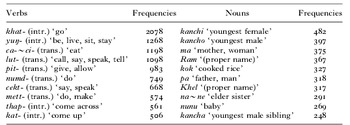
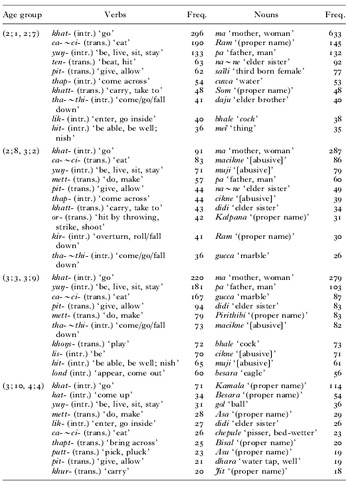
Tables 2 and 3 give an impression of the ten most frequently used noun and verb stems found in adult and children's speech. Children's data are pooled in cross-sections over four six-month intervals.
The ten most frequent nouns and verbs among adults

The ten most frequent nouns and verbs per age group

The most frequent nouns are mainly proper names, kinship terms and abusive words,Footnote 6 reflecting perhaps a universal bias in spontaneous conversation. What is important for current purposes, however, is that this bias is the same for adults (Table 2) and children (Table 3). Therefore, if there is a difference in noun-to-verb ratios during language acquisition or generally between children and adults, it cannot be attributed to the use of proper names, kinship terms and abusive words. The same holds for the kinds of verbs used: there is no noticeable difference between the lexical range of verbs and nouns that are most frequently used by adults and children, or across different age periods.
Quantitative results
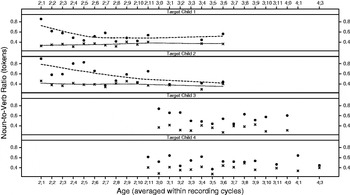
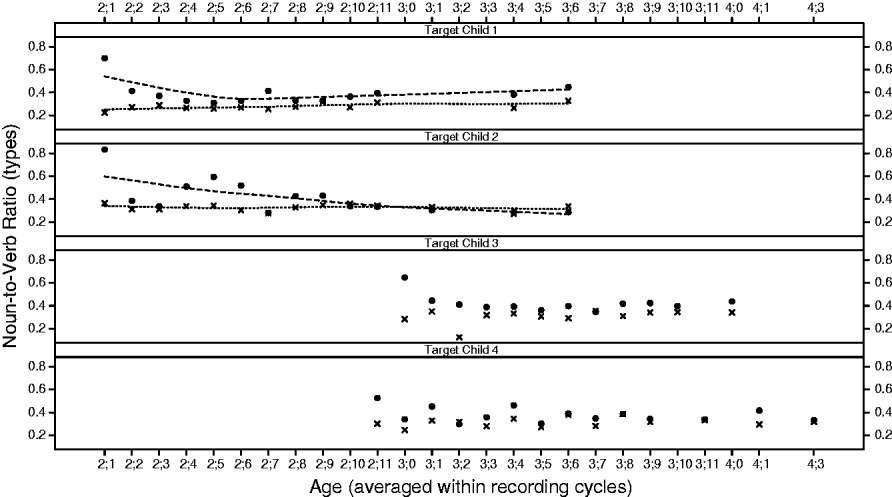
Figures 1 and 2 show the development of the noun-to-verb ratio R N/V, based on tokens and types respectively. Overall, there is no fundamental difference between the token vs. type measurements and so any developmental pattern in the data is likely to be independent of the degree to which speakers repeat the same words again and again. However, the strength of effects may differ between types and tokens, and we therefore submit both measurements to statistical analysis below.
Noun-to-verb ratios in tokens (dots (•) and dashed lines represent children; crosses (×) and dotted lines adults).

Noun-to-verb ratios in types (dots (•) and dashed lines represent children; crosses (×) and dotted lines adults).
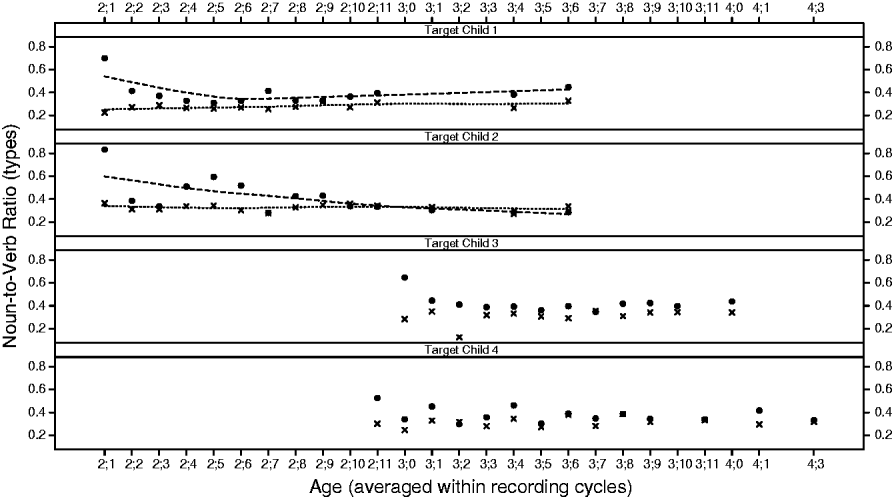
The data for Children 1 and 2 suggest a development during the second year of age. After this, the values level off, subject to random fluctuation. The development is captured by local (loess) regression lines.Footnote 7 It is possible that there is a similar trend between age 3 ; 0 and 3 ; 4 in Child 3, but with only five datapoints (recording cycles), it is impossible to perform statistical analysis. No trend at all is discernible for Child 4. What does appear from the graphs is that overall, Children 3 and 4 tend to have a slightly higher noun-to-verb ratio than that of the pooled adults, especially with regard to token counts.
This suggests that any noticeable development in the noun-to-verb ratio happens at earlier ages, i.e. before about 3 ; 1, but that the adult distribution does not seem to be fully reached even at later ages. Taken on their own, the adult distributions shows a distinctly low overall noun-to-verb ratio, in line with our impression that in Chintang discourse noun phrase positions are often left empty (in the form of ‘ellipsis’ or ‘pro-drop’), similarly to what is known from Chinese and other Sino-Tibetan languages.
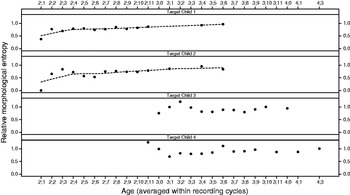
As explained earlier, our hypothesis is that children will approach the noun-to-verb ratio of the surrounding adult speech only once they have sufficiently mastered verb morphology. To test this, we examined children's morphological development in terms of the relative morphological entropy (of each child to that of the pooled adults) of the verb forms used, as defined in (11) above. Figure 3 shows the result, again with local regression lines fitted for the younger children (see the ‘Appendix’ for the actual relative entropy values).
Children's morphology entropy of verbs relative to the morphological entropy of verbs in the surrounding adult speech.

Like in Figure 1 and 2, there is a clear development for the younger children up to about age 3;1, but no discernible trend for Children 3 and 4. In the age range of Children 3 and 4, it seems that children have reached the same level of proficiency as the adults, with individual values centered on a relative entropy of 1.Footnote 8
Statistical analysis
Our hypothesis is that the development of the noun-to-verb ratio in Chintang can be explained to a significant extent by the development of children's relative morphology entropy, i.e. by how they improve in mastering the range of verb forms over time. As suggested by Figures 1–3, both developments seem to be completed before the age for which we have data for Children 3 and 4, and they are therefore only apparent in the data from Children 1 and 2 up to and including age 3;1. During the age range represented by Children 3 and 4, morphological proficiency seems to have attained adult levels (with a relative entropy of 1), while the noun-to-verb ratio appears be somewhat lower than that of the adults. In the following, we examine these observations in turn, first discussing the younger children (1 and 2 up to and including age 3;1) and then the older children (3 and 4).
Our explanatory factor is the development of children's relative entropy over time. This presupposes that relative entropy indeed increases with age. Gries and Stoll (Reference Gries and Stoll2009) show for other developmental measurements that, while the development shows an overall trend, there may well be relatively arbitrary local non-linearities, and this makes a simple linear fit unsuitable for such measurements. In response to this, we fit a locally weighted smoothing (loess) regression line that minimizes the variance in the data, but that at the same time still displays an overall developmental trend and then apply an F-test to evaluate the fit of the regression line. The ideal compromise we found (by visual inspection) is based on a loess-regression with a bandwidth of 0·6 for the local fits, plotted as a dashed line in Figure 3. An F-test of this regression model reveals a significant increase of entropy with age (Child 1:  =6·26, p=0·022, adjusted R 2=0·73, N=11; Child 2: F df=3·16=4·22, p=0·046, adjusted R 2=0·63, N=12). This is different for noun morphology. Applying the same analytical methods that we used for verbs reveals no evidence for an increase of the relative entropy of nouns with age in any of the children (all ps>0·1).
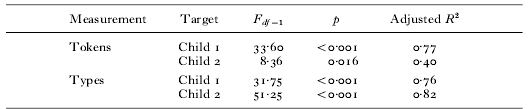
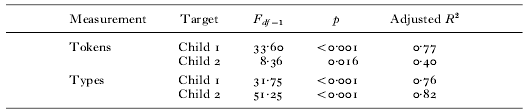
By contrast to correlations with age, we expect the correlation between the noun-to-verb ratio and the relative morphological entropy of verbs to be linear because we hypothesize that entropy directly explains the ratio (or at least a substantial proportion thereof). F-tests on the linear regressions are summarized in Table 4 and indeed reveal significant effects of verb entropy on the noun-to-verb ratio for both tokens and types and for both children examined (and again no significant effect of the relative entropy of noun morphology).Footnote 9 This confirms our hypothesis: children's noun-to-verb ratios are significantly correlated with their morphological proficiency as measured through relative entropy. The regressions capture substantial amounts of variation, with a mean R 2-value of 0·77. This is remarkable given that the natural speech we recorded varies across an enormous range of topics – some demanding more, and others fewer, nouns, and some demanding more complex, and others less complex, verb forms.
Linear regression of the noun-to-verb ratio on relative morphological entropy (N=11 datapoints for Child 1, and 12 for Child 2)
For Children 3 and 4 the graphs in Figures 1–3 do not suggest any development, and this is confirmed by regression analysis (where no model ever reaches significance). But overall, both children have significantly higher noun-to-verb ratios than the surrounding adults (for tokens: Child 3: t=6·77, df=17·26, p<0·001, N=12; Child 4: t=5·55, df=23·55, p<0·001, N=14; for types: Child 3: t=4·00, df=21·15, p<0·001, N=12; Child 4: t=3·11, df=21·31, p=0·005, N=14). Indeed, adult language has a generally low noun-to-verb ratio (grand average for tokens  =0·37 and for types =0·31), in line with experimental evidence from a closely related language (Stoll & Bickel, Reference Stoll, Bickel, Lieven, Guo, Budwig, Ervin-Tripp, Nakamura and Özçalişkan2009). Unlike the noun-to-verb ratio, the older children's morphological entropy is virtually identical with that of adults (Child 3: t=1·42, df=21·25, p=0·17; Child 4: t=1·65, df=22·41, p=0·11).
DISCUSSION
Previous studies have shown that from the first words onward there are language-specific differences in the composition of the early vocabulary, and that there is no conceptually based universal noun preference in terms of the first words uttered (Childers et al., Reference Childers, Vaughan and Burquest2007; Tardif et al., Reference Tardif, Fletcher, Liang, Zhang, Kaciroti and Marchman2008; Bornstein et al., Reference Bornstein, Cote, with Maital, Painter, Park, Pascual, Pecheux, Ruel, Venuti and Vyt2004) nor any universal noun bias in terms of early frequencies (Tardif, Reference Tardif1996; Tardif et al., Reference Tardif, Shatz and Naigles1997; Choi & Gopnik, Reference Choi, Gopnik and Clark1993; Reference Choi and Gopnik1995; Brown, Reference Brown1998; de Léon, Reference de Léon, Fox, Jurafsky and Michaelis1999). The absence of such a universal bias means that we cannot explain the high noun-to-verb ratio in the younger children in Chintang by appeal to a conceptual basis, independent of the specific language that is acquired. Instead, explanations for differences in the relative importance of nouns and verbs need to consider cross-linguistic and cross-cultural variation. We propose that the explanations for our findings fall into two main types: first, the typological characteristics of the language that highlight either verbs or nouns, and second, the nature of the interactions between children and their interlocutors. We discuss these in turn in the light of our results.
Learning of verbs: proficiency and productivity
When learning Chintang, children are exposed to adult speech with a low overall noun-to-verb ratio. This means that many utterances consist of verbs only, and this leaves verbs in a relatively salient position, similarly in many respects to what has been noted for Mandarin Chinese or Korean. From this, one would expect children to learn verbs relatively early (as is the case in Mandarin Chinese and Korean). But the children observed in our study adapt to the noun-to-verb ratio of the surrounding adult speech only gradually during their third year of age. This gradual adaptation is significantly tied to the mastering of the verb morphology, which explains a substantial amount of the variance. Of course, these results must be tentative because our evidence for this gradual process is based on only two children, and there is no doubt that children vary in the way they acquire language. However, this is a natural limit of all longitudinal research we are aware of and to the extent that we find a consistent pattern, we propose that it is one of the acquisitional paths representative of how Chintang is acquired.
We suggest the main reason for the correlation between the noun-to-verb ratio and morphological proficiency is that for all its regularity, Chintang morphology is very hard to learn because of the sheer number of possible verb forms (over 1,800 in our data). This makes the task of a Chintang child very different from that of a Mandarin Chinese child, where the verb form is nearly always the same. However, it has been noted for other languages with complex verb morphologies, such as the Mayan languages, that children can and do manage to identify stems despite such complexities (Pye, Reference Pye1983; Brown, Reference Brown1998; de Léon, Reference de Léon, Fox, Jurafsky and Michaelis1999; Pfeiler, Reference Pfeiler, Bittner, Dressler and Kiliani-Schoch2003). One factor that appears to make this possible in Mayan languages is that verb morphology is more clitic-like than affixal: even though there are well-defined root and stem classes for nouns and verbs for children, these classes might be less clear given the fact that ‘much of the obligatory inflectional morphology, as well as some other non-obligatory but very frequent morphology, applies both to nouns and to verbs’ (Brown, Reference Brown1998: 716). This suggests that in these languages, the morphology is not very tightly tied to specific stems, and this could well facilitate their identification. However, matters are very different in Chintang, where verb morphology is clearly affixal (as demonstrated in detail by Bickel et al., Reference Bickel, Banjade, Gaenszle, Lieven, Paudyal, Rai, Rai, Rai and Stoll2007), and where noun and verb morphology show virtually no overlap.
Another factor noted by Brown (Reference Brown1998) is that in the Mayan languages studied children often produce bare stems without the inflections that are obligatory in adult speech. In the Chintang data, however, we find no unambiguous case of a bare root. All zero-marked forms that we found in our data fit a context where they are most likely indeed intended as third person subjunctive forms, in the same way as they are used by adults (cf. 5):
(12) a-ma ta kina=na na-tei! CLLDCh1R02S05.816 1s.poss-mother [3sg.s.sbjv]come and.then=ptcl 3sg.a.2sg.p-beat[sbjv] ‘My mum may come and beat you up!’ or ‘If/when my mum comes, she may beat you up!’ (Child 1, age 2 ; 2)
Here, the zero form (ta) occurs embedded before a conjunction (kinana, covering both sequential and conditional readings), which is a regular context for a subjunctive in Chintang. The main clause also contains a subjunctive (natei ‘she may beat you up’), signaling that the entire utterance is to be understood as a warning.Footnote 10 What we do find in our corpus, however, are a few cases where children use bare endings, i.e. without a stem. In the following example, we observe Child 1 at age 2 ; 2 responding to a request by an older child to repeat an utterance. The response triggered much laughter among the other children and adults that were present:
(13) CHILD, age 14: ca-ŋa-ʔã=mo lud-u-c-a=na! eat-1sg.s.nonpast=rep tell-3p-3nonsg.p.imp[2sg.a]=ptcl‘Tell them, “I'll eat”!’child, age 2 ; 2:ŋa-ʔã CLLDCh1R02S03a.0711sg.s.nonpast‘I'll.’
Instead of attaching the ending to the stem ca-, the child uses only the grammatical morphemes of the ending. Interestingly, the child correctly leaves off the reportative (quotative) clitic =mo that the older child uses because she embedded the expression as a complement to the verb ludaca ‘tell them!’.
This suggests that Chintang children may well pay particular attention to endings, trying to learn them as quickly as possible. The task is still considerable, however, because there is no phonological word boundary or stress pattern that would facilitate dividing words into stems and suffixes (although there are secondary cues for dividing between prefixes and stems; see Bickel et al., Reference Bickel, Banjade, Gaenszle, Lieven, Paudyal, Rai, Rai, Rai and Stoll2007). In line with this, we have only very few examples of the kind shown in (13). Thus, there does not appear to be an easy route around laboring through the complexities of Chintang verb morphology, and this is exactly what we find quantitatively: it takes children until about age three to reach sufficient proficiency of verb morphology, understood as the extent to which verb forms are used in a similarly flexible way to that which characterizes adult speech.
While our explanation of the development of the noun-to-verb ratio builds on the complexities of verb morphology, Brown (Reference Brown1998) suggests for Tzeltal that the critical factor may in fact be the degree to which verbs have a rich, lexically detailed semantics as opposed to more abstract and general meanings. Tzeltal children start out with verbs that entail a great amount of information about referents (e.g. verb meanings like ‘eat tortillas’ vs. just ‘eat’), and this could lower their noun-to-verb ratio independently of verb morphology. This contrasts with English and Hebrew children, where the noun-to-verb ratio is higher and where children supposedly start out with verbs that have a very general semantics such as do, make, get (Clark, Reference Clark1993; Ninio, Reference Ninio1999). Tardif (Reference Tardif, Hirsh-Pasek and Golinkoff2006) makes a similar suggestion for Mandarin Chinese, where children tend to have a lower noun-to-verb ratio.
In order to evaluate this hypothesis for Chintang, one would first need detailed semantic analyses of the verbs. In Table 1 we include glosses of the verbs by simply pasting together the most frequent translations that they occur with in the corpus. These glosses give a very rough idea of the meaning, but they are not at all based on a real semantic analysis. In the adult language, for example, we know from detailed elicitation that the verb khatt- entails caused motion of an object from one place to another place (while leaving delivery unclear) – hence both ‘carry’ and ‘take’ are possible translations, but ‘take’ only in the highly specific sense of ‘take from A to B’, not in the sense of ‘take someone to the hospital (and leave the person there)’, ‘take something in one's hands’ – let alone in the sense of, say ‘take a course’; for all these other meanings, Chintang uses different verbs. Similarly, the verb yuŋ- occurs with many different English translations, but from a Chintang perspective it has the unitary meaning of temporary location. Again, there is no simple translational equivalent in English. The general lesson from this is that, as linguists have emphasized for over a century, words have very different semantics in different languages, and without a fully fledged universal meta-language for semantic analysis, these meanings cannot be compared as to their specificity. To date, there is no such meta-language that would be generally accepted and that has been applied to any of the languages considered here.
Second, even if one could successfully develop such a meta-language, one would need in addition a detailed corpus analysis of how adults and children in fact use the verbs in the different languages in order to actually test the hypothesis. At least for Tzeltal, results are ambiguous. In the earliest vocabulary there seems to be an even distribution between semantically specific (‘heavy’) and more general (‘light’) verbs (Brown, Reference Brown1998: 722). At the same time, Brown states that the most frequent verbs used in the input are intransitive verbs that are what she calls ‘light verbs’. As a result, it is unclear whether Tzeltal children really do start out with semantically specific verbs. Only detailed quantitative analyses across Tzeltal, Mandarin Chinese and Chintang will be able to tell. In addition, such a study would need to control for a number of other factors, the most important one being indeed frequency, because Theakston, Lieven, Pine and Rowland (Reference Theakston, Lieven, Pine and Rowland2004), in a study of twelve English-speaking children's verbal development, showed that, once frequency was controlled, there was no evidence that verbs with more general meanings are learned earlier or later than verbs with a more detailed meaning.
Why is the children's overall noun-to-verb ratio higher than the adults' ratio?
Our second major result is that, despite the gradual reduction in noun-to-verb ratios for the two younger children, all the children still show an overall noun-to-verb ratio that is significantly higher than the ratio of the adults. This is at odds with what is known from Mandarin Chinese and other languages, where children's noun-to-verb ratios mirror adult distributions much more closely from early on in the acquisition process. There are a number of factors that could explain the difference.
One of the reasons might be that children are not fully productive with the verbal system as suggested above, and that they therefore still rely more on nouns than on the morphologically more difficult verbs. As we have noted, without formal experiments it is difficult to assess the extent to which this could explain the high noun-to-verb ratio. Another factor that could explain children's overall high ratio could be the number of prompting contexts, where adults specifically draw children's attention to objects or encourage them to name objects. Choi and Gopnik (Reference Choi and Gopnik1995) found that English mothers encourage children to name objects more often while Korean mothers encourage activity-oriented discourse more often. This correlates with a relatively lower noun-to-verb ratio in Korean than in English, for both adults and children. Detailed conversational analysis is beyond the scope of the present study, but as noted in the ‘Methods’ section, we have identified a number of cases where children are directly asked to repeat a given utterance. While we have excluded children's answers to this from the analyses of children's actual language use, we examined the proportion of adult utterances that explicitly prompt for nouns, i.e. utterances of the type illustrated by the following (and excluding utterances that prompt for complete sentences with verbs):
(14) kocuwa=mo lud-a=na CLLDCh3R02S04.978 dog=rep say=imp[2sg.s]=ptcl ‘Say “dog”!’
Utterances of this type make up very small proportions of adult speech (with a median and mode of 0 per recording cycle and a mean=0·1% for the two younger children, and mean=0·04% for the two older children). This makes it unlikely that this kind of prompting plays an important role for children's noun-to-verb ratio. There may of course be other kinds of prompting (such as asking questions like ‘Is this a dog?’) that need closer analysis, but at any rate these types do not strike us a characteristic of adult/child interaction in Chintang.
Finally, another, and perhaps the most likely, explanation could be that, for reasons explained in the ‘Methods’ section, we collected the speech of the surrounding adults and not just speech addressed to the children, whereas all other studies have only measured child-directed speech. Within child-directed speech, noun-to-verb ratios of both adults and children are known to be highly sensitive to the precise context in which the data is collected: Goldfield (Reference Goldfield1993) (analyzing twelve English mother–child dyads) found that during toy play, more noun types and tokens occurred than verb types or tokens, but during non-toy play (mothers playing with their children without toys present, physical play) more verb types and tokens were used. This contextual variation in child-directed speech is also shown by Tardif et al. (Reference Tardif, Gelman and Xu1999) for English and Mandarin Chinese children and their caretakers in three different activity contexts, by Choi (Reference Choi2000) for Korean and English input in the contexts of toy play and book reading, and by Ogura et al. (Reference Ogura, Dale, Yamashita, Murase and Mahieu2006) for Japanese children and their caretakers in the contexts of book reading vs. toy play. This may reflect the kind of referential functions that noun phrases are associated with. Both our video-recordings and our fieldwork experience suggest that Chintang adults do not engage in play with the children. As a result, adults are not really involved most of the time in the same conversational practices as the children, and this might be a reason for the ongoing difference in the distributions of nouns and verbs. The kind of conversational practice that seems to dominate among Chintang children is asking about or drawing attention to referents, most typically in play contexts. Examples are given in (15), taken from a scene where two children are playing with marbles, and much of the conversation revolves around the current location of the marbles:
- (15)
(a) a-gucca khoi? CLLDCh4R05S05.229 1sg.possessor-marble where? ‘Where [is] my marble?’ (age 3 ; 3)
(b) ba gucca, ba! CLLDCh4R05S05.447 dem marble dem ‘This marble [is] there!’ (age 3 ; 4)
Even for the older children (target Children 3 and 4), verb-less utterances of this type make up 65% on average per recording cycle. Utterances where nouns occur as arguments of verbs are much less common.
A question that we must leave open, however, is the role of other children in structuring the input. Their speech may also turn out to differ from adult speech and, possibly, to also affect the noun-to-verb ratio. However, since the children in the recordings sessions ranged in age from 2 ; 0 to 15 ; 0, it would have been difficult to draw any clear conclusions. We intend a detailed comparison of surrounding adult and child speech in a future study, also addressing possible distinctions in child-directed vs. adult-directed speech (cf. our observations on this in the ‘Methods’ section).
CONCLUSIONS
The children in this study show a reduction in the noun-to-verb ratio which is significantly correlated with a rise in their morphological proficiency, as assessed through the frequency distributions of verb forms used. Children also show an overall higher ratio of nouns to verbs than that of the surrounding adult speech.
We have shown that typological design – here, the complexity of verb morphology – of a language can have a systematic impact on how children use nouns and verbs. In addition, we have discussed preliminary evidence that specific conversational practices – here, practices separating children from adults – may have an additional impact on noun and verb use.
This suggests that a deeper understanding of reference to objects and to events or states requires close attention to the interplay between the typological characteristics of a language and the cultural practices its use is embedded in. This in turn calls for more extensive cross-cultural research based on systematic longitudinal recordings where both linguistic and socio-cultural factors can be systematically taken into account.
APPENDIX