Investigations of the determinants of the quality of mother–infant attachment relationships have focused predominantly on aspects of the caregiving context (Ainsworth, Blehar, Waters, & Wall, Reference Ainsworth, Blehar, Waters and Wall1978; Sroufe, Reference Sroufe1985; Sroufe, Egeland, Carlson, & Collins, Reference Sroufe, Egeland, Carlson and Collins2005; Thompson, Reference Thompson, Damon and Eisenberg1998). Recent technological advances in molecular genetics now permit the genotyping of individuals' genomes, thus enabling researchers to examine the relationship among quality of attachment organization, genetic variation, and maternal responsiveness and sensitivity. The incorporation of molecular genetic elements into research on the determinants of the quality of mother–infant attachment relationships is in keeping with recent calls by developmental psychopathologists for a multiple levels of analysis perspective on typical and atypical development (Cicchetti & Dawson, Reference Cicchetti and Dawson2002; Cicchetti & Toth, Reference Cicchetti and Toth2009; Cicchetti & Valentino, Reference Cicchetti, Valentino and Masten2007; Curtis & Cicchetti, Reference Curtis and Cicchetti2003). Such a multilevel perspective advocates the criticality of addressing developmental processes in their full complexity, rather than focusing solely on a single developmental domain or level of analysis (Cicchetti & Curtis, Reference Cicchetti, Curtis, Cicchetti and Cohen2006; Masten, Reference Masten2007; Masten & Cicchetti, Reference Masten and Cicchetti2010a, Reference Masten and Cicchetti2010b).
The vast majority of research conducted to date has focused on two genes, the serotonin transporter gene (5-HTT) and the dopamine D4 receptor gene (DRD4), in explaining variation in the quality of attachment organization. A major focus of the contribution of molecular genetic variation to infant–mother attachment relationships has been on disorganized attachment, characterized by the lack of a coherent strategy to deal with the stress of separations and reunions with the mother in the Strange Situation (Main & Solomon, Reference Main, Solomon, Brazelton and Yogman1986, Reference Main, Solomon, Greenberg, Cicchetti and Cummings1990). Infants with disorganized attachments display unusual, often bizarre behaviors, in interaction with their mothers in stressful situations (Main & Solomon, Reference Main, Solomon, Greenberg, Cicchetti and Cummings1990). Frightened or frightening parental behavior has been posited as a major etiological pathway to the development of disorganized attachment (Hesse & Main, Reference Hesse and Main2006). The developmental sequelae of disorganized–disoriented attachments are often characterized by more maladaptive and pathological outcomes than is the case for other types of attachment insecurity (Carlson, Reference Carlson1998; van IJzendoorn, Schuengel, & Bakermans-Kranenburg, Reference van IJzendoorn, Schuengel and Bakersman-Kranenburg1999), underscoring the importance of better understanding etiological contributors.
Maltreated infants have been shown to be highly likely to develop disorganized attachments with their mothers (Carlson, Cicchetti, Barnett, & Braunwald, Reference Carlson, Cicchetti, Barnett and Braunwald1989a, Reference Carlson, Cicchetti, Barnett, Braunwald, Cicchetti and Carlson1989b). Across a number of laboratories, maltreated infants have been shown to manifest percentages of disorganized attachment ranging from 80% to over 90% (Barnett, Ganiban, & Cicchetti, Reference Barnett, Ganiban and Cicchetti1999; Carlson et al., Reference Carlson, Cicchetti, Barnett and Braunwald1989a; Cicchetti, Rogosch, & Toth, Reference Cicchetti, Rogosch and Toth2006; Lyons-Ruth, Bronfman, & Parsons, Reference Lyons-Ruth, Bronfman and Parsons1999; Lyons-Ruth, Connell, Zoll, & Stahl, Reference Lyons-Ruth, Connell, Zoll and Stahl1987; for meta-analyses, see Cyr, Euser, Bakermans-Kranenburg, & van IJzendoorn, Reference Cyr, Euser, Bakermans-Kranenburg and van IJzendoorn2010; van IJzendoorn et al., Reference van IJzendoorn, Schuengel and Bakersman-Kranenburg1999).
In this paper, we examined the effects of 5-HTT and DRD4 on infant attachment security and disorganization, with special attention to how the genes may function differently for children exposed to early maltreatment versus those experiencing less adverse rearing experiences. In addition, we investigated whether these genes moderated the effects of a randomized control trial early intervention that was found to increase attachment security and decrease disorganization in infants from maltreating families (Cicchetti et al., Reference Cicchetti, Rogosch and Toth2006).
This study of infants experiencing trauma early in life is the first to investigate the link between child maltreatment, 5-HTT and DRD4 polymorphisms, and the development of attachment organization and disorganization. Likewise, our examination of genetic moderators of intervention efficacy is innovative and consistent with Cicchetti and Gunnar's (Reference Cicchetti and Gunnar2008) call for the integration of biological processes into the design and evaluation of preventive interventions in order to derive a more precise and comprehensive understanding of the mediators and moderators underlying successful and unsuccessful intervention outcomes.
5-HTT
Given its importance in brain development and its pivotal role in individual differences in mood and emotion regulation (Caspi, Hariri, Holmes, Uher, & Moffitt, Reference Caspi, Hariri, Holmes, Uher and Moffitt2010; Hariri & Holmes, Reference Hariri and Holmes2006), molecular genetic association studies of mother–infant attachment relationships have examined candidate genes from the serotonergic system. The 5-HTT gene has a polymorphism in the linked promoter region (5-HTTLPR) in the 5′-regulatory region due to a 44 base pair deletion that eventuates in either the short (s) or long (l) allele (Lesch, Bengel, Heils, & Sabol, Reference Lesch, Bengel, Heils and Sabol1996). Because the short variant appears to be dominant, heterozygous (s/l) individuals can be functionally categorized with individuals who possess the homozygous (s/s) genotype. In vitro research has shown that the long allelic variant has two to three times the transcriptional activity than the short variant.
Genetic variation in the 5-HTT gene appears to be involved in the development of individual differences in infant attachment organization. To date, however, only a few studies of this association have been published. In an examination of the relationship between 5-HTTLPR and attachment organization, Barry, Kochanska, and Philibert (Reference Barry, Kochanska and Philibert2008) found that low maternal sensitive responsiveness predicted attachment security. However, this relation occurred only for infants who had the s/s or s/l alleles of 5-HTT. It is interesting that Barry et al. (Reference Barry, Kochanska and Philibert2008) did not obtain any relation between high maternal sensitivity and attachment security in infants who were homozygous for the l/l allele. A number of studies of socioemotional development have found that the presence of the l/l allele may exert a protective effect against maladaptation or psychopathology (Caspi et al., Reference Caspi, Sugden, Moffitt, Taylor, Craig and Harrington2003, Reference Caspi, Hariri, Holmes, Uher and Moffitt2010); however, the homozygous long allele did not confer protection against attachment insecurity in the Barry et al. (Reference Barry, Kochanska and Philibert2008) study.
In another investigation of 5-HTTLPR and attachment, Spangler, Johann, Ronai, and Zimmerman (Reference Spangler, Johann, Ronai and Zimmerman2009) found significant associations between infant attachment disorganization (but not security) and the s/s or s/l polymorphism of the serotonin transporter gene. A gene–environment interaction revealed that this relationship between the short allele of 5-HTTPLR and low maternal responsiveness was only valid for infants whose mothers manifested low responsiveness. These investigators also examined the relationship among DRD4, the −521 C/T single nucleotide polymorphism (SNP), and attachment security and disorganization. No significant genetic associations or gene–environment interactions were found between these genes and attachment quality.
Two recent studies have examined the relation between genetic polymorphisms in the serotonin transporter gene and adult attachment classification on the Adult Attachment Interview (AAI; George et al., Reference George, Kaplan and Main1984; Main, Goldwyn, & Hesse, Reference Main, Goldwyn and Hesse2002). Caspers, Paradiso, Yucuis, Troutman, Arndt, and Philibert (Reference Caspers, Paradiso, Yucuis, Troutman, Arndt and Philibert2009) found an association between the short allele (s/s or s/l) and unresolved loss or trauma classifications on the AAI. Moreover, the l/l allele conferred protection in the face of unresolved loss or trauma. Gene × Environment (G × E) interaction effects were not found in this study.
In a subsequent investigation, Reiner and Spangler (Reference Reiner and Spangler2010) examined the relation between 5-HTTLPR genetic variation on adult attachment. Relations between polymorphisms of the serotonin transporter gene and aspects of adult attachment security were not obtained. In addition, Reiner and Spangler (Reference Reiner and Spangler2010) did not replicate Caspers et al.'s (Reference Caspers, Paradiso, Yucuis, Troutman, Arndt and Philibert2009) finding that individuals with the short allele of 5-HTTLPR were more likely to be classified as unresolved on the AAI.
DRD4
The DRD4s play an important role in cognitive and emotional processes that are subserved by neural circuits in the prefrontal cortex (Wang, Zhong, Gu, & Yan, Reference Wang, Zhong, Gu and Yan2003). The encoding gene for the D4 receptors, DRD4, has a variety of functional variants, one of which is the number of 48 base pair variable number tandem repeats (VNTRs) in the coding region of the gene (VanTol et al., Reference VanTol, Wu, Guan, Ohara, Bunzoq and Olivier1992). The most common functional variants are the 4-repeat (short) and 7-repeat (long) alleles; the 7-repeat functional variant is associated with lower dopamine receptor efficiency (Asghari et al., Reference Asghari, Sanyal, Buchwaldt, Paterson, Jovanovic and Van Tol1995).
In two studies conducted with the same low-risk, middle-class community sample of ethnically homogeneous Caucasian infants of Hungarian origin, Lakatos et al. (Reference Lakatos, Toth, Nemoda, Ney, Sasvari-Szekely and Gervai2000, Reference Lakatos, Nemoda, Toth, Ronai, Ney and Sasvari-Szekely2002) examined the association between disorganized attachment and the DRD4 7-repeat variant of the dopamine receptor gene. In their first study, Lakatos et al. (Reference Lakatos, Toth, Nemoda, Ney, Sasvari-Szekely and Gervai2000) found that the presence of a 7-repeat allele of DRD4 predisposes infants to developing a disorganized attachment. In a subsequent investigation of this sample (Lakatos et al., Reference Lakatos, Nemoda, Toth, Ronai, Ney and Sasvari-Szekely2002), the same group of infants was genotyped for the functional −521 C/T SNP in the upstream regulatory region of the DRD4 gene. The investigators examined the association of the −521 C/T SNP, both alone and in interaction with the DRD4 exon III 7-repeat allele (Lakatos et al., Reference Lakatos, Nemoda, Birkas, Ronai, Kovacs and Ney2003). The −521 C/T SNP had no main effect on disorganized attachment status; however, the association between disorganized attachment and the 7-repeat allele of DRD4 was enhanced significantly when it occurred in conjunction with the −521 SNP T allele (both for CT and TT genotypes), thereby providing corroborative evidence for their prior finding that the DRD4 gene plays a role in the development of attachment disorganization, at least in low-risk, ethnically homogeneous community samples (Lakatos et al., Reference Lakatos, Nemoda, Toth, Ronai, Ney and Sasvari-Szekely2002).
In a follow-up of the prior findings of Lakatos et al. (Reference Lakatos, Toth, Nemoda, Ney, Sasvari-Szekely and Gervai2000, Reference Lakatos, Nemoda, Toth, Ronai, Ney and Sasvari-Szekely2002), Gervai and colleagues (Reference Gervai, Nemoda, Lakatos, Ronai, Toth and Ney2005) utilized DNA collected from the infants' parents in order to further replicate and extend the link between infant attachment disorganization and the DRD4 gene. Transmission disequilibration tests revealed a trend for preferential transmission of the DRD4 7-repeat allele to disorganized infants. In addition, there was a significant nontransmission of this allele to securely attached infants. Haplotype analysis of the exon III repeat and the −521 C/T promoter polymorphism revealed that the secure attachment was due to the low rate transmission of the T.7 haplotype, which contained both the 7-repeat and the −521 C/T alleles. Gervai and colleagues (Reference Gervai, Nemoda, Lakatos, Ronai, Toth and Ney2005) concluded that the absence of the T.7 haplotype of the DRD4 gene may serve a protective function in the promotion of secure attachment in infancy.
In an effort to independently replicate the findings emanating from the laboratory of Lakatos and colleagues, Bakermans-Kranenburg and van IJzendoorn (Reference Bakermans-Kranenburg and Van IJzendoorn2004) utilized data from a twin sample and failed to find an association between disorganized attachment and either the 7-repeat DRD4 allele, the −521 C/T genotype, or their Gene × Gene interaction. Moreover, even when Bakermans-Kranenburg and van IJzendoorn (Reference Bakermans-Kranenburg and Van IJzendoorn2004) combined their sample with that of Lakatos and colleagues (Reference Lakatos, Toth, Nemoda, Ney, Sasvari-Szekely and Gervai2000, Reference Lakatos, Nemoda, Toth, Ronai, Ney and Sasvari-Szekely2002, 2003), the Gene × Gene interaction effect of DRD4 7-repeat and −521 C/T polymorphism on disorganized attachment was not obtained.
Bakermans-Kranenburg and van IJzendoorn (Reference Bakermans-Kranenburg and van IJzendoorn2007) subsequently conducted a meta-analysis that contained all published studies on the association of DRD4 and disorganized attachment and found a very small effect size (0.05). Thus, the results of the broader literature do not unequivocally support the conclusion emanating from Lakatos et al.'s (Reference Lakatos, Toth, Nemoda, Ney, Sasvari-Szekely and Gervai2002, Reference Lakatos, Nemoda, Toth, Ronai, Ney and Sasvari-Szekely2003) Hungarian sample that genetic variation in DRD4 exerts a significant main effect on disorganized attachment.
In recent years, investigators have begun to examine G × E in an attempt to resolve the discrepant findings on the direct effect of DRD4 on attachment disorganization. Hesse and Main (Reference Hesse and Main2006; see also Main & Hesse, Reference Main, Hesse, Greenberg, Cicchetti and Cummings1990) have proffered the intriguing hypothesis that infant disorganized attachment is the result of repeated exposure to frightened or frightening parental behavior (Abrams, Rifkin, & Hesse, Reference Abrams, Rifkin and Hesse2006; see also Lyons-Ruth et al., Reference Lyons-Ruth, Bronfman and Parsons1999), which stems from the parent's own unresolved loss or trauma (Jacobvitz, Leon, & Hazen, Reference Jacobvitz, Leon and Hazen2006). Van IJzendoorn and Bakermans-Kranenburg (Reference van IJzendoorn and Bakermans-Kranenburg2006) tested this hypothesis empirically and found that DRD4 moderated the link between maternal unresolved loss or trauma on the AAI (George et al., Reference George, Kaplan and Main1984; Main & Goldwyn, Reference Main and Goldwyn1984), and the infant's disorganized attachment. Specifically, maternal unresolved attachment status predicted infant disorganized attachment only if the infant had the DRD4 7-repeat allele. In contrast, infants who had the shorter non-7-repeat DRD4 allelic variants did not develop disorganized attachments even when their mothers were classified as having unresolved loss or trauma on the AAI. An additional analysis of maternal frightening behavior in the presence of the long variant of DRD4 did not increase the probability of infant attachment disorganization.
Gervai and colleagues (Reference Gervai, Novak, Lakatos, Toth, Danis and Ronai2007) conducted an additional G × E interaction investigation in which they examined the interplay between genetic and caregiving contributions to disorganized attachment. Participants from Lakatos et al.'s (2000, 2002, 2003) low-risk Hungarian sample of ethnically homogeneous Caucasian, middle-class infants were combined with Lyons-Ruth, Connell, Grunebaum, and Botein's (Reference Lyons-Ruth, Connell, Grunebaum and Botein1990) predominantly Caucasian high-risk Boston sample of infants whose families met federal poverty guidelines. Over half of the families in Lyons-Ruth et al.'s (1990) sample were receiving clinical home-visiting services due to Department of Human Services' concerns about the quality of care the infants were receiving. Gervai et al. (Reference Gervai, Novak, Lakatos, Toth, Danis and Ronai2007) found a main effect of disrupted maternal affective behavior, coded from Lyons-Ruth et al.'s (Reference Lyons-Ruth, Bronfman and Parsons1999) AMBIANCE coding system, on infant disorganization, but only in the infants who carried the short form of the DRD4 gene. Among infants who were carriers of the DRD4 7-repeat allele, no relationship was obtained between quality of maternal affective communication and infant disorganized attachment. The G × E finding was independent of the degree of social risk and of maternal DRD4 genotype. Notably, within this ethnically diverse sample, the main effect of the infant DRD4 7-repeat genotype, previously demonstrated to exert a direct effect on infant attachment disorganization (Lakatos et al., Reference Lakatos, Toth, Nemoda, Ney, Sasvari-Szekely and Gervai2000, Reference Lakatos, Nemoda, Toth, Ronai, Ney and Sasvari-Szekely2002), was not significant.
To our knowledge, the only study that has examined the relation between DRD4 and adult attachment was conducted as part of the Reiner and Spangler (Reference Reiner and Spangler2010) investigation described above. The 7-repeat allele was associated with adult attachment security, but only for individuals who had unloving recollections of their caregiver (i.e., individuals with “earned secure” adult attachment). As was the case for the Gervai et al. (Reference Gervai, Novak, Lakatos, Toth, Danis and Ronai2007) results, the 7-repeat allele of DRD4 may have conferred protection for the development of secure adult attachment despite the presence of adverse parental experiences.
Finally, to date there have been only two G × E papers published utilizing an attachment-based intervention with young children (Bakermans-Kranenburg, van IJzendoorn, Mesman, Alink, & Juffer, Reference Bakermans-Kranenburg, van IJzendoorn, Mesman, Alink and Juffer2008; Bakermans-Kranenburg, van IJzendoorn, Pijlman, Mesman, & Juffer, Reference Bakermans-Kranenburg, van IJzendoorn, Pijlman, Mesman and Juffer2008). A video-feedback intervention to promote positive parenting and sensitive discipline (VIPP-SD) was randomly assigned to parents and their 1- to 3-year-old children, screened for their relatively high levels of externalizing behavior. The intervention focused upon improving maternal sensitivity and disciplinary practices: VIPP-SD was found to be efficacious in decreasing externalizing behavior in children with the DRD4 7-repeat allele. Specifically, the effects of the intervention were largest in children with the DRD4 7-repeat allele whose mothers showed the highest increase in the use of positive discipline (Bakermans-Kranenberg, van IJzendoorn, Pijlman, et al., Reference Cicchetti and Gunnar2008). In a second paper on a subsample of the same group of mothers and infants, screened for relatively high levels of externalizing behavior, receiving the VIPP-SD intervention, Bakermans-Kranenburg, van IJzendoorn, Mesman, et al. (Reference Cicchetti and Gunnar2008) investigated the effect of the intervention on infant daily cortisol production. The VIPP-SD intervention was shown to be efficacious in decreasing daily cortisol production in children with the DRD4 7-repeat allele, but not in children without the 7-repeat allele. Thus, in both papers, genes were demonstrated to moderate the efficacy of the intervention.
Hypotheses
The present investigation was guided by five hypotheses.
Hypothesis 1: We hypothesize that the presence of a short allele (s/s or s/l) in 5-HTTLPR will be more strongly associated with attachment disorganization in nonmaltreated infants, whereas all maltreated infants, regardless of 5-HTTLPR genotype, will have high rates of disorganized attachment because of experiencing anomalous behavior and insensitive affective communication in interaction with their maltreating mothers (Azar, Reference Azar and Bornstein2002; Lyons-Ruth et al., Reference Lyons-Ruth, Bronfman and Parsons1999; Rogosch, Cicchetti, Shields, & Toth, Reference Rogosch, Cicchetti, Shields, Toth and Bornstein1995). We expect that these effects for nonmaltreated and maltreated infants will be obtained at age 1 year (13 months), age 2 years, and for stability of disorganization, from age 1 to 2 years.
Hypothesis 2: We hypothesize that the presence of the DRD4 7-repeat allele will be more strongly associated with attachment disorganization in nonmaltreated infants, whereas all maltreated infants, irrespective of DRD4 genotype, will have high rates of disorganized attachment due to their experiencing the anomalous behavior and insensitive affective communication common to maltreating mothers. We expect that these effects for nonmaltreated and maltreated infants will be obtained at age 1 year, age 2 years, and for stability of disorganized attachment, from age 1 to age 2 years.
Hypothesis 3: We hypothesize that the presence of one or both of the risk alleles from 5-HTTLPR (i.e., s/s, s/l) and/or DRD4 (i.e., 7-repeat allele) will be more strongly associated with disorganized attachment in nonmaltreated infants, whereas all maltreated infants, irrespective of either or both of the aforementioned genotypes, will have high rates of disorganization due to their experiencing maternal anomalous behavior and insensitive affective communication with their maltreating mothers.
Hypothesis 4: We hypothesize that infants in the intervention group who developed a secure attachment at postintervention will be less likely to have risk genotypes.
Hypothesis 5: Among nonmaltreated children, secure attachment will be less likely among those infants who possess one or both of the risk genotypes.
Method
Participants
Participants in the current study (N = 153) are a subset of a larger study (Cicchetti et al., Reference Cicchetti, Rogosch and Toth2006; N = 189) for whom DNA samples were obtained. Infants in maltreating families and their mothers were recruited for a study of the effects of child maltreatment on infant development and for an evaluation study of the efficacy of two preventive interventions designed to optimize mother–infant relationships and improve parenting. In the current report, the maltreatment sample consisted of 106 infants (47 boys, 59 girls) and their mothers. A nonmaltreated comparison group of 47 infants (26 boys, 21 girls) and their mothers also were recruited. During the initial assessment, infants were on average 13.3 months of age (SD = 0.80); mothers ranged in age from 18 to 41 years (M = 26.67, SD = 5.91). The majority of mothers (73.2%) were of minority race or ethnicity.
In order to recruit 1-year-old infants in maltreating families and their mothers, a Department of Human Services (DHS) recruitment liaison was retained. As an employee of DHS, the liaison was able to access DHS Child Protective Service (CPS) and preventive service records in order to identify all infants known to have been maltreated and/or who were living in maltreating families with their biological mothers. Infants who had been placed in foster care were not targeted for inclusion because of the limited ongoing contact with their mothers. The DHS liaison contacted eligible families and explained the project to mothers. Mothers who were interested in participating signed a release form in order for their names to be given to project staff. During the initial contact by project staff, the mothers provided informed consent and permission for their infant's participation. Mothers also signed a release allowing project staff to have access to DHS records regarding the family's CPS and preventive service involvement.
Maltreatment determinations
All DHS records pertaining to the family were accessed and independently coded by trained research coders. The Maltreatment Classification System (MCS; Barnett, Manly, & Cicchetti, Reference Barnett, Manly, Cicchetti, Cicchetti and Toth1993) was utilized to classify all forms of maltreatment that had occurred in the family and that the infant had experienced. Based on operational criteria, the MCS designates all subtypes of maltreatment (i.e., neglect, emotional maltreatment, physical abuse, sexual abuse). Coding of the Department of Social Services records was conducted by trained research assistants, doctoral students, and clinical psychologists. Adequate reliability has been obtained (weighted κs = 0.86–0.98; Manly, Kim, Rogosch, & Cicchetti, Reference Manly, Kim, Rogosch and Cicchetti2001). Other investigators have demonstrated that the MCS is reliable and valid in classifying maltreatment (Bolger, Patterson, & Supersmidt, Reference Bolger, Patterson and Kupersmidt1998; Dubowitz, Pitts, Litrownik, Cox, Runyan, & Black, Reference Dubowitz, Pitts, Litrownik, Cox, Runyan and Black2005; English et al., Reference English, Upadhyaya, Litrownik, Marshall, Runyan and Graham2005; Manly, Reference Manly2005; Smith & Thornberry, Reference Smith and Thornberry1995).
In terms of the subtypes of maltreatment, neglect involves failure to provide for the child's basic physical needs for adequate food, clothing, shelter, and medical treatment. In addition to inadequate attention to physical needs, forms of this subtype include lack of supervision, moral–legal neglect, and education neglect. Emotional maltreatment involves extreme thwarting of children's basic emotional needs for psychological safety and security, acceptance and self-esteem, and age-appropriate autonomy. Examples of emotional maltreatment of increasing severity include belittling and ridiculing the child, extreme negativity and hostility, exposure to severe marital violence, abandoning the child, and suicidal or homicidal threats. Physical abuse involves the nonaccidental infliction of physical injury on the child (e.g., bruises, welts, burns, choking, broken bones). Injuries range from minor and temporary to permanently disfiguring. Finally, sexual abuse involves attempted or actual sexual contact between the child and caregiver for purposes of the caregiver's sexual satisfaction or financial benefit. Events range from exposure to pornography or adult sexual activity, to sexual touching and fondling, to forced intercourse with the child.
In the recruited sample, 66.0% of the infants had directly experienced abuse and/or neglect during the first year of life. None of the infants with individual level maltreatment had been sexually abused, whereas 10.0% had been physically abused, 82.6% had been neglected, and 68.7% had been emotionally maltreated. Few cases of physical abuse were present in the sample because of the high likelihood of foster care placement when abuse occurs during infancy. The remaining 34.0% of the infants were living in families where abuse and neglect had been experienced by siblings.
Recruitment of nonmaltreating families
Because of the predominance of poverty in the sample of maltreating families, a demographically comparable sample of mothers and infants in low-income families was recruited through the rolls of families receiving Temporary Assistance to Needy Families (TANF). The DHS liaison identified families with infants from the TANF rolls and screened these families for child maltreatment. The DHS liaison then contacted eligible families, explained the study, and for interested mothers, obtained a signed release form in order for the family's name to be given to the research staff. Subsequently, project staff obtained informed consent and signed permission for all DHS records pertaining to the family to be reviewed. DHS and preventive records were thoroughly screened to rule out the existence of documented child maltreatment in these families. Mothers also were interviewed regarding maltreatment and any DHS involvement to further validate nonmaltreatment status.
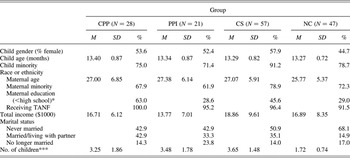
Following completion of baseline assessments, the mothers and infants recruited for the maltreatment sample were randomly assigned to one of three groups: child–parent psychotherapy (CPP), psychoeducational parenting intervention (PPI), and community standard (CS). Some mothers assigned to receive one of the active interventions declined to participate and were included in the nonactive intervention CS group (see Cicchetti et al., Reference Cicchetti, Rogosch and Toth2006). The resulting group sizes in the current sample were CPP (n = 28), PPI (n = 21), and CS (n = 57). The maltreatment groups and the nonmaltreatment comparison group were comparable on a range of demographic variables, as shown in Table 1. The groups did not differ on child gender, child minority race or ethnicity, or age at the initial assessment. Furthermore, the groups did not differ on maternal age, maternal minority race or ethnicity, current receipt of TANF, total family income, or marital status. Mothers on average were 26.70 years of age (SD = 5.93), 72.5% were of minority race or ethnicity, and 30.1% of mothers were currently married or living with a partner. The average family income was $17,150.00, including welfare benefits, and 95.4% of the families were currently receiving TANF. Overall, 41.4% of the mothers had a high school education or less. However, a difference among the groups emerged, χ2 (3, N = 153) = 9.63, p = .02. The CPP group had more mothers with less than a high school education than the PPI and NC groups; all other group contrasts were not significant. Maternal education level was not significantly related to attachment or genotype variables, and thus was not considered further. Finally, the groups differed on the number of children to whom the mothers had given birth, F (3, 149) = 17.41, p < .001. Post hoc tests indicated that mothers in the NC group had fewer children than the mothers in each of the maltreatment groups, but the CPP, PPI, and CS groups did not differ from each other. Thus, the families in the sample are characterized by poverty, relatively large family size, and frequent unstable marriages.
Demographic characteristics

Note: CPP, child–parent psychotherapy; PPI, psychoeducational parenting intervention; CS, community standard; NC, nonmaltreated; TANF, Temporary Assistance to Needy Families.
*p < .05. ***p < .001.
Previous findings indicated that the CPP and PPI groups were comparable in terms of baseline attachment classification and improvement in rates of secure attachment following the interventions (Cicchetti et al., Reference Cicchetti, Rogosch and Toth2006). The two groups also were very comparable demographically. Because of the reduction in sample size as a result of not being able to obtain DNA samples from all participants and the resulting small size of the separate intervention groups, the CPP and PPI groups were combined into one maltreated intervention group (MI, n = 49) and contrasted with the CS or maltreated control group (MC, n = 57) and the nonmaltreated comparison group (NC, n = 47) in subsequent analyses.
Based on the larger sample from the original study, demographic features were compared for families where child DNA samples were obtained (n = 153) and for those where DNA was not obtained (n = 36). The groups did not differ significantly on child gender, child race, or child age. Moreover, the groups also did not differ significantly on maternal age, minority race or ethnicity, high school education status, marital status, receipt of TANF, or current family income. Finally, the groups also did not differ significantly on baseline or on age 2 follow-up distributions of attachment classifications. Thus, the reduced sample in the current study with DNA did not evince biased based on demographic characteristics or attachment classification. However, more children in the original MC group (29.6%) did not provide DNA samples, compared to the MI group (12.5%) and the NC group (9.6%), χ2 (2, N = 189) = 10.44, p < .01.
Procedures
During the baseline assessment period, home- and center-based research sessions were conducted with the mothers and infants. During interviews conducted in the home by trained research interviewers, mothers completed demographic interviews and a variety of self-report questionnaires. During a subsequent center-based laboratory session, mothers and infants participated in the Strange Situation procedure, in addition to other assessments. When children were approximately 26 months old, follow-up assessments utilizing the same home- and center-based sessions and procedures were conducted for all groups, after the CPP and PPI interventions had been completed.
Preventive interventions
CPP
This model of intervention is derived from the work of Fraiberg (Fraiberg, Adelson, & Shapiro, Reference Fraiberg, Adelson and Shapiro1975) and Lieberman (Reference Lieberman1992). A guiding assumption of CPP is that difficulties in the parent–infant relationship do not result from deficits in parenting knowledge and skill alone. Rather, the problems that maltreating mothers have in relating sensitively and responsively to their infants stem from insecure internal representational models that evolved in response to the mother's own experiences in childhood. In CPP the patient is not the mother or the infant but is instead the relationship between the mother and her baby. Masters level therapists met weekly with mothers and their infants during sessions conducted in the home over the course of 1 year. The approach is supportive, nondirective, and nondidactic and includes developmental guidance based on the mother's concerns. During the sessions, the therapist and the mother engage in joint observation of the infant. Through respect, empathic concern, and unfailing positive regard, the therapeutic relationship provides the mother with a corrective emotional experience through which the mother is able to differentiate current from past relationships and form positive internal representations of herself and of herself in relationship to others, particularly her infant. As a result of this process, mothers are able to expand their responsiveness, sensitivity, and attunement to the infant, fostering security in the mother–child relationship and promoting emerging autonomy in the child.
PPI
This model of preventive intervention is derived from the preventive intervention work of Olds and colleagues (Olds & Kitzman, Reference Olds and Kitzman1990; Olds et al., Reference Olds, Eckenrode, Henderson, Kitzman, Powers and Cole1997, Reference Olds, Henderson, Kitzman, Eckenrode, Cole and Tatelbaum1998), in which nurses provided a home-based education program on infant physical and psychological development and parenting, encouraged mothers to seek further education and employment, and enhanced informal social support. From this home-based model, the PPI intervention was supplemented by a variety of cognitive and behavioral techniques in order to address parenting skill deficits and social–ecological factors, such as limited personal resources, poor social support, and stresses in the home, associated with maltreatment. Masters level therapists, experienced in working with multiproblem families, conducted home visits scheduled weekly over a 12-month period. The PPI model was psychoeducationally based, striving to address current concerns, provide parental education and parenting skill training, reduce maternal stress, foster social support, and increase life satisfaction. The approach is didactic in nature, and involved training in parenting techniques, problem solving, and relaxation.
Both the CPP and PPI interventions were manualized, with central components and core principles of each approach specified. Therapists participated in individual and group supervision on a weekly basis, and checks on the fidelity of the intervention implementation for each approach were conducted throughout the course of intervention. Extensive outreach was typically necessary to engage mothers in the interventions. Both the CPP and PPI interventions were found to be efficacious in fostering securing attachment in toddlers in maltreating families (Cicchetti et al., Reference Cicchetti, Rogosch and Toth2006).
CS
Mothers and infants randomized to the CS (MC) group did not receive enhanced services. Rather, families continued to receive services that were typically available to maltreating families in the community. Families may have continued to be monitored by CPS and may have participated in other preventive services programs.
Measures
Demographics interview
This measure has been used extensively in research with high-risk, low-income populations. Information obtained includes: family composition, gender, race or ethnicity, birth dates, parent's education and occupation, income level, and receipt of public assistance.
Strange Situation
During the baseline assessments, the standard Strange Situation (Ainsworth et al., Reference Ainsworth, Blehar, Waters and Wall1978) was conducted with mothers and infants to assess the infant's attachment organization. Two independent raters each coded all of the videotapes of the individual Strange Situation sessions, and raters were unaware of the maltreatment status and group assignment of individual mother–child dyads. When there was a disagreement in coding, discussion proceeded until consensus was obtained for the primary attachment classification. Ainsworth's criteria for the A, B, and C classifications were utilized, and D classifications were based on the Main and Solomon (Reference Main, Solomon, Greenberg, Cicchetti and Cummings1990) criteria.
During the follow-up postintervention assessments at age 26 months, the standard Strange Situation was again conducted. The coding system developed by Schneider-Rosen, Braunwald, Carlson, and Cicchetti (Reference Schneider-Rosen, Braunwald, Carlson and Cicchetti1985), which emphasizes the developmental reorganizations that occur within the attachment behavioral systems as well as among the attachment, exploration, affiliation, and fear/wariness behavioral systems, was utilized. Coding of the videotaped sessions was completed by two independent raters who were unaware of group status, family history, or baseline attachment classification. They coded all videotapes, with any disagreements resolved by conferencing. The four-category attachment classification system (A, B, C, D) was used.
The coders attained 100% agreement with the Strange Situation training tapes utilized by Alan Sroufe. One coder (D.C.) was trained by Mary Main to code attachment disorganization/disorientation and trained the second coder (F.R.) to reliability. Interrater agreement for the entire attachment classification exceeded 88%.
DNA collection, extraction, and genotyping
Using an established protocol, trained research assistants obtained DNA samples from participants by collecting buccal cells with the Epicentre Catch-All Collection Swabs. Subsequently, using the conventional method, DNA was extracted with the Epicentre BuccalAmp DNA Extraction Kit in order to prepare DNA for polymerase chain reaction (PCR) amplification.
Genotyping was conducted following previously published protocols. For 5-HTTLPR, the procedures of Gelernter, Kranzler, and Cubells (Reference Gelertner, Kranzler and Cubells1997) were used. The DRD4 exon 3 VNTR was PCR amplified with HotStar TAQ PCR Mix (Qiagen, Chatsworth, CA, Catalog No. 203205) and followed previously published protocols. The −521 SNP from the DRD4 gene was genotyped as described in Kramer et al. (Reference Krämer, Cunillera, Càmara, Marco-Pallarés, Cucurell and Nager2007). SNP genotyping was completed using Applied Biosystems Custom Taqman SNP Genotyping Assays, with resultant product analyzed using endpoint allelic discrimination. For each gene, representative genotypes were identified and sequenced with a Beckman–Coulter CEQ8000 semiautomated fluorescent sequencing system utilizing the Fragment Analysis Application and associated software.
The call rates for the genes were as follows: 5-HTTLPR, DRD4 exon 3 VNTR, and the DRD4 −521 SNP were 100%, 97.3%, and 99.3% successfully genotyped, respectively.
The Hardy–Weinberg equilibrium was evaluated for each of the three genes. For 5-HTTLPR, the s/s, s/l, and l/l genotypes were in the Hardy–Weinberg equilibrium, χ2 (1) = 0.02, p = .89, for DRD4, presence of the 7-repeat allele also was in the Hardy–Weinberg equilibrium, χ2 (1) = 0.13, p = .72, as was also the case for DRD4 −521, χ2 (1) = 2.36, p = .12.
Results
Genotypes of the 5-HTTLPR and DRD4 genes were examined in relation to attachment disorganization and secure attachment within the three study groups: MI, MC, and NC. The groups were contrasted on Strange Situation attachment classifications at the baseline (M age = 13.3 months) and at the age 2 follow-up assessments, as well as for variables examining stability of attachment disorganization and attachment security.
For 5-HTTLPR, presence of a short allele from either the s/s or s/l genotypes was contrasted with the homozygous long allele genotype (l/l). For the DRD4 gene, children with a 7-repeat allele were contrasted with children without a 7-repeat allele. We also considered whether presence of the DRD4 −521 T allele (TT or CT vs. CC) clarified findings for the influence of the DRD4 7-repeat allele. In addition, in order to examine potential risk across the two genes, a combined genetic risk variable was generated consisting of the presence of any risk genotype (s/s or s/l and/or DRD4 7-repeat) versus children without either risk genotype.Footnote 1
The three study groups were compared on their distributions across these three genotype variables. For 5-HTTLPR, the percentages in each group with the s/s or s/l genotype were comparable, with 69.4%, 52.6%, and 51.5%, for the MI, MC, and NC groups, respectively, having a short allele, χ2 (2, N = 153) = 4.18, p = .12. For DRD4, the distribution of the presence of the 7-repeat allele was 25.0%, 37.5%, and 28.9%, respectively, across groups, χ2 (2, N = 149) = 2.01, p = .37. The DRD4 −521 T allele also was comparable across groups, 85.7%, 82.1%, and 68.1%, respectively, χ2 (2, N = 152) = 5.03, p = .08. Finally, for the combined presence of risk genotype variable, the distribution was 72.9%, 66.1%, and 60.0%, χ2 (2, N = 149) = 4.19, p = .12. Thus, these findings indicate that the MI, MC, and NC groups had comparable distributions of genotypic variation across the 5-HTTLPR, DRD4, and composite risk genotype variables.
We also evaluated whether child race or ethnicity groups (Black, n = 85; White, n = 28; multiracial/other, n = 40) evinced differences in genotype distributions. No significant differences were observed for the presence of the DRD4 7-repeat, χ2 (2, N = 149) = 1.78, p = .41, or the DRD4 −521 T allele, χ2 (2, N = 152) = 3.29, p = .19. Group differences were found for 5-HTTLPR, χ2 (2, N = 153) = 11.42, p = .003, with the s/s or s/l genotype occurring less frequently among children who were Black (45.9%) compared to children who were White (78.6%) or children who were in the multiracial/other group (67.5%). Racial differences in the distribution of the 5-HTTLPR genotypes are routinely observed (Gerlernter et al., Reference Gelertner, Kranzler and Cubells1997).
Baseline attachment classification for study groups
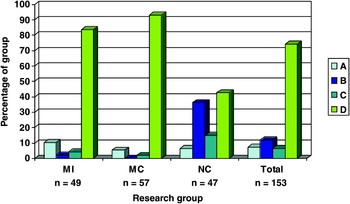
Consistent with previously reported group differences in attachment classifications in the larger study (Cicchetti et al., Reference Cicchetti, Rogosch and Toth2006), the current subsample with DNA demonstrated the same pattern of differences in attachment across study groups, χ2 (6, N = 153) = 52.47, p < .001 (see Figure 1). At baseline, both the MI group and the MC group had high rates of disorganized attachment, 83.7% and 93.0%, respectively, contrasting with 42.6% of children in the NC group with disorganized attachment, χ2 (2, N = 153) = 37.68, p < .001. Secure attachment was virtually nonexistent in the maltreated groups; only one child was classified as secure in the MI group, and no child was secure in the MC group, whereas the rate of secure attachment in the NC group was 36.2%, χ2 (2, N = 153) = 39.03, p < .001.
Attachment classifications at baseline. [A color version of this figure can be viewed online at journal.cambridge.org/dpp]

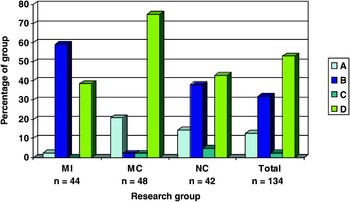
At the age 2 follow-up assessment, significant group differences in attachment classification were again observed, χ2 (2, N = 134) = 39.39, p < .001 (see Figure 2). However, substantial change had occurred in the MI group following the intervention, with a decrease in the rate of disorganized attachment to 38.6%, comparable to the NC group, 42.9%, whereas the rate of disorganized attachment remained substantial in the MC group, 75.0%, χ2 (2, N = 134) = 14.71, p < .001. Similarly, the rate of secure attachment had increased to 59.1% in the MI group, contrasting with 2.1% in the MC group and 38.1% in the NC group, comparable to baseline rates of secure attachment in this study of high risk infants, χ2 (2, N = 134) = 14.71, p < .001 (cf. Cicchetti et al., Reference Cicchetti, Rogosch and Toth2006).
Attachment classifications at age 2 follow-up. [A color version of this figure can be viewed online at journal.cambridge.org/dpp]

Baseline attachment classification and genotypic variation
Next, for the whole sample, irrespective of maltreatment group, we examined the extent to which baseline attachment classification varied as a function of genotype groups. For 5-HTTLPR, the distribution of s/s or s/l versus l/l genotypes was not significantly associated with attachment classification, χ2 (3, N = 153) = 4.27, p = .23. The rate of having an s/s or s/l genotype versus a l/l genotype for each of the attachment classifications was as follows: Type A (avoidant): 45.5% versus 54.5%, Type B (secure): 38.9% versus 61.1%, Type C (resistant): 70% versus 30%, and Type D (disorganized): 60.5% versus 39.5%. Similarly, the distribution of the DRD4 7-repeat allele did not vary significantly by baseline attachment classification, χ2 (3, N = 149) = 1.39, p = .71, as indicated by the following attachment group percentages having the 7-repeat allele versus not having a 7-repeat allele: Type A: 45.5% versus 54.5%, Type B: 33.3% versus 66.7%; Type C: 33.3% versus 66.7%, and Type D: 28.8% versus 71.2%. Finally, for the genotype risk composite, again no significant differences were observed across baseline attachment classification groups, χ2 (3, N = 149) = 3.70, p = .30. Across the attachment classifications, the presence of either risk genotype versus no risk genotype was as follows: Type A: 63.6% versus 36.4%, Type B: 50.0% versus 50.0%, Type C: 77.8% versus 22.2%, and Type D: 71.2% versus 28.2%. Thus, none of the attachment classification groups was found to be significantly related to specific genotypic variation in the overall sample.
Attachment disorganization
We next focused on disorganized attachment and investigated whether disorganized attachment was related differentially to different genotypes among maltreated (MI and MC) and nonmaltreated (NC) infants. At baseline and follow-up, we considered whether children were classified as disorganized versus not, as well as children who evinced disorganized attachment at both time periods versus those who did not. All analyses 2 × 2 contrasts utilize Fisher's exact two-tailed test to establish significance levels.
5-HTTLPR
In the MI group, no associations between the 5-HTTLPR genotype groups and disorganization were observed across the different timeframes. For example, at baseline, 68.3% of children with disorganized attachment had an s/s or s/l genotype and 31.7% had the l/l genotype, compared to 75.0% of nondisorganized infants with the s/s–s/l genotype and 25.0% with the l/l genotype, χ2 (1, N = 49) = 0.14, p = 1.00. Similarly, after intervention, when the rate of disorganization in the MI group decreased, there continued to be no differentiation between those classified as disorganized at follow-up (76.5% s/s–s/l vs. 23.5% l/l) and those not classified as disorganized (70.4% s/s–s/l vs. 29.6% l/l), χ2 (1, N = 44) = 0.20, p = .74. Stable disorganized attachment also was not influenced by the 5-HTTLPR genotype group, χ2 (1, N = 44) = 0.02, p = 1.00. In the MI group, for children who had stable disorganized classification (n = 14), 71.4% had s/s–s/l genotypes versus 28.6% with l/l genotypes, contrasting with 73.3% of children who did not evince stable disorganization with the s/s–s/l genotype and 26.7% with the l/l genotype. Thus, 5-HTTLPR genotypes were not related differentially to disorganized attachment at baseline or follow-up and did not relate to stable disorganized attachment in the MI group.
Similar findings were found in the MC group, with no differentiation of disorganized attachment classification based on 5-HTTLPR genotype. Given the high rate of disorganization at both baseline (93.0%) and at age 2 follow-up (75.0%) in this group, the nondisorganized cell sizes were small. Nevertheless, at baseline, 52.8% of D-classified children had the s/s–s/l genotype compared to 47.2% with the l/l genotype; among nondisorganized children, the rates for s/s–s/l and l/l were both 50.0%, χ2 (1, N = 57) = 0.01, p = 1.00. At the age 2 follow-up, results were comparable, χ2 (1, N = 48) = 0.00, p = 1.00, with 50.0% of children classified as disorganized having an s/s–s/l genotype and 50.0% having an l/l genotype. For children not classified as disorganized at follow-up, the genotype rates also were 50.0% s/s–s/l and 50.0% l/l. Stable disorganized attachment (n = 35/48) also was not differentiated by genotype, χ2 (1, N = 48) = 0.11, p = 1.00. Among children with stable disorganized attachment, 48.5% had the s/s–s/l genotype versus 51.4% with l/l; for children who did not evince stable disorganized attachment, 53.8% had the s/s–s/l/L genotype and 46.2% had the l/l. Thus, across the two time periods, no association of attachment disorganization and genotype was observed in the MC group.
A different picture emerged among children in the NC group. At baseline, the results were not significant, χ2 (1, N = 47) = 2.71, p = .14, with 65.0% of children classified as disorganized having the s/s–s/l genotype versus 35.0% with l/l, and among nondisorganized children, 40.7% were s/s–s/l and 59.3% were l/l. At the age 2 follow-up, a significant association was observed, χ2 (1, N = 42) = 6.22, p = .03, with 72.2% of disorganized children having the s/s–s/l genotype versus 27.8% with the l/l genotype; for nondisorganized 33.3% had the s/s–s/l genotype and 66.7% had the l/l. Similarly, stable disorganized attachment in the NC group also was related to genotype, χ2 (1, N = 42) = 7.47, p = .015. Among children with stable disorganized attachment, 83.3% had the s/s–s/l genotype versus 16.7% with l/l; in contrast, among children who did not have stable disorganized attachment, 36.7% had the s/s–s/l genotype whereas a greater proportion, 63.3%, had the l/l genotype. Thus, unlike the lack of association in the MI and MC groups, in the NC group, the s/s–s/l genotype was more commonly observed among disorganized children at age 2 and those with stable disorganized attachment.
DRD4
We next examined whether the DRD4 7-repeat allele was related to attachment disorganization differentially in the MI and MC groups as compared to the NC group.
For children in the MI group with a disorganized classification at baseline, only 17.5% carried the 7-repeat allele versus 82.5% of children without the 7-repeat allele. For children in the MI group who were not disorganized, 62.5% had the 7-repeat allele versus 37.5% who did not, χ2 (1, N = 48) = 7.20, p = .017. Thus, disorganization at age 12 months in the MI group was more likely to occur in the absence of the DRD4 7-repeat allele. At age 2 follow-up after intervention, no association of the DRD4 7-repeat allele and a disorganized classification was observed within the MI group, χ2 (1, N = 43) = 0.18, p = 1.00; 17.6% of children with a D classification had the 7-repeat allele versus 82.4% without the repeat, whereas 23.1% of those without a D classification had this allele versus 76.9% without the allele. In terms of children who evinced stable disorganized attachment from baseline to age 2 follow-up, no child with stable disorganized attachment (n = 14) in the MI group had the 7-repeat allele. However, 31.0% of those who did not evince stable disorganized attachment had the 7-repeat allele versus 69.0% who did not have the allele, χ2 (1, N = 43) = 5.50, p = .02. Thus, the DRD4 7-repeat allele, which has shown some relations with disorganized attachment, was less likely to be associated with disorganization at age 12 months or with stability of attachment disorganization following intervention at age 2 for children in the MI group.
Given the potential of the DRD4 −521 T allele to clarify the role of the DRD4 7-repeat, we also evaluated whether co-occurrence of the T allele with the 7-repeat augmented the relationship with disorganized attachment. For baseline attachment disorganization, the results were comparable to those observed for the 7-repeat allele alone, χ2 (1, N = 48) = 6.15, p = .03, Nonsignificant findings again were observed for the presence of the 7-repeat and T alleles at age 2 follow-up for disorganization, χ2 (1, N = 43) = 0.32, p = .67. For children in the MI group who were disorganized at both time points, the previously significant finding was no longer significant, χ2 (1, N = 43) = 3.29, p = .16. Thus, incorporation of the DRD4 −521 T allele did not contribute to clarifying the results for the DRD4 7-repeat allele.
For the MC group, no association of the DRD4 7-repeat allele and disorganized attachment was observed at baseline, χ2 (1, N = 56) = 0.29, p = .63, with 36.5% of children with D classifications having the 7-repeat allele versus 63.5% without the allele, as compared to 50% of nondisorganized children in the MC group with the 7-repeat allele versus 50% without. Similarly, no differentiation by genotype was observed at the follow-up at age 2, χ2 (1, N = 47) = 0.21, p = .73; 34.3% of children with disorganized attachment had the 7-repeat allele versus 65.7% who did not. Among nondisorganized children in the MC group, 41.7% had the 7-repeat allele versus 58.3% who did not. Stable disorganized attachment also was not associated with the 7-repeat allele, χ2 (1, N = 47) = 0.04, p = 1.00. For those with stable disorganized attachment, the presence of the 7-repeat allele was 35.3% versus 64.7% without the allele; comparable rates for the not stable disorganized group were 38.5% with the allele versus 61.5% without. Overall, for this group of maltreated toddlers in the absence of intervention, DRD4 was unrelated to attachment disorganization. When the combination of the DRD4 7-repeat and the DRD4 −521 T allele was considered, again all results were nonsignificant in the MC group.
Examination of the NC group indicated that at the baseline assessment, rates of the DRD4 7-repeat allele did not differentiate those with disorganized attachment (31.6% with the 7-repeat vs. 68.4% without) compared to nondisorganized children (26.9% with the 7-repeat allele vs. 73.1% without the allele), χ2 (1, N = 45) = 0.12, p = .75. However, 1 year later, a significant difference was observed, χ2 (1, N = 40) = 5.63, p = .04, with 52.9% of children classified as disorganized having the 7-repeat allele versus 47.1 % without, contrasting with 17.4% who were not classified as disorganized having the allele versus 82.6% without. Stable disorganized attachment across the 1-year period was not differentiated by the 7-repeat allele, χ2 (1, N = 40) = 1.16, p = .45. Thus, there was some indication that the DRD4 7-repeat occurred more frequently among nonmaltreated children at age 2 who were disorganized.
Within the NC group, 61.5% of children who had a 7-repeat allele also had a −521 T allele. When the presence of the combined alleles was considered for its effect on disorganization, the findings were weaker than when the 7-repeat allele was considered alone. Again, no significant differences emerged at baseline, χ2 (1, N = 45) = 1.64, p = .23, whereas the previously significant effect at age 2 was diminished in significance, χ2 (1, N = 40) = 4.32, p = .053. Effects of the co-occurring alleles also did not relate significantly to stable disorganized attachment, χ2 (1, N = 40) = 2.54, p = .18. Thus, inclusion of the −521 T allele did not help in isolating the effect of the DRD4 gene.
5-HTTLPR and DRD4 composite genotype risk
We also sought to examine the combined influence of both the 5-HTTLPR and DRD4 genes through examining children who had either or both of the putative risk genotypes versus those who had neither, in order to consider multigenic contributions to attachment disorganization. At the baseline assessment, 102 children (68.5%) had one or both risk genotypes, whereas 47 children (31.5%) had neither. The frequency of having a risk genotype did not differ across the study groups, χ2 (2, N = 149) = 4.19, p = .12.
For the MI group, no associations were observed between having a risk genotype and a disorganized attachment classification at baseline, χ2 (1, N = 48) = 0.40, p = 1.00. Among children with disorganized attachment 77.5% had a risk genotype versus 22.5% did not; for nondisorganized children 87.5% had a risk genotype but 12.5% did not. At age 2 follow-up, no significant differences were obtained, χ2 (1, N = 43) = 0.12, p = 1.00. Among children classified as disorganized at age 2, 76.5% had a risk genotype and 23.5% did not, whereas for children who were not disorganized at age 2, 80.6% had a risk genotype whereas 19.2% did not have a risk genotype. In addition, examination of stable disorganized attachment in relation to the genotype risk composition also yielded no significant differences, χ2 (1, N = 43) = 0.73, p = .44.
For those with stable disorganized attachment, 71.4% had a risk genotype whereas 28.6% did not. Among children who did not evince stable disorganized attachment, 82.2% had a risk genotype versus 17.2% who did not.
Similar to the MI group, the MC group also did not evince associations of disorganized attachment and the genetic risk composite. At baseline, 65.4% of children classified as disorganized had a risk genotype versus 34.5% of disorganized children who did not have a risk genotype. Among children who were not classified as disorganized, 75.0% had a risk allele and 25.0% did not, χ2 (1, N = 56) = 0.16, p = 1.00. Disorganized classification at age 2 follow-up also was not associated with presence of a risk genotype, χ2 (1, N = 47) = 0.06, p = 1.00; among children classified as disorganized, 62.9% had a risk genotype and 37.1% did not have a risk genotype. Children not classified as disorganized evinced 66.7% with a risk genotype and 33.3% without a risk genotype. Finally, stable disorganized attachment also was not differentiated by genotype in the MC group, χ2 (1, N = 47) = 0.23, p = .74. Among children with stable disorganized attachment 61.8% had a risk genotype versus 38.2% without; for children who did not have stable disorganized attachment, 69.2% had a risk genotype and 30.8% did not.
Thus, any putative risk from the 5-HTTLPR and DRD4 genotypes combined did not evince associations with assessments of disorganization at age 1 or age 2 or with stability of attachment disorganization in the two maltreatment groups.
In contrast, associations emerged in the NC group. Whereas the difference in the rate of D classification at baseline for those children with a risk genotype (73.7% with vs. 26.3% without a risk genotype) and those who were not disorganized (50.0% with vs. 50.0% without a risk genotype) did not attain significance, χ2 (1, N = 45) = 2.57, p = .13, differences were found at age 2 follow-up within the NC group, χ2 (1, N = 40) = 9.82, p = .003. For children who were classified as disorganized at follow-up, 88.2% had a risk genotype versus 11.8% without a risk genotype, compared to 39.1% of the children who were not disorganized who had a risk genotype versus 60.9% without a risk genotype. Similarly, nonmaltreated children who evinced a stable disorganized attachment were more likely to have a risk genotype (90.9% with vs. 9.15% without) than were children who did not have stable disorganized attachment (48.3% with a risk genotype vs. 51.7% without), χ2 (1, N = 40) = 6.04, p = .03. Thus, only among nonmaltreated children was there an association between putative risk genotypes and disorganized attachment observed at age 2 and stability of attachment disorganization across both assessment periods.
Attachment security
The baseline attachment classifications revealed that only one child in the MI group and no child in the MC group had a secure attachment classification. Thus, this lack of secure attachment precluded analysis of variation by genotypes at this time period in these two groups. In addition, because no improvement in the attainment of secure attachment was observed in the MC group, analyses of genetic influences on security at follow-up were not feasible. However, because of improvement in attachment security in the MI group and the presence of secure children in the NC group, analyses for these groups were conducted.
For the MI group, at follow-up, no association of the 5-HTTLPR genotype group and secure attachment was observed, χ2 (1, N = 44) = 0.004, p = 1.00, with 73.1% of the children with secure attachment having an s/s or s/l genotype versus 26.9% of children with a secure attachment having an l/l genotype, compared to 72.2% of the children with insecure attachment having an s/s or s/l genotype versus 27.8% of insecurely attached children with an l/l genotype. Similarly, no relations were observed for the DRD4 genotype groups, χ2 (1, N = 43) = 0.03, p = 1.00, with 20.0% of the securely attached children having a 7-repeat allele versus 80% without, and 22.2% of the insecurely attached children having the DRD4 7-repeat allele versus 77.8% without the allele. Inclusion of the −521 T allele in combination with the 7-repeat did not alter the pattern of findings observed for the 7-repeat allele alone in relation to security in the MI group. Finally, examining both genes together indicated that having a 5-HTTLPR or DRD4 risk genotype did not affect security status, χ2 (1, N = 43) = 0.03, p = 1.00 in the MI group; 80% of secure children in the MI group had a risk genotype versus 20% who did not have a risk genotype. For children classified as insecure at follow-up, 77.8% had a risk genotype versus 22.2% of insecure children who did not have a risk genotype. Thus, no evidence was found that the 5-HTTLPR and DRD4 genotypes collectively were related to secure attachment organizations in the MI group at the age 2 follow-up in response to the intervention. Intervention effectiveness was not moderated by genes.
In the NC group at the baseline assessment, no association was found between secure versus insecure attachment and 5-HTTLPR genotypes, χ2 (1, N = 47) = 2.65, p = .14; 64.7% of secure children had a l/l genotype versus 35.3% with an s/s or s/l genotype, whereas among children classified as insecure, 40.0% had an l/l genotype versus 60.0% with s/s–s/l. For DRD4 7-repeat genotypes, again no association was found, χ2 (1, N = 45) = 0.55, p = .51; among secure children 35.3% had the 7-repeat allele, whereas 64.7% did not; among insecurely attached children 25.0% had the 7-repeat allele and 75.0% did not. A lack of significant association at baseline of secure attachment and the 5-HTTLPR/DRD4 combined risk composite also was found, χ2 (1, N = 45) = 1.91, p = .22. The rate of a risk allele versus absence was 47.5% versus 52.9% among secure children, and 67.9% versus 32.1% among children with insecure baseline attachment classifications.
However, differences were observed in the NC group for the age 2 follow-up assessment in relation to 5-HTTLPR, χ2 (1, N = 42) = 6.42, p = .025, with 75.0% of the children with a secure attachment evincing a l/l genotype versus 25.0% with an s/s or s/l genotype, whereas among children with an insecure attachment classification 34.6% had an l/l genotype versus 65.4% with an s/s–s/l genotypes. Similarly, for DRD4, only 6.7% of secure children carried a DRD4 7-repeat allele versus 93.3% who did not have 7-repeat allele, whereas 48.0% of children with insecure classifications had the 7-repeat allele and 52.0% did not, χ2 (1, N = 40) = 7.30, p = .013. These results were not further clarified by examination of the combined 7-repeat and −521 T alleles, χ2 (1, N = 40) = 6.00, p = .016.
When the influence of any risk genotype was considered, differences again were found at age 2 in the NC group, χ2 (1, N = 40) = 11.11, p = .002; 26.7% of children with a secure attachment classification had a risk genotype versus 73.3 % who did not have a risk genotype, compared to children with an insecure classification, where 80.0% had a risk genotype versus 20.0% without a risk genotype. Given the lack of significant associations at the baseline assessment, we also considered the extent to which children who evinced a stable secure attachment in the NC group at follow-up differed by genotype risk. Of children who had stable secure attachment, 22.2% had a 5-HTTLPR or DRD4 risk genotype versus 73.8% who did not have a risk genotype. For children who did not have a stable secure attachment, 71.0% had a risk genotype versus 29% who did not have a risk genotype, χ2 (1, N = 40) = 6.91, p = .018. Thus, unlike maltreated children in the MI group where no association of attachment security and genetic variation was found at age 2 following intervention, in the NC group risk genotypes evinced associations with age 2 attachment security and security of attachment over time.
Discussion
Within the combined total sample, none of the attachment groups were found to be significantly associated with any specific genetic variation among the genes included in this investigation. An examination of the MI group revealed that genotypic variation in 5-HTTLPR did not significantly relate to attachment disorganization across the baseline and postintervention assessments. In addition, in infants in the MI group who evinced stability of disorganized attachment from baseline to postintervention, there was no significant relationship between stable disorganization and 5-HTTLPR polymorphic variation.
Of interest, within the MI group, we found that there was a greater probability that disorganized attachment would occur at baseline in the absence of the DRD4 7-repeat allele. Moreover, at postintervention, no association of the DRD4 7-repeat allele and disorganization was obtained in the MI group. With respect to stable disorganization, we discovered that no infant in the MI group who demonstrated disorganized attachment both at the baseline and postintervention time periods had the DRD4 7-repeat allele, whereas 31% of the MI infants who did not show stability of attachment disorganization did possess the DRD4 7-repeat allele. Finally, the analysis of the relation between disorganization and the risk genotype composite within the MI group revealed that there was no statistically significant association at baseline, postintervention, or with stable disorganized attachment.
Thus, within the MI group, genotypic variation in the serotonin transporter gene did not demonstrate any significant relations to disorganization at any assessment period, and for the dopamine D4 receptor gene, greater likelihood of disorganization at baseline and for stability of disorganization was found when the putatively higher risk gene variant was absent. Furthermore, genetic variation was not found to moderate intervention efficacy. Specifically, at the 1-year follow-up (i.e., postintervention for the MI group), there was no significant association of 5-HTTLPR genetic variation and change of attachment status from disorganized to secure. Moreover, no association between DRD4 polymorphic variants and change of attachment status was obtained in the MI group of infants at the postintervention assessment. Likewise, an analysis of the genetic risk composite did not reveal a significant relation between variation in the risk genotypes and change in attachment organization from disorganization to security.
Similar to the MI group, the baseline, 1-year follow-up, and stability of disorganization analyses all revealed that there were no associations between 5-HTTLPR genotypic variation and disorganized attachment in the MC group. For children in the MC group, genetic variation in DRD4 was found to be unrelated to disorganized attachment across each age period of assessment. Finally, there were no significant associations found between genotypic variation on the risk composite and disorganization at baseline, 1-year follow-up, and on the longitudinal stability of disorganized attachment for infants in the MC group.
Thus, for the MC group of infants, no significant relations were obtained between genotypic variation in the serotonin transporter gene, the dopamine D4 receptor gene, the genetic risk composite, and attachment disorganization. Regardless of genotypic variation, MC infants obtained high rates of disorganized attachment at all three measurement periods.
Maltreated infants evidenced very high percentages of disorganized attachment at baseline. Moreover, the MC group exhibited very high percentages of disorganization across all time periods assessed. These high percentages of disorganized attachment are consistent with those found in the extant literature (Barnett et al., Reference Barnett, Ganiban and Cicchetti1999; Carlson et al., Reference Carlson, Cicchetti, Barnett and Braunwald1989a; Cyr et al., Reference Cyr, Euser, Bakermans-Kranenburg and van IJzendoorn2010; Lyons-Ruth et al., Reference Lyons-Ruth, Bronfman and Parsons1999). Despite the presence of high percentages of disorganized attachment in the MC group over time, there were no direct effects of genotypic variation in the serotonin transporter and the dopamine receptor gene on disorganization. Likewise, there was an absence of any genetic relation and disorganization found when examining the genetic risk composite.
Based on these results, it appears that genetic variation in both 5-HTTLPR and DRD4 is less important in the etiological pathway to disorganization in maltreated infants than are the anomalous aspects of parenting by maltreating mothers. Specifically, it may be that the high rate of disorganization overpowers the genetic contribution to disorganized attachment in maltreated infants.
In contrast to the MI and MC groups, who predominantly comprised infants with disorganized attachment at baseline, there was more differentiation of attachment organization in the NC group. Hence, this may have enabled genetic variation to manifest its influence in the less highly stressful environment in which the NC group resided.
Within the NC group, there was no significant relation between genetic variation in 5-HTTLPR and disorganization at baseline. At the age 2 assessment, however, a significant relationship was found between 5-HTTLPR genetic variation and disorganized attachment. In addition, for NC infants who displayed stable disorganization at baseline and the 1-year follow-up, a significant relation was obtained for variation in 5-HTTLPR and disorganization. Thus, unlike the findings for the MI and MC groups, the ss/sl genotype was more commonly observed among infants with disorganized attachment at age 2 and among those with stable disorganization.
At baseline in the NC group, variation in DRD4 was not significantly related to disorganization; however, at 1-year follow-up, the DRD4 7-repeat allele was significantly related to disorganization. In addition, there was no relationship between genotypic variation in DRD4 and stability of disorganized attachment from age 1 to age 2 years. We did not find that consideration of the joint influence of the DRD4 7-repeat allele and the DRD4 −521 T allele provided a stronger articulation of the genetic influences on attachment disorganization; results were comparable irrespective of the −521 T allele.
Within the NC group at baseline, there was no relationship between the composite risk genotype and disorganization. At age 2, however, and again with respect to stable disorganization, the risk genotype was significantly associated with disorganized attachment. Moreover, at the age 2 assessment, 75% of securely attached infants in the NC group possessed the l/l variant of 5-HTTLPR, suggesting that this genotype may have conferred protection against developing insecure or disorganized attachment. Only 6.7% of securely attached NC infants at the age 2 assessment had the 7-repeat DRD4 allele, whereas 93.3% of securely attached NC infants did not possess the 7-repeat DRD4 allele. In addition, 73.3% of the securely attached infants carried no risk genotypes, whereas 26.7% of securely attached NC infants had risk genotypes. Furthermore, 80% of insecurely attached infants in the NC group had risk genotypes compared to 20% of insecures who possessed no risk genotypes.
Finally, 22% of the NC infants who evidenced stability in secure attachment organization were carriers of one or both of the risk genes, whereas 73.8% of the infants with stability in attachment security did not possess any of the risk composite genotypes. In contrast, for NC infants who did not demonstrate stable secure attachment organization, 71% had one or more risk genes, and 29% had no risk genes. Finally, note that requiring the co-occurrence of the −521 T allele along with the 7-repeat allele of DRD4 in the criteria for our genetic risk composite did not lead to stronger relations with attachment disorganization or security in any of our analyses.
Thus, genetic variation appears to play a more prominent role in disorganization in the NC group than it does in either of the two maltreatment groups, MI and MC. Moreover, within the NC group it appears that the presence of one or more risk genotypes is associated with attachment security at the age 2 assessment and with stability of attachment security over time.
Prior investigations of the relation between genotypic variation in 5-HTTLPR and DRD4 and attachment organization have obtained mixed results. One study has obtained a significant relationship between 5-HTTLPR and attachment security (Barry et al., Reference Barry, Kochanska and Philibert2008), whereas another has reported a link between 5-HTTLPR and disorganization (Spangler et al., Reference Spangler, Johann, Ronai and Zimmerman2009). As reviewed earlier, there also has been inconsistency in investigations of the relationship between attachment disorganization and the DRD4 7-repeat allele. There have now been more failures to replicate the original report that there was a direct effect of DRD4 on disorganization than there have been replications (Bakermans-Kranenburg & van IJzendoorn, Reference Bakermans-Kranenburg and van IJzendoorn2007).
The vast majority of studies that have investigated the relationship between genotypic variants in 5-HTTLPR and DRD4 have been conducted with samples that are predominantly ethnically homogeneous, Caucasian, and middle class. An exception has been the study by Gervai and colleagues (Reference Gervai, Novak, Lakatos, Toth, Danis and Ronai2007). The participants in this investigation were more ethnically diverse and contained a subsample of families residing in poverty. The sample in the Gervai et al. (Reference Gervai, Novak, Lakatos, Toth, Danis and Ronai2007) study consisted of a combination of infants living in Bucharest, Hungary, and a smaller subgroup living in Boston, Massachusetts. Gervai et al. (Reference Gervai, Novak, Lakatos, Toth, Danis and Ronai2007) found a G × E on the relation between disrupted maternal affective communication and disorganized attachment among infants who were carriers of the short form of DRD4.
Our findings relating genetic influences on attachment security and disorganization in the nonmaltreated group were obtained with a low socioeconomic status sample. Further research is needed to determine if the results generalize to a more socioeconomically diverse sample. In addition, our sample was racially and ethnically diverse. The sample size did not allow for determination of potential differences among racial/ethnic groups in relations between genetic variation and attachment. Future work with sufficiently large samples would be beneficial to determine if relations are maintained within distinct racial/ethnic groups. Generally, there has been a paucity of genetic research on non-White populations, and research is needed to establish generalizability across different racial groups (Oquendo, Canino, Lehner, & Licinio, Reference Oquendo, Canino, Lehner and Licinio2010).
The current investigation is the first to examine the influence of genetic variation on the development of attachment in maltreated infants, as well as comparable low-income, ethnically diverse infants who had not experienced maltreatment. The differential influence of genes for these two demographically comparable groups of young children highlights the deleterious effects of early disturbances in caregiving on the development of attachment disorganization, with genetic variation minimally involved when environmental stress and failures in caregiving are extreme. Moreover, our results indicated that early, theoretically informed interventions designed to promote attachment security were powerful in improving attachment organization in maltreated infants. Genetic variants did not alter the receptiveness of the children to benefit from the interventions. Rather, the interventions proved efficacious, irrespective of genetic variation in the children. The current investigation possesses important implications for decision making on behalf of children who have experienced maltreatment during the early years of life. Although the negative effects of maltreatment on attachment are profound, these effects are not immutable and plasticity of the attachment system is feasible. Genetic differences in this study did not determine who would benefit from intervention. As a result, early intervention in maltreating families is imperative, particularly given the substantial stability of attachment disorganization among maltreated infants in the absence of active efforts to improve family functioning and the parent–child relationship.