Word comprehension and production are critical features of young children's language development. Parents eagerly await their child's first words, take pride when their child begins to understand them or says something, and worry if their child appears slower in language than their child's friends. When children grow up hearing two languages from the start, parents often expect them to acquire language at a slower rate. Is this expectation based on a misconception (King & Mackey, Reference King and Mackey2007, p. 26), or is it actually the case that at a given point in early development bilingual children know fewer words in each language than do monolingual children (e.g., Bialystok, Craik, Green, & Gollan, Reference Bialystok, Craik, Green and Gollan2009, p. 89; Genesee, Reference Genesee2007, p. 6)? In the present study we address this question by comparing the comprehension and production vocabularies of bilingual and monolingual children in the second year of life.
SOURCES OF VARIATION IN BILINGUAL AND MONOLINGUAL VOCABULARY ACQUISITION
Variation in early word comprehension and production is large and normal (e.g., Bates, Dale, & Thal, Reference Bates, Dale, Thal, Fletcher and MacWhinney1995). Possible sources of this variation are manifold, ranging from individual differences in ability to distinguish phonetic cues over differences in language input to variability in social understanding (Baldwin & Moses, Reference Baldwin and Moses2001; Hart & Risley, Reference Hart and Risley1995; Tsao, Liu, & Kuhl, Reference Tsao, Liu and Kuhl2004). Our study investigates the number of languages that children are learning as a source of variation. In doing so, we minimize controllable demographic differences between children learning two languages and those learning just one. Unlike previous studies, we compare bilingual and monolingual children who are matched in age, overall length of language exposure, birth status, birth order, family socioeconomic status (SES), and gender.
Word learning crucially depends on opportunities to hear words used in context (e.g., Hart & Risley, Reference Hart and Risley1995). For young children, these opportunities have much to do with the length of time they have heard a language (i.e., with their age). To circumvent the possibility that children differed in the overall length of language exposure, we studied bilingual and monolingual children who were matched in age.
We also controlled for the overall length of time that bilingual and monolingual children had to learn vocabulary in a particular language. All children in this study were exposed to their target language(s) from birth. Bilingual children in this study were going through a process of bilingual first language acquisition (BFLA; De Houwer, Reference De Houwer1990, Reference De Houwer2009; Meisel, Reference Meisel, Hyltenstam and Obler1989).
The children in this study were also all term and firstborn (birth status and birth order have both been reported to affect vocabulary size in monolinguals; for birth status, see Kern & Gayraud, Reference Kern and Gayraud2007; for birth order, see Hoff-Ginsberg, Reference Hoff-Ginsberg1998). We also held family SES constant, because SES strongly influences vocabulary size in monolinguals (Hart & Risley, Reference Hart and Risley1995; Lee, Reference Lee2011): All children grew up in comparable middle-class families living in the same country. The bilingual and monolingual groups of children were also closely matched on gender, because as a group girls tend to develop early vocabulary faster (Bornstein, Hahn, & Haynes, Reference Bornstein, Hahn and Haynes2004; Fenson et al., Reference Fenson, Dale, Reznick, Bates, Thal and Pethick1994; Kern & Gayraud, Reference Kern and Gayraud2010). All children (except one) heard each parent speak only one language to them. This exposure pattern was the same for bilinguals and monolinguals.
Thus, the only major controllable factor that differentiated bilingual and monolingual groups in the present study is that one group heard two languages from birth and the other just one language. This design holds promise for better understanding whether the number of languages that children are exposed to helps to explain vocabulary size at an early age.
Finally, the age at which children are studied also matters. The older children are, the more different variables are likely to play a role in their word learning. Vocabulary knowledge is cumulative, and differences between children's linguistic experiences, and thus their opportunities to learn words, increase as children grow (Hart & Risley, Reference Hart and Risley1995). Although individual children vary in their lexical knowledge from when they start to understand and produce words (e.g., Bates et al., Reference Bates, Dale, Thal, Fletcher and MacWhinney1995), the extent of these differences is smaller than when children are somewhat older, say, 2 or 3 years of age (Hart & Risley, Reference Hart and Risley1995). The present study minimizes these possibly confounding differences by studying children in the beginning and at the middle of the second year of life. This timing permitted closer focus on the number of languages being acquired as a factor in word learning.
BILINGUAL VERSUS MONOLINGUAL VOCABULARY ACQUISITION
Few studies have specifically compared young BFLA children's vocabulary development to that of comparable monolinguals. The first was Pearson, Fernández, and Oller (Reference Pearson, Fernández and Oller1993). Using an early version of the American English MacArthur Communicative Development Inventories (CDI; Fenson et al., Reference Fenson, Dale, Reznick, Thal, Bates and Hartung1993) and its Spanish version (Jackson-Maldonado & Bates, Reference Jackson-Maldonado and Bates1988), Pearson et al. (Reference Pearson, Fernández and Oller1993) compared 12 bilingual Spanish–English infants’ total word comprehension to that of 10 monolingual English infants (total word comprehension is the sum of words that infants only understood plus the ones they understood and produced). Infants ranged in age from 8 to 16 months. Pearson et al. (Reference Pearson, Fernández and Oller1993) converted raw CDI scores to percentile norming scores obtained for a large group of monolingual English children (Fenson et al., Reference Fenson, Dale, Reznick, Thal, Bates and Hartung1993). Comparison percentiles for Spanish were constructed on the basis of the English language data; however, CDI norming studies in different languages do not always use the same percentile ranks, which renders cross-linguistic comparisons problematic (De Houwer, Reference De Houwer and Cruz-Ferreira2010). Based on these percentile norming score comparisons for each language separately, bilingual and monolingual infants understood similar numbers of words. Again using percentile scores, Pearson et al. (Reference Pearson, Fernández and Oller1993) also compared word production in 25 bilingual Spanish–English, 32 monolingual English, and 3 monolingual Spanish toddlers 16 to 27 months of age. Production vocabulary size was the same for bilinguals and monolinguals, regardless of whether bilinguals’ overall production vocabulary or production vocabulary in just a single language was considered.
In addition to comparing bilinguals’ and monolinguals’ vocabulary sizes, Pearson et al. (Reference Pearson, Fernández and Oller1993) carried out a translation equivalent (TE) analysis. TE analysis computes the total number of different concepts or lexicalized meanings that bilingual children know in their two languages, now commonly called total conceptual vocabulary (TCV; Swain, Reference Swain1972). For monolingual children, TCV is congruent with the number of words known as measured by the CDI, where one word is meant to stand roughly for one concept (i.e., lexical meaning). In bilingual children, however, TCV does not (necessarily) coincide with the number of words known (De Houwer, Bornstein, & De Coster, Reference De Houwer, Bornstein and De Coster2006; Pearson et al., Reference Pearson, Fernández and Oller1993). For example, consider the French word chapeau and the Dutch word hoed. Chapeau and hoed form a TE pair that lexically expresses the single meaning “hat.” A bilingual child learning French and Dutch may understand both words of this TE pair. Supposing these two words are the only words understood by the child; the child will then have a total comprehension vocabulary consisting of two lexical items but a TCV of only one lexical meaning. Bilingual TCV is the sum of the number of TEs known and the word meanings known in just one of the two languages. Bilingual TCV, then, abstracts away from the number of languages a particular meaning is known in and will tend to be lower in size than vocabulary in both languages combined.
Pearson et al. (Reference Pearson, Fernández and Oller1993) found that bilingual and monolingual TCVs did not differ. Bilinguals and monolinguals knew equal numbers of lexicalized meanings. For their entire study, Pearson et al. (Reference Pearson, Fernández and Oller1993) concluded that, using the range of measures employed, “there is no statistical basis for concluding that the bilingual children in this study were slower to develop vocabulary before the age of 30 months than were the monolinguals” (p. 117).
Later, Águila, Ramon-Casas, Pons, and Bosch (Reference Águila, Ramon-Casas, Pons, Bosch and Diez-Itza2007) compared bilingual Spanish–Catalan and monolingual Spanish- and Catalan-speaking children between 12 and 24 months of age. Their purpose-developed parent-report instrument (modified from Águila, Ramon, Pons, & Bosch, Reference Águila, Ramon, Pons, Bosch, Mayor Cinca, Zubiauz de Pedro and Díez-Villoria2005) contained many cognate words from these two lexically similar languages and consisted of 148 items (in contrast, the CDI contains between approximately 400 and 700 lexical items, depending on the language and the target age group). Bilinguals’ overall levels of production for their two languages combined far exceeded those of monolinguals.
More recently, Hoff et al. (Reference Hoff, Core, Place, Rumiche, Señor and Parra2012) compared 47 bilingual Spanish–English toddlers’ overall production vocabulary (combining two languages) with that of 56 demographically matched monolingual English toddlers, aged 22, 25, and 30 months. No bilingual–monolingual group differences in overall language production emerged. Like Pearson et al. (Reference Pearson, Fernández and Oller1993), Hoff et al. (Reference Hoff, Core, Place, Rumiche, Señor and Parra2012) used the American English and Spanish versions of the CDI (Jackson-Maldonado et al., Reference Jackson-Maldonado, Thal, Fenson, Marchman, Newton and Conboy2003). However, in contrast to Pearson et al. (Reference Pearson, Fernández and Oller1993), Hoff et al. (Reference Hoff, Core, Place, Rumiche, Señor and Parra2012) reported lower production vocabulary in bilingual children when only one of their languages, English, was taken into account (there was no Spanish monolingual comparison group).
In this literature, only Pearson et al. (Reference Pearson, Fernández and Oller1993) considered comprehension; all studies considered production. One study looked at production in each language in bilinguals compared to monolinguals and reported no differences (Pearson et al., Reference Pearson, Fernández and Oller1993). Another study compared English production and reported a bilingual disadvantage (Hoff et al., Reference Hoff, Core, Place, Rumiche, Señor and Parra2012). Two studies reported equal bilingual and monolingual overall production (i.e., comparing monolingual production to bilingual production in both languages combined; Hoff et al., Reference Hoff, Core, Place, Rumiche, Señor and Parra2012; Pearson et al., Reference Pearson, Fernández and Oller1993). One study reported superior overall production vocabularies for bilinguals (Águila et al., Reference Águila, Ramon-Casas, Pons, Bosch and Diez-Itza2007).
All of these studies concerned BFLA children and thus appropriately controlled for overall length of exposure to two versus one language. All three studies used parent-report instruments; however, the one used by Águila et al. (Reference Águila, Ramon-Casas, Pons, Bosch and Diez-Itza2007) differed from the others and was not based on the original CDI developed by Fenson et al. (Reference Fenson, Dale, Reznick, Thal, Bates and Hartung1993). Pearson et al. (Reference Pearson, Fernández and Oller1993) converted raw CDI scores to norming percentile scores; Hoff et al. (Reference Hoff, Core, Place, Rumiche, Señor and Parra2012) used raw scores. Sample size is an issue in Pearson et al. (Reference Pearson, Fernández and Oller1993), which had just 3 monolingual Spanish children as a comparison group. Only Hoff et al. (Reference Hoff, Core, Place, Rumiche, Señor and Parra2012) controlled for birth status (preterm vs. term), SES, gender, and age between groups.
In addition to the controls in the Hoff et al. (Reference Hoff, Core, Place, Rumiche, Señor and Parra2012) study, our study controls for birth order. Furthermore, our study involves a new language combination, Dutch and French, involving two languages that have hitherto not been investigated for comparisons between monolingual and BFLA children. If the number of languages being learned is important for young children's vocabulary size, bilingual–monolingual similarities and differences should be consistent regardless of which language combination is considered. By focusing on a different language combination than hitherto examined, our study allows a more generalizable assessment of the importance of the number of languages in early vocabulary size.
French has featured in earlier bilingual–monolingual comparisons involving children under age 3 (Thordardottir, Rothenberg, Rivard, & Naves, Reference Thordardottir, Rothenberg, Rivard and Naves2006). However, this study did not limit itself to BFLA children but included bilingual children who had learned a second language toward the end of their first year. Thus, the time that bilingual and monolingual children had to learn their languages was different. This confound applies equally to the comparative study by Junker and Stockman (Reference Junker and Stockman2002); for other early bilingual–monolingual comparisons, there is no information on how long the bilinguals had been exposed to their two languages (Barreña, Ezeizabarrena, & García, Reference Barreña, Ezeizabarrena, García, Pérez-Vidal, Juan-Garau and Bel2008; Doyle, Champagne, & Segalowitz, Reference Doyle, Champagne and Segalowitz1977; Pérez-Pereira, Resches, & Fernández, Reference Pérez-Pereira, Resches, Fernández and Eriksson2006; Rimel & Eyal, Reference Rimel and Eyal1996; Vagh, Pan, & Mancilla-Martinez, Reference Vagh, Pan and Mancilla-Martinez2009).
In the present study, we collected longitudinal data for 31 middle-class bilingual children with Dutch and French input from birth and 30 demographically comparable monolingual children with Dutch input from birth. Children were studied at ages 13 and 20 months using Dutch and French CDI adaptations of the original American English CDI. This design allowed us to examine vocabulary sizes for both word comprehension and word production and to compare groups for relations between comprehension and production. Through a comparison of the Dutch and French CDIs, we also conducted a TE analysis, which allowed us to compute and compare TCVs. It is our aim to present as comprehensive an analysis as possible with these data so as to fully investigate potential similarities and differences in bilinguals’ and monolinguals’ vocabulary sizes.
METHOD
Participants
The participants came from 61 middle-class families. Thirty-one were bilingual Dutch–French speaking, and 30 were monolingual Dutch speaking. The term family here refers to the unit made up of the first biological child, mother, and father.
In the bilingual families, all but one reported using the “one person, one language” principle in speaking to children. In the one exception, both parents used both Dutch and French in addressing the child. In 14 of the one person, one language families, mothers spoke French to their children and fathers spoke Dutch; in 16 families, mothers spoke Dutch and fathers spoke French. These language-use patterns began when the children were born. All parents in the bilingual families knew both Dutch and French.
Detailed information on the number of half hours per day that children heard Dutch, French, or both languages is available for most children through language diaries between child ages 5 and 20 months. This information makes clear that the frequency with which most bilingual children heard each language fluctuated considerably over time. It is thus impossible to state a single proportion of waking time that children heard each language. Periods in which children heard each language about equally over a week's time alternated with periods in which children heard one language much more often. However, all children heard each language every day up until the age of 20 months. Children in the monolingual group heard just Dutch spoken to them by their parents and other caregivers from birth.
For both bilingual and monolingual groups, language data were collected about firstborn, healthy, full-term children at the ages of 13 and 20 months. At 20 months, however, data for Dutch for 1 child in the bilingual group and for French for 2 additional bilingual children were missing. Results for 20 months that involve just Dutch are based on data from 30 children in the bilingual group, and results that involve Dutch and French are based on data from 28 bilingual children.
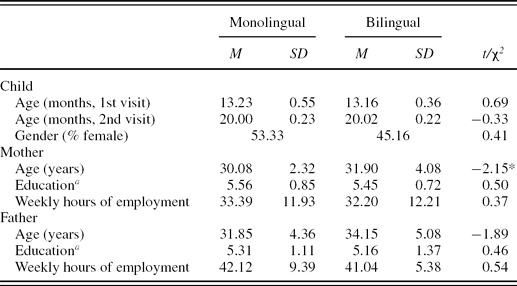
Demographic characteristics of children, mothers, and fathers are presented in Table 1. There was a small but significant difference in average maternal age in the monolingual and bilingual groups (the latter being higher), but otherwise the groups were matched. Because of this group difference, we evaluated maternal age as a covariate. Controlling for maternal age did not change any findings; uncontrolled analyses are reported.
Sample demographic characteristics

aMeasured on the 7-point Hollingshead (Reference Hollingshead1975) scale. A score of 5 corresponds to partial college or specialized postsecondary training.
*p < .05.
Per family, we collected data from adults in addition to the child's parents where relevant and possible. These “third persons,” designated by mothers, knew the child well and regularly took care of the child. They were all females and were the child's grandmother, aunt, nanny, family childcare provider, or a professional childcare provider at a daycare center. Their ages ranged from 21 to 65, and their educational levels varied, with the highest diplomas ranging from junior high school to 4-year college.
Instruments and procedures
Mothers, fathers, and third persons (if available) each completed the Dutch adaptation of the CDI (N-CDI; Zink & Lejaegere, Reference Zink and Lejaegere2002). In bilingual families, mothers, fathers, and third persons (if available) each additionally completed the CDI's European French adaptation (F-CDI; Kern, Reference Kern2007). Everyone reportedly completed the forms without consulting any other person (unlike Marchman & Martínez-Sussmann, Reference Marchman and Martínez-Sussmann2002, where reporters added on to one another on the same word list). Our procedure of having more than one person fill out a CDI form makes it possible to have the best possible assessment of a young child's lexical knowledge and to avoid underrepresentation (Bornstein, Putnick, & De Houwer, Reference Bornstein, Putnick and De Houwer2006; De Houwer, Bornstein, & Leach, Reference De Houwer, Bornstein and Leach2005). In the present study, we only consider vocabulary items on the CDI and not gestures or sentences.
The N-CDI
When children were 13 months of age, reporters completed the infant form Woorden en Gebaren (Words and Gestures; N-CDI: Infant). When children were 20 months of age, reporters completed the toddler form Woorden en Zinnen (Words and Sentences; N-CDI: Toddler). The N-CDI: Infant form contains a total of 434 vocabulary items. The N-CDI: Toddler form contains a total of 703 vocabulary items. Items on both the N-CDI: Infant and the N-CDI: Toddler forms can be checked in one of two ways: Either the item is just understood or it is understood and said; alternatively, reporters can leave the item unchecked, which means that it is not known to the child.
The F-CDI
When children were 13 months of age, reporters completed the infant form Mots et Gestes (Words and Gestures; F-CDI: Infant). When children were 20 months of age, they completed the toddler form Mots et Phrases (Words and Sentences; F-CDI: Toddler). The F-CDI: Infant form contains a total of 414 vocabulary items. Items on the F-CDI: Infant form can be checked in one of two ways: Either the item is just understood or it is understood and said; alternatively, reporters can leave the item unchecked, which means that it is not known to the child. This is like the N-CDI: Infant. The F-CDI: Toddler form, however, only asks reporters to check off those words that the child is using at the moment (“Cochez les mots que votre enfant utilise en ce moment”). Therefore, there is no measure of comprehension for the F-CDI at 20 months. (This follows standard practice for the CDI toddler forms in several other languages.) There are a total of 698 lexical items listed on the F-CDI: Toddler form.
Scoring
Each child received one cumulative score per vocabulary item on each of the two monolingual (the N-CDI: Infant and the N-CDI: Toddler) or four bilingual (the N-CDI: Infant and the F-CDI: Infant and the N-CDI: Toddler and the F-CDI: Toddler) lists. This cumulative score is the best score given by any single reporter for that item. For instance, if mother reported that the child understood Dutch hoed (hat), but father reported that the child both understood and said hoed, we credited the child with saying hoed. The cumulative score was zero for all items that children neither understood nor said.
For each child, a comprehension scale was computed as the count of all cumulative score items that were rated as understood but not also said. A production scale was computed as the count of all cumulative scores that were rated as understood and said. Separate comprehension and production scales were computed for each form (Dutch and French) at each age.
Our comprehension scale differs from what is called the comprehension scale in many CDI studies. Comprehension scales in CDI infant form norming studies tend to combine scores for just understood and understood and said (following Fenson et al., Reference Fenson, Dale, Reznick, Thal, Bates and Hartung1993). Here we make no reference to normed percentiles, and we analyze comprehension without production, so our two scales are nonoverlapping. In addition to using separate comprehension and production scales, we also computed a total comprehension scale, which combines our separate comprehension and production scales and thus coincides with the comprehension scale typically used in CDI norming studies based on the infant form (e.g., Pearson et al., Reference Pearson, Fernández and Oller1993). Given that the N-CDI: Toddler form (but not the F-CDI: Toddler form) also includes a comprehension measure and that the N-CDI: Toddler form norming tables also combine scores for understood with those for understood and said (Zink & Lejaegere, Reference Zink and Lejaegere2002), we also computed a total comprehension scale for the Dutch data at 20 months. Analyses and results presented here are based on the separate comprehension and production scales and on the total comprehension scales.
Because children were evaluated by varying numbers of reporters, we tested whether children with 3 reporters and those with fewer than 3 would score similarly on the Dutch comprehension, production, and total comprehension scales. At 13 months, the 23 children with fewer than 3 reporters scored similarly to the 38 children with 3 reporters, ts (59) = –1.03 to –1.97, ns. Likewise, at 20 months, the 23 children with fewer than 3 reporters scored similarly to the 37 children with 3 reporters, ts (58) = –1.68 to –0.14, ns. In our analyses, we therefore do not distinguish between scores based on different numbers of reporters.
Coding for TEs and TCV scoring
In addition to analyzing the words in each language that children understood or produced, we examined the extent to which children understood or produced words from either language that were each other's everyday cross-language TEs. To carry out this TE analysis, we followed methods used in Pearson et al. (Reference Pearson, Fernández and Oller1993) and elaborated in De Houwer (Reference De Houwer2009). We compared the Dutch and French infant forms to each other, and we compared the Dutch and French toddler forms to each other. A list was generated of those words and phrases on the Dutch CDI form that have a TE on the matching French CDI form. The same was done in the reverse. Each cross-language synonym pair thus found represented a single lexicalized meaning. For each bilingual child at each age, a bilingual TCV score was then computed. This score counts lexicalized meanings rather than number of words and credits the bilingual child only once for each meaning known, regardless of whether the child knows the word for that meaning in one or both languages. For the monolingual children, the TCV score equals the number of words known in just a single language. As explained below, there were slight differences in how the TCV was computed dependent on age.
Analytic plan
Our analyses are organized according to (a) comprehension, (b) production, and (c) total comprehension, which combines comprehension with and without production. Within each, we look at both ages and compare the bilinguals and monolinguals for each age (French at 20 months had no separate comprehension score). Within each, we compare the bilinguals’ overall word knowledge combining Dutch and French with the monolinguals’ overall word knowledge (restricted to just Dutch), and we compare the bilinguals’ partial knowledge relating to just Dutch with the monolinguals’ knowledge of Dutch. For both groups at both ages, we also compare the ratio of comprehension to production to determine whether monolingual or bilingual children comprehend or produce words at different rates. For example, if one group had a higher ratio than another, we could conclude that the former group had more advanced comprehension compared to production than the latter group. Finally, we compare bilingual and monolingual TCVs. Where possible, we report Cohen (Reference Cohen1988) d as effect size. We discuss the size of effects corresponding to Cohen's benchmarks for small (0.20), medium (0.50), and large (0.80) ds, and they can be interpreted in terms of standard deviations from the mean.
RESULTS
Comprehension
The N-CDI: Infant and the F-CDI: Infant data (13 months)
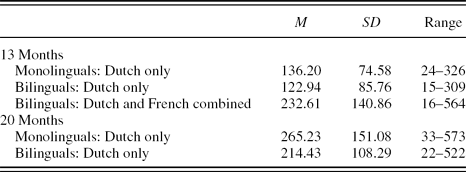
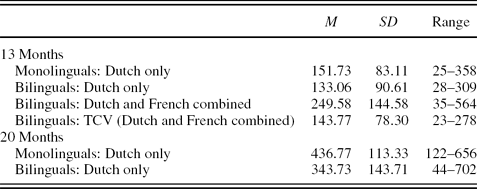
For the comprehension of words that were not produced, we conducted two comparisons. The first involved only Dutch. On average, infant bilinguals understood as many Dutch words as did monolingual infants, t (59) = 0.64, ns, d = 0.17 (Table 2).
13-Month and 20-month comprehension
For monolingual infants, Dutch word comprehension equals their overall word comprehension. When we compared the bilingual infants’ overall word comprehension (combining Dutch and French) with that of the monolinguals, we found that, on average, the bilinguals understood 71% more words than did the monolinguals (Table 2), a significant difference, t (45.91) = –3.36, p ≤ .01, d = –0.90.
There was a large range of variation among children in each group and for each variable, as shown by the standard deviations and ranges (Table 2). The ranges were fairly similar just for Dutch, F (1, 59) = 2.33, ns, but the range was wider for the bilinguals for Dutch and French combined comprehension, F (1, 59) = 18.45, p ≤ .001 (for example, compare 564 words understood for the bilingual child with the most words with only 326 for the analogous monolingual child).
The N-CDI: Toddler (20 months)
For comprehension at age 20 months, we could only compare the Dutch CDI data. The monolingual toddlers understood similar numbers of Dutch words as the bilingual toddlers (Table 2), t (52.58) = 1.50, ns, d = 0.39. As at age 13 months, there was large interindividual variation within each group, but the variation was larger among the monolinguals than among the bilinguals, F (1, 58) = 4.61, p ≤ .001 (Table 2).
Production
The N-CDI: Infant and the F-CDI: Infant data (13 months)
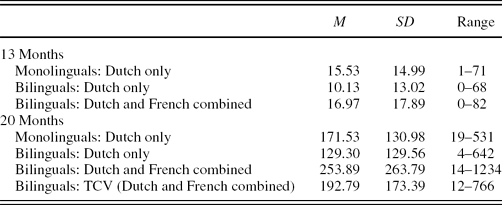
We conducted two comparisons for the children's word production. The first involved only Dutch (Table 3). On average, bilingual and monolingual production did not differ, t (59) = 1.51, ns, d = 0.39.
13-Month and 20-month production
For monolingual infants, Dutch word production equals their total word production. When we compared the bilingual infants’ overall word production (combining Dutch and French) with that of the monolinguals, we found that, on average, the bilinguals and the monolinguals produced similar numbers of words (Table 3), t (59) = –0.34, ns, d = –0.09.
Given the fairly low averages for word production, which are common at the age of 13 months, it is not surprising to find a much smaller range of variation for production than for comprehension (Table 3). Compared to the monolinguals, the bilinguals’ ranges of variation were similar. This was the case for only Dutch, F (1, 59) = 0.81, ns, and for the bilinguals’ Dutch and French combined production, F (1, 59) = 0.84, ns.
The N-CDI: Toddler and the F-CDI: Toddler data (20 months)
We initially looked just at Dutch. On average, the bilingual and monolingual toddlers were reported to produce equal numbers of Dutch words, t (58) = 1.26, ns, d = 0.32 (Table 3). As was the case for Dutch-only comprehension and production at 13 months, variation in Dutch-only production at 20 months was similar for the two groups, F (1, 58) = 0.37, ns.
Comprehension comparisons at 20 months were necessarily limited to Dutch only. For production we also considered the bilinguals’ second language, French. For monolingual toddlers, Dutch word production equals their overall word production. When we compared the bilingual toddlers’ overall word production (combining Dutch and French) with that of the monolinguals, we found that, on average, the bilinguals produced similar numbers of words as the monolinguals (Table 3), t (38.94) = –1.49, ns, d = –0.42.
As was the case for overall word comprehension at 13 months, overall word production at 20 months showed a wide range of interindividual variation, with larger within-group variation for the bilinguals than for the monolinguals, F (1, 56) = 4.09, p ≤ .05 (Table 3). The wider bilingual variation is because the bilingual child with the most words produced 232% more words (1,234) overall than the analogous monolingual child (531). The wider bilingual variation for overall word production at 20 months is different from overall word production at 13 months, when there was similar variation in the two groups.
Comprehension and production compared
The N-CDI: Infant and F-CDI: Infant data (13 months)
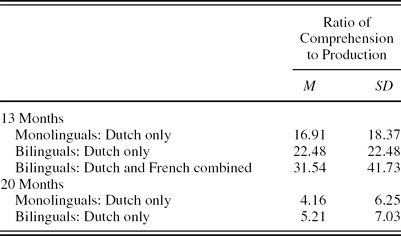
In both groups at age 13 months, production lagged behind comprehension without production (Table 4). We computed ratios of comprehension to production for each child. At 13 months, ratios were over 1.00 (indicating greater comprehension than production) for all children in Dutch and for all but one bilingual child in Dutch and French combined. On average, the monolinguals understood 16.91 words for every word they produced. When only the bilinguals’ Dutch was considered, they understood 22.48 words for every word they produced, a nonsignificant difference with the 16.91 value for the monolinguals, t (56) = –1.04, ns, d = –0.27. For the bilinguals’ knowledge across the two languages, the gap was greater: They understood 31.54 words for every word they produced in French and Dutch combined, but this ratio also did not significantly differ from that of the monolinguals, t (36.54) = –1.71, ns, d = –0.49 (for French, the ratio was 25.46, SD = 25.84, for words understood to words produced).
Ratios between word comprehension and word production for monolingual and bilingual children
The N-CDI: Toddler data (20 months)
At age 20 months, children in both groups understood more Dutch words than they produced (Table 4). In both groups the gap between the numbers of words produced and just understood decreased over the 7-month period between ages 13 and 20 months. Overall, 24 of 30 bilingual children and 19 of 30 monolingual children had ratios over 1.0. There was no difference between the bilinguals and the monolinguals for Dutch: The ratio of Dutch words just understood and Dutch words produced was 5.21 for the bilinguals and 4.16 for the monolinguals, t (58) = –0.61, ns, d = –0.16. (No data for French were available, given the nature of the F-CDI.)
Comprehension and production combined: Total comprehension
Following the tradition established in many CDI studies, we analyzed children's total comprehension. This includes the comprehension of words that were not produced and the comprehension of words that were also produced. Total comprehension is then the sum of what we have so far subsumed under comprehension on the one hand and production on the other hand. The measure of total comprehension is equivalent to children's total word knowledge (total vocabulary size) as measured by the CDI.
The N-CDI: Infant and F-CDI: Infant data (13 months)
We compared the number of different words that the two groups of children knew at 13 months (Table 5). The first comparison involved just Dutch. Infant bilinguals and monolinguals did not differ on total comprehension of Dutch words, t (59) = 0.84, ns, d = 0.21. Variation in Dutch-only total comprehension was also similar for the bilinguals and the monolinguals, F (1, 59) = 1.52, ns.
13-Month and 20-month total comprehension
Dutch total comprehension for the bilinguals represents only a portion of their total comprehension. We therefore compared the bilinguals’ overall comprehension, which includes both of their languages, with that of the monolinguals, which includes only a single language. On average, the bilingual children knew 60% more words than did the monolingual children (Table 5), a significant difference, t (48.17) = –3.25, p ≤ .01, d = –0.86.
We found large interindividual variation in both groups and larger variation in bilingual total comprehension for both languages combined than in monolinguals, F (1, 59) = 16.09, p ≤ .001 (Table 5). This result mirrors what we found for comprehension without production.
The N-CDI: Toddler data (20 months)
We could only compare the Dutch CDI data because we had no comprehension data for French at age 20 months (the same limitation that held for comprehension without production). On the whole, the monolingual toddlers knew more Dutch words than did the bilingual toddlers (Table 5), t (58) = 2.78, p ≤ .01, d = 0.72. There was large interindividual variation within each group (Table 5) that did not differ between the monolinguals and the bilinguals, F (1, 59) = 1.56, ns, reflecting our finding for age 13 months.
TCV: Number of different lexicalized meanings
The N-CDI: Infant and F-CDI: Infant data (13 months)
In computing TCVs for both groups at age 13 months, we did not distinguish between comprehension and production because of the generally low numbers of words produced at 13 months. For the bilinguals this meant that, if they just understood a word in one language, but produced its TE in the other, they were credited with a single lexicalized meaning.
The bilinguals were also credited with a single lexicalized meaning if they understood a word in one language and its other language TE and if they produced a word in one language and its other language TE. In addition, they were credited with a single lexicalized meaning for all CDI items they understood or produced that did not have a TE on the other language form. Total bilingual TCV was the sum of all these single lexicalized meanings.
For the monolinguals, the TCV was the sum of all the words understood and produced (equal to the total comprehension measure). We found no differences between bilingual and monolingual TCVs, t (59) = 0.39, ns, d = 0.10. Rather, we found a wide range of variation among the children in each group that was similar across the two groups (Table 5), F (1, 59) = 0.18, ns.
For the bilinguals, the TCV was generally much lower than the total number of words in their vocabulary, t (30) = 7.92, p ≤ .001, d = 0.95 (Table 5). On average, the bilinguals knew 250 words representing 144 different lexical meanings. For the monolinguals, the TCV was necessarily identical to total comprehension; on average, the monolinguals knew 152 words representing 152 different lexical meanings.
The N-CDI: Toddler and F-CDI: Toddler data (20 months)
For the 20-month data, given the absence of F-CDI comprehension data, only a cross-language comparison of production was possible. Regardless of language, bilingual TCV was the sum of bilingual toddlers’ production of either one or two words making up a TE and of words produced that did not form a TE pair across the N-CDI and the F-CDI. For the bilinguals, TCV production was lower than the overall number of words produced, t (27) = 3.42, p ≤ .01, d = 0.28 (Table 3). For the monolinguals, TCV production was necessarily identical to overall word production. No differences emerged between the bilinguals and the monolinguals in the number of lexicalized meanings produced, t (56) = –0.53, ns, d = –0.14. The variation among children in each group was fairly similar, F (1, 56) = 0.61, ns (Table 3), which mirrors the finding for TCV involving comprehension and production at 13 months.
DISCUSSION
The results of this comparative study of vocabulary size in demographically matched bilingual and monolingual children were presented in terms of comprehension, production, total comprehension, and TCV. Here we structure the discussion of our results in terms of (a) overall vocabulary knowledge (combining both languages for the bilinguals) and (b) Dutch vocabulary knowledge. We chose this format because other studies find different results for overall and single-language vocabulary sizes (e.g., Hoff et al., Reference Hoff, Core, Place, Rumiche, Señor and Parra2012). We also discuss group differences and similarities in interindividual variation. Before concluding, we add a discussion on the importance of sampling.
Overall vocabulary knowledge
There were no significant differences between the bilinguals and monolinguals in our study for overall word production at either 13 or 20 months. This confirms earlier findings in Pearson et al. (Reference Pearson, Fernández and Oller1993) and Hoff et al. (Reference Hoff, Core, Place, Rumiche, Señor and Parra2012). As here, these studies were based on the CDI. However, our findings contrast with those by Águila et al. (Reference Águila, Ramon-Casas, Pons, Bosch and Diez-Itza2007), who found an overall production advantage for bilinguals. The number of words parents could report in their study, however, was far lower than what is possible through the CDI. The difference between the instruments used here and in Águila et al.'s (Reference Águila, Ramon-Casas, Pons, Bosch and Diez-Itza2007) study may help account for the divergent findings. In addition, because Águila et al.'s (Reference Águila, Ramon-Casas, Pons, Bosch and Diez-Itza2007) total list of words was more selective, the monolinguals may not have been adequately assessed.
In both our groups at 13 months, comprehension without production outpaced production. Other studies have so far not directly compared comprehension to production between bilingual and monolingual infants. Overall total comprehension at 13 months, which combined comprehension with and without production, was greater in the bilinguals: When their languages were combined, the bilingual infants in our study on average understood 60% more words than did the monolingual infants. This difference reflects that, when comprehension without production was compared, the bilingual infants on average were reported to understand 233 words for Dutch and French combined, which is 71% more than the monolinguals, who were reported to understand only 136 words.
Bilingual infants thus reached a level of lexical understanding that it takes monolinguals many more months to achieve (cf. the norms tables for the Dutch and French CDIs; Zink & Lejaegere, Reference Zink and Lejaegere2002, and Kern & Gayraud, Reference Kern and Gayraud2010, respectively). One possible reason for the bilinguals’ faster lexical development may lie in the specific nature of bilingual input settings, where hearing two languages rather than one practically guarantees there will be more input variation than in monolingual settings (De Houwer, Reference De Houwer and Brown2006, Reference De Houwer2009). For example, bilingual infants often hear the same meaning expressed by two different word forms, that is, TEs (for a fuller discussion, see De Houwer, Reference De Houwer2009).
The finding that bilingual infants understood more words than did monolingual infants suggests that more diversified language input can lead to more vocabulary knowledge. The ceilings of word learning normally seen in a monolingual population mask that, had their input situation been more varied, word learning could dramatically increase.
Our findings of a comprehension advantage for bilingual infants contrast with those of Pearson et al. (Reference Pearson, Fernández and Oller1993), the only other study to analyze comprehension in young BFLA children. Pearson et al. (Reference Pearson, Fernández and Oller1993) found that for overall total comprehension, bilinguals performed equally to monolinguals. One reason for the discrepancy may be methodological: Pearson et al. (Reference Pearson, Fernández and Oller1993) compared percentile norms rather than raw scores. This strategy neutralizes variation between raw scores, and thus possibly also between language groups, because raw vocabulary score values between 0 and the top score (which lies around 400 for the CDI infant form) are converted to fit into approximately 20 percentile categories. Pearson et al. (Reference Pearson, Fernández and Oller1993) also studied far fewer children at any particular age and did not control for birth status, birth order, family SES, and gender. In addition, Pearson et al. (Reference Pearson, Fernández and Oller1993) collapsed data for children at different ages.
When in our study TEs were taken into account and thus abstraction was made of the actual number of words that the bilinguals knew, the comprehension advantage for the bilinguals at age 13 months disappeared: The bilinguals and the monolinguals knew similar numbers of lexicalized meanings. At age 20 months we found no differences between groups in the number of lexicalized meanings produced. This result concurs with the TCV results in Pearson et al. (Reference Pearson, Fernández and Oller1993), the only other study to consider TCV in BFLA children.
That the numbers of different lexicalized meanings known by bilinguals and monolinguals at age 13 months were the same suggests that learning words and learning to understand lexicalized meanings are not equivalent. In a monolingual environment, it is difficult to tease apart word knowledge and meaning knowledge, and it is certainly not possible to do this on the basis of the CDI. However, in a bilingual context, it becomes clear that learning words and learning meanings are different. In a study of the same group of children at age 13 months (De Houwer et al., Reference De Houwer, Bornstein and De Coster2006), we found that bilinguals knew words from both languages to refer to the same meaning and that they knew meanings that they associated with a word from just one of their two languages. The more words the children knew, the more likely they were to have learned a word in their other language, rather than a word for a meaning they did not yet know in either language.
This finding, and the finding of similar levels of lexicalized meanings known by bilinguals and monolinguals in spite of superior word comprehension in bilinguals, suggests that learning more different meanings does not depend on how many languages a child is acquiring. At the same time, the early word learning advantage for bilinguals at age 13 months shows that, given a communicative need to make sense of one's world, more words can be acquired faster than would be expected on the basis of monolingual data alone.
Because of the lack of comprehension data for French at 20 months, we could not explore the extent to which the overall early lexical comprehension advantage for bilinguals would be maintained later in development.
Single language vocabulary knowledge (Dutch)
Ours is the first study we know of to compare lexical understanding in a single language across BFLA-bilingual and monolingual groups statistically (as Pearson et al., Reference Pearson, Fernández and Oller1993, explain, their comparisons could not be statistically tested because of their small sample sizes). At age 13 months, there was no difference between bilingual and monolingual vocabulary in Dutch comprehension and Dutch total comprehension. However, by the time the participants were 20 months of age, a difference between bilingual and monolingual groups was emerging. There was no difference for Dutch comprehension, but when total comprehension (i.e., words just understood and words both produced and understood) was compared, the monolinguals knew 25% more Dutch words than did the bilinguals. This longitudinal difference for total comprehension may have to do with total comprehension not differing much from comprehension without production (levels of production were low at age 13 months), whereas at age 20 months total comprehension included much higher production levels in addition to comprehension without production.
Had we only considered Dutch comprehension and production as two different scales, we would not have found any bilingual–monolingual difference at 20 months. We included an analysis of total comprehension vocabulary for the Dutch CDI toddler form because this is also done for the N-CDI norming study (Zink & Lejaegere, Reference Zink and Lejaegere2002); CDI toddler norming studies for other languages usually consider word production only, so that analyzing total comprehension for CDI toddler forms is not normally possible. Depending on whether comprehension and production are considered separately or jointly, cases can be made for both a monolingual advantage at 20 months for just Dutch and for no difference. The emphasis depends on whether one considers comprehension and production as being similar or different aspects of word knowledge. Our study further found that in both groups at both ages, Dutch comprehension outpaced Dutch production.
Neither at age 13 nor at age 20 months were there any bilingual–monolingual group differences for Dutch production. No previous studies have compared early production by BFLA infants to that of monolinguals. Our finding for the toddlers confirms Pearson et al. (Reference Pearson, Fernández and Oller1993), but it contradicts the findings by Hoff et al. (Reference Hoff, Core, Place, Rumiche, Señor and Parra2012), who compared somewhat older (22, 25, and 30 months) bilingual children's English vocabularies with those of English monolinguals. There are three main possible explanations for the disparity in the findings. First, the children in Hoff et al.'s (Reference Hoff, Core, Place, Rumiche, Señor and Parra2012) study were older than those in the present study, and it is possible that as they get older, bilingual children start to produce fewer words in a particular language than do monolingual children because they are speaking their other language more frequently (an interpretation that helps to explain why Hoff et al., Reference Hoff, Core, Place, Rumiche, Señor and Parra2012, found no differences between overall bilingual and monolingual production, in spite of the differences for just English). Second, the greater homogeneity in the groups in our study may explain some differences in findings: unlike the present study, Hoff et al. (Reference Hoff, Core, Place, Rumiche, Señor and Parra2012) did not control for birth order, and their monolingual group had nine more firstborn children than their bilingual group. Children with older siblings may have less access to adult language input than firstborn children, even if in bilingual homes older siblings play a supporting role for the majority language (Bridges & Hoff, Reference Bridges, Hoff, Chan, Kapia and Jacob2008). As Hoff et al. (Reference Hoff, Core, Place, Rumiche, Señor and Parra2012) indicate, the bilingual children in their study who heard substantially more English than Spanish at home did not differ from the monolinguals in English word production, suggesting that amount of input is an important explanatory factor. Third, the two studies likely differ in data collection procedures. Hoff et al. (Reference Hoff, Core, Place, Rumiche, Señor and Parra2012) give no information about who filled out their CDI forms, opening the possibility that just a single rater filled out the CDI forms for both languages. We collected data from more than one reporter. This is especially important in bilingual homes because the two parents may speak to their child in different languages and so may not hear the child speak the other language. If, for instance, a mother who usually spoke Spanish to her child and in turn usually heard her child speak Spanish to her was the only one to complete the English CDI in Hoff et al. (Reference Hoff, Core, Place, Rumiche, Señor and Parra2012), the information on the English CDI would likely be incomplete. A person who had regularly heard the child speak English would have to complete an English CDI form as well for the information to be more complete (i.e., contain more checked items).
Even if parents speak two languages to a child, children will not necessarily respond in two languages (De Houwer, Reference De Houwer2009), and parents will again only be able to fully complete the CDI for a single language. Even if children use both languages with a single parent, a more complete picture of the child's use of two languages can only be gained by having additional persons fill out the CDI. Finally, in bilingual families with an older and a younger child (there were several of these in the Hoff et al., Reference Hoff, Core, Place, Rumiche, Señor and Parra2012, study), parents may have difficulty remembering what words the younger child said in which language and may be more prone to emphasize the language they themselves usually speak to the child when checking items on a CDI form.
As Hoff et al. (Reference Hoff, Core, Place, Rumiche, Señor and Parra2012) did, we compared bilingual children's word knowledge to that of monolingual children for only a single language. It is better to be able to compare bilingual data to monolingual data for two languages (a comparison with Spanish monolinguals might not have revealed a production disadvantage for Hoff et al.’s, Reference Hoff, Core, Place, Rumiche, Señor and Parra2012, bilingual children). For the production part of their study, Pearson et al. (Reference Pearson, Fernández and Oller1993) attempted such a comparison, but because of the small size (n = 3) of their Spanish-speaking comparison group, the findings are tenuous. Only Águila et al. (Reference Águila, Ramon-Casas, Pons, Bosch and Diez-Itza2007) compared BFLA data to each of two larger monolingual groups. However, the very high degree of lexical overlap between the two languages in their study, Spanish and Catalan, and the relatively low number of lexical items investigated make it difficult to interpret their findings. There is indirect information for each language separately on the same children in the present study through an earlier comparison with percentile norms for Dutch and French (De Houwer, Reference De Houwer and Cruz-Ferreira2010). This comparison identified more bilingual children performing in the top 20% than would be expected from monolingual norms in each language. At the same time, for each language separately there were proportionally as many children below the 10th percentile as would be expected from monolingual norms. These findings support the conclusion that the bilinguals in our study were generally performing at the level of monolinguals or better when just a single language was being compared.
Overall and single language vocabulary knowledge: Summary
In sum, we found bilingual–monolingual differences for overall comprehension and total comprehension at 13 months, where the bilinguals outperformed the monolinguals, and for total comprehension in a single language (Dutch) at 20 months, where the monolinguals outperformed the bilinguals. For 12 other comparisons covering both overall and single language measures, however, we found no group differences.
Taking into account only measures for comprehension and production separately, we found no bilingual–monolingual differences for Dutch and just a single difference (out of three comparisons) when the bilinguals’ languages were combined; that is, bilingual infants understood 71% more words than did monolinguals. For the young bilinguals and monolinguals in the present study, the number of languages being acquired did not appear to generally affect vocabulary size.
Differences and similarities in interindividual variation
In addition to group averages, we investigated group differences in interindividual variation. We found wide interindividual variation in the bilingual and monolingual children for all measures. In both groups, overall and Dutch production at 13 months showed a narrower range of variation than any other measure (this most likely relates to the low levels of production at this age). In addition, the range of variation within each language group was generally similar: When we compared the ranges of variation for the bilingual children with those for the monolingual children, we found no differences for eight comparisons (at 13 months: overall and Dutch production, Dutch comprehension and Dutch total comprehension, and TCV; at 20 months: Dutch production and Dutch total comprehension, and TCV), greater variation in bilinguals for three comparisons (at 13 months: overall comprehension and overall total comprehension; at 20 months: overall production), and greater variation in monolinguals for just one comparison (at 20 months: Dutch comprehension).
The greater variation within the bilinguals compared to the monolinguals for overall comprehension and total comprehension at 13 months reflects the finding of overall greater comprehension and total comprehension vocabulary size in bilinguals at that age. As pointed out above, bilinguals are most likely to hear many more different word types across their both languages combined than are monolinguals in their single language. Because of this circumstance, it is to be expected that, as bilingual children grow older, their overall comprehension vocabulary and the bilingual variation in comprehension continues to be greater than that of age-matched monolinguals, although the differences with monolinguals may become smaller as more and more language specialization emerges. Our study was unable to investigate this issue longitudinally because of the lack of French comprehension data at 20 months.
The greater variation for overall production at 20 months in the bilinguals is because when Dutch and French words were combined, average word production was much higher in the bilingual group (254 words for the bilinguals and 172 for the monolinguals; however, there was no statistical difference in overall production at 20 months for bilinguals and monolinguals).
That we found nearly the same range of variation in lexical meaning knowledge for bilinguals and monolinguals (see the TCV analyses) most likely reflects that young children share fairly similar worlds, with food, drink, sleep, play, and objects around the house fairly similar, at least in the same society and social class. It is not the things talked about that are necessarily more diverse in a bilingual family setting (all else being equal), but the words used to refer to them.
We identified lexical meanings and TE pairs from an adult perspective, which may not be the same as the child's. That is, words we place in a TE pair are not necessarily identical in meaning to a bilingual child. For example, a child may interpret French chapeau to refer to all hats but Dutch hoed only to the hat that the child's father wears, even though French chapeau and Dutch hoed refer to much the same category of objects in adult speech across both languages. Young children's lexicalized meanings often differ from those of adults, regardless of whether children are reared bilingually or monolingually (Clark, Reference Clark1993; De Houwer, Reference De Houwer2009). The meanings that both young bilingual and monolingual children attribute to lexical items are not stable or predictable (Clark, Reference Clark1993; De Houwer, Reference De Houwer2009). We acknowledge the importance of these issues, but the nature of the data does not allow us to include them in our TE analysis.
The importance of sampling
In comparisons between groups to determine whether the number of languages explains interindividual variation, group sampling is important. For example, our sample was designed to be fairly homogeneous in terms of SES. SES is a meaningful variable in early monolingual lexical development (e.g., Hart & Risley, Reference Hart and Risley1995). Lower SES bilingual groups may not have done as well as our bilingual group, but in a comparison with similarly low SES monolingual children, we may see similar comparative profiles to what we found in this study. This question remains to be investigated. In bilingual–monolingual comparisons such as Pearson et al.'s (Reference Pearson, Fernández and Oller1993), where raw CDI scores are compared to CDI percentile norms, it is important to take into consideration that CDI norms are generally based on a middle-class sample and that applying CDI percentile norms to low SES bilinguals may not be valid.
It is widely recognized that bilingual learning environments are highly variable (e.g., Pearson, Fernández, Lewedeg, & Oller, Reference Pearson, Fernández, Lewedeg and Oller1997), and so our findings may not generalize to other bilingual samples. Our sample was recruited to be homogeneous in terms of the kind of bilinguals: All bilingual children had had regular input in two languages from birth and most of them heard their parents address them in a single language. Other bilingual children may usually hear their two languages from the same individual, may start learning a second language only once they have started speaking a first, may end up replacing their first language by their second, and so forth. These different kinds of circumstances may lead to apparent differences with monolinguals. To make valid bilingual–monolingual comparisons, variables other than the number of languages being acquired should be excluded to the extent possible, as done in our study. Bilingual–monolingual comparisons involving other kinds of bilinguals may yield different results. For instance, in an aggregate analysis of published data, Bialystok, Luk, Peets, and Yang (Reference Bialystok, Luk, Peets and Yang2010) compared English Peabody Picture Vocabulary Test standardized scores from 772 monolingual English children and 966 bilingual children between the ages of 3 and 10. Bilinguals knew English and any one of several other languages. Monolinguals outperformed bilinguals at every yearly age level, leading the authors to conclude that “bilingual children tend to know fewer words in one of their languages than comparable monolingual speakers of that language” (Bialystok et al., Reference Bialystok, Luk, Peets and Yang2010, p. 529). The bilingual children in that study mostly had a non-English language at home (E. Bialystok, personal communication to the first author, January 2, Reference Bialystok, Luk, Peets and Yang2010), and hence did not necessarily start to hear English, the language they were tested in, beginning at birth. As such, many were likely acquiring English as a chronologically second language. Thus, they likely had had less overall time and presumably less exposure than the monolinguals to English. This factor, rather than that the bilinguals were acquiring two languages, could explain the bilingual–monolingual differences found in Bialystok et al. (Reference Bialystok, Luk, Peets and Yang2010).
In addition to sampling, the measurement instrument used could contribute to bilingual–monolingual differences. For example, specific Peabody Picture Vocabulary Test items may represent words that a bilingual person happens to understand in the language that is not being tested. Bilinguals typically discuss certain topics mainly or only in one language (Oller, Pearson, & Cobo-Lewis, Reference Oller, Pearson and Cobo-Lewis2007, called this the “distributed characteristic” of bilingual word knowledge and use). When Bialystok et al. (Reference Bialystok, Luk, Peets and Yang2010) explored this possibility in a subsample of 87 bilingual and 75 monolingual 6-year-olds, they found that bilinguals performed equally on test items that were related to school contexts (which are shared by bilinguals and monolinguals) but worse on vocabulary items relating to home contexts, which, typically, bilinguals would be familiar with through a language other than English.
Summary and conclusions
Controlling for many common sampling variables, our study of young bilinguals and monolinguals revealed an overall lexical comprehension advantage at 13 months for bilinguals, who understood more words when both their languages were taken into account. We found a monolingual advantage for Dutch total comprehension (combining comprehension with and without production) at 20 months. None of the remaining (12) comparisons revealed a group difference. Interindividual variation within each group was mostly similar for the bilinguals and the monolinguals.
Looking at a range of different measures for a hitherto unexplored language combination, our study finds no evidence of consistent differences between young bilinguals’ and monolinguals’ vocabulary sizes. The number of languages (two vs. one) that young children are learning appears not to be a central factor in explaining variability in vocabulary size.
Exposing children to two languages from birth does not slow down lexical development. That some individual bilinguals comprehend and produce more words than some of the best performing monolinguals underscores that learning two languages does not compromise lexical development. If compared to monolingual norms, some bilingual children seem slow in lexical development, parents and speech professionals should try to understand what causes the delay, rather than attribute it to bilingualism. Hearing problems have to be excluded, and the child's language input experiences have to be taken into consideration. Hart and Risley (Reference Hart and Risley1995) demonstrated how important input frequency is for monolingual children; Song, Tamis-LeMonda, Yoshikawa, Kahana-Kalman, and Wu (Reference Song, Tamis-LeMonda, Yoshikawa, Kahana-Kalman and Wu2012) and Hoff et al. (Reference Hoff, Core, Place, Rumiche, Señor and Parra2012) showed that input is of equal importance for bilingual children. Instead of focusing on bilingual–monolingual comparisons, examining variation in children's language exposure, regardless of the number of languages they are acquiring, holds better promise for understanding the large variability in early lexical development.
ACKNOWLEDGEMENTS
We thank the families who took part in this study. We also thank S. De Coster and H. Gehot for the TE analyses. We are grateful to the anonymous reviewers for supportive and helpful comments on an earlier version of this paper. This research was financed by grants from the University of Antwerp, Belgium (to A.D.H) and was supported by the Intramural Research Program of the NIH, NICHD.