


Introduction
Does the threat of automation to workers’ employment provoke distinct policy preferences from the threat of globalization (such as job offshoring)? If so, how are the preferred policies to respond to such structural changes different? While there is a rich literature on how globalization affects public support for policies such as compensatory redistribution or protectionism (beginning with Cameron Reference Cameron1978), and a recent increase in studies on how automation affects various preferences in response (see Gallego and Kurer Reference Gallego and Kurer2022 for one overview), few studies directly compare the impact of these structural threats on public policy preferences.
This paper addresses this gap by articulating simple expectations of which structural threat should induce different policy preferences. We compare the impact of hypothetical automation-based and openness shocks on preferences toward policies dealing with their unemployment consequences. We focus on two policy dimensions to address these economic shocks: one dimension in the form of compensatory policies to address welfare losses to specific workers via redistribution (including recent proposals of the basic income) and retraining programs, and a second dimension of “protectionist interventions” that attempt to preempt employment disruption.
These structural changes have affected large portions of the workforce in advanced industrialized states over the last 40 years. Salaries of the median worker in these countries have increased little (Milanovic Reference Milanovic2016), and many countries have experienced forms of job polarization where wage gains and occupational opportunities have accrued more heavily toward more educated workers, leaving traditional middle-class workers behind economically (e.g. Goos et al. Reference Goos, Manning and Salomons2009). These trends have correlated with increasing political disaffection, such as increased electoral abstention and heightened appeal of populist parties (Boix Reference Boix2019), although such patterns of course cross-nationally differ due to variations in political and economic institutions and corresponding policies (Iversen and Soskice Reference Iversen and Soskice2019).
The relative magnitudes of the competing long-term structural causes of such job polarization and corresponding inequality and stagnant wage growth remain debated. Much literature documents the effect of trade openness and production offshoring on worker wages (e.g. Wood Reference Wood2018). This research tradition also finds a strong correlation between such openness and demand for social protection to try to compensate for job loss (Rodrik Reference Rodrik1998). Regardless of whether openness via trade and offshoring still greatly threaten job security in advanced industrialized democracies, such issues remain politically salient, as the appeal of many populist parties is based on forms of economic protectionism or nationalism (Colantone and Stanig Reference Colantone and Stanig2018; Milner Reference Milner2021).
However, in the last decade, there has been growing attention to automation as another major structural threat to worker security and cause of job polarization; digital and robotic technologies have disrupted labor markets, and there is increasing evidence of the negative impact of robotization, automation, and artificial intelligence on the existence of many jobs (Acemoglu and Restrepo Reference Acemoglu and Restrepo2018). Recent studies find a net negative impact of specific technologies, such as industrial robots, on employment and wages in local labor markets in the USA (Acemoglu and Restrepo Reference Acemoglu and Restrepo2020) or wages in Germany (Dauth et al. Reference Dauth, Findeisen, Südekum and Wößner2021).Footnote 1
Despite the importance and controversy of this structural threat, relatively few studies directly compare what policies workers prefer to address these distinct structural changes. Do workers respond to job losses from automation differently from those caused by openness? Much of the political-economy literature on the preferences for compensatory redistribution or protection in response to increased globalization was developed prior to the rise and understanding of the role that rapid automation has played in reducing job security across countries. Further, there remains a limited literature on the policy preferences of workers to respond to automation, in particular beyond compensation (Gallego et al. Reference Gallego, Kuo, Manzano and Fernández-Albertos2022).
To address this question, we gather new data and experimental evidence on public preferences for different government policies to respond to these different structural changes. In contrast to most empirical studies which analyze the effect of individual labor-market vulnerability on preferences based on various models of self-interest, we focus on preferences for government actions that would assist hypothetical workers. We use an experimental design that compares how automation versus openness shocks affect preferences for different compensation policies (direct redistribution, retraining, and the more recent extreme policy of the basic income), versus preferences for prevention.
We present evidence from Spain, which has experienced job loss due to automation and where openness issues remain salient. Our data are from two embedded survey experiments that present respondents with hypothetical cases of workers affected by technological and openness-based causes of unemployment and ask about government policies in response. The general approach of both experiments is to assess how these structural challenges affect preferences for different policies to help affected workers. The first experiment presents short vignettes of firms closing down for distinct reasons that are randomly manipulated; the scenarios are about a firm replacing its domestic workforce with a foreign workforce or with robots, across culturally similar and dissimilar countries. The second experiment is a conjoint design that presents pairs of hypothetical unemployed workers that vary, among other information, the cause for the worker losing her job. Then we ask which unemployed worker should receive a basic income (BI)-like instrument to assess whether technological unemployment or different types of openness shocks make affected workers viewed to be “more deserving” of this policy.
We obtain the following main findings. In the firm-vignette experiment, we find no evidence that automation (robot substitution) as a source of job loss induces different redistributive demands. However, we find that individuals are more likely to prefer the government to prevent firms from moving when they replace existing workers with foreign workers than when they replace them with robots. While compensation via redistribution to workers is generally more popular than protectionism, worker-oriented openness shocks provoke more support for protectionism relative to robotization shocks.
Similarly, in the conjoint experiment, we find that job loss due to technological change does not make the hypothetical recipient more or less “deserving” of support for a transfer than job loss due to other economic causes unrelated to the worker, such as offshoring or bad firm management. Our results indicate that despite recent attention to automation as a source of job insecurity and major change to occupational distributions, it does not provoke more desire for redistribution than openness shocks. Rather, openness threats (at least via offshoring) are linked with support for preventive protectionist measures more so than automation-induced change.
Section 1 of the paper reviews the relevant motivating literature for the design and presents theoretical expectations. Section 2 presents the design and results from the firms-vignette experiment. Section 3 does so for the conjoint experiment. Section 4 discusses implications.
Section 1. Relevant literature and expectations
Relevant literature
The labor-market consequences of international trade and offshoring have been amply discussed in the comparative and international political economy literature, whereas the job changes and redistributive implications of automation have received only recent but growing scholarly attention among social scientists and policymakers.Footnote 2 While most labor economists agree that digital technologies such as computers and robots have generally increased economic efficiency and productivity of firms and organizations, there remains disagreement and uncertainty about the magnitude of job disruption caused by innovations such as computerization, automation, robots, and artificial intelligence (AI). Recent studies document job polarization due to automation and existential threats to current occupational structures, and Frey and Osborne’s prediction that 47% of jobs could be lost to automation in the next 20 years is one salient example of a dire prediction (Reference Frey and Osborne2017). Acemoglu and Restrepo find a negative impact of robots on local employment in the US local labor markets (Reference Acemoglu and Restrepo2018, Reference Acemoglu and Restrepo2020). There is more agreement that the introduction of digital technologies in the workplace has generated unequal welfare consequences among workers. These technological shocks have created new high-skilled job opportunities and raised the salaries of more educated employees, but other workers have accelerated automating repetitive tasks and thus caused the substitution of many workers in routine jobs, often in manufacturing and administration (e.g. Acemoglu and Autor Reference Acemoglu, Autor, Ashenfelter and Card2011; Autor and Dorn Reference Autor and Dorn2013; Goos et al. Reference Goos, Manning and Salomons2014; Oesch Reference Oesch2013). These processes have occurred in Spain, the evidence site for this paper; automation has reduced employment in middle-income and high routinization jobs such as retail banking and select manufacturing sectors (Sebastian Reference Sebastian2018).Footnote 3 Spain, like most OECD countries, has experienced a large increase in the importance of abstract tasks in the occupational structure from 2005 to 2015, and less demand for occupations with routine and thus more automatable tasks (Biagi and Sebastian Reference Biagi and Sebastian2017). More broadly, longitudinal studies that trace the long-term work trajectories of “routine-task” workers (Kurer and Gallego Reference Kurer and Gallego2019) find that a sizable number of job changes (especially downgrades) are caused by technological change.
Both automation and openness have apparently had large political consequences. While the causal chain remains contested, recent research finds that in terms of voting consequences, workers who are more vulnerable to automation are more likely to support radical right-wing parties in Europe (Anelli et al. Reference Anelli, Colantone and Stanig2019; Im et al. Reference Im, Mayer, Palier and Rovny2019; Kurer Reference Kurer2020) or shift to support Trump in the USA (Frey et al. Reference Frey, Berger and Chen2018). Other findings indicate that automation has increased political support for parties that promise some form of redistribution toward native workers (Kurer and Palier Reference Kurer and Palier2019; Gingrich Reference Gingrich2019). Boix (Reference Boix2019) argues that the ICT revolution caused increasing voter apathy and partisan decline. Similar claims were made regarding the long-term effect of trade openness on undermining support for mainstream left-wing parties and increasing support for populist right-wing parties (Burgoon Reference Burgoon2009). Yet other correlational evidence indicates that vulnerability to offshoring increases support for mainstream left-wing pro-redistribution parties (Rommel and Walter Reference Rommel and Walter2018). One of the empirical debates is whether compensatory redistribution measures have simply been insufficient in reducing support for protectionism and parties that espouse it (Gingrich Reference Gingrich2019; Colantone and Stanig Reference Colantone and Stanig2018); Swank and Betz (Reference Swank and Betz2003) present evidence that more generous welfare states in the post-war era were able to prevent greater turns toward populism, with Milner (Reference Milner2021) indicating limited effects of such compensation.
While there has been an understandable preoccupation with the political consequences of these structural challenges to workers, there remain surprisingly few studies that directly compare the impact of each challenge on different socio-tropic policy responses.Footnote 4 One of the challenges is that many threatened occupations have tasks that render them vulnerable to both openness (via cheaper production offshore) and automation (Owen Reference Owen2019). Further, there is little attention to examining policies that are more explicitly “other-regarding,” as opposed to the intellectual focus on policies whose support is more motivated by direct self-interest.
Policy preferences in response to openness and automation
Regarding responses to globalization, much of the large literature is on support for government redistribution (either via direct compensation or retraining or redistribution) as a response to unemployment caused by openness. Simplifying, a wealth of literature documents a strong correlation between aggregate trade openness and types of social spending (e.g. Rodrik Reference Rodrik1998; Hays et al. Reference Hays, Ehrlich and Peinhardt2005; Burgoon Reference Burgoon2009). At the individual level, there is much evidence for the connection between individual-level openness risks and support for compensatory redistribution (generally in the form of greater social spending) in many advanced industrialized democracies. Most pertinently, Walter finds European evidence that job vulnerability to trade or offshoring increases demand for compensatory social policies (principally among the affected low-skilled individuals) (Reference Walter2010, Reference Walter2017).
Another policy option in response to these structural shocks of openness is some form of protection or prevention of such openness, as discussed by Colantone and Stanig (Reference Colantone and Stanig2018). They note that political parties or governments might prefer reducing openness to protect economic losers more directly from globalization (particularly as fiscal costs to forms of compensation increase). Individuals can support prevention (or protection) as a substitute or complement to the oft-studied policy of compensation for economic losses associated with labor-market threats. In this vein, there is a rich observational literature on correlates of supporting protectionism (in trade or offshoring). While most studies find that a majority supports free trade and various forms of economic openness, Owen and Johnston (Reference Owen and Johnston2017) find using cross-national data that occupational task routinization and offshorability are jointly correlated with support for trade protection, and Mansfield and Mutz (Reference Mansfield and Mutz2013) demonstrate with US data that nationalism (in their view more so than economic self-interest variables) increases opposition to offshoring.
The literature on the impact of automation on policy preferences is more preliminary and mainly concentrated on the outcomes of compensation and income redistribution. In a seminal study, Thewissen and Rueda (Reference Thewissen and Rueda2019) found with observational European evidence that routine-task intensity (RTI) is correlated with support for compensatory redistribution. Building on this study, the empirical focus has been on the assessing the correlation between different measurements of “self-interested” automation risk and forms of compensation. Overall, the evidence regarding various compensatory policies – such as support for passive redistribution, active redistribution, universal basic income, and active labor-market policies – indicate mixed findings about whether technological risk correlates with types of compensatory policies (for reviews, see Gallego and Kurer Reference Gallego and Kurer2022; Busemeyer et al. Reference Busemeyer, Gandenberger, Knotz and Tober2023; Weisstanner Reference Weisstanner, Clegg and Durazzi2023). For example, some recent evidence indicates that workers concerned about automation are less likely to support active labor-market policies (Busemeyer and Sahm Reference Busemeyer and Sahm2022; Kurer and Häusermann Reference Kurer, Häusermann, Marius, Achim, Kees and Paul2022; Busemeyer et al. Reference Busemeyer, Gandenberger, Knotz and Tober2023).Footnote 5 Gallego et al. (Reference Gallego, Kuo, Manzano and Fernández-Albertos2022) consider as well protectionist policies and find evidence that technological risk correlates with support for such policies.
This study contributes to the debates on policy preferences in response to openness and automation in two main directions. First, while most of this literature proceeds from classical models of worker self-interest,Footnote 6 this study focuses on support for policies that affect other economically harmed workers. It examines public support for more “other-regarding” policies, as opposed to the focus on policies whose support is more motivated by direct self-interest.Footnote 7 Second, while the literature has been mainly concerned with the political consequences of different structural changes in isolation, our study aims to compare different types of policy responses, between globalization and automation. The closest design to the first experiment is Di Tella and Rodrik (Reference Di Tella and Rodrik2020); we discuss their results in the next section.
Basic-income policies
Partially in response to the concerns posed by rapid automation, politicians and policy entrepreneurs have accelerated consideration for a more extreme response to structural changes in the labor market, which is a basic income. This proposal is considerably more ambitious than the policy initiatives discussed above. One of the premises is that existing social policies are insufficient in facilitating a long-term response to changes in employment structure (as well as a belief that employment for some will simply become impossible), and thus a more expansive permanent form of redistribution is needed. We briefly consider the literature on this more extreme but also widely discussed policy response to massive structural changes to the workforce. A basic income is an unconditional cash transfer with no conditions for receipt nor time limits, discussed as a potential solution to mass technological unemployment (e.g. Van Parijs Reference Van Parijs2004; Gentilini et al. Reference Gentilini, Grosh, Rigolini and Yemtsov2020). Several localities in Finland have recently fielded such a policy. One of the justifications for these local-level trials is the concern that the rapid pace of technological innovation makes the skills of some workers obsolete and thus difficult for them to re-enter the labor force.Footnote 8
Although the idea of a basic income (universal or not) has been in the discussion of various responses to long-term structural shocks for over a decade, there remain few studies of the individual-level correlates of support for it. The most recent study by Vlandas (Reference Vlandas2021) uses European Social Survey data from 2016 to 2017 and finds that a straightforward universal basic income (UBI) is more supported by younger, low-income, left-leaning individuals, and the unemployed; individuals with positive views of benefit recipients, and/or high trust in political institutions are also more supportive. At the country level, support tends to be higher where existing redistribution benefit activation is more pronounced and unemployment benefits are less generous. Vlandas notes across many countries that there is majority or near-majority support for UBI, with many large pluralities “strongly supporting” a UBI. Dermont and Weisstanner (Reference Dermont and Weisstanner2020) specifically test for a correlation between unemployment risk by automation (measured using routine-task intensity) and support for the UBI, finding no link between the two variables.
Study motivation and expectations
This study builds on the existing literature on policy preferences in several ways. It more explicitly compares in a causal fashion the effect of automation-based and openness shocks on support for various policies to address such potential threats. The experimental designs of the paper cover a wider range of policies than is typically assessed in one sample; we consider two categories of policies aimed at moderating the unemployment impact on the economic conditions of individuals (direct redistribution and worker re-training), as well as protectionist measures that intervene at the market and firm levels to prevent the very realization of shocks. We also consider in a separate design support for a hypothetical basic-income policy, a policy which is increasing in political salience (and building on previous studies, examine whether causes of worker unemployment affect UBI support).
Proceeding to our expectations, we start from the standard economics argument that the most efficient policy to address the labor-market losses of trade openness (as well as other forms of worker substitution) is direct redistribution to compensate economic losers, rather than protectionism or prevention of such change. Although transfers to negatively affected workers imply increased taxation, most economists agree that this cost is less distortionary than the costs of protectionism or regulations deterring technological changes. Our results, as in the case of Tella and Rodrik’s US results (2020) (discussed more below), seem to indicate that people are aware of these differential policy costs, since more individuals across all experimental groups, regardless of the type of structural shock, prefer unemployment benefits or training programs as a response; this is preferred over governmental interventions to prevent firms from offshoring or preventing the introduction of robots in production processes.
Our main interest, however, is to assess whether automation-based shocks, the focus of recent public and scholarly concerns, cause stronger or distinct policy reactions from openness shocks. We first consider simple hypotheses regarding preferences for policies to “prevent” economic shocks. We hypothesize that on aggregate individuals will prefer protective measures when the source of worker substitution comes from offshoring or openness, more so than the policies of preventing the introduction of robots in the workplace. That is, prevention of openness is expected to be more strongly preferred to prevention of automation. Several reasons guide this expectation. First, there are visible out-groups who benefit from offshoring (such as individuals in other countries). Technological shocks are typically linked to “structural processes” that do not have obvious out-groups associated with them (Rodrik Reference Rodrik2018). As the existence of out-group beneficiaries might have a mobilizing effect regarding protection, automation-based scenarios should produce overall less demand than offshoring scenarios for policies to prevent the negative shock. In other words, workers should prefer production to continue to take place domestically (Mansfield and Mutz Reference Mansfield and Mutz2013) when the threat to that production is associated with an outgroup benefitting from it, compared to when an outgroup does not exist.
Second, efficiency losses associated with policies preventing firms from offshoring could be viewed as lower than losses associated with measures impeding the substitution of workers with robots. This could be due to common media framings that tend to place more weight on the positive spillovers of automation, making them more salient, as opposed to those of globalization. In the case of automation prevention, individuals could perceive these restricting measures as reducing the productivity and competitiveness of domestic firms. For example, policies to prevent automation could reduce positive spillovers that could potentially be accrued to other domestic economic agents, such as the gains from the use of technology, or an increase in tax revenue when companies become more productive.Footnote 9 Technological change and the introduction of robots might be more associated with progress, economic growth, and reduced prices of consumer goods. In the case of protectionist policies aimed to prevent offshoring, the domestic production of affected companies would be less efficient, but workers could potentially view this cost as being limited to certain firms and economic sectors, rather than the entire economy (that is, there would be less likelihood of positive spillovers being foregone). In sum, given the relative media underemphasis on overall welfare gains via lower prices from openness (Gallego et al. 2019), individuals may have more positive views about technology than about offshoring. Therefore, any policy aimed at slowing down automation might be viewed less favorably.Footnote 10
Regarding whether openness or automation shocks might provoke greater demand for redistribution toward those negatively affected, for analogous reasons, we expect that on average, openness exposure should trigger a more direct demand for the government to intervene regarding direct compensation than in the case of technological change. The first reason is related to similar support for protectionism as a response: the role of out-groups and non-domestic “winners” should increase preferences for redistribution for those economically hurt by such out-groups. Second, as automation may be viewed to be more of a natural structural change, workers hurt by such change might be viewed as less deserving of transfers or support.Footnote 11
Section 2. Vignette experiment on firm closure
To assess the role of automation versus openness shocks on these different policy preferences, we fielded an online survey in Spain to a sample of 3,100 individuals in the workforce between 18 and 64 years old in November and December 2018.Footnote 12 The sample was stratified by gender, age, and level of education (lower secondary or less, secondary, and any university) to approximate representativeness of the working-age population. The first experiment assesses preferences for policies to respond to scenarios of automation and offshoring, including compensation, training, and protection (or prevention). The second experimental design looks at how various reasons for job loss might affect support for a BI type instrument to assist such workers.
In our first test, we examine if workers prefer different policies when they observe unemployment caused by technological change compared to unemployment caused by openness. To address this question, we present individuals with a simple vignette about a hypothetical firm in Spain closing down and measure policy responses to this situation. To elicit causal effects, we randomly provide respondents with different versions of the vignette, each of which highlights a distinct reason for the firm closing down. The reasons are due to automation (substitution of workers by robots), substitution by human workers, and offshoring production to a foreign country. We also distinguish between offshoring to a country that is culturally similar (Portugal) versus one that may be viewed as more of a cultural threat (China), to compare the effect of openness toward countries that are more culturally distinct (e.g. Mansfield and Mutz Reference Mansfield and Mutz2013). The vignettes are designed to be simple text embedded in the assessment of the policy preference to maximize attentiveness. The text of the question was as follows, with “/” denoting six separate versions of the question. Respondents were assigned to each version with 1/6 probability.
“Imagine that a company based in Spain is in the process of restructuring. The management decides to dismiss almost all workers and move the production to a new headquarters in [another region of Spain/Portugal/China] where new workers [will be hired/will not be hired because it will be totally operated by robots].”
This simple design allows us to measure the impact of different types of job loss on support for policies.Footnote 13 Our main dependent variables of interest are distinct policy options. After reading this vignette, the individual read the following questions, covering policies of direct financial compensation, re-training, and prevention. The question was, “Are you in favor or against the government taking the following measures in situations like this, bearing in mind that they entail economic costs?” The three policies were: “Compensate the dismissed employees with a subsidy,” “Offer the dismissed training programs,” and “Prevent the company from making this change.” Response options for all three policies were “strongly against, against, neither in favor nor against, in favor, strongly favor,” with higher values indicating higher agreement.Footnote 14
Demographic-variables measurement
To assess the correlation between previously hypothesized demographic variables and policy preferences, we also collected demographic data of gender, age, education, employment status, and income, and in additional specifications control for such variables. Female gender is coded as 1, age is recoded in nine categories between 18 and 64, education is coded into two categories (any university or vocational training as 1 and the rest 0), employment contract status is coded as four separate binary indicators (indefinite, fixed-term, self-employed, and unemployed), and household income is recoded into heptiles. To facilitate exposition of results, unless otherwise noted, we show coefficients for binary indicators for each of the above demographic variable categories.
We also gather data on the respondent’s occupation at the 2-digit ISCO code. We utilize the occupation code to calculate two prominent indicators of objective risk of technological automation. The most widely used measure of risk codes the RTI in an occupation based on occupational dictionaries from 1990. This method builds from the claim that routine tasks are easier to codify and automate (Autor et al. Reference Autor, Levy and Murnane2003). To measure RTI in a survey context, we asked all respondents about their employment situation and, to workers or unemployed respondents, which occupation at the 2-digit ISCO code level best describes their current or previous job. From this, we assigned the RTI score calculated by Sebastian (Reference Sebastian2020) for occupations in Spain based on the method described in Autor et al. (Reference Autor, Levy and Murnane2003), with higher values of RTI indicating higher routinization; this variable is labeled RTI.Footnote 15 We do this to assess the correlation between these risk indicators and different policy preferences, and also use them to test conditional treatment effects of such risks. Part B of the SI presents descriptive statistics for the main variables of interest.
Results
We wish to assess if replacement via robots provokes any difference in support or prioritization of policies relative to replacement via workers (either in the domestic or foreign contexts). This design allows us to learn if individuals believe that economic job losses caused by robots call for any type of different policy responses; we can also assess the effect of this occurring domestically versus abroad. Figure 1 displays the proportion supporting each policy overall (favor or strongly favor), by treatment condition. The figure indicates that across all groups, redistribution is favored over protectionism. Across all treatment groups, there is high support for worker financial compensation, at around 0.57, but this support varies little across treatment groups. Regarding support for policies to train unemployed workers, the mean level of support is much higher, around 0.79, across all conditions. Overall, support for preventive action is lowest at 0.51. Thus, even if certain scenarios differ in how much they induce support for protectionism, individuals still prefer to compensate for these changes as opposed to stopping them.
Support for different policies in response to firm closing, by treatment framing.

As the dependent variable takes on five possible ordered categories, we estimate for each policy an ordered-logistic model with higher values indicating greater support. Table 1 displays the results of where the dependent variable is the category of support for each policy, with the baseline condition set as the firm closing down and moving within Spain and replacing with new workers.Footnote 16 Columns 1–3 are the main effects of each treatment, and 4–6 consider the demographic covariates (discussed above) as well.Footnote 17
Policy preferences in response to firm-closing scenarios

Model is ordered logit regression. Standard errors in parentheses. Baseline scenario is domestic worker placement.
*p < 0.10, **p < 0.05, ***p < 0.01.
We first note from Table 1 that none of the treatment scenarios affect support for either the policies of compensation via transfers or worker retraining. In our “control” condition where the baseline scenario is the firm closing and replacing with other domestic workers, support for compensation of workers (the proportion who either agree or strongly agree) is 0.54 (out of 1); support for training is the largest at 0.79, and support for preventing the firm from closing down is 0.48 (this policy garners the lowest support and for this scenario is only supported by a minority). Table 1 indicates no precisely estimated coefficients on the treatments regarding either form of compensation. Specifically, relative to the control group that frames a scenario of domestic displacement of workers by new workers, the offshoring-based framing has no effect on support for redistribution. Overall, while there is consistently high support for both forms of redistribution across all groups (more so than protectionism), the firm vignettes do not affect this support.
However, consistent with one of our expectations, the offshoring scenario increases support for preventing the firm from closing down in the first place, relative to the domestic baseline scenario. Recall that in the control group, overall support for this action is at 0.48. Table 1 shows that for the scenarios that describe a firm closing down and offshoring to replace with foreign workers, relative to the baseline condition where the firm closes down and relocates domestically, support for preventing the action of the firm offshoring and hiring foreign workers is higher. Binary support for this action in the Portuguese-worker and Chinese-worker scenarios increases to 0.55 and 0.57, respectively. The precisely estimated coefficients for these scenarios in the ordered-logit model indicate that in terms of the five categories of agreement with this policy, the predicted probability for “strongly favor” increasing by 4–5% points in these scenarios, versus the control group (in these treatments scenarios, the proportion supporting the “disagree” option is correspondingly smaller).
By contrast, the coefficients on the variables for the vignettes of the firm closing down and substituting with robots domestically or in Portugal and China are not precisely estimated. Thus, the scenarios of offshoring and being replaced by foreign workers are perceived to have a worse outcome in terms of support for preventing the action, relative to domestic worker replacement. Substitution with foreign workers provokes a slightly stronger policy response in terms of greater support for prevention, but the scenarios of substitution with robots in other countries do not have the same effect. One implication of this result is that if technological-based unemployment continues to accelerate, it will not provoke greater demand for stopping automation, relative to stopping offshoring – it is offshoring and replacement by foreign human workers that poses a threat to support for openness. Notably, there is a more consistent effect of offshoring scenarios on support for protectionism than of robot substitution on support for stopping automation.Footnote 18
While not the theoretical focus of this study, Columns 4–6 show that the inclusion of covariates does not affect treatment effects of these three policy preferences. The coefficients of the treatment variables of the firm closing for different reasons – principally via worker replacement – are the same substantive magnitude. These latter three models control for many relevant demographic variables (with the minimum category for each variable, for example, RTI quartile 1 or income heptile 1, set as baselines). We note that quartiles of RTI (a conventional measure of automation risk) are uncorrelated with any policy preferences. One way to conceptualize the relative impact of the treatment is that the scenario of a firm closing down and relocating with a Portuguese workforce is approximately one-third the size of the effect of being in a very vulnerable occupation category (that of being in a machinery plant).Footnote 19
The overall direction of our results is consistent with that of Di Tella and Rodrik (Reference Di Tella and Rodrik2020) (who use a US mTurk sample). That study in particular focuses on how most scenarios, including a technology scenario, increase demand for trade protectionism (though its magnitude is smaller than the foreign-country offshoring scenarios). Trade shocks have stronger effects and in particular trade shocks caused by developing countries elicit the greatest demand for protection, many times more so than demand for compensation as a response; as they summarize, “changes in the desired government response are heavily biased towards trade protection rather than financial assistance” (2020, p. 1009). Similarly, we find evidence that worker substitution via offshoring also provokes a form of “anti-openness” in the form of offshoring prevention.Footnote 20 As with their US evidence, we do not find that robot-based substitution has an analogous effect. These results complement US evidence in that we find similar effects for a different type of openness threat.
Section 3. Automation versus openness in assessing benefit deservingness
The second experiment of the paper assesses if individuals single out technological-based unemployment as an economic shock that makes affected workers particularly deserving of a basic income, compared principally to other openness-based shocks. It is a conjoint experiment (Hainmueller et al. Reference Hainmueller, Hopkins and Yamamoto2014) which is useful to efficiently measure the causal effect of which aspects of a choice scenario make one option more or less supported by an individual; the design is also useful when we wish to compare several features that can take on many values, and assess which features make an option more attractive. The experiment assesses a more fiscally realistic version of a basic income policy which might restrict access to the long-term unemployed or be in poverty.
According to our expectations, overall, openness-oriented shocks might make individuals more sympathetic to economic losers from this shock due to outgroup hostility and the belief that technological shocks are more structural. However, individuals could believe that technological unemployment makes affected workers particularly unlikely to find employment again, and they may be more likely to support giving a basic income to workers displaced by technology than to workers who are unemployed because of other reasons, including trade. We focus on the comparison between support for basic income for workers affected by technology shocks as opposed to trade shocks. While our theoretical focus is on the differences between these structural threats in how they affect preferences for transfers, we also include other reasons for job loss related to worker effort or factors beyond the worker’s control to benchmark any such effects, and to help mask the intent of the design.Footnote 21 Some of our other included dimensions are also relevant to contemporary debates about how to construct basic-income-like policies, in terms of which types of recipients should be prioritized. We view trade versus technology as competing “external” reasons beyond the worker’s capacity that are not directly informative about the level of effort that the worker exerted prior to being unemployed.
In the conjoint experiment, we presented respondents with two hypothetical unemployed workers, and we asked which of the two should receive a basic income, described as an unlimited and unconditional transfer. The wording was:
Some countries have a guaranteed income, that is a monthly economic benefit for people with low income with no temporal limit. For now, access to these programs is restricted to groups that meet certain characteristics.
We are interested in knowing your opinion about which profiles of people should have access to a program like this one. We will describe two persons currently unemployed. Please read carefully.
Which of these two persons do you think should have priority access to a guaranteed income program like the one described above?
We present two profiles that fully randomly vary the attributes of two workers along five dimensions, as well as the order in which these dimensions were presented. We include, in the description, the most relevant sociodemographic characteristics (gender, age, education, and income). In the case of income, the values reflect the cut-points between the income quintiles.
Our key independent variable of interest in the conjoint design is the reason for losing a job, which can take seven values. We include two attributes informative about a high or low level of deservingness by mentioning that the reason for losing the last job was an illness or the low productivity of the worker. A third possible reason was that technological innovation, providing the example of robots and software, made the job redundant to clearly suggest that technological change was the reason for becoming unemployed. We also include three different attributes relative to international trade, to capture different dimensions or threats posed by trade. One is cultural distance of the trading partner; thus, we include that the reason for losing the job was that production was offshored to China or Portugal. The final trade dimension listed was that the company could not compete with foreign products. Finally, we also incorporate a category that suggests that economic problems unrelated to the worker were the cause of losing the job, by saying that the company closed down due to bad economic management.Footnote 22 The categories included as attributes in the conjoint experiment are presented in Table 2. These different categories allow us to compare the effect of structural threats to other common reasons for job loss.
Attributes of the conjoint design

Recall that the goal of this design is to examine whether individuals are more likely to support an unconditional unlimited economic benefit similar to a basic income for workers who lose their job due to technological change, compared to job loss due to openness shocks. Following standard practice, we analyze by treating each unemployed worker as an observation and then regressing the respondent choice (which worker would be a more deserving recipient) on the randomized attributes of this worker.Footnote 23 The coefficients indicate the extent to which each attribute increases or decreases the likelihood that a worker will be chosen relative to the baseline category, suggesting that a given characteristic increases or decreases support for being a recipient of the benefit. Figure 2 presents the main results of the conjoint experiment.
Attributes predicting the preferred candidate for basic income transfer.
Note: The figure reports the regression coefficients resulting from a linear probability model of regressing whether respondents choose a particular unemployed worker as more deserving of receiving a basic income-like benefit on the attributes of this person. They indicate if each attribute increases or decreases the probability that a person with these attributes is chosen in a conjoint experiment in which respondents must select which of two unemployed workers are most deserving of obtaining this benefit. Positive values indicate that holding this attribute increases the likelihood that a worker will be prioritized, relative to the baseline of each dimension, while negative values indicate the opposite.
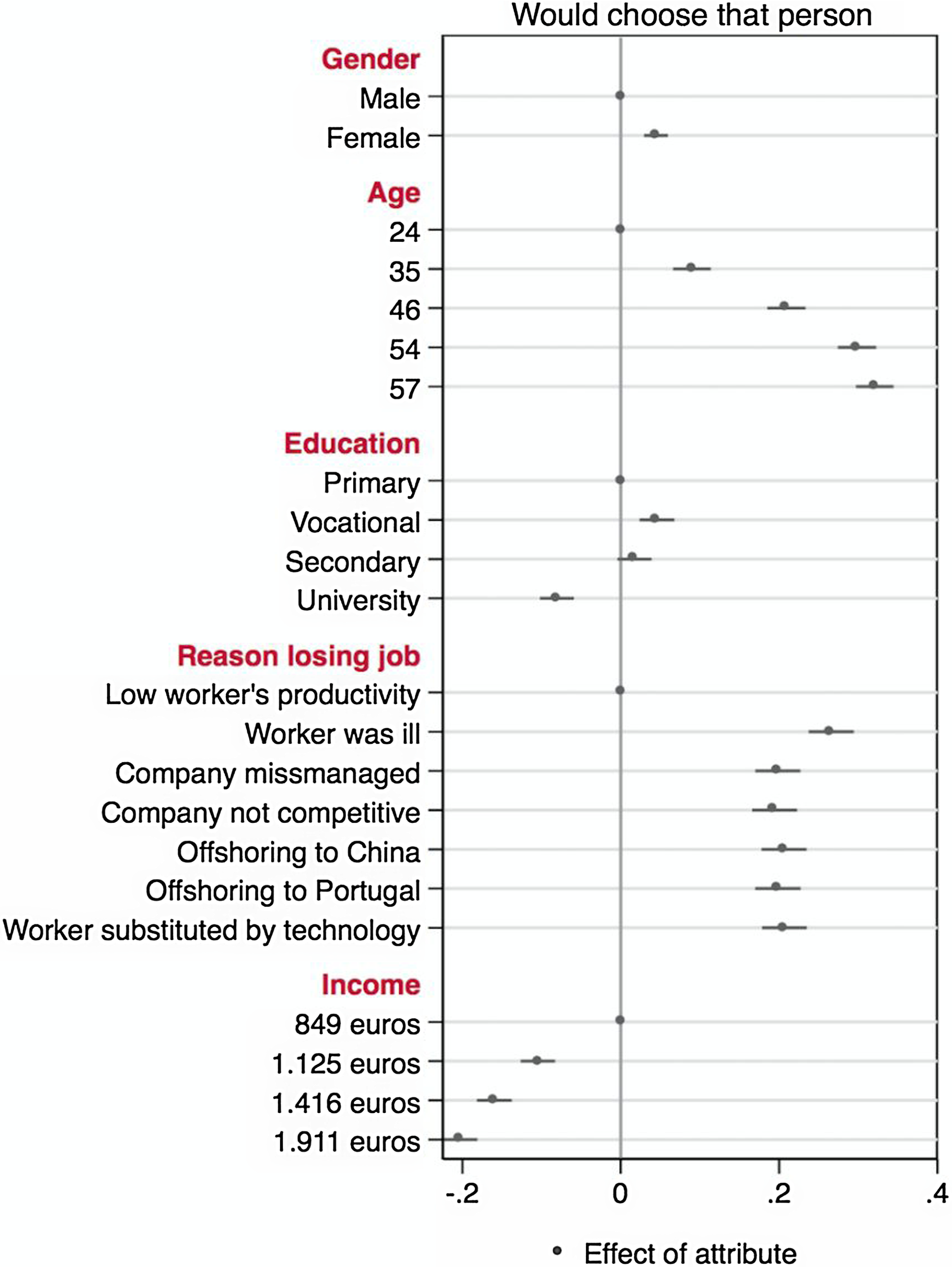
We are most interested in the effect of the reason why a worker becomes unemployed on respondent support for this policy (worded to be an economic benefit similar to a basic income). The results are striking. Consistent with baseline expectations and findings in other contexts, we find that people are much less likely to support the basic income for unproductive workers and most likely to support it for workers who are laid off due to illness, suggesting that deservingness considerations of course matter in determining support for these benefits. Many of the hypothetical recipient sociodemographic variables affect the likelihood of being chosen in expected direction. Support is higher for more vulnerable candidates, including workers who are less educated, older, female, and have lower salaries. These results are sensible and suggest that respondents read the list of attributes carefully.
The figure shows that technological job loss does increase support for recipient deservingness relative to the baseline category of low productivity by a large amount, an average of 20% points. This shock for example is equivalent in magnitude to the deservingness of a middle-aged unemployed worker versus a young worker. However, as the figure shows, we find that the type of structural economic shock that workers suffer are not distinct from one another in how much they affect support for basic income; they are also not distinct from some other reasons for job loss. Technological unemployment, different types of openness shocks, and firm closure due to economic mismanagement have very similar effects on the likelihood that a worker who lost their job because of these reasons is preferred as a recipient of basic income. We find no evidence that technological unemployment increases support for basic income relative to similar external economic shocks. While all these reasons increase support for the candidate relative to a baseline reason of low worker productivity, they are indistinguishable from one another causally affecting their deservingness of such a policy.Footnote 24 Our results overall indicate that technological substitution does matter in determining deservingness of such a transfer, but not any more so than openness concerns. The findings challenge our initial hypothesis that perhaps trade openness or globalization generally, in causing job losses associated with out-group foreign “winners,” would provoke greater support for transfers than automation.
Section 4. Conclusion and implications
This paper presents the results of new tests to directly compare the “other regarding” policy responses to two prominent challenges to worker job stability: openness and automation. Our focus has been on measuring causal effects of these scenarios on policies toward workers affected by them. In terms of aggregate policy preferences, our findings confirm standard economics claims that overall people are more willing to support and retrain unemployed workers with financial transfers instance of imposing barriers to markets and firms. Our vignette experiment indicated that neither openness nor robot-substitution scenarios increased support for redistribution, relative to consideration of domestic worker substitution. While offshoring scenarios induce greater demand for preventing this scenario relative to domestic worker replacement, the scenarios of robot replacement in other countries did not increase support for stopping firms. That is, stopping offshoring with foreign workers seems preferable to stopping automation abroad. In our conjoint experiment about assessing deservingness of a BI-like benefit, we find that compared to a baseline worker-specific reason for job loss, technological reasons for job loss do not provoke any difference in beliefs about entitlement to redistribution than do openness-related concerns. Both reasons have a similar effect size on beliefs about transfer deservingness.
We reiterate that differential effects across the designs could be because, in the vignette design, the outcome is support for various government policies, while in the conjoint, the focus is on assessing who should be a beneficiary of a specific transfer program. The parsimonious, limited nature of our vignettes and conjoint profiles may explain some of the lack of variation in results. We generally note that government policies to prevent such change are actually less supported than forms of compensation, which remain overall popular. If governments are considering policies to respond to both structural threats, those preventing offshoring with foreign workers are unsurprisingly the more politically preferable to stopping domestic inter-regional restructuring. However, we do not find strong evidence that automation – even if automation occurs abroad and threatens domestic workers – provokes especially strong preferences for prioritizing assisting such individuals over other threats to jobs, including openness.
We had articulated several straightforward reasons why openness may persist in being more threatening than automation in the aggregate, provoking a stronger protectionist public reaction more so than automation does a “Luddite” reaction. One is that openness issues related to trade and offshoring are associated with out-groups, such as economic beneficiaries or sources of economic threat from other countries, and that the salience of out-groups – particularly if the out-groups are noted as foreign workers – provokes a greater demand for protection than domestically generated technological change. Another reason is that given media framings that tend to emphasize the concentrated costs and less so the aggregate benefits of these structural changes, impeding firms from offshoring could be seen as less costly in terms of efficiency to citizens than deterring the introduction of new technologies in domestic productive processes. These reasons, complemented with other research that finds that the technology-based substitution of work does not quickly lead to mass unemployment (Kurer and Gallego Reference Kurer and Gallego2019), might indicate why technological concerns do not necessarily trump openness in terms of demands for slowing down this structural threat. Recent advances in AI though could challenge these findings.
Supplementary material
The supplementary material for this article can be found at https://doi.org/10.1017/S0143814X23000260
Data availability statement
Replication materials are available in the Journal of Public Policy Dataverse at https://doi.org/10.7910/DVN/CMKNTE.
Acknowledgments
We thank Jose Fernandez-Albertos for helpful discussion. We thank audiences at the annual meetings of the European Political Science Association and American Political Science Association, the editor, and anonymous reviewers for feedback. We thank the NORFACE Joint Research Programme, project file number 462.19.336.
Funding statement
This research was made possible by funding from the Spanish Economic Ministry, State Program of Research, Development, and Innovation Oriented to the Challenges Society, grant numbers CSO2013-48,451-R and CSO2017-87,597-R.



